
LLC Cost by State, Advertised Fee vs True First Year Cost
The filing fee is about half the bill. Across all fifty states the advertised number averages $121.30, and the first year actually costs $236.12. That gap is not a trick. It is the annual report, the flat state tax, and in three states a newspaper notice, none of which show up in the price a formation site quotes you.

Across all fifty states the advertised LLC filing fee averages $121.30 and the true first year cost averages $236.12, so the advertised number is 51.4 percent of the real one. California has the widest gap, $70 advertised against $890 in year one.
Key Takeaways
- 1The advertised LLC filing fee averages $121.30 across all fifty states. The true first year cost averages $236.12.
- 2The advertised number is 51.4 percent of the real one, a factor of 1.95.
- 3California has the widest gap, $70 advertised against $890 in year one, a factor of 12.7.
- 4Massachusetts is the most expensive first year at $1,000, followed by California at $890 and Tennessee at $700.
- 5Seven states levy a flat tax every LLC owes regardless of income, from $100 in Tennessee to $800 in California.
- 6Arizona, Nebraska and New York require newspaper publication, and none of the three publishes a price.
Every State, Advertised Fee Against True Year One Cost
Sort any column by clicking its heading. Each row links to the state source it was read from and carries the date it was last checked.
| What the state also charges | ||||||
|---|---|---|---|---|---|---|
| AlabamaVerified Oct 15, 2026 | $200 | $28 | None | None | $228 | 1.1x |
| AlaskaFlaggedVerified Aug 30, 2026 | $250 | $50 | None | $100biennial | $400 | 1.6x |
| ArizonaNoticeFlaggedVerified Sep 10, 2026 | $50 | None | None | None | $50 | 1.0x |
| ArkansasFlaggedVerified Sep 5, 2026 | $45 | None | $150 | None | $195 | 4.3x |
| CaliforniaFlaggedVerified Aug 24, 2026 | $70 | None | $800 | $20biennial | $890 | 12.7x |
| ColoradoVerified Oct 14, 2026 | $50 | None | None | $25 | $75 | 1.5x |
| ConnecticutVerified Oct 14, 2026 | $120 | None | None | $80 | $200 | 1.7x |
| DelawareFlaggedVerified Aug 24, 2026 | $110 | None | $400 | None | $510 | 4.6x |
| FloridaVerified Aug 12, 2026 | $125 | None | None | $139 | $264 | 2.1x |
| GeorgiaFlaggedVerified Aug 12, 2026 | $110 | None | None | $60 | $170 | 1.5x |
| HawaiiVerified Oct 15, 2026 | $50 | $20 | None | $15 | $85 | 1.7x |
| IdahoVerified Oct 14, 2026 | $100 | None | None | None | $100 | 1.0x |
| IllinoisFlaggedVerified Jul 26, 2026 | $150 | None | None | $75 | $225 | 1.5x |
| IndianaFlaggedVerified Jul 30, 2026 | $100 | None | None | $32biennial | $132 | 1.3x |
| IowaFlaggedVerified Sep 6, 2026 | $50 | None | None | $30biennial | $80 | 1.6x |
| KansasFlaggedVerified Sep 6, 2026 | $85 | None | None | $90biennial | $175 | 2.1x |
| KentuckyVerified Oct 9, 2026 | $40 | None | $175 | $15 | $230 | 5.8x |
| LouisianaFlaggedVerified Oct 1, 2026 | $125 | None | None | $35 | $160 | 1.3x |
| MaineFlaggedVerified Sep 13, 2026 | $175 | None | None | $85 | $260 | 1.5x |
| MarylandFlaggedVerified Aug 15, 2026 | $100 | None | None | $300 | $400 | 4.0x |
| MassachusettsFlaggedVerified Aug 19, 2026 | $500 | None | None | $500 | $1,000 | 2.0x |
| MichiganFlaggedVerified Sep 10, 2026 | $50 | None | None | $25 | $75 | 1.5x |
| MinnesotaFlaggedVerified Sep 10, 2026 | $155 | None | None | None | $155 | 1.0x |
| MississippiFlaggedVerified Sep 10, 2026 | $50 | None | None | None | $50 | 1.0x |
| MissouriFlaggedVerified Sep 10, 2026 | $50 | None | None | None | $50 | 1.0x |
| MontanaFlaggedVerified Sep 10, 2026 | $35 | None | None | None | $35 | 1.0x |
| NebraskaNoticeFlaggedVerified Jul 26, 2026 | $100 | $25 | None | $25biennial | $150 | 1.5x |
| NevadaFlaggedVerified Aug 21, 2026 | $75 | None | None | $350 | $425 | 5.7x |
| New HampshireFlaggedVerified Jul 26, 2026 | $102 | None | None | $100 | $202 | 2.0x |
| New JerseyVerified Oct 14, 2026 | $100 | None | None | $75 | $175 | 1.8x |
| New MexicoFlaggedVerified Sep 10, 2026 | $50 | None | None | None | $50 | 1.0x |
| New YorkNoticeFlaggedVerified Aug 12, 2026 | $200 | $50 | None | $9biennial | $259 | 1.3x |
| North CarolinaFlaggedVerified Aug 12, 2026 | $125 | None | None | $203 | $328 | 2.6x |
| North Dakota | $135 | None | None | $50 | $185 | 1.4x |
| OhioFlaggedVerified Jul 26, 2026 | $99 | None | None | None | $99 | 1.0x |
| OklahomaVerified Oct 12, 2026 | $100 | None | None | $25 | $125 | 1.3x |
| OregonFlaggedVerified Jul 26, 2026 | $100 | None | None | $100 | $200 | 2.0x |
| PennsylvaniaFlaggedVerified Jul 26, 2026 | $125 | None | None | $7 | $132 | 1.1x |
| Rhode IslandFlaggedVerified Jul 26, 2026 | $150 | None | $400 | $50 | $600 | 4.0x |
| South CarolinaFlaggedVerified Jul 26, 2026 | $110 | None | None | None | $110 | 1.0x |
| South DakotaVerified Oct 15, 2026 | $150 | None | None | $55 | $205 | 1.4x |
| TennesseeFlaggedVerified Aug 12, 2026 | $300 | None | $100 | $300 | $700 | 2.3x |
| TexasVerified Oct 13, 2026 | $300 | None | None | None | $300 | 1.0x |
| UtahFlaggedVerified Jul 26, 2026 | $59 | None | None | $18 | $77 | 1.3x |
| VermontFlaggedVerified Aug 28, 2026 | $155 | None | $250 | $45 | $450 | 2.9x |
| VirginiaVerified Jul 26, 2026 | $100 | None | None | $50 | $150 | 1.5x |
| WashingtonVerified Oct 13, 2026 | $180 | None | None | $70 | $250 | 1.4x |
| West VirginiaFlaggedVerified Aug 15, 2026 | $100 | $30 | None | $25 | $155 | 1.6x |
| WisconsinFlaggedVerified Jul 26, 2026 | $130 | None | None | $25 | $155 | 1.2x |
| WyomingVerified Aug 12, 2026 | $100 | None | None | $60 | $160 | 1.6x |
- Notice
- The state requires a newspaper notice and does not set its price, so it is not in the total.
- Partial
- Read at the state source but not fully confirmed.
- Flagged
- Not re-confirmed at the state source on our latest check.
How We Calculate Year One
Before the formula, here is what it produces across all fifty states.
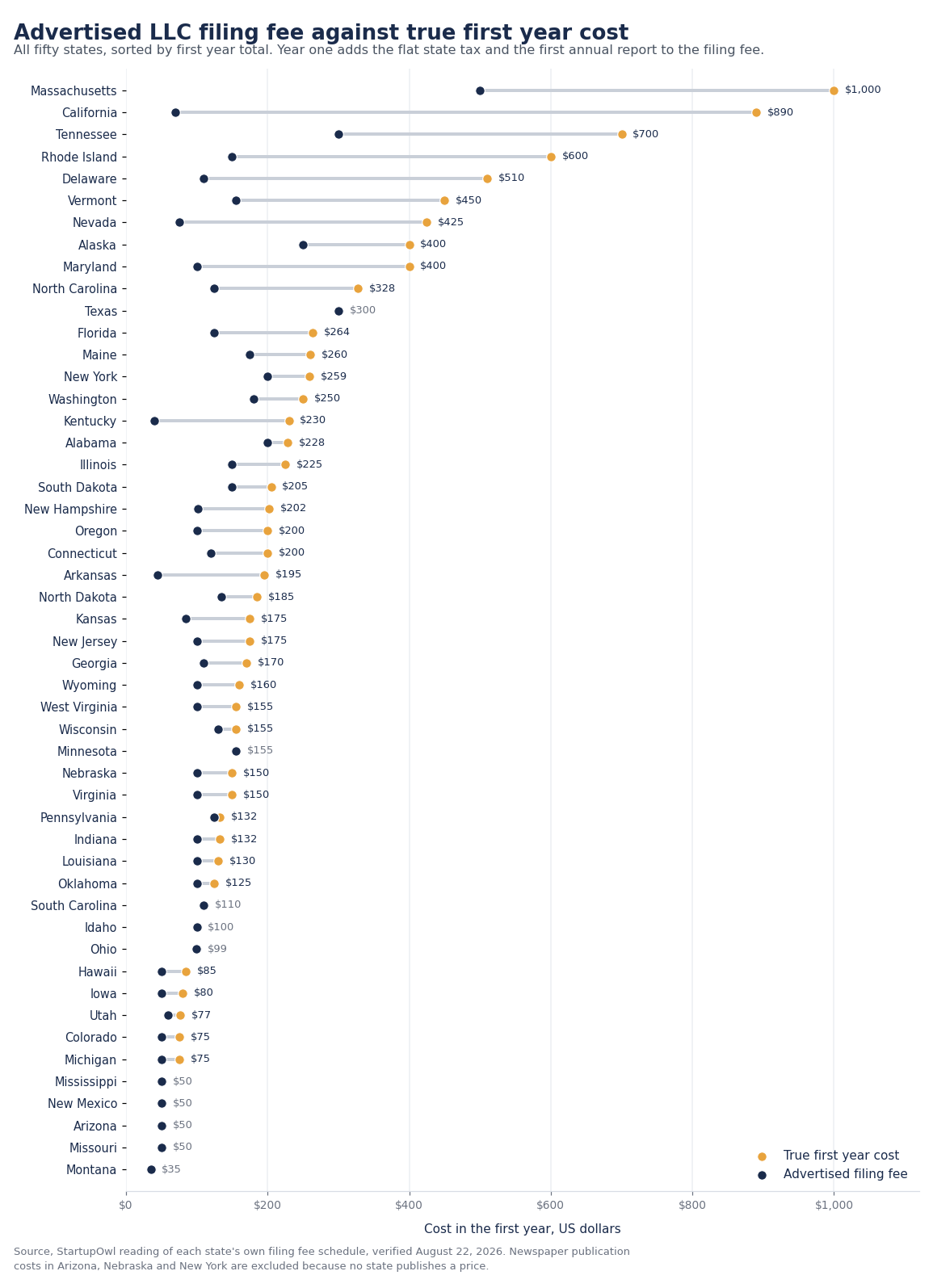
Here is the formula in full, so you can check our arithmetic against your own state.
Year one total equals the state filing fee, plus any charge the state requires only in the first year, plus the flat annual state tax where one exists, plus the first recurring report fee.
Four things sit outside it on purpose. Newspaper publication, because the three states that require it do not set the price. Registered agent fees, because you can act as your own. Anything a formation company adds. And income tax, which depends on what you earn rather than on where you filed.
One wrinkle worth saying out loud. Several states do not bill the first report until month thirteen or fourteen. We still count it. A founder budgeting a first year needs the number the state will actually ask for, not the one that happens to land inside twelve calendar months.
Seven states charge a flat tax, not a fee
The distinction matters and most comparison tables get it wrong. A fee buys you a filing. A tax is owed because the company exists.
Seven states levy a flat amount every LLC owes. It is due whatever you earn. California charges $800 a year, Rhode Island and Delaware $400 each, Vermont $250, Kentucky $175, Arkansas $150 and Tennessee $100. California calls its $800 an annual tax, and calling it a fee is how a $70 state ends up described as cheap.
California is the sharpest example. The advertised fee is $70. The first year costs $890. That is 12.7 times the number on the label, and the widest gap of any state.
How this was verified
Every figure was read at a state government source, a Secretary of State fee schedule, a statute, or a department of revenue page. None of it comes from us. Each row links to the source it came from and carries the date we last read it there.
Rows carry their own status. You never have to trust the table as a whole. Verified means the figure was read at that state's own source on the date shown beside it. Flagged means we have not managed to re confirm it since that date, which usually happens when a state moves its fee schedule or serves it from a page our checker is blocked from reading. We would rather show a flag than imply a fresh check we did not make. The date at the top of this page is the most recent read of any row, and every row read earlier than that prints its own date.
Where online and paper rates differ the table shows the online rate, because that is what most founders pay. Optional expedite charges are excluded everywhere.
What Each State Charges Once Against What It Charges Every Year
| California | $70 | $810 | 11.57x | $8,170 |
|---|---|---|---|---|
| Kentucky | $40 | $190 | 4.75x | $1,940 |
| Nevada | $75 | $350 | 4.67x | $3,575 |
| Delaware | $110 | $400 | 3.64x | $4,110 |
| Arkansas | $45 | $150 | 3.33x | $1,545 |
| Maryland | $100 | $300 | 3.00x | $3,100 |
| Rhode Island | $150 | $450 | 3.00x | $4,650 |
| Vermont | $155 | $295 | 1.90x | $3,105 |
| North Carolina | $125 | $203 | 1.62x | $2,155 |
| Tennessee | $300 | $400 | 1.33x | $4,300 |
| Florida | $125 | $138.75 | 1.11x | $1,512.50 |
| Massachusetts | $500 | $500 | 1.00x | $5,500 |
| Oregon | $100 | $100 | 1.00x | $1,100 |
| New Hampshire | $102 | $100 | 0.98x | $1,102 |
| New Jersey | $100 | $75 | 0.75x | $850 |
| Connecticut | $120 | $80 | 0.67x | $920 |
| Wyoming | $100 | $60 | 0.60x | $700 |
| Georgia | $110 | $60 | 0.55x | $710 |
| Kansas | $85 | $45 | 0.53x | $535 |
| Colorado | $50 | $25 | 0.50x | $300 |
| Illinois | $150 | $75 | 0.50x | $900 |
| Michigan | $50 | $25 | 0.50x | $300 |
| Virginia | $100 | $50 | 0.50x | $600 |
| Maine | $175 | $85 | 0.49x | $1,025 |
| Washington | $180 | $70 | 0.39x | $880 |
| North Dakota | $135 | $50 | 0.37x | $635 |
| South Dakota | $150 | $55 | 0.37x | $700 |
| Utah | $59 | $18 | 0.31x | $239 |
| Hawaii | $50 | $15 | 0.30x | $200 |
| Iowa | $50 | $15 | 0.30x | $200 |
| Louisiana | $125 | $35 | 0.28x | $475 |
| Oklahoma | $100 | $25 | 0.25x | $350 |
| West Virginia | $100 | $25 | 0.25x | $350 |
| Alaska | $250 | $50 | 0.20x | $750 |
| Wisconsin | $130 | $25 | 0.19x | $380 |
| Indiana | $100 | $16 | 0.16x | $260 |
| Nebraska | $100 | $12.50 | 0.13x | $225 |
| Pennsylvania | $125 | $7 | 0.06x | $195 |
| New York | $200 | $4.50 | 0.02x | $245 |
| Alabama | $200 | None | 0.00x | $200 |
| Arizona | $50 | None | 0.00x | $50 |
| Idaho | $100 | None | 0.00x | $100 |
| Minnesota | $155 | None | 0.00x | $155 |
| Mississippi | $50 | None | 0.00x | $50 |
| Missouri | $50 | None | 0.00x | $50 |
| Montana | $35 | None | 0.00x | $35 |
| New Mexico | $50 | None | 0.00x | $50 |
| Ohio | $99 | None | 0.00x | $99 |
| South Carolina | $110 | None | 0.00x | $110 |
| Texas | $300 | None | 0.00x | $300 |
The Three States That Require a Newspaper Notice
Arizona, Nebraska and New York require public notice of a new LLC in a newspaper. New York asks for six consecutive weeks in two papers picked by the county clerk. Nebraska asks for three successive weeks. Arizona lets you skip it if your statutory agent sits in Maricopa or Pima county, because the state posts the notice itself.
None of the three publishes a price. Newspapers set their own rates, and rates in downstate New York run far above rates upstate. So the table flags the requirement and leaves the cost out of the total. We would rather show a hole than fill it with a number no state stands behind.
Frequently Asked Questions
What does an LLC actually cost in the first year?
An average of $236.12 in state charges, against an average advertised filing fee of $121.30. The advertised figure is 51.4 percent of the real one. Your own number depends on the state. Montana starts at $35 and Massachusetts at $500, and the states with the widest gaps are not the ones with the biggest headline fees.
Which state is cheapest for an LLC?
Montana, at $35 for the whole first year. It charges $35 to file and waives the annual report, and that waiver could end. Four states follow at $50. Arizona, Missouri and New Mexico ask for nothing after the filing fee. Mississippi also costs $50 but requires a free annual report every April 15. Arizona is a newspaper notice state too, and no Arizona paper publishes a set rate. Cheap to register is not the same as cheap to run, and forming out of state means registering twice.
Which state has no annual fee for an LLC?
Several do, and the table shows which. Missouri, New Mexico and Arizona are the clearest cases, because none asks for a recurring report, so the filing fee is the last money the state wants. Minnesota, Montana and Mississippi are the trap. Each requires a report every year and charges nothing to file it on time. Miss Montana's April 15 date and it costs $35. Mississippi shares that deadline and can dissolve a company that ignores it. Delaware asks for no report, then bills a flat $400 tax every June 1.
Which state is the most expensive?
Massachusetts, at $1,000 in the first year, $500 to file and $500 for the annual report. California comes second at $890 and gets there differently, a $70 filing fee sitting under an $800 annual tax. Tennessee is third at $700. Massachusetts is expensive on the label. California looks cheap on the label and is not.
Why is California $890 when the filing fee is $70?
The $800 annual tax does it. Every California LLC owes that amount regardless of income, and regardless of whether it trades at all. It is a tax rather than a filing fee, so it never appears in formation pricing. Add the $20 Statement of Information due within 90 days of forming and the first year reaches $890.
Does this include registered agent or formation company costs?
No, none of it. Every number here is money paid to a state government. Registered agent services, formation packages, operating agreement templates and expedite fees all sit outside the total. You can act as your own registered agent in every state, so that cost is a choice rather than a requirement.
How often do these numbers change?
Often enough to matter. A stale table misleads. Kansas cut its filing fee from $160 to $85 in May 2026. Colorado raised its Periodic Report from $10 to $25 in July 2024. Louisiana has published notice that its fees rise on October 1, 2026. Every row carries the date we last read it at the source.
State fees and taxes change without much notice. Every figure here carries the date it was last read at a state source, and you should confirm the current amount with the state before you file. This page is for information and is not legal or tax advice.
About the Author
Editor, StartupOwl
Eliot leads StartupOwl's state data research. He maintains the site's fifty state records of LLC filing fees, annual costs, processing times, and small business grant programs, checking each figure against the state office that publishes it and logging the date it was verified. Based in New Jersey, he has spent his working life in and around small businesses, and he writes for the founder who wants the real number rather than the advertised one. Every figure under his byline traces to a named source, and when a state proves a number wrong, the correction is published, not buried.