
How to Start an LLC in Any State (2026)
Everything you need to form an LLC, from picking a state to filing your paperwork and staying compliant. No lawyer required. Filing fees and rules for all 50 states.

In This Article
- Overview
- National Quick Facts
- Step 1: Choose Your State of Formation
- Step 2: Choose a Name for Your LLC
- Step 3: Appoint a Registered Agent
- Step 4: File Your Articles of Organization
- Step 5: Create an Operating Agreement
- Step 6: Get an EIN from the IRS
- Step 7: Open a Business Bank Account
- Step 8: Stay Compliant (Annual Reports and Taxes)
- Cost Breakdown
- State Variations
- 50-State Comparison
- State Guides
- Top LLC Services
- FAQ
- Common Mistakes
To start an LLC, you need to: (1) pick a state, (2) choose a name, (3) appoint a registered agent, (4) file your Articles of Organization with the state, (5) write an operating agreement, (6) get an EIN from the IRS, and (7) open a business bank account. None of it needs a lawyer. The whole process usually takes 1 to 4 weeks and costs between $35 and $500 in state filing fees alone, depending on where you file.
What You'll Learn
- Filing fees range from $35 in Montana to $500 in Massachusetts
- Most states process LLC filings in 5 to 10 business days
- You can form your LLC yourself without a lawyer or paid service
- Nine states have no state income tax, which affects your bottom line
- Only three states (New York, Arizona, Nebraska) require you to publish a notice in a newspaper
- An operating agreement is not legally required in most states, but you should have one anyway
Note
LLC formation typically costs between $35 and $500 depending on your state. The median state filing fee is $100. Most founders finish the process in 1-4 weeks in most states.
National LLC Quick Facts
$35 - $500
Filing Fee Range
$100
Median Filing Fee
9
No Income Tax States
3
Require Publication
3
Require OP Agreement
50
States + DC
No State Income Tax:
Alaska, Florida, Nevada, New Hampshire, South Dakota, Tennessee, Texas, Washington State, Wyoming
Choose Your State of Formation
Most people should just form their LLC in the state where they live and plan to do business. It keeps things simple. Filing anywhere else can mean paying two states.
You might have heard that Delaware or Wyoming are better for LLCs. That is mostly true for large companies with investors or complex ownership structures. Home state usually wins for everyone else. If you form in Delaware but operate in Texas, for example, you will need to register as a foreign LLC in Texas anyway and pay fees in both states.
Things to consider
- Filing cost: State fees range from $35 (Montana) to $500 (Massachusetts). Most states charge between $50 and $150.
- Income tax: Alaska, Florida, Nevada, New Hampshire, South Dakota, Tennessee, Texas, Washington, and Wyoming have no state income tax.
- Privacy: Wyoming, Delaware, and New Mexico do not require you to list member names in public filings.
- Ongoing costs: Some states charge $0 for annual reports, others charge $300 or more. Check the annual report fee before you file.
Note
Where to file: No filing at this step, it decides where the rest get filed
Common Mistakes
- •Forming in Delaware or Wyoming when you only do business in your home state
- •Not checking annual report fees before choosing a state
- •Ignoring foreign LLC registration requirements
Choose a Name for Your LLC
Your LLC name needs to be unique in the state where you file. Every state requires that the name include "LLC" or "Limited Liability Company" (some states also accept "L.L.C."). Some words need approval. Most states restrict you from using words like "bank," "insurance," or "university" without special approval.
Before you get attached to a name, search your state's business name database to make sure it is available. Most Secretary of State sites have one. The search is free. If you want to operate under a different name than your legal LLC name, you can file a DBA (doing business as) in most states.
Naming tips
- Keep it short and easy to spell
- Check if the matching domain name is available
- Search the USPTO trademark database to avoid conflicts
- Some states let you reserve a name for 60-120 days while you get your paperwork together
Note
Where to file: State business name database
Common Mistakes
- •Not checking the state database before settling on a name
- •Forgetting to include LLC or Limited Liability Company in the name
- •Skipping the trademark search
Appoint a Registered Agent
Every LLC needs a registered agent. This is a person or company that receives legal documents and official state mail on behalf of your business. Your agent needs a physical street address in the state where your LLC is formed (P.O. boxes do not count).
You can be your own registered agent in most states, but there are a few good reasons to hire a professional service instead. Three stand out. First, your name and address go on the public record if you serve as your own agent. Second, you have to be available at that address during business hours to accept documents. Third, a professional service makes sure nothing gets missed if you move or travel.
What a registered agent does
- Accepts service of process (lawsuits and legal notices)
- Receives annual report reminders and tax documents from the state
- Forwards everything to you, usually by email and regular mail
Professional registered agent services typically cost between $39 and $299 per year. Some LLC formation services include the first year free.
Note
Where to file: Listed on your Articles of Organization
Common Mistakes
- •Using a P.O. box as the registered agent address
- •Forgetting to update your agent if you move to a new state
- •Not having someone available at the address during business hours

Recommended: Northwest Registered Agent
$39 + state fee. Includes registered agent, business address, domain, website, email, and phone. No upsells.
File Your Articles of Organization
This step creates the LLC. You file a document called the Articles of Organization (some states call it a Certificate of Organization or Certificate of Formation) with your state's filing agency. In most states, that is the Secretary of State's office.
The form runs one or two pages. You will need to provide your LLC name, your registered agent's name and address, your principal office address, and sometimes the names of the members or managers.
Filing fees by state
The cost varies a lot by state. Here are some examples:
- Cheapest: Montana ($35), Kentucky ($40), Arkansas ($45)
- Middle range: California ($70), Delaware ($110), Georgia ($110)
- Most expensive: Massachusetts ($500), Texas ($300), Tennessee ($300)
Most states let you file online, which is faster and sometimes cheaper than paper filing. Processing takes 5 to 10 business days. Paying extra buys expedited service, usually 1 to 3 business days.
Note
Where to file: Secretary of State or equivalent agency
Common Mistakes
- •Leaving required fields blank on the form
- •Not double-checking your registered agent information
- •Filing by mail when online is available and faster
Recommended: Northwest Registered Agent
$39 + state fee. Includes registered agent, business address, domain, website, email, and phone. No upsells.
Create an Operating Agreement
An operating agreement is an internal document that spells out how your LLC is run. Nobody files it with the state. It covers things like ownership percentages, how profits are split, what happens if a member leaves, and who has authority to make decisions.
Most states do not legally require an operating agreement. You still want one. Banks often ask for it when you open a business account, and without one, your state's default LLC rules apply to your business, which might not match what you actually want.
What to include
- Member names and ownership percentages
- How profits and losses are divided
- Voting rights and decision-making procedures
- What happens if a member wants to leave or sell their interest
- How the LLC can be dissolved
If you are a single-member LLC, an operating agreement is even simpler but still important. One page can do it. It strengthens the legal separation between you and your business.
State notes
New York is one of the few states that technically requires all LLCs to have an operating agreement (under state law, Section 417 of the NY LLC Act). California, Maine, and Missouri also have specific provisions. Every LLC should have one.
Note
Where to file: Internal document, not filed with the state
Common Mistakes
- •Skipping the operating agreement because it is not required in your state
- •Not addressing what happens if a member dies or wants out
- •Using a generic template without customizing it for your situation
Get an EIN from the IRS
An EIN (Employer Identification Number) is basically a Social Security number for your business. You need one to open a business bank account, file taxes, and hire employees. It is free. The application takes about 15 minutes.
You can apply online on the IRS website (irs.gov) and get your EIN immediately. IRS.gov lists the tool as open Monday to Friday 6 a.m. to 1 a.m. the next day, Saturday 6 a.m. to 9 p.m. and Sunday 6 p.m. to midnight, Eastern Time. You can also apply by mail or fax, but there is no reason to since the online process is instant.
When you need an EIN
- If your LLC has more than one member (always required)
- If you plan to hire employees
- If you want to open a business bank account (most banks require it)
- If you elect S-Corp tax treatment
Single-member LLCs with no employees can technically use the owner's Social Security number for tax purposes, but getting an EIN is still a good idea. It costs nothing. Most banks ask for one. It also keeps your Social Security number off invoices and vendor paperwork.
One limit is worth knowing before your first client pays you. A single member LLC with no corporate election is a disregarded entity. On a Form W-9 the IRS wants the owner's name on line 1. The number must match that name. That means the owner's Social Security number, or the owner's own EIN, not the LLC's. Our EIN application guide shows what goes in each box.
Note
Where to file: IRS.gov - EIN application
Common Mistakes
- •Paying a third party for something the IRS gives away for free
- •Applying outside IRS business hours and getting locked out
- •Not saving your EIN confirmation letter
Open a Business Bank Account
Once you have your EIN and your LLC paperwork, open a separate bank account for the business. This part is not optional. Mixing personal and business money (called commingling) is one of the easiest ways to lose your LLC's legal protection.
Most banks will ask for your Articles of Organization, your EIN confirmation letter, your operating agreement, and a photo ID. Bring all four. Some banks also want a business license, though not every business needs one.
What to look for
- Low or no monthly fees
- Free online banking and bill pay
- Integration with accounting software (QuickBooks, Xero, etc.)
- A bank that is convenient for depositing checks or cash if you need to
You do not need to bank with a big national chain. Local credit unions often have better terms. Online platforms like Mercury or Relay do too.
Note
Where to file: Your chosen bank or credit union
Common Mistakes
- •Using your personal account for business transactions
- •Not bringing all required documents to the bank
- •Choosing a bank based on name recognition instead of fees and features
Stay Compliant (Annual Reports and Taxes)
Formation is not the end. Most states require you to file an annual report (sometimes called a periodic report or statement of information) and pay a fee each year to keep your LLC in good standing.
If you miss the deadline, your state can dissolve your LLC or revoke its authority to do business. Reinstating a dissolved LLC usually costs extra and takes time. Put the date in your calendar.
Annual report fees vary a lot
- $0: A handful of states have no annual report or no fee
- $50-150: Most states fall in this range
- $300+: California charges $800/year as a franchise tax (separate from the annual report), and Massachusetts has a $500 annual report fee
Tax obligations
LLCs are pass-through entities by default, which means the business itself does not pay federal income tax. Instead, profits and losses pass through to the members' personal tax returns. You will still need to:
- File a federal tax return (Form 1065 for multi-member LLCs, Schedule C for single-member)
- Pay self-employment tax on your share of the profits
- File state tax returns if your state has income tax
- Collect and remit sales tax if you sell taxable goods or services
- Pay estimated quarterly taxes if you expect to owe $1,000 or more
Publication requirements
Three states require you to publish a notice of your LLC formation in a local newspaper: New York, Arizona, and Nebraska. In New York, this can cost anywhere from $200 to $2,000+ depending on the county. Arizona and Nebraska stay under $100.
Note
Where to file: State filing agency + IRS
Common Mistakes
- •Missing annual report deadlines and getting your LLC dissolved
- •Not setting aside money for estimated quarterly taxes
- •Forgetting about your state's specific franchise tax or renewal fees
Cost Breakdown
What Does It Really Cost to Start an LLC?
The state filing fee is just one part of the total cost. Here is a realistic breakdown of what most people end up spending in their first year, covering the state filing, the registered agent, an optional formation package and the first annual report. Some of those lines are optional. The charges the state itself sends you are not.
If you do everything yourself and serve as your own registered agent, you could start an LLC for as little as $35 (Montana) to $500 (Massachusetts) and nothing else. That gets you the state filing and a free EIN from the IRS. That is the floor.
Most people spend a bit more. A registered agent service runs $39 to $149 per year. If you use a formation service to handle the filing, that adds $0 to $299 depending on the package. Add in your state's annual report fee, and you are looking at a total first-year cost somewhere between $100 and $800 for most states.
The outlier is California, where the annual franchise tax alone is $800. New York's publication requirement can add another $300 to $2,000 depending on the county. Neither is optional.
We checked all fifty states at their own fee schedules in July 2026 and the pattern holds nationally. The advertised filing fee averages $121.32 while the first year averages $234.34. The gap is the point. The state by state breakdown sits in our LLC cost by state table.
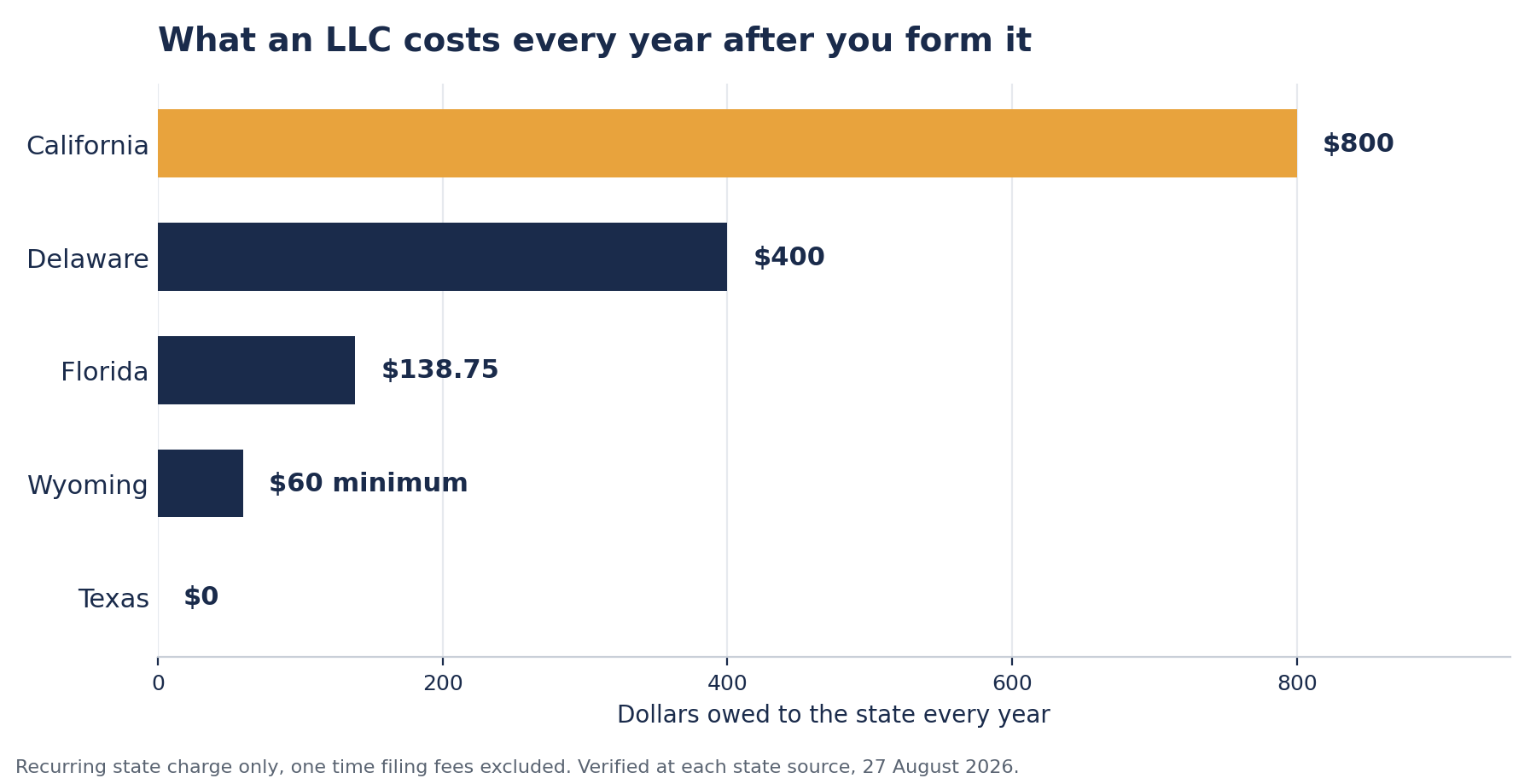
The filing fee is paid once. What decides the long run cost of an LLC is the charge that arrives every year, and it swings by hundreds of dollars from one state to the next. Texas asks nothing to keep an LLC on its books, while California asks $800 whether the business trades or not.
| Item | Cost Range | Notes |
|---|---|---|
| State filing fee (Articles of Organization) | $35-500 | One-time fee, varies by state. Median is about $100. |
| Registered agent service | $0-299/year | Free if you serve as your own. Professional services run $39-299/year. |
| Name reservation (optional) | $0-50 | Not required in most states, but useful if you need time to prepare. |
| Operating agreement | $0-500+ | Free if you write it yourself. Attorneys charge $300-500+. |
| EIN (Employer Identification Number) | $0 | Always free from the IRS. Do not pay anyone for this. |
| Annual report / renewal | $0-800+/year | Annual or biennial depending on state. CA franchise tax is $800/year. |
| Publication (if required) | $40-2,000+ | Only required in NY, AZ, and NE. New York is by far the most expensive. |
| Business license (if required) | $0-500+ | Depends on your industry and location. Not all businesses need one. |
How Rules Vary by State
The basic steps are the same everywhere. The details change significantly from one state to the next, and here are the areas where you will see the biggest differences:
Filing Fees
Montana is the cheapest at $35. On the other end, Massachusetts charges $500, and $520 if you file online or by fax, because the Corporations Division adds a $20 expedited service fee to electronic filings at that price. Most states fall somewhere between $50 and $150, with $100 being the most common fee.
Processing Time
Online filings are fastest. States like Wyoming and Colorado can process your LLC in under 24 hours. Others, like New York and California, may take a week or more for standard processing. Nearly every state offers an expedited option if you need it faster.
What Expedited Filing Costs
Rushing is priced by the state, not by the formation service you file through, and the price for the same rough speed is nowhere near the same. New York turns a filing around in 24 hours for $25. California charges $350 for that window. These seven fee pages were read at the agency on September 20, 2026.
| State | Cheapest expedite | Fastest expedite | Worth knowing |
|---|---|---|---|
| Iowa | $15, five business days | $200, one hour | The surcharge is per document, and it is kept even when the filing comes back rejected. |
| New York | $25, 24 hours | $150, two hours | Same business day costs $75 and has to arrive by noon. |
| Delaware | $50, 24 hours | $1,000, one hour | Same day on an LLC formation is $100. Two hour service is $500. |
| Connecticut | $50, single tier | $50, single tier | The state says most filings through its portal are accepted automatically, so expediting is usually unnecessary. |
| Texas | $50, two to three business days | $750, same day | Next day is $500. Both fast tiers run through the Austin office or email, not the online system. |
| Georgia | $120, two business days | $1,200, one hour | Same day costs $275 and has to arrive by noon. |
| California | $350, 24 hours | $750, same day | A four hour service costs $500, but the document must clear a $500 preclearance first, and both are drop off only in Sacramento. |
Read at the agency on September 20, 2026. Iowa Secretary of State, New York Department of State, Delaware Division of Corporations with its August 2026 fee schedule, Connecticut business portal, Texas Express, Georgia Secretary of State, California Secretary of State.
Every figure above sits on top of the ordinary filing fee, so a founder in a hurry in Georgia pays the state to file and another $275 to have it looked at that day. Three things decide whether that is money well spent.
- What the state already does for nothing. Connecticut says outright that filings through its portal are usually accepted automatically, and the 50-state comparison further down this page lists several states where standard online processing is immediate. Paying to jump a queue that does not exist buys nothing at all.
- The cutoff time. Same day service in Georgia and New York only counts if the document reaches the office before noon. An afternoon filing pays the same day price for next day work.
- What happens if the form is wrong. Iowa and New York both keep the surcharge when a document comes back rejected, so a slow read of the form is worth more than the fee.
The other 43 states are missing because their expedite fees have not been read at the source yet. States get added here as they are verified.
Annual Reports
Most states require an annual report and charge somewhere between $0 and $300 for it. A few bill every two years instead. California's $800 annual franchise tax is the highest ongoing cost for any state.
Filing Fees Versus First Year Cost
The filing fee is the number every state advertises. It is rarely the number you pay. Across the 40 states with every charge verified at the state's own source, the cheapest place to file is often not the cheapest place to keep an LLC for twelve months.
California shows it best. Filing costs $70, cheaper than 32 of those 40 states. Then the $800 annual franchise tax arrives and the first year total reaches $870, which only Massachusetts beats. The exemption people remember was temporary, it covered tax years beginning in 2021 through 2023 and no longer applies.
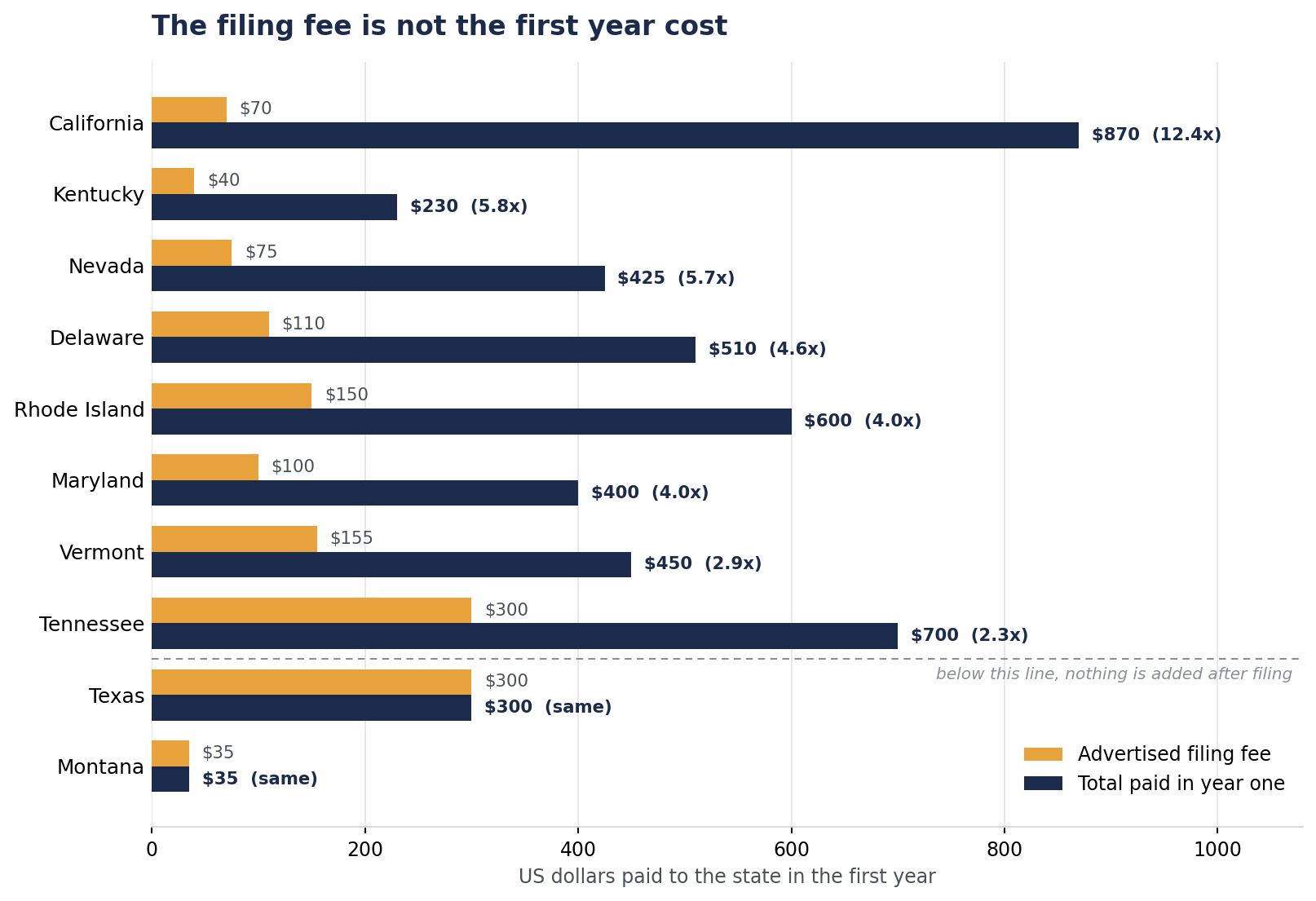
Kentucky files at $40 and finishes the year at $230. Nevada files at $75 and finishes at $425. Texas asks $300 up front and then asks for nothing. Read the second bar, not the first.
Publication Requirements
Only three states require you to publish a notice of LLC formation in a local newspaper: New York, Arizona, and Nebraska. New York is by far the most expensive, with publication costs ranging from about $200 in upstate counties to over $1,500 in New York City. Budget for it before you file.
Operating Agreement Requirements
While almost no state will reject your LLC filing for not having an operating agreement, New York law specifically requires all LLCs to adopt one. California, Maine, and Missouri also have provisions around operating agreements. Have one regardless.
States with Unique Requirements
50-State LLC Comparison
Click any column header to sort. Click a state name to view its full LLC guide.
| State | Filing Fee | Processing Time | Annual Report | Income Tax | OP Agreement Req. |
|---|---|---|---|---|---|
| Alabama | $200 | Not published by the state | - | Yes | Optional |
| Alaska | $250 | Immediate | $100 | No | Optional |
| Arizona | $50 | 12 days, ACC live board | - | Yes | Optional |
| Arkansas | $45 | 1-3 business days | $150 | Yes | Optional |
| California | $70 | 2 business days as of August 28, 2026 | $20 | Yes | Optional |
| Colorado | $50 | Immediate | $25 | Yes | Optional |
| Connecticut | $120 | Many online filings accepted automatically | $80 | Yes | Optional |
| Delaware | $110 | a timeframe the state does not publish | $400 | Yes | Optional |
| Florida | $125 | 1-5 business days | $138.75 | No | Optional |
| Georgia | $110 | 7-10 business days | $60 | Yes | Optional |
| Hawaii | $50 | 10-15 business days | $15 | Yes | Optional |
| Idaho | $100 | 5-7 business days | $0 | Yes | Optional |
| Illinois | $150 | 5-10 business days | $75 | Yes | Optional |
| Indiana | $100 | Not published by the state | $32 | Yes | Optional |
| Iowa | $50 | a timeframe the state does not publish | $30 | Yes | Optional |
| Kansas | $85 | Immediate | $90 | Yes | Optional |
| Kentucky | $40 | Immediate | $15 | Yes | Optional |
| Louisiana | $125 | 1-2 business days | $35 | Yes | Optional |
| Maine | $175 | N/A | $85 | Yes | Required |
| Maryland | $100 | 6 to 8 weeks | $300 | Yes | Optional |
| Massachusetts | $500 | 1-2 business days | $500 | Yes | Optional |
| Michigan | $50 | a timeframe the state does not publish | $25 | Yes | Optional |
| Minnesota | $155 | 2 to 5 business days | $0 | Yes | Optional |
| Mississippi | $50 | 1-2 business days | $0 | Yes | Optional |
| Missouri | $50 | a timeframe the state does not publish | - | Yes | Required |
| Montana | $35 | 5-6 business days | $0 | Yes | Optional |
| Nebraska | $100 | 2-3 business days | $25 | Yes | Optional |
| Nevada | $75 | 1 business day | $350 | No | Optional |
| New Hampshire | $102 | Not published by the state | $100 | No | Optional |
| New Jersey | $100 | 1-2 business days | $75 | Yes | Optional |
| New Mexico | $50 | 1-3 business days | - | Yes | Optional |
| New York | $200 | a timeframe the state does not publish | $9 | Yes | Required |
| North Carolina | $125 | 15-20 business days | $203 | Yes | Optional |
| North Dakota | $135 | 5 business days | $50 | Yes | Optional |
| Ohio | $99 | 3 to 7 business days | - | Yes | Optional |
| Oklahoma | $100 | Not published by the state | $25 | Yes | Optional |
| Oregon | $100 | 1-3 business days | $100 | Yes | Optional |
| Pennsylvania | $125 | 1-3 business days | $7 | Yes | Optional |
| Rhode Island | $150 | 1-3 business days | $50 | Yes | Optional |
| South Carolina | $110 | 1-2 business days | - | Yes | Optional |
| South Dakota | $150 | Immediate | $55 | No | Optional |
| Tennessee | $300 | Immediate to same-day | $300 | No | Optional |
| Texas | $300 | a timeframe the state does not publish | $0 | No | Optional |
| Utah | $59 | Immediate | $18 | Yes | Optional |
| Vermont | $155 | 1 business day | $45 | Yes | Optional |
| Virginia | $100 | Same day online, 5 business days with an attachment | $50 | Yes | Optional |
| Washington State | $180 | days to weeks | $70 | No | Optional |
| West Virginia | $100 | 5-10 business days | $25 | Yes | Optional |
| Wisconsin | $130 | a timeframe the state does not publish | $25 | Yes | Optional |
| Wyoming | $100 | Immediate online, 15 days by mail | $60 | No | Optional |
LLC Guides by State
Popular States
All States
Top LLC Formation Services
We tested every major LLC formation service. Here's how they compare on the features that actually matter.
| Feature | Northwest Registered Agent | ZenBusiness | Tailor Brands |
|---|---|---|---|
| Starting Price | $39 + state fees | $0 + state fees | $0 + state fees |
| Formation Speed | Same-day only on the $199 package | 7-10 days, 1 day on Pro | 1-14 business days |
| Support | Lifetime Corporate Guides | Phone, chat, Velo AI 24/7 | Phone, Chat, Email |
| States Covered | 50 states | 50 states | 50 states |
| In Business Since | 1998 | 2015 | 2014 |
| Get Started → | Get Started → | Get Started → |
Frequently Asked Questions
Common Mistakes to Avoid
- Picking the wrong state: Do not form in Delaware or Wyoming just because you read it is "better." Unless you have a specific legal reason, file in the state where you actually do business.
- Paying for a free EIN: The IRS charges nothing for one. If someone asks you to pay, you are on the wrong website.
- Skipping the operating agreement: Even if your state does not require one, get it in writing. This is especially important for multi-member LLCs.
- Mixing personal and business money: Open a separate bank account right away. Commingling funds is one of the fastest ways to lose your liability protection. Courts look for it.
- Missing deadlines: Set reminders for annual report deadlines and tax due dates. A dissolved LLC is a headache to reinstate.
- Ignoring local requirements: Your city or county may require a business license or permit even if your state does not.
Sources
Ready to Start Your LLC?
Form your LLC online in minutes. Northwest's $39 package includes registered agent, business address, domain, website, email, and phone. No upsells.
About the Author
Editor, StartupOwl
Eliot leads StartupOwl's state data research. He maintains the site's fifty state records of LLC filing fees, annual costs, processing times, and small business grant programs, checking each figure against the state office that publishes it and logging the date it was verified. Based in New Jersey, he has spent his working life in and around small businesses, and he writes for the founder who wants the real number rather than the advertised one. Every figure under his byline traces to a named source, and when a state proves a number wrong, the correction is published, not buried.
Was this article helpful?
Questions about starting an LLC
No comments yet. Ask the first question and a member of our team will answer.
Leave a comment