
How to Write a Business Plan Step by Step, With a Free Template
How to write a business plan in 7 steps. Free templates from SBA and SCORE, plus costs from $0 (DIY) to $15,000+ (professional writers). 15-20 pages typical.

In This Article
- Key Takeaways
- Step-by-Step
- Cost Breakdown
- What a Business Plan Is and When You Need One
- Who Needs a Business Plan and What Lenders Expect
- How to Write Your Business Plan Step by Step
- How Much a Business Plan Actually Costs
- Best Free Templates and Tools for Your Business Plan
- What to Do If You Cannot Write a Plan Yourself
- 5 Business Plan Mistakes That Kill Funding Applications
- FAQ
$0–$15,000
Est. Cost
3 weeks
Timeline
7
Total Steps
Your business plan is the one document that can unlock funding, attract partners, and turn a good idea into a real company. Traditional plans run 15-20 pages, take 3-4 weeks to write properly, and cost anywhere from $0 (using free government templates) to $15,000+ if you hire a professional writing firm.
The SBA, most banks, and angel investors expect a structured plan with 9 core sections including financial projections, market analysis, and a clear funding request. Skip those sections and your application stalls. Nail them and you jump to the front of the review pile.

This guide gives you the exact steps, free templates, cost breakdowns, and common pitfalls so you can build a plan that actually gets funded. If you also need help choosing the right funding type, start with our how to get a business loan guide or browse the best small business loans for a side-by-side comparison.
What a Business Plan Is and When You Need One
A business plan is a formal document that explains what your company does, how it makes money, and where it is headed over the next 3-5 years. According to the U.S. Small Business Administration, it serves as "the foundation of your business" and a roadmap for structuring, running, and growing your company.
You need a business plan when you are applying for an SBA loan, pitching investors, seeking a business line of credit, or entering a franchise agreement. Even if you are bootstrapping, the plan forces you to price the work, size the market and put a date on the month you run out of cash, which is better done before a lender asks.
There are 2 main formats. A traditional plan runs 15-20 pages and is what banks and SBA lenders require. A lean plan (also called a one-page plan) is a single-page chart that works well for early-stage startups or rapid iteration. Most funded businesses end up creating both.
Who Needs a Business Plan and What Lenders Expect
Every lender, from community banks to SBA-backed programs, requires a business plan as part of the loan application package. If you are applying for an SBA 7(a) loan or an SBA microloan, your plan must include financial projections that show a clear path to repayment. SBA loans also require good documentation of your business and personal finances, including past tax returns and bank statements.

Investors prioritize 4 things when reviewing a business plan: market size and growth backed by credible data, a clear customer pain point your product addresses, the founding team's relevant expertise and traction, and detailed financial projections showing a path to profitability. If your plan does not address all four, expect rejection.
For startup business loans, most SBA lenders look for a personal credit score near 680 and conventional banks near 620. Those floors belong to the lender, not to the SBA, so they move from bank to bank. However, your business plan is what convinces a lender that your numbers are achievable. A weak plan with a 750 credit score loses to a strong plan with a 680 score.
How to Write Your Business Plan Step by Step
Writing a fundable business plan follows a 7-step process that takes 3-4 weeks if you are doing it yourself. Professional writers at firms like Growthink typically complete plans in the same timeframe but charge $2,000-$15,000.

Start by downloading a free template. The SBA publishes three sample business plans, two traditional and one lean. They match the format lenders expect. SCORE's startup template includes 11 worksheets with fillable exercises for each section. Both are free, in Word, PDF, and Google Docs formats.
Follow the 7 steps detailed in this guide (and outlined below in the Steps section): research your market, write your company description, detail your products and pricing, build a marketing plan, create financial projections, write your executive summary last, and format everything for submission. Each step includes specific timelines, costs, and the exact resources you need.
If you want software to handle the financial projections automatically, LivePlan costs $15/month billed annually, or $20/month month to month, and generates profit-and-loss, balance sheet, and cash flow statements from your inputs. It also includes 550+ sample plans for benchmarking.
How Much a Business Plan Actually Costs
Your total cost depends entirely on whether you write the plan yourself or hire help. A DIY plan using free templates from the SBA or SCORE costs $0 in hard dollars, though you will invest 40-80 hours of your time over 3-4 weeks.
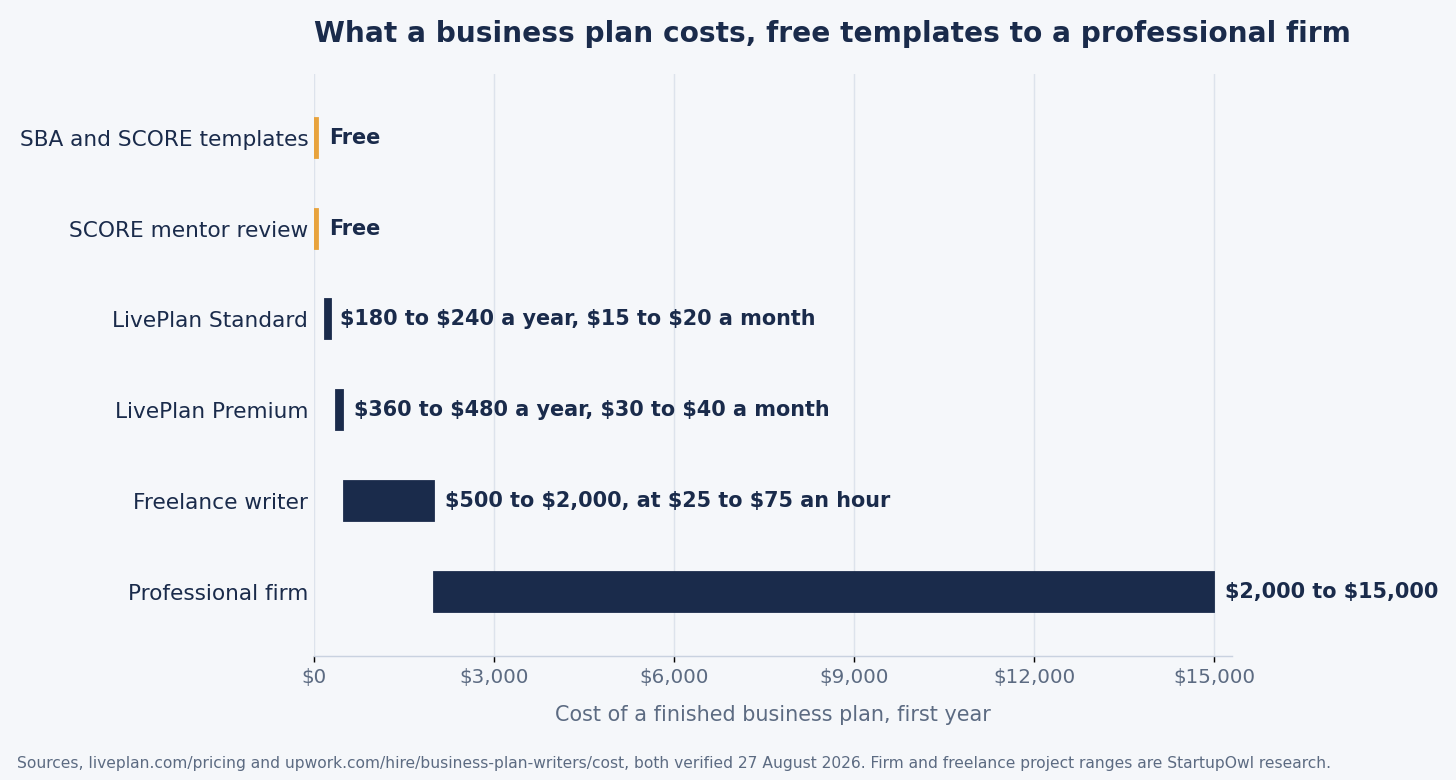
Business plan software like LivePlan ($15-$40/month) or Upmetrics can halve the drafting time. Both build the financial statements for you. Upwork lists a median of $25 to $75 an hour for the plan writers on its own site, and most finished plans there run $500-$2,000. Firms charge $2,000-$15,000. That buys deeper financial modeling, and a rush job costs more.
Here is the honest trade-off. Free templates work well if you have financial literacy and 40+ hours to invest. Consider paying if you are raising $250,000+ and need institutional-quality projections. A firm at $2,000-$15,000 buys you the modeling and the formatting. On a $250,000 raise that is 0.8% to 6%. It does not buy a better answer. No published data shows a paid plan wins approval more often than a good self-written one. Treat the fee as time you are buying back.
Business Plan Cost Comparison
| Type / Provider | Rate | Notes |
|---|---|---|
| DIY with free templates (SBA, SCORE) | $0 | Requires 40-80 hours of your time. Free Word, PDF, and Google Docs formats. |
| LivePlan Standard (software) | $15/month | Auto-generated financials, 550+ sample plans, AI writing assistance. $15 a month billed annually, $20 month to month. |
| LivePlan Premium (software) | $30-$40/month | Everything in Standard plus deeper market research, scenario modelling and financial analysis. QuickBooks and Xero sync is in both plans. |
| Freelance writer (Upwork) | $500-$2,000 | Upwork lists a median of $25 to $75 an hour. Typical project runs 20-40 hours. Quality varies significantly. |
| Professional writing firm | $2,000-$15,000 | Includes financial modeling, market research, and investor-ready formatting. 3-4 week turnaround. |
| SCORE mentor review | $0 | Free mentoring funded by the SBA. Available online or in person nationwide. |
Best Free Templates and Tools for Your Business Plan
You do not need to pay anything to create a solid, fundable business plan. Here are the 5 best free and low-cost options, ranked by usefulness for funding applications:
- SBA.gov offers 3 free sample business plans, two traditional and one lean. They match the exact format lenders expect. They are examples, not workbooks. The structure is guaranteed to meet SBA requirements.
- SCORE.org Startup Template includes 11 worksheets with fillable exercises for every section. The market research worksheets are especially useful for first-time founders. SCORE also offers free mentor reviews of your finished plan.
- LivePlan costs $20/month month to month, or $15/month billed annually, and auto-generates P&L, balance sheet, and cash flow projections. It includes over 550 sample plans and a 35-day money-back guarantee, which is a refund window rather than a free trial.
- PandaDoc offers industry-specific templates with fillable fields and NDA sections, useful when sharing with potential investors.
- Smartsheet provides free downloadable templates in Word, PDF, and Excel, including industry-specific variants for restaurants, retail, and service businesses.
For your financial projections specifically, SCORE also offers a free financial projections template to calculate expenses, sales forecasts, cash flow, and break-even analysis.
SBA Lenders Prioritize Your Funding Request Section
If you are applying for any SBA loan program, the funding request section matters most after the executive summary. Say how much you need. Specify how you will use each dollar, and your repayment timeline over 3-5 years. Include projected monthly loan payments. Show your cash flow covers them with room to spare. The SBA publishes no loan payment calculator. Take that figure from our business loan calculator, or from your lender's amortization schedule. The SBA does publish a free break-even analysis calculator on its Calculate your startup costs page. Break-even is the number that backs your cash flow claim.
What to Do If You Cannot Write a Plan Yourself
Not everyone has the time or confidence to write a plan from scratch. Here are your best alternatives, sorted by cost:
- Free SCORE mentoring ($0) pairs you with a retired executive who will help you draft and review your plan section by section. Find a mentor at SCORE.org by entering your zip code.
- Business plan software ($15-$40/month) tools like LivePlan walk you through each section with prompts, examples, and automatic financials. This is the best option if you want to maintain control while cutting the time in half.
- Freelance writer ($500-$2,000) on Upwork or Fiverr. Ask for samples of funded plans and check references. Upwork lists a median of $25 to $75 an hour for this work.
- Professional consulting firm ($2,000-$15,000) is worth the investment if you are seeking $250,000+ in funding. Firms like Growthink and Wise Business Plans include financial modeling, market research, and investor-ready formatting.
If you are still in the early idea stage and not yet ready for a full plan, try a lean one-page plan first. Then expand it into the full traditional format when you are ready to apply for a business loan or pitch angel investors.
5 Business Plan Mistakes That Kill Funding Applications
- Skipping the financial projections entirely. Lenders open your plan and flip straight to the numbers. If your P&L, cash flow, and balance sheet are missing or use round numbers with no supporting assumptions, your application gets flagged. Always show your math.
- Writing the executive summary first. Your summary should distill the plan, not set its direction. Writing it first leads to overblown claims that the rest of the plan cannot support. Write it last and keep it to 1-2 pages.
- Claiming "no competition." Every business has competitors, even if they are indirect. Telling a lender you have no competition signals that you have not researched the market. Identify 3-5 competitors and explain your differentiation clearly.
- Forgetting owner compensation. If your financial projections do not include a salary for you, your profit numbers are artificially inflated. Lenders know this and will mentally subtract a market-rate salary, which can turn your projected profit into a loss.
- Submitting without a third-party review. Typos, inconsistent numbers across sections, and formatting errors signal carelessness. Have a SCORE mentor or CPA review your plan before it goes to any lender. It is free, and it catches the errors you have stopped seeing.
After Your Plan Is Done, Choose Your Funding Path
A finished business plan opens multiple funding doors. If you are seeking $50,000 or less, consider an SBA microloan or microloans for small business. For $50,000-$5 million, the SBA 7(a) program is the most popular path. If you need short-term cash while you wait for loan approval, a working capital loan or invoice factoring can bridge the gap. For early-stage startups with no revenue, explore pre-seed funding or small business grants.
This content is for informational purposes only and does not constitute financial, legal, or tax advice. Business financing terms, rates, and eligibility vary by lender, credit profile, and business characteristics. Consult a licensed financial advisor or CPA before making borrowing decisions. Cost ranges for professional services reflect industry averages as of 2026 and may change without notice.
Step-by-Step Process
- 1
Research your market and competitors thoroughly
Before you write a single word, spend 2-3 weeks gathering hard data on your target market size, growth rate, customer demographics, and top competitors. You need credible, up-to-date numbers (industry reports, Census data, trade association stats) because lenders will fact-check your claims.
Use free resources like the U.S. Census Bureau for demographic data and the Bureau of Labor Statistics for industry trends. Your market analysis section should identify at least 3-5 direct competitors and explain what makes your solution different or better.
Tips
- Pull data from at least 3 independent sources to cross-validate market size claims.
- Include a SWOT analysis that honestly addresses your weaknesses and threats.
- Use your NAICS code to find industry-specific data quickly on Census.gov and BLS.gov.
Common Mistakes
- Citing outdated market data (older than 2 years) that lenders immediately flag as unreliable.
- Claiming there are no competitors, which signals to investors that you have not done real research.
- 2
Write your company description and define your legal structure
Your company description tells readers exactly who you are, what problem you solve, and which customers you serve. Include your legal entity type (LLC, S Corp, C Corp, sole proprietorship), your physical location, and a clear mission statement in 2-3 sentences.
If you have not chosen a legal structure yet, review our LLC vs S Corp comparison or explore LLC formation services. Lenders and SBA loan officers will look for your entity type, tax structure, and how those choices protect you legally and financially.
$0 (writing only; LLC filing fees are $50-$500 by state if you need to form an entity) 1-2 days SBA.govTips
- State your business structure early because it affects tax treatment and personal liability.
- Keep the mission statement under 3 sentences that a 12-year-old could understand.
Common Mistakes
- Burying the legal structure deep in the appendix instead of stating it prominently in the company description.
- 3
Describe your products or services with clear pricing
Explain exactly what you sell, how it works, and why customers will pay for it. Include your pricing strategy, any intellectual property (patents, trademarks), and the product lifecycle. If you are pre-revenue, describe your prototype or minimum viable product (MVP) stage.
Lenders want to see your unique selling proposition (USP) in 1-2 sentences. Your product section should also cover expected R&D costs and how you plan to manufacture or deliver your service at scale.
Tips
- Include unit economics (cost to produce vs. selling price) to demonstrate profitability potential.
- If you have early traction (pre-orders, LOIs, beta users), highlight those numbers prominently.
Common Mistakes
- Describing features instead of customer benefits, which makes the plan read like a technical manual rather than a business case.
- 4
Build your marketing and sales strategy
Outline exactly how you will reach customers and convert them into paying clients. Include your customer acquisition channels (paid ads, SEO, referral programs, direct sales), estimated customer acquisition cost (CAC), and monthly or annual sales targets for years 1 through 3.
Banks and investors want specific numbers, not vague promises. For example, if you plan to spend $2,000/month on Google Ads to generate 50 leads at a $40 CAC, spell that out. Pair this section with your accounting software setup so you can actually track these metrics from day one.
Tips
- Include at least 2 customer acquisition channels so you are not dependent on a single source.
- Show projected conversion rates for each stage of your sales funnel with realistic percentages.
Common Mistakes
- Projecting hockey-stick growth with no marketing budget or specific acquisition strategy to back it up.
- 5
Create detailed financial projections for 3 to 5 years
This is the section lenders study most closely. You need 3 core financial statements: a projected profit-and-loss (income) statement, a balance sheet, and a cash flow statement. Cover at least 3 years of projections, though SBA lenders typically want a 5-year outlook.
Include a break-even analysis showing exactly when your revenue will cover expenses. If you already operate, include your last 3-5 years of actual financial statements as well. Business plan software like LivePlan (from $15/month billed annually, $20/month month to month) auto-generates these statements from your inputs, which saves weeks of spreadsheet work.
Tips
- Use conservative revenue estimates and optimistic expense estimates to build lender confidence.
- Build 3 scenarios (best case, expected, worst case) so investors see you have planned for downturns.
- Download the free SCORE financial projections template for a solid starting framework.
Common Mistakes
- Projecting profitability in month 1 without accounting for ramp-up time, seasonal dips, or delayed receivables.
- Omitting owner compensation from expenses, which inflates profit and signals inexperience to lenders.
- 6
Write your executive summary last
The executive summary sits on page 1 but should be the last thing you write. Keep it to 1-2 pages maximum. It should cover your business overview, the problem you solve, your target market, leadership team highlights, key financial projections, and (if applicable) your funding request amount.
This is your elevator pitch on paper. Many lenders decide whether to read the full plan based on this section alone. Lead with your strongest data point (revenue, traction, market size) and close with the specific dollar amount you need and how you will use it.
Tips
- Write a first draft in under 500 words, then trim it to only the facts that would make an investor lean forward.
- Include your funding request amount and a 1-sentence explanation of how those funds will be deployed.
Common Mistakes
- Writing the executive summary first, then trying to make the rest of the plan match overly optimistic opening claims.
- 7
Format, review, and submit your completed plan
A traditional business plan should be 15-20 pages (excluding appendices). Use clear headings, bullet points, charts, and white space so a loan officer can scan the key points in 15 minutes. Add a table of contents with page numbers for plans over 10 pages.
Include appendices with supporting documents: tax returns, key team resumes, contracts, permits, patents, and market research data. Have at least 2 people (ideally a CPA or SCORE mentor) review your plan before submission. Free SCORE mentors are available at SCORE.org and can review your plan at no cost.
$0 (free SCORE mentor review) to $2,000-$15,000 (professional writer or consultant) 3-5 days for review and revisions SCORETips
- Ask your SCORE mentor to role-play as a skeptical lender and challenge every assumption in the plan.
- Export your plan as a PDF for submission (never send an editable Word file to a lender).
- Include a 1-page lean version for quick-read situations alongside your full traditional plan.
Common Mistakes
- Submitting a plan with typos, inconsistent financial numbers across sections, or missing table of contents.
- Skipping the appendix, which is where lenders look for proof behind your claims (tax returns, LOIs, permits).
Cost Breakdown
| Item | Cost Range | Notes |
|---|---|---|
| DIY with free templates (SBA, SCORE) | $0 | Free downloadable templates from SBA.gov and SCORE.org in Word, PDF, and Google Docs formats. |
| Business plan software (LivePlan, Upmetrics) | $15-$40/month | LivePlan Standard is $20 a month, or $15 billed annually. Premium is $40 a month, or $30 billed annually. Both include 550+ sample plans and auto-generated financials. |
| Freelance business plan writer | $500-$2,000 | Upwork lists a median of $25 to $75 an hour for plan writers on its site. Expect 20-40 hours of work for a standard plan. |
| Professional business plan writing firm | $2,000-$15,000 | Price tracks how deep the financial modeling goes and how fast you need it. The top of the range buys investor-grade projections, market research and formatting. |
| SCORE mentor review | $0 | Free mentoring through SCORE.org, funded by the SBA. Available online or in person. |
Frequently Asked Questions
A traditional business plan should be 15-20 pages (excluding appendices). Investor-ready or SBA loan plans may run 20-40 pages with detailed financials and market analysis. A lean startup plan is typically just 1 page and focuses on key metrics like customer segments, revenue streams, and cost structure.
Yes for the prose, no for the part that decides your application. An AI can draft a company description or tidy your executive summary in minutes. It cannot produce your financial projections, because the SBA expects forecasted income statements, balance sheets and cash flow statements covering the next five years, built from your own numbers and matched to your funding request. Treat a generated draft as a first pass you still have to evidence.
Professional business plan writers typically charge $2,000-$15,000 for a comprehensive, investor-grade plan. Freelancers cost less. Upwork lists a median of $25 to $75 an hour for the writers on its site, a range it draws from past contracts worldwide rather than from a quote you have been given. Most freelance projects land between $500 and $2,000. The price depends on plan complexity, financial modeling depth, and the writer's experience level.
You need 3 core financial statements: a projected profit-and-loss (income) statement, a projected balance sheet, and a projected cash flow statement. SBA lenders want these for 3-5 years forward. If your business is already operating, also include your actual financial statements from the last 3-5 years, plus tax returns and bank statements as appendix items.
Yes. A business plan is a required component of nearly every SBA loan application. Your plan must include financial projections the bank uses to determine if you qualify, a detailed funding request explaining how much you need and how you will spend it, and a description of your repayment strategy. Free SBA-specific templates are available at SBA.gov.
A traditional business plan is a detailed, 15-20 page document covering 9 sections that lenders and investors expect to see. A lean plan is a 1-page chart that maps out your value proposition, customer segments, revenue streams, and cost structure. Use the lean format for rapid iteration in early stages, then expand to a traditional plan when you apply for funding.
This content is for informational purposes only and does not constitute financial, legal, or tax advice. Business financing terms, rates, and eligibility vary by lender, credit profile, and business characteristics. Consult a licensed financial advisor or CPA before making borrowing decisions. APR ranges reflect industry averages as of 2026 and may change without notice.
Sources & References
- Write Your Business Plan - U.S. Small Business Administration
- Sample Business Plans - U.S. Small Business Administration
- SCORE Business Plan Template for a Startup Business
- LivePlan Pricing
- How to Write an SBA Business Plan - Fit Small Business
- Business Plan Writer Hourly Rates - Upwork
- How Much Does a Small Business Plan Cost - BPlanWriter
- How to Write a Business Plan - Bank of America
About the Author
Editor, StartupOwl
Eliot leads StartupOwl's state data research. He maintains the site's fifty state records of LLC filing fees, annual costs, processing times, and small business grant programs, checking each figure against the state office that publishes it and logging the date it was verified. Based in New Jersey, he has spent his working life in and around small businesses, and he writes for the founder who wants the real number rather than the advertised one. Every figure under his byline traces to a named source, and when a state proves a number wrong, the correction is published, not buried.
Was this article helpful?
Questions about How to Write a Business Plan Step by Step, With a Free Template
No comments yet. Ask the first question and a member of our team will answer.
Leave a comment