
How to Fund a Startup in 2026, Every Funding Option Explained
Learn how to fund a startup with 10+ funding options from $100K pre-seed rounds to $100M+ Series C. Compare SBA loans (10-13% APR), VC, grants, and more.

Funding Phases
- 1
Validate Your Idea (Pre-Seed)
You have a concept and possibly an MVP. Funding at this stage comes from personal savings, friends and family, angel investors, or accelerators. Pre-seed rounds typically range from $100,000 to $5 million, and the goal is 12 to 18 months of runway to prove early traction.
- Build a minimum viable product (MVP) or working prototype
- Secure 3 to 5 early customers or letters of intent
- Incorporate and set up a clean cap table using Carta or similar tools
- Apply to accelerators like Y Combinator ($125K for 7% plus $375K on an uncapped MFN SAFE) or Techstars
$0 to $250,000 (bootstrapping) or $100K to $5M raised - 2
Prove Product-Market Fit (Seed)
You have paying customers and repeatable revenue. Seed rounds in 2026 range from $500,000 to $5 million, with a median of $2 to $4 million. Angel investors, seed-stage VC firms, and SAFE notes are the most common instruments. The median dilution at seed stage is roughly 20%.
- Demonstrate monthly recurring revenue or strong unit economics
- Raise via priced equity rounds or SAFE notes
- Target angel investors, seed VCs, or angel syndicates
- Apply for SBIR Phase I grants if you have an R&D component
$500K to $5M raised; expect 15-25% equity dilution - 3
Scale Your Growth Engine (Series A)
You have proven product-market fit and need capital to scale. Series A rounds typically range from $3 million to $23 million, with valuations of $10 million to $30 million. Institutional VCs like Sequoia, Andreessen Horowitz, and First Round Capital lead these rounds. Fewer than 10-15% of seed-funded startups reach this stage.
- Prepare 12 to 18 months before you need the capital
- Build a data room with financial projections, CAC/LTV metrics, and a growth roadmap
- Target 100 to 200 investor conversations to close a round
- Hire a startup attorney to negotiate your term sheet
$3M to $23M raised; 15-25% additional dilution - 4
Expand Market Share (Series B and Beyond)
You are scaling aggressively with strong revenue and clear path to profitability. Series B rounds range from $10 million to $60 million, Series C from $20 million to $100 million, and later rounds can exceed $150 million. Private equity, hedge funds, and corporate VCs join at these stages.
- Demonstrate scalable unit economics and strong market position
- Expand into new geographies or product lines
- Consider secondary market sales or pre-IPO financing
- Build a board of directors with institutional investor representation
$10M to $150M+ raised; significant additional dilution - 5
Use Debt and Grants as Non-Dilutive Alternatives (Any Stage)
Not every dollar needs to come from equity investors. SBA 7(a) loans offer rates from 10.00% to 13.50% with up to $5 million in financing. SBIR grants provide up to $323,090 (Phase I) or $2.15 million (Phase II) with zero equity dilution. Revenue-based financing, business lines of credit, and invoice factoring are also options once you have consistent revenue.
- Check your personal credit score (680+ for SBA, 625+ for online lenders)
- Apply for SBIR/STTR grants through sbir.gov if your business has an R&D focus
- Compare SBA 7(a) lenders through the SBA Lender Match tool
- Explore revenue-based financing or a business line of credit for working capital
$0 (grants) to $5M (SBA loans); interest costs vary by product
Your startup needs money, and the sheer number of funding options can feel overwhelming. Between equity rounds, government loans, federal grants, and alternative financing, there are more than a dozen distinct paths to capital, each with its own cost, speed, and trade-offs. Already generating revenue? Skip the theory and route yourself in four questions. For revenue generating businesses, revenue based financing is among the fastest, and we ranked the tested providers by honest cost. And if you would rather buy proven cash flow than build it, the business acquisition loan stack prices far lower than startup debt.
The right funding source depends on three things: your stage (pre-revenue vs. revenue-generating), your credit and financial profile, and how much ownership you are willing to give up. The Y Combinator deal costs 7% equity for $125,000, with a further $375,000 on an uncapped MFN SAFE. An SBA 7(a) loan costs no equity but needs a personal guarantee, and the SBA caps the variable rate at the base rate plus 3.0 to 6.5 points by loan size, so with the bank prime rate at 7.00% from 17 September 2026 the ceiling runs 10.00% on a loan above $350,000 and 13.50% on one of $50,000 or less. A merchant cash advance funds in 24 hours but can hit 150%+ effective APR.

This guide covers every major funding option available to you in 2026, organized by startup stage and funding type. You will find real rates, verified dollar amounts, and honest trade-offs for each path so you can make a decision that fits your business.
Platform sellers get their own pages here. The Amazon seller loans guide and the Shopify Capital alternatives compare built in offers against funders you can apply to.The Startup Funding Landscape in 2026
Startup funding falls into three broad categories: equity (you sell ownership), debt (you borrow and repay with interest), and non-dilutive capital (grants and competitions that require no repayment or equity). Each category includes multiple specific products with dramatically different costs.

Equity funding includes pre-seed, seed, Series A through E, and accelerator investments. Pre-seed rounds range from $100,000 to $5 million, while seed rounds average $500,000 to $5 million with a 2026 median of $2-4 million according to industry data. Series A rounds range from $3 million to $23 million. You give up 10-25% equity per major round, and fewer than 10-15% of seed-funded startups successfully raise a Series A.
Debt funding includes SBA loans, traditional bank loans, online lender term loans, business lines of credit, and merchant cash advances. SBA caps 7(a) variable rates at 10.00% to 13.50% today, tightest on the largest loans, bank loans range from 7% to 12% APR for well-qualified borrowers, and online lenders run far higher. OnDeck, one of the larger ones, reported an average of 53.2% APR on its term loans in the half year to 30 June 2026.
Non-dilutive capital includes SBIR/STTR grants (Phase I up to $323,090, Phase II up to $2.15 million), state grants, foundation grants, and programs like the Tory Burch Foundation for women-owned businesses. These require no repayment and no equity, but competition is fierce and timelines are long.
Which Funding Fits Your Startup Stage
Pre-revenue (idea to MVP). Your options are the most limited and the most personal. Friends and family rounds, personal savings, credit cards, and accelerators are the primary paths. Y Combinator invests $500,000 (split as $125,000 for 7% equity plus $375,000 on an uncapped MFN SAFE) and runs four batches per year as of 2026. Other top accelerators include Techstars, 500 Global, and Gener8tor, which typically invest $10,000 to $150,000 for 2-10% equity. Read more about pre-seed funding options. Our Runway Number page works out how much savings one person needs to quit a job and start a business, and publishes its method.
Early revenue (seed stage). Once you have paying customers, angel investors and seed-stage VCs become realistic. Seed rounds in 2026 range from $500,000 to $5 million. Smaller rounds often use SAFE notes, while larger rounds use priced equity. The median dilution for seed deals is approximately 20% according to Carta's 2024 data. The median time from seed to Series A is 18 months, so plan your runway accordingly.
Growth stage (Series A+). You have proven product-market fit and need fuel to scale. Series A rounds range from $3 million to $23 million, with valuations of $10 million to $30 million. VCs in 2026 expect strong unit economics, a clear GTM strategy, and scalable revenue before they commit. Investors like Sequoia, Andreessen Horowitz, Accel Partners, and Bessemer Venture Partners lead at this stage. Series B typically ranges from $10 million to $60 million, and Series C from $20 million to $100 million.
Established businesses needing capital. If you have 2+ years in business, strong revenue, and decent credit, SBA loans and traditional bank loans are your lowest-cost options. SBA 7(a) loans go up to $5 million with variable rates of 10.00% to 13.50%. SBA 504 loans offer fixed rates tied to Treasury bonds, typically 6-7%, for real estate and heavy equipment. If you are earlier or have weaker credit, business loans for startups from online lenders are another path, though rates are higher.
Loans, Equity, Grants and Alternatives Compared
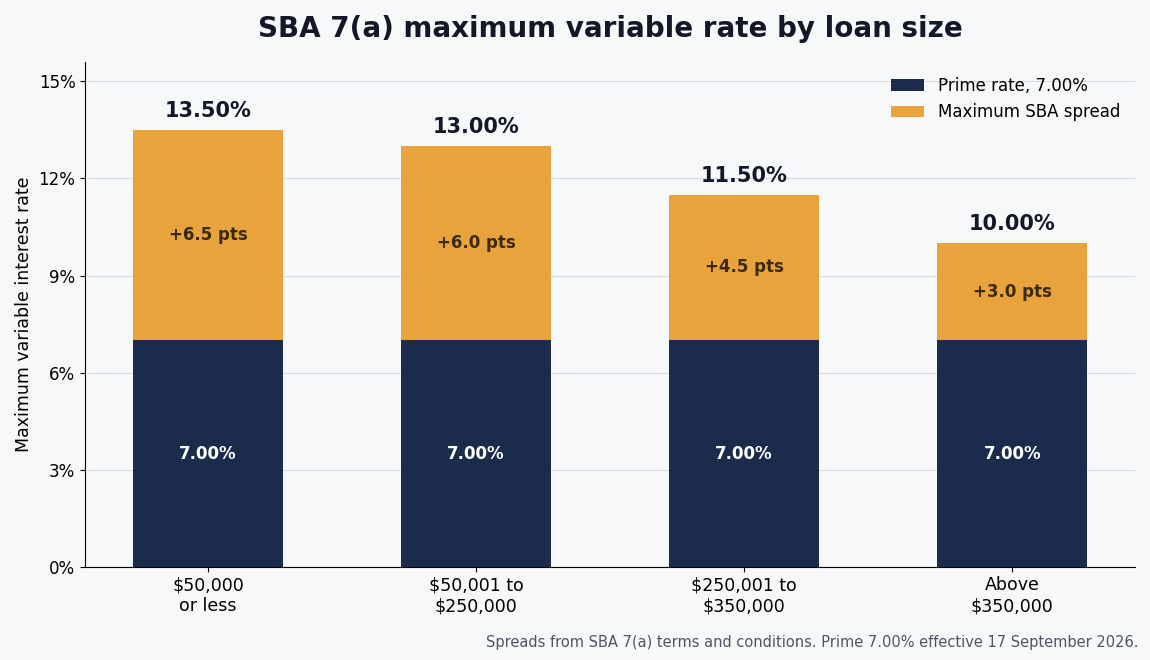
SBA Loans. The SBA closed fiscal year 2025 with a record $44.8 billion across 84,400 guaranteed 7(a) and 504 loans. The most popular is the SBA 7(a) loan, which offers up to $5 million at variable rates of 10.00% to 13.50%. SBA does not publish a rate, it caps what a lender may charge, prime plus 3.0 points above $350,000 rising to prime plus 6.5 points at $50,000 or less, and prime rose to 7.00% on 17 September 2026. SBA Express loans cap at $500,000 with faster approvals. SBA microloans go up to $50,000 at rates of 8% to 13%. Guarantee fees for FY2026 range from 0.25% to 3.75% of the guaranteed portion, depending on loan size. Every business owner with 20%+ ownership must sign a personal guarantee.
Traditional Bank Loans. Banks offer the lowest rates (7% to 12% APR) but the toughest requirements. You typically need a credit score of 680+, at least 2 years in business, solid financials, and collateral. The application process takes weeks to months. If you qualify, bank rates are hard to beat. Learn how to prepare with our guide on how to get a business loan.
Online Lenders. OnDeck lends $5,000 to $400,000 on a term loan, over terms of up to 24 months, and it publishes what borrowers actually paid rather than a range. Its average was 53.2% APR on term loans and 59.8% on lines of credit, across loans originated in the half year to 30 June 2026. Minimums are lower than a bank, a 625 credit score, 1 year in business and $100,000 of annual revenue, and money can land the same day. Fundbox does not publish a rate at all. It publishes the bar to apply, $30,000 in annual revenue, a business checking account and three months in business, and you learn your fee at approval. Both are fast and expensive, and you should price the total repayment rather than the headline. Compare your options in our best small business loans guide.
Merchant Cash Advances. MCAs use factor rates of 1.1 to 1.5 instead of interest rates. A factor rate of 1.3 on a $50,000 advance means you repay $65,000 total. The effective APR can range from 40% to over 150%, depending on how quickly you repay. Few borrowers take just one. MCA debt appeared in more than 230 bankruptcy filings in 2025, the peak year in Bloomberg Law docket data, and the bankruptcy attorneys quoted there describe debtors arriving with four or five advances stacked on top of each other. Use these only as a last resort for short-term cash needs. Read our full breakdown of merchant cash advances.
Venture Capital and Angel Investment. Angel investors are wealthy individuals who invest their own money, typically at the pre-seed and seed stages. Angel checks range from a few thousand dollars to $500,000+. Institutional VCs invest larger amounts starting at Series A. Founders typically give up 10-25% equity per round. In 2026, VCs want to see strong traction, capital efficiency, and a thoughtful plan for deploying their capital.
Federal Grants (SBIR/STTR). The SBIR and STTR programs fund R&D-focused small businesses through 11 federal agencies. Phase I awards go up to $323,090 for proof-of-concept work over 6-12 months. Phase II awards go up to $2,153,927 for technology development over 24 months. These are completely non-dilutive. Congress reauthorized both programs through September 30, 2031 when the Small Business Innovation and Economic Security Act became law on April 13, 2026, ending a lapse that had run since September 30, 2025. Check sbir.gov for the latest solicitation status. Also explore other small business grants.
Revenue-Based Financing. This non-dilutive option ties your repayment to a percentage of monthly revenue, typically 1-9%. It works well for SaaS and subscription businesses with strong recurring revenue. You repay more when revenue is high and less when it dips. The total cost of capital usually runs 1.5x to 2.5x the amount borrowed. Invoice factoring is a related option if your business invoices other companies.
SBA Loans. Two programs cover most of what a founder borrows to buy. The 7(a) is the general purpose loan, capped at $5 million and usually priced against prime. The 504 is for owner occupied property and long life equipment, at a fixed rate with 10% down, and it runs through a Certified Development Company rather than a bank alone. Our SBA 504 vs 7(a) comparison covers which one fits which purchase.
Funding Options at a Glance
| Type / Provider | Rate | Notes |
|---|---|---|
| SBA 7(a) Loan | 10.00% - 13.50% variable APR | Up to $5M. Requires personal guarantee. 30-90 day funding. Rate capped at prime plus 3.0 to 6.5 points by loan size. |
| SBA 504 Loan | 6% - 7% fixed rate | Real estate and equipment only. 10% down payment required. Fixed rate tied to Treasury bonds. |
| SBA Microloan | 8% - 13% APR | Up to $50,000 from nonprofit intermediary lenders. Good for true startups. |
| Traditional Bank Loan | 7% - 12% APR | Requires 680+ credit, 2+ years in business, collateral. Lowest cost but hardest to qualify. |
| Online Lender (OnDeck) | 35% - 99% APR | 625+ credit, $100K revenue, 1 year in business. Same-day funding available. |
| Merchant Cash Advance | 40% - 150%+ effective APR | Factor rates 1.1-1.5. No credit score minimum. Funds in 24-48 hours. High risk of debt spiral. |
| Seed VC Round | 15-25% equity dilution | $500K-$5M typical. SAFE notes or priced rounds. 18-month median to Series A. |
| Series A VC Round | 15-25% equity dilution | $3M-$23M. Requires product-market fit. Fewer than 15% of seed startups reach this stage. |
| SBIR Phase I Grant | $0 cost (non-dilutive) | Up to $323,090. R&D focused. 6-12 month projects. Reauthorized through September 2031. |
| Y Combinator Accelerator | 7% equity + MFN SAFE | $500K total investment. $125K for 7% + $375K uncapped MFN SAFE. Four batches per year. |
How to Choose the Right Funding for Your Startup
Start with three questions: How much do you need? How fast do you need it? And what are you willing to give up (equity, a personal guarantee, or high interest)?

If you need less than $50,000 and are brand new. Look at SBA microloans ($50,000 max, 8-13% rates), microloans for small business from nonprofit CDFIs, or business credit cards with 0% intro APR periods. Start building business credit early.
If you need $50,000 to $500,000 and have revenue. SBA 7(a) loans are your best rate at 10.00% to 13.50%, but the process takes 30-90 days. If you need cash in under a week, online lenders like OnDeck fund the same day but charge 35-99%+ APR. A working capital loan or business line of credit may also fit.
If you need $500,000+ and want to grow fast. Equity fundraising (seed or Series A) is the standard path for high-growth startups. You give up ownership, but you get capital with no monthly payments. If you have R&D, SBIR grants give you up to $2.15 million with zero dilution.
If you have strong credit (680+) and 2+ years in business. A traditional bank loan at 7-12% APR is your cheapest option. Pair it with SBA programs for even better terms. See our SBA loan guide for step-by-step instructions.
If your credit is below 620 or you are pre-revenue. Your options narrow to accelerators, angel investors, invoice factoring (if you have receivables), or merchant cash advances (only as a last resort). Focus on improving your business credit score to unlock better options within 6-12 months.
Keep Your Cap Table Clean from Day One
Stacking multiple SAFE notes with different valuation caps and discounts creates a messy cap table that scares off later investors. Use a tool like Carta to track ownership from your first investment. The median seed dilution is 20%, so model the impact of every fundraising decision before you sign.
5 Funding Mistakes That Can Sink Your Startup
1. Raising too much equity too early. Every round dilutes your ownership. If you give away 25% at pre-seed and 20% at seed, you may own less than 50% before Series A even starts. Model your dilution across multiple rounds before you accept any deal.
2. Ignoring the true cost of fast capital. A merchant cash advance with a 1.3 factor rate repaid over 6 months has an effective APR of 40-60%. In 2025, more than 230 bankruptcy filings involved MCA debt, the highest year on record. Always calculate the effective APR before signing. If the provider will not show you the APR equivalent, walk away.
3. Skipping SBA loans because they seem slow. Yes, SBA loans take 30-90 days, but variable rates of 10.00% to 13.50% save you tens of thousands compared to online lender rates of 35%+. Plan ahead so you are not forced into expensive last-minute financing.

4. Not preparing your financials before approaching investors. VCs in 2026 expect to see clear unit economics, CAC/LTV ratios, and a 12-18 month financial projection. Walking into a pitch without these is a fast rejection. Use accounting software to keep your books investor-ready. Set up your business accounting properly from day one.
5. Failing to incorporate correctly before raising. Investors (especially VCs) expect a Delaware C-Corp with a clean cap table. If you formed an LLC, you may need to convert before raising institutional capital. Check our guide on LLC formation and LLC vs S Corp comparison to understand the trade-offs for your situation.
SBIR/STTR Program Status in 2026
The SBIR and STTR programs are authorized through September 30, 2031. The Small Business Innovation and Economic Security Act became Public Law 119-83 on April 13, 2026, ending the lapse that had frozen new solicitations since September 30, 2025, so agencies are accepting applications again. Check sbir.gov for the latest updates before investing time in an application. Register at SAM.gov and Grants.gov now so you are ready when solicitations reopen.
Quick Wins to Start Today
Check your personal credit score for free at AnnualCreditReport.com. Most SBA lenders want 680+.
Register at SAM.gov and Grants.gov today if you plan to apply for any SBIR or STTR grants.
Set up a free Carta account to keep your cap table clean before any investor conversation.
Open a separate business checking account and start building a 3-month bank statement history.
Use the SBA Lender Match tool at sba.gov to get matched with up to 3 SBA-approved lenders.
Frequently Asked Questions
Pre-seed rounds typically range from $100,000 to $250,000 for the basics: early product development, market validation, and a small team. Seed rounds average $500,000 to $5 million in 2026. Plan for 12-18 months of runway so you can hit milestones before needing to raise again.
SBA loans and traditional banks typically require a personal credit score of 680+. Online lenders like OnDeck accept scores as low as 625, and Fundbox goes down to 600. Merchant cash advances may approve scores below 500, but the effective APR can exceed 150%. Check your business credit score alongside your personal score.
Bootstrapping costs nothing in interest or equity. If you need outside capital, SBIR/STTR grants are free money (up to $323,090 for Phase I with zero repayment or dilution). For debt, SBA 504 loans offer fixed rates of 6-7% for real estate and equipment. Traditional bank loans run 7-12% APR for well-qualified borrowers.
The median dilution at seed stage is approximately 20%. Most founders give up 10-25% per major funding round. Try to maintain more than 50% ownership through Series A, because dilution compounds quickly in later rounds. Model every scenario with a cap table tool like Carta before signing term sheets.
It is difficult but not impossible. SBA microloans (up to $50,000 at 8-13%) are more accessible to newer businesses through nonprofit intermediary lenders. For larger SBA 7(a) loans, you typically need a profitable business with steady revenue and a credit score of 680+. A solid business plan can help offset limited operating history.
Speed varies wildly by funding type. Merchant cash advances fund in 24-48 hours. Online lenders like OnDeck can fund the same day. SBA loans take 30-90 days. Venture capital rounds typically take 3-6 months from first pitch to money in the bank. SBIR grants can take 6-12 months from application to award.
This content is for informational purposes only and does not constitute financial, legal, or tax advice. Business financing terms, rates, and eligibility vary by lender, credit profile, and business characteristics. Consult a licensed financial advisor or CPA before making borrowing decisions. APR ranges reflect industry averages as of early 2026 and may change without notice.
Sources & References
- SBA.gov - 7(a) Loans Program
- SBA.gov - 7(a) Terms, Conditions, and Eligibility
- Lendio - Current SBA Loan Interest Rates (February 2026)
- NerdWallet - SBA Loan Rates 2026
- Fundwell - SBA Loan Interest Rates for 2026
- BusinessCapital.com - Business Loan Interest Rates 2026
- SBIR.gov - About SBIR/STTR Programs
- Y Combinator - Standard Deal
- Carta - Pre-Seed Funding Guide
- GrowthList - Startup Funding Stages Guide
- NerdWallet - OnDeck Business Loans Review 2026
- Aspire - Merchant Cash Advance Guide 2026
- Congress.gov - S.3971 Small Business Innovation and Economic Security Act (Public Law 119-83)
- SBA.gov - Record Capital Delivered to Small Businesses in FY25 (news release 25-83)
- Federal Reserve H.15 Selected Interest Rates, bank prime loan rate
- SBA maximum allowable 7(a) interest rates by loan size
- OnDeck business term loans, amounts, terms and average APR
- Fundbox qualifying requirements
About the Author
Editor, StartupOwl
Eliot leads StartupOwl's state data research. He maintains the site's fifty state records of LLC filing fees, annual costs, processing times, and small business grant programs, checking each figure against the state office that publishes it and logging the date it was verified. Based in New Jersey, he has spent his working life in and around small businesses, and he writes for the founder who wants the real number rather than the advertised one. Every figure under his byline traces to a named source, and when a state proves a number wrong, the correction is published, not buried.
Was this article helpful?
Questions about How to Fund a Startup in 2026, Every Funding Option Explained
No comments yet. Ask the first question and a member of our team will answer.
Leave a comment