
How to Open a Business Bank Account for Your LLC
Open your LLC bank account online. Here is every document you need, what it costs, and how to pick the right bank.

You can open a business bank account for your LLC in 10 to 30 minutes online. It costs $0 at Mercury, Bluevine or Relay. Chase charges $15/month and waives it if you hold a $2,000 balance. You need four documents. Articles of Organization, EIN letter, operating agreement, and government-issued photo ID.
6
Total Steps
$0–$15
Est. Cost
30 minutes to 2 business days
Timeline
Easy
Difficulty
A business bank account costs $0 to $15 per month at most banks. The whole process takes under 30 minutes once your papers are ready. You can open one online with Mercury or Bluevine, and neither asks for a minimum deposit. Or take your documents into a traditional bank branch. You can fund the account that day.
You need four documents. Your Articles of Organization, your EIN from the IRS, a signed operating agreement, and a government-issued photo ID. Keep running the business through your personal checking account instead and you put your LLC's liability protection at risk in court. This guide walks the whole process, step by step, with real costs and provider links.
Gather four documents before you touch a bank application. Missing even one will delay your approval or get you denied. Get them together first.
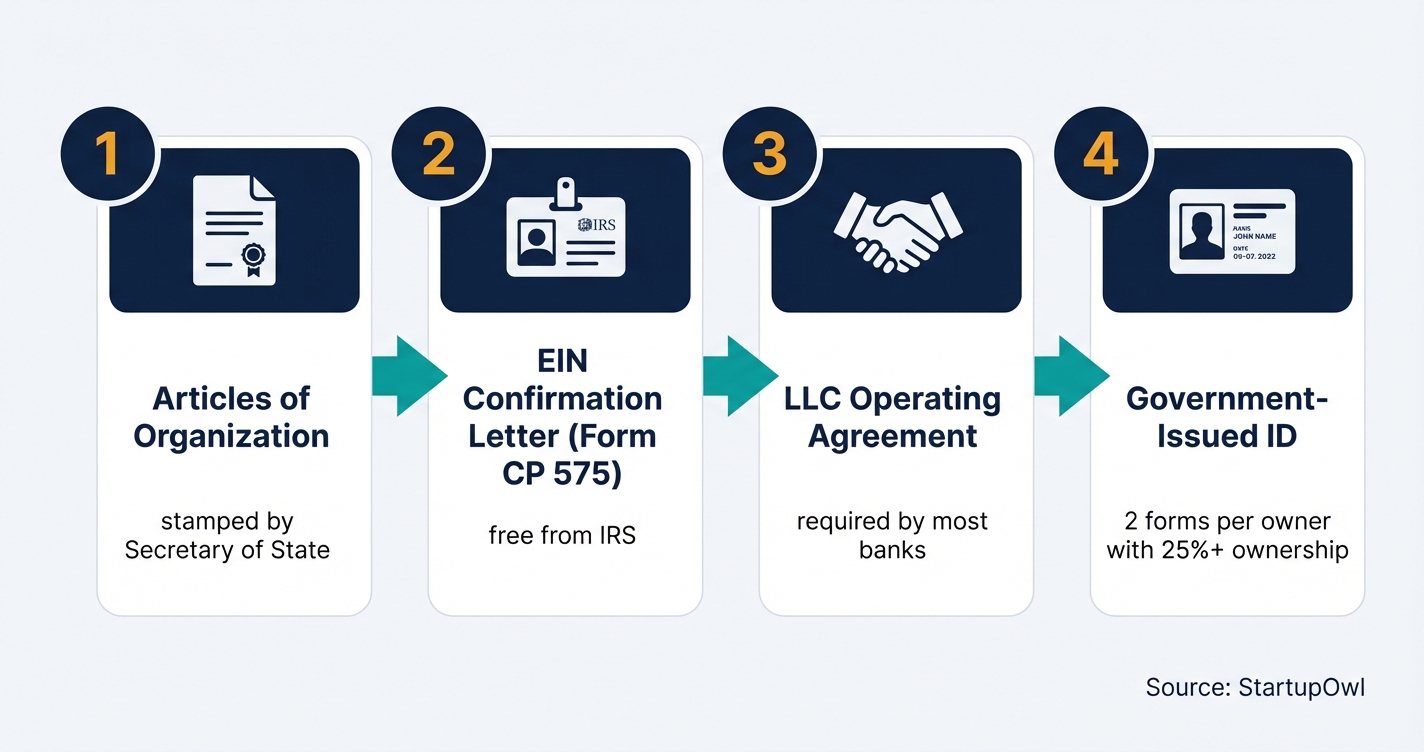
- Articles of Organization (stamped) from your state's Secretary of State office. This document proves your LLC exists. A draft or unsigned version will not work.
- EIN Confirmation Letter (Form CP 575) from the IRS. Applying online is free. The IRS issues the number right away. Our EIN application guide walks you through it.
- LLC Operating Agreement signed by all members. Most banks ask for it. Your state may not require one. Our operating agreement guide shows you how to write one.
- Government-issued photo ID for every member who signs. How many forms depends on the bank. Huntington asks LLC applicants for 2. A driver's license plus a passport is the usual pair. Chase names a single state-issued license or passport instead. Anyone holding 25% or more is identified separately, under the bank's beneficial ownership check.
Some banks go further and want ID from every member of a multi-member LLC. Ownership share does not matter to them.
You do not need a business license to open the account, unless your local rules require one for your trade. Revenue is not required either. Nor is a business plan.
If you are opening the account from outside the United States, the order matters more than the paperwork. Stripe will not open for a US company that has no US bank account. So the sequence runs LLC, EIN, bank, then Stripe. Our guide to Stripe unsupported countries walks that route. It also says who should skip it.
That list assumes a US person with a US address and a Social Security number. Most providers screen your country first. If you live outside the United States the documents are only half the problem. Our guide to a US business bank account for non residents sets out who accepts which countries.
The application itself takes 10 to 15 minutes at most online providers. You type in your LLC's legal name, EIN and business address, then your own name, Social Security number and date of birth. Then you upload the documents.
Mercury usually approves in 1 to 2 business days. Bluevine and Relay run to similar timelines. Chase can approve you the same day if you apply in a branch with everything in hand. A manual review takes 3 to 5 business days, and newer or multi-owner LLCs trigger one more often.
KYC and AML rules have tightened. Those stand for Know Your Customer and Anti-Money Laundering, the checks a bank runs before it lets you open an account. Banks now verify your identity, your LLC's registration and your business address more closely than they did five years ago. So use the exact legal name printed on your Articles of Organization in every field. Even LLC against L.L.C. can trigger a review.
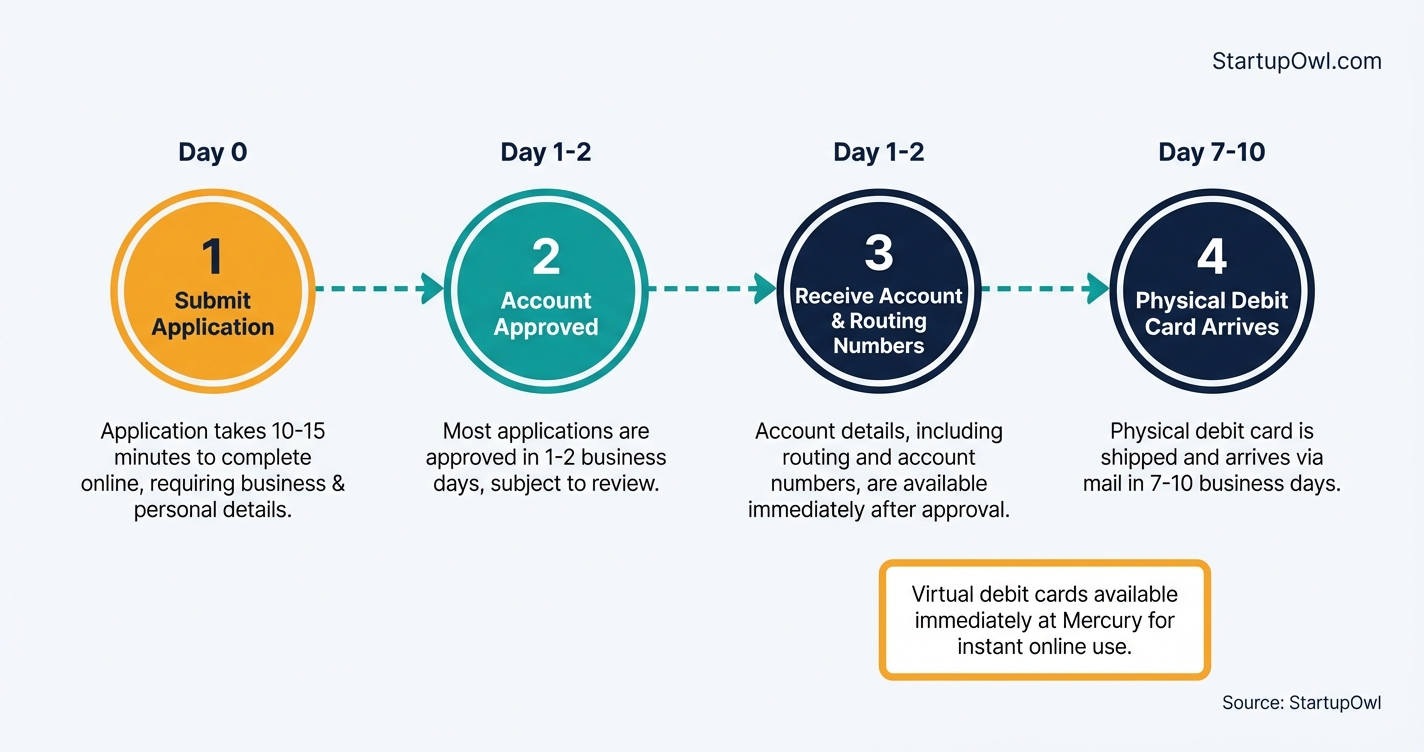
Once you are approved, your routing number and account number arrive by email or appear in your dashboard. A physical debit card usually takes 7 to 10 business days. Mercury does not make you wait. You can create a virtual card and spend on the day you are approved.
Step-by-Step Process
- 1
Confirm Your LLC Formation Is Complete
Before you apply for a business bank account, verify that your LLC is officially registered with your state. You need a stamped copy of your Articles of Organization (sometimes called a Certificate of Formation) from your Secretary of State. This document proves your business legally exists.
If you have not yet filed, visit your best LLC formation services guide to choose a provider. Most states process filings in 3 to 7 business days, though expedited options can cut this to 24 hours for an extra $50 to $100. Get the stamped document in hand, or a digital copy from your state's portal. Then you are ready to apply.
Tips
- Download a digital copy of your Articles of Organization from your state's Secretary of State website so you have it ready to upload.
- If your LLC name has changed since formation, file a DBA (Doing Business As) certificate before opening the account.
- Multi-member LLCs should gather photo IDs for every member with 25% or more ownership before starting the application.
Common Mistakes
- Trying to open a bank account before your LLC is officially registered with the state, which will result in an automatic denial.
- Using a draft Articles of Organization instead of the state-stamped final version.
- 2
Apply for Your Free EIN from the IRS
Your Employer Identification Number (EIN) is your LLC's federal tax ID. You need it to open a bank account, file taxes and hire employees. It costs nothing. The IRS charges $0 and the form takes under 5 minutes online through the IRS EIN Assistant.
The IRS issues your EIN as soon as it verifies your answers online. You can bank with it right away. Print or save the confirmation notice (Form CP 575) because banks will ask for it. If you already have an EIN from your EIN application, skip to the next step.
Tips
- Apply on IRS.gov directly. Never pay a third-party site for an EIN; the IRS does not charge a fee.
- Save the CP 575 confirmation letter as a PDF immediately; you cannot re-download it from the IRS later.
Common Mistakes
- Paying $50 to $200 on a third-party EIN filing site when the IRS application is completely free.
- Applying for an EIN before your LLC is registered with the state, which can cause delays per IRS guidance.
- 3
Draft or Finalize Your LLC Operating Agreement
Most banks require an LLC operating agreement when you open a business account, even for single-member LLCs. It sets out who owns the LLC, how profits are split and who may operate the bank account. Many banks reject applications without one.
A solo founder needs very little. Your operating agreement can be a simple 1 to 3 page document naming you as the sole member and manager. Multi-member LLCs need a more detailed agreement covering capital contributions, voting rights, and dissolution terms. Free templates are available from your state's Secretary of State website, or you can use a service like LegalZoom for $0 to $99.
Tips
- Create one even if your state does not require it. Most banks will ask. They want to see it during account setup.
- Include a clause specifying who is authorized to open and manage bank accounts on behalf of the LLC.
Common Mistakes
- Skipping the operating agreement entirely because your state does not mandate one, only to have the bank reject your application.
- 4
Choose the Right Bank or Fintech for Your LLC
This is the biggest decision in the process. You have three options. Online fintechs (Mercury, Bluevine, Relay), national banks (Chase, Bank of America) and local credit unions. Each tier carries different fees, features and trade-offs. See our full best business bank accounts comparison for details.
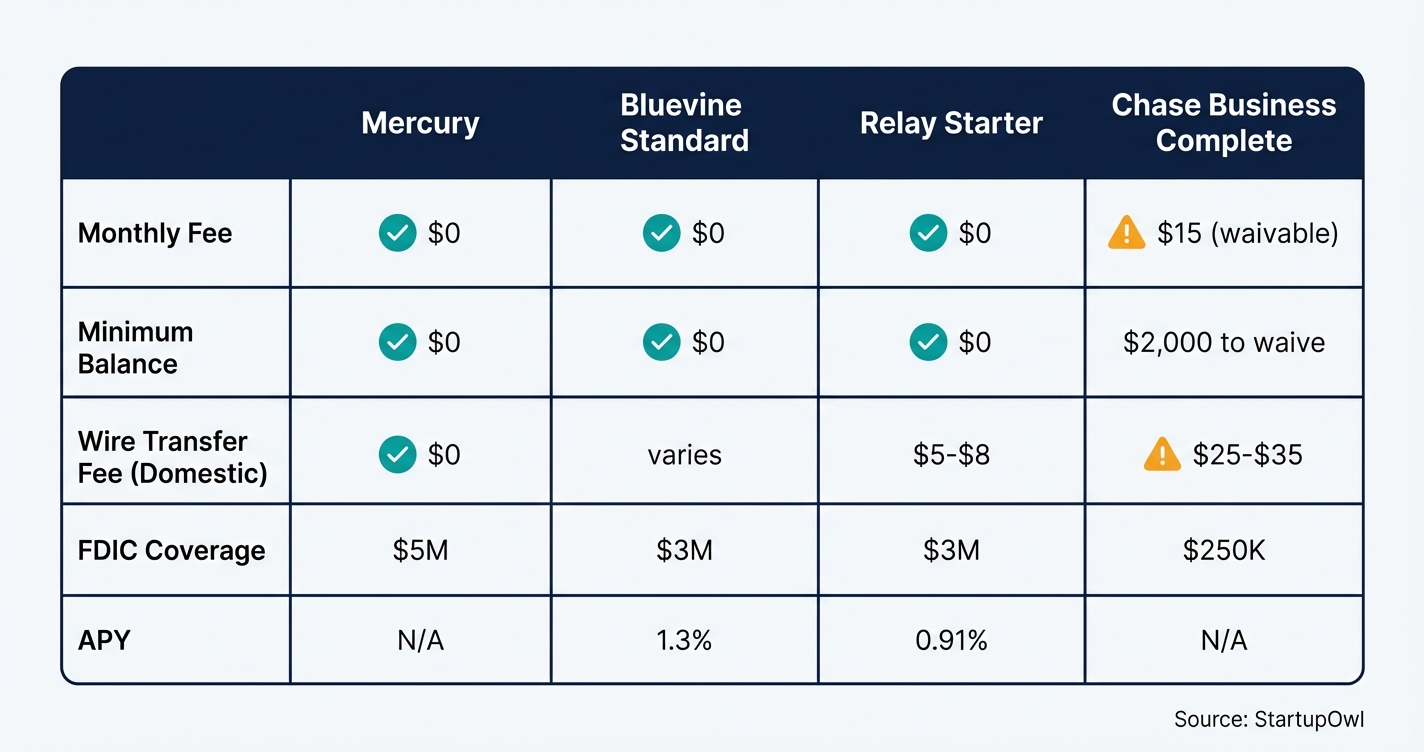
Mercury charges $0/month with no minimum balance, free domestic wire transfers, and FDIC coverage up to $5 million through partner banks and their sweep networks. Bluevine's Standard plan is also $0/month, with FDIC insurance up to $3 million, and it pays 1.3% APY on balances up to $250,000 only in months you spend $500 on the Bluevine debit card or take in $2,500 of customer payments. Miss the goal, that month earns nothing. Chase Business Complete Banking charges $15/month, waivable with a $2,000 minimum daily balance, and what you buy for it is the branch network, more than 5,000 branches and 14,000 ATMs for in-person cash deposits.
If your business handles cash daily (restaurants, retail), choose a bank with branch access. If you operate online, a fintech will save you money.
$0/month (Mercury, Bluevine, Relay) to $15/month (Chase) to $95/month (Bluevine Premier) 30 minutes of research MercuryTips
- If you send wire transfers regularly, Mercury offers free domestic and international USD wires. Chase publishes no single national wire fee. Its business fee schedule sits behind a ZIP code prompt, because the pricing follows the branch where the account was opened, so pull yours before you compare.
- Mercury, Bluevine and Relay take no cash deposits at a branch. Cash is the dividing line here. If your business handles cash daily, shop the national banks and local credit unions instead.
- Check whether the bank integrates with your accounting software (QuickBooks, Xero, or FreshBooks) before you commit.
Common Mistakes
- Choosing a bank only because it is nearby without comparing monthly fees. A $15/month fee adds up to $180 a year. A free online account costs nothing.
- Overlooking wire transfer fees. Traditional banks charge for every outgoing wire, and Chase sets the amount by the ZIP code the account was opened in. Mercury charges $0 for domestic USD wires.
- 5
Submit Your Application Online or In-Branch
With your documents ready, the actual application takes 10 to 15 minutes. Most online providers (Mercury, Bluevine, Relay) take a fully digital application. Nothing is posted or faxed. You will upload your Articles of Organization, EIN confirmation, operating agreement, and a photo of your government-issued ID through the bank's secure portal.
For Chase and other traditional banks, you can apply online if your LLC has a single member or manager. Multi-member LLCs and other complex structures typically need to apply in person at a branch. Bring government-issued ID for each owner with 25% or more ownership, and ask your bank how many forms it wants before you go. Approval at online providers usually happens within 1 to 2 business days. Chase can approve same-day in branch.
$0 (no application fees at any major provider) 10 to 15 minutes to apply; 1 to 2 business days for approval MercuryTips
- Have all four documents (Articles of Organization, EIN letter, operating agreement, photo ID) saved as PDFs on your desktop before you start.
- If your application is denied, try a different provider. There is no credit impact from business bank account applications.
Common Mistakes
- Submitting blurry or cropped document uploads, which triggers manual review and delays approval by 3 to 5 business days.
- 6
Fund Your Account and Record the Initial Deposit
Once approved, fund your account with an initial deposit. Mercury and Bluevine set no minimum. Chase has no required minimum to open either, but you must move money in within 60 days or the account will be closed. A common first deposit is $100 to $1,000 from your personal account.
Record this transfer as an "Owner Contribution" or "Member Contribution" in your bookkeeping software. This is not income. It should not appear on your profit and loss statement. It goes on the balance sheet as owner's equity. Connect your new account to your accounting software right away so every future transaction is tracked automatically. Then set up your small business accounting system before you start spending.
$0 to $1,000 (initial deposit, which is your own money) 5 minutes to transfer funds; 1 to 3 business days for ACH to settle QuickBooksTips
- Transfer a round number (e.g., $500 or $1,000) to make your bookkeeping cleaner from day one.
- Label the initial deposit as Owner Contribution in QuickBooks or your accounting software to keep your books accurate.
- Order a debit card and set up online bill pay immediately so you are ready to make business purchases.
Common Mistakes
- Recording your initial deposit as income instead of owner's equity, which will inflate your reported revenue and create tax problems.
- Forgetting to fund a Chase account within 60 days, resulting in automatic account closure.
A business bank account costs $0 to $95 per month, depending on the provider you choose. Most new LLCs pay nothing. See our detailed business bank account fees breakdown for the full comparison.
Mercury charges no monthly fees, no minimum balance, no overdraft fees, and no fees for domestic or international USD wire transfers. Bluevine's Standard plan is also free, and it pays 1.3% APY on balances up to $250,000 in months you spend $500 on the debit card or receive $2,500 in customer payments. A quiet month pays nothing. Treat the yield as a bonus rather than a reason to pick the account. Relay's Starter plan costs $0/month and includes up to 20 checking accounts.
Chase Business Complete Banking charges $15/month, and Chase waives it at $2,000. Three routes count, a $2,000 minimum daily balance, $2,000 of Chase QuickAccept deposits, or $2,000 of Chase for Business credit card purchases. Chase Performance Business Checking runs $40/month, waived at a $35,000 combined average beginning day balance, Platinum is $95/month. That one is waived at a $100,000 average beginning day balance, or $50,000 if you link it to a Chase Private Client account. Few first year LLCs hold that.
The hidden cost most LLC owners miss is wire transfer fees, and Chase makes that one hard to price before you open. It publishes no single national figure. Its business fee schedule sits behind a ZIP code prompt, because the pricing follows the branch where the account was opened. So pull the schedule for your own ZIP first. At Mercury an outgoing domestic USD wire costs $0, so the comparison you are really making is between a known zero and a number you have to go and look up.
Cost Breakdown
| Item | Cost Range | Notes |
|---|---|---|
| Monthly account fee (online fintech) | $0/month | Mercury, Bluevine Standard, and Relay Starter all charge $0/month with no minimum balance. |
| Monthly account fee (traditional bank) | $15 to $95/month | Chase Business Complete is $15/month (waivable with $2,000 balance). Chase Performance is $40/month. Chase Platinum is $95/month. |
| EIN application | $0 | Always free at IRS.gov. Never pay a third-party site. |
| Operating agreement (DIY) | $0 to $99 | Free templates online; LegalZoom charges up to $99 for a guided version. |
| Operating agreement (attorney-drafted) | $300 to $1,000 | Recommended for multi-member LLCs with complex ownership structures. |
| Outgoing domestic wire (traditional bank) | set by ZIP code fee schedule | Mercury charges $0 for domestic USD wires. Relay charges $5 to $8 per domestic wire. |
| Outgoing domestic wire (fintech) | $0 to $8 per transfer | Mercury is free. Relay Starter charges $8; Relay Grow/Scale charges $5. |
| Initial deposit | $0 to $1,000 | Mercury and Bluevine require $0. Chase requires funding within 60 days but no set minimum. |
| Overdraft fee | $0 to $34 per item | Mercury and Bluevine charge $0 overdraft fees. Chase charges $34 per item (max 6 per day), waivable if overdrawn by $5 or less. |
Your bank account is open. Now protect yourself and set up the financial infrastructure around it.
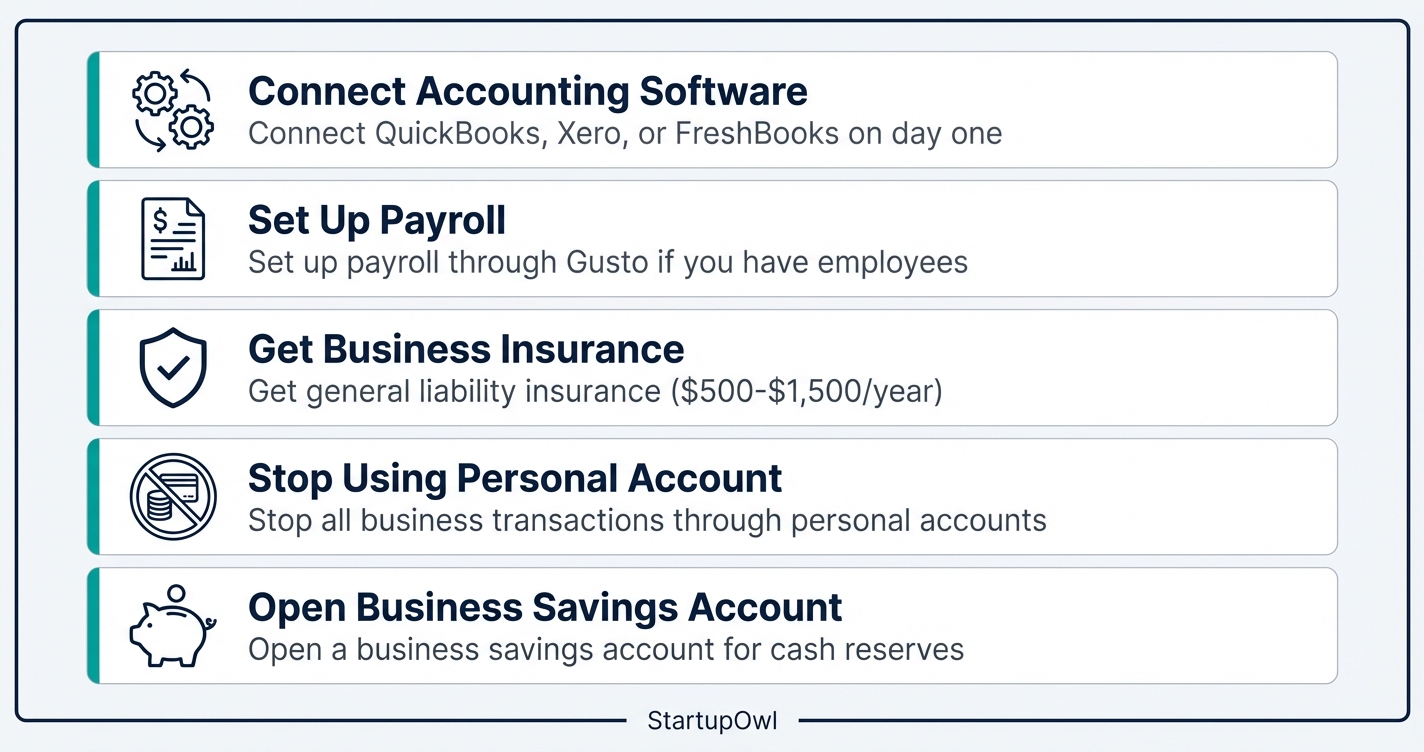
- Connect accounting software immediately. Link your new account to QuickBooks, Xero, or FreshBooks so transactions sync automatically. See our how to set up accounting guide for step-by-step instructions.
- Set up payroll if you have employees. Providers like Gusto connect directly to Mercury, Bluevine, and Chase. Our payroll setup guide walks you through the process. Do it before your first payday.
- Get business insurance. General liability insurance costs $500 to $1,500/year for most small businesses and protects your LLC. See our best business insurance picks.
- Stop using your personal account for business expenses. From today, every business purchase, vendor payment and client deposit should flow through this account. It protects your liability shield. It also makes tax time far simpler.
- Consider a business savings account. If you expect to hold more than $10,000 in cash, open a business savings account at the same institution. Bluevine pays 1.3% APY on Standard checking balances up to $250,000 in months you spend $500 on the debit card or take in $2,500 of customer payments.
Next, decide how money gets into the account. Most businesses take cards. That cost is priced as a percentage plus a flat number of cents per sale, not a single rate. See what credit card processing actually costs before you sign with a provider.
If Your Bank Holds or Freezes the Account
Sometimes the money stops moving and nobody at the bank will explain why. Wires sit pending. Deposits go on hold. The person on the phone says only that your account is under review. That silence is often a rule rather than bad service, and knowing which rule tells you what to do next.
Why your bank cannot tell you
A bank that has filed a suspicious activity report is barred from telling you it did. It cannot hint either. 31 CFR 1020.320(e) forbids disclosing the report or anything that would reveal it exists. The bank must refuse even a subpoena and cite the rule when it does. So a manager who will not answer may be obeying the law.
Not every hold means a report was filed. Banks also freeze accounts over a name mismatch, a large first deposit, or an unexpected wire from abroad. Those clear with a phone call. The reporting rule only bites at $5,000 or more. An attempted transaction counts the same as a completed one.
The clock the rule sets, and the one it does not
The filing has a deadline. Your money does not. A bank must file within 30 calendar days of the date it first detected the facts. It gets another 30 days if no suspect has been identified, and 60 days is the cap. No rule tells the bank when to release your funds, and that is the unwelcome half of the answer.
What to do while it is held
- Ask about the account, not the report. The bank cannot discuss a filing. It can tell you which documents it wants and who is reviewing the file.
- Send the paperwork before they ask twice. Send it in one batch. Formation documents, the EIN letter, invoices behind the flagged payment, and the beneficial ownership certification you signed at opening.
- Do not split the payment into smaller amounts. Restructuring a transaction to duck a threshold is reportable in its own right. It makes your position worse.
- Keep payroll money somewhere else. A second account at another institution is cheap insurance against a hold you cannot time.
A freeze nobody will explain is also why founders change banks. Our comparison of business bank accounts covers the monthly cost and the documents each provider asks for at opening. Move it between payrolls, not during one.
The Complete Checklist
- Verify LLC formation is complete with your Secretary of State01
Confirm you have a stamped copy of your Articles of Organization.
5 minutes$0 - Apply for a free EIN on IRS.gov02
Use the IRS EIN Assistant to get your number instantly online.
5 minutes$0 - Save your EIN confirmation letter (Form CP 575) as a PDF03
Banks require this document during the application.
1 minute$0 - Draft or finalize your LLC operating agreement04
Even single-member LLCs need one for most bank applications.
30 minutes to 2 hours$0 to $500 - Gather photo ID for every owner at 25% or more05
A driver's license, passport or state ID. Ask your bank how many forms it wants, the count varies.
5 minutes$0 - Compare at least 3 bank or fintech options06
Review monthly fees, wire transfer costs, FDIC coverage, and software integrations.
20 to 30 minutes$0 - Submit your bank application online or in-branch07
Upload your documents and complete the application form.
10 to 15 minutes$0 - Fund your new account with an initial deposit08
Transfer money from your personal account and record it as Owner Contribution.
5 minutes (1 to 3 days for ACH to settle)$0 to $1,000 - Connect your account to accounting software09
Link your bank to QuickBooks, Xero, or FreshBooks for automatic transaction syncing.
10 minutes$0 to $30/month - Order a business debit card10
Request a physical debit card for in-person purchases and ATM access.
7 to 10 business days to arrive$0
What You Need by Business Type
Everything above assumes an LLC. Banks ask for a different pile of paper for each structure. We read 2 published requirement lists on 24 August 2026, one from Chase and one from Huntington Bank. The pattern behind them is the same. You prove who you are, you prove the business exists, and you hand over a tax ID. Which document does the proving is the only thing that changes. Both banks close with the same warning, so ask yours before you drive over.

Sole proprietorship
There is no formation document, because nothing was ever filed. Your Social Security number usually stands in for an EIN. Chase says a sole proprietorship with no employees typically does not need one, and the IRS test agrees. Add a DBA or assumed name certificate if you trade under anything other than your own name. One catch is worth knowing early. Huntington makes sole proprietors open in a branch, with 2 forms of photo ID, rather than online.
General partnership
An EIN is not optional here. The IRS makes a partnership an automatic EIN case, whether or not it has employees. Our EIN application guide covers the free route. Huntington asks for one photo ID per general partner, the partnership agreement, and the EIN assignment letter. A government issued business license can stand in when no written agreement exists. Chase publishes no general partnership list at all. Its partnership entry covers limited liability partnerships, and asks for an agreement naming every partner and the business. Huntington also wants at least 2 partners in the room.
Corporation
A corporation always needs an EIN too. Same IRS rule, no exceptions for size. Huntington asks for the registration of incorporation filed with your state, one photo ID for each authorized signer, and the EIN assignment letter. At least 2 officers have to be present. A DBA certificate joins the pile if you trade under a second name. More signers means a slower opening than an LLC, so start collecting IDs early.
The certification of beneficial owners your bank hands you
Every US bank collects a signed certification of beneficial owners before it opens a business account. The form is the bank's. You cannot go and get one in advance, and 31 CFR 1010.230 sets what it asks for. The rule runs two separate tests, and the second one is the one founders never see coming.
| Test | Who it names | How many people |
|---|---|---|
| Ownership | Anyone who owns 25% or more of the equity, directly or through another company | Up to 4, and sometimes nobody |
| Control | One person with significant responsibility to manage or direct the business, such as a managing member, president or treasurer | Exactly 1, even if they own no part of it |
Five equal partners at 20% each name nobody under the first test. They still name one. The second test has no ownership threshold at all. That control person is the gap most guides leave open. It catches the manager who assumed none of this applied. What each named person hands over is the same short set. Legal name, home address, date of birth, and Social Security number. Huntington publishes its sample certification form, read in full on 4 September 2026. It caps the whole exercise at 5 people, up to 4 owners plus the one controlling party. It also asks for ID copies only from people who are not US citizens. Your bank may still want to see a license for everyone named.
Your business address will not do here. The rule wants where each person actually lives. The certification also comes back at every new account. A second account or a business loan at the same bank starts it again. Your bank then keeps the record for 5 years after you close the account.
Sole proprietors skip this one
A sole proprietorship is not a legal entity customer under the rule, so there is nothing to certify. Nothing was filed with a state. LLCs, corporations and general partnerships are all inside it, whatever their size. Nonprofit corporations are a half case, because the rule asks them for the control person and drops the 25% test.
This is not the FinCEN report that ended in 2026
The bank form and the FinCEN beneficial ownership information report are two different things. Readers mix them up constantly. FinCEN made the reporting exemption permanent on 11 August 2026, effective on the 14th. US formed companies no longer file BOI reports, per FinCEN's own alert. Your bank still asks for its certification. That duty sits in a separate rule, unamended since 2017.
Here are the direct links for every tool and form mentioned in this guide.
- IRS EIN Online Application (free, takes under 5 minutes)
- Mercury ($0/month business checking, free domestic wires)
- Bluevine Business Checking ($0/month Standard plan, 1.3% APY when you meet a monthly activity goal)
- Relay Financial ($0/month Starter plan, up to 20 checking accounts)
- Chase Business Complete Banking ($15/month waivable, more than 5,000 branches)
- FDIC Electronic Deposit Insurance Estimator (EDIE) (verify your deposit insurance coverage)
- FDIC Deposit Insurance at a Glance (official coverage limits)
- SBA Tax ID Guide (EIN overview and state tax ID guidance)
These are the most expensive mistakes LLC owners make when opening their first business bank account. Every one of them has real dollar consequences.
- Commingling personal and business funds. Using your personal checking account for business transactions puts your LLC's liability protection at risk. If a court determines you treated the LLC's money as your own, it can "pierce the corporate veil" and hold you personally liable for business debts. That is an unlimited financial exposure.
- Paying for an EIN. The IRS provides EINs for $0 at IRS.gov. Third-party sites charge $50 to $200 for the same 5-minute process. This is money thrown away.
- Skipping the operating agreement. Even for single-member LLCs, most banks require an operating agreement during account setup. If you show up without one, your application gets rejected and you lose a trip to the branch (or a week of back-and-forth with an online provider).
- Choosing a bank based on proximity alone. A Chase Business Complete account you never waive costs $180/year in monthly fees alone, before a single wire, against $0 at Mercury, Bluevine or Relay. Compare total cost, not convenience.
- Ignoring FDIC coverage limits. Standard FDIC insurance covers $250,000 per depositor, per insured bank, per ownership category. Your LLC sits in the corporation, partnership and unincorporated association category. The FDIC insures that separately from the personal accounts you hold at the same bank. The two limits do not eat each other. Above $250,000 the excess is uninsured unless your provider spreads deposits across partner banks (Mercury covers up to $5M; Bluevine and Relay cover up to $3M).
- Not connecting accounting software on day one. Every week you delay syncing your bank account to accounting software is a week of transactions you will have to categorize by hand later. That work is not free. At tax time it costs you $100 to $300 in extra bookkeeper hours.
If the address is the thing holding you up, our comparison of virtual address services compared shows which providers banks actually accept and which field to put the address in.
Frequently Asked Questions
No. An EIN alone is not enough. Banks also require your Articles of Organization (or Certificate of Formation), a government-issued photo ID, and in most cases an operating agreement. Federal KYC (Know Your Customer) regulations require banks to verify both your business identity and your personal identity.
The application itself takes 10 to 15 minutes. Online providers like Mercury and Bluevine typically approve accounts within 1 to 2 business days. If you walk into a Chase branch with all your documents, you can open an account same-day. Complex LLC structures (multi-member, holding companies) may trigger a manual review that takes 3 to 5 business days. Most founders are not in that group.
Legally, no state requires a single-member LLC to open a separate business bank account. Practically, yes. Commingling personal and business funds is the fastest way to lose your LLC's liability protection. A court can pierce the corporate veil if you treat LLC money as your own. The cost of a free business checking account at Mercury or Bluevine is $0. The cost of a pierced corporate veil is potentially everything you own.
Mercury, Bluevine, and Relay all offer $0/month business checking with no minimum balance. Mercury stands out for free domestic and international USD wire transfers and up to $5 million in FDIC coverage through sweep networks. Bluevine offers 1.3% APY on balances up to $250,000, but only in months you spend $500 on its debit card or receive $2,500 in customer payments. Relay lets you create up to 20 checking accounts free. That suits Profit First budgeting. See our full best business bank accounts comparison.
Yes, if you bank with an FDIC-insured institution. The standard limit is $250,000 per depositor, per insured bank, per ownership category as of 2026. Fintech providers like Mercury extend coverage to $5 million and Bluevine to $3 million by distributing your deposits across multiple FDIC-insured partner banks through sweep networks. Verify your bank's FDIC status at FDIC.gov.
Online applications are faster (approved in 1 to 2 days) and give you access to fee-free options like Mercury and Bluevine. A branch application at a traditional bank such as Chase or Bank of America can leave you with an active account the same day. Complex ownership structures often trip online verification, so those applications tend to end in a branch anyway. Chase requires multi-member LLCs to apply in person. There is no way around that.
Mercury disclosure. Mercury is a fintech company, not an FDIC-insured bank. Banking services provided through Choice Financial Group and Column N.A., Members FDIC. FDIC deposit insurance covers the failure of an insured bank. Deposits in checking and savings accounts are FDIC-insured through Choice Financial Group and Column N.A. and their Sweep Program Network Banks. Certain conditions must be satisfied for pass-through FDIC insurance to apply.
Sources & References
- IRS EIN Application
- FDIC Deposit Insurance at a Glance
- SBA Get Federal and State Tax ID Numbers
- Mercury Pricing
- Bluevine Business Checking Plans and Pricing
- Chase Business Complete Banking
- Relay Financial Pricing
- FDIC Electronic Deposit Insurance Estimator (EDIE)
- 31 CFR 1010.230, Beneficial Ownership Requirements for Legal Entity Customers
- 31 CFR 1020.320, Reports by Banks of Suspicious Transactions
- FinCEN Beneficial Ownership Information Reporting
- Huntington Certification of Beneficial Owners Sample Form
About the Author
Editor, StartupOwl
Eliot leads StartupOwl's state data research. He maintains the site's fifty state records of LLC filing fees, annual costs, processing times, and small business grant programs, checking each figure against the state office that publishes it and logging the date it was verified. Based in New Jersey, he has spent his working life in and around small businesses, and he writes for the founder who wants the real number rather than the advertised one. Every figure under his byline traces to a named source, and when a state proves a number wrong, the correction is published, not buried.
Was this article helpful?
Questions about How to Open a Business Bank Account for Your LLC
No comments yet. Ask the first question and a member of our team will answer.
Leave a comment