
Best Business Bank Accounts for LLCs
Four accounts, all $0 a month. We checked each at the provider's own pricing page on 2 September 2026. Here is which one fits your LLC, and what the tiers above free actually cost.

- All four picks charge $0 a month, with no minimum balance and no waiver condition to meet.
- Novo is the pick for most new LLCs, and it is the only one of the four with no paid tier above free.
- Mercury is the pick above $250,000. Its partner bank sweep network insures deposits to $5M.
- Relay opens 20 checking accounts on its free plan, which suits split budgets and client money.
- Bluevine pays 1.3% on Standard, but only in months you spend $500 on the card or take in $2,500 of customer payments.
- None of the four suits cash. Bluevine is the only one that takes it at all, through Green Dot, and it charges a fee.
Most LLCs should open Novo Business Checking. It has no monthly fee. There is no minimum balance, so a slow first year costs you nothing to bank. Novo includes invoicing, bookkeeping and Reserves for tax money. Its FDIC cover stops at $250,000, which is more than most new LLCs hold.
Three cases call for a different account.
- Mercury Business Checking fits an LLC that holds more than $250,000. Its partner bank sweep network insures well past that limit.
- Relay Starter fits an LLC that splits money across budgets or holds client funds. It opens many checking accounts under one login.
- Bluevine Business Checking Standard fits an owner who wants the balance to earn interest. Bluevine sets monthly activity terms on that rate.
Cash is the gap here. All four are online only. Only Bluevine takes cash, through Green Dot stores, for a fee.
Most LLC owners overpay for business banking. The good accounts now charge nothing and still do real work. We compared 4 and put Novo first. It is free. It is built for independent businesses, not funded startups. And it ships the back office a new LLC does not have yet, invoicing, expense categorization, tax reserves, and plain profit and loss reports.
Mercury takes second on merit. It holds large balances better than anything else here, with free wires and sweep coverage far above the standard $250,000. That matters enormously at $400,000 and not at all at $4,000. Pick by which problem you actually have.
One honest limit. None of the four takes cash deposits. If your LLC handles physical currency, you need a bank with branches too. We will not pretend otherwise.

Novo
$0
Novo costs $0 a month. There is no minimum balance and no waiver to meet. It is built for independent businesses rather than funded startups, and it carries the back office a new LLC does not have yet, invoicing, automatic expense categorization, tax Reserves and profit and loss reports.
Get StartedSide-by-Side Comparison
| Feature | |  |  |  |
|---|---|---|---|---|
| Monthly Fee | $0 | $0 | $0 | $0 |
| Minimum Balance/Commitment | $0 | $0 | $0 | $0 |
| FDIC Insured | Up to $250,000 via Middlesex Federal Savings | Up to $5M via partner banks | Up to $3M | Up to $3,000,000 |
| Built-in Invoicing | Yes, included free | No | No | Yes, Stripe-powered |
| Tax Set-Aside Tools | Reserves, allocate before you spend | No | Sub-accounts, manual | No |
| Cash Deposits | Not supported | Not supported | Not supported | Green Dot locations, fee applies |
| Best For | Independent businesses that need to get paid and stay organized | Digital-first startups and e-commerce businesses | Businesses segmenting cash flow into sub-accounts | High-balance businesses wanting to earn interest |
| Rating | 4.4/5 | 4.3/5 | 4.0/5 | 4.1/5 |
Full Reviews
Pros
- Genuinely $0 monthly fee with no minimum balance. First-year and ongoing cost is $0.
- Free ACH transfers and incoming wires save money on routine transactions.
- Native integrations with Stripe, Shopify, QuickBooks, and Amazon reduce manual bookkeeping work.
- Built-in invoicing and AI bookkeeping tools included at no extra cost, eliminating the need for a separate invoicing app.
Cons
- No cash deposits. Period.
- No phone line. Support runs through in-app tickets, where you chat with an agent, plus email if you cannot log in, and users report slow answers during urgent issues like account freezes.
- 0% APY on all balances. Your money earns nothing sitting in Novo while competitors like Bluevine pay interest.
- Check clearing and fund availability can be slower than expected based on user reports.
Pros
- Truly $0 monthly fee with no minimum balance, no overdraft fees, and no transaction fees on USD activity.
- Free domestic and international USD wire transfers, a feature that typically costs $20 to $35 per wire at other banks.
- FDIC insurance up to $5M through sweep networks across partner banks, far above the standard $250K.
- Mercury Treasury pays a yield on idle cash above $250,000. It is not FDIC insured. It may lose value.
- Virtual cards you can create and kill in seconds, with spend controls per team member.
Cons
- No cash deposits. At all. If your business handles physical cash, Mercury cannot be your primary bank.
- Account closures without warning are a documented pattern across BBB, Trustpilot and Reddit. Some users report months without access to funds.
- Customer support runs Monday to Friday only, 6am to 5pm PT. No weekend or after-hours phone support.
- Check deposits clear slowly. Users report waits of a week or more, which hurts a business that lives on checks.
- Choice Financial Group, one of Mercury's two partner banks, entered an FDIC consent order in December 2023 over Bank Secrecy Act gaps.
Pros
- Up to 20 free checking accounts on the Starter plan with no monthly fee or minimum balance, making Profit First allocation effortless
- FDIC insurance coverage up to $3M through Thread Bank's deposit sweep program, which is 12x the standard $250K
- Direct QuickBooks Online and Xero integrations on all plans, including the free tier, with auto-syncing transaction feeds
- iOS app rated 4.8 and Android 4.5, with biometric login, instant card freeze, and real-time transaction alerts
Cons
- Thread Bank received an FDIC consent order in 2024, and users report sudden account freezes with delayed access to their funds
- Recurring invoices and auto charging a card on file start on the $30 a month Grow plan, bulk bill payments need Scale, and outgoing domestic wires cost $8 on Starter against $5 on the paid plans
- Mobile check deposits can take seven to ten days to clear, and the savings account has no external ACH access
- No interest on checking balances and no physical branches, although cash goes in free at Allpoint+ ATMs, up to $1,000 per deposit
Pros
- The Standard plan is truly $0 per month with no minimum balance, no overdraft fees, and unlimited transactions.
- 1.3% APY on Standard checking balances up to $250,000, but only in months you spend $500 on the Bluevine debit card or take in $2,500 of customer payments. The 3.0% APY headline belongs to the Premier plan, which pays on all balances and costs $95 a month unless you meet its waiver terms.
- FDIC insurance up to $3,000,000 per depositor through the Coastal Community Bank sweep program.
- Sub-accounts (up to 5 on Standard) make it easy to separate tax reserves, payroll, and operating funds without opening multiple bank accounts.
- Built-in invoicing with Stripe-powered payment links and new estimate features reduce the need for separate billing software.
Cons
- Account freezes with no warning. This is a documented pattern across Trustpilot, the BBB, Reddit, and ConsumerAffairs. Locked funds can take days or weeks to release.
- No weekend customer support. If your account gets frozen on a Friday evening, you're stuck until Monday at 8am ET.
- Cash deposits cost $4.95 each via Green Dot, and there is no free way to deposit physical cash.
- No Zelle integration. Bluevine is not part of the Early Warning Services network that powers Zelle.
- Mobile check deposits can be held for up to 7 days, even for repeat payors with clean histories.
How to Choose
You just formed an LLC and want one free account that also does the admin.
Novo costs $0 a month. No minimum, no waiver. It includes invoicing, automatic expense categorization and profit and loss reports. For a new LLC that is the difference between a bank account and a back office.
You want tax money kept separate.
Novo Reserves split income on arrival. The tax share never sits in your spending balance. Most free accounts leave you to move that money by hand, which is how founders end up short in April.
You are launching an online LLC and want zero banking fees from day one.
Mercury charges $0 a month. There is no minimum balance, no overdraft fee and no transaction fee on USD activity. Domestic and international USD wires are free, which saves $20 to $35 a transfer against a traditional bank.
You need FDIC coverage well above the standard $250,000 limit.
Mercury insures deposits to $5M. That runs through its partner banks and their sweep network, which is 20 times the standard $250,000 limit. Novo tops out at $250,000 through Middlesex Federal Savings.
You need to organize LLC finances across multiple sub-accounts for budgeting or projects.
Relay opens 20 checking accounts. They come free on the Starter plan. Profit first budgeting and project accounting both get easier, without opening a second bank relationship.
You want a free business checking account that also pays interest on your balance.
Bluevine pays interest on checking. Standard is $0 a month and pays 1.3% on balances up to $250,000, but only in months you spend $500 on the debit card or take in $2,500 of customer payments. Plus costs $30 a month and pays 1.75% with no activity terms.
You deposit cash regularly from a retail or service based LLC.
None of the four suits cash. Bluevine is the only one that takes it at all, through Green Dot, and it charges a fee for each deposit. If cash is daily for you, pair one of these accounts with a local bank that has branches.
How We Picked
We started with the business bank accounts LLC owners in the United States actually use. Both kinds counted. That means online only neobanks and traditional institutions with branch networks. For each one we read the published fee schedule, the interest terms, the FDIC coverage limit, the transfer policy and the mobile app ratings.
Each account was scored across four categories. Pricing and value carries 35%. Features such as wire transfers and interest rates carry 25%, ease of use including app quality and onboarding speed carries 20%, and customer support carries the last 20%. We read user reviews on Trustpilot, the BBB, Google Play and the App Store to test the marketing against real experience.
Free with no minimum won heavy preference. Most new LLCs cannot promise a steady daily balance, so a waiver condition is a fee waiting to happen. We also marked providers down for documented patterns of sudden freezes or closures. Losing access to your operating funds can shut a business overnight.
Who Needs This
Every LLC needs its own bank account. Mixing personal and business money is the fastest way to lose the liability protection you formed the LLC for. Courts call that piercing the corporate veil, and it puts your personal assets in reach in a lawsuit. A separate business checking account is the paper trail that keeps the two apart.
The protection is not the only reason. A business account makes tax filing simpler and bookkeeping far easier, and most payment processors, payroll providers and accounting tools require one. If you plan to take payments, hire contractors or apply for a business credit card, you need an account linked to your EIN.
There is one exception. A sole proprietor who has not formed an LLC, and who handles very few transactions, can technically run on a personal account. But the week you file LLC paperwork with your state, open the business account. It costs $0 at all four picks here, so waiting buys you nothing.
Non residents have an extra problem. A US business bank account is what stands between a new US LLC and a working Stripe account, which is why our guide to accepting payments when Stripe is not supported in your country treats the bank account as the hard part rather than the formation.
Eligibility is the first filter from abroad, and the four accounts do not agree on it. Mercury names 48 prohibited countries. Relay names 31, and Bluevine runs an allowlist of 25. Our guide to a US business bank account for non residents puts all three lists side by side.
In-Depth Comparison
Novo and Mercury are the two strongest options here. They solve different problems. Novo wins on what it does for you. It costs $0 a month. The account brings invoicing, expense categorization, Reserves for tax money, and profit and loss reports. For a founder with no bookkeeper, that is a whole back office inside the banking app.
Mercury wins on where money sits. It is also free monthly. Its domestic and international USD wires cost nothing, and FDIC coverage runs to $5M through its partner bank sweep network. Novo tops out at $250,000 through Middlesex Federal Savings. Below that ceiling the difference is theoretical. Above it, Mercury is the safer home.
Relay suits owners who need granular organization. Its free plan creates up to 20 separate checking accounts under one business. That fits profit first budgeting, or splitting funds by project. It does not match Novo's built in bookkeeping or Mercury's wire savings.
Bluevine fills a narrower niche. Its checking pays interest with no monthly fee, which suits businesses holding moderate balances. It is also the only account here that takes cash at all, through Green Dot retail locations for a fee.
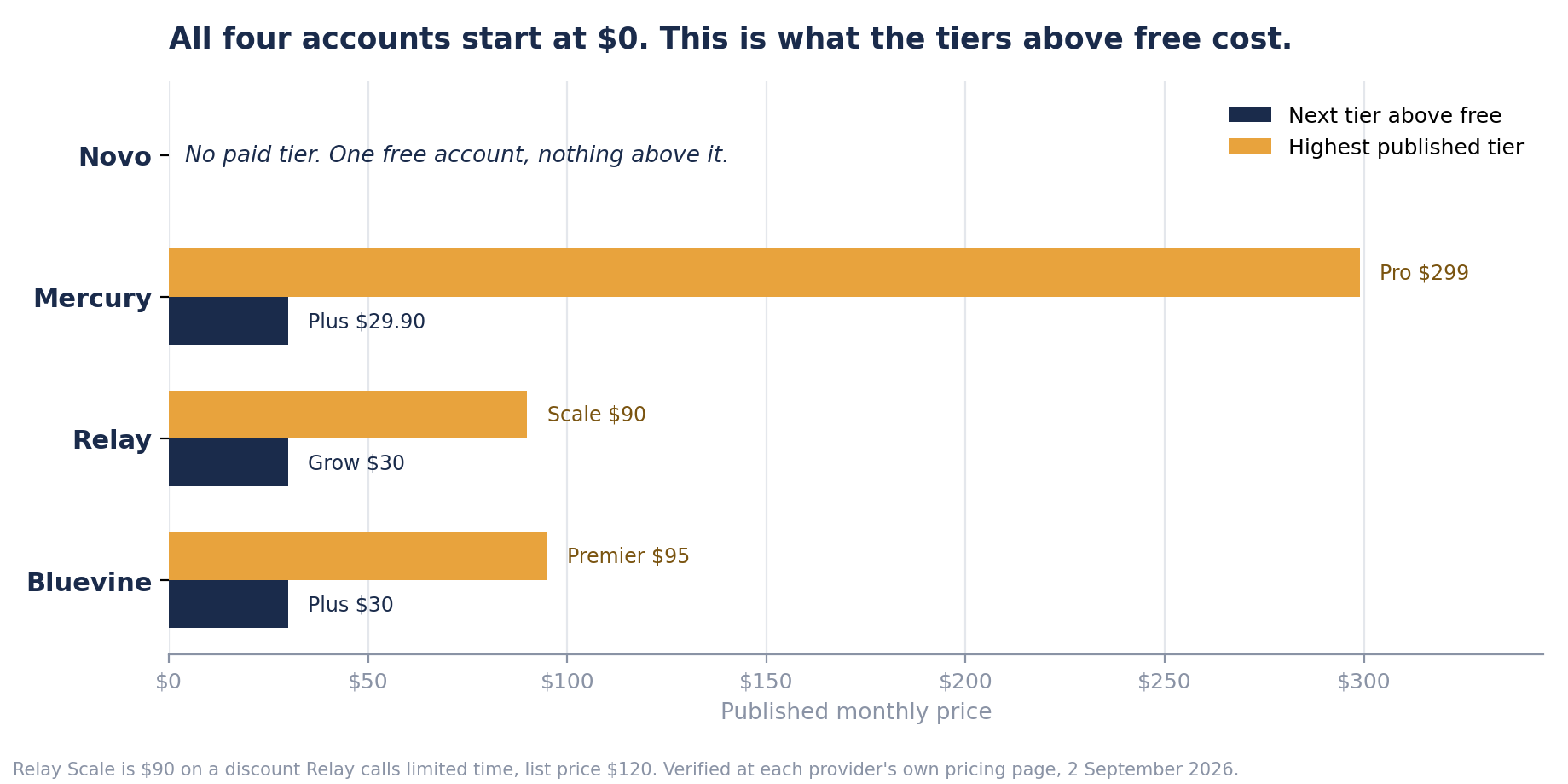
All four start at $0, so the real question is what sits above free. Only Novo has nothing above it. Mercury, Relay and Bluevine all publish paid tiers. Mercury Pro is $299 a month, which buys a relationship manager and unlimited invoicing that almost no new LLC needs. The tier worth knowing about is the one directly above free, and on all three that sits at about $30.
One gap none of these fills. Daily cash businesses are not served well by any online account. Pair one of these with a local bank that has branches. Use the online account for everything else.
What to Avoid
Watch the monthly maintenance fee. Chase Business Complete Banking charges $15 a month and waives it in any month you hold a $2,000 minimum daily balance, take deposits through Chase QuickAccept, or spend on a Chase business credit card. The charge is monthly, so one quiet month costs $15, not a year of fees. Miss the bar every month and it is $180 a year. Branch banks price this way as a rule, so read the waiver conditions before you open anything.
Account closures are the other risk. Mercury, despite its fee structure, has documented cases of closing accounts with no warning and no explanation. Users on Reddit and Trustpilot report being locked out of funds for weeks. If your LLC needs fast access to every dollar, keep a backup account at a second institution. Never put all of your operating capital in one place, especially one with no branches.
Alternatives Worth Considering
Sometimes none of the four is the answer. The clearest case is cash. All 4 picks here are online only, so if your LLC takes physical currency most weeks, no amount of free features will serve you. Do both. Open one of the four for everything else, and pair it with a bank that has a branch near you. The branch account takes the deposits. The online account does the rest.
We do not name a branch bank pick here, and that is deliberate. We rank only what we have put through the comparison above, and every account in it is one we can check against a published fee schedule. A branch bank is a local decision. The right one is usually whichever has a branch you can walk to and terms you have actually read.
Cost may be all you care about. If what you want is the cheapest account rather than the best fit, our guide to free business checking works the same question from the fee side, including what the free accounts still charge for wires, express ACH and cash.
Bookkeeping is the next job. If you would rather have AI categorize and reconcile transactions than do it by hand, our guide to AI bookkeeping for small business covers the tools that connect straight to your bank feeds.
Our Methodology
Four weighted criteria decide the ranking. Pricing and fee transparency carries 35%, features and account benefits 25%, ease of use including the mobile apps and onboarding 20%, and customer support quality the final 20%. Pricing came from each provider's own published fee schedule. We cross referenced Trustpilot, the BBB and Reddit for reliability signals.
No monthly fee came first. Free standard transfers and meaningful FDIC coverage counted next. Deal breakers weighed against a provider, and the two that moved rankings here were no cash deposits and documented patterns of sudden account closures.
Frequently Asked Questions
About the Author
Editor, StartupOwl
Eliot leads StartupOwl's state data research. He maintains the site's fifty state records of LLC filing fees, annual costs, processing times, and small business grant programs, checking each figure against the state office that publishes it and logging the date it was verified. Based in New Jersey, he has spent his working life in and around small businesses, and he writes for the founder who wants the real number rather than the advertised one. Every figure under his byline traces to a named source, and when a state proves a number wrong, the correction is published, not buried.
Was this article helpful?
Novo disclosures. Novo Platform Inc. is a fintech, not a bank. Banking services are provided by Middlesex Federal Savings, F.A., Member FDIC. Deposits are insured up to $250,000 through Middlesex Federal Savings. The Novo Business Credit Card is issued by Continental Bank. Cashback terms, 2 percent on eligible purchases with a checking balance of $5,000 or more, 1 percent below that. Eligibility for Novo products is subject to final Novo determination.
Mercury disclosures. Mercury is a fintech company, not an FDIC-insured bank. Banking services provided through Choice Financial Group and Column N.A., Members FDIC. FDIC deposit insurance covers the failure of an insured bank. Deposits in checking and savings accounts are FDIC-insured through Choice Financial Group and Column N.A. and their Sweep Program Network Banks. Certain conditions must be satisfied for pass-through FDIC insurance to apply.
Mercury Treasury. Mercury Treasury is offered by Mercury Advisory, LLC, an SEC-registered investment adviser ("Mercury Advisory"). This communication does not constitute an offer to sell or the solicitation of an offer to buy any security. All Brokerage and Clearing services are provided by, and securities are offered through Apex Clearing Corporation, an SEC-registered broker dealer and member FINRA/SIPC. Treasury accounts are not FDIC insured, are not bank deposits, and are not guaranteed by Choice Financial Group or Column N.A., and may lose value. Please review Mercury Advisory's ADV Wrap Fee Brochure for more detail. Mercury Advisory is a wholly-owned subsidiary of Mercury Technologies, Inc.
APY. Annual Percentage Yield (APY) is accurate as of 09/02/2026. This is a variable rate account. The interest rate and annual percentage yield may change at any time and without prior notice. Fees may reduce earnings.
Financial Disclaimer. This content is for informational purposes only and does not constitute financial, legal, or tax advice. Pricing and features are accurate as of September 2026 and may change. Consult a qualified professional for advice specific to your situation.
Sources & References
- Novo, No Fee Business Checking, $0 monthly fee and no minimum (verified 2026-09-02)
- Mercury, Pricing, free plan plus Plus at $29.90 and Pro at $299 (verified 2026-09-02)
- Mercury, Treasury eligibility and the $250,000 minimum (verified 2026-08-27)
- Relay, Plans and Pricing, Starter $0, Grow $30, Scale $90 on a limited time discount from $120 (verified 2026-09-02)
- Bluevine, Business Checking APY by plan, Standard 1.3% with conditions, Plus $30 at 1.75%, Premier $95 at 3.0% (verified 2026-09-02)
- FDIC, Deposit Insurance, at least $250,000 per depositor per insured bank (verified 2026-08-29)
Questions about Best Business Bank Accounts for LLCs
No comments yet. Ask the first question and a member of our team will answer.
Leave a comment