
Business Entity Types Explained
Your plain-English guide to every business structure, from sole proprietorships to nonprofits, with real costs, tax rules, and a scenario-based decision framework.

- LLC formation costs $35 to $500; the national average is $132.
- S Corp election saves about $3,650 at $80K profit on a $50K salary, more as profit grows.
- C Corps pay a flat 21% federal tax and face double taxation on dividends.
- Sole proprietorships require zero filings but offer zero liability protection.
Choosing a business entity type is the single most consequential tax and legal decision you will make as a founder. It determines how much you pay the IRS, whether your personal assets are at risk, and how easy it is to bring on partners or investors. Yet most founders pick a structure based on a blog post and a gut feeling.
This guide breaks down all 7 major entity types with specific filing costs, tax rules, and liability trade-offs so you can match the right structure to your actual situation. If you earn under $50K freelancing, you need a different answer than someone raising a seed round or launching a real estate portfolio.
Business Entity Types at a Glance
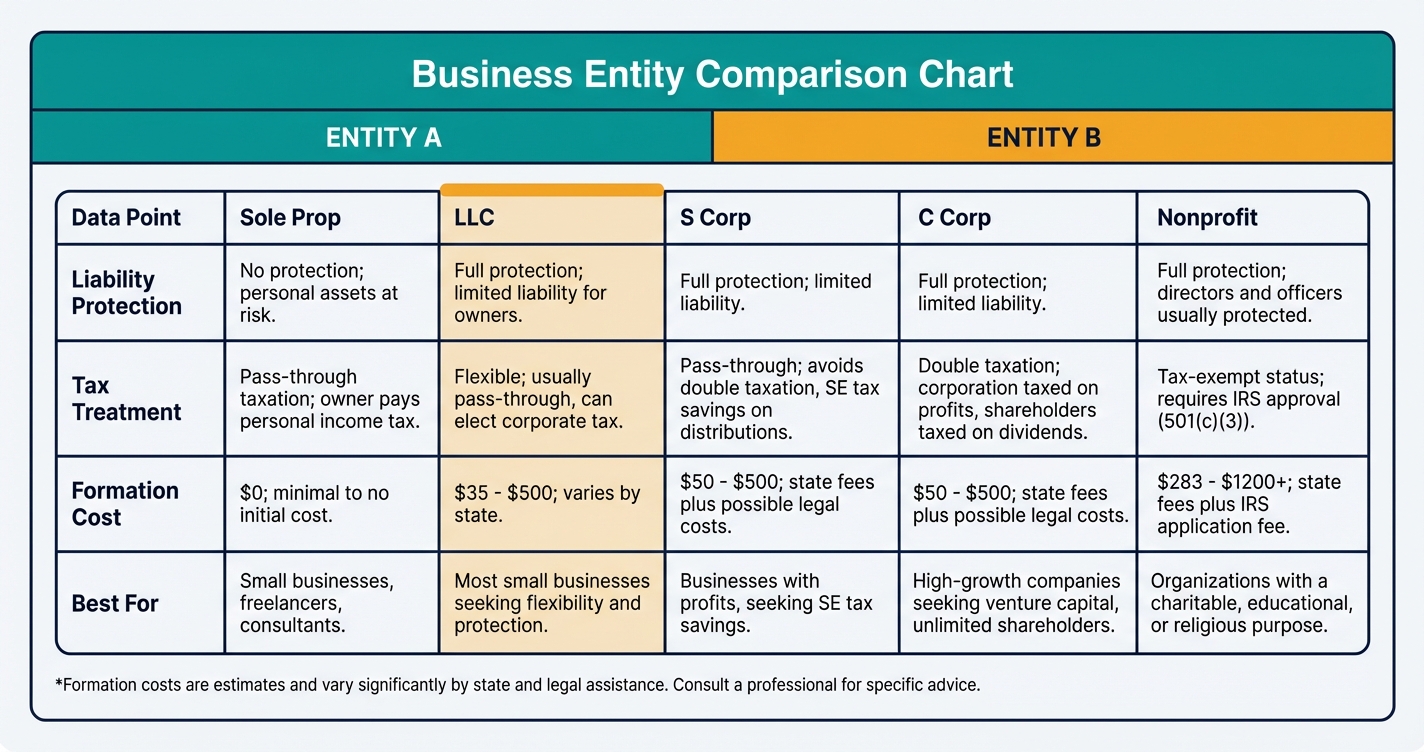
| Entity Type | Liability | Tax Treatment | Formation | Ownership | Best For | Cost |
|---|---|---|---|---|---|---|
| Sole Proprietorship | None. You are personally liable for all debts. | Pass-through. Report on Schedule C (Form 1040). | Zero paperwork. No state filing required. | One owner only. | Solo freelancers, side hustles, and testing a business idea. | $0 state filing; local license fees may apply. |
| General Partnership | None. Each partner is personally and jointly liable. | Pass-through. File Form 1065; partners get Schedule K-1. | Minimal. No state filing required in most states. | Two or more partners. No maximum. | Two or more co-founders sharing equal risk and management. | $0 to $100 depending on state and DBA filing. |
| Limited Partnership | Limited partners protected; general partners fully liable. | Pass-through. File Form 1065; partners get Schedule K-1. | Moderate. Must file Certificate of Limited Partnership. | At least one general and one limited partner. No maximum. | Real estate ventures and passive investor structures. | $70 to $300 state filing fee (varies by state). |
| LLC | Full protection. Members shielded from business debts. | Flexible. Default pass-through; can elect S Corp or C Corp. | Simple. File Articles of Organization with your state. | No limit on members. Individuals, entities, and foreigners allowed. | Most small businesses, consultants, and real estate investors. | $35 to $500 state filing fee; average $132. |
| S Corporation | Full protection. Shareholders shielded from corporate debts. | Pass-through. File Form 1120-S; shareholders get K-1. | Moderate. Incorporate, then file Form 2553 with IRS. | Max 100 shareholders. U.S. citizens/residents only. One stock class. | Profitable businesses ($80K+) wanting self-employment tax savings. | $50 to $500 state incorporation fee plus $0 IRS filing. |
| C Corporation | Full protection. Shareholders shielded from corporate debts. | Double taxation. 21% federal corporate rate plus shareholder-level tax on dividends. | High. Articles of Incorporation, bylaws, board, stock issuance. | No limits. Any number of shareholders, multiple stock classes. | VC-funded startups, public companies, and QSBS-eligible ventures. | $50 to $500 state incorporation fee. |
| Nonprofit | Full protection for directors and officers (with proper governance). | Tax-exempt under 501(c)(3) if approved by IRS. Must file Form 990. | High. State incorporation plus IRS Form 1023 or 1023-EZ. | No owners. Governed by a board of directors (min. 3 in most states). | Charitable, educational, or religious organizations. | $8 to $300 state fee plus $275 to $600 IRS application fee. |
Sole Proprietorship
A sole proprietorship is the default business structure in the United States. If you earn money from self-employment and have not filed formation documents with your state, you are already operating as a sole proprietor. There is no state registration required, no separate tax return to file, and no formation cost. If you are wondering how earnings differ by work status, The Own Boss Gap compares median earnings of employees and of self-employed people with and without a company in all fifty states.
You report all business income and expenses on Schedule C attached to your personal Form 1040. You also pay 15.3% self-employment tax on net earnings (12.4% Social Security up to the wage base plus 2.9% Medicare). Quarterly estimated tax payments are required if you expect to owe $1,000 or more.
The biggest downside is liability. You and the business are legally the same entity. If the business is sued or defaults on a debt, your personal home, car, and savings are all at risk. There is no legal separation between you and the business.

- Best if you are testing a business idea, freelancing under $30K/year, or running a casual side hustle.
- Upgrade when your income exceeds $30K to $50K annually, you sign contracts with clients, or you have personal assets worth protecting.
- When you are ready, forming an LLC is the natural next step. See our sole proprietorship vs LLC comparison for a detailed breakdown.
Partnership
A general partnership forms automatically when two or more people go into business together. Like a sole proprietorship, you do not need to file formation documents in most states. However, partnerships must file an annual Form 1065 (informational return) with the IRS and issue Schedule K-1s to each partner.
Each partner reports their share of income on their personal return and pays self-employment tax. Partners are also jointly and personally liable for all partnership debts and obligations. If your partner signs a bad deal, your personal assets are on the line too.
A limited partnership (LP) is a different structure that requires filing a Certificate of Limited Partnership with your state. Filing fees run from $70 in California to $200 in New York. LPs have at least one general partner (unlimited liability, manages the business) and one or more limited partners (liability capped at their investment, no management role). LPs are popular for real estate syndications, family investment funds, and venture capital.
- General partnerships are best for two co-equal founders with no outside investors and low risk tolerance (or limited assets).
- Limited partnerships work well for raising passive capital while keeping management control with a single general partner.
- If you want liability protection for all owners, an LLC is almost always the better choice. See our entity type overview for a full comparison.
Limited Liability Company (LLC)
The limited liability company (LLC) is the most popular filed entity type for new U.S. businesses, and for good reason. It combines the liability protection of a corporation with the tax simplicity of a partnership. You form an LLC by filing Articles of Organization (sometimes called a Certificate of Formation) with your state's Secretary of State.
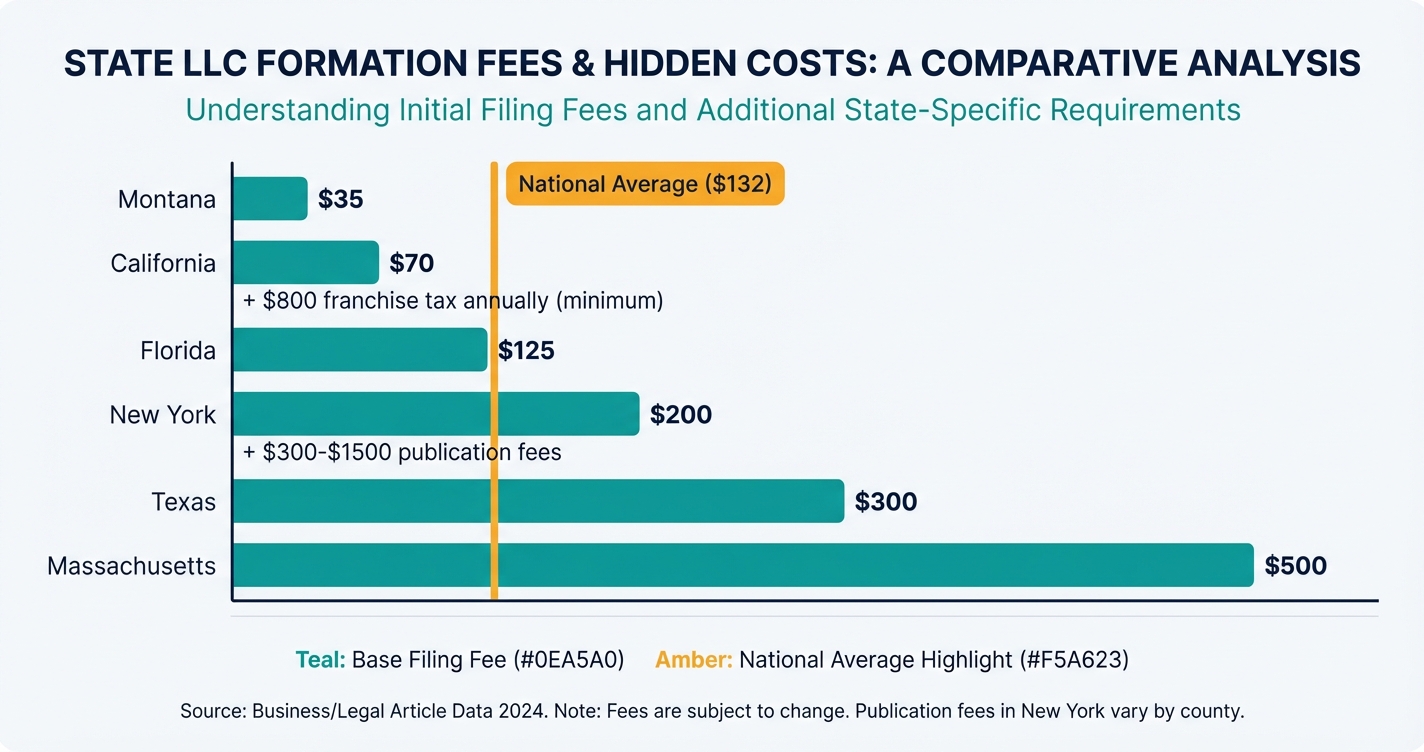
Formation costs range from $35 in Montana to $500 in Massachusetts, with the national average at about $132 as of 2026. Annual report fees average $91 per year. California is a notable outlier: the filing fee is just $70, but you owe an $800 annual franchise tax starting in your first year, even if your LLC earns zero revenue. Four states (Arizona, Missouri, New Mexico, Ohio) charge no annual LLC fees at all.
For federal tax purposes, the IRS treats a single-member LLC as a disregarded entity (taxed like a sole proprietorship on Schedule C). A multi-member LLC defaults to partnership taxation (Form 1065). You can also elect to be taxed as an S Corp (Form 2553) or a C Corp (Form 8832). This tax flexibility is the LLC's superpower.
If your net self-employment income exceeds $80,000 per year, electing S Corp taxation lets you split income between salary (subject to 15.3% self-employment tax) and distributions (not). For someone earning $100K, that split can save $5,000 to $15,000 annually.
- No ownership restrictions: individuals, other LLCs, corporations, trusts, and foreign nationals can all be members.
- Management flexibility: member-managed (all owners run the business) or manager-managed (hired or designated managers).
- Check our best LLC formation services to compare DIY vs. professional filing. Or explore the Series LLC if you need multiple asset-protected compartments under one umbrella.
S Corporation
An S Corporation is not a separate entity type. It is a federal tax election that an existing LLC or corporation makes by filing IRS Form 2553. S Corp status lets your business income pass through to your personal return (like an LLC) while also allowing you to reduce self-employment taxes by paying yourself a reasonable salary and taking additional profit as distributions.
The self-employment tax savings can be significant. If your business earns $120,000 and you pay yourself a $60,000 salary, you only owe the 15.3% payroll tax on that $60,000. The remaining $60,000 in distributions avoids Social Security and Medicare taxes entirely. That is roughly $7,775 in annual savings. Here is the gap. SE tax on the full $120,000 would be $16,955, and payroll tax on the $60,000 salary is $9,180.

To qualify, your business must meet strict IRS requirements:
- No more than 100 shareholders (family members can count as one).
- Shareholders must be U.S. citizens or resident aliens, certain trusts, or estates.
- Only one class of stock is permitted (voting vs. non-voting differences are allowed).
- Cannot be a bank, insurance company, or domestic international sales corporation.
The Form 2553 deadline is 2 months and 15 days after the start of the tax year (March 15 for calendar-year businesses). For new entities, the deadline is 2 months and 15 days from the formation date. Miss the deadline and you wait until the following tax year, unless you qualify for late election relief under Rev. Proc. 2013-30.
S Corp status adds compliance requirements: mandatory payroll, quarterly payroll tax deposits, Form 1120-S filing, and Schedule K-1 distribution to shareholders. Read our full guide on how to start an S Corp or compare it directly with a C Corp in our C Corp vs S Corp breakdown.
C Corporation
A C Corporation is the standard corporate structure and the default tax classification when you incorporate in any state. C Corps are separate legal entities from their owners, providing full personal liability protection. They file Form 1120 and pay a flat 21% federal corporate income tax rate on all net profits (unchanged since the 2017 Tax Cuts and Jobs Act and confirmed by the OBBBA signed July 4, 2025).
The primary downside is double taxation. The corporation pays 21% on its profits, and then shareholders pay personal income tax (up to 23.8% including the net investment income tax) when those profits are distributed as dividends. The combined effective rate can reach 36% to 40% on distributed earnings.

So why would you choose a C Corp? Three scenarios stand out:
- Raising venture capital. VCs invest through preferred stock, which requires multiple classes of stock. S Corps cannot do this. C Corps can.
- QSBS tax exclusion. Under Section 1202, qualifying C Corp stock held for 5+ years can exclude up to $15 million in capital gains from tax (expanded by the OBBBA in July 2025). That $15 million, and the partial exclusions at 3 and 4 years, apply to shares acquired after 4 July 2025. Older shares cap at $10 million. Our QSBS requirements guide covers every test.
- Going public. Public companies are structured as C Corps. If an IPO is on your roadmap, start here.
Formation costs mirror those of an S Corp (which is just a C Corp with a tax election): state incorporation fees range from $50 to $500. Delaware is the most popular incorporation state for C Corps due to its well-developed corporate law, though the $90 formation fee comes with a $300 annual franchise tax. Most small businesses are better off incorporating in their home state. For a detailed breakdown, read our C Corp vs S Corp comparison.
Nonprofit Organization
A nonprofit is a corporation organized for charitable, educational, religious, scientific, or literary purposes. It is formed at the state level by filing Articles of Incorporation (or a Certificate of Incorporation) with your Secretary of State. State filing fees range from $8 in Kentucky to over $200 in some states. California charges $115 for a public benefit corporation.
After incorporating, you apply for federal tax-exempt status with the IRS. The full Form 1023 costs $600 to file and takes 3 to 9 months to process. Small nonprofits that expect gross receipts under $50,000 and assets under $250,000 may qualify for the streamlined Form 1023-EZ, which costs $275 and processes faster.
Tax-exempt status under Section 501(c)(3) means the organization pays no federal income tax on mission-related activities. Donors can deduct contributions on their personal returns. However, nonprofits must file annual Form 990 returns, and unrelated business income is still taxable.

- Nonprofits have no owners. A board of directors (minimum 3 in most states) governs the organization. No one receives equity or dividends.
- Total startup costs (state filing + IRS application) typically range from $283 to $1,200 depending on your state and which IRS form you file.
- Ongoing annual costs include state corporate filings ($10 to $50/year) and potential charitable solicitation registration in each state where you fundraise.
- For the full step-by-step process, see our how to start a nonprofit guide.
The right entity type depends on four variables: your revenue, your risk exposure, your number of owners, and your growth plans. Here is a scenario-based framework.
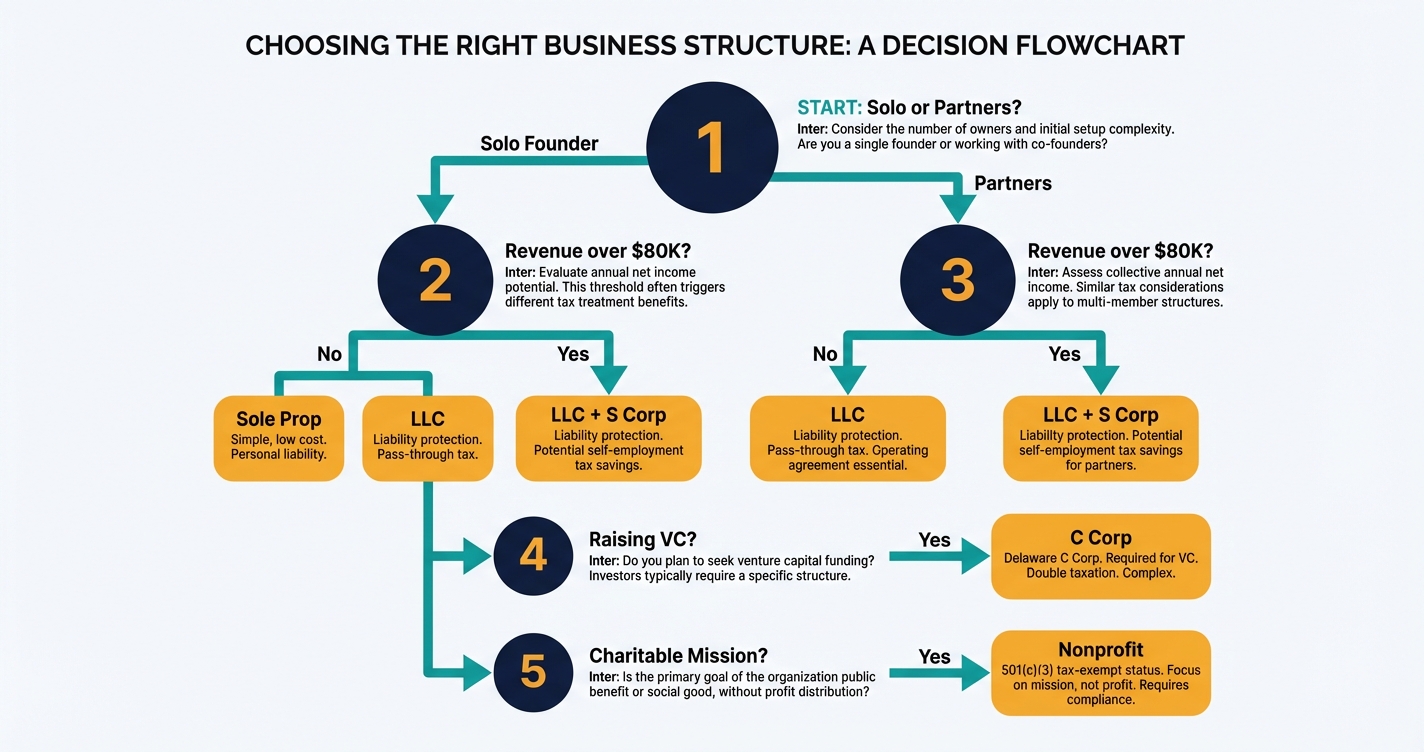
- If you are a solo freelancer earning under $50K/year with no employees, start as a sole proprietor. You can always form an LLC later. But if you have personal assets to protect (a home, savings above $25K), form an LLC now. The $50 to $200 filing fee is cheap insurance.
- If you are launching a service business or consulting firm with moderate risk, form an LLC in your home state. It gives you liability protection and pass-through taxation. Use our best LLC services guide to compare filing options.
- If your net profit exceeds $80K/year and you are the sole or primary owner, form an LLC and elect S Corp taxation by filing Form 2553. The payroll tax savings typically exceed the added compliance costs once you pass the $80K mark. Read our S Corp formation guide.
- If you plan to raise venture capital or issue stock options to employees, form a Delaware C Corporation. VCs require preferred stock, which S Corps cannot issue. The QSBS exclusion (up to $15M in tax-free gains) is only available to C Corp shareholders.
- If you are investing in real estate with passive investors, consider an LLC (or a Series LLC for multi-property portfolios). A limited partnership works too, but the general partner has unlimited personal liability unless you use an LLC as the general partner entity.
- If you are co-founding a business with an equal partner, form a multi-member LLC. Avoid a general partnership because both partners face unlimited personal liability. The LLC operating agreement replaces the partnership agreement and adds asset protection.
- If your mission is charitable, educational, or religious, incorporate as a nonprofit and file for 501(c)(3) status. Budget $500 to $1,200 for combined state and IRS fees, plus 3 to 9 months for IRS processing.
Regardless of which entity you choose, you will also need to register your business name, open a business bank account, and appoint a registered agent (for LLCs and corporations). If you operate under a trade name different from your legal entity name, file a DBA.
Your business structure is not permanent. As your revenue grows, your ownership changes, or your goals shift, you can (and should) convert to a more appropriate entity. Here are the most common transitions.
- Sole proprietorship to LLC. The most common conversion. File Articles of Organization with your state ($35 to $500), get a new EIN from the IRS (free, online, same day), and open a separate business bank account. The process takes 1 to 3 weeks in most states. See our sole proprietorship vs LLC comparison.
- LLC to S Corp (tax election). You keep your LLC legal structure and file Form 2553 with the IRS. There is no IRS filing fee. The deadline is March 15 for calendar-year businesses. You must set up payroll and pay yourself a reasonable salary going forward. See how to start an S Corp.
- LLC to C Corp (tax election). File Form 8832 with the IRS. This is typically done when preparing for a VC funding round or when you want to issue stock options.
- C Corp to S Corp. File Form 2553 within 2 months and 15 days of the tax year you want the election to take effect. All shareholders must consent.
If you need to shut down an entity entirely, follow the formal dissolution process to avoid ongoing fees and tax obligations. Our LLC dissolution guide walks through the steps. Changing your entity's legal name (but keeping the same structure) is a separate process covered in our LLC name change guide.
If your LLC operates in a state other than where it was formed, you will need a foreign LLC registration. And every LLC or corporation should stay current on annual report filings to maintain good standing with the state.
Structure also changes when ownership does. A setup chosen for one person running one business is rarely the right one for two generations holding it together, and our guide to the family business succession plan covers what to fix in the operating agreement before an interest changes hands.
The most common change of all is an LLC becoming a C corporation, usually because an investor or a buyer asked for it. That one is a state filing with its own fee, and our guide to an LLC to C corp conversion gives the costs, the tax rules and the EIN answer.
Frequently Asked Questions
The sole proprietorship is the most common structure in the U.S. because it requires no state filing. If you earn any self-employment income and do not form another entity, you are automatically a sole proprietor. However, the LLC is the most popular filed entity type for new businesses.
LLC filing fees range from $35 in Montana to $500 in Massachusetts. The national average is about $132 as of 2026. You will also pay annual report fees in most states, averaging $91 per year. California adds an $800 annual franchise tax starting in year one.
An LLC is a state-level legal structure. An S Corp is a federal tax election (IRS Form 2553). You can form an LLC and elect S Corp taxation to get liability protection plus self-employment tax savings. The S Corp election requires you to pay yourself a reasonable salary and limits you to 100 shareholders.
No. You can freelance as a sole proprietor with no state filing at all. You report income on Schedule C of your personal tax return. But you have zero liability protection. If your annual income exceeds $30,000 to $50,000, forming an LLC is worth the $50 to $200 filing fee for asset protection alone.
The federal C Corp tax rate is a flat 21% on all taxable income, set by the Tax Cuts and Jobs Act of 2017. This rate remained unchanged under the One Big Beautiful Bill Act signed July 4, 2026. State corporate taxes add another 0% to 11.5% depending on where you operate.
Yes. The most common conversions are sole proprietorship to LLC and LLC to S Corp (via Form 2553). Converting from LLC to C Corp requires filing Form 8832 with the IRS. The process typically costs $25 to $300 in state fees plus potential tax consequences, so consult a CPA first.
For calendar-year businesses, the deadline is March 15 of the year you want S Corp status to take effect. New entities have 2 months and 15 days from their formation date. If you miss the deadline, you can request late election relief under Rev. Proc. 2013-30 for up to 3 years and 75 days.
As of March 2026, FinCEN exempted all U.S.-created entities from BOI reporting under an interim final rule. Only foreign entities registered to do business in the U.S. must file. This rule may change, so check FinCEN.gov for updates before your next annual review.
The Delaware C Corporation is the standard for VC-backed startups. It allows unlimited shareholders, multiple classes of stock (common and preferred), and qualifies for the Qualified Small Business Stock (QSBS) exclusion that can eliminate up to $15 million in capital gains tax on a stock sale.
You incorporate as a nonprofit corporation in your state (filing fee: $8 to $300), then apply for 501(c)(3) tax-exempt status with the IRS using Form 1023 ($600) or Form 1023-EZ ($275). The IRS typically takes 3 to 9 months to process a full Form 1023 application. See our nonprofit formation guide for the step-by-step process.
Sources & References
About the Author
Editor, StartupOwl
Eliot leads StartupOwl's state data research. He maintains the site's fifty state records of LLC filing fees, annual costs, processing times, and small business grant programs, checking each figure against the state office that publishes it and logging the date it was verified. Based in New Jersey, he has spent his working life in and around small businesses, and he writes for the founder who wants the real number rather than the advertised one. Every figure under his byline traces to a named source, and when a state proves a number wrong, the correction is published, not buried.
Was this article helpful?
Questions about this guide
No comments yet. Ask the first question and a member of our team will answer.
Leave a comment