
Foreign LLC Registration
How to register your LLC as a foreign entity in another state, with exact filing fees, timelines, and state-by-state requirements.

In This Article
- Foreign LLC filing fees range from $70 (California) to $750 (Texas).
- Registration requires a Certificate of Good Standing plus a local registered agent.
- New York adds $500 to $1,500+ in mandatory newspaper publication costs.
- Operating without registration risks court access denial and retroactive fines.
6
Total Steps
$150–$1,500
Est. Total Cost
1 to 6 weeks depending on state and processing method
Timeline
Moderate
DIY Difficulty
If your LLC does business in a state other than where it was formed, that state considers you a "foreign" LLC. Foreign here does not mean international. It simply means your LLC was created in a different state. If you are a non US person who owns a US LLC, that is a different subject entirely and it carries its own IRS reporting, see Form 5472 for foreign owned US LLCs. Every state requires you to register before transacting business there, and the penalties for skipping this step range from court access denial to retroactive fines multiplied by each year you operated without registration.
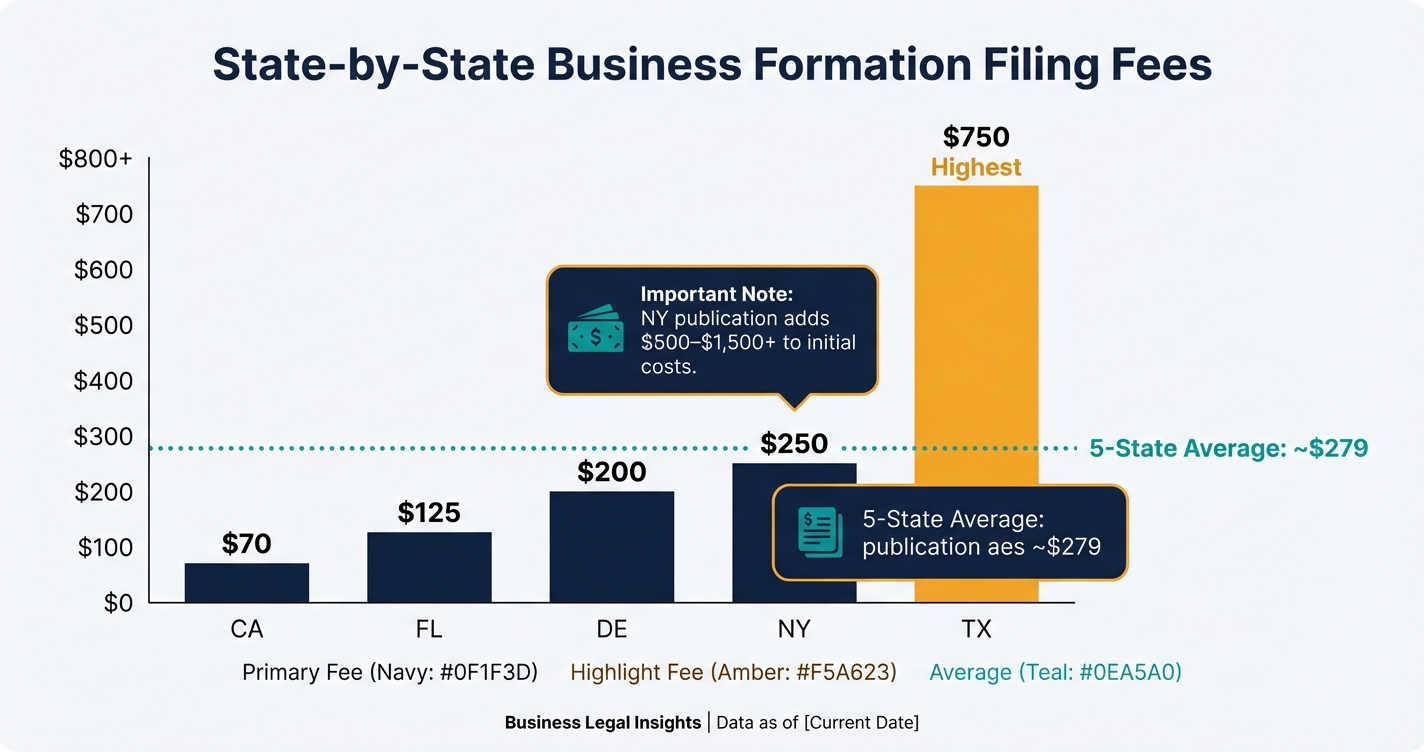
Filing fees vary wildly: Florida charges $125, California charges $70 (plus an $800 annual franchise tax), and Texas charges a steep $750. This guide walks you through every step, with exact costs and timelines for the five highest-traffic states.
This is also the cost most people miss when they read that they should form in Wyoming or Delaware. Our Wyoming vs Delaware LLC comparison works through what the second state adds over five years.
Before you file a single form, gather these items. Missing any one of them will delay your registration or get your application rejected.
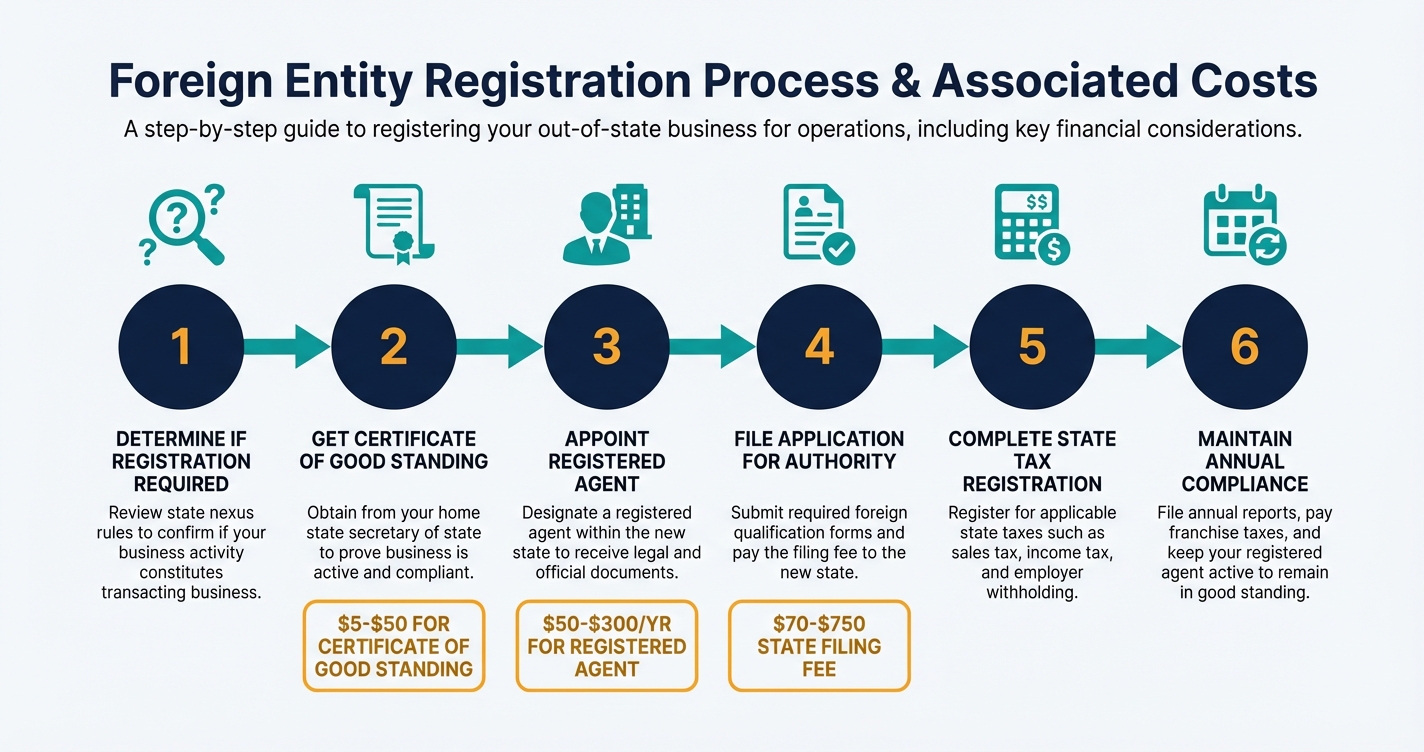
Pre-filing checklist:
- Your LLC's full legal name (exactly as it appears in your home state's records)
- Your LLC's state of formation and formation date
- Your LLC's EIN (you will not need a new one)
- A Certificate of Good Standing from your home state, which your own state may issue under another name such as Certificate of Existence or Certificate of Status (check the target state's freshness requirement)
- A registered agent with a physical street address in the target state
- The name and address of the office in your home state that maintains your LLC's formation records
- A credit card, check, or money order for the filing fee
- Your LLC's principal office address
If your LLC was formed in one state and you are expanding operations, you will also want to review our complete guide to business entity types to confirm that a foreign LLC registration (rather than forming a new entity) is the right move. For LLC owners considering an entity change, see our how to start an S Corp guide or sole proprietorship vs LLC comparison.
Step-by-Step Process
- 1
Determine Whether You Need to Register
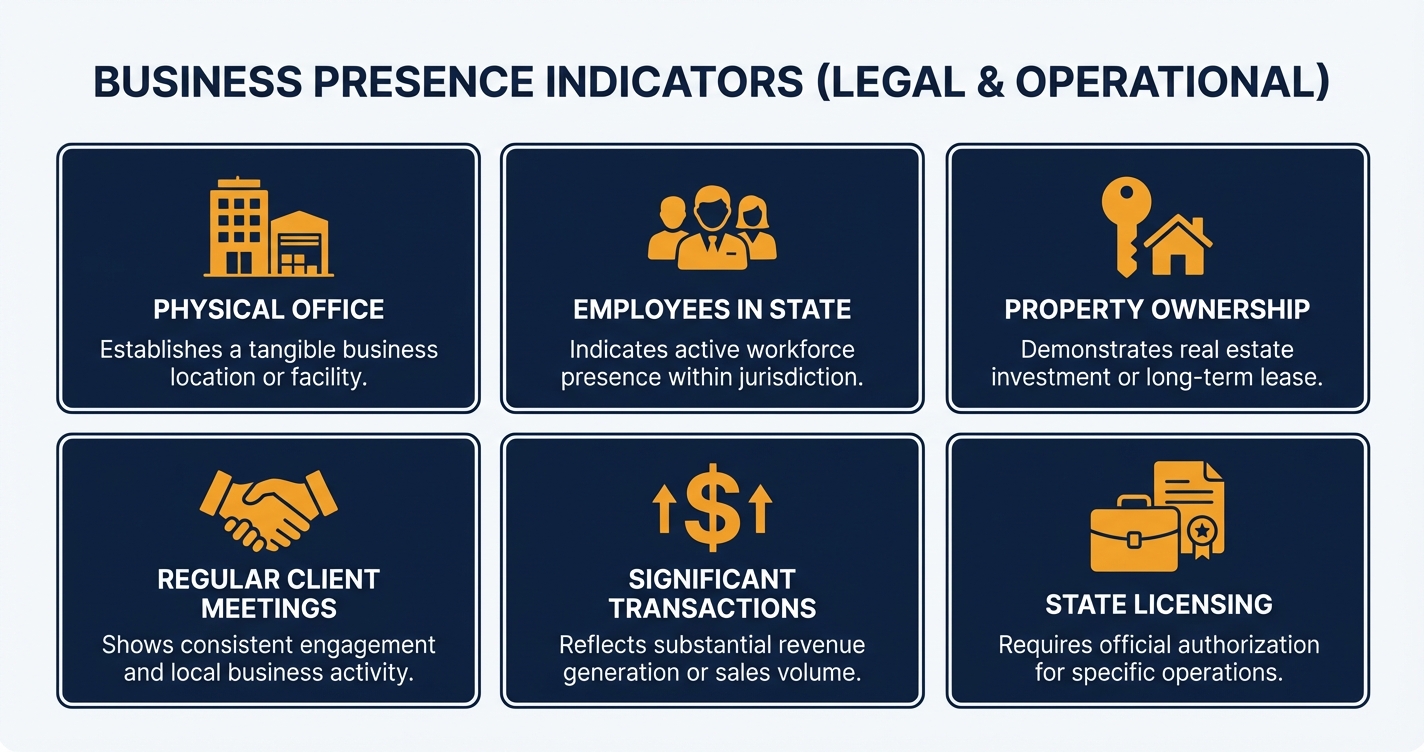
Not every out-of-state activity requires foreign LLC registration. You need to register only if you are "transacting business" (or "doing business") in the new state. Common triggers include maintaining a physical office, hiring employees, owning or leasing real property, or conducting repeated and significant transactions.
Activities that typically do not trigger registration include:
- Selling products online to customers in the state (without a physical presence)
- Using independent contractors (not employees) in the state
- Holding bank accounts in the state
- Conducting a single isolated transaction
- Engaging in interstate commerce that passes through the state
Each state defines "doing business" differently. Texas lists activities that do not constitute transacting business in BOC § 9.251 but does not formally define the term. California uses the standard of "entering into repeated and successive transactions" per California Corporations Code § 17708.03. If you are unsure, consult a business attorney in the target state.
$01-3 days for research No filing required at this step. Review the target state's Secretary of State website for their 'doing business' guidance.Common Mistakes
- Assuming online-only sales require registration (they usually do not unless you have physical presence or employees in the state)
- Waiting until a lawsuit arises to register (by then you cannot sue in that state's courts until you become compliant)
- Ignoring the requirement because the business is small (penalties apply regardless of company size or revenue)
- 2
Obtain a Certificate of Good Standing from Your Home State
Almost every state requires you to submit a Certificate of Good Standing (also called a Certificate of Existence or Certificate of Status) from your LLC's home state. This document proves your LLC has filed all required reports and paid all fees in its state of formation.
Costs and processing times vary widely. Wyoming and Colorado issue certificates for free with instant online downloads. California charges $5 but requires a mail or in-person request that takes about 4 weeks. Delaware charges $50 and processes by mail in 2 to 3 weeks. You can typically request certificates from your home state's Secretary of State office.
Pay attention to freshness requirements. Different states accept certificates of different ages:
- 30 days: Arkansas, D.C., Michigan, New Jersey, Vermont, Wyoming
- 60 days: Arizona, Hawaii, Illinois (LLCs), Indiana, Oregon
- 90 days: Connecticut, Florida, Georgia, Idaho, Iowa, Kansas, Massachusetts
- 6 months: California, Delaware, Mississippi, Montana, North Carolina
- 1 year: New York
$0-$50 (varies by home state)Instant to 4 weeks depending on home state Your home state's Secretary of State or Division of Corporations websiteCommon Mistakes
- Ordering the certificate too early so it expires before the target state processes your application
- Discovering your LLC is not in good standing because of a missed annual report or unpaid franchise tax (fix this first before requesting the certificate)
- 3
Appoint a Registered Agent in the New State
Every state requires your foreign LLC to have a registered agent with a physical street address (not a PO Box) in that state. The agent accepts legal documents (lawsuits, subpoenas, state correspondence) on behalf of your LLC during normal business hours.
You have three options:
- Be your own registered agent if you have a physical address in the state and can be available during business hours ($0)
- Appoint a trusted person who lives or works in the state ($0, but they take on a legal responsibility)
- Hire a commercial registered agent service ($50 to $300/year). Compare options in our best registered agent services guide.
A commercial service is the safest option if you do not live in the target state. It guarantees someone is always available during business hours to accept service of process. Missing a legal notice can result in a default judgment against your LLC.
$0-$300/year (commercial agent services typically $50-$300/year)Same day No state filing at this step. You will list the registered agent on your Application for Authority.Common Mistakes
- Using a PO Box address for your registered agent (states require a physical street address)
- Naming yourself as the registered agent when you do not actually have a physical address in the state or cannot be available during business hours
- 4
Check Name Availability in the New State
Your LLC's legal name must be distinguishable from other business names on file in the new state. If your name is already taken, you have two options: reserve an available name variation, or adopt a fictitious (DBA) name for use in that state only. Your LLC still keeps its original name in your home state.
Here's how name searches work in the top five states:
- California: Free online search at bizfileonline.sos.ca.gov
- Texas: Search via SOSPortal ($1 per search)
- Florida: Free search at Sunbiz
- New York: Name availability inquiry for $5 per name through the Department of State
- Delaware: Free search at Delaware Division of Corporations
If your name is unavailable, consider filing under a fictitious name in the new state. Your home-state LLC name stays the same. Check our DBA filing guide for more on using a fictitious name, and see our business name registration guide for naming rules.
$0-$5 for name search; $25-$75 for optional name reservationSame day for online searches Target state's Secretary of State or Division of Corporations websiteCommon Mistakes
- Assuming your home-state LLC name is automatically available in every other state (it is not; another business may already use that name)
- Forgetting to include 'LLC' or 'Limited Liability Company' in the name as required by the new state's naming rules
- 5
File the Application for Authority with the New State
This is the core filing. The form name varies by state (Application for Authority, Certificate of Registration, Application for Registration), but the content is similar. You will provide your LLC's legal name, state of formation, registered agent details, principal address, and the date you began (or will begin) transacting business in the new state.
Here are the filing fees and timelines for the five biggest states:
- California: $70 (Form LLC-5 filed with the Secretary of State). Standard processing takes 2 to 4 weeks. In-person drop-off adds a $15 handling fee.
- Texas: $750 (Form 304 filed via SOSPortal). Online filings process in 2 to 3 business days. Paper filings take 5 to 10 days. Credit card payments add a $0.25 plus 2.25% convenience fee.
- Florida: $125 (filed at Sunbiz). Processing takes 2 to 5 business days online.
- New York: $250 (Application for Authority filed by mail or in person with the Department of State). Online filing is not available. Standard processing takes 3 to 4 weeks. Expedited options: $25 for 24-hour, $75 for same day, $150 for 2-hour.
- Delaware: $200 (Certificate of Registration filed with the Division of Corporations). Standard processing takes 10 to 15 business days. Priority 2-hour service costs $500; priority 1-hour service costs $1,000.
Attach your Certificate of Good Standing and any required supplemental documents (like the name of the official who maintains LLC records in your home state). Double-check that your registered agent has accepted the appointment in writing, as some states require a signed consent on the form.
$70-$750 (state filing fee, varies by state)2 business days to 4 weeks depending on state and filing method Target state's Secretary of State or Division of Corporations (see URLs above for each state)Common Mistakes
- In New York, forgetting that online filing is not available for foreign LLC applications (you must file by mail, fax, or in person)
- In Texas, not budgeting for the $0.25 plus 2.25% credit card processing fee on top of the $750 filing fee (bringing the real cost to about $767)
- Filing an expired Certificate of Good Standing that does not meet the target state's freshness requirement
- 6
Complete State-Specific Post-Filing Requirements
Several states impose additional obligations after your application is approved. The biggest one is New York's publication requirement.
New York publication requirement: Within 120 days of filing your Application for Authority, you must publish a notice in two newspapers (one daily, one weekly) in the county where your LLC's office is located. The notice runs once a week for six consecutive weeks. The county clerk designates which newspapers qualify. Publication costs range from $500 to $1,500+ depending on the county (Manhattan is the most expensive). After publication, file a Certificate of Publication with the Department of State for a $50 fee.
Other common post-filing tasks across all states:
- Register for state taxes: California charges a mandatory $800/year franchise tax starting in year one, even with zero revenue. Texas requires annual franchise tax reports by May 15 (though most LLCs earning under $2.65 million owe no tax). Florida and Delaware require annual reports ($138.75 and $300, respectively).
- Obtain business licenses: Many cities and counties require local business permits. Check with the target state and municipality.
- Open a business bank account in the new state if needed. See our best business bank accounts comparison.
- File annual reports: Most states require foreign LLCs to file annual or biennial reports. See our LLC annual report guide for deadlines and fees.
$0-$1,500+ (NY publication $500-$1,500+; CA franchise tax $800/year; other states vary)Ongoing (NY publication takes 6+ weeks; annual reports are due yearly) Varies by state. In New York, file the Certificate of Publication with the Department of State. For tax registration, contact the state's Department of Revenue or Comptroller.Common Mistakes
- In New York, missing the 120-day publication deadline (this can result in suspension of your LLC's authority to do business)
- In California, being surprised by the $800 annual franchise tax that applies even if your LLC earns zero revenue in the state
- Forgetting to file annual reports in the new state (failure to file can lead to administrative revocation of your foreign registration)
The total cost of registering a foreign LLC depends on three factors: which state you are registering in, whether you use expedited processing, and whether you hire a formation service or DIY it.
Cheapest scenario: You are registering a California foreign LLC, already have a Certificate of Good Standing, and serve as your own registered agent. Total cost: $70 for the state filing fee. But remember, California then charges an $800/year franchise tax starting in year one.
Most expensive common scenario: You are registering in New York, need a registered agent service, and must complete the publication requirement in Manhattan. Total first-year cost: $250 (filing fee) + $1,500 (publication) + $50 (Certificate of Publication) + $300 (registered agent) = roughly $2,100.
DIY vs. formation service: Using a service like those in our best LLC formation services guide typically costs $39 to $300+ on top of state fees. The benefit is convenience and error reduction, which matters most in high-fee states like Texas where a rejected $750 application is costly. If you are comfortable with government forms, DIY saves that service fee entirely.
| Item | Cost Range | Notes |
|---|---|---|
| Certificate of Good Standing (home state) | $0-$50 | Free in Wyoming and Colorado; $5 in California; $50 in Delaware. Processing from instant to 4 weeks. |
| Name search / reservation (optional) | $0-$75 | Free online search in most states. Name reservation is optional ($25-$75). |
| State filing fee (Application for Authority) | $70-$750 | CA $70, FL $125, DE $200, NY $250, TX $750. One-time fee. |
| Registered agent service (annual) | $50-$300/year | Required in every state. Can be $0 if you serve as your own agent with a physical address. |
| New York publication requirement | $500-$1,500+ | Required only in New York. Costs vary by county; Albany is cheapest, Manhattan most expensive. |
| NY Certificate of Publication filing fee | $50 | Required after completing the 6-week publication in New York. |
| Expedited processing (optional) | $25-$1,000 | NY: $25 (24hr), $75 (same day), $150 (2hr). DE: $500 (2hr), $1,000 (1hr). TX: $25. |
| Annual report / franchise tax (ongoing) | $0-$800/year | CA $800/yr franchise tax. DE $300/yr. FL $138.75/yr. TX no annual report fee (franchise tax only if revenue exceeds $2.65M). |
| Formation service fee (if using a service) | $39-$300+ | Optional. DIY is free beyond state fees. Services handle paperwork and filing. |
State rules differ enough that a one-size-fits-all approach will get you in trouble. Here are the critical differences for the five highest-traffic states.
California
- Filing fee: $70 (Form LLC-5)
- Processing: 2 to 4 weeks by mail; $15 extra for in-person drop-off
- Annual obligations: $800/year franchise tax (even with zero revenue) + $25 Statement of Information every 2 years
- Certificate of Good Standing must be dated within 6 months
- California defines "transacting intrastate business" as entering into "repeated and successive transactions" in the state
Texas
- Filing fee: $750 (Form 304 via SOSPortal)
- Processing: 2 to 3 business days online; 5 to 10 days by mail
- Late penalty: $750 per year of delinquency (calculated from when you first transacted business in Texas)
- 90-day grace period before late fees apply
- Annual franchise tax report due May 15 (no tax owed if revenue is under $2.65 million)
- Series LLCs can register using Form 313
New York
- Filing fee: $250 (Application for Authority, mail only)
- Processing: 3 to 4 weeks standard; $25 (24hr), $75 (same day), $150 (2hr) expedited
- Publication requirement: Must publish in 2 newspapers for 6 weeks within 120 days of filing ($500 to $1,500+)
- Certificate of Existence must be dated within 1 year
- Online filing is not available for foreign LLC registrations
Florida
- Filing fee: $125 (filed via Sunbiz)
- Processing: 2 to 5 business days
- Annual report: $138.75 due by May 1 each year. Late fee is $400 (no waiver available).
- Certificate of Good Standing must be dated within 90 days
- No state income tax for LLCs
Delaware
- Filing fee: $200 (Certificate of Registration)
- Processing: 10 to 15 business days standard; 2-hour priority ($500), 1-hour priority ($1,000)
- Annual tax: $300 due June 1 (late penalty of $200 + 1.5% monthly interest)
- Certificate of Good Standing must be dated within 6 months
For state-specific LLC formation details, check our state guides like LLC requirements in California, LLC requirements in Texas, or LLC requirements in New York.
Your total timeline depends on three bottlenecks: getting the Certificate of Good Standing, the target state's processing time, and any post-filing requirements like New York's publication.
Fastest path (Texas or Florida):
- Day 1: Order Certificate of Good Standing from home state (instant in states like Wyoming)
- Day 1: File Application for Registration online
- Day 3 to 5: Receive Certificate of Authority
- Total: 3 to 5 business days
Slowest path (New York with California home state):
- Week 1 to 4: Wait for California Certificate of Good Standing (4-week processing by mail)
- Week 5: Mail Application for Authority to NY Department of State
- Week 8 to 9: Receive approval (3 to 4 week processing)
- Week 9 to 15: Complete 6-week publication requirement
- Week 15: File Certificate of Publication
- Total: 3 to 4 months
Expedited options worth considering:
- New York: Pay $75 extra for same-day processing of your Application for Authority
- Delaware: Pay $500 for 2-hour priority processing
- Texas: Pay $25 for expedited processing
- Many home states offer expedited Certificates of Good Standing for an additional $25 to $100
If you need to operate in the new state immediately, start the Certificate of Good Standing request first. It is the most common bottleneck. Plan for the worst-case timeline and work backward from your target launch date.
These are the errors that cost LLC owners the most time, money, and legal exposure when registering as a foreign entity.
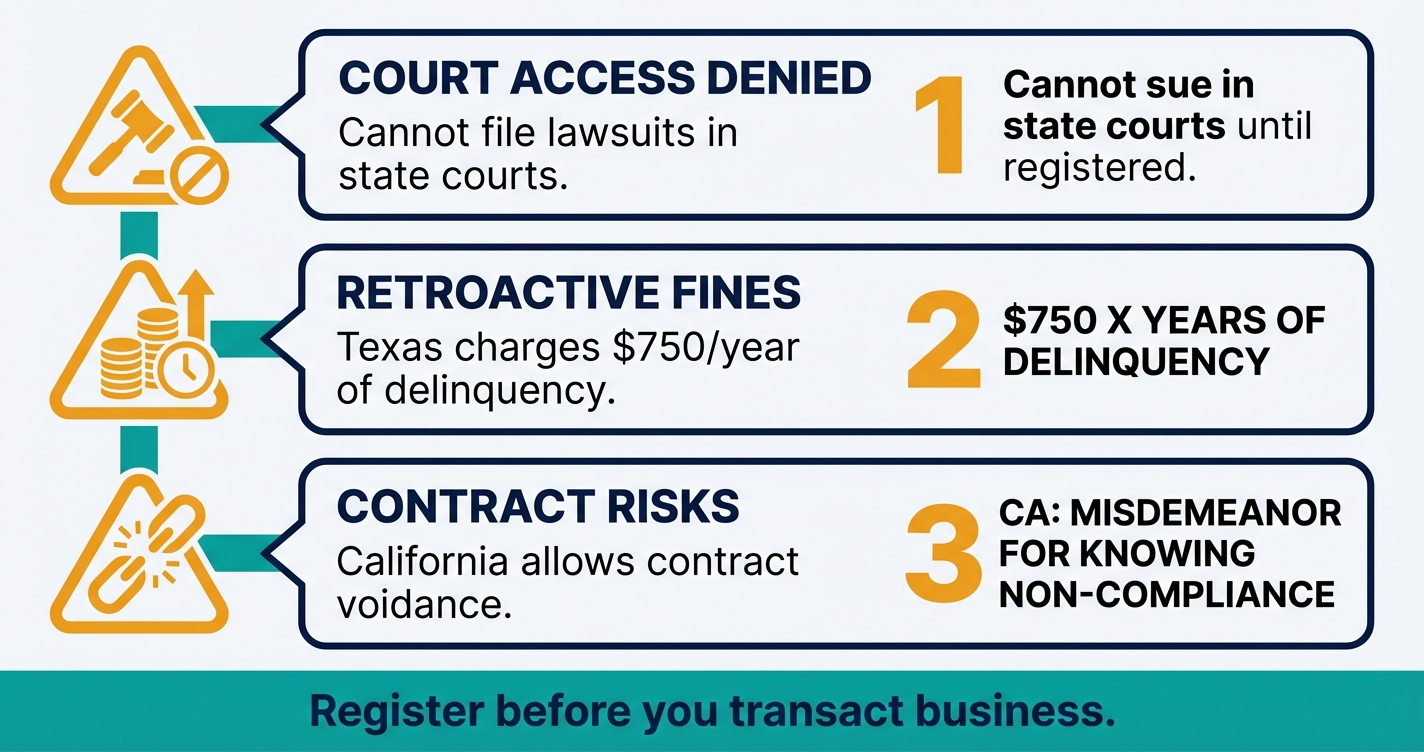
1. Operating without registering and racking up late fees. Texas charges a late fee of $750 for each full or partial year you transacted business without registration. An LLC that operated in Texas for 3 years before registering would owe $2,250 in late fees on top of the $750 registration fee. Total: $3,000. The 90-day grace period is your only buffer.
2. Losing the right to sue in state courts. Most states bar unregistered foreign LLCs from filing lawsuits. If a client in New York owes your LLC $50,000 and you are not registered there, you cannot bring suit until you become compliant. You can still be sued, however.
3. Confusing "foreign LLC" with international LLC. "Foreign" in this context means out-of-state, not out-of-country. A Wyoming LLC doing business in Florida is a foreign LLC in Florida. This causes confusion when reading state filing instructions.
4. Ignoring annual compliance in the new state. Registration is not a one-time event. You must file annual reports, pay franchise taxes, and maintain your registered agent. Failure to comply can result in administrative revocation. Florida charges a $400 late fee for annual reports filed after May 1, and will administratively dissolve your LLC by the third Friday in September if you still have not filed.
5. Not budgeting for New York's publication requirement. Many LLC owners budget $250 for the New York filing fee and are shocked to discover the mandatory newspaper publication costs an additional $500 to $1,500+. Using Albany County for your LLC office address is the cheapest publication option.
6. Forgetting California's $800 franchise tax. Registering a foreign LLC in California triggers the $800/year minimum franchise tax immediately, even if your LLC has zero revenue in the state. This catches many out-of-state LLCs off guard. If you later leave California, see our how to dissolve an LLC guide (or more precisely, you will file a cancellation of your foreign registration).
7. Filing the wrong form. States use different form names. In Texas it is Form 304 for LLCs (and Form 313 for series LLCs). In California it is Form LLC-5. In New York it is the Application for Authority. Filing the wrong form delays processing and you may lose your filing fee.
Foreign qualification is the right filing when you genuinely trade in both states. It is the wrong one when you have simply relocated, because you then pay two states for as long as the LLC exists. If the plan is to leave the old state behind entirely, read how to move an LLC to another state first, since 42 states let you move the company itself and keep the EIN.
Frequently Asked Questions
Sources & References
- Texas Secretary of State - Foreign or Out-of-State Entities
- New York Department of State - Application for Authority (Foreign LLCs)
- California Secretary of State - Application to Register a Foreign LLC (Form LLC-5)
- Delaware Division of Corporations - Foreign LLC Registration Certificate
- Florida Division of Corporations - LLC Forms and Fees
- IRS - Employer Identification Number (EIN)
- SBA - Choose a Business Structure
About the Author
Editor, StartupOwl
Eliot leads StartupOwl's state data research. He maintains the site's fifty state records of LLC filing fees, annual costs, processing times, and small business grant programs, checking each figure against the state office that publishes it and logging the date it was verified. Based in New Jersey, he has spent his working life in and around small businesses, and he writes for the founder who wants the real number rather than the advertised one. Every figure under his byline traces to a named source, and when a state proves a number wrong, the correction is published, not buried.
Was this article helpful?
Questions about this guide
No comments yet. Ask the first question and a member of our team will answer.
Leave a comment