
How to Start an S Corp
A complete step-by-step guide to forming an S Corp, including state filing fees, Form 2553 deadlines, and IRS eligibility rules for 2026.

In This Article
- S Corp election via Form 2553 is free; total formation cost runs $100 to $750.
- Form 2553 is due 2 months and 15 days after the tax year starts, so March 15, 2027 for a 2027 election.
- Tax savings begin around $50K to $60K in annual net profit.
- You must pay yourself a reasonable salary before taking distributions.
7
Total Steps
$100–$750
Est. Total Cost
2 to 6 weeks
Timeline
Moderate
DIY Difficulty
An S Corp is not a business entity you create from scratch. It is a federal tax election you layer onto an existing LLC or corporation by filing IRS Form 2553. That single form can save you $5,000 to $15,000 per year in self-employment taxes once your net profit exceeds roughly $60,000.
The process takes 6 to 10 steps depending on whether you already have an LLC or need to form one from scratch. Total cost ranges from $100 to $750 for DIY filers, and the entire setup takes 2 to 6 weeks in most states. This guide walks you through every step with real filing fees, deadlines, and the most common mistakes that delay your election.
Before you start the S Corp formation process, confirm that you meet the IRS eligibility requirements and gather the documents you will need. Missing even one requirement (like having an ineligible shareholder) will cause the IRS to deny your Form 2553 election outright.
S Corp Eligibility Checklist
- Domestic entity: Your LLC or corporation must be formed under U.S. state law.
- 100 or fewer shareholders: A married couple can count as one shareholder.
- Eligible shareholders only: U.S. individuals, certain trusts, estates, and 501(c)(3) nonprofits. No partnerships, corporations, or non-resident aliens.
- One class of stock: All shares must have identical rights to distributions and liquidation proceeds. Voting rights can differ.
- Not an ineligible corporation: Certain financial institutions, insurance companies, and DISCs cannot elect S Corp status.
Documents and Information You Will Need
- Your desired business name (confirmed available in your state)
- A physical business address (P.O. boxes are not accepted for registered agent)
- Social Security numbers or ITINs for all shareholders
- An understanding of each shareholder's ownership percentage
- A decision on whether to form an LLC or corporation (LLC is more common for small businesses)
You should also decide which state to form in. If you do business in only one state, form there. If you are considering Delaware or Wyoming for legal advantages, remember that you will still need to register as a foreign LLC in your home state, which adds a second set of fees. Consult our complete guide to business entity types if you are still deciding between an LLC, S Corp, or C Corp.
Step-by-Step Process
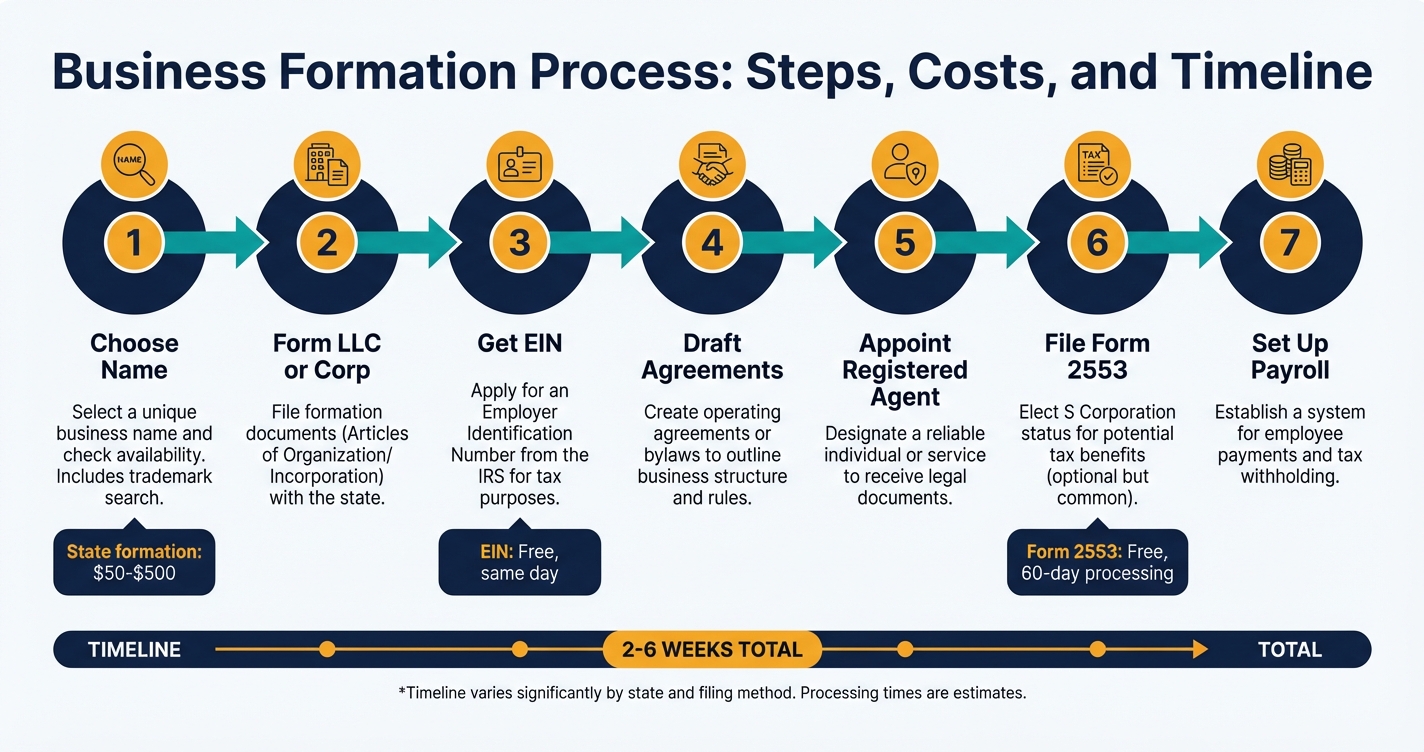
- 1
Choose and Reserve Your Business Name
Your S Corp needs a unique name that is not already taken in your state. Search your state's Secretary of State business name database to confirm availability. Most states let you search online for free.
If you are not ready to file formation documents immediately, you can reserve your name. Delaware charges $75 for a 120-day reservation. California and Texas do not offer formal name reservations for LLCs, so you will want to file your formation documents promptly. Your name must typically include "LLC," "Inc.," or "Corp." depending on the entity type you choose.
If you plan to operate under a different name, you will also need a DBA ("doing business as") filing. Check out our DBA filing guide and how to register a business name for details.
$0–$75Same day Your state's Secretary of State business name search tool (usually online)Common Mistakes
- Not searching the USPTO trademark database in addition to your state database, which can lead to infringement issues later
- Choosing a name too similar to an existing business, which causes your formation filing to be rejected
- 2
Form Your LLC or Corporation with the State
An S Corp is a tax election, not a standalone entity. You must first form either an LLC or a corporation with your state's Secretary of State. Most small business owners form an LLC and then elect S Corp taxation because the LLC offers simpler ongoing management.
Filing fees vary widely by state. Here are the most common states:
- Delaware: $110 for an LLC or $89+ for a corporation (DE Division of Corporations)
- California: $70 for an LLC, $100 for a corporation
- Texas: $300 for either entity type
- Florida: $125 for an LLC, $70 for a corporation
- New York: $200 for an LLC, $125 for a corporation (plus $600 to $2,000 in publication fees for LLCs)
You can file yourself or use one of the best LLC formation services to handle the paperwork. Standard processing takes 3 to 15 business days in most states; expedited options are available for an extra fee.
$50–$500 (state filing fee)3–15 business days (standard); same day to 3 days (expedited) Your state's Secretary of State office or websiteCommon Mistakes
- Filing Articles of Organization (LLC) when you meant to file Articles of Incorporation (corporation), or vice versa
- Forgetting to include a registered agent name and address on the formation document, which causes automatic rejection
- Not budgeting for New York's publication requirement, which adds $600 to $2,000 in surprise costs
- 3
Get Your EIN from the IRS
Your Employer Identification Number (EIN) is essentially a Social Security number for your business. You need it before you can file Form 2553, open a business bank account, or run payroll. The good news: it is completely free and takes about 5 minutes online.
Apply directly at IRS.gov/EIN. You will receive your EIN immediately upon completing the online application. The tool is available Monday through Friday, 7:00 a.m. to 10:00 p.m. Eastern Time. Print or save your EIN confirmation notice; you will need it for your Form 2553 filing.
If you cannot use the online tool (e.g., international applicants), you can fax Form SS-4 and receive your EIN within 4 business days, or mail it and wait about 4 weeks.
$0Same day (online); 4 business days (fax); 4 weeks (mail) IRS EIN online application at IRS.govCommon Mistakes
- Paying a third-party website $50 to $100 for an EIN when the IRS provides it for free
- Applying for an EIN before your LLC or corporation is officially formed with the state, which can delay the application
- 4
Draft Your Operating Agreement or Corporate Bylaws
If you formed an LLC, you need an operating agreement. If you formed a corporation, you need corporate bylaws. This document establishes ownership percentages, management structure, distribution rules, and voting rights.
For S Corp purposes, your agreement must confirm that you have only one class of stock (or, for LLCs, that all membership interests have identical distribution and liquidation rights). Voting rights can differ, but economic rights cannot. The IRS will deny your S Corp election if your operating agreement creates a second class of stock.
States like California, Delaware, Missouri, and New York legally require an operating agreement for LLCs. Even where it is optional, having one protects your liability shield. You can draft one yourself using a template (free to $100) or hire an attorney ($500 to $2,000).
$0–$2,0001–5 days Internal document (not filed with the state in most cases)Common Mistakes
- Creating distribution terms that give different economic rights to different members, which violates the one-class-of-stock rule and disqualifies your S Corp election
- Skipping the operating agreement entirely, which can weaken your liability protection in court
- 5
Appoint a Registered Agent
Every LLC and corporation must designate a registered agent in the state where it is formed. This person or company accepts legal documents, tax notices, and state correspondence on your behalf. You named one during Step 2, but you can change it anytime.
You can serve as your own registered agent for free if you have a physical address (not a P.O. box) in your formation state and are available during business hours. Most business owners prefer to hire a professional service for $50 to $300 per year to keep their home address off public records and ensure nothing gets missed.
Compare options in our best registered agent services guide. If you ever expand to other states, you will need a registered agent in each state where you do business (see our foreign LLC registration guide).
$0 (self) or $50–$300/year (professional service)Same day Named on your Articles of Organization or Incorporation; change via your state's SOSCommon Mistakes
- Using a P.O. box as your registered agent address, which most states do not allow
- Letting your registered agent lapse, which can cause your business to lose good standing and miss legal notices
- 6
File IRS Form 2553 to Elect S Corp Status
This is the step that actually makes you an S Corp for tax purposes. Form 2553 is a one-time filing with the IRS. There is no fee to file it. You must have your EIN before completing this form, and every shareholder must sign the consent section (Column K).
The deadline for calendar-year businesses is 2 months and 15 days after the start of the tax year. An election covering 2027 is due by March 15, 2027. A due date that lands on a weekend or a District of Columbia holiday moves to the next business day, which is why the 2026 date was March 16 and not March 15. New businesses formed mid-year get 2 months and 15 days from their formation date.
As of 2026, the IRS does not accept Form 2553 electronically. You must mail or fax it. Faxing is recommended because you get immediate delivery confirmation. After filing, the IRS sends a CP261 acceptance letter or a denial letter within about 60 days. If you have not heard back, call the IRS Business and Specialty Tax Line at (800) 829-4933.
Missed the deadline? Late election relief is available under Rev. Proc. 2013-30 for up to 3 years and 75 days after the intended effective date. Write "FILED PURSUANT TO REV. PROC. 2013-30" at the top of Page 1 and attach a reasonable cause statement.
$060 days for IRS processing and acceptance letter IRS via mail or fax (see Form 2553 instructions for current addresses by state)Common Mistakes
- Missing a shareholder signature on Column K, which invalidates the entire election
- Filing after the deadline without including a late-election relief statement, which defaults your election to the following tax year
- Entering an incorrect EIN or entity name that does not match the IRS records, causing denial
- 7
Set Up Payroll and Pay Yourself a Reasonable Salary
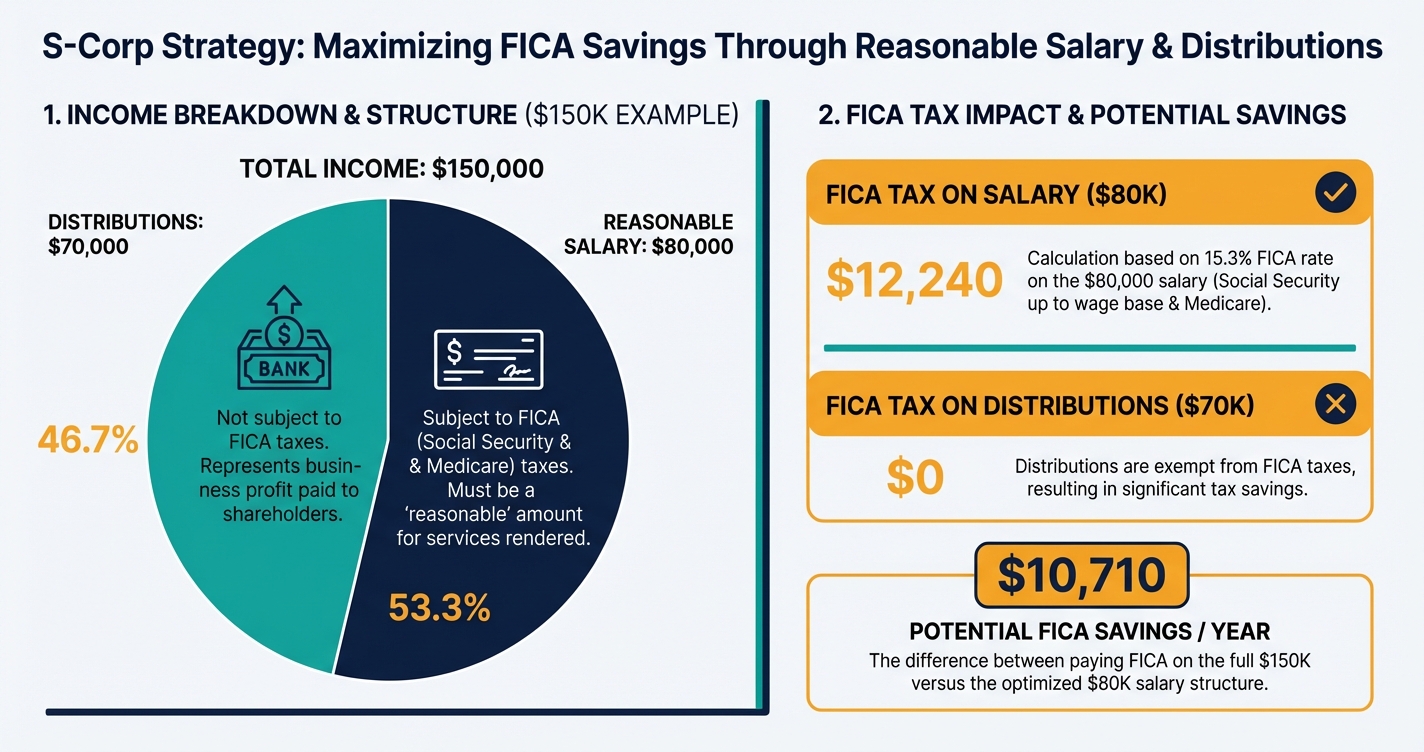
This is the step most new S Corp owners underestimate. If you work in the business, the IRS requires you to pay yourself a reasonable salary through payroll before taking any profit distributions. "Reasonable" means a salary comparable to what a similar business would pay an employee doing the same work in the same geographic area.
The combined FICA tax rate on your salary is 15.3% (12.4% for Social Security up to $184,500 in 2026, plus 2.9% for Medicare). Distributions are not subject to FICA, which is where your tax savings come from. For example, if your business earns $150,000 and you pay yourself an $80,000 salary, you only pay FICA on the salary portion, potentially saving over $10,000 per year compared to a standard LLC.
You will need a payroll service to handle W-2s, withholding, quarterly Form 941 filings, and year-end Form 1120-S preparation. Budget $30 to $150 per month for a payroll provider and $500 to $2,500 per year for CPA-prepared S Corp tax returns. Open a dedicated business bank account to keep salary and distributions cleanly separated.
$30–$150/month for payroll; $500–$2,500/year for tax preparation1–2 weeks to set up payroll Payroll provider (e.g., Gusto, ADP, QuickBooks Payroll); IRS Form 941 filed quarterlyCommon Mistakes
- Taking distributions without paying yourself any salary, which is a top IRS audit trigger for S Corps
- Setting your salary too low based on the unofficial 60/40 rule, which the IRS does not endorse and courts have rejected
The total cost to start an S Corp depends on your state, whether you hire professionals, and the ongoing services you need. Here is the full picture, broken into one-time and recurring costs.
One-Time Formation Costs
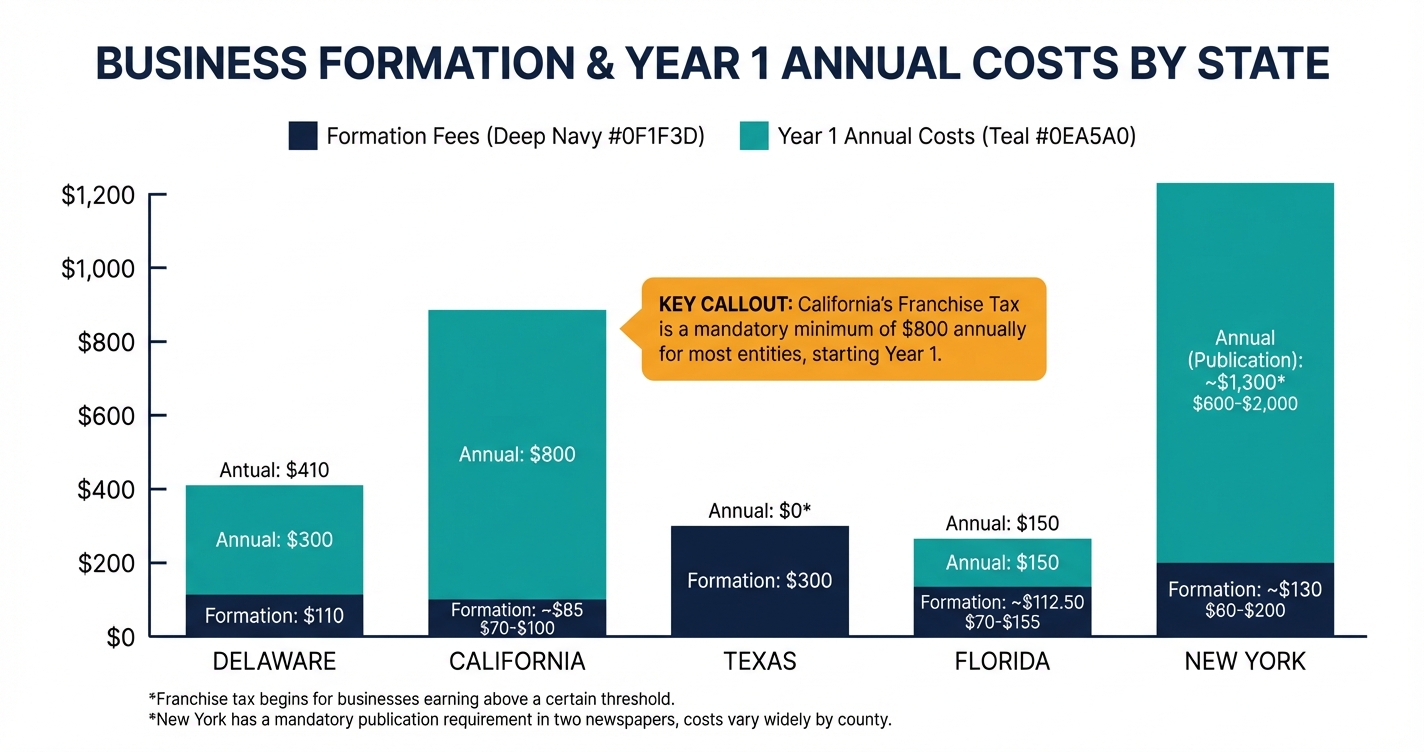
Your biggest upfront cost is the state filing fee. It ranges from $50 in low-cost states like Kentucky to $500 in Massachusetts. The five most popular states for formation look like this:
- Delaware: $110 (LLC) or $89+ (corporation)
- California: $70 (LLC) or $100 (corporation)
- Texas: $300 for either entity type
- Florida: $125 (LLC) or $70 (corporation)
- New York: $200 (LLC) or $125 (corporation), plus $600 to $2,000 in publication fees for LLCs
The IRS charges nothing for Form 2553 or your EIN. If you handle everything yourself, your total one-time cost can be as low as $100 to $200 in a budget-friendly state.
Recurring Annual Costs
S Corps are not a "set it and forget it" structure. You will pay ongoing costs every year to stay compliant:
- Payroll service: $360 to $1,800 per year ($30 to $150/month)
- CPA tax preparation (Form 1120-S): $500 to $2,500 per year
- Registered agent: $50 to $300 per year
- State annual report or franchise tax: $0 to $800 per year (California's $800 franchise tax is the highest)
DIY vs. Professional Formation Service
If you file everything yourself, expect to spend $100 to $500 total in government fees. Using a professional formation service like those in our best LLC formation services guide typically adds $0 to $300 for the formation itself, plus $100 to $300 for registered agent service. The real ongoing expense is payroll and tax prep, which runs $1,000 to $4,000 per year combined.
| Item | Cost Range | Notes |
|---|---|---|
| State formation filing fee (LLC or corporation) | $50–$500 | Varies by state. DE $110, CA $70–$100, TX $300, FL $125, NY $200. |
| IRS Form 2553 (S Corp election) | $0 | No fee to file. Must be mailed or faxed. |
| EIN application | $0 | Free at IRS.gov. Never pay a third-party site for this. |
| Name reservation (optional) | $0–$75 | Not available in all states. DE charges $75 for 120 days. |
| Operating agreement or bylaws | $0–$2,000 | Free with a template; $500–$2,000 if drafted by an attorney. |
| Registered agent (annual) | $0–$300/year | Free if you serve as your own agent; $50–$300/year for a professional service. |
| Payroll service (annual) | $360–$1,800/year | Required for S Corps. Budget $30–$150/month. |
| S Corp tax preparation (Form 1120-S) | $500–$2,500/year | CPA-prepared returns. Complexity and state affect cost. |
| State annual report or franchise tax | $0–$800/year | CA $800/year, TX $0 for most, FL $150, DE $300, NY $9 (biennial). |
| NY publication requirement (if applicable) | $600–$2,000+ | Required for New York LLCs only. Cost depends on county. |
While the S Corp election is a federal tax matter, your underlying entity (LLC or corporation) is governed by state law. That means formation fees, annual compliance costs, and ongoing requirements differ dramatically.
California
California imposes an $800 annual minimum franchise tax on all LLCs and corporations, plus a 1.5% tax on S Corp net income. The $800 minimum is waived for the first tax year only. Formation costs $70 for an LLC or $100 for a corporation through the California Secretary of State. You must also file a Statement of Information ($25) annually.
Texas
Texas charges $300 to file formation documents for either an LLC or corporation. The good news: most small S Corps owe zero franchise tax thanks to the $2.65 million revenue threshold. A franchise tax report must still be filed annually, even if no tax is owed. There is no state income tax in Texas.
Florida
Florida charges $125 to form an LLC or $70 for a corporation. The annual report costs $150 and is due by May 1 each year. Late filing increases the fee to $550. Florida has no personal income tax, making it attractive for S Corp owners. File through Sunbiz.org.
New York
New York charges $200 to form an LLC or $125 for a corporation. LLCs face a publication requirement that adds $600 to $2,000+ depending on the county (New York County is the most expensive). Biennial reports cost just $9. Check the NY Division of Corporations for current details.
Delaware
Delaware charges $110 to form an LLC and has a $300 annual franchise tax due June 1 each year. LLCs in Delaware do not file annual reports. The state is popular for its business-friendly Court of Chancery and strong legal precedents, but forming in Delaware only makes sense if you do business there or want specific legal protections. Otherwise, you will also need to register as a foreign entity in your home state.
Most S Corp formations take 2 to 6 weeks from start to finish. Here is a realistic timeline:
- Week 1: Choose your name, file formation documents with your state (same-day to 3 days if expedited), and apply for your EIN online (instant).
- Week 1-2: Draft your operating agreement or bylaws. Appoint a registered agent if you have not already.
- Week 2: File Form 2553 by mail or fax. Faxing is faster and gives you same-day confirmation of delivery.
- Weeks 2-10: Wait for your IRS acceptance letter (CP261). This typically arrives within 60 days. You do not need the letter to start operating; you can begin running payroll and filing taxes as an S Corp while you wait.
Expedited Options
Most states offer expedited processing for an extra fee. Delaware charges $50 for 24-hour processing or $1,000 for same-hour service. California offers $350 for same-day handling through the SOS office. Texas processes online filings within 2 to 3 business days at standard speed.
There is no way to expedite IRS processing of Form 2553. Faxing instead of mailing can save you 1 to 2 weeks of mail transit time. If you need your S Corp election confirmed quickly, fax the form and call the IRS Business and Specialty Tax Line at (800) 829-4933 after 60 days to check status.
S Corp formation has more pitfalls than a standard LLC. Here are the mistakes that cost founders the most money and time.
1. Missing the Form 2553 Deadline
If you miss that deadline, 2 months and 15 days after the start of the tax year, your S Corp election defaults to the following tax year. That means an entire year of paying self-employment tax on all your profits. Late relief under Rev. Proc. 2013-30 is available but requires extra paperwork and a reasonable cause statement.
2. Forgetting a Shareholder Signature
Every single shareholder must sign Form 2553 in Column K. One missing signature invalidates the entire election. The IRS will send a denial letter, and you will have to refile (potentially missing the deadline window).
3. Not Paying Yourself a Reasonable Salary
The IRS actively audits S Corps that pay artificially low salaries while taking large distributions. In Watson v. United States, a CPA who paid himself $24,000 while taking $220,000 in distributions had $175,000 reclassified as wages, plus back taxes and penalties. Use Bureau of Labor Statistics data or salary comparison tools to determine a defensible salary, not an arbitrary 60/40 split.
4. Skipping Payroll Setup Entirely
Some new S Corp owners take all income as "owner draws" like they did with a sole proprietorship. This defeats the purpose of the S Corp election and is noncompliant. You must run actual payroll with W-2s, withholding, and quarterly Form 941 filings.
5. Ignoring State-Level Taxes
The S Corp election only changes your federal tax treatment. States like California still impose their own franchise taxes ($800 minimum). Failing to budget for these state costs is a common surprise for new S Corp owners.
6. Creating a Second Class of Stock
If your operating agreement gives certain members preferential distribution rights or convertible debt that functions like equity, the IRS can retroactively terminate your S Corp status. Review your operating agreement carefully before filing Form 2553.
7. Not Filing the Annual Form 1120-S
S Corps must file Form 1120-S with the IRS every year, on the 15th day of the third month after your tax year ends. For the 2025 tax year that fell on March 16, 2026, and for the 2026 tax year it is March 15, 2027. The IRS charges a per-shareholder, per-month penalty for late filings that can quickly reach thousands of dollars. For ongoing requirements, see our LLC annual report requirements guide. If you ever decide the S Corp is not right for you, our how to dissolve an LLC guide explains your options. You can also change your LLC name without affecting your S Corp election.
8. Missing the 83(b) Window on Vesting Shares
If your shares vest over time instead of landing in your hands outright, you hold what the IRS calls substantially nonvested property. That brings a second deadline. It has nothing to do with Form 2553. A section 83(b) election must be filed no later than 30 days after the date the property was transferred. File it and you are taxed on what the shares are worth on the transfer date, which at a company that just incorporated is usually close to nothing. Skip it and you are taxed on each tranche as it vests, at whatever the shares are worth by then.
The 30 days run from the transfer date, not from your incorporation date and not from your first payroll run. If day 30 lands on a Saturday, Sunday or legal holiday, IRS Form 15620 says the election is timely when it is postmarked the next business day. That is the only relief named. The election also cannot be revoked without IRS consent. Mail Form 15620 to the IRS office where you file your own federal return, and give a copy to the company.

What the IRS Actually Means by a Reasonable Salary
The 60/40 split you have read about is not in any IRS rule. The IRS gives a test instead. It starts where most owners never look. It starts at where your money comes from. Pay yourself for the work you do before you take a cent as a distribution. Get that number wrong either way and the election costs you.
Where Your Revenue Comes From Decides the Number
The IRS asks what you did for the company. To answer it, the IRS looks at where the sales came from. There are three sources. Only one turns into wages.
| Source of gross receipts | How payments to you are treated |
|---|---|
| Services you personally perform | Wages, subject to employment taxes |
| Services of non-shareholder employees | Non-wage distributions, no employment taxes |
| Capital and equipment | Non-wage distributions, no employment taxes |
One thing catches owners out. Your admin work counts as wages too. It counts even when it bills nothing. A manager who never bills an hour still helps the people who do, and the IRS reads that as a service to the company.
The Nine Factors the IRS Names
The IRS lists nine factors it weighs. There is no safe percentage. Two of the nine are about your files, not your judgement, so you can build your case long before an audit.
- Training and experience
- Duties and responsibilities
- Time and effort devoted to the business
- Dividend history
- Payments to non-shareholder employees
- Timing and manner of paying bonuses to key people
- What comparable businesses pay for similar services
- Compensation agreements
- The use of a formula to determine compensation
The QBI Trade Off Nobody Mentions
A low salary is the risk everyone names. A high one costs you as well. Pay you take as reasonable compensation is left out of qualified business income. That is the base for the Section 199A deduction of up to 20 percent. So each dollar you run through payroll is a dollar that cannot earn it. And each dollar you keep out of payroll is a dollar the IRS may call wages. The number sits between two penalties. A method you can show beats a round figure.
The Cases Behind the Reclassification
The IRS points to four rulings when it explains this power. Learn the names. They are what your accountant will argue from if your salary is ever queried.
| Case | What it settled |
|---|---|
| Joly v. Commissioner, T.C. Memo. 1998-361 | The power to treat distributions as wages |
| Veterinary Surgical Consultants, P.C. v. Commissioner, 117 T.C. 141 (2001) | Shareholders who work are employees |
| Joseph M. Grey Public Accountant, P.C. v. Commissioner, 119 T.C. 121 (2002) | The same point, for a professional firm |
| David E. Watson, PC v. U.S., 668 F.3d 1008 (8th Cir. 2012) | What counts as fair pay for work done |
What to Keep on File
Two of the nine factors reward the file itself. Those two are your pay agreement and your formula. Build the file the day you set the salary. Not the day the letter arrives.
- A written pay agreement, dated before the year it covers
- The method or formula you used, written down in plain terms
- The wage data you leaned on, with its date and where it came from (the free Bureau of Labor Statistics wage series covers most jobs by metro area)
- A record of your hours and duties, split between your work and the work of staff or equipment
- Board minutes recording the salary decision
- Payroll records showing the salary ran all year, not booked as a lump in December
That last one is where most of the damage happens. A salary agreed in December and paid in one December run looks like a distribution in a costume. It is also the easiest to fix. Our guide to running payroll and our tested list of payroll services both start from zero.
The Health Premium Trap for 2 Percent Shareholders
Own more than 2 percent of the stock and the health rules change. The company deducts what it pays. It also reports those premiums as wages on your W-2, with income tax withheld. They belong in Box 1 and not in Boxes 3 and 5. So they are wages for income tax, not for Social Security or Medicare. Get that split wrong and your W-2 overstates your FICA wages.
The other half is quieter. A 2 percent shareholder cannot join a QSEHRA at all. That catches owners who set one up for staff and assumed it covered them too.
A third piece reaches past the company. The premium has to be paid by the corporation and reported on your W-2 to be deductible at all. Buy the same policy personally, with your own money, and the above the line deduction disappears. That deduction lowers your adjusted gross income. The marketplace uses that figure to decide your premium tax credit.
So the salary you set here does not only settle your FICA bill. It caps that deduction too. For 2026 the credit ends completely above 400 percent of the federal poverty line, which is $62,600 for one person. We work the whole interaction through in health insurance for LLC owners.
Frequently Asked Questions
Sources & References
- IRS: S Corporations
- IRS: About Form 2553
- IRS: Get an Employer Identification Number
- IRS: S Corporation Employees, Shareholders and Corporate Officers
- SBA: Get Federal and State Tax ID Numbers
- FinCEN: Beneficial Ownership Information Reporting
- IRS: Instructions for Form 2553
- Cornell Law: IRC Section 1362
- IRS: S Corporation Compensation and Medical Insurance Issues
- IRS: Qualified Business Income Deduction
- SSA: Contribution and Benefit Base
About the Author
Editor, StartupOwl
Eliot leads StartupOwl's state data research. He maintains the site's fifty state records of LLC filing fees, annual costs, processing times, and small business grant programs, checking each figure against the state office that publishes it and logging the date it was verified. Based in New Jersey, he has spent his working life in and around small businesses, and he writes for the founder who wants the real number rather than the advertised one. Every figure under his byline traces to a named source, and when a state proves a number wrong, the correction is published, not buried.
Was this article helpful?
Questions about this guide
No comments yet. Ask the first question and a member of our team will answer.
Leave a comment