
DBA Filing
File your DBA in 7 steps. Covers filing fees ($10 to $150), publication requirements, and state-specific rules for California, Texas, Florida, New York, and Delaware.

In This Article
- DBA filing fees range from $10 to $150; total cost with publication is $25 to $300.
- A DBA does not create a legal entity, provide liability protection, or require a separate EIN.
- California, New York, and Florida require newspaper publication (adds $25 to $200).
- Delaware moved all DBA filings to a statewide online system effective February 2, 2026.
7
Total Steps
$25–$300
Est. Total Cost
1 to 8 weeks (depending on publication requirements)
Timeline
Easy (no attorney needed for most filings)
DIY Difficulty
A DBA ("doing business as") lets you operate your business under a name that is different from your legal name or your registered entity name. Filing one costs $10 to $150 in government fees depending on your state, and the entire process takes 1 to 8 weeks. If you skip the filing, you risk fines, contract enforceability problems, and the inability to open a business bank account under your chosen name.
This guide walks you through every step, including the publication requirements that trip up most first-time filers in states like California, New York, and Florida. You will also learn which states file at the county level versus the state level, and how Delaware's brand-new statewide system (effective February 2, 2026) changes everything for businesses there.
Before you start the filing process, gather these items so you can complete everything in one sitting:
- Your desired DBA name (with 2 to 3 backup options)
- Your legal name or registered entity name
- Business address (street address, not a PO Box in most states)
- Names and addresses of all owners
- Your EIN or Social Security Number
- Date your business was formed or started
- Nature of your business (brief description)
- Payment method for filing fees (credit card, check, or money order)
If you are filing in California, you will also need to know your county clerk's specific form and fee. County requirements differ, and the county clerk's website is the best resource for current forms. Check with California Secretary of State for entity-level searches before filing at the county.
If you do not yet have a business entity, you might want to consider whether you should form an LLC instead of just filing a DBA. A DBA gives you a name, but an LLC gives you liability protection. Many founders file an LLC first, then add a DBA under it for branding purposes.
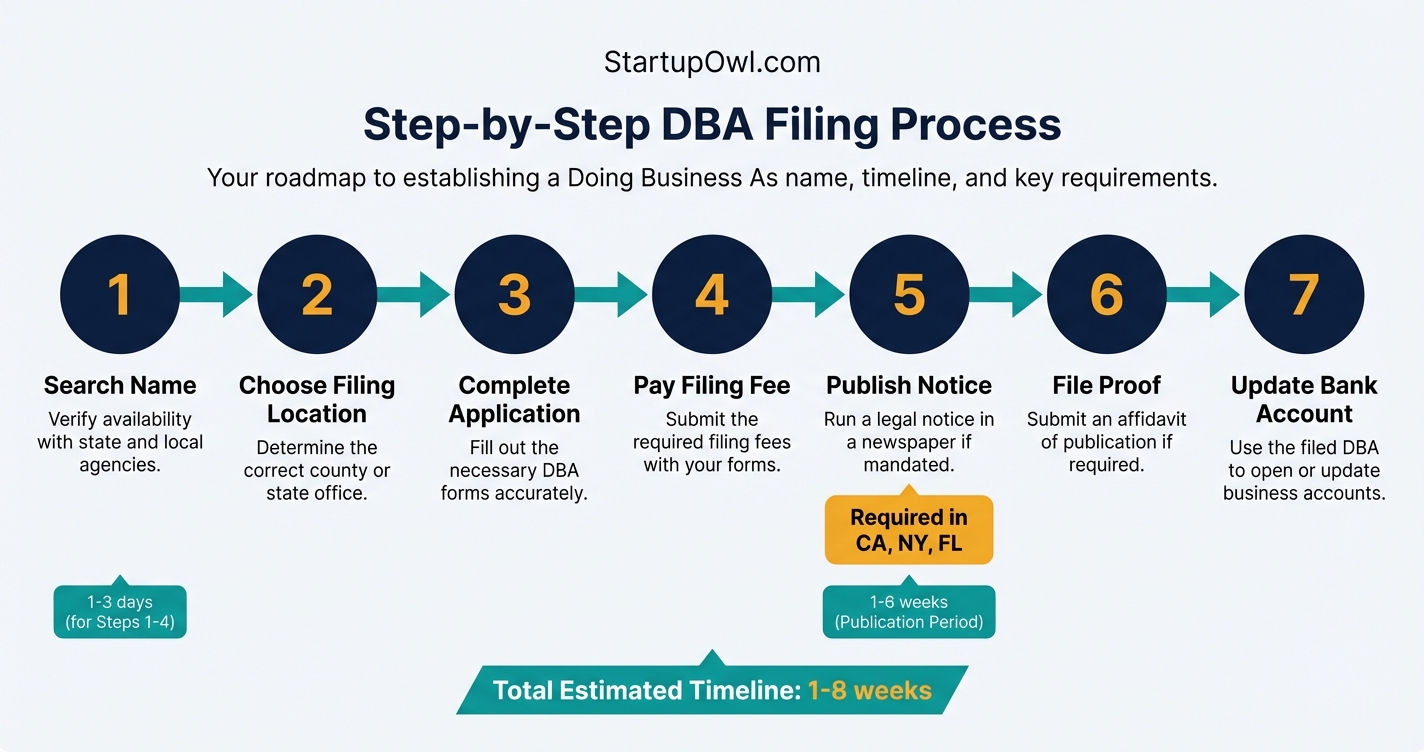
Step-by-Step Process
- 1
Search for Your DBA Name's Availability
Before you file anything, confirm that your desired DBA name is not already taken. In states with state-level filing (like Florida and Texas), search the state's business name database. In county-level states (like California and New York), search both the county clerk's records and the state's business entity database.
In Florida, search through the Sunbiz portal. In Texas, use the SOSPortal. In New York, check the NY Department of State database. A DBA name must be distinguishable from existing registered names. Remember that a DBA does not provide trademark protection, so also check the USPTO trademark database to avoid infringing on someone else's mark.
$0 (most searches are free)Same day (15-30 minutes) State Secretary of State website, county clerk's name database, or USPTO trademark searchCommon Mistakes
- Only checking one database (state entity names) while ignoring county-level DBA registrations
- Choosing a name that includes restricted words like 'Bank,' 'Insurance,' or 'LLC' when you are not that entity type
- Failing to check the USPTO trademark database for potential conflicts that could trigger a cease-and-desist letter
- 2
Determine Where You Need to File
Your filing location depends on your state and your business structure. This is where most people get confused because the rules vary dramatically.
- California: All DBAs file at the county clerk level. If you operate in multiple counties, you must file in each county.
- Texas: LLCs, corporations, and LPs file with the Secretary of State using Form 503. Sole proprietors and general partnerships file with the county clerk.
- Florida: All DBAs file at the state level with the Division of Corporations (Sunbiz).
- New York: LLCs and corporations file a Certificate of Assumed Name with the NY Department of State. Sole proprietors and partnerships file with their county clerk.
- Delaware (as of Feb 2, 2026): All DBAs now file statewide through the Delaware One Stop portal, replacing the old county-level system.
$0 (research step)Same day (15-30 minutes) State Secretary of State website or county clerk website for your jurisdictionCommon Mistakes
- Filing at the county level when your entity type (LLC or corporation) requires state-level filing, or vice versa
- Failing to file in every county where you conduct business in states like California and New York
- 3
Complete and Submit Your DBA Application
Download or access the correct DBA form for your jurisdiction. The form typically asks for your legal name, DBA name, business address, owner names and addresses, date of formation, and nature of business. In Texas, LLCs use Form 503 (Assumed Name Certificate). In Florida, use the online Fictitious Name Registration through Sunbiz. In California, you submit a Fictitious Business Name Statement to your county clerk.
Some states still require notarization. California requires the form to be notarized, though some counties have dropped this. Delaware's new system (effective February 2, 2026) has eliminated notarization entirely. Double-check your county's specific requirements before submitting. Errors or missing information will delay processing by days or weeks.
$0–$10 (notarization if required)1-2 hours to complete; same-day if filing in person or online Your county clerk's office (CA, NY sole props) or Secretary of State website (TX, FL, NY LLCs/corps, DE)Common Mistakes
- Submitting an incomplete form (missing owner addresses or incorrect entity type) that causes rejection
- Forgetting that California requires filing within 40 days of starting to use the fictitious name
- 4
Pay the Government Filing Fee
Filing fees vary widely. Here are the fees for the five highest-traffic states as of 2026:
- California: $10 to $100 depending on your county. Los Angeles County charges $26 for the first name. San Francisco County charges $67. Sacramento County charges $44.
- Texas: $25 for state-level filing (LLCs/corporations). County-level filings for sole proprietors run $15 to $25.
- Florida: $50 flat fee filed with the Division of Corporations.
- New York: $25 for LLCs and corporations filing with the Department of State. Sole proprietors filing at the county level pay $25 to $100 (Manhattan charges $100).
- Delaware: $25 statewide filing fee under the new system. Out-of-state entities also need a $25/year Trade Name Only license.
$10–$150 (varies by state and county)Same day (payment processed at time of filing) Same office where you submit the application; most accept credit cards, checks, or money ordersCommon Mistakes
- Forgetting about the credit card convenience fee (Texas charges $0.25 plus 2.25% on top of the $25 filing fee)
- In Delaware, not having an active Delaware business license before attempting to register a trade name under the new system
- 5
Publish Your DBA in a Local Newspaper (If Required)
Several states require you to publish a notice of your DBA in a local newspaper. This is the step that adds the most time and cost to the process.
- California: Publish for 4 consecutive weeks in an approved newspaper in your county. Publication costs $75 to $200. Your county clerk has a list of approved publications.
- Florida: Publish once in a newspaper in the county where your principal place of business is located. Cost runs $25 to $150. You must publish before filing the registration with Sunbiz.
- New York: Some counties require publishing in two newspapers (one daily, one weekly) for 6 consecutive weeks. Publication costs can range from $40 to over $100.
- Texas: No statewide publication requirement for state-level filings, though some counties may require it.
- Delaware: No publication requirement under the new 2026 system.
Contact your county clerk's office or the newspaper directly to place your legal notice. Many newspapers now accept online submissions.
$0–$200 (depending on state and newspaper)1 to 6 weeks (California takes 4 weeks; Florida is same-day publication) An approved newspaper of general circulation in your county; ask your county clerk for the listCommon Mistakes
- In Florida, registering the DBA on Sunbiz before publishing the newspaper notice (Florida law requires publication first)
- In California, publishing in a newspaper that is not on the county clerk's approved list, which can invalidate the filing
- Failing to file the affidavit of publication back with the county clerk within the required timeframe
- 6
File Proof of Publication (If Applicable)
After the newspaper publication period ends, you need to file proof with the appropriate office. In California, the newspaper will provide an Affidavit of Publication that you (or the newspaper) must file with the county clerk within 30 days of the last publication. In New York, some counties require an affidavit from the publisher filed with the county clerk.
In Florida, no proof of publication is required. When you file your registration on Sunbiz, you certify under penalty of perjury that you published the notice. The state does not ask for documentation. If your state has no publication requirement (like Texas for state-level filings or Delaware under the new system), skip this step entirely.
$0–$10 (some counties charge a small recording fee)Same day to 1 week after publication period ends County clerk's office where you filed the original DBA applicationCommon Mistakes
- Missing the 30-day deadline in California to file the affidavit of publication, which can invalidate your DBA
- Assuming all states require proof of publication when many (like Florida) rely on self-certification
- 7
Update Your Bank Account and Business Records
Once your DBA is approved, bring a certified copy of your DBA certificate to your bank to update your business bank account. Most banks require a DBA certificate before allowing deposits or transactions under the new name. A certified copy typically costs $5 to $10 from your filing office.
Update all your business materials to reflect the new name: invoices, contracts, website, business cards, and marketing materials. If you use a registered agent service, notify them of the DBA as well. You do not need a new EIN; one EIN covers your legal entity and all its DBAs. However, the IRS recommends informing them of your trade name by including it on your tax return.
$5–$10 (certified copy of DBA certificate)1 to 3 days Your bank; also notify your registered agent and update business licensesCommon Mistakes
- Trying to open a bank account under the DBA name before receiving official confirmation of the filing
- Failing to update local business licenses and permits that reference your old business name
DBA filing is one of the cheapest things you can do for your business. Here is a realistic breakdown of what you will actually pay:
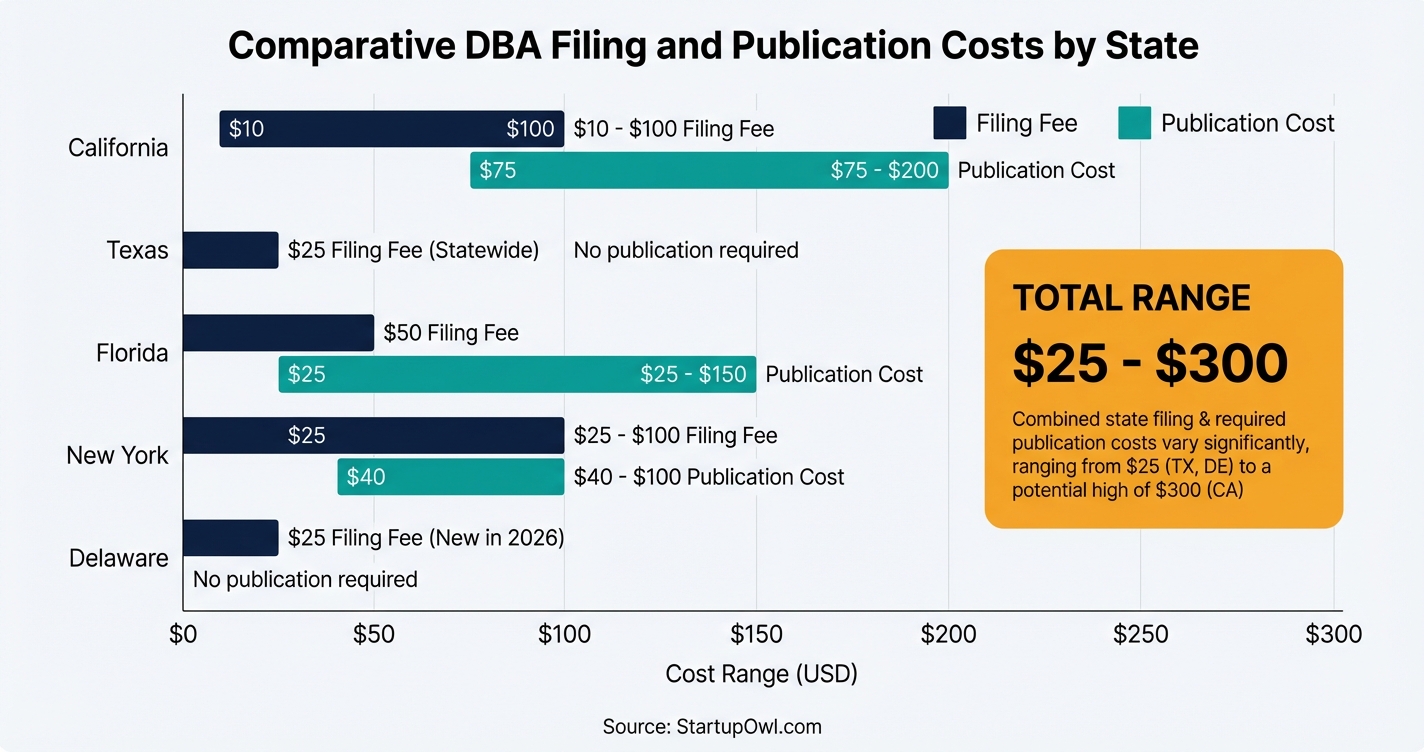
If you are a sole proprietor in Texas filing at the county level, your total cost might be as low as $15 to $25 with no publication requirement. In California's Los Angeles County, plan on $26 for the filing fee plus $75 to $200 for the required 4-week newspaper publication. That brings your total to roughly $100 to $225.
Florida falls in the middle at $50 for the state filing plus $25 to $150 for the required newspaper ad, totaling $75 to $200. New York's Manhattan (New York County) is the most expensive single filing at $100 for sole proprietors, plus potential publication fees of $40 to $100+.
If you want to skip the paperwork, online services like LegalZoom or ZenBusiness charge $99 to $250 on top of government fees. They handle the name search, form completion, filing, and (in some states) publication for you. For a single straightforward DBA, most people can handle this themselves in under an hour.
| Item | Cost Range | Notes |
|---|---|---|
| Government filing fee (state or county) | $10–$150 | Varies by state and county. CA: $10-$100, TX: $25, FL: $50, NY: $25-$100, DE: $25. |
| Newspaper publication fee | $0–$200 | Required in CA, FL, NY, and some other states. Not required in TX (state filings) or DE. |
| Notarization fee | $0–$15 | Required in some CA counties and a few other states. Not required in FL, TX, or DE (new system). |
| Certified copy of DBA certificate | $5–$10 | Recommended for banking. Most banks require a certified copy to update your account. |
| Filing service (optional) | $50–$250 | Services like LegalZoom ($99+) handle name search, filing, and publication. DIY is cheaper. |
| DBA renewal (when applicable) | $10–$100 | CA: every 5 years. TX: every 10 years. FL: every 5 years. NY: no renewal. DE: no renewal with active license. |
| Total DIY cost range | $25–$300 | Low end: TX sole prop with no publication. High end: CA or NY with publication and certified copies. |
State DBA rules are the most fragmented area of business filing in the United States. There is no federal DBA filing. Every state sets its own rules for names, fees, filing locations, publication, and renewal. Here are the rules for the five highest-traffic states.
California calls DBAs "fictitious business names" and requires county-level filing. You must file a Fictitious Business Name Statement with the county clerk's office in every county where you conduct business. Filing fees range from $10 to $100 by county (Los Angeles: $26, San Diego: $54, San Francisco: $67). California also requires publication in a local newspaper for 4 consecutive weeks and renewal every 5 years. You must file within 40 days of starting to use the name. For details, visit your county clerk's website or the CA Secretary of State.
Texas calls DBAs "assumed names." LLCs and corporations file Form 503 with the Texas Secretary of State for $25. Sole proprietors and partnerships file with their county clerk for $15 to $25. State-level filings are valid for 10 years. Texas does not allow amendments to assumed name certificates. If you need to change information, you must file a Certificate of Abandonment ($10) and then a new Form 503 ($25).
Florida calls DBAs "fictitious names." All filings go through the state-level Division of Corporations (Sunbiz) for a $50 fee. You must publish a notice before filing your registration. Online filing is processed in 2 to 3 days; mail takes 3 to 5 business days. Registration lasts 5 years.
New York has a split system. LLCs and corporations file a Certificate of Assumed Name with the NY Department of State for $25. Corporations pay an additional $100 per NYC county or $25 per county outside NYC. Sole proprietors and partnerships file a Business Certificate with their county clerk (Manhattan charges $100; many other counties charge $25). New York DBA registrations do not expire.
Delaware underwent a major overhaul effective February 2, 2026, under House Bill 40. All DBA filings are now centralized through the Delaware One Stop portal, administered by the Division of Revenue. The filing fee is $25 statewide. Notarization is no longer required. The old county-level system through Prothonotary offices has been replaced. Existing county registrations remain valid, but re-registration in the new system is free during the transition window and recommended. Out-of-state entities must obtain a Trade Name Only license for $25/year.
The total time to get your DBA filed and approved depends almost entirely on whether your state requires newspaper publication.
- No publication required (TX state-level, DE): 1 to 5 business days from submission to approval.
- Publication required (CA, FL, NY): 2 to 8 weeks total. The filing itself may be approved in 1 to 3 days, but the 4-week California publication period or the pre-filing publication in Florida adds significant time.
In Florida, online filings through Sunbiz are processed in 2 to 3 business days. In Texas, you now file online through SOSPortal, which replaced SOSDirect and SOSUpload on 29 September, and you create a new free SOSPortal account to start. California county clerks can take 5 to 10 business days to process, depending on the county's volume.
Expedited processing is available in some jurisdictions. New York offers $150 for 2-hour processing, $75 for same-day, and $25 for 24-hour processing for filings with the Department of State. Texas does not offer expedited processing for assumed name certificates. If you are in a hurry, check your specific filing office for rush options.
These are the mistakes that cause the most rejections, delays, and (in some cases) legal trouble:
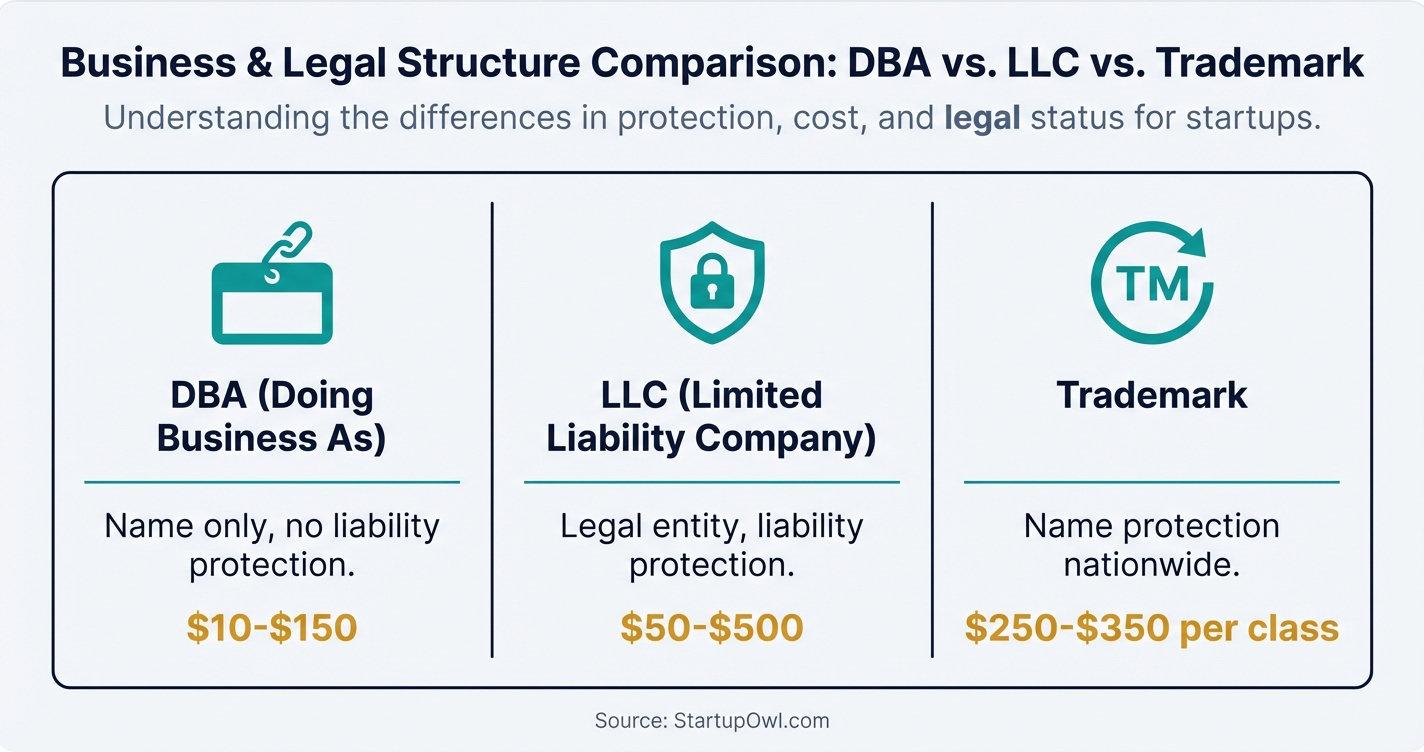
- Confusing a DBA with an LLC or trademark. A DBA is only a name. It does not give you liability protection (that is an LLC or corporation). It does not give you exclusive rights to the name nationwide (that is a federal trademark). If you are a sole proprietor using a DBA, you are still personally liable for all business debts.
- Filing in the wrong office. In Texas, LLCs file with the Secretary of State while sole proprietors file with the county clerk. In New York, LLCs file with the Department of State while sole proprietors file with the county clerk. Filing in the wrong place means starting over.
- Skipping newspaper publication in states that require it. California, Florida, and New York all require some form of publication. In California, failure to publish can invalidate your DBA. In Florida, the Fictitious Name Act (s.865.09, F.S.) requires publication before you file your registration.
- Missing renewal deadlines. California and Florida DBAs expire after 5 years. Texas expires after 10 years. If you let your DBA lapse, you may lose the right to use the name, have trouble enforcing contracts, and face fines.
- Thinking a DBA replaces a business license. A DBA is not a license to operate. You may still need a city or county business license, a state sales tax permit, and industry-specific permits. Check with your local SBA office for what is required.
One final note for Delaware business owners: the transition to the new statewide DBA system under HB 40 means existing county-level registrations will operate on a first-come, first-served basis for name claims. If you have an existing Delaware DBA, re-register through the Delaware One Stop portal as soon as possible to protect your name.
Filing the DBA but never using it. A registered trading name only does its job once customers meet it, on the sign, the invoices and the website. Google is the place this bites hardest. Its Business Profile rules require the listing name to be the name used consistently in the real world, so a DBA that exists only on paper will not defend a profile name, and the mismatch between a filed entity name and a trading name is one of the most common causes of a suspended Google Business Profile.
Frequently Asked Questions
Sources & References
About the Author
Editor, StartupOwl
Eliot leads StartupOwl's state data research. He maintains the site's fifty state records of LLC filing fees, annual costs, processing times, and small business grant programs, checking each figure against the state office that publishes it and logging the date it was verified. Based in New Jersey, he has spent his working life in and around small businesses, and he writes for the founder who wants the real number rather than the advertised one. Every figure under his byline traces to a named source, and when a state proves a number wrong, the correction is published, not buried.
Was this article helpful?
Questions about this guide
No comments yet. Ask the first question and a member of our team will answer.
Leave a comment