
Essential Business Contracts and Templates Every Business Needs
What business contracts actually are, what they cost, and how to get the right ones in place without overpaying for legal help.

In This Article
Definition
A business contract is a written agreement that spells out what each party will do, when they will do it, and how much it will cost.
A business contract is a written agreement that says what each side will do, by when, and for how much. Free templates cover routine work. Square Contracts charges nothing, and Rocket Lawyer starts at $149 a year after a 7 day free trial. A lawyer costs far more, an average of $824.63 to draft and $513.65 to review. Most founders start with three, a service agreement, an NDA, and an independent contractor agreement.
One contract on your desk deserves a lawyer. The rest do not. Drafting a business contract from scratch averages $824.63, and having a lawyer read one you wrote averages $513.65, both from ContractsCounsel marketplace data checked on 21 August 2026. Square and Rocket Lawyer hand you a template for $0 to $149 a year. Knowing which contract is the exception is the whole job.
$0 with Square Contracts, no subscription and no monthly fee
Free Option
$149 a year for Rocket Lawyer Standard, documents and e-signatures included
Low-End
$513.65 average for a lawyer to review one contract
Mid-Tier
$824.63 average for a lawyer to draft one, or $225 to $300 an hour
Premium
A business contract is a written agreement between two or more parties. It states who does what, by when, for how much, and what happens when someone falls short. A spoken deal can count too. The written one is the deal you can prove.
Four things make a contract enforceable. An offer, acceptance, consideration (something of value moving each way), and mutual agreement. Miss one and a court may refuse to enforce it. That is the whole test. It is also why a free template signed properly beats a $824.63 contract nobody signed.
Say you hire a web developer for $5,000 over 60 days. Your service agreement names the deliverables, splits payment 50% up front and 50% on delivery, and lets you walk if the work runs 14 days late. Without it you have a grievance. With it you have a claim.
The six contracts a small business meets first:
- Service agreements for client and vendor work
- Independent contractor agreements for 1099 workers
- Non-disclosure agreements before you share anything private
- Partnership agreements once there is more than one owner
- Employment contracts for W-2 hires
- Sales contracts for product deals
The gap between a free template and a lawyer drafted contract is $824.63. Closing it correctly is the whole decision. ContractsCounsel marketplace data puts drafting at $824.63 on average, review at $513.65, and hourly work at $225 to $300. Those averages run across states and industries. We checked them on 21 August 2026.
Paying that on every deal is waste. Paying nothing on a commercial lease is worse. A signed template protects you as well as a drafted one when the terms are right, because what counts is offer, acceptance, consideration, and agreement, not who typed the file.
This page used to carry dispute numbers here, a 9% dispute rate and a $91,000 median court bill. We pulled them on 20 July 2026. Each one traced back to a blog quoting a blog, with no study we could open. A number we cannot check does not belong on a page about legal risk.
Every business contract carries the same seven parts, whether it came free from Square or cost $824.63 from a lawyer. Here is what goes in each one.
- Parties, the full legal names, addresses, and entity details of everyone signing.
- Scope, exactly what is delivered, with quantities and specs.
- Payment terms, the price, the schedule, the due dates, and the late fees.
- Confidentiality, what neither side may repeat.
- Termination, how either side ends the deal and with how much notice.
- Dispute resolution, whether a fight goes to mediation, arbitration, or court, and whose state law applies.
- Signatures and dates, which make it binding.
A template takes 15 to 30 minutes to fill in. A lawyer drafting from scratch usually takes 1 to 2 weeks. Most tools ask you questions. The answers become the contract.
Then you send it for signature. Electronic signatures hold up under the federal ESIGN Act, 15 U.S.C. 7001, in force since 2000. The law says a contract cannot be denied force just because it was signed on a screen. It does not make anyone accept a digital record. Your counterparty can still ask for ink.
You can have a contract signed and filed in under 30 minutes. Five steps.
Step 1, pick where the template comes from. Free is a real option. Square Contracts costs nothing, with no subscription and no monthly fee, and it suits service work well. Rocket Lawyer runs $149 a year on the Standard plan after a 7 day free trial, and adds attorney questions to the document library. PandaDoc, Signeasy, and DocuSign publish free tiers too, though we have not tested them.
Step 2, match the contract type to the job. Service agreement for client work. Independent contractor agreement for a 1099 hire. NDA before you share anything private. Partnership agreement when a co-founder appears. One warning about the free route, Square offers no NDAs, partnership agreements, employment contracts, or leases, so those need another source.
Step 3, fill in every clause. Put in your real payment terms, dates, and deliverables. Leave no placeholder text. Name the state whose law governs the deal, and say how a dispute gets handled.
Step 4, buy the review where the stakes are real. An attorney review averages $513.65. Spend it on a commercial lease, a partnership agreement, an employment contract, or anything past $10,000. Skip it on a $2,000 freelance job.
Step 5, sign and store it. Use the platform own e-signature, keep a copy in cloud storage, and set a reminder to reread the contract in a year. If your business bank account and accounting system are running, match the payment terms in the contract to the terms on your invoices.
Contract costs run from $0 to $824.63. The ladder below shows what each rung buys. Every figure was checked on 21 August 2026.
| Option | Cost | What you get |
|---|---|---|
| Square Contracts | $0 | Free templates, e-signature, no subscription, no NDA or partnership templates |
| Rocket Lawyer Standard | $149 a year | Document library, e-signatures, 12 attorney questions, 7 day free trial |
| Rocket Lawyer Plus | $249 a year | Adds 36 attorney questions and 12 live attorney calls |
| Attorney review | $513.65 average | A lawyer reads and marks up a contract you already have |
| Attorney drafting | $824.63 average | A lawyer writes the contract from scratch for your business |
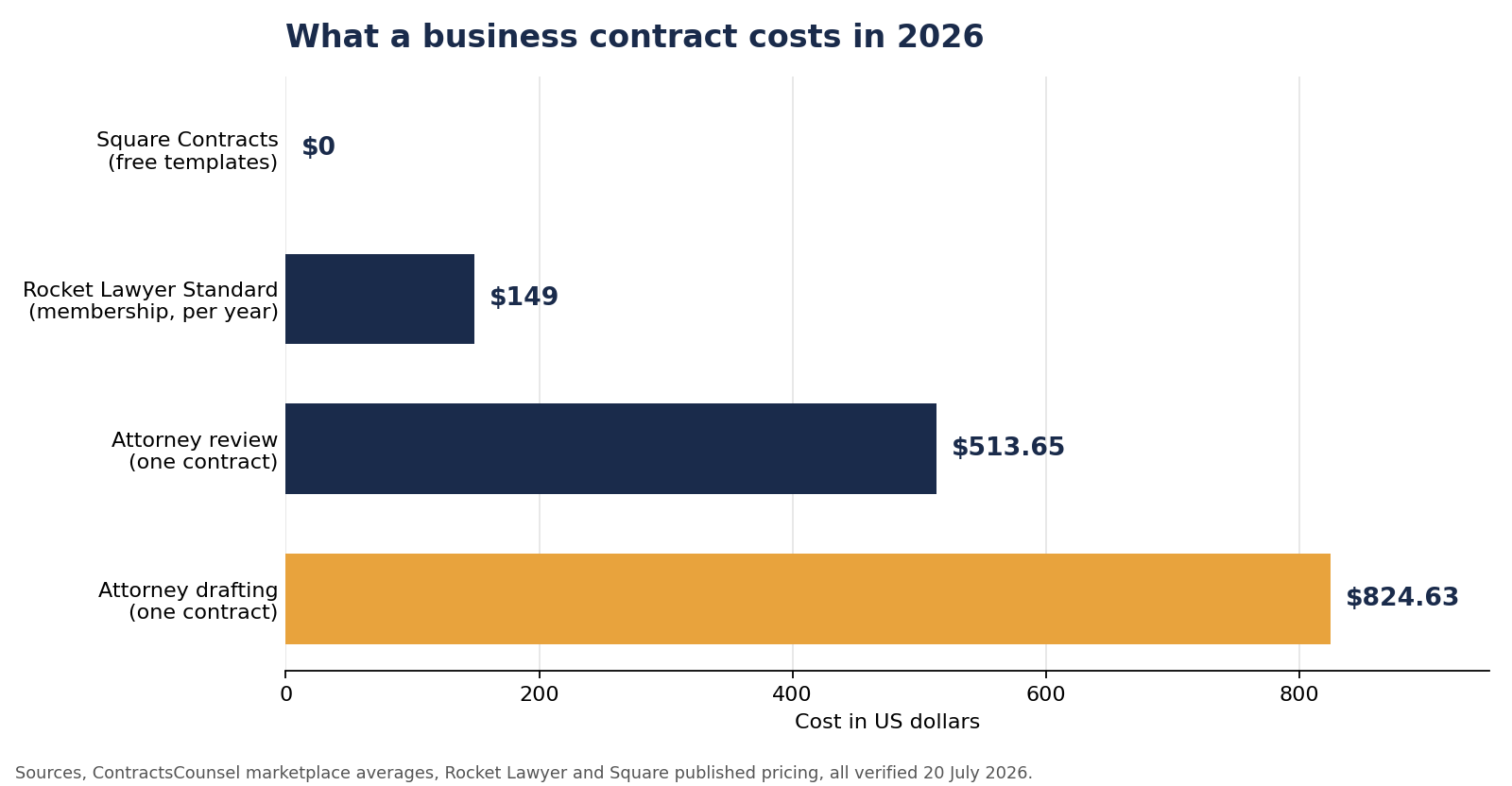
Hourly attorney work runs $225 to $300. Complex deals usually go that way. PandaDoc, Signeasy, and DocuSign run free tiers of their own, and PandaDoc paid Starter plan is $19 per seat a month. We name them because you will meet them, not because we tested them.
The cheap path is a free template for routine work, plus one paid review of the deal that carries the most money. Pay once, where it counts. That keeps a first year legal bill near $513.65 rather than several thousand. For the wider budget, see our complete business setup guide.
Contract needs split by business model, and the spread runs from $0 to about $2,500. Find yourself below.
Freelancers and consultants need a client service agreement first, an NDA for early talks, and an independent contractor agreement if they subcontract. Free templates cover all three. One review of the master service agreement adds about $513.65.
E-commerce sellers need website terms of service, a refund policy, a supplier agreement, and a shipping contract. Marketplace sellers inherit the marketplace terms. Direct sales need your own. Our business website setup guide covers the terms of service side.
Retail and restaurant owners sign a commercial lease. Never sign one unread. Budget $513.65 or more for a lawyer to read it. Vendor agreements, employment contracts, and supplier terms follow.
Professional services firms live on their engagement letters. Pay for the drafting. An agency, accountant, or law firm should not adapt a template here, because the document defines the revenue. Two or three drafted contracts at $824.63 each is the real starting bill.
Food businesses carry extra liability. Every contract wants an indemnity clause. Our guides to general liability insurance and the best business insurance options cover the other half of that risk.
These five errors show up again and again, and four of them cost $0 to fix.
1. Using a template without changing it. A downloaded file may miss your state rules or your trade terms. Fixing it costs nothing. Getting it wrong costs you the contract.
2. Leaving out dispute resolution. With no clause, a fight defaults to court in whatever venue a judge picks. Name mediation first, then arbitration. That keeps most fights out of a courtroom.
3. Relying on a spoken deal. Oral contracts can be enforced, but proving the terms is the hard part. On a $20,000 project with nothing written, you are likely eating the loss.
4. Forgetting the termination clause. With no exit written down, you are stuck with a vendor who stopped delivering. Write in notice periods, cure periods, and the triggers that end the deal.
5. Skipping the governing law clause. You are in Texas, your client is in California, and nothing says whose law applies. That argument gets settled expensively. Name your home state.
If you are still choosing an entity, our LLC vs S Corp comparison covers how that choice changes which contracts you sign.
The termination clause matters most in the contract founders sign for the longest term, the commercial lease. That one is worth a lawyer. If yours has no exit written into it, the four ways out of a commercial lease covers what is left, and what each route costs.
Frequently Asked Questions
A lawyer drafting a business contract charges $824.63 on average, and a lawyer reviewing one you already have charges $513.65. Both are flat fee averages from ContractsCounsel marketplace data, checked on 21 August 2026. Hourly rates run $225 to $300. A template from Square or Rocket Lawyer costs $0 to $149 a year and covers routine work.
Yes, you can. No US law requires a lawyer to write a business contract. It needs an offer, acceptance, consideration, and mutual agreement to be enforceable. Most founders start from a free Square Contracts template rather than a blank page, because the template already carries the payment, termination, and dispute clauses that are easy to forget.
Yes, a free template signed properly binds as much as one a lawyer drafted for $824.63. Price is not the test. The four elements are. The risk with a free template is what it leaves out, such as a state clause or a term your trade expects. Edit every clause, and buy the $513.65 review for high value deals.
Three of them. A client service agreement for the work that earns money, a non-disclosure agreement for anything private you share, and an independent contractor agreement for 1099 workers. Square Contracts covers the service agreement free. Square offers no NDAs, so the other two come from Rocket Lawyer or another template library.
No, not every one. Routine deals under $10,000, such as freelance jobs, simple service work, and NDAs, run fine on an edited template. Pay for a lawyer on a commercial lease, a partnership agreement, an employment contract, or any deal past $10,000. At $513.65, one review of your biggest contract is the best legal spend you make.
Square Contracts is our pick for free, with editable templates, built in e-signature, no subscription, and no monthly fee. The gap is coverage. Square offers no NDAs, partnership agreements, employment contracts, or leases. Rocket Lawyer covers those at $149 a year after a 7 day free trial. PandaDoc, Signeasy, and DocuSign also run free tiers we have not tested.
Once a year is enough. Read your active contracts, then read them again after any change in your business structure, your prices, or your state rules. Old terms are a common source of argument. Set a calendar reminder, and check again whenever you change your LLC operating agreement or your entity type.
Sources & References
About the Author
Editor, StartupOwl
Eliot leads StartupOwl's state data research. He maintains the site's fifty state records of LLC filing fees, annual costs, processing times, and small business grant programs, checking each figure against the state office that publishes it and logging the date it was verified. Based in New Jersey, he has spent his working life in and around small businesses, and he writes for the founder who wants the real number rather than the advertised one. Every figure under his byline traces to a named source, and when a state proves a number wrong, the correction is published, not buried.
Was this article helpful?
Questions about Essential Business Contracts & Templates
No comments yet. Ask the first question and a member of our team will answer.
Leave a comment