
How to Set Up a Business
A step-by-step guide to setting up your business operations, from opening a bank account to launching your website, with real costs and timelines for 2026.

You can set up a fully operational business for $500 to $5,000 in year one by completing 7 steps: open a business bank account ($0), set up accounting software ($0 to $38/month), get general liability insurance ($45 to $100/month), build a website ($16 to $29/month), set up payroll if you have employees ($49 to $80/month plus per-employee fees), hire a registered agent ($50 to $300/year), and get business licenses. Most founders complete everything in 5 to 10 business days.
7
Total Steps
$500–$5,000
Est. Cost
5-10 business days
Timeline
Medium
Difficulty
Setting up a business costs between $500 and $5,000 for most service-based and online businesses, and you can complete the core steps in 1 to 2 weeks. This guide walks you through the 7 operational setup steps that come after you've formed your entity and received your EIN (if you haven't done that yet, start with our EIN application guide). You'll open a business bank account, set up accounting software, get insurance, build a website, and put the right legal and payroll systems in place.
Before you tackle these 7 setup steps, confirm you've already completed these prerequisites. If you skip entity formation and jump straight to setup, you'll have to backtrack (and potentially redo paperwork).
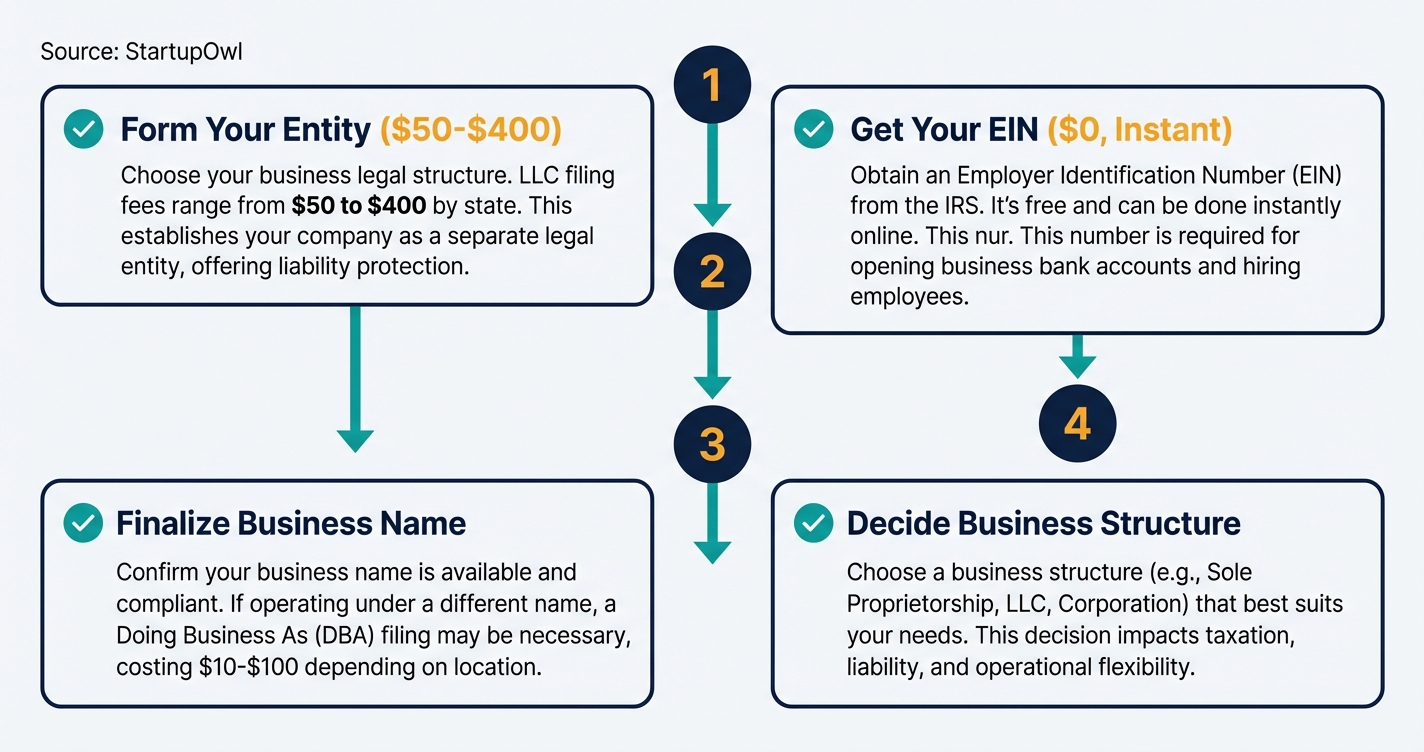
- Business entity formed. Your LLC, S Corp, or corporation should be filed with your state's Secretary of State. If you haven't done this yet, check our best LLC formation services guide. State filing fees range from $50 to $400+ depending on your state.
- EIN in hand. You can apply for an EIN online at IRS.gov for $0 and receive it instantly. You need an EIN to open a business bank account, hire employees, and file taxes.
- Business name finalized. Your legal name (on your formation documents) and any DBA ("doing business as") name should be decided. If you're using a DBA, file it with your county or state (typically $10 to $100).
- Business structure decided. Know whether you're operating as a sole proprietorship, single-member LLC, multi-member LLC, S Corp, or C Corp. This affects how you set up banking, accounting, and payroll. See our LLC vs S Corp tax comparison if you're still deciding.
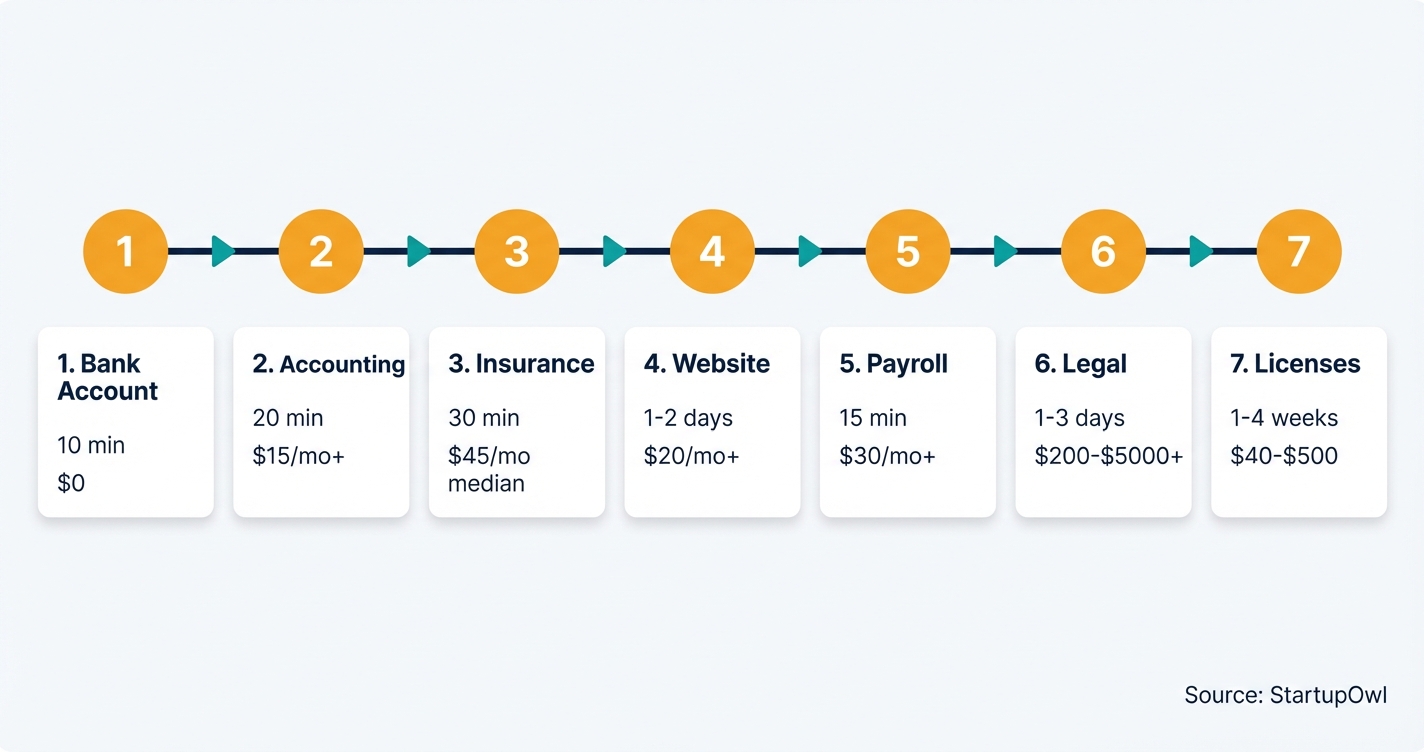
Setting up a business feels like running 7 short errands in a specific order. Most steps take under an hour, but a few (business insurance quotes, payroll state registration, and business licenses) involve waiting periods of 1 to 4 weeks.
The easiest step is opening your bank account. Mercury's online application takes about 10 minutes, and you'll typically be approved within 1 to 2 business days. The most time-consuming step is building your website, which can take anywhere from 2 hours (if you use a Squarespace template with minimal customization) to 2 weeks (if you're writing all the copy yourself and iterating on design).
The biggest frustration is usually business licensing. Requirements vary by city, county, and state, and there's no single federal database. Expect to spend 1 to 2 hours researching your specific requirements on the SBA's license finder tool and your state's Secretary of State website.
One thing founders consistently underestimate is the payroll tax registration timeline. Even though you can set up Gusto in an hour, getting registered with your state for unemployment insurance and withholding can take 2 to 4 weeks by mail (faster if your state offers online registration). Start this process the moment you know you'll hire employees.
Step-by-Step Process
- 1
Open a Business Bank Account
Your business bank account separates personal and business finances, which is critical for liability protection and clean tax records. If you're an LLC or corporation, mixing funds can pierce your corporate veil and expose personal assets. Open a dedicated business bank account before you spend a single dollar on your business.
Mercury offers a $0 monthly fee business checking account with no minimum deposit, no overdraft fees, and free domestic and international USD wire transfers. You can apply online in about 10 minutes and get approved in 1 to 2 business days. Deposits are FDIC-insured up to $5 million through Mercury's partner banks and sweep networks. If you need cash deposits, consider a traditional bank like Chase or Bank of America instead (Mercury does not accept cash).
For a full comparison of options, see our guide to the best business bank accounts.
$0 (Mercury, Bluevine, Relay) to $30/month (traditional banks) 10 minutes to apply; 1-2 business days for approval MercuryTips
- Have your EIN confirmation letter, articles of organization, and government-issued ID ready before you start the application.
- Open both a checking and savings account so you can set aside money for quarterly tax payments from day one.
- If you deal in cash regularly, skip online-only banks and open at a local branch of Chase, Wells Fargo, or a credit union.
Common Mistakes
- Using a personal bank account for business transactions, which weakens your LLC liability protection and creates a bookkeeping nightmare at tax time.
- Paying $15 to $35 per wire transfer at a traditional bank when Mercury and Relay offer free domestic wires.
- 2
Set Up Your Accounting Software
You need an accounting system from day one, not at tax time. Every dollar that flows through your business bank account should be categorized automatically so you always know your profit, expenses, and tax obligations. Waiting even 3 months to set up accounting creates hours of retroactive cleanup work (or a $300 to $500 bill from a bookkeeper to reconcile your records).
QuickBooks Online Simple Start costs $38 per month and supports one user, automated transaction categorization, basic invoicing, and receipt capture. If that's too steep, Wave offers a $0 accounting platform with invoicing and receipt scanning (you pay only for payment processing at 2.9% plus $0.60 per credit card transaction). For a broader comparison, visit our best accounting software guide.
Connect your bank account to your accounting software immediately. QuickBooks and Wave both support automatic bank feed imports, so every transaction appears in your books within 24 hours.
$0 (Wave) to $38/month (QuickBooks Simple Start) to $75/month (QuickBooks Essentials) 30-60 minutes to set up and connect your bank QuickBooksTips
- Connect your business bank account and credit card feeds on the same day you create your accounting account so you never have missing transactions.
- Set up a 'tax savings' category and automatically tag 25-30% of net income so quarterly estimated tax payments don't catch you off guard.
Common Mistakes
- Postponing accounting setup until tax season, which leads to $300 to $500 in bookkeeper cleanup fees and potential missed deductions.
- Choosing QuickBooks Plus at $115/month when Simple Start at $38/month handles everything a solo founder or small team needs in year one.
- 3
Get Business Insurance
General liability insurance protects you if a customer slips in your office, if you damage a client's property, or if someone sues for advertising injury. The average slip-and-fall claim costs $45,000, according to The Hartford's 2026 claims data. Without coverage, that's coming out of your pocket.
Small businesses pay a median of $45 per month (about $540 per year) for a standard $1 million per-occurrence, $2 million aggregate general liability policy, as of 2026 according to Insureon. Low-risk businesses like consultants pay closer to $30 to $40/month, while restaurants and retail stores with foot traffic pay $80 to $150/month. Read our guide to best business insurance for provider comparisons.
If you have a physical location, consider a Business Owner's Policy (BOP) that bundles general liability with property insurance for an average of $83 per month. For a deeper explanation, see what is general liability insurance.
$30-$45/month (low-risk) to $100-$150/month (retail/food service) 15-30 minutes to get online quotes; same-day coverage available coverwallet.comTips
- Get quotes from at least 3 providers (CoverWallet, Hiscox, and NEXT Insurance) to find the lowest rate for your industry.
- Bundle general liability with property coverage in a BOP if you rent office or retail space; the bundle typically saves 10-15% vs. buying separately.
- Pay your premium annually instead of monthly to save 5-10% at most insurers.
Common Mistakes
- Skipping insurance entirely because you think you're too small, then facing a $45,000 average slip-and-fall claim with no coverage.
- Buying a $1M/$1M policy when your lease or contract requires a $1M/$2M aggregate, which forces you to upgrade mid-year and pay a prorated increase.
- 4
Build Your Business Website
Your website is your 24/7 storefront, and you can launch a professional one for under $350 per year. Squarespace starts at $16 per month for the Basic plan (billed annually), which includes unlimited bandwidth, mobile-optimized templates, built-in SEO tools, SSL security, and a free custom domain for your first year. The Core plan at $29/month adds advanced analytics and e-commerce with 0% transaction fees.
If you need e-commerce from day one, Shopify starts at $39/month and includes payment processing, inventory management, and abandoned cart recovery. For service businesses that just need a clean online presence, Squarespace or Wix (starting at $17/month) is typically enough. See our best website builders for small business comparison.
Register your domain separately through Namecheap for about $14/year if you want to keep costs low, or use the free first-year domain included with most annual Squarespace plans. For a full walkthrough, visit how to create a business website.
$16-$29/month (Squarespace) to $39/month (Shopify); domain $0-$20/year 2-8 hours for a basic DIY site; 1-2 weeks for a polished 5+ page site SquarespaceTips
- Start with a 14-day free trial on Squarespace or Wix to build your site before you pay anything.
- Claim your Google Business Profile (free) the same week you launch your website; it helps local SEO immediately.
- Keep your launch site to 5 pages max (Home, About, Services, Contact, Blog) and add more as your business grows.
Common Mistakes
- Spending $3,000 to $5,000 on a custom-designed website before you've validated your business idea, when a $192/year Squarespace site does the job.
- Forgetting to add an SSL certificate (Squarespace includes it free), which causes browsers to show a 'Not Secure' warning and drives away visitors.
- 5
Set Up Payroll (If You Have Employees)
If you plan to hire employees (including yourself as a W-2 employee of an S Corp), you need payroll software to calculate wages, withhold federal and state taxes, file payroll tax returns, and issue W-2s. Getting payroll wrong triggers IRS penalties: the failure-to-deposit penalty alone runs 2% to 15% of the unpaid tax, depending on how late you are.
Gusto's Simple plan costs $49 per month plus $6 per employee as of March 2026. For a solo S Corp founder running monthly payroll, that's about $55/month. The Plus plan at $80/month plus $12 per employee adds multi-state payroll, time tracking, and next-day direct deposit. See our guide to best payroll services for full comparisons, and how to set up payroll for the detailed walkthrough.
If you only pay independent contractors (no W-2 employees), Gusto's Contractor-Only plan starts at $35/month plus $6 per contractor, with the base fee waived for the first 6 months.
$0 (contractor-only for 6 months) to $49-$80/month base plus $6-$12 per employee 1-2 hours for initial setup; 2-4 weeks for state tax registration GustoTips
- Register for state unemployment insurance and state withholding tax accounts before you run your first payroll; Gusto can handle this for you in most states.
- Set your payroll schedule (bi-weekly or semi-monthly) and stick to it; changing mid-year creates reconciliation headaches.
- If you're an S Corp, pay yourself a 'reasonable salary' before taking distributions to avoid IRS scrutiny.
Common Mistakes
- Classifying employees as 1099 contractors to save on payroll taxes; IRS reclassification penalties start at $50 per misclassified W-2 and can escalate to 100% of unpaid employment taxes.
- Missing quarterly payroll tax deposit deadlines, which triggers a 2% to 15% failure-to-deposit penalty from the IRS.
- 6
Hire a Registered Agent and Handle Legal Compliance
Every LLC and corporation must maintain a registered agent in the state where it's formed. The registered agent receives legal documents (lawsuits, state correspondence, annual report reminders) on your behalf during business hours. You can serve as your own registered agent for $0, but that means your home address goes on public record and you must be available at that address during all business hours.
Professional registered agent services cost $50 to $300 per year. Northwest Registered Agent charges $125/year and includes a business address, mail forwarding, and compliance alerts. For more options, see our best registered agent services comparison.
While you're handling legal compliance, file your LLC operating agreement (required in some states, strongly recommended in all). Check if your state requires an annual report or franchise tax filing, and set a calendar reminder so you don't miss the deadline and incur late fees (which run $25 to $200+ in most states).
$0 (self) to $50-$300/year (professional service) 15-30 minutes to sign up online; immediate activation NorthwestTips
- Use a professional registered agent if you work from home; it keeps your home address off public records and protects your privacy.
- Set annual calendar reminders for your state's annual report and franchise tax due dates to avoid late fees.
Common Mistakes
- Forgetting to file your annual report, which can result in administrative dissolution of your LLC and loss of liability protection.
- Using a P.O. Box as your registered agent address; most states require a physical street address.
- 7
Get Business Licenses and Permits
The licenses you need depend on your state, city, county, and industry. Almost every business needs at least a general business license from the city or county where you operate, which costs $40 to $500 depending on location. Some states (like Alaska, Delaware, and Montana) don't have a general state business license, while others (like Washington and Nevada) require one.
Use the SBA's license and permit tool to find exactly what you need based on your state and industry. Professional services (accountants, lawyers, contractors, cosmetologists) need occupational licenses from their state licensing board, which can cost $50 to $500+ and require continuing education.
If you're selling products, check whether your state requires a sales tax permit (usually free). Food service businesses need health department permits ($100 to $1,000), and home-based businesses may need a home occupation permit ($0 to $150).
$40-$500 for general business license; varies by industry 1-4 weeks depending on state and type of license SBA.govTips
- Check requirements at all three levels: city, county, and state. Missing any one of them can result in fines.
- If you sell products online across state lines, research sales tax nexus rules or use a service like TaxJar to automate compliance.
- Renew licenses before they expire; most local licenses require annual renewal, and late fees can double the cost.
Common Mistakes
- Assuming you don't need a license because you work from home; many cities require a home occupation permit even for online businesses.
- Selling products without a sales tax permit, which creates back-tax liability plus penalties when the state catches up.
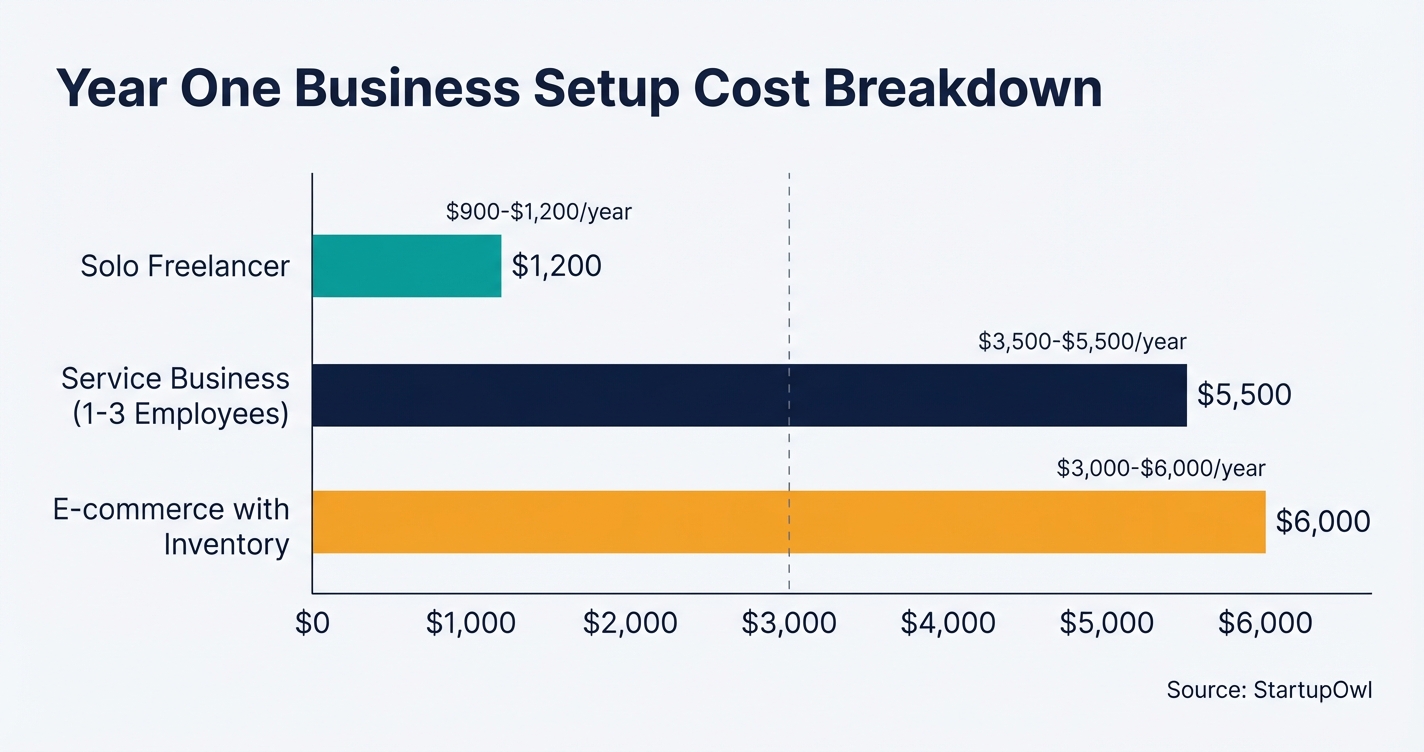
Your total first-year setup cost depends on your business type and whether you have employees. Here are three realistic scenarios.
Solo freelancer or consultant (no employees, service-based). Using Mercury ($0/month), Wave accounting ($0/month), a Squarespace Basic website ($16/month), general liability insurance ($40/month), and a registered agent ($125/year), your year-one total is roughly $900 to $1,200.
Small service business with 1-3 employees. Add QuickBooks Simple Start ($38/month), Gusto Simple payroll ($49/month + $6 per employee), and higher insurance premiums ($80/month for a BOP), and your year-one total climbs to $3,500 to $5,500.
E-commerce business with inventory. Swap Squarespace for Shopify ($39/month), add product liability insurance (an extra $200 to $600/year), and budget for sales tax compliance tools like TaxJar ($19/month), and you're looking at $3,000 to $6,000 before inventory costs.
For a detailed breakdown of every fee, see our business bank account fees guide.
Cost Breakdown
| Item | Cost Range | Notes |
|---|---|---|
| Business Bank Account | $0-$30/month | Mercury and Relay are $0/month; traditional banks like Chase charge $12-$15/month (waivable with minimum balance) |
| Accounting Software | $0-$38/month | Wave is free; QuickBooks Simple Start is $38/month as of 2026 |
| General Liability Insurance | $30-$150/month ($360-$1,800/year) | Median is $45/month per Insureon; varies by industry and location |
| Business Website | $16-$39/month ($192-$468/year) | Squarespace Basic $16/month; Core $29/month; Shopify starts at $39/month |
| Domain Name | $0-$20/year | Free first year with annual Squarespace plan; $14/year via Namecheap |
| Payroll Service | $49-$80/month base + $6-$12/employee | Gusto Simple $49 + $6/person; Plus $80 + $12/person; skip if no employees |
| Registered Agent | $0-$300/year | $0 if you serve as your own; $125/year at Northwest Registered Agent |
| Business Licenses and Permits | $40-$500 | Varies widely by state, city, and industry; SBA has a free lookup tool |
| Total Year-One Estimate (Solo, Service-Based) | $500-$3,000 | Using free bank, Wave accounting, basic insurance, Squarespace Basic, no employees |
| Total Year-One Estimate (With Employees, E-commerce) | $3,000-$8,000+ | Adds payroll, higher insurance, Shopify, and multiple licenses |
Once you've completed all 7 steps, take these follow-up actions within your first 30 days to make sure nothing falls through the cracks.
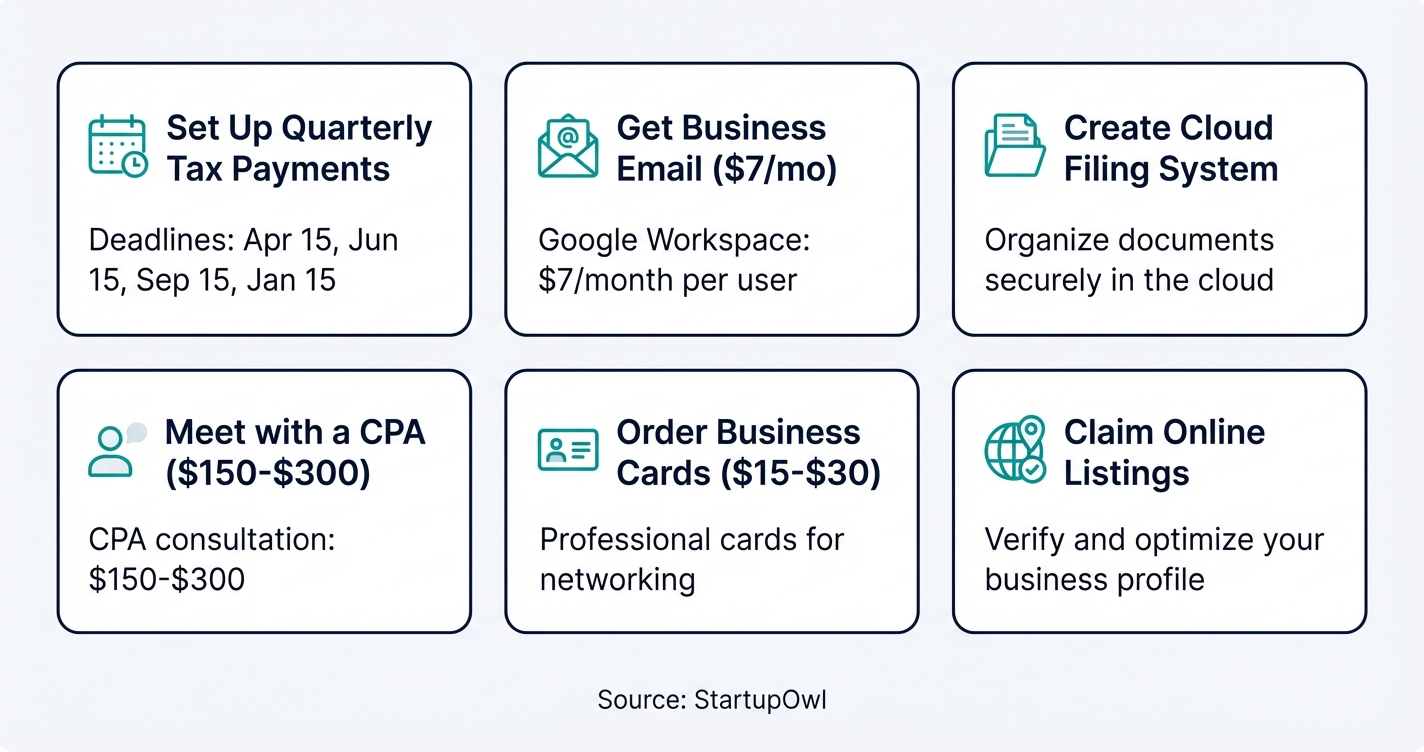
- Set up quarterly estimated tax payments. If you expect to owe more than $1,000 in federal taxes, the IRS requires quarterly estimated payments (due April 15, June 15, September 15, and January 15). Mark these in your calendar now. Use IRS Form 1040-ES to calculate your payments.
- Order business cards and branded materials. Services like Vista Print start at $15 to $30 for 250 cards.
- Set up a business email address. Google Workspace starts at $7/month per user and gives you a professional email address at your domain (e.g., [email protected]).
- Create a simple filing system. Store your EIN letter, formation documents, operating agreement, insurance certificates, and bank statements in one cloud folder (Google Drive or Dropbox). Your CPA will thank you at tax time.
- Schedule a meeting with a CPA. Even one $150 to $300 consultation in your first month can save you thousands by ensuring your entity structure, accounting method, and estimated tax payments are set up correctly.
The Complete Checklist
- Apply for your EIN on IRS.gov01
Takes 10 minutes and is completely free; you'll receive your EIN instantly online.
10 minutes$0 - Open a business bank account02
Apply at Mercury, Relay, or your local bank with your EIN letter and formation documents.
10-minute application; 1-2 days for approval$0-$30/month - Set up accounting software03
Create a QuickBooks or Wave account and connect your business bank feed.
30-60 minutes$0-$38/month - Get general liability insurance04
Get quotes from 3+ providers and purchase a $1M/$2M policy.
30 minutes for quotes; same-day coverage$30-$150/month - Register your domain name05
Secure your .com domain through Namecheap or your website builder.
5 minutes$0-$20/year - Build and launch your business website06
Use Squarespace or Wix to create at least a 5-page site (Home, About, Services, Contact, Blog).
2-8 hours for DIY$16-$39/month - Claim your Google Business Profile07
Free listing that helps you appear in local search results and Google Maps.
15 minutes$0 - Set up payroll (if you have employees)08
Sign up for Gusto or a similar service and register for state payroll taxes.
1-2 hours setup; 2-4 weeks for state registration$49-$80/month + per-employee fees - Hire a registered agent09
Sign up with Northwest or another provider to keep your address private and stay compliant.
15 minutes$0-$300/year - Get required business licenses and permits10
Use the SBA lookup tool to identify federal, state, and local requirements for your industry.
1-4 weeks$40-$500
Here are the key tools and official resources you'll need to complete every step in this guide. All links verified as of 2026.
- IRS EIN Application (Free). Apply for an EIN on IRS.gov. Available Monday through Friday, 7 AM to 10 PM Eastern.
- Mercury (Free Business Banking). mercury.com. $0 monthly fees, free USD wires, FDIC-insured up to $5M.
- QuickBooks Online ($38+/month). quickbooks.intuit.com/pricing. Simple Start plan for small businesses.
- Wave Accounting (Free). waveapps.com. Free invoicing and accounting; pay only for payment processing.
- Gusto Payroll ($49+/month). gusto.com/product/pricing. Payroll, benefits, and HR in one platform.
- Squarespace ($16+/month). squarespace.com/pricing. Website builder with templates, hosting, and domain included.
- SBA License and Permit Finder. sba.gov license finder. Free federal and state license lookup by industry.
- SBA Startup Cost Calculator. sba.gov cost calculator. Free downloadable PDF spreadsheet for budgeting.
- Northwest Registered Agent ($125/year). northwestregisteredagent.com. Privacy-focused registered agent with compliance alerts.
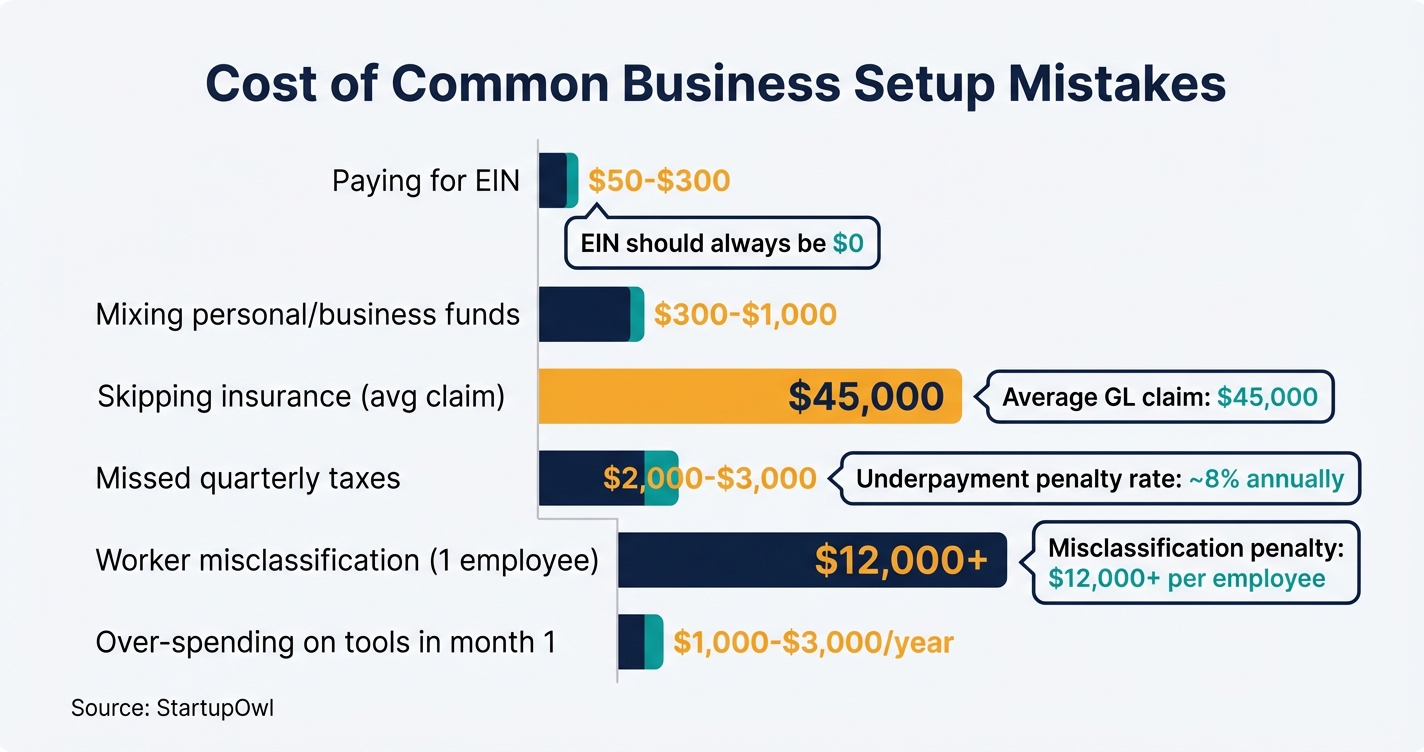
These are the most expensive mistakes founders make during business setup, along with what each one actually costs.
- Mixing personal and business bank accounts. This weakens your LLC's liability protection (called "piercing the corporate veil") and can make you personally liable for business debts. It also creates a bookkeeping mess that costs $300 to $1,000 to untangle when you file taxes.
- Skipping insurance because "nothing will happen." The average general liability claim costs $45,000. Even a dismissed lawsuit still generates $10,000 to $25,000 in legal defense costs. A $45/month policy eliminates this risk.
- Paying for an EIN. The IRS issues EINs for $0 at IRS.gov. Third-party services charge $50 to $300 for the exact same 10-minute process. Do not pay for this.
- Ignoring quarterly estimated tax payments. The IRS charges an underpayment penalty (currently around 8% annually on the unpaid amount) if you don't make quarterly payments. For a business earning $100,000 in profit, that's roughly $2,000 to $3,000 in avoidable penalties and interest.
- Classifying W-2 employees as 1099 contractors. The IRS and state labor departments aggressively pursue misclassification. Penalties include back employment taxes, a $50 per W-2 penalty, and potential 100% of the withheld taxes you should have collected. For one misclassified employee earning $50,000/year, total penalties can exceed $12,000.
- Over-spending on tools in month one. You don't need QuickBooks Advanced at $275/month, Shopify Plus at $2,300/month, or a $5,000 custom website before you've made your first sale. Start with the cheapest tier of everything and upgrade when revenue justifies it.
Frequently Asked Questions
Most service-based and online businesses can complete their full operational setup for $500 to $3,000 in year one. That covers a free bank account, accounting software ($0 to $456/year), general liability insurance ($360 to $1,800/year), a website ($192 to $348/year), a registered agent ($0 to $300/year), and business licenses ($40 to $500). Add payroll at $588 to $960/year base cost if you have employees.
You can complete the core setup steps in 5 to 10 business days. Opening a bank account takes 1 to 2 days. Accounting and insurance can be done the same day. Building a website takes 2 hours to 2 weeks depending on complexity. The slowest step is business licensing, which can take 1 to 4 weeks in some jurisdictions.
Legally, no. Practically, yes. A separate business bank account makes tax reporting dramatically easier and protects you if you're audited. Without one, you'll spend extra time (and potentially $300 to $500 in bookkeeper fees) separating personal and business transactions at year-end. If you ever convert to an LLC, you'll need one anyway.
Get your EIN from the IRS (free, instant at IRS.gov), then open your business bank account. These two steps take under 30 minutes combined and unlock everything else: accounting, insurance, payroll, and your website domain registration.
Yes. The IRS lets you deduct up to $5,000 in startup costs and an additional $5,000 in organizational costs in your first year, for a maximum $10,000 immediate deduction. Qualifying expenses include LLC filing fees, registered agent fees, business license applications, legal service fees, and pre-opening marketing. Any costs above the $5,000 threshold must be amortized over 15 years.
Your homeowner's or renter's insurance does not cover business-related claims. If a client visits your home office and is injured, or if you damage a client's property while working, you need general liability insurance. Policies for home-based consultants start at about $30 to $40 per month. That's roughly $1/day to protect against claims that average $45,000.
Mercury disclosure. Mercury is a fintech company, not an FDIC-insured bank. Banking services provided through Choice Financial Group and Column N.A., Members FDIC. FDIC deposit insurance covers the failure of an insured bank. Deposits in checking and savings accounts are FDIC-insured through Choice Financial Group and Column N.A. and their Sweep Program Network Banks. Certain conditions must be satisfied for pass-through FDIC insurance to apply.
Sources & References
- IRS - Apply for an Employer Identification Number (EIN) Online
- SBA - Calculate Your Startup Costs
- SBA - Apply for Licenses and Permits
- Mercury - Pricing
- QuickBooks Online - Pricing
- Gusto - Pricing
- Squarespace - Pricing Plans
- Insureon - General Liability Insurance Cost
- The Hartford - General Liability Insurance Cost
- NerdWallet - Best General Liability Insurance for Small Businesses
About the Author
Editor, StartupOwl
Eliot leads StartupOwl's state data research. He maintains the site's fifty state records of LLC filing fees, annual costs, processing times, and small business grant programs, checking each figure against the state office that publishes it and logging the date it was verified. Based in New Jersey, he has spent his working life in and around small businesses, and he writes for the founder who wants the real number rather than the advertised one. Every figure under his byline traces to a named source, and when a state proves a number wrong, the correction is published, not buried.
Was this article helpful?
Questions about How to set up a Business
No comments yet. Ask the first question and a member of our team will answer.
Leave a comment