
What Is a Registered Agent?
Your registered agent is the official contact between your business and the state. Here is what they do, what they cost, and whether you need one.

- All 50 states require a registered agent for LLCs, corporations, and limited partnerships.
- Professional services cost $99 to $300 per year. Serving as your own agent is free.
- P.O. boxes are prohibited in every state. Your agent must have a physical street address.
- Without a registered agent, you risk fines, default judgments, and business dissolution.
Definition
A registered agent is a person or company you designate to receive lawsuits, tax notices, and official government correspondence on behalf of your business.
First introduced: Varies by state. Most modern statutes trace to the Revised Model Business Corporation Act (1984), though the concept of a designated agent for service of process dates back much further in common law.
A registered agent is a designated person or business that receives legal and government documents on your behalf. Every LLC and corporation in the U.S. must have one. You can serve as your own agent for $0, hire a professional service for $99 to $300 per year, or use an attorney for $500+. The agent must have a physical street address in your state (no P.O. boxes) and be available during regular business hours.
Required in all 50 states for LLCs, corporations, and limited partnerships
All 50 U.S. states require LLCs, corporations, and limited partnerships to designate a registered agent before the state will accept your formation paperwork. Your registered agent is the person or company authorized to receive lawsuits, tax notices, and official government mail on behalf of your business during normal business hours. Skip this requirement, and you cannot legally form your business. Ignore it after formation, and you risk fines, default judgments, or involuntary dissolution by the state.
$0 (you serve as your own agent)
DIY Cost
$99/year–$300/year
Service Cost
$500+
Attorney Cost
A registered agent (sometimes called a statutory agent, resident agent, or agent for service of process) is the person or company officially designated to receive legal documents and government correspondence on your business's behalf. Think of your registered agent as your company's legal mailbox, except the law requires a real human to be there during business hours to sign for what comes in.
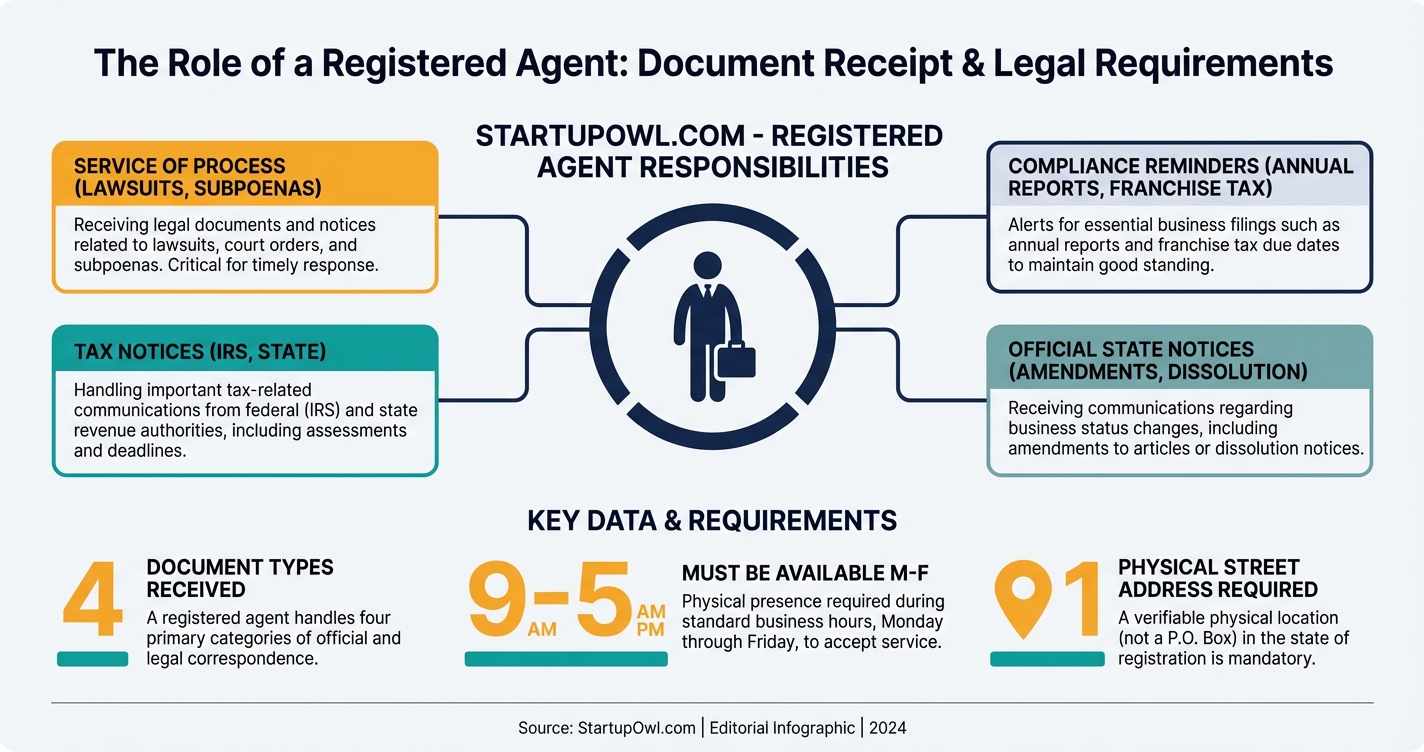
Your registered agent handles four types of documents. Service of process (lawsuits, subpoenas, and court summons) is the most critical. They also accept tax notices from the IRS and state agencies, compliance correspondence like annual report reminders and franchise tax deadlines, and official state notifications including amendments and dissolution notices.
You name your registered agent on your formation documents (Articles of Organization for an LLC, or Articles of Incorporation for a corporation) when you file with your Secretary of State. That agent's name and address become part of the public record. If you ever need to change agents, you will file a change-of-agent form with the state, which typically costs $0 to $50 depending on your state.
The core requirement is the same everywhere: your registered agent must have a physical street address in the state where your business is formed or registered, and they must be available during regular business hours (typically 9 a.m. to 5 p.m., Monday through Friday) to accept documents in person.
Yes. Every LLC, corporation, limited partnership, and limited liability partnership in all 50 U.S. states must appoint and maintain a registered agent. This is not optional. Your Secretary of State will reject your formation filing if you do not list a registered agent on your paperwork.
The requirement also applies if you register your business as a foreign entity in another state. If you form an LLC in Delaware but operate in California, you need a registered agent in both states.
Here is what happens if you fail to maintain one:
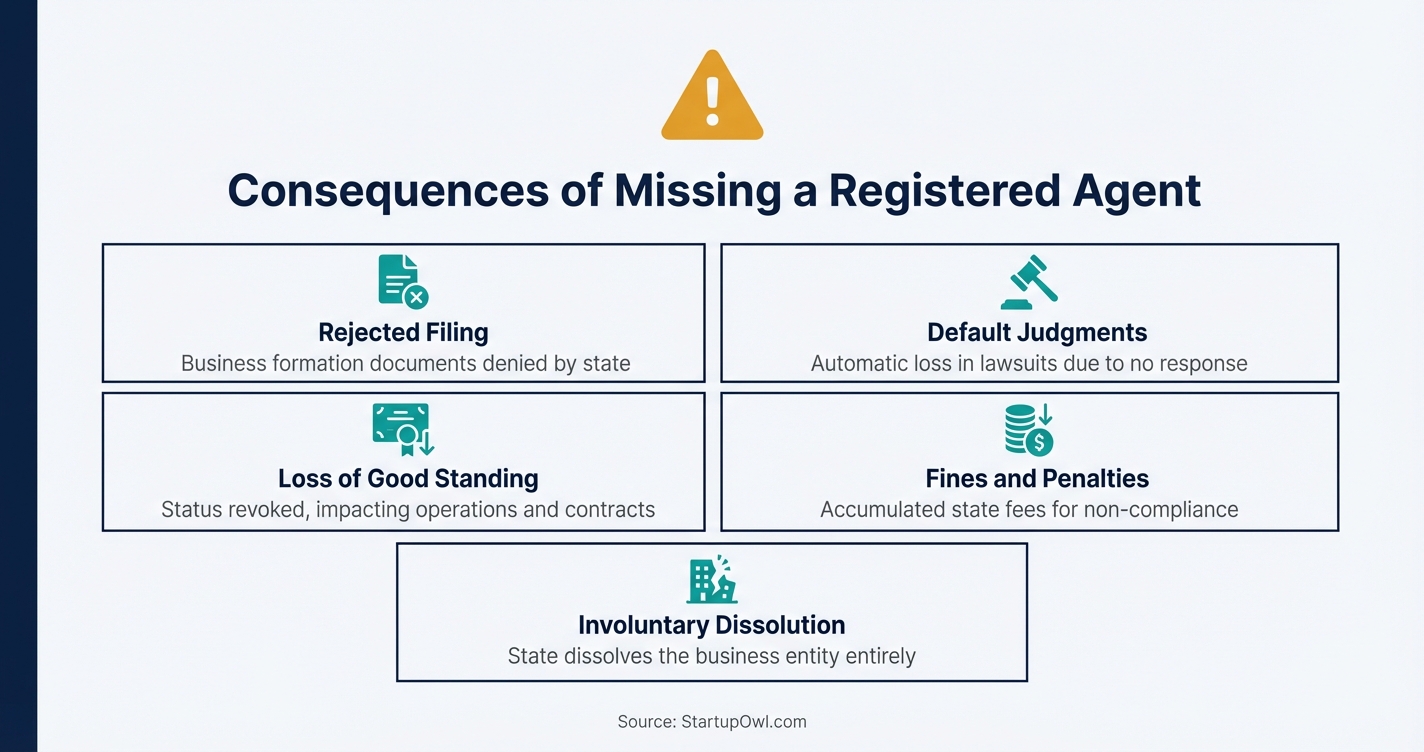
- Your formation filing gets rejected. The state will not process your Articles of Organization or Incorporation without a named agent.
- Default judgments in lawsuits. If nobody is available to accept service of process, a court can enter a judgment against your business without your knowledge. Overturning a default judgment is expensive and time-consuming.
- Loss of good standing. The state can revoke your certificate of good standing, which means you cannot obtain financing, sign contracts, or renew business licenses.
- Fines and penalties. States impose penalties for non-compliance, and some begin charging monthly.
- Involuntary dissolution. In the worst case, the state can administratively dissolve your business entity, stripping away your limited liability protection entirely.
Bottom line: if your business is an LLC, corporation, or any formal entity filing with a Secretary of State, you need a registered agent at all times.
A basic registered agent service handles one core function: receiving and forwarding legal documents and government correspondence. But most professional services include more than the bare minimum. Here is what you typically get at each price tier.
Basic tier ($99 to $150/year) includes a compliant physical in-state address, business-hours availability to accept service of process, same-day scanning and forwarding of received documents, and a secure online dashboard where you can view your documents anytime.
Mid-tier ($150 to $200/year) adds compliance reminders for annual report deadlines, franchise tax due dates, and other filing obligations. Some providers include document storage and access to state-specific formation forms pre-filled with the agent's address.
Premium tier ($200 to $300/year) often bundles registered agent service with formation filing, operating agreement templates, EIN application assistance, and ongoing compliance management. Some providers include mail forwarding and virtual office features at this level.
The registered agent fee is a tax-deductible business expense. The IRS considers it an "ordinary and necessary" expense under IRC Section 162. Single-member LLCs and sole proprietors report it on Schedule C (line 17, Legal and Professional Services). Partnerships report it on Form 1065, and corporations on Form 1120.
You have three options for appointing a registered agent. Choose based on your budget, privacy needs, and how available you are during business hours.
Option 1: Serve as your own registered agent ($0). In most states, you can name yourself as registered agent if you are at least 18 years old, have a physical street address in the state, and can be available at that address during business hours every weekday. This option costs nothing, but your home address becomes public record, and you must be present to accept documents. If you travel, work off-site, or simply want privacy, this creates problems. Whatever address you use instead still has to clear the state, the IRS, your payment processor and Google, and our guide to picking a business address for an LLC shows which address passes which check.
Option 2: Hire a professional registered agent service ($99 to $300/year). This is what most business owners do. You sign up with a commercial registered agent, and they provide a compliant physical address, handle all document receipt and forwarding, and send you compliance reminders. Providers like Northwest Registered Agent charge $125/year, while LegalZoom charges $249/year. Some providers (like Bizee) offer the first year free when bundled with LLC formation. Compare options in our best registered agent services guide.
Option 3: Use an attorney ($500+/year). If your business handles complex legal matters or you want an attorney on retainer, some law firms offer registered agent services. This is the most expensive option and is usually overkill for small businesses.
To appoint your agent, list their name and physical address on your formation documents (Articles of Organization or Incorporation) before filing with the Secretary of State. The process is instant since it happens as part of your formation filing. If you need to change your agent later, file a Statement of Change (or Certificate of Amendment, depending on your state) and pay a filing fee of $0 to $50.
The cost of a registered agent depends entirely on which route you take. Here is the full breakdown.
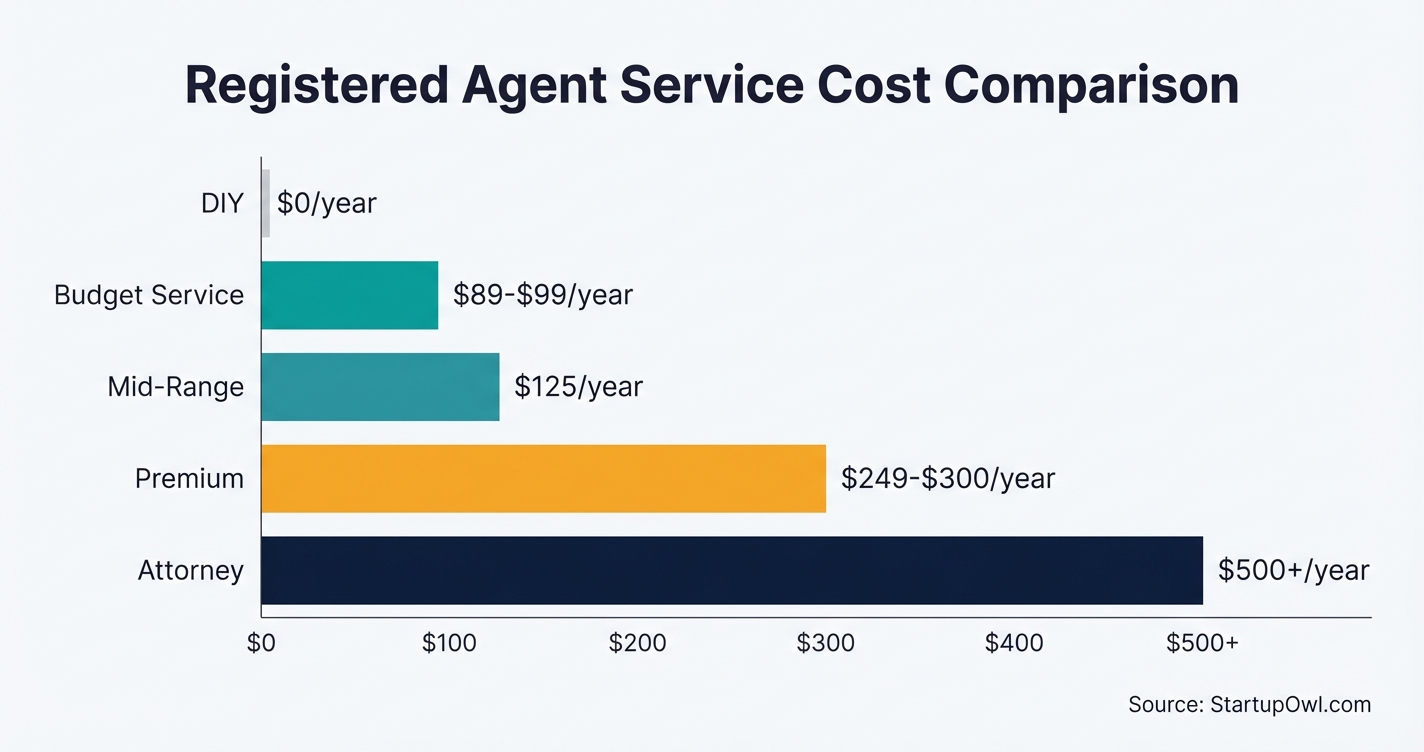
DIY (serve as your own agent): $0. If you have a physical address in your state and can be available during business hours, you pay nothing. The tradeoff is privacy exposure (your address is public record) and the risk of missing documents if you are away.
Professional services: $99 to $300 per year. This is the most common range. Budget providers like Harbor Compliance start at $89 to $99 for new customers. Mid-range services like Northwest Registered Agent charge $125/year. Premium services like LegalZoom run $249/year. Some providers offer the first year free when you bundle with LLC formation.
Attorney: $500+ per year. Law firms offering registered agent services charge a premium for the legal expertise that comes with it. This makes sense for trusts, complex multi-entity structures, or businesses in highly regulated industries.
Multi-state costs multiply. If you do business in 3 states, you need a registered agent in each one. At $125/year per state, that is $375/year. Some national providers offer multi-state discounts.
Changing your agent costs $0 to $50 in state filing fees. In Florida, the Statement of Change costs $25. In New York, a Certificate of Change costs $30. In Illinois, the filing fee is $25 for business corporations. Some states let you update your agent for free during your annual report filing.
While the core requirement (physical address, business-hours availability, receive and forward documents) is consistent across states, terminology and specific rules vary. Here is a summary for 15 key states.
| State | Official Term | Can You Be Your Own Agent? | Key Notes |
|---|---|---|---|
| California | Agent for Service of Process | Yes | Must be a CA resident. Corporations cannot be listed as their own agent. LLCs cannot be agents in CA. |
| Texas | Registered Agent | Yes | Address cannot be a mailbox or answering service. Employee must be present during business hours. |
| Florida | Registered Agent | Yes | Physical address required. P.O. boxes and virtual addresses not accepted. When agent resigns, you have 31 days to name a replacement. |
| New York | Agent for Service of Process | Yes | NY Secretary of State must be designated as agent in original formation. You can add a different agent later. Change fee is $30. |
| Delaware | Registered Agent | Yes (if in DE) | Commercial agents must hold a Delaware business license. Physical street address required. Change fee is $50 for LLCs. |
| Illinois | Registered Agent | Yes | If agent cannot be reached, IL Secretary of State may accept service. Change fee is $25. |
| Nevada | Registered Agent | Yes (noncommercial option) | All entities must appoint an agent. "Noncommercial" option lets you serve as your own. |
| Ohio | Statutory Agent | Yes (if OH resident) | Must have a physical address in Ohio. |
| Georgia | Registered Agent | Yes | Can update agent info on your annual registration filing at no extra cost. |
| Pennsylvania | Commercial Resident Office Provider (CROP) | Yes | Physical address required. Virtual addresses not accepted. |
| Washington | Registered Agent | Yes | Two types: Commercial and Non-Commercial. Physical WA address required. Agent resignation effective 31 days after filing. |
| Michigan | Registered Agent | Yes | Must designate agent when filing Articles of Organization. Physical MI address required. |
| Colorado | Registered Agent | Yes | Must be at least 18. Updated rules under HB 24-1137 (effective July 2026) tightened non-compliant agent restrictions. |
| New Jersey | Registered Agent | Yes | Must be at least 18. Must be NJ resident or registered agent service. |
| Massachusetts | Registered Agent | Yes (if 18+) | Must have physical location in-state and be present during business hours. |
| Connecticut | Registered Agent | Yes (individuals only) | An LLC may not serve as its own agent. Must be an individual or another business with a CT street address. |
Check your specific state's Secretary of State website for the most current rules and filing fees. You can find links to every state SOS through the SBA's business registration page.
Using a P.O. box as your agent address. This is prohibited in all 50 states. A registered agent must have a physical street address where documents can be hand-delivered. If you list a P.O. box, your formation filing will be rejected, and if the state discovers it later, you risk losing good standing.
Naming yourself and then being unavailable. If you serve as your own registered agent and you travel, work from a different location, or simply are not home during business hours, you can miss service of process. A missed lawsuit notice can result in a default judgment against your business, which means the court rules against you because you never responded.
Forgetting to update your agent when they resign or move. If your registered agent resigns, most states give you 30 to 31 days to name a replacement. Miss that window, and you are operating without an agent. States can impose fines and begin the administrative dissolution process.
Not designating an agent in states where you are foreign-qualified. If your LLC is formed in Delaware but operates in Texas, you need a registered agent in both states. Many business owners forget this and end up out of compliance in their operating state.
Confusing a registered agent with a business address. Your registered agent's address is specifically for receiving legal and government documents. It is not your principal business address. Using your agent's address for general business correspondence, bank accounts, or customer-facing purposes can create compliance and legal issues.
This content is for informational purposes only and does not constitute legal or tax advice. Business formation laws vary by state and change frequently. Consult a qualified attorney or CPA for advice specific to your situation before making any formation or tax election decisions.
Frequently Asked Questions
Sources & References
- SBA - Register Your Business
- IRS - Schedule C (Form 1040)
- Delaware Division of Corporations - FAQ on Registered Agents
- Delaware Code Title 8, Chapter 1, Subchapter III (Registered Agents)
- Illinois Secretary of State - Corporation Registered Agent Change
- Washington Secretary of State - Registered Agents
- Florida Division of Corporations - LLC Statutes
About the Author
Editor, StartupOwl
Eliot leads StartupOwl's state data research. He maintains the site's fifty state records of LLC filing fees, annual costs, processing times, and small business grant programs, checking each figure against the state office that publishes it and logging the date it was verified. Based in New Jersey, he has spent his working life in and around small businesses, and he writes for the founder who wants the real number rather than the advertised one. Every figure under his byline traces to a named source, and when a state proves a number wrong, the correction is published, not buried.
Was this article helpful?
Questions about this guide
No comments yet. Ask the first question and a member of our team will answer.
Leave a comment