
Business Bank Account Fees and How to Avoid Them
Every fee a business checking account can charge, from the monthly fee to the wire and cash deposit charges nobody advertises, checked at the source.

Business checking costs $0 to $75 a month. The spread is real. Mercury, Bluevine, Found, Novo and Relay all charge $0 a month with no minimum balance. Wells Fargo Initiate Business Checking charges $15 a month unless you keep $2,000 in the account. Add overages and cash fees and a traditional account can pass $1,000 a year.
A business checking account can cost you nothing or it can cost you $1,200 a year. The monthly fee is the part everyone looks at. It is rarely the part that hurts. Transaction overages, cash deposit charges and wire fees do the real damage, and they sit in a PDF nobody opens. Every number on this page came from the bank's own fee schedule in July 2026.
What a business bank account really costs
A business checking account costs $0 to $75 a month in fees alone, before a single transaction. Three things set your total. Who you bank with, how many transactions you run, and whether you touch cash. The monthly fee is the smallest of the three.
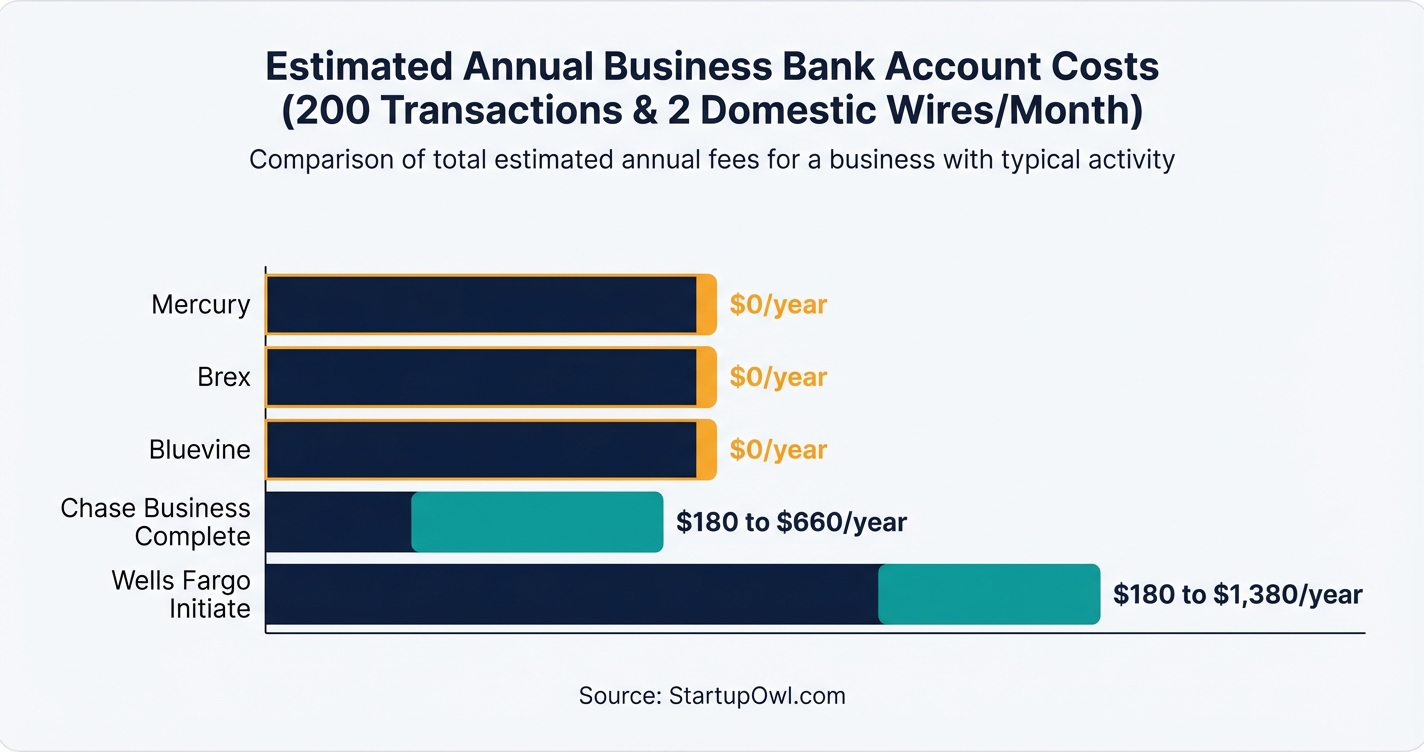
At Wells Fargo, Initiate Business Checking charges $15 a month. That is $180 a year. You can avoid it with a $2,000 minimum daily balance or $5,000 in average combined business deposits. Navigate Business Checking charges $25, waived at a $10,000 daily balance. Optimize Business Checking charges $75 and covers up to five linked accounts.
Chase Business Complete Banking sits in the same place at $15 a month. A $2,000 minimum daily ending balance clears it. So does $2,000 in eligible card purchases. Miss the balance by a dollar and you pay.
Mercury, Bluevine, Found, Novo and Relay all charge nothing per month and hold no minimum. The gap is real money. A fee you forget to waive costs $180 a year, every year. Our business bank account comparison lines the providers up side by side.
Free accounts that are actually free
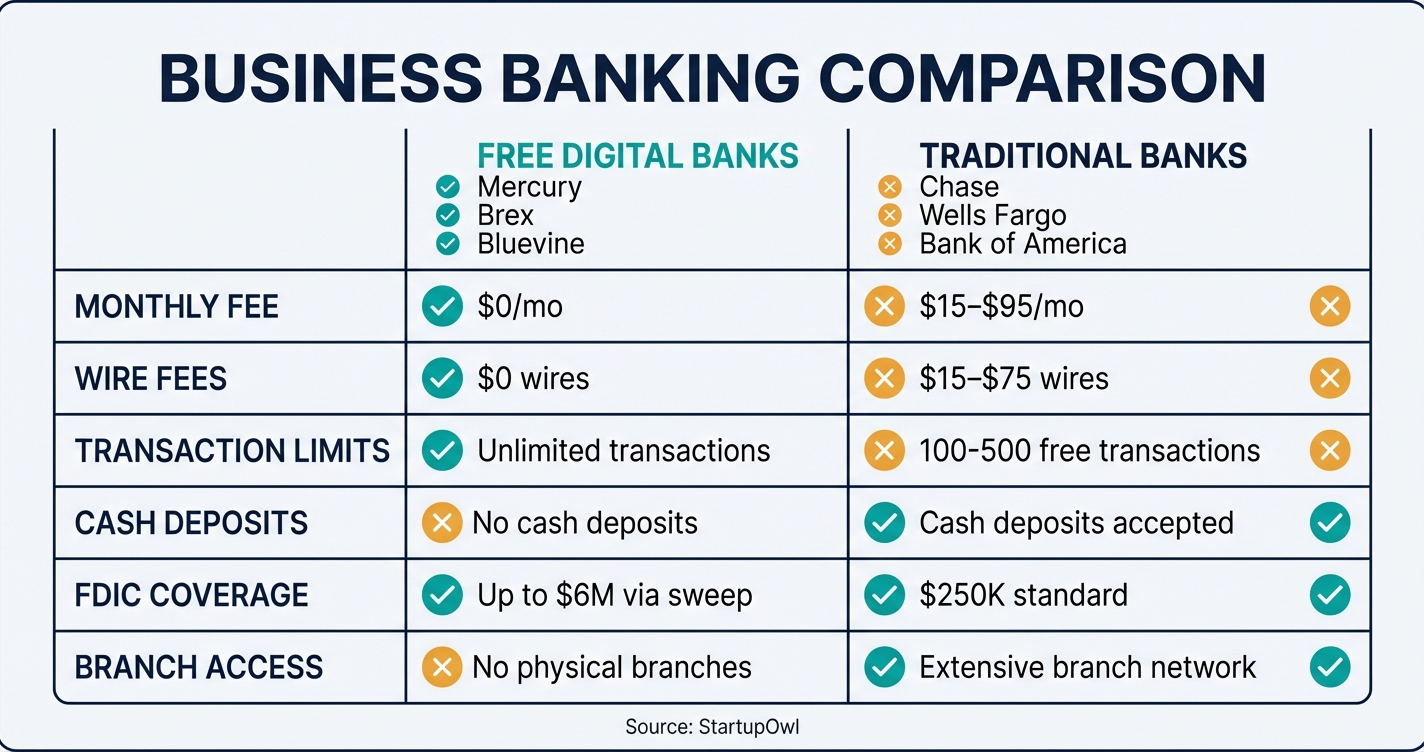
Five accounts on our roster charge $0 a month with no minimum balance and no overdraft fee. None of them is a stripped down account. Each has one real trade off.
- Mercury charges nothing monthly and nothing for ACH. USD international wires are free, or $15 if you want intermediary fees charged back to Mercury. Non-USD wires carry a 1% conversion fee. Treasury opens at a $250,000 balance. Mercury is a financial technology company, not a bank. Deposits sit at Choice Financial Group and Column N.A.
- Bluevine charges no monthly fee, no overdraft fee and no in-network ATM fee. Transactions are unlimited and standard ACH is free. Deposits are insured to $3 million through Coastal Community Bank and its program banks. The Standard plan pays 1.3% if you spend $500 on the debit card or take in $2,500 a month. Bluevine is a financial technology company, not a bank. There are no branches.
- Found is built for freelancers and it takes cash and check deposits, which most fintech accounts do not. Bookkeeping and tax tools are included free. Domestic wires cost $15. Paper checks cost $1 each. Banking is through Lead Bank and coverage is the standard $250,000.
- Novo charges no monthly service fee, sets no minimum balance and caps no transactions. Standard next-day ACH is free and unlimited, mailed checks are free, incoming wires are free, and Novo reimburses up to $7 a month of third-party ATM fees at home and abroad. Then comes the trade off. An outgoing domestic wire runs up to $45, which is dearer than most branch banks charge, and same-day ACH costs 1.5% of the transfer with a $0.50 floor and a $20 ceiling. Novo takes no cash deposits at all. It is a financial technology company, not a bank, deposits sit at Middlesex Federal Savings and coverage is the standard $250,000.
- Relay is the cheapest of the five for actually moving money. The free Starter plan sends a domestic wire for $8 and a same-day ACH for $5, sends standard ACH and mailed checks free, and receives ACH, domestic wires, international wires and mobile check deposits for nothing. You also get 20 checking accounts to split money across, which is why bookkeepers like it. Cash is easy too. It goes in free at an Allpoint ATM or costs up to $4.95 at a Green Dot retailer. Relay is a financial technology company, not a bank, banking runs through Thread Bank, and its sweep programme carries coverage to $3 million per business.
Notice the gap. A single domestic wire costs nothing at Mercury and up to $45 at Novo, and that $45 is bigger than most monthly fees on this page. If you send wires, the wire price decides the account, not the monthly fee.
The trade off all five share is branches. There are none. If you need a teller, you will keep a second account somewhere with a lobby. Our explainer on business versus personal accounts covers why the split matters.
What the paid tiers get you
A paid account buys three things. A branch, cash handling, and a lending relationship. Here is what each tier costs at Wells Fargo and Chase as of July 2026.
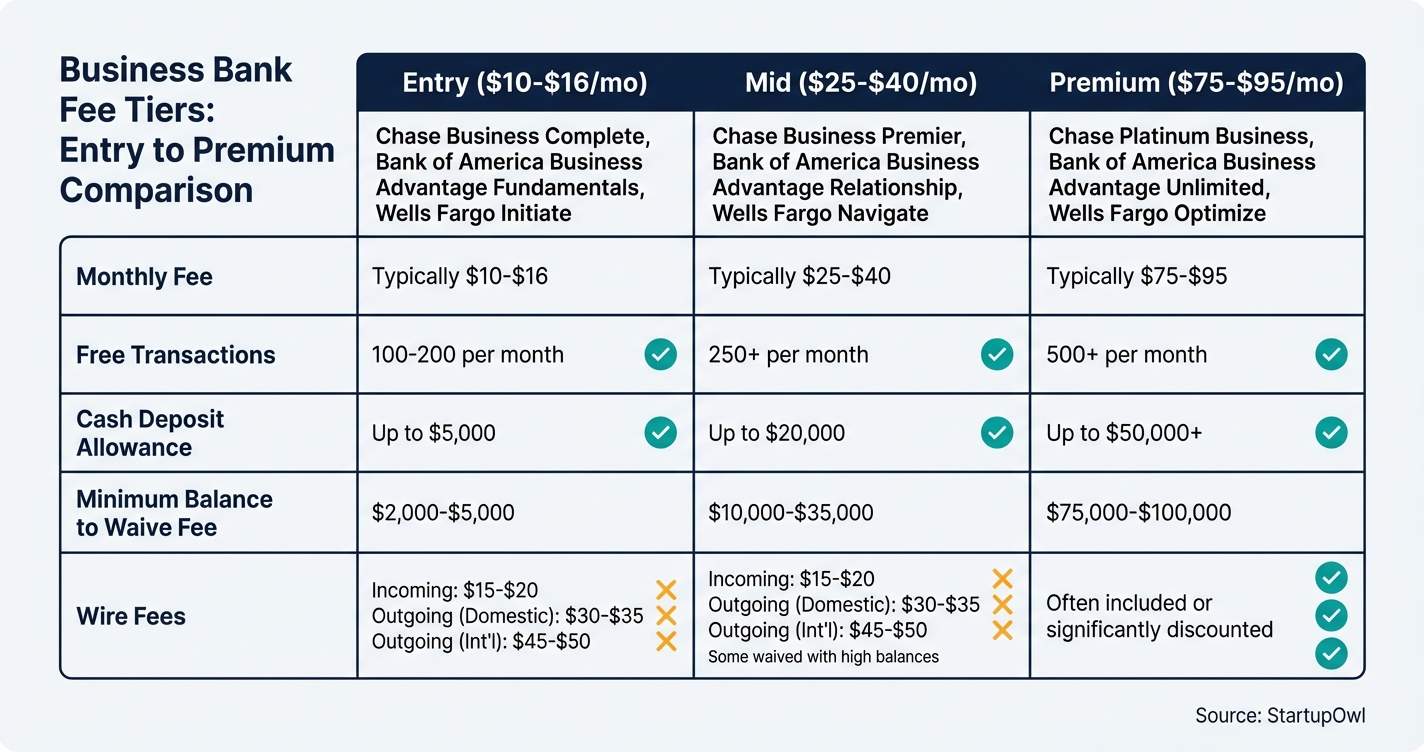
Entry tier, $15 a month
- Wells Fargo Initiate Business Checking. $15 a month, waived by a $2,000 minimum daily balance or $5,000 in average combined business deposits. You get 100 transactions a month, then $0.50 each. Cash deposits are free to $5,000, then $0.30 per $100.
- Chase Business Complete Banking. $15 a month, waived by a $2,000 minimum daily ending balance. It includes up to 20 checks and teller transactions and $5,000 of in-branch cash deposits each statement cycle. Card acceptance is built in.
Middle tier, $25 a month
- Wells Fargo Navigate Business Checking. $25 a month, waived by a $10,000 minimum daily balance or $15,000 in average combined deposits. Transactions rise to 250 and free cash deposits rise to $20,000 a month. It pays interest.
Top tier, $75 a month
- Wells Fargo Optimize Business Checking. $75 a month for up to five linked accounts, then $30 per extra account. There is no balance waiver. An earnings allowance on your balance offsets the fee instead.
The math is short. If you cannot hold the waiver balance every single month, a free account saves you $180 to $900 a year in monthly fees alone.
The fintech version of a paid tier
Relay sells the same upgrade idea without the branch, and it prices it against transactions rather than tellers. Grow costs $30 a month and Scale costs $90, cut from $120 on a discount that was running when we checked in July 2026. Both come with a 14 day trial. What the money buys is cheaper movement. A domestic wire falls from $8 to $5. A same-day ACH falls from $5 to $3, then to $1 on Scale with ten of them free every month. A SWIFT international wire falls from $25 to $22 and then $20, and a local network international payment falls from $5 to $1.50. Scale also lifts you from 20 checking accounts to 50.
Run the arithmetic before you upgrade, because it is unusually easy here. At four wires and a dozen same-day ACH payments a month, Grow saves about $36 against Starter and costs $30, so it pays for itself. Scale at the same volume saves about $70 and costs $90, so it does not. Count your wires first. The upgrade that works is the one your payment volume already justifies.
How to pay less
Most founders can cut their banking cost to zero. These seven moves do it, in the order that pays best.
- Move your main account to a free provider. Mercury, Bluevine, Found, Novo and Relay Starter charge $0 a month with no minimum. That alone saves $180 to $900 a year. That is the big one. Add the ACH and overage fees you stop paying.
- Match the account to your wire habit. This is the fee nobody budgets for. A domestic wire costs $0 at Mercury, $8 at Relay Starter, $15 at Found and up to $45 at Novo. Four wires a month is the difference between $0 and $2,160 a year, on accounts that all advertise the same $0 monthly fee.
- Keep the bank account for cash only. If you take cash, hold one traditional account for deposits. Chase includes $5,000 of in-branch cash a cycle. Sweep the rest to your free account.
- Use ACH instead of wires. Standard ACH is free at all five free providers. Same-day ACH is not, it runs $5 at Relay Starter and 1.5% capped at $20 at Novo. If the money can wait a day or two, send standard.
- Set a balance alert above the waiver line. Wells Fargo waives its $15 fee at a $2,000 daily balance. Alert yourself at $2,500. Missing the line by a dollar costs the full fee.
- Count your transactions before you pick a tier. Wells Fargo Navigate costs $10 more a month than Initiate and includes 150 more transactions. At $0.50 each, the upgrade pays for itself past 120 transactions. Count first.
- Ask your current bank for a review. Fee waivers and transaction limits are set per relationship. A year of steady deposits is a reason to call and ask. The worst answer is no.
Ready to switch? Our guide on how to open a business bank account lists the documents to have ready first.
Bank charges are only half your cost of handling money. If you take cards, the processor takes a percentage plus fixed cents on every sale, and at a small average ticket those cents cost more than any monthly bank fee. Our guide to credit card processing fees works out what you actually pay per sale.
When a free account stops working
Free accounts work until one of five things happens. Each has a number attached.
- Your cash volume passes the free limit. Wells Fargo Initiate covers $5,000 a month. Navigate covers $20,000 for $10 more a month. Above that, the $0.30 per $100 charge beats the upgrade every time.
- Your balance passes $250,000. Standard FDIC insurance covers $250,000 per depositor, per insured bank, per ownership category. Bluevine extends coverage to $3 million through its program banks, and Relay reaches the same $3 million through Thread Bank's sweep to program banks. Confirm your own number with your provider before you rely on it.
- You need to borrow. Banks lend to customers they can see. If you plan to apply for an SBA loan within a year, $180 a year of deposit history is cheap groundwork.
- You pass 250 transactions a month. That is the ceiling on Wells Fargo Navigate. Either move to a provider with no cap, or budget $0.50 per transaction over it.
- Your idle cash starts earning nothing. Mercury opens Treasury at $250,000. Bluevine pays 1.3% on its free plan when you meet the monthly activity goal, and up to 3.0% on paid plans.
Read our checklist on how to open a business bank account before you move anything.
Full Cost Breakdown
| Item | Cost Range | Notes |
|---|---|---|
| Monthly maintenance fee | $0 to $75 | Free at Mercury, Bluevine, Found, Novo and Relay Starter. Wells Fargo runs $15 to $75 by tier. |
| Outgoing domestic wire | $0 to $45 | Free at Mercury. Relay charges $8 on Starter and $5 on its paid plans. Found charges $15, or $10 on Pro. Novo charges up to $45. |
| Same-day ACH transfer | $0 to $20 | Relay charges $5, $3 or $1 by plan, with ten free a month on Scale. Novo charges 1.5% of the transfer, minimum $0.50 and maximum $20. |
| Standard ACH transfer | $0 | Free at Mercury, Bluevine, Found, Novo and Relay. Next day or one to two days, not same day. |
| Outgoing international wire in USD | $0 to $25 | Mercury sends USD wires free, or $15 to have intermediary fees charged back. Relay charges $25 on the SWIFT network, down to $20 on Scale, and $5 or less on local networks. |
| Currency conversion | 1% and up | Mercury charges a flat 1% on non-USD wires. Relay starts at 1%. Banks set their own rate and markup. |
| Transaction over the monthly limit | $0 to $0.50 each | Wells Fargo includes 100 on Initiate and 250 on Navigate. Bluevine and Novo do not cap transactions. |
| Cash deposit at a bank branch | $0 to $0.30 per $100 | Chase includes $5,000 in branch a cycle. Wells Fargo charges $0.30 per $100 over its limit. |
| Cash deposit on a fintech account | $0 to $4.95 | Relay is free at an Allpoint ATM and up to $4.95 at a Green Dot retailer. Found takes cash and checks. Novo takes no cash at all. |
| Overdraft | $0 to $35 | Wells Fargo charges $35 an item, four a day maximum. Mercury, Bluevine and Relay charge nothing. |
| Non-network ATM withdrawal | $0 to $5 | Wells Fargo charges $3 in the US and $5 abroad. Novo charges nothing and reimburses up to $7 a month of operator fees. Relay charges nothing and Allpoint withdrawals are free. |
| Debit card purchase in another currency | 3% | Wells Fargo adds 3% of the US dollar amount on foreign currency purchases. |
| Paper check sent for you | $0 to $1 | Found charges $1 a check on its free plan and nothing on Pro. Novo and Relay mail checks free. |
| Express check deposit | up to 2% | Novo charges up to 2% of the check amount, minimum $0.50, to release funds early. Standard deposits are free. |
| Stop payment | $30 | Wells Fargo charge, same for a paper item or an ACH item. |
What to prioritize by business type
The right account depends on how money actually moves through your business. Six common shapes.
Freelancers and solo consultants
You run few transactions and rarely touch cash. Your account should cost $0. Found is built for this, with bookkeeping and tax tools included. Mercury suits you if you keep banking and books apart. Expect to pay nothing.
Ecommerce businesses
Payouts from processors arrive constantly. Transaction caps are your enemy. Bluevine does not cap transactions and Mercury does not either. Watch the 1% Mercury conversion fee if you settle in another currency.
Brick and mortar retail
Cash is your biggest fee risk. Chase includes $5,000 of in-branch cash a cycle. Wells Fargo Navigate includes $20,000 for $25 a month. Pair one of them with a free account for everything that is not cash.
Restaurants and food service
You have the retail cash problem plus daily card settlements. Wells Fargo Navigate fits both, with 250 transactions and $20,000 in free cash deposits. Both problems, one account. The $25 fee disappears at a $10,000 balance.
Professional services
Wires are your cost driver, not transactions. Ten domestic wires a month costs nothing at Mercury, $80 at Relay Starter, $150 at Found and up to $450 at Novo. Same monthly fee, wildly different bill. Check your state bar rules first, some require client trust accounts at a chartered bank.
Multiple entities or Profit First budgeting
If you split income across buckets, the cost that bites is per account, not per month. That changes the shortlist. Relay gives you 20 checking accounts on its free plan and 50 on Scale, and Found includes 10 sub-accounts it calls Pockets. Wells Fargo Optimize covers five linked accounts for $75 a month and charges $30 for each one after that, so matching Relay's twenty accounts would mean fifteen extra at $30 each, about $6,300 a year against $0.
For the wider setup picture, see our business setup guide.
Frequently Asked Questions
Monthly fees run $0 to $75. Mercury, Bluevine, Found, Novo and Relay Starter charge nothing and hold no minimum balance. Wells Fargo Initiate and Chase Business Complete both charge $15 a month, waived at a $2,000 daily balance. Wells Fargo Navigate is $25 and Optimize is $75. Relay sells paid tiers at $30 and $90 that buy cheaper transactions rather than branch access. Figures checked at each provider's own fee schedule in July 2026.
It depends on whether you send wires. On monthly fee alone, five accounts tie at $0. On money movement they split hard. Mercury is the only one that sends a domestic wire for nothing, Relay Starter charges $8, and Novo charges up to $45 on the same $0 monthly plan. A business sending four wires a month pays about $32 at Relay and $180 at Novo. Traditional banks rarely win unless you deposit cash.
Banks file a Currency Transaction Report with FinCEN when a customer moves more than $10,000 in cash in or out in one business day. It is not a fee. It is a reporting duty on the bank, not a cap on what you may deposit, and splitting deposits to stay under it is a federal offence on its own. It matters on a fees page because cash heavy businesses need a branch account, and branch accounts carry the monthly fees.
Transaction overages and cash deposit processing. Wells Fargo Initiate includes 100 transactions, then charges $0.50 each, so 300 transactions a month costs $1,200 a year. Cash above the free limit costs $0.30 per $100. Overdrafts run $35 an item, up to four a day. None of it appears on the product page.
Close to it. Mercury, Bluevine and Found charge $0 a month, no minimum balance and no overdraft fee. ACH is free at all three. You will still meet fees for some things. Found charges $15 a domestic wire and $1 a paper check, and Mercury adds 1% on non-USD wires. The real trade off is that none of them has branches.
The standard amount is $250,000 per depositor, per insured bank, for each ownership category. Some fintech providers spread deposits across partner banks to raise that. Bluevine states coverage up to $3 million through Coastal Community Bank and its program banks. Mercury, Bluevine and Found are technology companies, not banks, so your coverage depends on the partner bank. Confirm your figure with the provider.
Yes. Bank fees on a business account are ordinary business expenses, so maintenance fees, wire fees and transaction fees are generally deductible. Keep them categorized through the year rather than hunting them in January. Your accounting software can tag them automatically. Ask a licensed CPA about your own return, since this is general information and not tax advice.
Use cash volume to decide. If you deposit cash, need a teller, or plan to borrow, a traditional account at $15 a month is worth it. If your money moves by ACH and card, a free account saves $180 to $1,200 a year. Plenty of founders run both. One free account for daily work, one bank account for cash.
Sources & References
- Mercury business banking pricing
- Bluevine business checking, fees and FDIC coverage
- Found plans and fee footnotes
- Wells Fargo Initiate Business Checking fee schedule, effective July 1 2026
- Wells Fargo Navigate Business Checking fee schedule, effective July 1 2026
- Wells Fargo business checking accounts and monthly fees
- Chase Business Complete Banking account terms
- FDIC deposit insurance coverage limits
- Novo fee list, transaction fees and ATM reimbursement
- Novo fee schedule
- Relay plans, transaction fees and FDIC coverage
About the Author
Editor, StartupOwl
Eliot leads StartupOwl's state data research. He maintains the site's fifty state records of LLC filing fees, annual costs, processing times, and small business grant programs, checking each figure against the state office that publishes it and logging the date it was verified. Based in New Jersey, he has spent his working life in and around small businesses, and he writes for the founder who wants the real number rather than the advertised one. Every figure under his byline traces to a named source, and when a state proves a number wrong, the correction is published, not buried.
Was this article helpful?
Questions about Business Bank Account Fees
No comments yet. Ask the first question and a member of our team will answer.
Leave a comment