
How to Dissolve an LLC
A step-by-step guide to dissolving your LLC the right way, with exact costs, timelines, and state-specific filing details.

In This Article
- State dissolution filing fees range from $0 (California) to $220 (Delaware).
- File a final federal tax return and check the "Final return" box with the IRS.
- Expect the full process to take 2 to 6 months from vote to completion.
- Unpaid franchise taxes keep accruing until you formally dissolve.
8
Total Steps
$0–$220
Est. Total Cost
2 to 6 months
Timeline
Moderate
DIY Difficulty
Closing your LLC is not as simple as locking the door and walking away. If you skip the formal dissolution process, your state keeps charging annual fees and your tax obligations keep piling up. In California alone, that means $800 per year in franchise tax until you properly cancel.
This guide walks you through every step of dissolving an LLC, from the member vote through the final IRS filing. You will find exact costs, timelines, and the specific forms you need in the five highest-traffic states.
Dissolving is not the only exit. If someone would rather buy the business than watch it close, the tax outcome is a different shape entirely, and how a sale price gets split on Form 8594 is where most of that difference is decided. Where the buyer is your own co-owner, the split is different again, see buying out a business partner in an LLC.
Before you file anything, gather these documents and complete these tasks. Skipping a prerequisite can delay your dissolution by weeks or months.
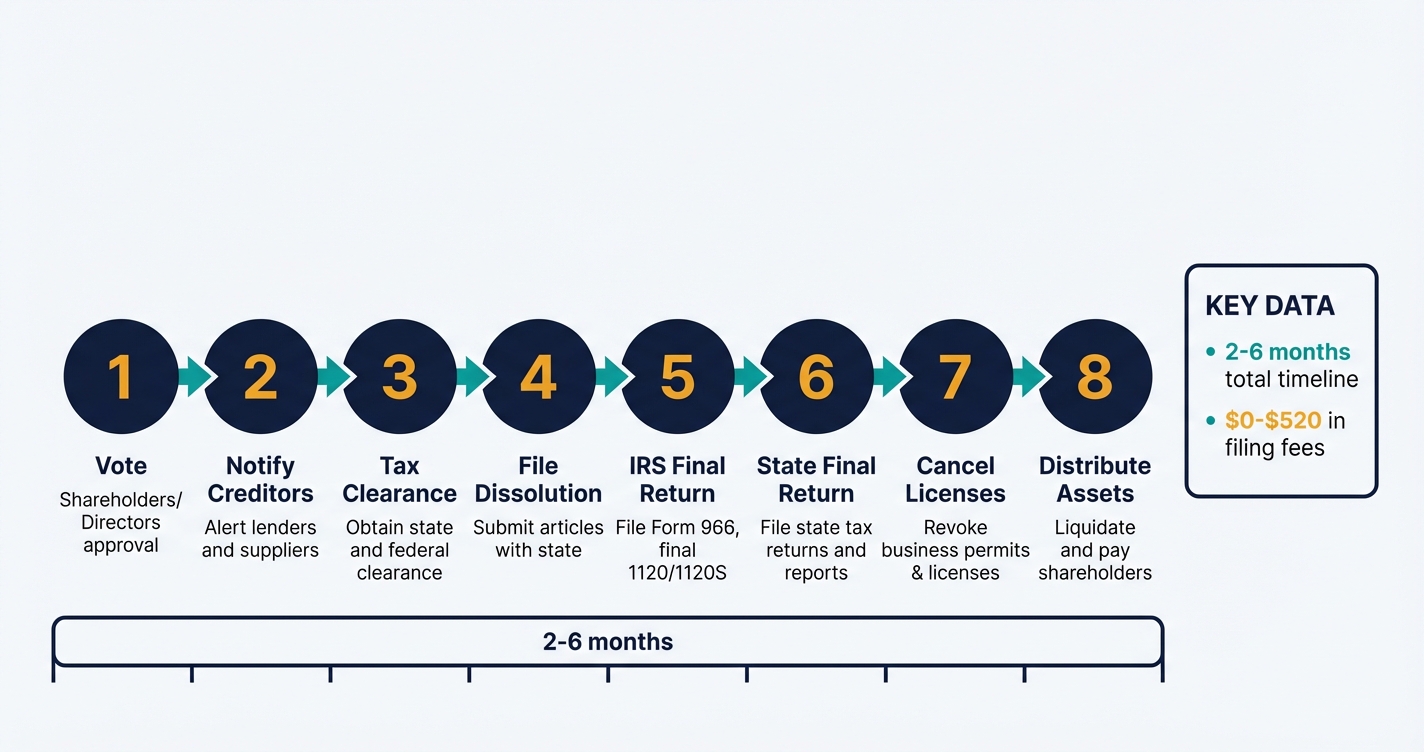
Your pre-dissolution checklist:
- A copy of your LLC's operating agreement (check for dissolution procedures, voting thresholds, and distribution rules)
- Your LLC's Articles of Organization (you will need the exact entity name and file number from your state)
- A list of all known creditors with mailing addresses and outstanding balances
- Your most recent federal and state tax returns
- Your LLC's EIN confirmation letter from the IRS
- Access to your business bank accounts and credit lines
- A list of every state where your LLC is registered as a foreign entity (check your records or search each state's SOS database)
- Any active business licenses, permits, or DBA registrations
If you are a single-member LLC with no debts, no employees, and only one state registration, this process is straightforward and you can likely handle it yourself in a few hours. If you have multiple members, outstanding debts, or registrations in several states, consider hiring a professional dissolution service or CPA to avoid costly mistakes.
Step-by-Step Process
- 1
Vote to Dissolve and Document the Decision
Before you file anything with the state, your LLC members need to formally agree to dissolve. Check your operating agreement first. It likely spells out the exact voting threshold (unanimous, majority, or two-thirds) and any notice requirements for a dissolution vote.
If your operating agreement is silent, your state's default LLC act applies. Most states require a majority vote of all members. In Delaware, the default threshold is two-thirds of membership interests. For single-member LLCs, you do not need a formal vote, but you should still put the decision in writing and date it.
- Draft a written resolution recording the vote, the date, and the signatures of all consenting members
- Keep meeting minutes or a signed consent form in your LLC records
- Store these documents for at least 4 years in case of audit
This resolution is a prerequisite for your state filing. Some states (including California) will reject your dissolution form without it.
$0Same day to 1 week Internal LLC records (no state filing required for this step)Common Mistakes
- Skipping the written resolution and later having no proof of member consent
- Not checking the operating agreement for a specific voting threshold before proceeding
- Failing to notify all members of the dissolution vote, which can trigger legal disputes
- 2
Settle Debts and Notify Creditors
Once the vote passes, your LLC enters a "winding up" period. During this time, you can only conduct business activities related to shutting down. Your first priority is notifying every known creditor in writing. Most states give creditors 90 to 120 days to submit claims against the LLC.
Send a written notice to each creditor that includes your LLC's name, the dissolution date, a mailing address for claims, and a deadline for submitting them. Pay all valid debts with LLC assets before distributing anything to members. If you pay members before creditors, courts can reverse those distributions and hold members personally liable.
- In Delaware, creditors must be paid before any distributions to members per Section 18-804 of the Delaware LLC Act
- Keep copies of every creditor notification and proof of payment
- If debts exceed assets, consult a business attorney before proceeding
$0 (plus whatever you owe creditors)90 to 120 days for creditor claim period Direct written notice to each creditor (no state filing)Common Mistakes
- Distributing assets to LLC members before paying all creditor claims
- Failing to send written notice to all known creditors, which leaves you open to future lawsuits
- Not setting a clear deadline for creditor claims in the notification letter
- 3
Obtain Tax Clearance (If Your State Requires It)
Some states will not accept your dissolution filing until you prove all taxes are paid. Texas is the most notable example. You must obtain a Certificate of Account Status from the Texas Comptroller using Form 05-359 before filing your Certificate of Termination. Processing can take over one month, so start early.
Other states that require some form of tax clearance before dissolution include Illinois, Kansas, and Minnesota. New York does not require tax clearance for LLCs (only for corporations). California does not require a separate tax clearance certificate, but your dissolution form includes a statement that all final tax returns have been (or will be) filed with the Franchise Tax Board.
- Texas: File Form 05-359 by mail to the Comptroller of Public Accounts, P.O. Box 149348, Austin, TX 78714-9348
- California: No separate clearance needed, but you must certify tax compliance on the cancellation form
- Florida, New York, Delaware: No formal tax clearance required for LLCs
$0 (no fee for tax clearance certificates)1 to 6 weeks depending on state State Comptroller or Department of Revenue (varies by state)Common Mistakes
- Trying to file dissolution in Texas without the Comptroller's Certificate of Account Status attached
- Assuming all states require tax clearance when many (including New York and Florida) do not for LLCs
- 4
File Articles of Dissolution with Your State
This is the core filing that formally ends your LLC's existence. The form name varies by state, so pay attention to exactly what your Secretary of State calls it. Filing fees range from $0 to $220 across all 50 states.
Here is what you need in the five highest-traffic states:
- California: File Certificate of Cancellation (Form LLC-4/7) with the Secretary of State. If the vote was not unanimous, also file Certificate of Dissolution (Form LLC-3). No filing fee. Processing takes 3 to 4 weeks by mail; hand-delivery in Sacramento costs $15. Download forms here.
- Texas: File Certificate of Termination with the Secretary of State. Filing fee is $40. Attach the Comptroller's tax clearance certificate. File online via SOSPortal.
- Florida: File Articles of Dissolution with the Division of Corporations. Filing fee is $25. File online at Sunbiz.org.
- New York: File Articles of Dissolution with the Department of State within 90 days of the dissolution vote. Filing fee is $60. Expedited processing is available for an additional $25 to $150. File here.
- Delaware: File Certificate of Cancellation with the Division of Corporations. Filing fee is $220. You must also pay all outstanding franchise tax ($300/year) before filing. The franchise tax is not prorated, so dissolving on January 2 means you owe the full year.
$0–$220 (state filing fee)1 to 4 weeks for processing Secretary of State (or equivalent) in your state of formationCommon Mistakes
- Filing the wrong form (California has three different dissolution/cancellation forms depending on your situation)
- In Delaware, filing the Certificate of Cancellation without paying all outstanding franchise taxes first (it will be rejected)
- In New York, missing the 90-day filing deadline after the dissolution vote
- 5
File Final Federal Tax Returns and Form 966 with the IRS
The IRS does not care what your state calls this. It cares how you are taxed. Two federal filings close an LLC, the final return and, for some LLCs, Form 966 within 30 days of the vote. Most guides name only the first.
Check the "Final return" box on whichever return you file. That box does the closing. Miss it and the IRS keeps your LLC open, then sends a penalty notice the year after.
Here is which form to file based on your LLC's tax classification:
- Single-member LLC (disregarded entity): File your personal Schedule C with Form 1040. Check the "Final return" box. No Form 966.
- Multi-member LLC (partnership): File a final Form 1065 and issue final K-1s. Check the "Final return" box and the "Final K-1" box on each K-1. No Form 966.
- LLC taxed as S Corp: File a final Form 1120-S and final K-1s, check the "Final return" box, and file Form 966. Yes, S corps too. The IRS puts Form 966 under corporation rules and says in that heading that they include S corporations.
- LLC taxed as C Corp: File a final Form 1120, check the "Final return" box, and file Form 966.
If the single member is not a US person, none of those four lines is your route. A foreign owned single member LLC has no Schedule C, because its owner files no Form 1040. What it has is Form 5472, attached to a pro forma Form 1120, and the closing year is the one where it bites. The Form 5472 instructions put amounts paid or received in connection with dissolving the entity into Part V, along with distributions from the entity, so the final year always has something to report. The penalty for missing it is $25,000, and the IRS will not deactivate the EIN in step 7 while that return is outstanding. Our guide to Form 5472 for foreign owned LLCs carries the final year order of operations and the dedicated Ogden address these filers have to use.
The Form 966 clock starts at the vote, not here. The form is due within 30 days after the members adopt the plan to dissolve. That is step 1 of this guide. Step 4 alone can eat a month. So anyone working the list in order lands here late. Put Form 966 in the calendar the day the resolution is signed, and attach a certified copy of it when you send the form.
Does an LLC owe this form at all? The IRS never says in plain words. The form names a corporation or a farmer's cooperative. It never mentions LLCs. Line 8 asks for shares of stock an LLC does not have, and the signature line wants a president or a treasurer, not a member.
What pulls an LLC in is the election. An LLC that elects corporate treatment is treated as a corporation for tax under Regulations section 301.7701-3. That is why the IRS closing checklist sends electing LLCs to the corporation rules. Preparers split on it. Some skip the form.
The instructions exempt only two groups, exempt organizations and qualified subchapter S subsidiaries. The form is one page. Sending it costs nothing. So the cautious answer is to file it and keep the proof of mailing.
One case is clear cut. Do not file Form 966 for a change of tax classification. The instructions warn against filing it for a deemed liquidation and name the election to be treated as a disregarded entity as the example. Dropping your corporate election is not a dissolution. The company lives on.
Send Form 966 to the IRS service center where the company files its income tax return. No separate address. There is no e-file route. The current revision is still the October 2016 paper form. Do not expect the return to remind you either, because the 2025 instructions for Form 1120 and Form 1120-S never mention Form 966.
Had employees? File final Form 941 (quarterly payroll taxes) and Form 940 (FUTA), and issue final W-2s. The IRS Closing a Business checklist covers all of it.
The EIN outlives the LLC. The IRS will not cancel it. An EIN is that entity's permanent tax ID and it is never reused. What the IRS will do is deactivate the account so no more returns are expected, once every return is filed and every tax is paid. That letter is step 7 below. Read the address there, because it is not the one most guides print.
$0 (or CPA fees of $200–$1,000 if you hire help)Form 966 within 30 days of the dissolution vote, final return by its normal due date IRS service center where the LLC files its income tax returnCommon Mistakes
- Forgetting to check the 'Final return' box, which keeps your LLC active in IRS systems and triggers penalty notices the following year
- Treating Form 966 as a C corp only form, when the IRS lists it under corporation requirements that include S corporations
- Counting the 30 day Form 966 deadline from the state filing instead of from the day the members adopted the plan to dissolve
- Failing to issue final K-1s to all members of a multi-member LLC
- Filing a final Schedule C for a foreign owned single member LLC, which has no Schedule C to file and owes a final Form 5472 with a pro forma Form 1120 instead
- 6
File Final State Tax Returns
Your federal return is only half the equation. Every state where your LLC operated or was registered also expects a final tax filing. Miss this, and your state tax authority will keep the LLC active in their records.
Here is what to file in the top states:
- California: File a final Form 568 (LLC Return of Income) with the Franchise Tax Board and check the "Final" box. If you do not file this, the FTB auto-generates a new $800 franchise tax bill the next year.
- Texas: File a final franchise tax report (if your LLC met the revenue threshold of $2.65 million). Most small LLCs owe $0 in franchise tax.
- New York: File a final Form IT-204-LL (Partnership, LLC, LLP annual filing fee). The fee ranges from $25 to $4,500 based on New York-source income.
- Florida: No state income tax return for LLCs (Florida has no individual income tax).
- Delaware: Pay the $300 annual franchise tax for the final year through the Division of Corporations. This must be cleared before your Certificate of Cancellation is accepted.
Do not forget about sales tax. If your LLC collected sales tax, file a final sales tax return and close the account with your state's Department of Revenue.
$0–$800+ (depending on outstanding state taxes owed)Due by the return deadline for your final tax year State Franchise Tax Board, Department of Revenue, or Comptroller (varies by state)Common Mistakes
- In California, filing the SOS cancellation form without also filing a final Form 568 with the FTB (this triggers ongoing $800/year bills)
- Forgetting to close state sales tax accounts, which generates ongoing filing requirements and penalties
- 7
Cancel Licenses, Permits, and Registrations
After the state and IRS paperwork is filed, clean up the rest of your footprint. Cancel every license, permit and registration. Skip this and some agencies keep invoicing you for renewals.
- Cancel your city and county business licenses
- Cancel any state-level professional or occupational licenses
- Cancel DBA (fictitious business name) registrations
- If your LLC was registered as a foreign LLC elsewhere, file withdrawal paperwork in each state. Fees keep running until you do.
- Close your business bank accounts and credit lines. Banks often want a copy of the filed dissolution first.
Then write to the IRS. Ask it to deactivate the EIN, and give the LLC's legal name, its EIN, the business address, and your reason. Add a copy of the EIN assignment notice if you kept it. The IRS cannot cancel an EIN, it stays with your LLC forever, but it will close the business account. It will not do that until every return is filed and every tax is paid, and for a foreign owned single member LLC that includes the final Form 5472.
Check the address, because the IRS publishes two sets. Its EIN deactivation page, reviewed November 2025, gives Internal Revenue Service, MS 6055, Kansas City, MO 64108, or Internal Revenue Service, MS 6273, Ogden, UT 84201. The older Closing a Business page still prints Internal Revenue Service, Cincinnati, OH 45999. Nearly every dissolution guide online copied that one. Use the deactivation page. It is the one built for this letter, and the closing page now links out to it.
$0 in most cases (some states charge small admin fees)1 to 4 weeks Each licensing agency, state SOS for foreign LLC withdrawal, IRS Kansas City or Ogden for EIN deactivationCommon Mistakes
- Forgetting to withdraw from states where the LLC was registered as a foreign LLC (annual fees keep accruing)
- Not keeping a copy of the dissolution confirmation before trying to close bank accounts (banks often require it)
- Mailing the EIN deactivation letter to Cincinnati, the address the IRS closing page still prints and its dedicated EIN page does not
- 8
Distribute Remaining Assets and Store Records
After all debts are paid, taxes are filed, and creditor claims are resolved, distribute whatever is left to the LLC members. Follow the distribution rules in your operating agreement. If your operating agreement does not specify, distribute according to each member's ownership percentage.
The order of priority matters (and courts enforce it):
- Pay all remaining creditors and known liabilities
- Return any outstanding member contributions (if your operating agreement specifies)
- Distribute remaining assets to members based on their ownership interests
Finally, store all dissolution records securely. Keep your filed articles of dissolution, final tax returns, creditor notifications, member consent forms, and bank account closure confirmations for at least 4 years after the dissolution date. The IRS can audit returns for up to 3 years (6 years if there is a substantial understatement), and some states have longer retention requirements.
Congratulations. Your LLC is officially dissolved. If you are starting a new venture, check out our best LLC formation services or our complete guide to business entity types to pick the right structure next time.
$0Same day (after all prior steps are complete) Internal records (no state filing required for this step)Common Mistakes
- Distributing assets before all creditor claims are resolved, which can trigger personal liability for members
- Throwing away dissolution records too early (keep them at least 4 years for IRS audit protection)
Your total cost to dissolve an LLC depends on your state, how many states you are registered in, and whether you hire professional help. Here is the complete breakdown.
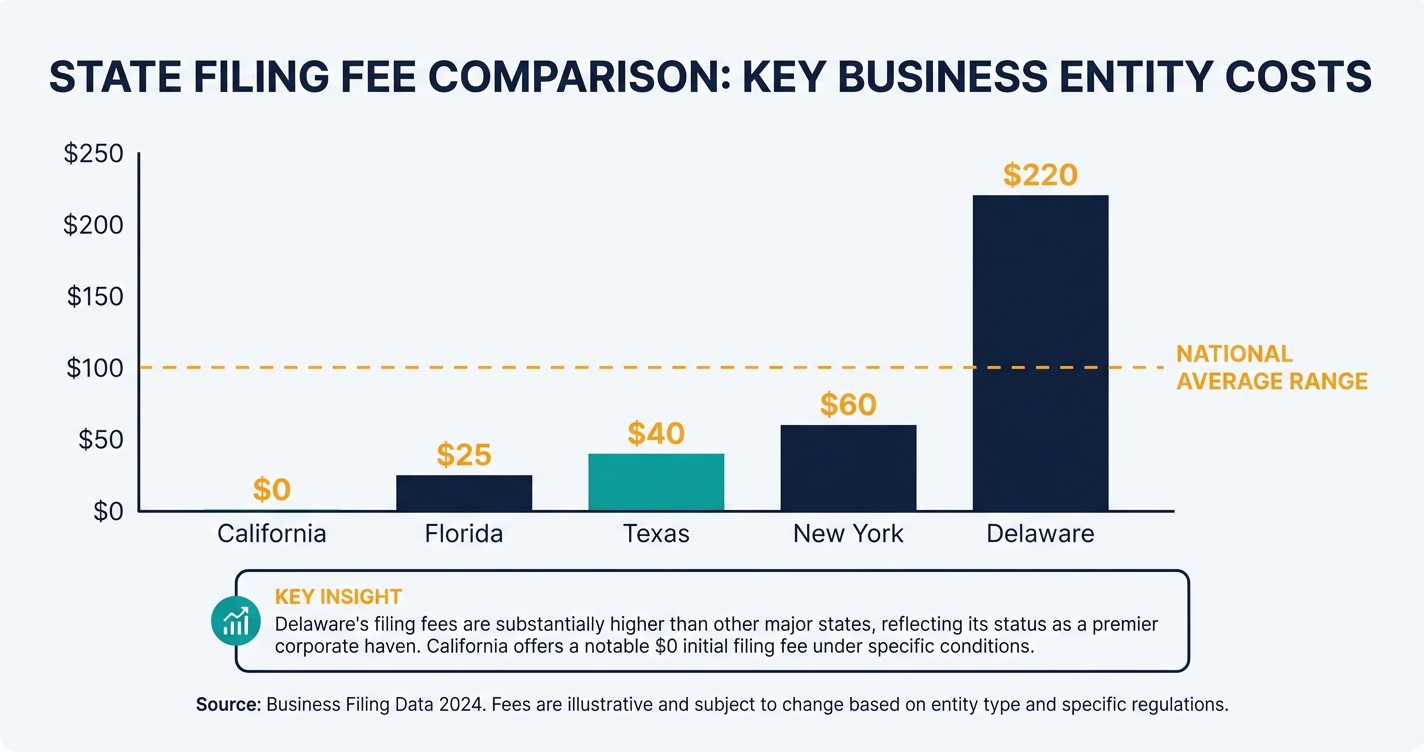
State filing fees are the only required cost. They range from $0 to $220. California, Georgia, North Carolina, Washington, and Wyoming charge nothing. Delaware charges the highest fee at $220. Most states fall in the $25 to $100 range.
The hidden cost that catches most people is outstanding franchise taxes. In California, you owe $800 for every year your LLC existed without being formally canceled, including the final year. In Delaware, you owe $300 for every year, and the tax is not prorated. If you dissolve your Delaware LLC on January 2, you owe the full $300 for that year.
If you were registered as a foreign LLC in additional states, you will need to file withdrawal paperwork in each one. Those fees typically run $0 to $200 per state. Until you withdraw, those states keep billing you for annual reports and franchise taxes.
DIY vs. professional service comparison:
- DIY (simple single-member LLC, one state): $0 to $220 total. You fill out the forms, file the final tax return, and mail it yourself. Best for uncomplicated LLCs with no debts.
- Professional dissolution service: $300 to $1,500+ including state fees, CPA fees, and service provider markup. Worth it if you have multiple states, outstanding tax obligations, or complex member distributions.
| Item | Cost Range | Notes |
|---|---|---|
| Articles of Dissolution filing fee | $0–$220 | CA is $0; FL is $25; TX is $40; NY is $60; DE is $220 |
| Tax clearance certificate | $0 | Required in TX, IL, KS, and a few others. No fee, but processing takes 1-6 weeks. |
| Outstanding franchise taxes (CA) | $800/year | Owed for every year the LLC existed, including the final year. Not prorated. |
| Outstanding franchise taxes (DE) | $300/year | Must be paid in full for the cancellation year, even if you dissolve January 2. |
| Foreign LLC withdrawal (per state) | $0–$200 | Required in each state where your LLC was registered as a foreign entity. |
| Expedited processing (optional) | $25–$1,000 | Varies by state. DE charges $100 for 24-hour service, $200 for same-day. |
| Certified copy of dissolution | $5–$50 | Optional but recommended. Useful for closing bank accounts. |
| CPA or attorney fees (optional) | $200–$1,000+ | For filing final tax returns and reviewing dissolution paperwork. DIY is free. |
| DIY total (simple LLC, no debts) | $0–$220 | Just the state filing fee. Most single-member LLCs can handle this themselves. |
| Full-service dissolution | $300–$1,500+ | Includes attorney or service provider fees, state fees, and tax return preparation. |
Every state has its own name for the dissolution form, its own fee, and its own quirks. Here are the details for the five states where most of our readers are dissolving LLCs.
California
- Form: Certificate of Cancellation (Form LLC-4/7). If the vote was not unanimous, also file Certificate of Dissolution (Form LLC-3). LLCs under 12 months old may use Short Form (LLC-4/8).
- Filing fee: $0. Hand-delivery in Sacramento adds $15.
- Processing time: 3 to 4 weeks by mail. You can also file online through California bizfile Online.
- Critical warning: You must also file a final Form 568 with the Franchise Tax Board and check the "Final" box. If you skip this step, the FTB assumes your LLC is still active and auto-generates a new $800 bill.
Texas
- Form: Certificate of Termination.
- Filing fee: $40.
- Prerequisite: Attach a Certificate of Account Status from the Texas Comptroller (Form 05-359). Processing takes over one month.
- File online via SOSPortal.
Florida
- Form: Articles of Dissolution.
- Filing fee: $25. Optional: $5 for Certificate of Status, $30 for certified copy.
- File online at Sunbiz.org.
- No tax clearance required. Florida has no state income tax, making this one of the simplest dissolutions.
New York
- Form: Articles of Dissolution, filed with the Department of State.
- Filing fee: $60. Expedited processing: $25 for 24 hours, $75 for same-day, $150 for 2-hour turnaround.
- Deadline: Must file within 90 days of the dissolution vote.
- No tax clearance required for LLCs (corporations do need one). Standard processing takes about 7 business days.
Delaware
- Form: Certificate of Cancellation, filed with the Division of Corporations.
- Filing fee: $220 for domestic LLCs, $200 for foreign LLCs.
- Prerequisite: All franchise taxes must be paid before filing. The annual franchise tax is $300 and is not prorated. File before December 31 to avoid owing for the next year.
- Expedited options: $100 for 24-hour processing, $200 for same-day. You can file online or by mail.
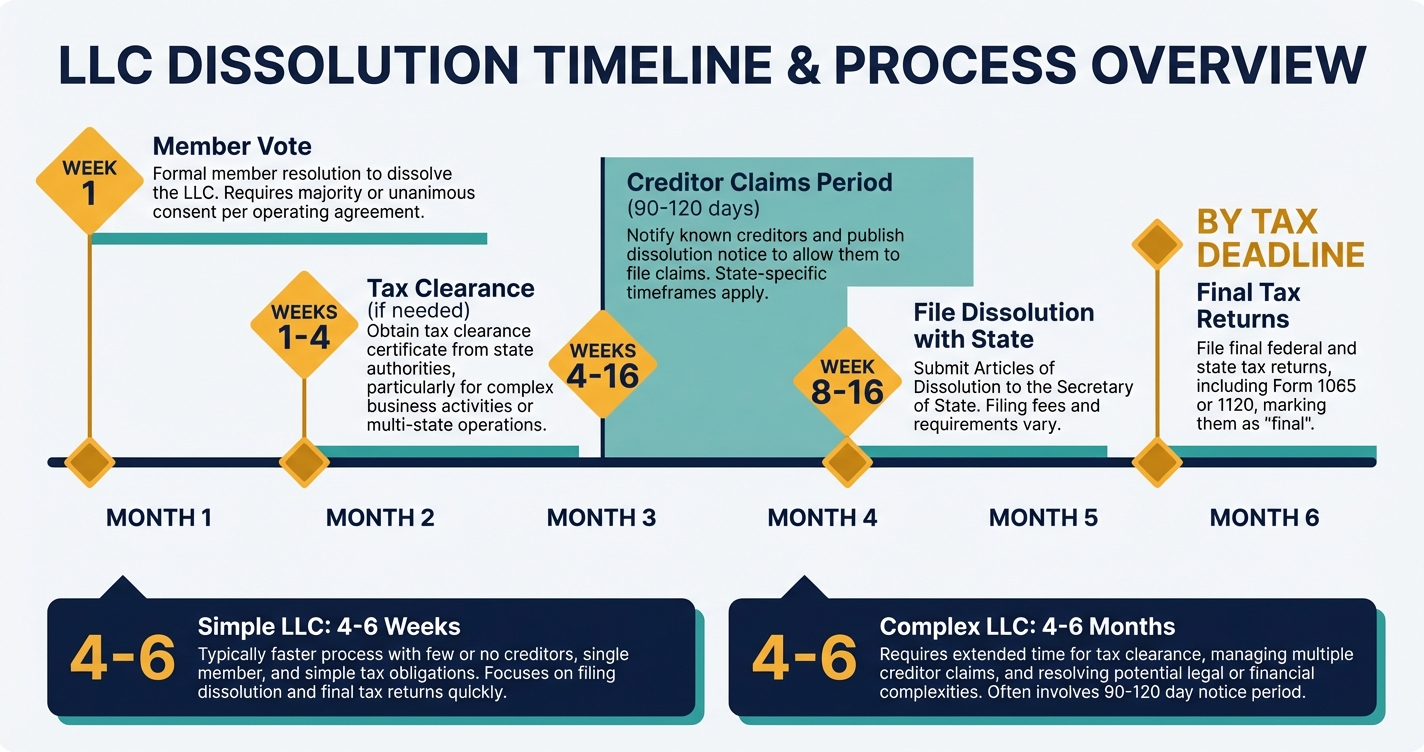
The full LLC dissolution process typically takes 2 to 6 months from vote to final completion. Here is how the timeline breaks down:
- Week 1: Hold the member vote, document the resolution, and begin notifying creditors.
- Weeks 1 to 4: If your state requires tax clearance (like Texas), request it immediately. This step alone can take over a month.
- Weeks 4 to 16: Wait for the creditor claim period to expire (typically 90 to 120 days). Pay all valid claims.
- Week 8 to 16: File your Articles of Dissolution with the state. Processing takes 1 to 4 weeks in most states.
- By tax deadline: File your final federal and state tax returns. For multi-member LLCs filing Form 1065, the deadline is the 15th day of the 3rd month after your tax year ends (March 15 for calendar-year LLCs).
If you need to move faster, most states offer expedited processing. Delaware offers same-day processing for $200 extra. New York offers 2-hour processing for $150 extra. California's standard processing is 3 to 4 weeks, but online filing through bizfile can be faster.
For a simple single-member LLC with no debts, no employees, and no foreign registrations, you can realistically complete everything in 4 to 6 weeks (assuming no tax clearance wait and a short creditor window).
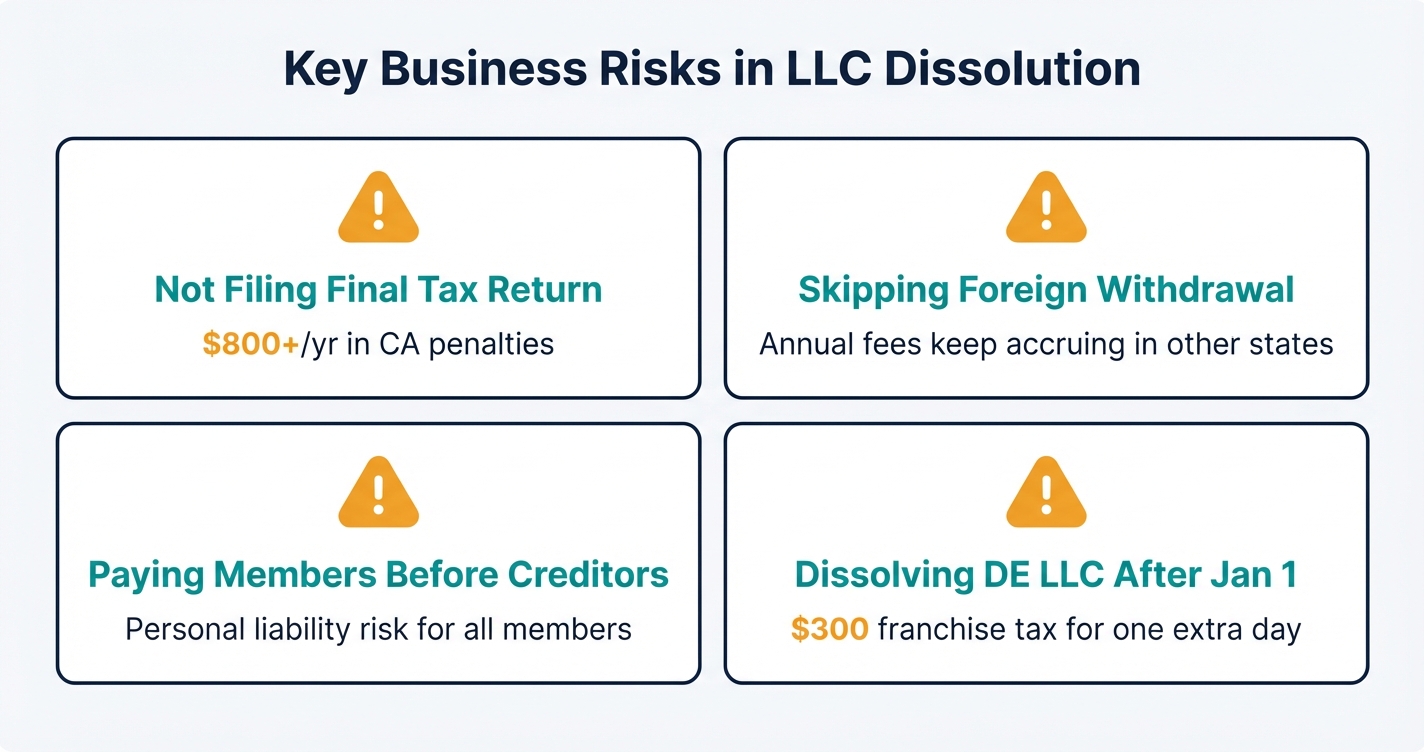
These are the most expensive mistakes people make when dissolving an LLC. Every one of them can cost you hundreds or thousands of dollars.
1. Just stopping operations without formally dissolving
This is the most common and most costly mistake. If you do not file dissolution paperwork, your state keeps billing you. In California, that is $800 per year in franchise tax. In Delaware, it is $300 per year plus late penalties. Eventually, the state will administratively dissolve your LLC, but you still owe every dollar of back fees and penalties that accrued.
2. Filing with the state but skipping the final tax return
In California, filing the cancellation form with the Secretary of State is not enough. If you do not also file a final Form 568 with the Franchise Tax Board and check the "Final" box, the FTB keeps generating $800/year bills. After 1 to 2 missed filings, you will owe $2,400 or more in cumulative penalties.
3. Forgetting to check the "Final return" box on IRS forms
Whether you file Schedule C, Form 1065, or Form 1120-S, always check the "Final return" box. If you do not, the IRS expects a return next year and will send penalty notices when one does not arrive.
4. Not withdrawing from foreign states
If your LLC was registered as a foreign LLC in other states, dissolving in your home state does not end your obligations elsewhere. You must file separate withdrawal paperwork in each state. Until you do, annual report fees and franchise taxes keep accruing.
5. Paying members before creditors
In every state, creditors have priority over member distributions during winding up. If you distribute assets to members before paying creditors, courts can reverse those payments and hold individual members personally liable.
6. Dissolving your Delaware LLC after January 1
Delaware's $300 annual franchise tax is not prorated. If you cancel on January 2, you owe the full $300 for the new year. If you know you are dissolving, file the Certificate of Cancellation before December 31 to save a full year of tax.
7. Not keeping records after dissolution
Store your dissolution documents for at least 4 years. The IRS audit window is 3 years (6 years for substantial understatements). You will need these records if a creditor, former member, or tax authority raises questions after the LLC is gone.
Dissolving because you moved house is the most common avoidable version of this filing. It costs you the EIN, the formation date and the whole business credit file. 42 states allow domestication instead, which relocates the same company without closing it, and our guide to moving an LLC to another state lists which states allow it and what each one charges.
One loose end that outlives the filing is a commercial lease. Dissolving the LLC does not cancel it, and if you signed a personal guarantee the landlord can still come to you. Deal with the space first, our guide to getting out of a commercial lease covers the four routes and what each one needs from the landlord.
The last loose end is the one nobody plans for, which is the owner running out of time before the business does. Closing is only one of the three endings. If somebody in the family might take it on instead, the documents are different and the deadline is shorter than owners expect, and our guide to the family business succession plan walks the handover in the order the paperwork has to happen.
One ending is not on this page, because it is not a choice you make. If the state closed the company for you over a missed report or a lapsed agent, that is administrative dissolution and the route back is different, our guide to the administratively dissolved LLC covers the deadline in each state and the fee to reverse it. Florida is the reason it matters which door you went through, because Sunbiz says a company that dissolved itself voluntarily can never reinstate.
Frequently Asked Questions
Sources & References
- IRS: Closing a Business
- California Secretary of State: LLC Forms
- Delaware Division of Corporations: Dissolutions and Cancellations
- New York Department of State: Articles of Dissolution for LLCs
- Texas Secretary of State: SOSPortal Business Filings
- Florida Division of Corporations
- FinCEN: Beneficial Ownership Information Reporting
- SBA: Close or Sell Your Business
- IRS: About Form 966, Corporate Dissolution or Liquidation
- IRS: If you no longer need your EIN
- IRS, Instructions for Form 5472
About the Author
Editor, StartupOwl
Eliot leads StartupOwl's state data research. He maintains the site's fifty state records of LLC filing fees, annual costs, processing times, and small business grant programs, checking each figure against the state office that publishes it and logging the date it was verified. Based in New Jersey, he has spent his working life in and around small businesses, and he writes for the founder who wants the real number rather than the advertised one. Every figure under his byline traces to a named source, and when a state proves a number wrong, the correction is published, not buried.
Was this article helpful?
Questions about this guide
No comments yet. Ask the first question and a member of our team will answer.
Leave a comment