
How to Start a Nonprofit Organization
A step-by-step walkthrough of forming a 501(c)(3) nonprofit, from state incorporation and bylaws to IRS tax-exempt status and charitable solicitation.

In This Article
- Total government fees run $600 to $1,200 for most nonprofit startups.
- IRS Form 1023-EZ takes 2 to 4 weeks; Form 1023 takes 3 to 12 months.
- State incorporation fees range from $25 (Texas) to $227 (Maryland).
- Missing IRS-required language in your articles is the most common costly mistake.
8
Total Steps
$600–$1,200
Est. Total Cost
2 to 12 months (depending on IRS form used)
Timeline
Moderate to Difficult
DIY Difficulty
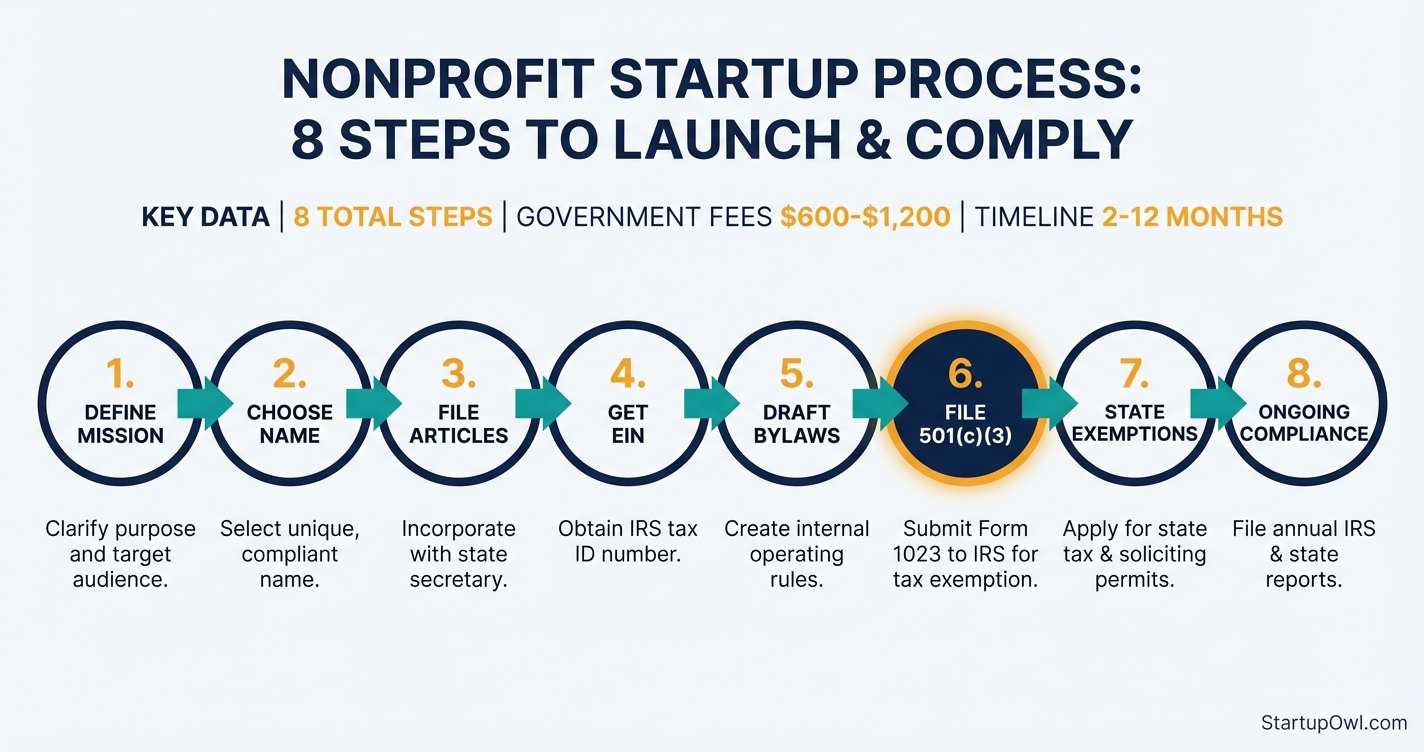
Starting a nonprofit costs between $600 and $1,200 in government fees alone, and the entire process takes 2 to 12 months depending on which IRS form you file. Most of that time is waiting on the IRS to approve your tax-exempt status. This guide breaks down every step with real costs, exact filing locations, and the mistakes that trip up first-time founders.
Before you file anything, gather these items. Missing any of them mid-process will delay your formation by weeks.
Before-You-Start Checklist
- A clear mission statement describing your charitable, educational, religious, or scientific purpose in 1 to 2 sentences.
- 3 to 7 founding board members with names, addresses, and a commitment to serve.
- A registered agent with a physical address in your state of incorporation (this can be you, a board member, or a registered agent service).
- A 3-year projected budget showing anticipated revenue and expenses. The IRS requires this on Form 1023.
- IRS-approved purpose and dissolution language for your articles of incorporation. Download the suggested clauses from the Instructions for Form 1023.
- A conflict-of-interest policy (required by the IRS for your 501(c)(3) application).
- A valid payment method for Pay.gov (debit card, credit card, or bank account for IRS filing fees).
If you want to skip the paperwork headaches, a formation service can handle most of these filings for $99 to $500 plus government fees. See our comparison of the best LLC formation services (many also handle nonprofits).
Step-by-Step Process
- 1
Define Your Mission and Choose a Board of Directors
Your mission statement drives everything (your articles of incorporation, your IRS application, and your fundraising). Keep it broad enough to allow for future programs, but specific enough to satisfy IRS requirements for a charitable, educational, religious, or scientific purpose.
You need a minimum of 3 board members in most states, including Florida and New York. Texas requires at least 3 directors as well. California recommends 3 and requires a president, secretary, and treasurer as officer roles.
- Draft a clear, one-paragraph mission statement describing your exempt purpose.
- Recruit founding board members (aim for 3 to 7 people) with diverse skills.
- Assign initial officer roles (president, secretary, treasurer at minimum).
- Prepare a 3-year budget projection of revenue and expenses, since you will need this for your IRS application.
$01-2 weeks No filing required. Internal planning step.Common Mistakes
- Writing a mission statement too narrow to allow future program expansion, then having to amend articles later ($25-$150 fee).
- Appointing too few board members or choosing board members who all share the same background (weakens grant applications).
- Skipping the 3-year budget projection and scrambling to create one during the IRS application.
- 2
Choose and Reserve Your Nonprofit Name
Your nonprofit name must be distinguishable from existing entities registered in your state. Most states require an entity designator like "Inc.," "Corp.," or "Incorporated" in the name. In Florida, you cannot use "Company" or "Co." for nonprofits.
Reserving a name is optional but smart if you need time before filing. Here is what it costs in the five biggest states:
- California charges $10 to reserve a name for 60 days via the Secretary of State's bizfile Online portal.
- Texas charges $40 to reserve for 120 days via SOSPortal.
- Florida charges $35 to reserve by mail through the Division of Corporations.
- New York charges $10 to file an Application for Reservation of Name with the Department of State.
- Delaware reservation costs vary; check the Division of Corporations.
Before filing, search your state's business entity database and the U.S. Patent and Trademark Office (USPTO TESS) to avoid name conflicts. If you plan to use a different operating name, you will need a DBA filing in most states.
$0 to $40 (name reservation is optional)Same day to 1 week Your state's Secretary of State or Division of Corporations websiteCommon Mistakes
- Not checking the USPTO trademark database and discovering a name conflict after incorporation.
- Forgetting the required entity designator (e.g., 'Inc.' or 'Corp.') and having the filing rejected.
- 3
File Articles of Incorporation with Your State
This is the legal document that creates your nonprofit corporation. Every state requires it, and it must include specific IRS-required language (a purpose clause, a dissolution clause, and a prohibition on private benefit) if you plan to apply for 501(c)(3) status. Missing this language is the single most common mistake, and fixing it means filing an amendment later for an extra $25 to $150.
Here are the filing fees and timelines for the five highest-traffic states:
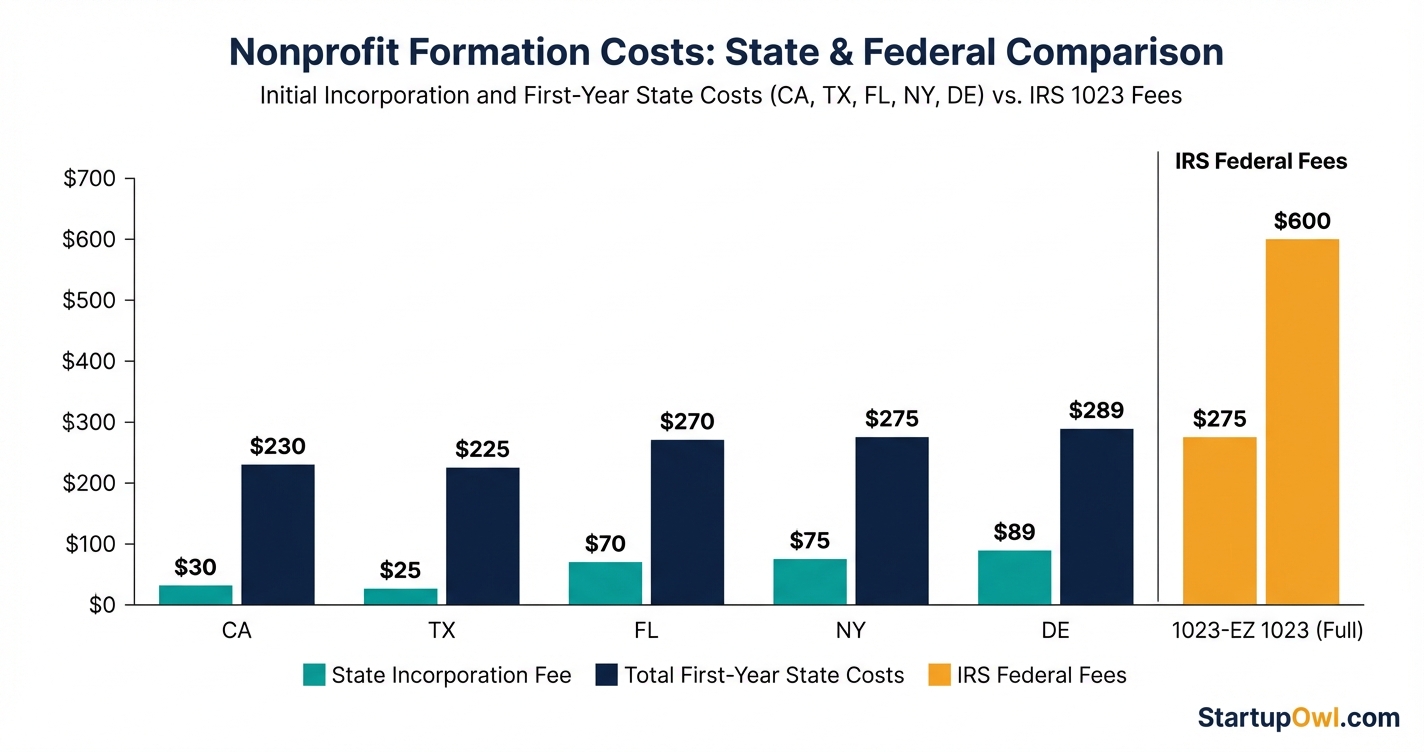
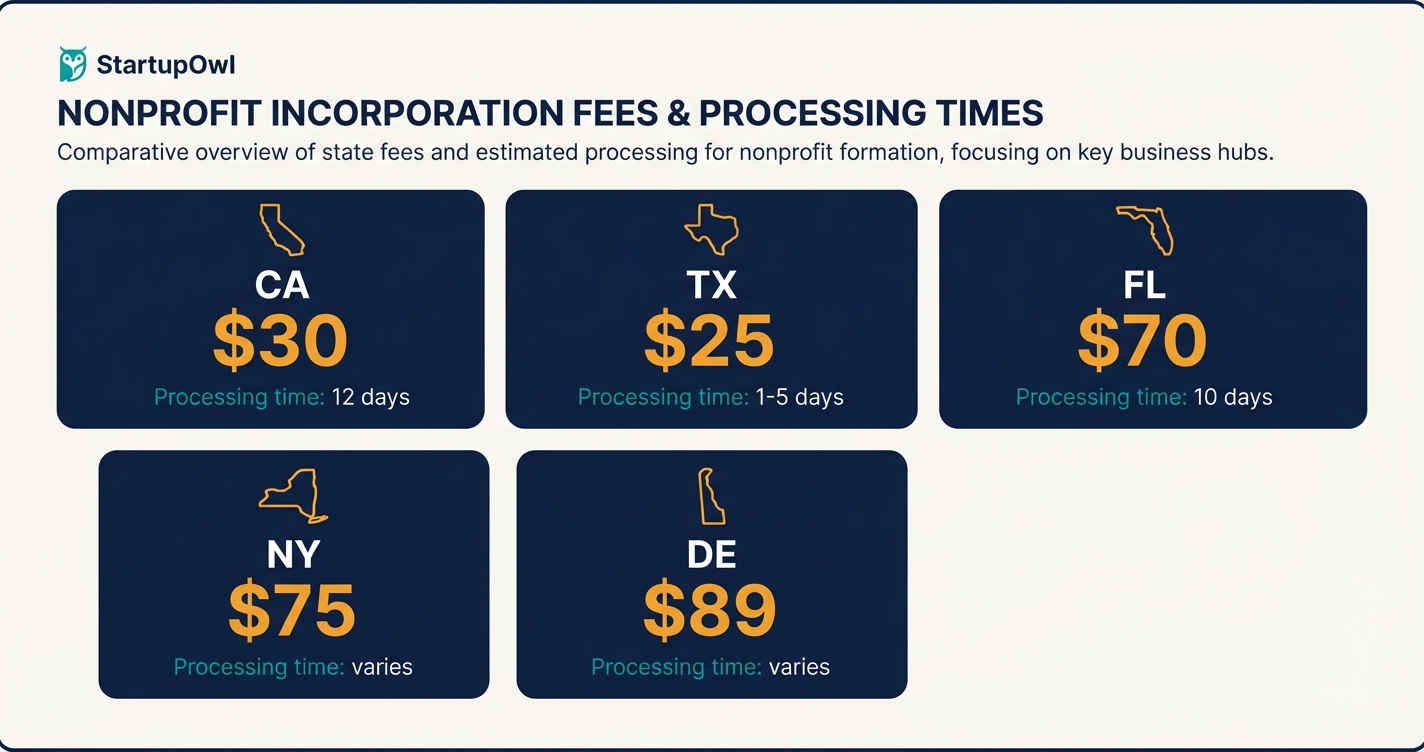
- California charges $30 for a public benefit corporation. File online through bizfile Online. Processing takes about 12 business days. You must also file a Statement of Information (SI-100) within 90 days for an additional $20.
- Texas charges $25 for the Certificate of Formation (Form 202). File through SOSPortal. Online processing takes 1 to 5 business days.
- Florida charges $70 ($35 filing + $35 registered agent designation). File through Sunbiz. Processing takes about 10 business days.
- New York charges $75 for the Certificate of Incorporation. File by mail to the Department of State.
- Delaware charges $89 for nonprofit incorporation through the Division of Corporations.
Your articles must include IRS-approved purpose language and a dissolution clause directing remaining assets to another 501(c)(3). The IRS publishes suggested language in the Instructions for Form 1023. Use it word for word.
$25 to $227 (varies by state; most states $30-$100)1 to 15 business days (varies by state and method) Your state's Secretary of State or Division of Corporations (see state links above)Common Mistakes
- Omitting the IRS-required purpose clause or dissolution clause, forcing an amendment filing later ($25-$150 extra).
- Using the state's boilerplate template without adding the IRS-specific language for 501(c)(3) eligibility.
- Filing in the wrong state (incorporate in the state where you will primarily operate, not the cheapest state).
- 4
Get an Employer Identification Number (EIN) from the IRS
An EIN is like a Social Security number for your nonprofit. You need it before you can open a bank account, hire employees, or apply for tax-exempt status. Getting one is free and takes about 5 minutes online.
Apply through the IRS EIN online application. You will receive your EIN instantly upon completion. The application is available Monday through Friday, 7 a.m. to 10 p.m. Eastern.
You can also apply by fax (Form SS-4, 4-business-day turnaround) or by mail (4 to 6 weeks). Online is almost always the best option. If you are forming in a state that processes articles slowly, you may need to wait until your incorporation is approved before applying since you will need the legal name as it appears on your state filing.
$0Same day (online); 4-6 weeks (mail) IRS.gov EIN online application (https://www.irs.gov/businesses/small-businesses-self-employed/apply-for-an-employer-identification-number-ein-online)Common Mistakes
- Applying before the state approves your articles and then entering the wrong legal name, creating a mismatch.
- Using a personal Social Security number instead of applying for a separate EIN for the nonprofit.
- 5
Draft Bylaws and Hold Your Organizational Meeting
Bylaws are your nonprofit's internal operating manual. They govern how your board makes decisions, elects officers, handles conflicts of interest, and manages finances. You do not file bylaws with the state, but the IRS requires a copy when you apply for 501(c)(3) status using Form 1023 (though not for Form 1023-EZ).
Your bylaws should cover at minimum:
- Board size, term limits, and election procedures
- Officer roles and responsibilities
- Meeting frequency and quorum requirements
- A conflict-of-interest policy (required for IRS Form 1023)
- Amendment procedures
- Fiscal year designation
After drafting bylaws, hold your first organizational board meeting. At this meeting the board should adopt the bylaws, elect officers, authorize the EIN application, and approve opening a business bank account. Document everything in meeting minutes signed by the secretary.
$0 (DIY) or $500-$2,000 (if hiring an attorney)1-2 weeks No state filing required. Keep bylaws and meeting minutes in your corporate records binder.Common Mistakes
- Forgetting to include a conflict-of-interest policy, which the IRS specifically looks for on Form 1023.
- Not recording meeting minutes from the organizational meeting, leaving you scrambling when the IRS requests them.
- 6
Apply for 501(c)(3) Tax-Exempt Status with the IRS
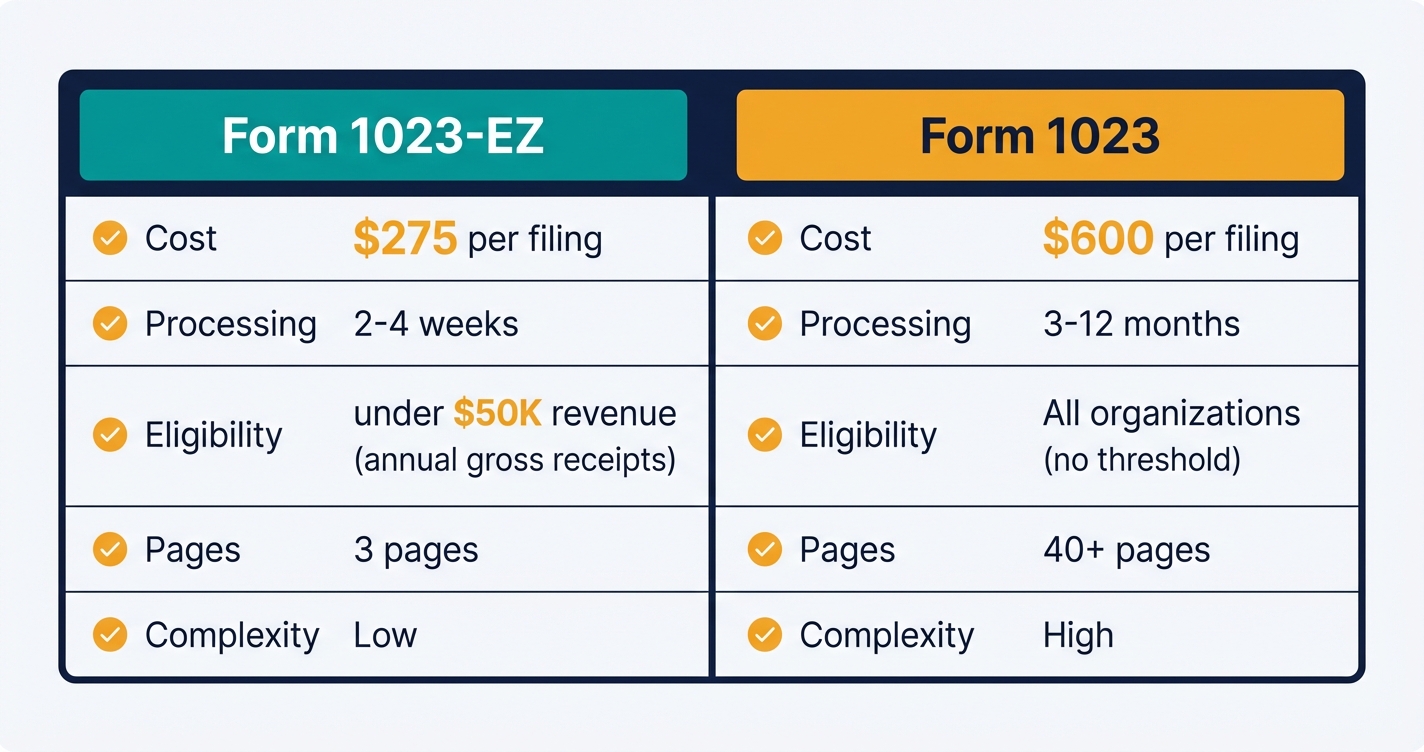
This is the big one. You will file either Form 1023 (full application, $600) or Form 1023-EZ (streamlined, $275) through Pay.gov. Both are filed electronically. The fee is non-refundable, even if your application is denied.
Form 1023-EZ is available if your projected annual gross receipts are $50,000 or less in each of the next 3 years and your total assets are valued at $250,000 or less. You must complete the IRS Eligibility Worksheet to confirm you qualify. Churches, schools, hospitals, and private operating foundations cannot use Form 1023-EZ. Processing takes roughly 2 to 4 weeks.
Form 1023 (the full application) is a detailed, 40+ page form requiring narrative descriptions of your activities, 3-year financial projections, and supporting documents. Processing takes 3 to 12 months currently. The IRS states it issues 80% of Form 1023 determinations within 191 days.
If approved, the IRS sends a determination letter confirming your 501(c)(3) status. This letter is critical for fundraising, grant applications, and proving tax-exempt status to donors. Keep it forever.
$275 (Form 1023-EZ) or $600 (Form 1023)2-4 weeks (1023-EZ) or 3-12 months (Form 1023) Pay.gov (https://www.pay.gov) — search for 'Form 1023' or 'Form 1023-EZ'Common Mistakes
- Filing Form 1023-EZ when your organization doesn't qualify (e.g., projected revenue over $50K), which results in rejection and a lost $275 fee.
- Submitting Form 1023 with incomplete financial projections or an inconsistent purpose statement, delaying processing by months.
- Not checking whether your articles of incorporation include the IRS-required language before applying (the IRS will reject you and keep the fee).
- 7
Apply for State Tax Exemptions
Federal 501(c)(3) status and state tax exemption are separate. You typically need your IRS determination letter in hand before applying for state-level exemptions. Most states offer exemptions from corporate income tax, sales tax, and property tax for qualifying nonprofits.
Here is what this looks like in the top five states:
- California requires filing Form 3500A (or Form 3500) with the Franchise Tax Board. There is no fee. You also register with the Attorney General's Registry of Charitable Trusts (Form CT-1) for $50.
- Texas requires filing Form AP-205 with the Comptroller's office for sales tax exemption. There is no fee, and processing usually takes less than a week. Texas does not require general charitable solicitation registration.
- Florida requires Form DR-5 with the Department of Revenue for sales tax exemption (no fee). You must also register with the Department of Agriculture and Consumer Services if soliciting donations ($10 to $400).
- New York requires Form CT-247 for franchise tax exemption and Form ST-119.2 for sales tax exemption, both filed with the Department of Taxation and Finance. You must also register with the Attorney General's Charities Bureau (Form CHAR410) for $25.
- Delaware has no state income tax for nonprofits, but you may need to register for charitable solicitation.
$0 to $50 (most state exemption filings are free; charitable registration fees vary)1-4 weeks after receiving IRS determination letter Your state's Department of Revenue, Franchise Tax Board, or Attorney General's office (varies by state)Common Mistakes
- Assuming federal 501(c)(3) status automatically exempts you from state taxes (it does not in most states).
- Forgetting to register for charitable solicitation before fundraising, which can result in fines and loss of fundraising ability.
- 8
Set Up Ongoing Compliance (Form 990, Annual Reports, and Recordkeeping)
Your nonprofit is legally required to file annual returns with the IRS and periodic reports with your state. Failing to file Form 990 for 3 consecutive years results in automatic revocation of your 501(c)(3) status, and you will have to re-apply from scratch.
Here are the three IRS filing options based on your organization's size:
- Form 990-N (e-Postcard) for organizations with gross receipts normally $50,000 or less. Filed electronically; no fee.
- Form 990-EZ for organizations with gross receipts under $200,000 and total assets under $500,000. No filing fee.
- Form 990 (full return) for organizations exceeding those thresholds. No filing fee.
On the state side, most states require an annual or biennial corporate report. Florida charges $61.25 annually. California requires a biennial Statement of Information ($20). Texas does not require a separate nonprofit annual report. New York does not charge for a standard DOS annual report, but you must file Form CHAR500 annually with the Attorney General.
Open a dedicated nonprofit bank account (see our best business bank accounts guide), set up bookkeeping software, and create a compliance calendar with all your state and federal filing deadlines. Consider reading our annual report requirements guide for more context on state reporting obligations.
$0-$61.25 per year (state annual reports; IRS Form 990 is free to file)Ongoing; IRS returns due by the 15th day of the 5th month after fiscal year end IRS.gov for Form 990 series; your state's Secretary of State for annual reportsCommon Mistakes
- Missing three consecutive years of Form 990 filing, triggering automatic revocation of 501(c)(3) status.
- Not setting up a compliance calendar and missing state annual report deadlines, which can result in administrative dissolution.
The total cost to start a nonprofit ranges from about $600 (DIY in a low-fee state using Form 1023-EZ) to over $6,000 (if you hire an attorney and file the full Form 1023 in a higher-fee state). Here is a realistic breakdown for two common scenarios.
Scenario 1: Small nonprofit in Texas, DIY with Form 1023-EZ
- Certificate of Formation: $25
- EIN: $0
- Form 1023-EZ: $275
- State tax exemption (AP-205): $0
- Total: $300
Scenario 2: Larger nonprofit in California, attorney-assisted with Form 1023
- Articles of Incorporation: $30
- Statement of Information (SI-100): $20
- Attorney General registration (CT-1): $50
- EIN: $0
- Form 1023: $600
- Attorney fees: $2,500
- Total: $3,200
The biggest cost variable is whether you hire professional help. Filing the full Form 1023 yourself is free beyond the $600 user fee, but the IRS estimates it can take a novice up to 100 hours to complete. Many founders find the $500 to $5,000 attorney cost worth it to avoid rejections and delays.
| Item | Cost Range | Notes |
|---|---|---|
| State Articles of Incorporation | $25-$227 | Texas is lowest ($25); Maryland is highest ($227). Most states fall between $30-$100. |
| Name Reservation (optional) | $0-$40 | Not required; CA $10, TX $40, FL $35, NY $10. |
| EIN Application | $0 | Free from IRS. Apply online at IRS.gov. |
| IRS Form 1023 (full application) | $600 | For organizations expecting over $50K/year in gross receipts. Non-refundable. |
| IRS Form 1023-EZ (streamlined) | $275 | For organizations expecting $50K or less in gross receipts and under $250K in assets. |
| State Tax Exemption Filing | $0-$50 | Most states charge no fee. California CT-1 costs $50. |
| Charitable Solicitation Registration | $0-$400 | Varies widely by state. Texas does not require it. Florida $10-$400. |
| State Annual Report (Year 1+) | $0-$61.25/year | Florida $61.25; California $20 (biennial); Texas none required. |
| Registered Agent Service (optional) | $100-$300/year | Required if you don't have a qualifying in-state address. |
| Attorney Fees (optional) | $500-$5,000 | For drafting articles, bylaws, and preparing IRS application. |
Nonprofit formation rules differ meaningfully across states. Here are the five states that generate the most searches, along with the key differences that affect your filing.
California charges $30 to file articles of incorporation for a public benefit corporation. You must also file a Statement of Information within 90 days ($20) and register with the Attorney General's Registry of Charitable Trusts (Form CT-1, $50) within 30 days of receiving assets. California has no fee for its state tax exemption application (Form 3500A). State processing takes about 12 business days.
Texas is the cheapest and fastest state for nonprofit formation. The Certificate of Formation costs just $25, and online filings through SOSPortal process in 1 to 5 business days. Texas does not require general charitable solicitation registration. Only veterans organizations and public safety organizations must register to fundraise.
Florida charges $70 for nonprofit articles of incorporation ($35 filing + $35 registered agent designation). You file through the Sunbiz portal. Florida nonprofits must file an annual report every year ($61.25) between January 1 and May 1. If you plan to solicit donations, you must register with the Department of Agriculture and Consumer Services ($10 to $400).
New York charges $75 to file a Certificate of Incorporation. New York requires consent from certain state agencies depending on your nonprofit's purpose (e.g., education nonprofits need approval from the State Education Department). You must register with the Attorney General's Charities Bureau (Form CHAR410, $25) before soliciting donations.
Delaware charges $89 for nonprofit incorporation and is known for a streamlined compliance process and strong privacy protections. However, Delaware has a smaller philanthropic funding pool compared to California or New York. If you plan to operate in another state, you will likely need to register as a foreign entity there as well.
The total timeline depends heavily on which IRS form you use. Here is a realistic timeline for each scenario.
Fast Track (Form 1023-EZ, straightforward state)
- Week 1: Mission, board selection, and name search
- Week 2: File articles of incorporation + get EIN
- Week 3: Draft bylaws, hold organizational meeting
- Week 4: File Form 1023-EZ on Pay.gov
- Weeks 5-8: IRS processes your application (2 to 4 weeks average)
- Total: 5 to 8 weeks
Standard Track (Form 1023, complex organization)
- Weeks 1-2: Mission, board, name reservation, state incorporation
- Weeks 3-4: EIN, bylaws, organizational meeting, 3-year financial projections
- Weeks 4-8: Prepare and file Form 1023 (preparation alone can take 20 to 100 hours)
- Months 3-12: IRS review (3 to 12 months; the IRS reports 80% of Form 1023 determinations are issued within 191 days)
- Total: 4 to 14 months
Some states offer expedited processing for an extra fee. Texas processes online filings within 1 to 2 business days at no extra cost. New York's expedited processing costs up to $1,000 for same-day or 24-hour service. California standard processing is about 12 business days.
On the IRS side, Form 1023-EZ cannot be expedited. Form 1023 can be expedited in limited circumstances (disaster relief organizations, for example), but the IRS considers these requests on a case-by-case basis.
These are the errors that trip up nonprofit founders most often. Each one can cost you weeks of delay or hundreds of dollars in extra fees.
1. Omitting IRS-Required Language in Your Articles of Incorporation
Your articles must include a purpose clause, a dissolution clause directing remaining assets to another 501(c)(3), and a prohibition on private inurement. If you use a state template without adding IRS language, the IRS will reject your application. You will then need to file a state amendment ($25 to $150) and resubmit. Check the IRS suggested language page before filing.
2. Choosing the Wrong IRS Form
Filing Form 1023-EZ when you are ineligible (expected revenue over $50,000 or assets over $250,000) results in rejection and a lost $275 fee. Conversely, filing the full Form 1023 when you qualify for the EZ version means spending $325 more and waiting months longer than necessary. Always complete the Eligibility Worksheet first.
3. Failing to File Form 990 for Three Consecutive Years
The IRS automatically revokes your tax-exempt status if you miss 3 years of annual returns. Reinstatement requires filing a brand-new Form 1023 (another $600) and going through the entire review process again. Set a recurring calendar reminder.
4. Not Registering for Charitable Solicitation Before Fundraising
Most states require nonprofits to register before soliciting donations, even online donations. Failing to register can result in fines and loss of the ability to fundraise in that state. If you fundraise in multiple states, you need to register in each one that requires it. Check the National Association of State Charity Officials (NASCO) for state-by-state rules.
5. Incorporating in the "Cheapest" State Instead of Your Operating State
Delaware charges just $89, but if your nonprofit actually operates in California, you will still need to register as a foreign corporation in California and pay California's fees on top of Delaware's. In most cases, you should incorporate in the state where your nonprofit will do the majority of its work. Read our foreign LLC registration guide to understand when out-of-state formation makes sense.
6. Skipping the Conflict-of-Interest Policy
The IRS specifically asks about this policy on Form 1023 (Schedule L). Not having one does not automatically disqualify you, but it raises a red flag and can lead to additional IRS scrutiny and delays. Draft one before you apply.
Frequently Asked Questions
Sources & References
- IRS Form 1023 Instructions (Rev. December 2024)
- IRS Form 1023-EZ Instructions (Rev. January 2026)
- IRS Where's My Application for Tax-Exempt Status
- SBA.gov Choose a Business Structure
- FinCEN Beneficial Ownership Information Reporting
- National Association of State Charity Officials (NASCO)
- Charitable Allies: How Much Does It Cost to Set Up a 501(c)(3)?
- Harbor Compliance: How Long Does It Take to Get 501(c)(3) Status?
About the Author
Editor, StartupOwl
Eliot leads StartupOwl's state data research. He maintains the site's fifty state records of LLC filing fees, annual costs, processing times, and small business grant programs, checking each figure against the state office that publishes it and logging the date it was verified. Based in New Jersey, he has spent his working life in and around small businesses, and he writes for the founder who wants the real number rather than the advertised one. Every figure under his byline traces to a named source, and when a state proves a number wrong, the correction is published, not buried.
Was this article helpful?
Questions about this guide
No comments yet. Ask the first question and a member of our team will answer.
Leave a comment