
What Is a Series LLC?
A Series LLC creates separate liability-shielded divisions under one parent LLC, saving thousands in formation fees compared to multiple standalone LLCs.

In This Article
- Series LLCs are available in roughly 20 states, DC, and Puerto Rico. The two newest laws, West Virginia's and Florida's, both took effect in 2026.
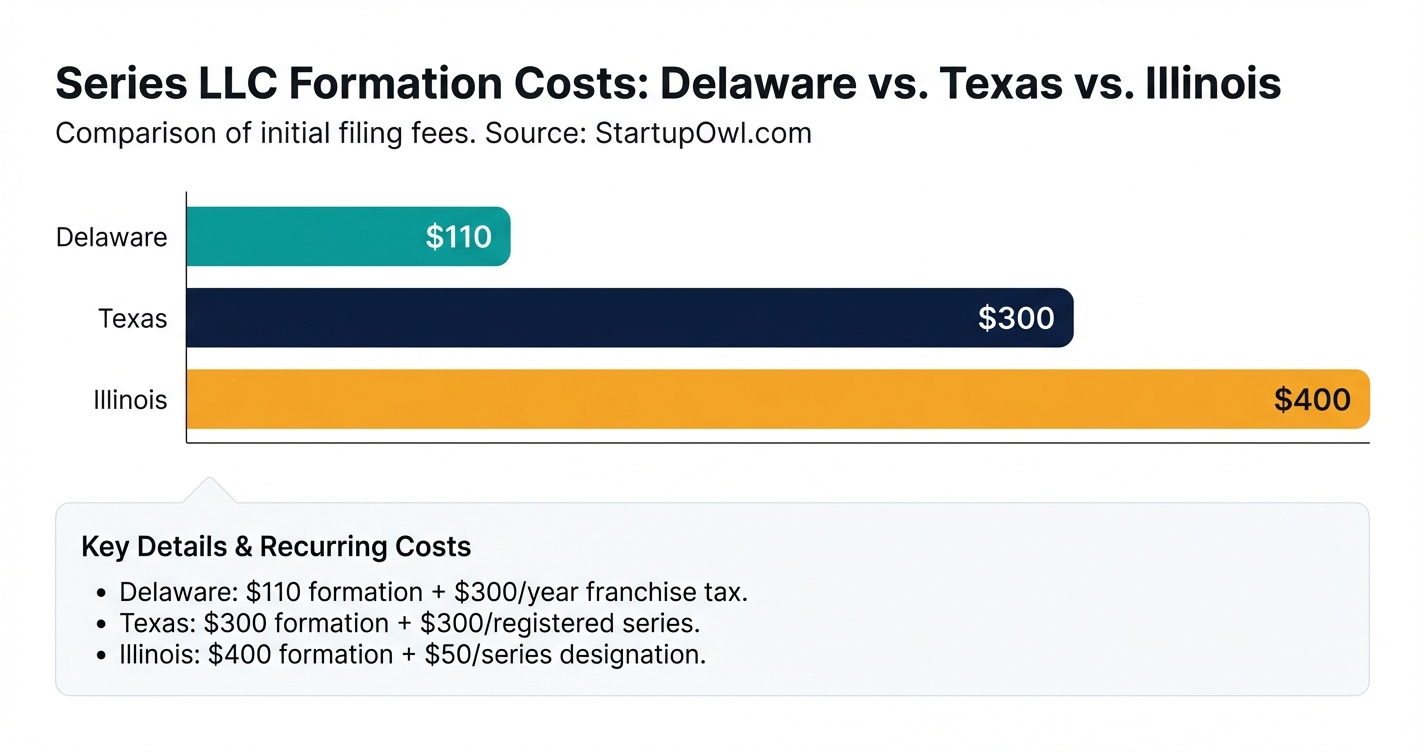
- Formation costs range from $110 (Delaware) to $400 (Illinois) for the parent LLC.
- Each series needs separate bank accounts, books, and records to preserve liability protection.
- IRS tax treatment remains unsettled; proposed 2010 regulations are still not finalized.
Definition
A Series LLC is a single parent limited liability company that can create multiple protected divisions (called series or cells), each with its own assets, liabilities, and members, shielded from the debts of the other series.
First introduced: 1996 (Delaware)
A Series LLC lets you spin up multiple protected divisions (called "series" or "cells") under a single parent LLC, each with its own assets, liabilities, and members. If you own 5 rental properties, you can place each one in its own series, and a lawsuit against one property can't reach the others. Delaware pioneered the structure in 1996. It is now available in roughly 20 states plus DC and Puerto Rico. Two laws landed in 2026. West Virginia's took effect on June 12 and Florida's on July 1.
What Is It?
A Series LLC is a single parent LLC that can spin up multiple internal divisions (called "series" or "cells"), each operating like its own standalone entity. Each series can hold separate assets, carry its own liabilities, have different members and managers, and conduct its own operations. The critical feature: debts and lawsuits against one series generally cannot reach the assets of any other series or the parent LLC itself.
Think of it as a corporate holding company, but without the cost of forming separate legal entities for each division. Instead of filing 5 separate LLC formations at $100 to $300 each, you file one Series LLC and create child series internally through your operating agreement (or, in some states, through a brief designation filing).
The concept was first introduced in Delaware in 1996, originally designed to simplify SEC filings for mutual fund companies. Since then, roughly 20 states, DC, and Puerto Rico have adopted some version of Series LLC legislation. Two arrived in 2026. West Virginia's Uniform Protected Series Act took effect on June 12, 2026. Florida's law passed back in 2025, as Chapter 2025-162, and took effect on July 1, 2026.
Real estate investors are the primary users. If you own 10 rental properties, each can sit in its own series. A slip-and-fall lawsuit at Property 3 puts only Property 3's assets at risk. Your other 9 properties, and your personal assets, stay protected. This is the same protection you'd get from forming 10 separate LLCs, but at a fraction of the cost and administrative burden.
The parent LLC files one set of formation documents, maintains one registered agent, and in most states files just one annual report. Each series still requires its own bank account, its own financial records, and rigorous internal documentation to keep the liability shield intact.
Benefits
The biggest draw of a Series LLC is cost savings. Forming 5 separate LLCs in Texas would cost $1,500 in state filing fees alone ($300 each). A single Texas Series LLC costs $300, and you can create unlimited protected series through your operating agreement with no additional state filing. If you choose to register each series publicly, it's $300 per registered series, but protected series (without state filing) are free to create.
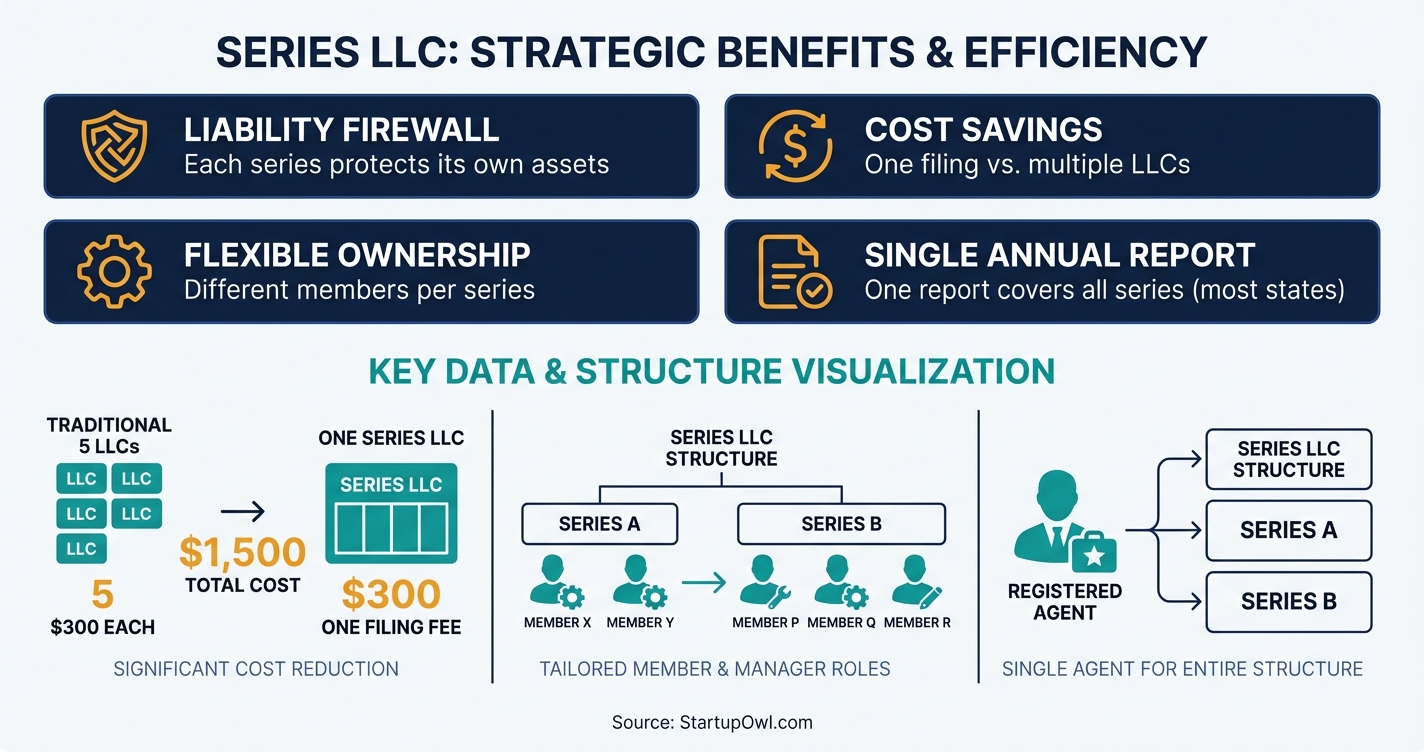
- Internal liability shields. Each series isolates its own assets from the debts and lawsuits of other series. If you hold 8 rental properties across 8 series, a judgment against one property's series cannot touch the other 7. This is the same protection you'd get from 8 separate LLCs.
- One registered agent, one annual report. In most states, the parent LLC handles all compliance centrally. You pay for one registered agent service (typically $50 to $300/year) instead of one per entity. In Illinois, a single $75 annual report covers the entire Series LLC and all its series.
- Flexible ownership per series. Series A can be owned 50/50 by two partners, while Series B can be 100% owned by a single investor. You can bring in different investors for different projects without restructuring the entire LLC.
- Easy expansion. Adding a new series is as simple as amending your operating agreement (in Delaware and most states) or filing a brief designation form (in Illinois, at $50 per series). Compare that to forming a brand-new LLC, which requires full Articles of Organization, a new EIN, a new registered agent appointment, and a new annual report.
- Tax election flexibility. Each series can potentially elect its own federal tax classification. Series A could be taxed as a disregarded entity, Series B as a partnership, and Series C as an S Corp. This lets you optimize tax treatment per business unit.
If you're comparing this structure to forming multiple standalone LLCs, the math usually favors the Series LLC once you're managing 3 or more separate assets or business lines in a single state that recognizes the structure.
Risks & Limitations
Series LLCs come with real trade-offs. Before you commit, weigh these risks carefully.
- Limited and inconsistent state recognition. Only about 20 states authorize domestic Series LLC formation. If you form a Texas Series LLC but own property in New York (which has no Series LLC law), a New York court might not respect the liability shield between your series. There is almost no case law answering this question definitively.
- Uncertain bankruptcy treatment. Federal bankruptcy courts have not clearly established whether an individual series can file for bankruptcy independently. The Uniform Protected Series Act addresses this, but most states have not adopted it yet.
- IRS tax ambiguity. The IRS issued proposed regulations in 2010 treating each series as a separate entity for federal tax purposes, but never finalized them. As of 2026, there is no universal IRS rule. Your CPA needs to navigate this gray area on a case-by-case basis.
- California's $800-per-series tax. If your Series LLC operates in California, the Franchise Tax Board imposes an $800 annual franchise tax on each series doing business in the state. A Series LLC with 5 active series in California owes $4,000/year in franchise taxes alone.
- Strict recordkeeping or you lose the shield. If you commingle funds, fail to maintain separate books for each series, or neglect proper documentation, creditors can pierce the veil and reach assets across series. The recordkeeping burden is essentially the same as running separate LLCs.
- Banking and lending friction. Many banks don't understand Series LLCs and may refuse to open separate accounts for individual series. Lenders may require personal guarantees or refuse to recognize the series structure. Call ahead before choosing a bank.
The bottom line: a Series LLC saves money on formation and annual compliance, but the administrative discipline required to maintain the liability shield is comparable to running separate LLCs. If you won't maintain separate books and bank accounts for each series, the structure won't protect you.
State Availability
Series LLC legislation is a patchwork. Some states have mature, well-tested frameworks (Delaware, Texas, Illinois). Others adopted the structure recently with limited case law. And major business states like California, New York, and Pennsylvania still don't allow domestic formation.
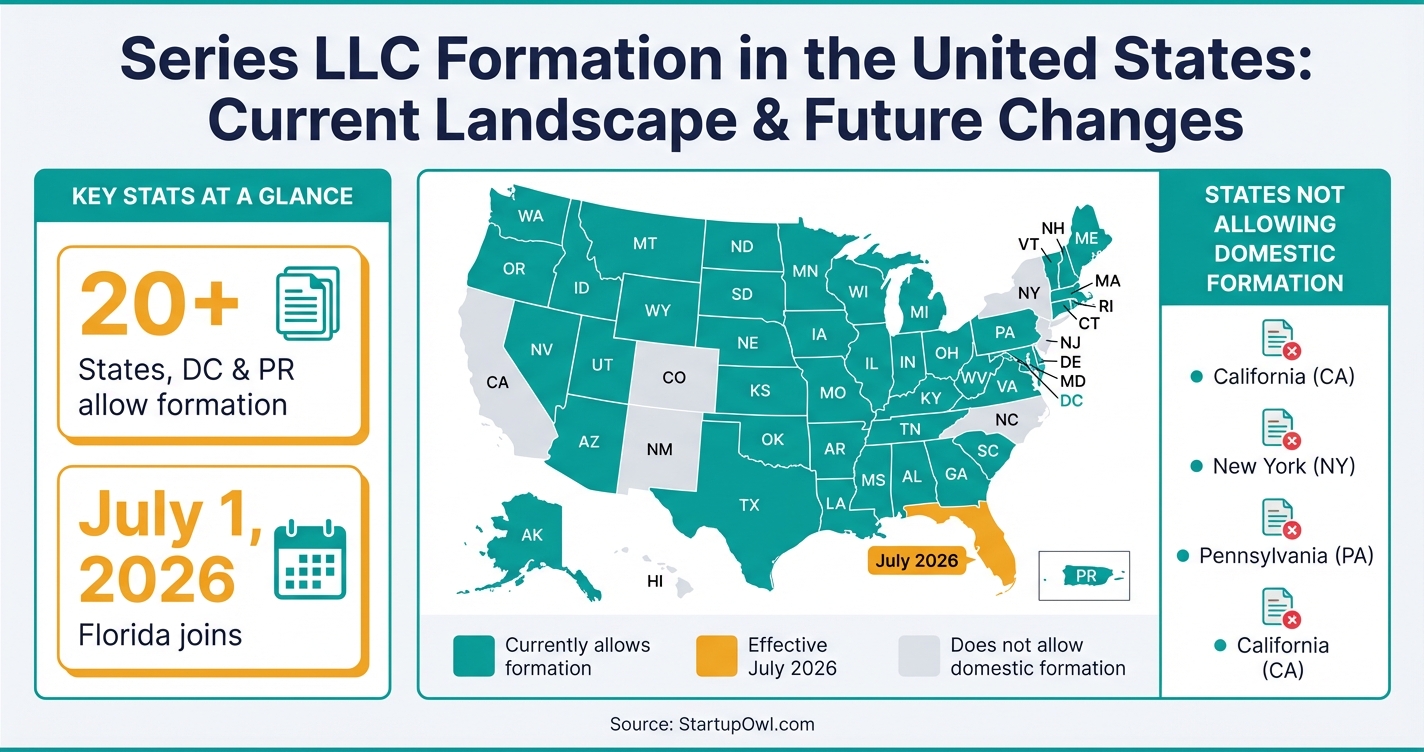
Here's what you need to know about the most popular formation states:
- Delaware pioneered the Series LLC in 1996 and has the most developed legal framework. Formation costs $110, with a $300/year franchise tax. Series are created through the operating agreement with no separate state filing. Delaware's Court of Chancery provides the most predictable business dispute resolution in the country.
- Texas charges $300 to form the parent LLC. Protected series require no state filing. Registered series (which gain public recognition and certificates of good standing) cost $300 each to file with the Texas Secretary of State. Texas has no annual report fee for LLCs.
- Illinois charges $400 for Series LLC Articles of Organization (compared to $150 for a standard LLC). Each series requires a Certificate of Designation at $50 per series. The annual report is $75 and covers the entire structure.
- Nevada offers privacy protections and no state income tax. Formation fees are competitive, but annual costs include a $150 annual list fee plus $200 state business license.
- Florida has allowed protected series since July 1, 2026. The law is Chapter 2025-162, Laws of Florida, signed on June 20, 2025. You create one by filing a protected series designation with the Florida Department of State. The name rule is strict. Each series name must start with the parent LLC's name and carry the phrase "protected series", or "P.S.", or "PS".
- West Virginia is the newest series state. Its Uniform Protected Series Act took effect on June 12, 2026. That cuts both ways. The statute is modern and follows the uniform text. But no West Virginia court has tested the shield between one series and another yet.
- Ohio has allowed series since April 12, 2021, and it is the entry on this list most often missed. The inter-series shield in R.C. 1706.761 only applies if three things are true, your articles of organization state that the company may have series, the operating agreement repeats that limitation, and each series keeps its own records. The articles line is the one founders miss, because it has to be there at formation.
Availability is easy to get wrong. A state can authorize protected series and never market them. Virginia has carried a Protected Series article in its LLC Act since 2019, and it is still missing from plenty of published lists, ours included until this update. Check your own Secretary of State before you decide your state is closed.
If your state doesn't allow domestic Series LLC formation, you can form in Delaware or Texas and register as a foreign LLC in your home state. Just remember: you'll pay compliance costs in both states, and your home state may not respect the internal liability shield.
How to Set It Up
Forming a Series LLC follows the same general process as forming a standard LLC, with a few critical additions. Here's a step-by-step overview with costs for the three most popular states.
- Choose your state. If you live and operate in a Series LLC state (TX, IL, NV, etc.), form there. If not, Delaware and Texas are the most popular out-of-state options. Factor in foreign LLC registration costs if you'll operate outside the formation state.
- Reserve your LLC name. Check availability on your state's Secretary of State website. Name reservation costs $25 in most states and lasts 60-120 days. Your name must include "LLC" or "Limited Liability Company."
- File Articles of Organization (or Certificate of Formation). Include the series-enabling language required by your state. In Texas, use Form 205 with specific provisions authorizing series. Filing fees: $110 (Delaware), $300 (Texas), $400 (Illinois).
- Appoint a registered agent. Required in every state. You can serve as your own agent if you're a state resident, or hire a professional service for $50 to $300/year. See our registered agent comparison.
- Draft a Series LLC operating agreement. This is the backbone of your structure. It must authorize series creation, define how assets and liabilities are allocated per series, outline management and voting for each series, and specify dissolution procedures. Do not use a standard LLC template. Budget $500 to $2,500 for attorney-drafted agreements.
- Create individual series. In Delaware, this happens within the operating agreement (no state filing). In Illinois, file a Certificate of Designation (Form LLC-37.40) for each series at $50 per series. In Texas, protected series need no filing; registered series require a Certificate of Registered Series at $300 each.
- Obtain EINs. Apply for a free EIN from the IRS for the parent LLC. If each series operates independently, get a separate EIN for each series to open bank accounts and file taxes properly.
- Open separate bank accounts. Each series needs its own business bank account. Not all banks understand Series LLCs, so confirm before visiting. Call the bank and ask specifically about opening accounts for individual series of a Series LLC.
Total first-year cost for a Texas Series LLC with 3 protected series (no registered series filing): approximately $300 in state fees, plus registered agent and operating agreement costs. Compare that to forming 3 separate Texas LLCs at $900 in state fees alone.
vs Alternatives
The natural comparison for a Series LLC is forming multiple separate LLCs. Both approaches give you liability separation between assets. The question is whether cost savings and convenience outweigh the uncertainties of the Series LLC structure.
- Series LLC vs. Multiple Separate LLCs. Separate LLCs cost more to form and maintain (separate filing fees, separate annual reports, separate registered agents per entity). But they offer clear, well-established liability protection that every court in every state recognizes. If you hold properties in states that don't recognize Series LLCs, separate LLCs are safer. If all your assets are in one Series LLC-friendly state, the Series LLC saves $1,000+/year in fees and compliance costs for a 5-property portfolio.
- Series LLC vs. Parent-Subsidiary LLC Structure. A holding company with subsidiary LLCs provides similar liability separation but requires forming each subsidiary as its own standalone LLC. This is more expensive than a Series LLC but offers stronger legal recognition across all 50 states. Investors seeking conventional bank financing often prefer this structure because lenders understand it.
- Series LLC vs. Land Trusts. Real estate investors sometimes use land trusts for privacy (keeping your name off public property records). Land trusts don't provide liability protection on their own. You can combine a land trust with a Series LLC: the trust holds legal title, and the series is the beneficiary. This provides both privacy and liability protection.
- Series LLC vs. Single LLC with Umbrella Insurance. If you only own 1-2 properties or a single business, a standard LLC with a $1-2 million umbrella policy (typically $200-$500/year) may be simpler and cheaper. The Series LLC becomes cost-effective at 3+ assets that need separate liability protection.
For a broader look at how LLCs compare to other entity types, see our complete guide to business entity types or our sole proprietorship vs LLC comparison.
Frequently Asked Questions
Sources & References
- IRS Proposed Regulations on Series LLCs (2010)
- California Franchise Tax Board - Series LLC
- Texas Secretary of State - Series LLC FAQ
- Delaware Division of Corporations - Fee Schedule
- Chapter 2025-162, Laws of Florida - Florida protected series law
- West Virginia Code Chapter 31B Article 14 - Uniform Protected Series Act
- Code of Virginia Title 13.1 Chapter 12 - Protected Series
- SBA - Choose a Business Structure
- Uniform Protected Series Act (ULC)
- Ohio Revised Code 1706.761 - Separate asset series-limited liability statement
About the Author
Editor, StartupOwl
Eliot leads StartupOwl's state data research. He maintains the site's fifty state records of LLC filing fees, annual costs, processing times, and small business grant programs, checking each figure against the state office that publishes it and logging the date it was verified. Based in New Jersey, he has spent his working life in and around small businesses, and he writes for the founder who wants the real number rather than the advertised one. Every figure under his byline traces to a named source, and when a state proves a number wrong, the correction is published, not buried.
Was this article helpful?
Questions about this guide
No comments yet. Ask the first question and a member of our team will answer.
Leave a comment