
Working Capital Loans, How They Work, Rates and Where to Get One
SBA caps working capital rates at prime plus 3.0%, a 10.00% October ceiling. Compare top lenders, credit minimums (560-680+), and get funded in 1-30 days.

In This Article
- Key Takeaways
- Step-by-Step
- Cost Breakdown
- What a Working Capital Loan Is and When to Use One
- If a Card Limit Cut Sent You Here, Read This First
- Who Qualifies for a Working Capital Loan
- How to Apply for a Working Capital Loan (Step by Step)
- What a Working Capital Loan Really Costs
- Top 5 Working Capital Lenders for 2026
- What to Do If You Do Not Qualify
- 5 Costly Mistakes to Avoid with Working Capital Loans
- FAQ
$0–$5,000,000
Est. Cost
30 days
Timeline
5
Total Steps
A working capital loan is a revolving credit line. It covers day to day costs like payroll, inventory and rent. You draw what you need. You pay interest only on what you use, then draw again as you repay. The SBA Working Capital Pilot Program caps its rate at 10.00% on loans over $350,000, with lines up to $5 million.
Your cost turns on one thing. Your credit score sets your tier. A business with 680+ credit borrows under the SBA ceiling of 10.00% to 13.50%. A startup with 600 credit might pay Fundbox weekly fees from 4.66% on a 12 week draw. A 500 score can mean factor rates worth 40%+ effective APR at lenders like Taycor Financial.
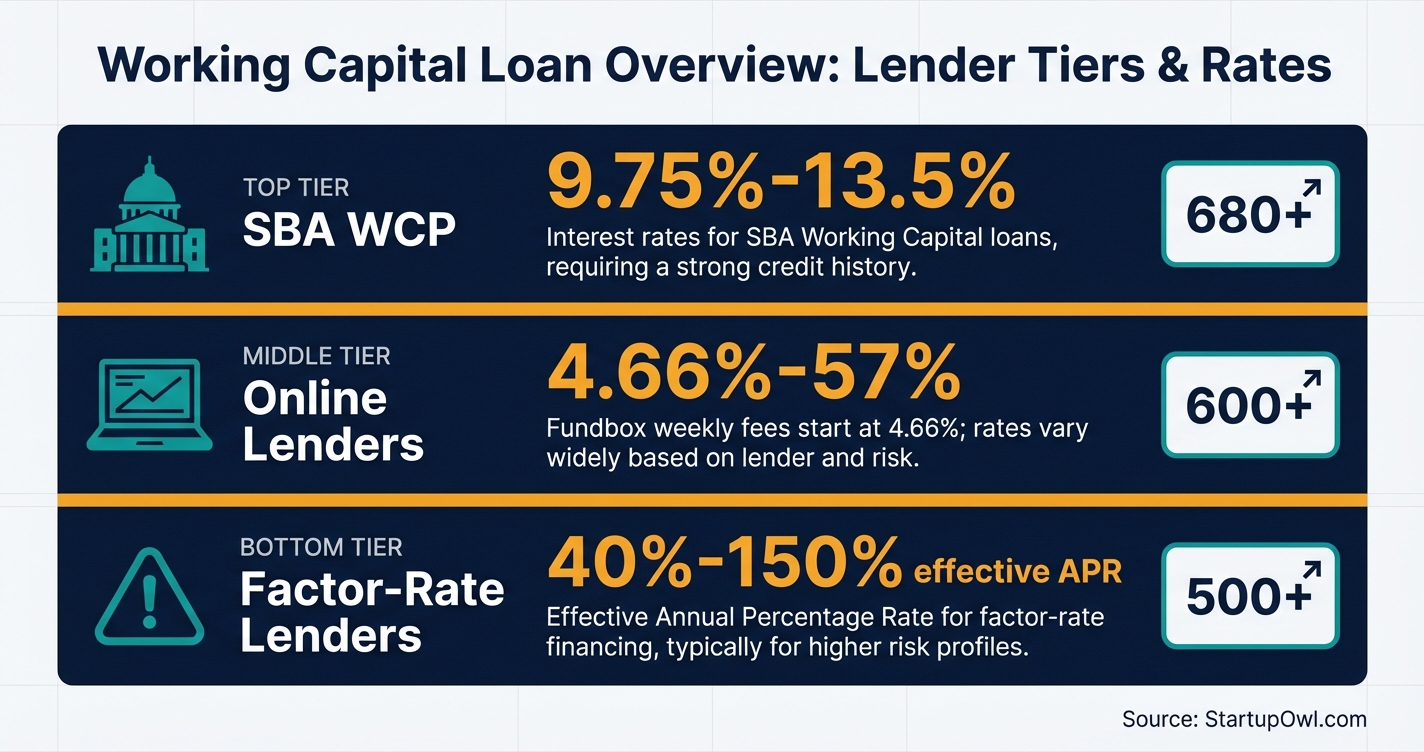
This guide covers rates, credit minimums and application steps for every tier. Start wider if you need to. Our guide to the best small business loans ranks the whole field.
What a Working Capital Loan Is and When to Use One
A working capital loan is a revolving line of credit, not a term loan. It funds short term operating needs. You draw against a limit, spend on inventory, payroll or supplier invoices, then repay and draw again. Think of a business credit card at a much lower rate. Suppliers who sell on credit land here often, so if your own net 30 payment terms created the gap, start there.
The SBA's 7(a) Working Capital Pilot Program (WCP) is the first to put domestic and international transaction financing in one credit line. It sits under the 7(a) umbrella. Terms run up to 60 months, with an 85% SBA guaranty on loans up to $150,000 and 75% above that.
The fit is a timing problem, not a revenue problem. Seasonal retailers, B2B firms on 30 to 90 day terms and manufacturers filling large contracts are the core cases. Equipment is different. Our equipment financing guide covers those routes end to end. Real estate belongs on a term loan. And if revenue is strong but credit is not, revenue based financing providers approve on deposit health instead. Buyers of cash heavy businesses like gas stations lean on that, and our station buyer guide shows where each product fits.
Platform sellers have their own routes too. See the Amazon seller loans guide and the Shopify Capital breakdown.
Practice owners, the practice loans guide covers your lane.
If a Card Limit Cut Sent You Here, Read This First
Through August 2026, cardholders have been posting about credit limits cut on accounts they had paid on time for years, several of them on charge cards sold with no preset spending limit. If that is what sent you to this page, the first question worth answering is whether the loan window is tightening the same way. It is not.
The Federal Reserve asks senior loan officers every quarter what changed at their bank. In the July 2026 survey, published 3 August 2026 and answered by 56 domestic banks, a modest net share reported tighter standards on credit card loans over the second quarter. Asked where their consumer standards sit against the whole range since 2005, banks placed every consumer category at the tighter end. The business answers went the other way. Standards on commercial and industrial loans to firms of all sizes were basically unchanged, banks put them easier than the midpoint of their own historical range, and a moderate net share reported narrower rate spreads on loans to small firms.
Those are two decisions made in two different parts of a bank. A card limit is set by a model reading your spending and your deposits, and it can move in a week. A working capital line is underwritten against receivables, inventory and time in business, then reviewed on a schedule. The card cut does not close it. It can still change how your file reads, because a lower limit against the same balance lifts your utilization, and personal credit sits inside most small business underwriting. Pull your report before you apply rather than after.
The counterweight is worth printing. Demand for business loans from small firms was basically unchanged in that same survey, so nothing here says move today. If a review has already landed on your card, our guide to the Amex financial review covers what triggers one and what an issuer can demand from you. If the cut has landed and payroll is close, emergency business funding ranks the routes by speed and by cost. The structural answer is duller and it is the one that works, a second source of credit opened before you need it, so that no single issuer's model decides whether your suppliers get paid.
Who Qualifies for a Working Capital Loan
Eligibility varies dramatically by lender. The table below shows what each lender tier requires.
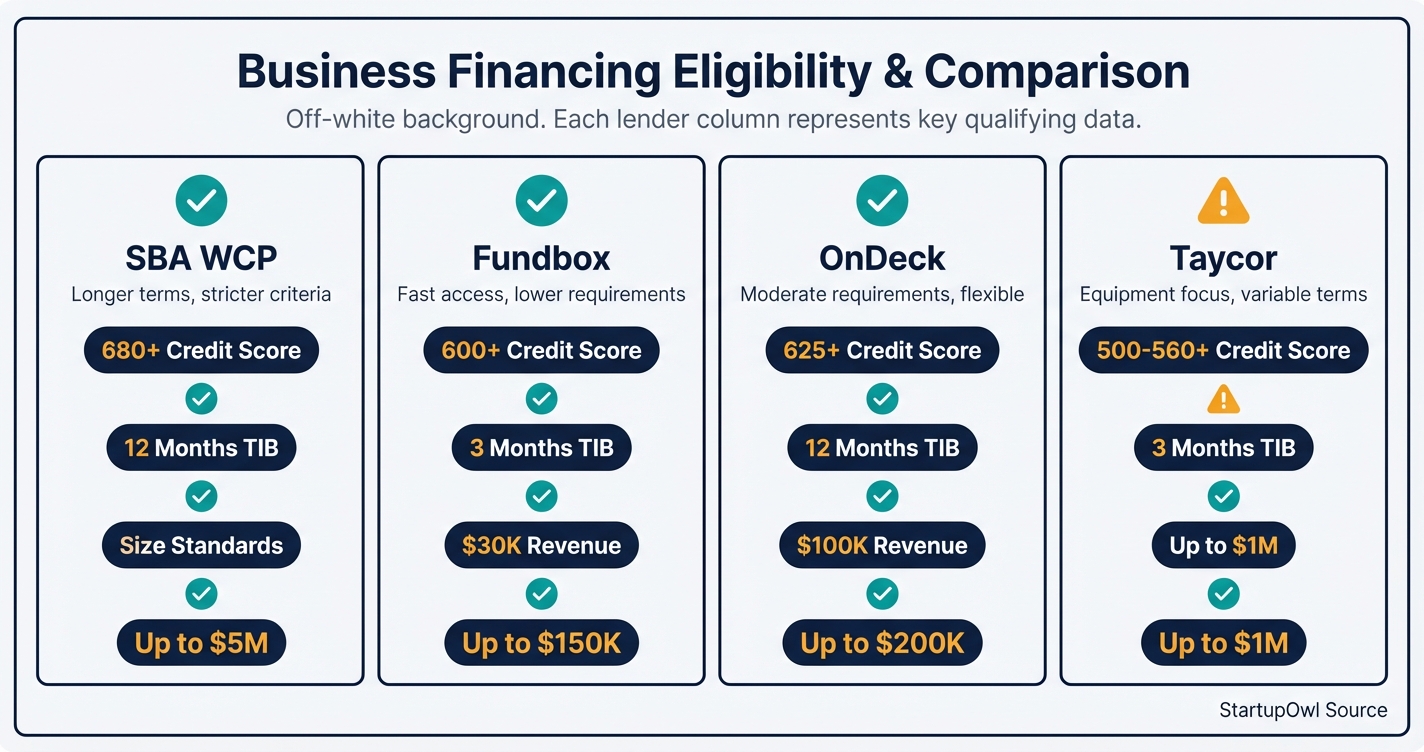
- SBA WCP: Personal credit score of 680+, at least 12 months in business, ability to produce accurate financial statements and receivable/payable reports, and your business must meet SBA size standards for your industry.
- Fundbox: Personal credit score of 600+, just 3 months in business, and $30,000 in annual revenue (per LendingTree, as of 2026). Maximum credit line of $150,000.
- OnDeck: Personal credit score of 625+, at least 12 months in business, and $100,000 in annual gross revenue. Lines of credit from $6,000 to $200,000.
- Taycor Financial: Personal credit score as low as 500 for some products (and 560+ for working capital lines), 3 months minimum in business. Factor rates starting at 1.01.
For SBA WCP specifically, your advance rates are capped by asset type. Domestic receivables qualify for up to 85% advance, insured foreign receivables up to 90%, uninsured foreign receivables up to 70%, and U.S. inventory up to 60%. If you are a brand-new business with no receivables, explore business loans for startups or microloans first.
How to Apply for a Working Capital Loan (Step by Step)
The application process differs based on whether you pursue an SBA-backed line or an online lender. Here is the general flow for both paths.
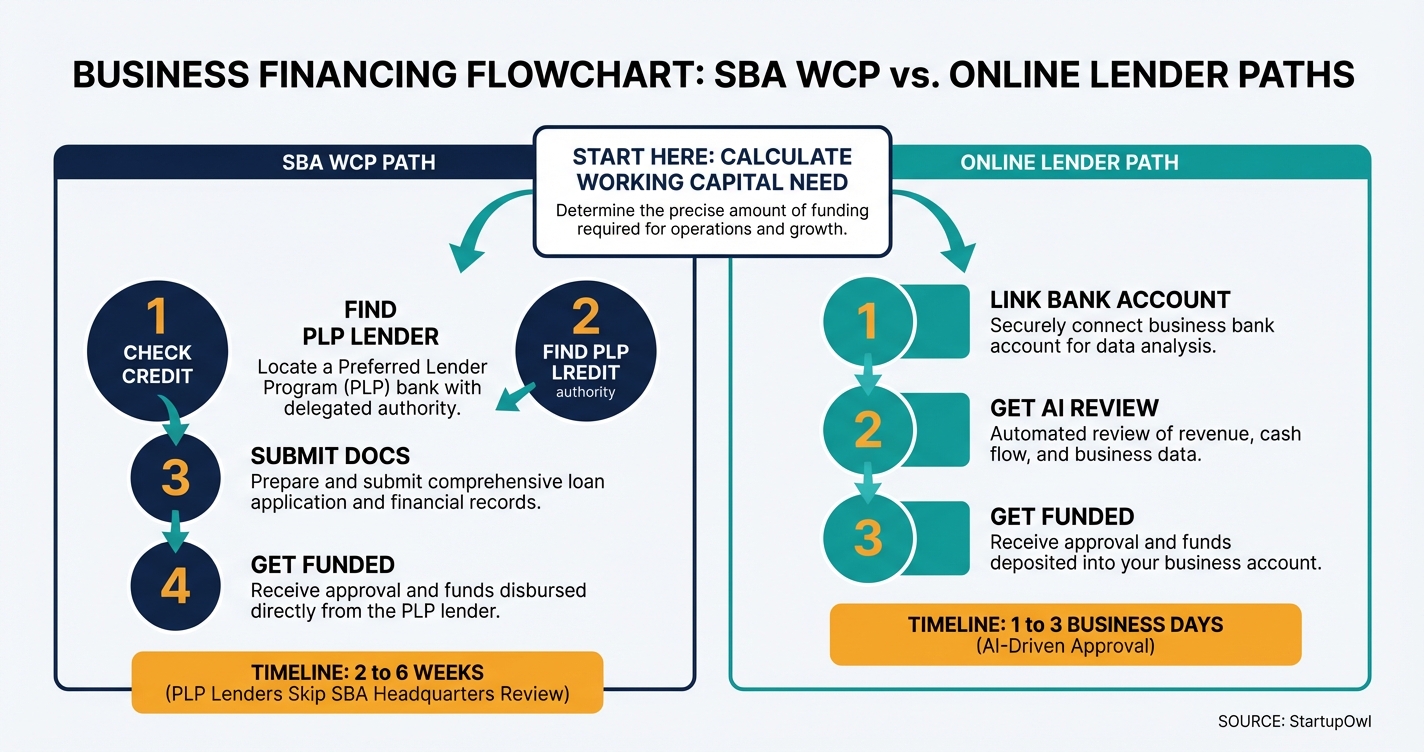
SBA WCP Path (2 to 6 weeks): Start with the SBA Lender Match tool. Look for a PLP-WCP lender, because a PLP lender can approve your loan without SBA headquarters review. That saves weeks. Prepare 2 to 3 years of tax returns, current financial statements, AR and AP aging reports, and any contracts or purchase orders. Loans over $2 million trigger a mandatory on site field review. Without PLP authority, your file goes through the Loan Guaranty Processing Center instead.
Online Lender Path (1 to 3 days): Fundbox and OnDeck take under 10 minutes to apply. Fundbox links to your bank account or accounting software and can fund the next business day. OnDeck wants 3 months of bank statements. It can fund within 24 hours for term loans up to $200,000, and same day in many states for qualifying applicants. Both start with a soft credit check, so your score is untouched until you draw.
Get three quotes, whichever path you take. Compare the total cost of capital, not the headline rate. A lower origination fee on one offer can wipe out a higher rate on another.
What a Working Capital Loan Really Costs
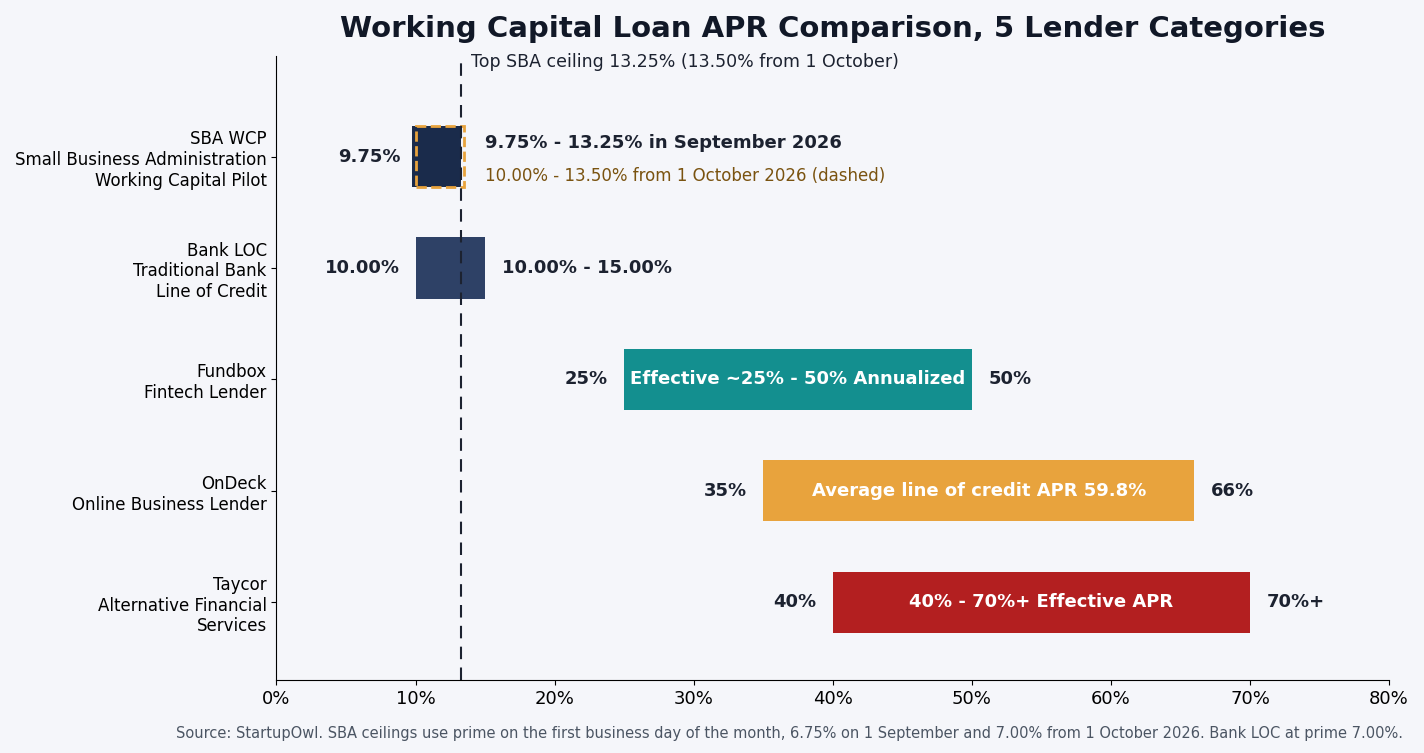
The SBA WCP caps rates based on loan size, all tied to the prime rate on the first business day of the month (7.00% on 1 October 2026, after lenders moved prime on 17 September following the Federal Reserve's 16 September increase). Here is the breakdown:
- Loans up to $50,000: Maximum 13.50% (Prime + 6.5%)
- Loans $50,001 to $250,000: Maximum 13.00% (Prime + 6.0%)
- Loans $250,001 to $350,000: Maximum 11.50% (Prime + 4.5%)
- Loans over $350,000: Maximum 10.00% (Prime + 3.0%)
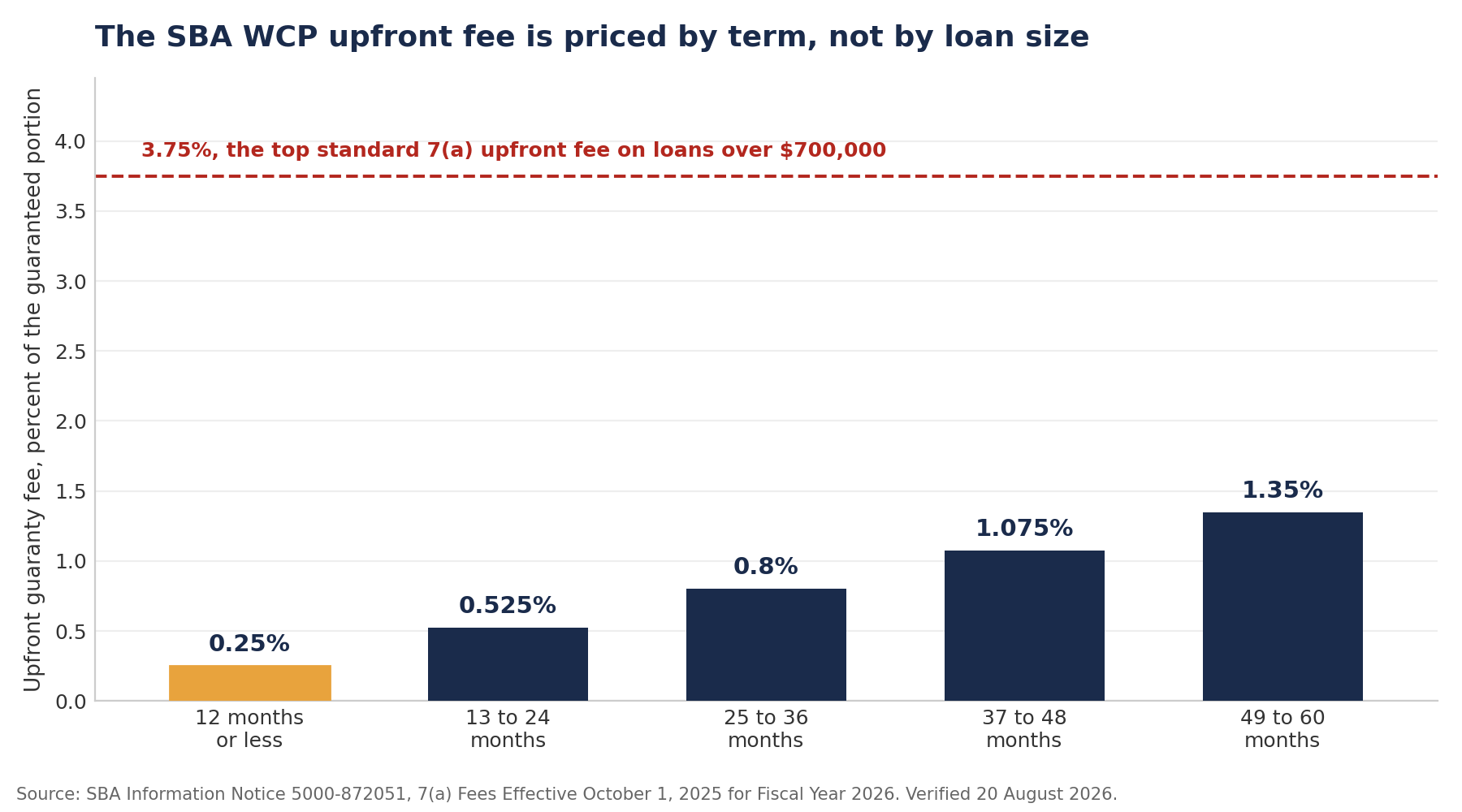
The guaranty fee is where WCP quietly beats standard 7(a). SBA Information Notice 5000-872051 puts WCP loans on their own upfront fee schedule, priced by maturity rather than by loan size. Twelve months or less costs 0.25% of the guaranteed portion. Longer terms step up, 0.525% to 24 months, 0.80% to 36 months, 1.075% to 48 months, and 1.35% to 60 months. A standard 7(a) loan over $700,000 pays up to 3.75%. That is the gap.
SBA's fiscal year 2026 manufacturer fee waiver has ended. For loans approved on or after 1 October 2026, SBA sets a 0% upfront fee on 7(a) loans of $700,000 or less to manufacturers, listed food supply chain businesses and rural businesses. It is unclear whether that fee applies to a WCP loan or only to the standard 7(a) table, so ask your lender which fee table your loan falls under.
Online lenders are a different world. OnDeck puts its own average line of credit rate at 59.8% APR, on loans originated in the half year to 30 June 2026 (per OnDeck's rate disclosure). Fundbox charges weekly fees from 4.66% on 12 week terms and 8.99% on 24 week terms. Those look small. They are not annualized APR figures.
Factor rate lenders like Taycor Financial charge 1.01 to 1.40. A 1.36 factor rate on a $10,000 12 month loan means you repay $13,600, which is roughly 70% APR. Convert every factor rate to APR first. Our merchant cash advance guide shows the math.
Working Capital Loan Rates Compared (2026)
| Type / Provider | Rate | Notes |
|---|---|---|
| SBA WCP (over $350K) | 10.00% max | Prime + 3.0%. The lowest ceiling SBA sets. Requires 680+ credit, 12+ months in business. |
| SBA WCP (up to $50K) | 13.50% max | Prime + 6.5%. Best for small draws with strong credit. |
| Traditional Bank LOC | 10.00% to 15.00% | Prime + 3% to 8%. Typically requires 3+ years in business. |
| Fundbox | 4.66% to 8.99% (weekly fee) | 12-24 week terms. Not APR. Effective annualized cost is much higher. |
| OnDeck LOC | ~35% to 66% APR | Lines of $6K to $200K. Fast funding but expensive. |
| Taycor Financial | 1.01 to 1.40 factor rate | Roughly 40% to 70%+ effective APR. Accepts credit scores as low as 500. |
Top 5 Working Capital Lenders for 2026
1. SBA WCP through Preferred Lenders
The best option if you have 680+ credit and at least 12 months in business. Rates are capped at 10.00% to 13.50% on loans up to $5 million, backed by an 85% SBA guaranty for loans under $150K. PLP-WCP lenders can approve without SBA review, cutting weeks off the timeline. Find participating lenders at SBA Lender Match.
2. Fundbox (Best for Startups)
Requires just 3 months in business, a 600+ personal credit score, and $30,000 in annual revenue. Lines of credit up to $150,000 with 12-to-24-week terms. Weekly fees start at 4.66%. No origination fees, no prepayment penalties, and next-day funding. Performs only a soft credit check on application. Apply at Fundbox.com.
3. OnDeck (Best for Speed)
Lines of credit from $6,000 to $200,000 with 12-to-24-month terms. Minimum credit score of 625, 12 months in business, and $100,000 in annual revenue. OnDeck's own disclosure puts the average line of credit at 59.8% APR. This is an expensive option, suited to short term needs. Same-day funding possible for qualifying applicants. Origination fee of 0% to 4%. Apply at OnDeck.com.
4. Taycor Financial (Best for Poor Credit)
Accepts personal credit scores as low as 500 for equipment products and 560+ for working capital lines. Factor rates start at 1.01 for lines of credit (with origination fees up to 3%) and go as high as 1.40 for term loans. Lines range from $10,000 to $1 million with 6-to-18-month terms. Funding in as little as 4 to 24 hours after approval. Apply at Taycor.com.
5. Bluevine (Best for Larger Lines with Fair Credit)
Lines run up to $250,000, with terms to 12 months and weekly or monthly payments. Bluevine has funded over $14 billion since 2013. Four places are excluded. Nevada, North Dakota, South Dakota and U.S. territories cannot apply. If you need more than Fundbox's $150,000 cap but do not qualify for SBA rates, Bluevine fills that gap.
Factor Rates Are Not the Same as Interest Rates
A 1.10 factor rate on a $100,000 loan means you repay $110,000. That total does not move. Paying early saves you nothing, because a factor rate is not interest. On a 12 month term 1.10 works out near 20% APR, and on a 6 month term nearer 40%. Ask for the APR in writing.
What to Do If You Do Not Qualify
Two things close this door. A credit score below 600, or less than 3 months in business, puts most working capital lines out of reach for now. These alternatives are ranked cheapest first.
- SBA Microloans: Up to $50,000 through nonprofit intermediaries. Rates of 8% to 13%. Available to startups and businesses that cannot get conventional financing.
- Business Credit Cards: Many offer 0% intro APR for 12-15 months. Good for bridging short-term gaps under $25,000. Build your business credit at the same time.
- Invoice Factoring: Sell your unpaid invoices for 80% to 90% of face value and receive cash in 1-3 days. Costs 1% to 5% of the invoice per month. No credit score minimum.
- Small Business Grants: Free money, no repayment. Competition is brutal. Worth a shot if you are a minority owned, women owned or veteran owned business.
- Merchant Cash Advance: Same day approval, and the price shows it. Effective APR runs 40% to 150%+. Last resort only.
If you are a very early-stage company still raising capital, our pre-seed funding and angel investors guide cover equity-based alternatives that do not require repayment at all.
5 Costly Mistakes to Avoid with Working Capital Loans
1. Borrowing more than your working capital supports. Most lenders cap your line at your current working capital amount (assets minus liabilities). A $50,000 working capital balance means your maximum line is typically $50,000, regardless of what a lender advertises. Borrowing beyond this increases your default risk and may trigger personal guaranty collection.
2. Ignoring advance rate caps on receivables. Even with an 85% advance rate on domestic receivables, you cannot access funds until qualifying invoices exist. Inventory advances cap at 60%. If you project $500,000 in receivables but only have $200,000 on the books today, your available draw is roughly $170,000 (85% of $200K), not $425,000.
3. Confusing factor rates with interest rates. A factor rate of 1.01 on a $50,000 advance costs $500 in fees. That looks cheap until you realize it is a 12-week product and the annualized cost exceeds 25% APR. Taycor's factor rates can go as high as 1.40, which on a $10,000 12-month loan equals $13,600 total repayment (roughly 70% APR).
4. Stacking hidden fees on top of interest. Some lenders charge origination fees (up to 5%), monthly maintenance fees ($20/month at OnDeck), and per-draw fees. On a $100,000 line with a 3% origination fee, you lose $3,000 before you even use the money. Read the full fee schedule and add every fee to your total cost calculation.
5. Failing to shop multiple lenders. The difference between the SBA WCP ceiling (10.00%) and OnDeck's disclosed average line of credit rate (59.8%) is enormous. Even if you only have fair credit, getting quotes from 3+ lenders can save thousands. Use the SBA's Lender Match tool and at least one online marketplace like Nav.com.
This is information, not advice. Nothing here is financial, legal or tax advice. Terms, rates and eligibility vary by lender, credit profile and business. Talk to a licensed financial advisor or CPA before you borrow. APR ranges reflect industry averages as of 2026 and can change without notice. SBA WCP ceilings are built on the prime rate on the first business day of the month, 7.00% on 1 October 2026, and reset at the start of each month.
Step-by-Step Process
- 1
Calculate your actual working capital need
Subtract your current liabilities from your current assets. The result is your working capital balance, and most lenders will cap your credit line at or near that number. If you have $100,000 in assets and $60,000 in liabilities, expect a maximum line of about $40,000.
Gather your most recent balance sheet or run the calculation from your accounting software. Lenders want to see that you can repay without over-leveraging your business.
Tips
- Use a 12-month rolling average of assets and liabilities for accuracy.
- Include accounts receivable in assets but only those under 90 days old.
- Ask your CPA to review the calculation before approaching lenders.
Common Mistakes
- Inflating asset values with stale receivables older than 90 days, which lenders will discount or reject.
- Confusing gross revenue with working capital, which leads to requesting far more than you can support.
- 2
Check your personal and business credit scores
SBA WCP lenders typically want a personal credit score of 680 or higher. Alternative lenders like Fundbox accept scores as low as 600, and Taycor Financial goes down to 500 for some products. Pull your free reports from AnnualCreditReport.com before you apply.
Your business credit score matters too. Lenders check Dun & Bradstreet, Experian Business, and Equifax Business. If you haven't started building business credit, open a business credit card and pay on time for at least 3 months before applying for a working capital line.
Tips
- Dispute any errors on your personal report before applying; corrections can take 30 days.
- Check your Dun & Bradstreet PAYDEX score at no cost through Nav.com.
Common Mistakes
- Applying to multiple lenders without checking your score first, triggering unnecessary hard inquiries.
- 3
Choose the right lender tier for your profile
Match your credit score, time in business, and revenue to the right lender. If you have 680+ credit and at least 12 months of operations, the SBA Working Capital Pilot Program gives you the lowest ceilings (10.00% to 13.50%, by loan size). For newer businesses, Fundbox requires just 3 months in business and $30,000 in annual revenue.
If your credit is below 600, look at Taycor Financial (minimum 500 for some products) or consider invoice factoring or a merchant cash advance as bridge options. Just know that factor-rate products can cost 40% to 150% in effective APR.
Tips
- Use the SBA Lender Match tool to find PLP-WCP lenders in your area.
- Get quotes from at least 3 lenders and compare total cost of capital, not just the advertised rate.
Common Mistakes
- Choosing the fastest lender without comparing total costs. A 1.01 factor rate on $50,000 costs $500 upfront plus weekly payments, which is far more expensive than a 12% annual loan.
- Assuming all SBA-approved lenders participate in the WCP program. Ask specifically about WCP eligibility.
- 4
Prepare your documentation package
SBA WCP loans require the most documentation. You will need 2 to 3 years of personal and business tax returns, current financial statements, accounts receivable and payable aging reports, and bank statements. Loans over $2 million require an on-site field review.
Alternative lenders need far less. Fundbox links directly to your business bank account or accounting software and can approve you in minutes. OnDeck requires just 3 months of bank statements and your tax ID. The less paperwork required, the higher the rate you will pay.
Tips
- Organize documents into a single PDF folder labeled by year and type before contacting lenders.
- Update your profit and loss statement and balance sheet to the most recent month.
- If you have government contracts or large purchase orders, include those as they can boost your advance rate.
Common Mistakes
- Submitting outdated financials. SBA WCP requires updated statements annually and a full credit analysis each year.
- Forgetting to include personal financial statements for all owners with 20% or more ownership.
- 5
Submit your application and negotiate terms
For SBA WCP, apply through a Preferred Lender Program (PLP-WCP) lender to skip the SBA review step entirely. PLP lenders have delegated authority to approve loans on their own, which saves weeks of processing time. Non-delegated applications must go through SBA review at the Loan Guaranty Processing Center.
For online lenders, the process is faster. Fundbox can approve you in minutes and fund by the next business day. OnDeck typically funds within 1 to 3 business days. Once you receive a term sheet, negotiate the origination fee (often 0% to 4%), draw fees, and maintenance fees before signing.
Origination fees of 0% to 5% of loan amount (varies by lender) 1 day (online lenders) to 2-6 weeks (SBA WCP) SBA.govTips
- Ask your SBA lender if they are a PLP-WCP lender with delegated authority for the fastest approval.
- Negotiate the origination fee down, especially if you bring strong financials or existing deposits to the lender.
Common Mistakes
- Signing a factor-rate agreement without converting it to APR first. A 1.10 factor rate on a 6-month $100,000 loan equals roughly 20% APR, not 10%.
Cost Breakdown
| Item | Cost Range | Notes |
|---|---|---|
| SBA WCP Interest (loans over $350K) | 10.00% (Prime + 3.0%) | A ceiling, not a quoted rate. SBA uses the prime rate on the first business day of the month, 7.00% on 1 October 2026. Variable. |
| SBA WCP Interest (loans up to $50K) | Up to 13.50% (Prime + 6.5%) | Smaller loans carry higher spreads. Still cheaper than most alternatives. |
| SBA Guarantee Fee | 0.25% to 1.35% | WCP has its own upfront fee schedule, priced by term, not by loan size. 0.25% at 12 months or less, rising to 1.35% at 49 to 60 months, per SBA Information Notice 5000-872051. Guaranty is 85% up to $150K and 75% above it. |
| Online Lender Rates (Fundbox) | 4.66% to 8.99% (weekly fee, not APR) | 12-week to 24-week terms. Effective APR is much higher when annualized. |
| Factor-Rate Lenders (Taycor Financial) | 1.01 to 1.40 factor rate | Equivalent to roughly 40% to 70%+ effective APR depending on term length. |
| Origination Fees | 0% to 5% | OnDeck charges 0% to 4%. Taycor up to 3%. Some SBA lenders charge flat fees up to $2,500. |
| Draw and Maintenance Fees | $0 to $20/month | OnDeck charges a $20 monthly maintenance fee (waived with $5K+ initial draw). Fundbox charges no draw or maintenance fees. |
Frequently Asked Questions
It depends on the lender. SBA Working Capital Pilot Program lenders typically require a personal credit score of 680 or higher. Fundbox accepts scores as low as 600, and Taycor Financial goes as low as 500 for some products. The lower your score, the higher your cost of capital will be.
Online lenders like Fundbox can fund as soon as the next business day after approval. OnDeck can fund same-day for qualifying applications. SBA WCP loans through PLP lenders take 2 to 4 weeks on average because of the documentation requirements, though the lender handles approval without SBA review.
The SBA WCP allows loans up to $5 million. Fundbox caps lines at $150,000. OnDeck offers lines of credit up to $200,000. Taycor Financial provides lines from $10,000 to $1 million. Your actual limit depends on your working capital balance, receivables, and overall creditworthiness.
Not always. Fundbox and OnDeck offer unsecured lines of credit (no collateral required), though they may file a UCC lien on business assets. SBA WCP loans are secured by your receivables, inventory, or contracts, with advance rates of 60% to 90% depending on asset type. Nearly all lenders require a personal guarantee regardless of collateral.
This is information, not advice. Nothing here is financial, legal or tax advice. Terms, rates and eligibility vary by lender, credit profile and business. Talk to a licensed financial advisor or CPA before you borrow. APR ranges reflect industry averages as of 2026 and can change without notice.
Sources & References
- SBA 7(a) Working Capital Pilot Program
- SBA 7(a) Loans Overview
- SBA Information Notice 5000-872051, 7(a) Fees Effective October 1, 2025 for Fiscal Year 2026
- SBA Waives Loan Fees for Small Manufacturers in Fiscal Year 2026
- Federal Reserve H.15, Selected Interest Rates, Bank Prime Loan Rate
- Federal Reserve Senior Loan Officer Opinion Survey, July 2026
- SBA Lender Match
- Nav.com: SBA Working Capital Line of Credit Guide
- LendingTree: Fundbox Business Loan Review
- OnDeck Business Line of Credit, rates and disclosures
- LendingTree: Taycor Financial Business Loans Review
- IRS Guide to Business Expense Resources
- Bankrate: Taycor Financial Business Loans Review
- NerdWallet: Fundbox Business Loan Review
About the Author
Editor, StartupOwl
Eliot leads StartupOwl's state data research. He maintains the site's fifty state records of LLC filing fees, annual costs, processing times, and small business grant programs, checking each figure against the state office that publishes it and logging the date it was verified. Based in New Jersey, he has spent his working life in and around small businesses, and he writes for the founder who wants the real number rather than the advertised one. Every figure under his byline traces to a named source, and when a state proves a number wrong, the correction is published, not buried.
Was this article helpful?
Questions about Working Capital Loans, How They Work, Rates and Where to Get One
No comments yet. Ask the first question and a member of our team will answer.
Leave a comment