
Best Startup Business Loans in 2026, Ranked by Who Lends to a Young Business
Two numbers decide this, six months in business and about $120,000 in yearly sales. Clear both and National Funding is our pick, up to $500,000 with funds in as fast as 24 hours. Short of them, three routes still lend.

In This Article
- Quick Answer
- Top Pick: National Funding
- Side-by-Side
- Full Reviews
- How to Choose
- The two kinds of startup, and only one can borrow this week
- What you need to qualify for a startup business loan
- Why National Funding is our pick for a startup with sales
- What a startup loan costs in 2026
- Startup loans with no revenue, the routes that exist
- How to apply for a startup business loan in four steps
- Four mistakes that get startup loan applications declined
- FAQ
- To a lender, a startup is a business about six months old with money moving through a bank account, not an idea.
- National Funding is our pick for that reader, up to $500,000, funding in as fast as 24 hours, FICO 600 typical, checked without touching your credit score.
- With no revenue yet, the SBA microloan program lends up to $50,000 at 8% to 13% and Kiva lends up to $15,000 at 0%.
- Fast online money is priced with a factor rate. $50,000 at 1.25 repays $62,500, and you should know that number before you sign.
- Applying to a big bank first with no track record wastes a hard credit pull. Start at six months. Not two years.
Every online lender asks the same two questions, how old the business is and what it deposits. National Funding's own FAQ sets the bar at six months in operation and $120,000 or more in annual sales, and most of its customers have a personal FICO score of 600 or higher. Clear that bar and it is our pick, up to $500,000, funded in as fast as 24 hours. Checking your options there does not touch your credit score. Miss the bar and no online lender will approve you, so applying anyway costs a hard credit inquiry for nothing. Three routes still lend with no sales, an SBA microloan up to $50,000, a Kiva loan up to $15,000 at 0%, and a community development lender. All three read a business plan and ask for proof the business is trading, not three months of bank statements.
Loan matcher
Find the lender that fits you
Five questions, about 30 seconds, nothing is stored
National Funding
Factor rate, quoted on application
Check your optionsSide-by-Side Comparison
| Feature | |||||
|---|---|---|---|---|---|
| Best for | Six months in with sales, money this week | Comparing several offers at once | Fair or poor credit, strong deposits | A real APR you can compare | Shopping SBA and bank products |
| Time in business | 6+ months | 6+ months | 6+ months | 1+ years | 6+ months |
| Revenue needed | $120,000 a year (live FAQ) | $50,000 a year | $15,000 a month | $100,000 a year | $50,000 a year |
| Min credit score | 600 typical | 560 | 500 | 625 | 600 |
| Amounts | $6,000 to $500,000 | $500 to $5,000,000 | $5,000 to $600,000 | $5,000 to $400,000 | $5,000 to $5,000,000 |
| Pricing | Factor rate from 1.10 | 8% to 60% APR by lender | Factor rate from 1.11 | APR from 35% | 7% to 30% APR by lender |
| Funding speed | As fast as 24 hours | About 1 business day | Same day possible | Same day possible | About a week |
| Credit impact to check | None | Soft pull | Soft pull | Soft pull | Soft pull |
| Prepayment penalty | No, early payoff discount | By lender | No, discount before midpoint | No | By lender |

Full Reviews
Factor rate, quoted on application
Fast funding for fair credit borrowers, priced as a factor rate, so the true cost takes a minute to work out.
Time in business: 6+ months
Min. revenue: $120,000/year
Pros
- Funds land as fast as 24 hours after approval, among the quickest in online lending
- Accepts personal credit scores around 600, which most banks turn away
- No prepayment penalty, and an early payoff discount is written into the agreement before you sign
- A named funding specialist handles your file, and Trustpilot reviewers praise them by name
Cons
- Factor rates (borrowers report offers from about 1.10 to 1.35) convert to true APRs that can pass 50% on short terms, far above SBA or bank pricing
- No rate card is published, so you cannot compare costs until you have applied and taken the call
- Daily or weekly ACH pulls can strain a business with uneven revenue
- Unsolicited mail and phone offers drive most of the 28 BBB complaints, and opting out takes persistence
Lendio gives you one application to shop 75+ lenders, but your data goes wide and final rates can climb past 50% APR.
Time in business: 6+ months
Min. revenue: $50K/year
Pros
- One 15-minute application reaches 75+ lenders, saving hours of individual applications across different platforms
- Accepts borrowers with credit scores as low as 560, giving subprime borrowers more options than most direct lenders offer
- Wide product range covering term loans, lines of credit, SBA 7(a), MCAs, equipment financing, and invoice factoring through a single portal
- Dedicated funding specialists walk first-time borrowers through product selection at no charge to the borrower
Cons
- Your personal and business data (including SSN and tax returns) is shared with multiple third-party lenders who may retain it permanently and contact you aggressively via phone, email, and text
- APR range stretches to 60%, and you cannot see actual rates until after submitting your full application, making upfront comparison impossible
- Revenue-based financing is repaid as a share of daily revenue rather than at a stated APR, so its true annualized cost is hard to compare against a term loan
- Customer support is limited to weekday business hours (Mon-Fri 7:30am-5pm MT), and multiple BBB and Reddit complaints describe unresponsive service after the initial application
- Once matched with a lender, Lendio is no longer involved in servicing your loan, leaving you without an advocate if problems arise
Fast funding for credit-challenged businesses, but factor rates can quietly push your effective APR above 30%.
Time in business: 6+ months
Min. revenue: $15,000/month
Pros
- Same-day funding possible with approval in as little as 4 hours, one of the fastest timelines among alternative lenders
- Accepts FICO scores as low as 500 and businesses with just 6 months of operating history
- Offers a prepayment discount of roughly 6% if you repay before the midpoint of your term
- Trustpilot score of 4.8 from 2,500+ reviews and A+ BBB rating since 2010, strong for the alternative lending category
Cons
- Factor rate pricing makes true cost comparison difficult; a 1.21 factor rate on a 12-month loan equates to roughly 30%+ effective APR
- The 2.5% origination fee is deducted from loan proceeds, reducing actual cash received while you repay interest on the full amount
- Daily or weekly automatic repayments can seriously strain cash flow for businesses with thin or variable margins
- Minimum revenue requirement of $15,000/month ($180,000/year) excludes many early-stage businesses, and Bankrate reports the real threshold may be $25,000/month
Fast same-day funding for fair-credit borrowers, but average APRs near 58% make OnDeck one of the most expensive online lenders we have reviewed.
Time in business: 1+ years
Min. revenue: $100K/year
Pros
- Same-day funding is genuinely available for term loans up to $200,000 if you complete checkout by 10:30 AM ET on a weekday.
- A 625 minimum FICO score and 1 year in business make OnDeck accessible to borrowers that traditional banks and SBA lenders routinely decline.
- On-time payments are reported to business credit bureaus, which helps you build a business credit profile.
- No prepayment penalty on either product, and repeat borrowers can qualify for reduced origination fees on subsequent loans.
Cons
- The average APR of 57.90% on term loans is roughly six times the 10.00% ceiling SBA sets on a 7(a) above $350,000. A $50,000 12-month term loan at this rate costs approximately $18,600 in finance charges.
- Daily or weekly automatic ACH repayments can crush cash flow during slow revenue weeks. You cannot switch to monthly payments on a term loan.
- Term loans are secured by a UCC-1 blanket lien and require a personal guarantee, meaning OnDeck can claim general business assets and pursue personal assets if you default.
- Maximum repayment terms cap at 24 months, forcing higher periodic payments compared to lenders offering 3 to 10-year terms.
- Without OnDeck's Prepayment Benefit, paying off your loan early still requires paying 75% of remaining interest, reducing the value of early repayment.
Fundera is a free loan marketplace that matches you with lenders, but the advertised low rates are reserved for the most qualified borrowers.
Time in business: 6+ months
Min. revenue: $50K/year
Pros
- One soft-pull application connects you to 25+ lenders across five product types, from SBA loans to equipment financing, without hurting your credit score.
- Dedicated loan specialists provide one-on-one guidance through the comparison process, which is reflected in the platform's 4.7 Trustpilot score from 1,110 reviews.
- Wide loan range from $5,000 to $5,000,000 covers everything from a quick cash flow bridge to major SBA-backed expansion financing.
- The service is free for borrowers. Fundera earns its commission (2% to 5%) from the matched lender, not from you.
Cons
- Your phone, email, and business details are shared with multiple third-party lenders immediately after applying. Users consistently report aggressive, high-volume sales outreach that is difficult to stop.
- Advertised 'starting at' APRs of 6.25% to 7.0% are only available to highly qualified borrowers. Less-qualified applicants are cross-sold into merchant cash advances with effective APRs that can exceed 100%.
- Pre-approval on the marketplace does not guarantee final approval. Borrowers report being denied by the matched lender after passing Fundera's initial screening, wasting time and triggering hard credit pulls.
- As a broker, Fundera adds a referral fee layer (2% to 5%) that is baked into your loan cost, even though you never see it as a line item.
How to Choose
Six months in, $120,000 or more in yearly sales, you need money this week
Six month floor. Cap of $500,000, funds as fast as 24 hours, and checking does not touch your credit. Price it as an APR before you sign.
Sales are real but your credit score is in the 500s
Credibly underwrites on bank deposits and reads scores down to 500. Expect a factor rate and daily or weekly payments.

You want several offers from one application before choosing
One form reaches 75 plus lenders from $500 to $5 million. Good for price discovery, and your data travels to every lender that looks.
No revenue yet and you need $15,000 or less
Kiva is not a lender. It is a 0% crowdfunded loan, covered below. You raise the first slice from people you know, then the public funds the rest, so budget two to three months and a real ask of your network.
A year in business and you want a plain APR to compare with your bank
OnDeck quotes a real APR from 35% and can fund the same day. Terms cap at 24 months and payments are daily or weekly.

The two kinds of startup, and only one can borrow this week
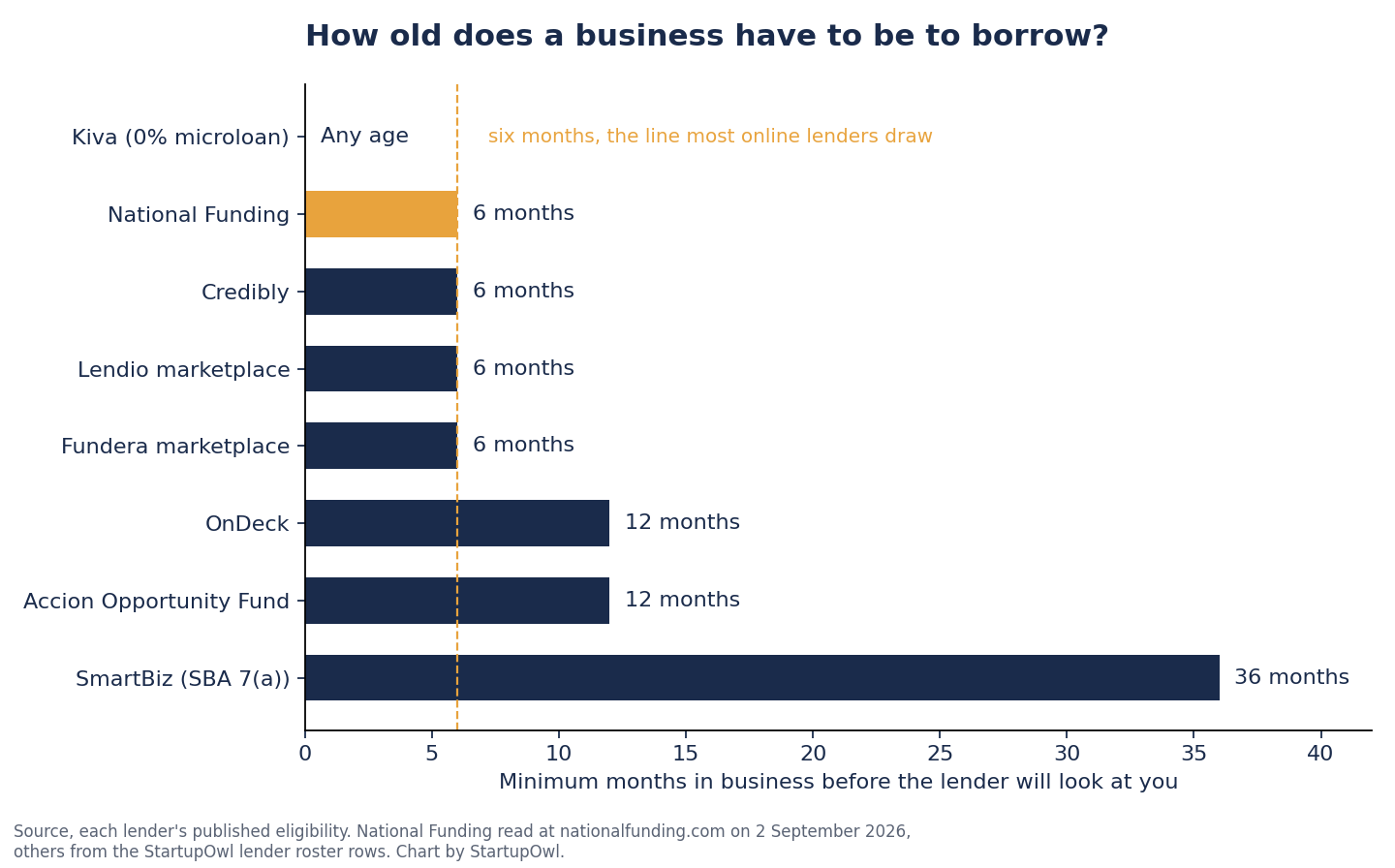
Lenders sort startups by age and bank deposits, not by how new the idea feels. Six months is the line. Most online lenders draw it there. National Funding, Credibly, Lendio and Fundera all start there. OnDeck and Accion Opportunity Fund want a year. An SBA 7(a) loan through SmartBiz wants three years. Kiva has no age floor at all, and it is not a lender, it is a crowdfunding site, which the no revenue section below explains.
So the first question is not which lender. It is which side of that line you stand on.
Open six months with sales landing in a business account? You are a borrower today. Every lender in the table above will read your application. National Funding is the one we would send you to first. If you opened last month, or you are still building, the online lenders will decline you. Applying anyway costs a hard inquiry. Skip to the no revenue routes further down. They are real, cheaper, and slower.
What you need to qualify for a startup business loan
Four things decide a startup loan application, time in business, monthly deposits, your personal credit score, and a personal guarantee. Business credit barely exists at six months. So every lender leans on you.
National Funding's own FAQ says most businesses qualify with at least six months in operation and $120,000 or more in annual sales, and that most customers have a personal FICO of 600 or higher. Checking your options there does not affect your credit score. Credibly reads bank deposits and accepts scores down to 500. Lendio's marketplace floor is 560. OnDeck wants 625 and a full year.
Expect a personal guarantee everywhere except Kiva. That means your savings, your car and your home equity are on the line if the business cannot pay. Read that clause before you read the rate.
| What lenders check | National Funding | SBA microloan | Kiva (crowdfunded, not a lender) |
|---|---|---|---|
| Time in business | 6 months | Startups accepted | Any |
| Revenue | $120,000 a year on the live FAQ | None required, plan quality matters | None |
| Personal credit | FICO 600 typical | Set by the intermediary, often 620 plus | No minimum |
| Personal guarantee | Yes | Usually | No |
| Collateral | Not required | Sometimes | No |
| Credit pull to check eligibility | None | Varies | Soft |
Why National Funding is our pick for a startup with sales
National Funding has lent for 27 years, $7 billion since 1999 to more than 100,000 businesses, and the reason it wins this page is fit. Its floor is six months. Its cap is $500,000. Funds arrive as fast as 24 hours after approval. A U.S. based funding specialist calls you, which matters when you are borrowing for the first time and have questions a form cannot answer. There is no prepayment penalty, and paying off early can earn a discount.
Here is the other chair. You should hear it from us. National Funding prices working capital with a factor rate, not an APR. Its own example is $50,000 at 1.25, repaid as $62,500 over the term. Payments come out daily or weekly by ACH on terms of 4 to 24 months. That is a fast product for a business that is already selling. It is the wrong product for a business that is not.
One more line from the fine print. In 15 states (AK, CO, MA, MN, NV, NJ, NY, ND, OK, OR, PA, RI, SD, TN and VT) National Funding offers sales based financing rather than a loan, so the paperwork looks different there.
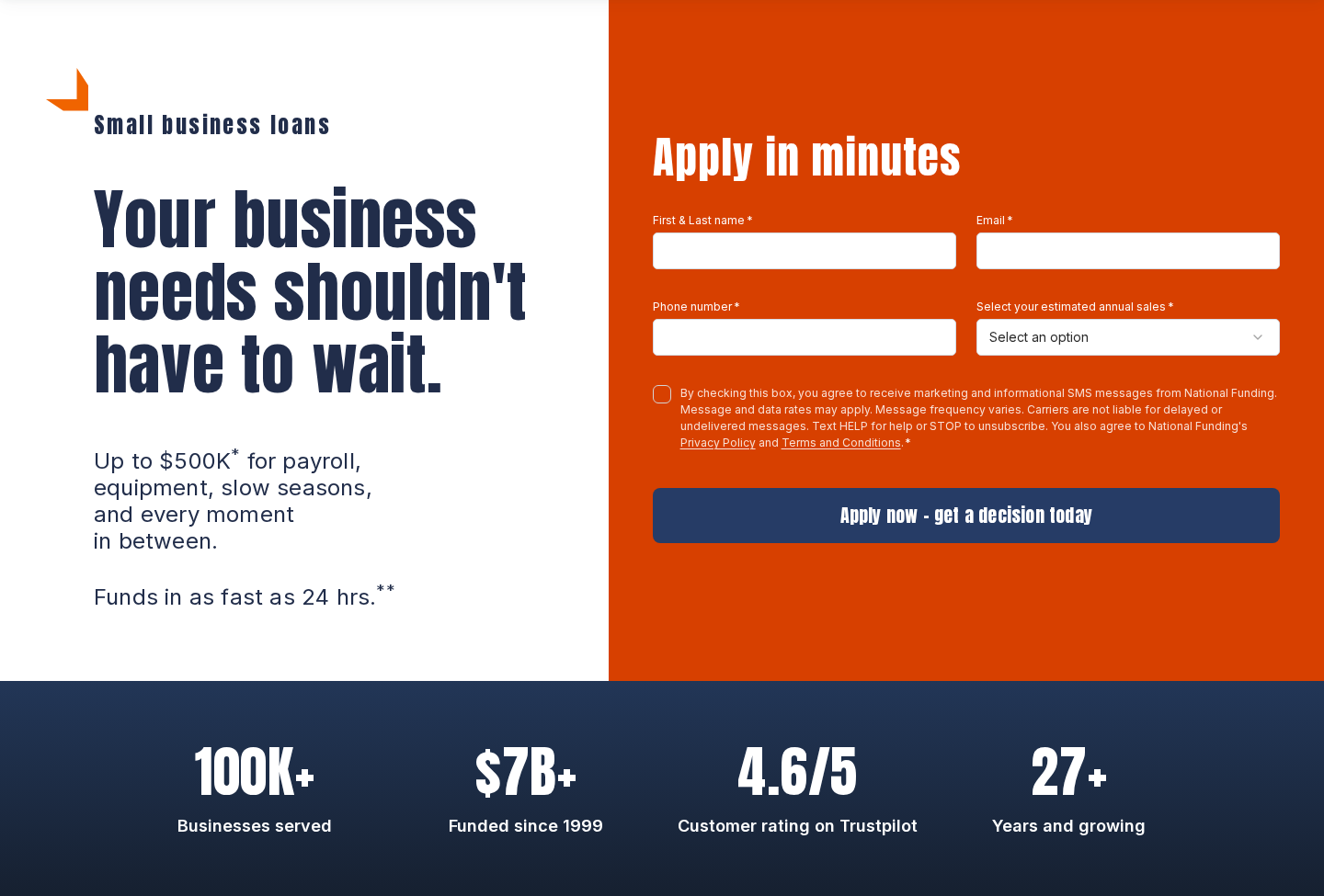
If you are six months in with sales, check your options at National Funding. It takes minutes. It does not touch your credit score. Our full National Funding review covers the factor rate math in detail.
What a startup loan costs in 2026
The cheapest startup money is the slowest. Kiva charges 0% and no fees on loans up to $15,000. SBA microloans run 8% to 13% for up to seven years, and the average one is about $13,000. SBA 7(a) loans are capped at prime plus a spread. Prime rose to 7.00% on 17 September 2026, so the ceilings sit between 10.00% on loans over $350,000 and 13.50% on loans of $50,000 or less.
Fast online money costs more and is priced differently. A factor rate multiplies the amount once. Borrow $50,000 at 1.25 and you repay $62,500, whether the term is 6 months or 12. Convert that to an APR before you compare it with a bank, and the shorter the term, the higher that APR gets. OnDeck prints a real APR from 35%. Credibly's factor rates start at 1.11. National Funding's start at 1.10.
| Route | Price | Amount | Speed |
|---|---|---|---|
| Kiva | 0%, no fees | $1,000 to $15,000 | About 1 to 2 months |
| SBA microloan | 8% to 13%, up to 7 years | Up to $50,000 | 30 to 90 days |
| SBA 7(a) | Capped at 10.00% to 13.50% at today's prime | Up to $5 million | Weeks to months |
| National Funding | Factor rate from 1.10 | $6,000 to $500,000 | As fast as 24 hours |
| OnDeck | APR from 35% | $5,000 to $400,000 | Same day possible |
Startup loans with no revenue, the routes that exist
A business with no sales has three real routes, and none of them is an online lender. The SBA microloan program lends up to $50,000 through nonprofit intermediaries that read your business plan instead of your bank statements. The average loan is about $13,000. The SBA still asks that you be an operating business, so a plan on its own will not clear it. Use the SBA's list of microlenders to find one in your state, and our guide to microloans for small business compares what those intermediaries lend. Community development financial institutions, CDFIs, are Treasury certified lenders that serve founders banks skip. The CDFI Fund keeps a searchable list. And then there is Kiva, which needs its own paragraph.
Kiva looks like the best deal on any table. 0% interest, no fees, no collateral, no credit check, up to $15,000. It is not a lender, and that is why the numbers look the way they do. Kiva is a crowdfunding site. After a 20 to 25 business day review, you must first ask your own friends, family and customers to lend to you during a private period that usually takes 10 to 15 days. Only then does your loan go public to Kiva's lenders for another 20 to 30 days. The money arrives through PayPal, repayment starts a month later and runs 12 to 36 months. So the price is zero and the cost is your time and your network. Budget two to three months. Kiva is also closed to businesses registered or mainly operating in Nevada or North Dakota. If you cannot name ten people who would lend you $50, Kiva is not your route.
Two more doors are worth a look. A business credit card underwrites you, not the business, and many carry a 0% intro period. Accion Opportunity Fund joins the list at 12 months and $50,000 in revenue. And if you are within reach of six months and $120,000 in sales, the fastest route may be to keep selling for a quarter and then apply to National Funding. Grants need no repayment at all, if you can wait for a decision.
How to apply for a startup business loan in four steps
Step one, pull your three credit reports free at AnnualCreditReport.com. Fix any errors. Keep card balances under 30% of their limits for the month before you apply.
Step two, gather three months of business bank statements, your last two personal tax returns, a government ID and a one page use of funds. For SBA and CDFI routes, write the full business plan with a 12 month cash flow. The SBA has a free template.
Step three, apply where your age and sales fit. Six months and $120,000 in sales, apply to National Funding. Under that, an SBA microlender or Kiva. Checking your options at National Funding does not touch your credit score, so start there if you qualify.
Step four, read the whole agreement. Find the personal guarantee, the payment frequency and the prepayment terms. Compare any factor rate as an APR. Then sign.
Four mistakes that get startup loan applications declined
Applying to a big bank first. Most want two years of tax returns, and a decline there still costs a hard inquiry.
Borrowing against a projection. If year one sales look like $60,000, do not borrow $50,000. Keep total annual payments under 25% of expected sales.
Ignoring the payment schedule. A daily ACH debit on a business with two slow weeks a month is how a good loan turns bad. Ask for weekly if daily does not fit your cash flow.
Skipping the business plan on an SBA or CDFI application. For a pre revenue founder, the plan is the application. Still choosing a structure? If so, form the LLC first so the loan has a business borrower.
Frequently Asked Questions
About the Author
Editor, StartupOwl
Eliot leads StartupOwl's state data research. He maintains the site's fifty state records of LLC filing fees, annual costs, processing times, and small business grant programs, checking each figure against the state office that publishes it and logging the date it was verified. Based in New Jersey, he has spent his working life in and around small businesses, and he writes for the founder who wants the real number rather than the advertised one. Every figure under his byline traces to a named source, and when a state proves a number wrong, the correction is published, not buried.
Was this article helpful?
This content is for informational purposes only and does not constitute financial, legal, or tax advice. Business financing terms, rates, and eligibility vary by lender, credit profile, and business characteristics. Consult a licensed financial advisor or CPA before making borrowing decisions. APR ranges reflect industry averages as of 2026 and may change without notice.
Sources & References
- SBA Microloan program, amounts, rates and terms
- SBA list of microlenders by state
- Federal Reserve H.15, bank prime loan rate
- Kiva U.S., borrow at 0%
- National Funding, small business loans and eligibility FAQ
- National Funding, working capital pricing example
- CDFI Fund, U.S. Department of the Treasury
- AnnualCreditReport.com
Questions about Best Startup Business Loans in 2026, Ranked by Who Lends to a Young Business
No comments yet. Ask the first question and a member of our team will answer.
Leave a comment