
How to Start an LLC in Indiana (2026)
Indiana prices the same filing two ways. State law sets $75 to file your Articles of Organization online.

In This Article
- Overview
- Quick Facts
- Introduction
- Choose a Name for Your Indiana LLC
- Choose a Registered Agent in Indiana
- File Your Articles of Organization with Indiana
- Get an EIN for Your Indiana LLC
- Create an Operating Agreement for Your Indiana LLC
- Open a Business Bank Account for Your LLC
- Federal BOI Reporting
- Top 3 LLC Services
- FAQ
- Next Steps
What You'll Learn in This Guide
This guide walks you through every step to legally form a Limited Liability Company (LLC) in Indiana, from picking a name to staying compliant year after year. We've kept it practical, current, and free of unnecessary fluff.
Note
Indiana LLC formation costs $100 in state fees. You can file DIY or through a formation service starting at $0.
Indiana LLC: Quick Facts
Last Verified: Sep 2026- Filing Fee (Online)
- $100
- Processing Time
- Not published by the state
- Expedited Available
- No
- Business Entity Report
- $32 (biennial)*
- State Income Tax
- Yes
- Sales Tax Rate
- 7%
- Filed With
- Indiana Secretary of State,…**
- Last Verified
- September 13, 2026
* Business Entity Report: $32, due By the end of the anniversary month of formation, every two years.
** Filed With: Indiana Secretary of State, Business Services Division
What You Need to Know About Forming an LLC in Indiana
Indiana prices the same filing two ways. State law sets $75 to file your Articles of Organization online. It sets $100 to file them any other way. Below is what each route costs, the six steps in order, and the report that falls due two years after you form.
An Indiana LLC puts a wall between what you own and what the business owes. If the LLC takes on debt or gets sued, your home, car and savings sit behind that wall. That is the whole point of forming one rather than trading as a sole proprietor.
Indiana is cheap to run once it is open. There is no franchise tax, and the Business Entity Report is due every two years rather than every year. That report costs $32 on INBiz and $50 on paper. Indiana also has its own series LLC statute, Indiana Code Article 23-18.1, which most states still lack.
One point gets reported wrongly across the web. The Articles of Organization do not ask for member or manager names, so your first filing keeps them off the public record. The Business Entity Report is a different matter. It asks for at least one governing person, and that includes a member when the LLC is member managed. You get privacy on day one and a name on the record two years later.
The order of work does not change. Pick a name the state will accept. Name a registered agent with an Indiana street address. File the Articles. Get an EIN from the IRS. Write an operating agreement. Then open a business bank account.
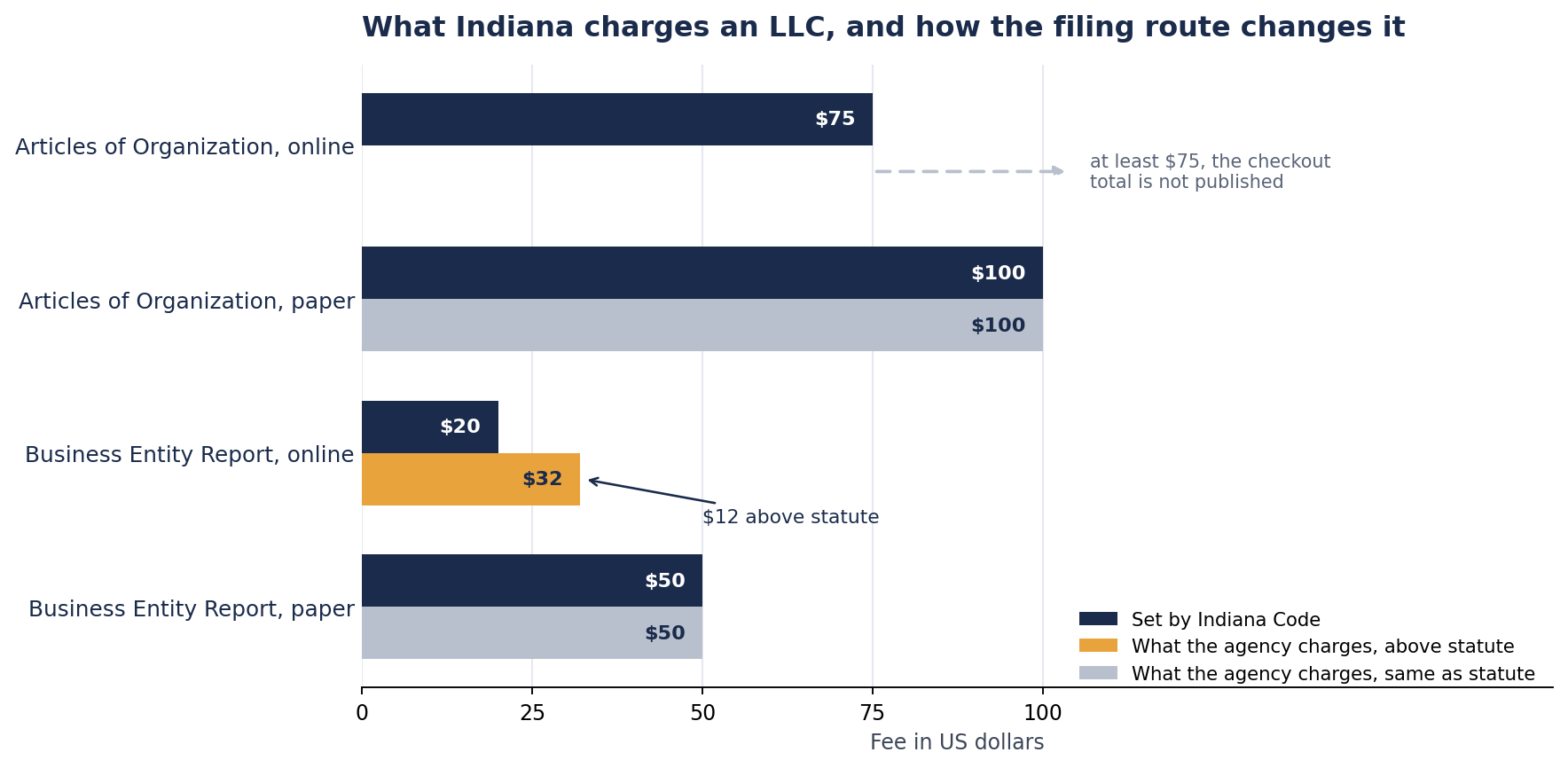
Indiana sets two prices for the same filing, and the cheaper one is the one you reach through INBiz. The chart puts the statute beside what the agency actually charges. On the report, the only filing where both numbers are public, the portal takes $12 more than the law sets. That gap is why this page prints no single online figure for the Articles.
Choose a Name for Your Indiana LLC
Your name has to follow Indiana's rules. It also has to differ from every name already on file with the state.
Indiana asks that your name differ from every other business on file. Check it free at bsd.sos.in.gov. If the name is free and you are not ready to file, an online form holds it for 120 days. The fee is $10, set by Indiana Code 23-0.5-9-36.
Search available names →Indiana LLC Naming Requirements
Optional Name Reservation
- Fee of $10 for the electronic application
- Holds the name for 120 days
- Filed through INBiz at inbiz.in.gov
Pro Tip
Search the Indiana business name database before you get attached to a name. It's free and takes two minutes.
Choose a Registered Agent in Indiana
Every Indiana LLC needs a registered agent. The agent takes legal papers for you, at a street address in the state, in business hours.
Your registered agent is the person or company that receives legal and tax correspondence for your LLC. That covers service of process, state filings, and compliance notices. The address has to be a street address in Indiana. INBiz says a P.O. Box only counts when it carries a rural route reference.
Your Three Options
- Be your own agent, if you live in Indiana and are there in business hours
- Ask someone you trust in Indiana to take the papers at their address
- Pay a registered agent service, $50 to $300 a year, to keep your address private
State Specific
Three Indiana rules decide whether option one works for you. The agent must be an Indiana resident or a business authorized to do business in Indiana. Your LLC cannot serve as its own registered agent. You may only have one agent at a time.
File Your Articles of Organization with Indiana
This filing creates your LLC. You send Form 49459 to the Indiana Secretary of State, Business Services Division.
Indiana charges by filing method, not by speed. Indiana Code 23-0.5-9-19 sets the fee at $75 for an electronic filing. It sets $100 for a filing made any other way. Form 49459 prints that $100 paper figure on its face. Both routes use the same form.
Read your total at INBiz checkout rather than trusting a quoted price. Indiana can charge more than the statute through its portal. Statute sets the Business Entity Report at $20 online, and the Secretary of State then publishes $32 on INBiz. The same gap can apply to the Articles. Other guides quote $95, $98 and $100 for the online filing, which is three answers to one question.
File Online
File by Mail
To file on paper, download Form 49459 from in.gov/sos/business/division-forms/business-forms. Send it with your payment to Secretary of State, Business Services Division, 302 West Washington Street, Room E-018, Indianapolis, IN 46204.
State Specific
The Articles do not ask for member or manager names, so your first filing keeps them off the record. The Business Entity Report is different. It falls due two years later and it does ask for at least one governing person.
Pro Tip
Form 49459 lets you leave the principal office line blank if you work from home. Do that and you must send State Form 9900382 with it.

Recommended: Northwest Registered Agent
$39 + state fee. Includes registered agent, business address, domain, website, email, and phone. No upsells.
Get an EIN for Your Indiana LLC
An EIN is a federal tax ID number for your business. You need one to open a bank account, hire employees, and file taxes.
Get your EIN from the IRS site. It is free. The form takes about five minutes and the number comes back at once. You can also use Form SS-4 by mail or fax, but that is slower.
Apply for your EIN on IRS.gov →You need the EIN before you can open a bank account or file Indiana state taxes. Get one even if you are the only member. It keeps your Social Security number off business paperwork.
Create an Operating Agreement for Your Indiana LLC
An operating agreement sets out who owns the LLC and who runs it. Indiana does not require one. Going without it is still a risk.
Indiana does not make you write one. Skip it and the state's LLC Act fills the gaps for you, on who decides what and how disputes end. Those default rules may not be what you want. Banks and partners will ask to see the agreement too.
Key Sections to Include
Pro Tip
Write one even if you are the only member. It shows a court that the LLC is a separate thing from you.
Open a Business Bank Account for Your LLC
A business bank account keeps your money and the LLC's money apart. That split is what keeps your liability shield standing.
Once the LLC is approved and you have the EIN, open a business checking account. This is not just tidy bookkeeping. Keeping the two sets of money apart is what makes the liability shield hold up in court. Mix them and a judge can rule the LLC was never separate from you.
What to Bring to the Bank
- Your filed and approved Articles of Organization
- Your EIN confirmation letter from the IRS
- A photo ID for each member opening the account
- Your operating agreement (many banks request this)
- An initial deposit (amount varies by bank)
Important
Mixing your money with the LLC's money is the fastest way to lose the shield. Courts call it piercing the corporate veil. You then owe the business debts yourself.
Federal BOI Reporting
No. FinCEN exempted every company formed in the United States from beneficial ownership reporting in an interim final rule published 26 March 2025 and applied from 21 March 2025, then made that exemption permanent in a final rule published 11 August 2026 and effective 14 August 2026. Only entities formed under foreign law and registered to do business in a US state still report.
Top 3 LLC Formation Services
We've independently reviewed the top LLC formation services in Indiana. Here's how they compare.
| Feature | Northwest Registered Agent Best Overall | ZenBusiness Best for LLC Formation | Tailor Brands Best for Branding |
|---|---|---|---|
| Starting Price | $39 + state fees | $0 + state fees | $0 + state fees |
| Formation Speed | Same-day only on the $199 package | 7-10 days, 1 day on Pro | 1-14 business days |
| Support | Lifetime Corporate Guides | Phone, chat, Velo AI 24/7 | Phone, Chat, Email |
| States Covered | 50 states | 50 states | 50 states |
| In Business Since | 1998 | 2015 | 2014 |
| Get Started → | Get Started → | Get Started → |
Frequently Asked Questions
What to Do Next
Once your Indiana LLC is approved, take these steps to set your business up for success.
Get an EIN
Apply for free in about 10 minutes at IRS.gov, required before opening a bank account or hiring anyone.
Open a Business Bank Account
Keep your money and the LLC's money apart from day one. Bring your EIN, Articles of Organization and a photo ID.
Create an Operating Agreement
Indiana does not require one. Write it anyway. It guards the liability shield and says who runs the LLC.
File Your Business Entity Report
Your first report is due two years after you form, then every two years. Indiana charges no late fee, it dissolves the LLC instead.
Paying contractors
Indiana is in the IRS forwarding program, so an e-filed 1099-NEC can reach the state. Check the Indiana floor before you skip a form under $2,000.
Ready To File?
Start your Indiana LLC with Northwest Registered Agent. $39 + state fee includes registered agent, business address, domain, and more.
About the Author
Editor, StartupOwl
Eliot leads StartupOwl's state data research. He maintains the site's fifty state records of LLC filing fees, annual costs, processing times, and small business grant programs, checking each figure against the state office that publishes it and logging the date it was verified. Based in New Jersey, he has spent his working life in and around small businesses, and he writes for the founder who wants the real number rather than the advertised one. Every figure under his byline traces to a named source, and when a state proves a number wrong, the correction is published, not buried.
Was this article helpful?
Questions about forming an LLC in Indiana
No comments yet. Ask the first question and a member of our team will answer.
Leave a comment