
Digital Marketing for Startups: Channels, Tactics, and Budget Allocation in 2026
Digital marketing for startups costs $500 to $10,000/month. Get the exact channel mix, tool stack, and budget splits to grow without wasting a dollar.

In This Article
$0–$10,000
Est. Cost
30 days
Timeline
6
Total Steps
The average startup spends between $500 and $10,000 per month on digital marketing, according to WebFX survey data (as of 2026). That range is wide because "digital marketing" covers everything from a free blog to a $10K/month Google Ads budget. This guide narrows it down to exactly what you should spend, where, and when.
Content marketing still generates 3x more leads than outbound at 62% lower cost, according to DemandSage (as of 2026). That makes organic channels the single best investment for startups that need to stretch every dollar. Below you will find a step-by-step plan, real tool pricing, and budget breakdowns for three different spending levels.
Why Digital Marketing Is the Default Growth Engine for Startups
You do not need a big team or a six-figure ad budget to compete online. You need a focused strategy that puts most of your money into two or three channels that match your customers. According to the HubSpot State of Marketing Report (2026), website/blog/SEO is the #1 ROI channel across all marketers, with paid social coming in at 26%.
For B2C brands specifically, email marketing delivers the best ROI, with a 2.8% conversion rate for B2C and 2.4% for B2B, according to FirstPageSage data cited by HubSpot (2026). Those numbers matter because they let you project revenue before you spend your first dollar on a tool subscription.
The rest of this guide is organized around the small business marketing plan framework: set up measurement, choose channels, build your tool stack, allocate budget, create content, and add paid amplification once organic proves your messaging. If you already have a plan and just need tool comparisons, skip to the tools section below.
How to Build Your Startup Marketing Engine (Step by Step)
Follow these six steps in order. Each one builds on the previous step, so skipping ahead (especially to paid ads) before validating your messaging with organic content is a common and expensive mistake.
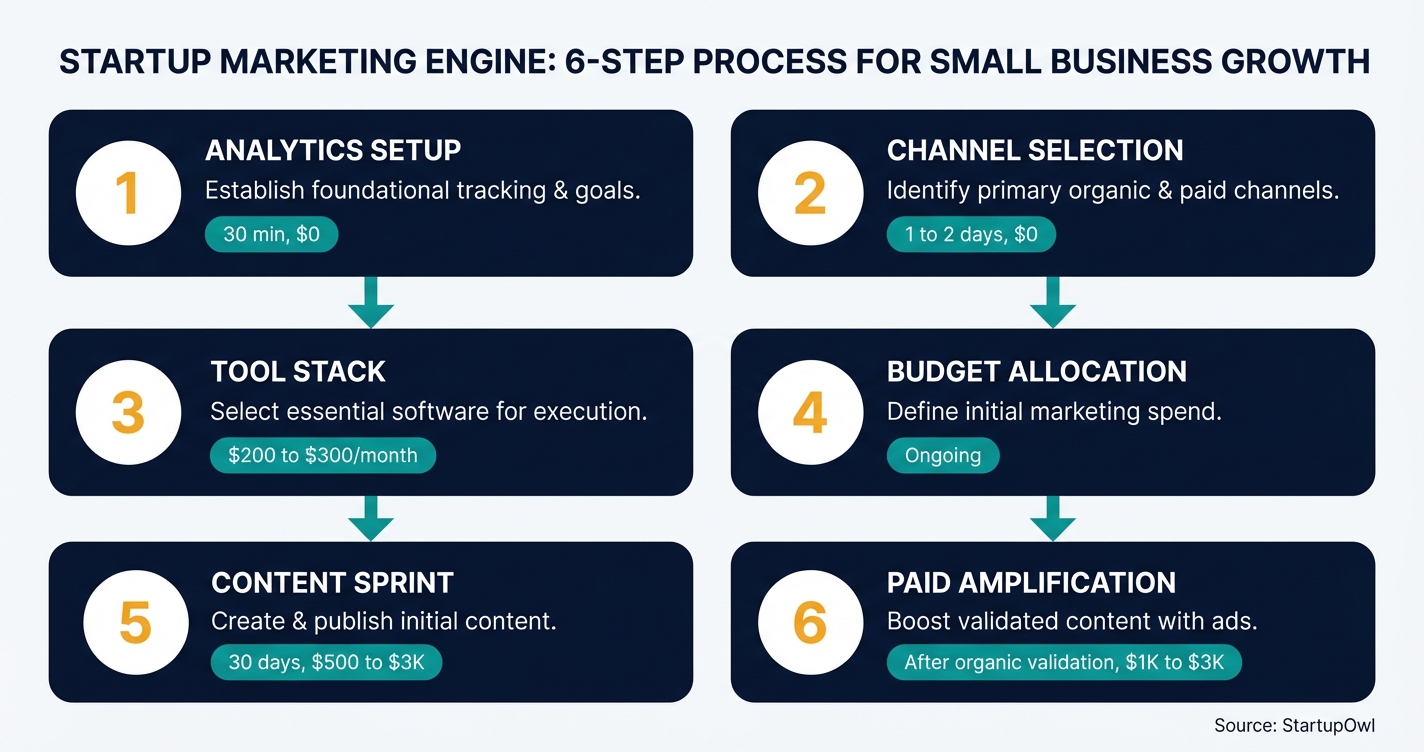
The steps below include specific tool names, pricing as of 2026/2026, and realistic timelines. For a broader view of how marketing fits into your growth trajectory, see our building a brand guide.
The Startup Marketing Tool Stack (With Real Pricing)
Your minimum viable stack should run $200 to $300/month total. Here are the five tools that earn their spot at every budget level.
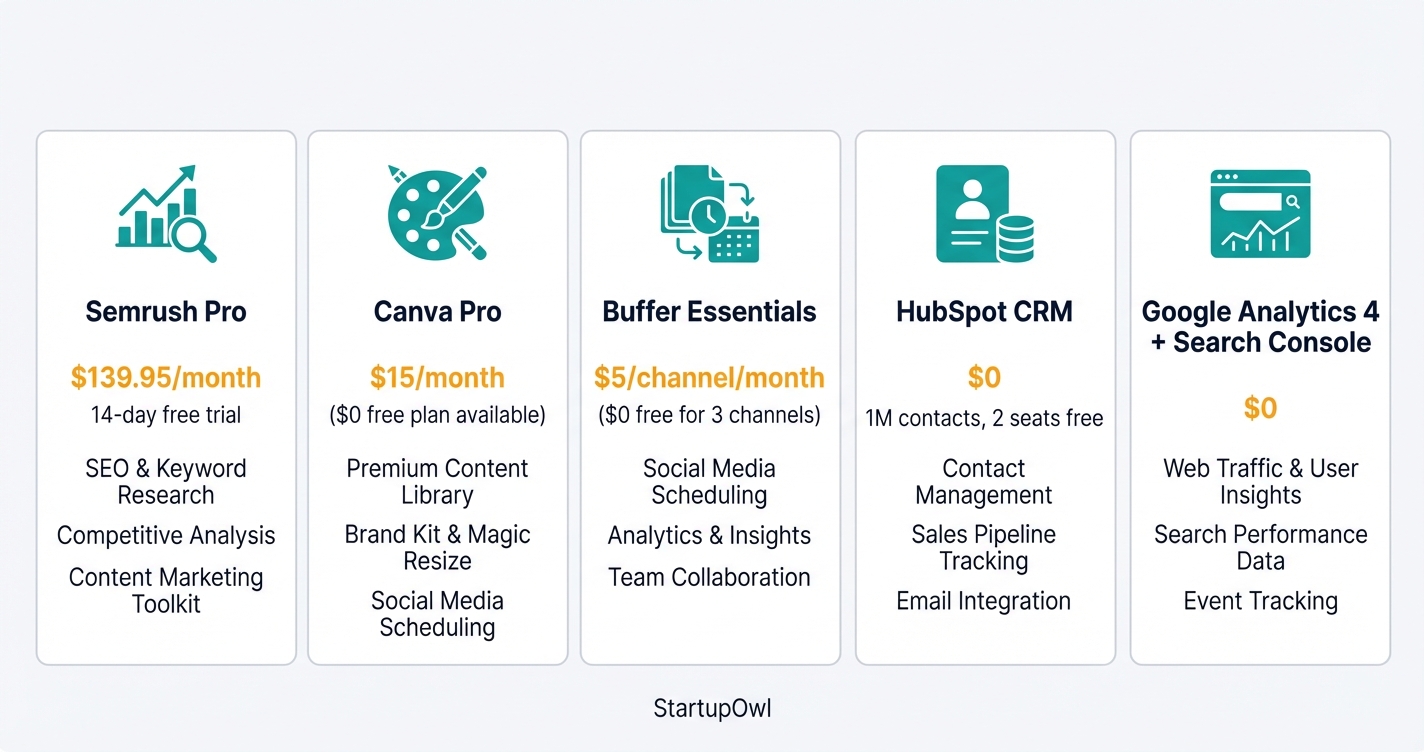
Semrush Pro costs $139.95/month (or $117.33/month billed annually, saving 17%) and includes keyword research, site audits, position tracking for 500 keywords, and competitor analysis across 5 projects (as of 2026). The 14-day free trial gives you full access, but requires a credit card, so set a reminder. If Semrush is too expensive at launch, the free tier of Google Search Console and Ahrefs Webmaster Tools cover basics until you can justify the cost.
Canva Pro runs $15/month or $120/year per person and includes 140+ million premium assets, 1TB of storage, and AI-powered features like background remover and Magic Write (as of 2026). The free plan includes 2M+ templates and 5GB of storage, which is enough for early-stage social graphics if you are not yet ready to pay.
Buffer Essentials costs $5/channel/month (or $6 monthly, paid annually with a 20% discount). The free plan covers 3 channels with 10 scheduled posts each (as of 2026). If you manage 3 social accounts, you can operate for months at $0 before needing to upgrade. For a more detailed comparison of scheduling tools, see our social media content calendar resource.
HubSpot CRM is free with up to 1,000,000 contacts, unlimited deals, and 2 user seats (as of 2026). You also get basic email marketing (2,000 sends/month with HubSpot branding), forms, landing pages, and live chat. The Starter plan at $15/seat/month removes branding and adds automation. For a deeper comparison of CRM options, see our CRM for startups guide.
Google Analytics 4 and Google Search Console are both free and non-negotiable. GA4 tracks traffic, conversions, and user behavior. Search Console shows which queries drive impressions and clicks. Together, they form the measurement foundation for everything else you build.
Monthly Budget Breakdown by Spending Level
| Type / Provider | Rate | Notes |
|---|---|---|
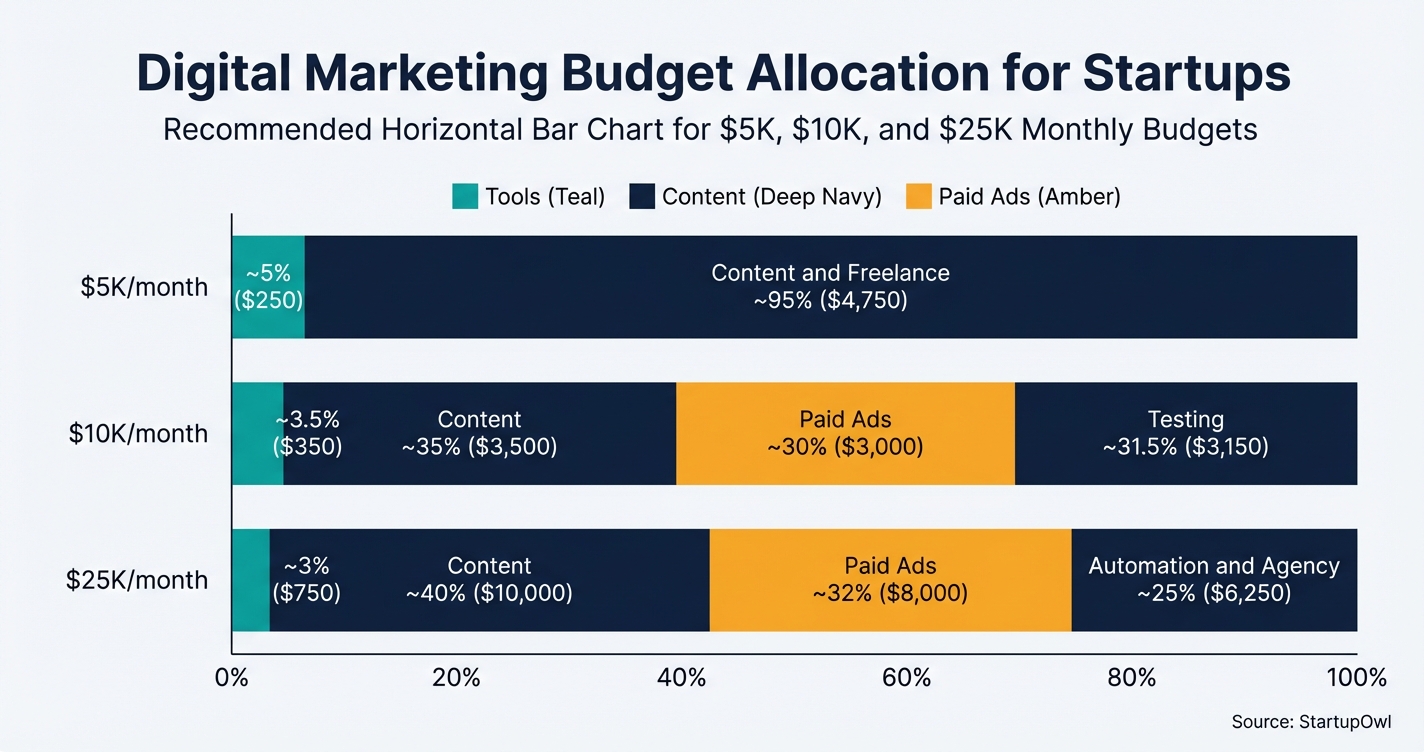
| $5K/month budget | ~$250 tools, ~$4,750 content + freelance | Organic-first strategy. Zero agency retainers. Every dollar should compound. |
| $10K/month budget | ~$350 tools, ~$3.5K content, ~$3K paid ads, ~$3K testing | Add paid amplification on top of your organic foundation. CRM stays free or Starter tier. |
| $25K/month budget | ~$700 tools, ~$10K content, ~$8K paid, ~$5K automation + agency | Full-stack across organic, paid, community. HubSpot Professional at ~$890/month may be justified. |
5 Digital Marketing Mistakes That Burn Startup Budgets
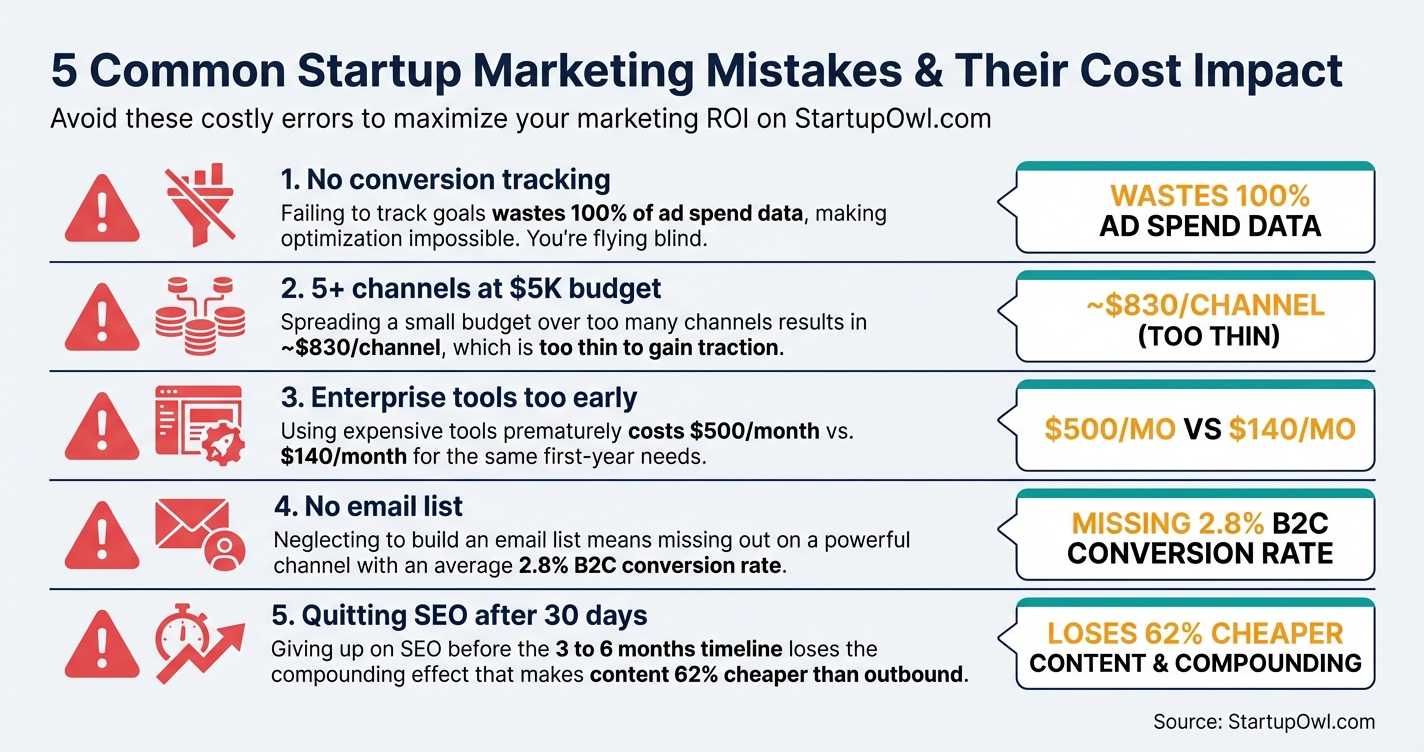
1. Running Google Ads before installing conversion tracking. Without tracking, you have no idea which keywords produce leads. The average Google Ads CPC is $5.26 as of 2026, according to WordStream. At that rate, even a modest $1,500/month budget burns through 285 clicks. If none are tracked, that entire spend is unaccountable.
2. Spreading budget across five-plus channels at once. A $5K budget divided among SEO, Google Ads, Facebook, Instagram, TikTok, and email gives each channel roughly $830/month. That is not enough to gain traction in any single channel, especially paid ones where 65% of small businesses are already competing, according to DemandSage.
3. Buying enterprise-tier tools too early. Semrush Business at $499.95/month is overkill for a startup with one website and fewer than 100 published pages. The Pro plan at $139.95/month tracks 500 keywords across 5 projects. That is enough for your first 12 to 18 months.
4. Skipping email list building in favor of social-only marketing. You do not own your Instagram followers, but you own your email list. Email delivers a 2.8% conversion rate for B2C (FirstPageSage, 2026), and list-building tools like HubSpot's free forms cost nothing to start. For a deeper comparison, check out our ConvertKit vs Mailchimp guide.
5. Expecting SEO results in 30 days. Organic content typically takes 3 to 6 months to show meaningful traffic gains. If you stop publishing after month one because you do not see results yet, you waste the compounding effect that makes content marketing so cost-effective in the first place.
What to Do This Week
Install Google Analytics 4 and Search Console today (both free). Then pick your two highest-ROI channels (for most startups, that is SEO/content plus email). Build your tool stack for under $300/month using the recommendations above, and launch your first 8 to 12 piece content sprint within 30 days. For a ready-to-use template to organize all of this, grab our free marketing plan template.
If you need help with pricing your own products before pouring money into marketing, check our cost-plus pricing guide and pricing calculator. For offline tactics that complement digital, see our guerrilla marketing ideas list. You have everything you need to start. The only mistake left is waiting.
Step-by-Step Process
- 1
Set up your free analytics foundation
Install Google Analytics 4 and Google Search Console before you spend a cent on marketing. These two free tools show you exactly where your traffic comes from, which pages convert, and how Google sees your site.
Connect both tools to each other so you can view organic search performance inside your Analytics dashboard. This setup takes about 30 minutes and gives you the baseline data you need to evaluate every marketing channel later.
Tips
- Set up at least one conversion event (form fill, purchase, or email signup) in GA4 on day one so you track ROI from the start.
- Verify your domain in Google Search Console immediately; indexing can take 2 to 4 weeks for new sites.
Common Mistakes
- Skipping goal/conversion setup and only tracking pageviews, which makes it impossible to measure channel ROI later.
- Waiting until after launching paid campaigns to install analytics, wasting your first round of ad spend data.
- 2
Choose your two highest-ROI channels first
Do not try to run five channels at once. Pick two channels that match your audience and budget. For most startups spending under $5K/month, that means SEO/content and one social platform or email marketing.
According to the HubSpot State of Marketing Report (2026), website/blog/SEO is the #1 ROI channel for marketers, followed by paid social at 26%. For B2C startups, email marketing delivers a 2.8% conversion rate. Pick the two that match your customer's behavior and double down on them before adding more.
Tips
- If your customers Google solutions to their problems, prioritize SEO and blog content as channel one.
- If your product is visual (food, fashion, home goods), pair Instagram or TikTok with email marketing for maximum impact.
Common Mistakes
- Spreading budget across five or more channels simultaneously, resulting in none getting enough investment to produce measurable results.
- 3
Build your minimum viable tool stack
Your core tool stack should cost between $200 and $300/month at the startup level. That includes an SEO tool, a design platform, a social scheduler, and (optionally) a CRM. Everything else is free.
Here is the starter lineup: Semrush Pro at $139.95/month for keyword research and site audits. Canva Pro at $15/month for all your graphics. Buffer Essentials at $5/channel/month for social scheduling. HubSpot CRM free tier for contact management (up to 1,000,000 contacts). Google Analytics and Search Console round it out at $0.
Tips
- Use Semrush's 14-day free trial before committing; that is enough time to audit your site and identify your top 20 keyword targets.
- Start with Buffer's free plan (3 channels, 10 posts each) if you only post to 2 to 3 platforms.
- HubSpot's free CRM handles up to 1,000,000 contacts; you will not need a paid CRM plan until you need advanced automation.
Common Mistakes
- Buying enterprise-tier tools before you have enough traffic or content to use them; Semrush Pro is plenty for the first 12 months.
- Forgetting that Semrush auto-renews with no refund policy, so set a calendar reminder before your trial ends.
- 4
Allocate your monthly budget by spending level
At $5K/month, keep tool costs to roughly $200 to $270/month and put the remaining 95% into content production and freelance support. Every dollar needs to compound, so prioritize organic-first (blog posts, SEO, email list building) with zero agency retainers.
At $10K/month, add paid amplification to your organic foundation. Spend roughly $3K to $4K on content, $2K to $3K on Google Ads for small business, and keep $500 to $1K for testing new channels. At $25K/month, you can go full-stack across organic, paid, community, and marketing automation (expect your tool costs to jump to $500 to $700/month at this level).
Tips
- Revisit your allocation quarterly; shift budget toward whichever channel shows the lowest cost-per-lead.
- At the $5K level, batch-produce 8 to 12 blog posts per month using a mix of in-house writing and AI drafting with human editing.
Common Mistakes
- Spending more than 10% of a sub-$5K budget on tools and subscriptions, leaving too little for the content and ads that actually drive leads.
- 5
Launch your first organic content sprint
Content marketing generates 3x more leads than outbound and costs 62% less, according to DemandSage. Your first content sprint should produce 8 to 12 pieces targeting long-tail keywords in your niche within 30 days.
Use Semrush or ChatGPT for small business research to find keywords with low difficulty and clear buyer intent. Publish each piece to your blog, repurpose it into 2 to 3 social posts with Canva graphics, and send a weekly email digest to your subscriber list. Expect SEO results to start showing in 3 to 6 months, but email and social traffic can arrive within days.
$500 to $3,000/month (content production) 30 days for first sprint; 3 to 6 months for SEO results SemrushTips
- Target keywords with a Keyword Difficulty score under 30 and monthly search volume above 200 for the fastest organic wins.
- Repurpose every blog post into at least two social media posts and one email segment to triple your distribution without additional writing.
Common Mistakes
- Publishing content without a target keyword or search intent, which wastes production budget on posts that never rank.
- Expecting SEO results in 30 days; realistic organic traffic growth takes 3 to 6 months of consistent publishing.
- 6
Add paid channels only after organic proves your messaging
Once your organic content shows which topics and angles convert, put paid budget behind your best performers. The average Google Ads CPC hit $5.26 in 2026, so you want to know exactly which keywords and landing pages convert before spending on clicks.
Start with a $1,000 to $3,000/month Google Ads test budget. Focus on your top 5 to 10 converting keywords from Search Console data. Set a target cost-per-lead that works for your business (the cross-industry average conversion rate for Google Ads search is 7.52% as of 2026). Kill underperforming campaigns after 2 weeks and reallocate to winners.
Tips
- Use your Google Search Console data to find keywords already driving organic clicks, then bid on the highest-converting ones for faster paid results.
- Set up conversion tracking in Google Ads on day one; without it you are flying blind on ROI.
Common Mistakes
- Running Google Ads without conversion tracking, making it impossible to determine which keywords generate actual leads or sales.
- Starting paid ads before validating your messaging with organic content, which often leads to expensive clicks that do not convert.
Cost Breakdown
| Item | Cost Range | Notes |
|---|---|---|
| SEO tool (Semrush Pro) | $139.95/month | 14-day free trial. Annual billing saves 17%. One user seat included. |
| Design (Canva Pro) | $15/month or $120/year | Free plan available with 2M+ templates. Pro adds 140M+ assets and brand kits. |
| Social scheduler (Buffer) | $0 to $5/channel/month | Free plan supports 3 channels with 10 posts each. Essentials adds unlimited scheduling. |
| CRM (HubSpot) | $0 to $20/seat/month | Free tier includes up to 1M contacts and 2 user seats. Starter removes branding at $15 to $20/seat/month. |
| Google Analytics + Search Console | $0 | Completely free. Essential baseline for all startups. |
| Content production (freelancers or in-house) | $500 to $5,000/month | Biggest variable cost. Expect $100 to $500 per blog post from freelancers depending on depth. |
| Google Ads budget | $1,000 to $10,000/month | Average CPC is $5.26 across industries (2026). Start small, scale after proving ROI. |
Frequently Asked Questions
Most startups spend between $2,000 and $6,000/month on digital marketing, according to industry surveys. If you are pre-revenue, start with free tools (Google Analytics, HubSpot CRM, Buffer free plan, Canva free) and invest your budget in content production rather than tool subscriptions.
SEO and content marketing deliver the highest long-term ROI at near-zero cost. Content generates 3x more leads than outbound and costs 62% less. You can publish blog posts, optimize for search, and build an email list using only free tools. Expect to wait 3 to 6 months for meaningful organic traffic, but the compounding returns make it the best zero-budget starting point.
Yes, but only after you have validated your messaging with organic content first. The average Google Ads CPC is $5.26 (as of 2026, per WordStream), and the average conversion rate is 7.52%. That means you need roughly 13 to 14 clicks (about $70) to generate one conversion on average. Start with $1,000 to $3,000/month and focus on your proven converting keywords.
At minimum, you need Google Analytics 4 (free), Google Search Console (free), and a CRM like HubSpot free (1,000,000 contacts). Add Canva (free or $15/month Pro) for design and Buffer (free for 3 channels) for social scheduling. An SEO tool like Semrush Pro ($139.95/month) is the biggest investment, but its 14-day free trial lets you audit your site before committing.
Expect 3 to 6 months of consistent publishing before organic search traffic becomes meaningful. Newer domains generally take longer because they lack the backlink authority of established sites. Target low-difficulty keywords (Keyword Difficulty under 30 in Semrush) to see quicker wins, and supplement with email and social distribution for immediate traffic while SEO builds.
At budgets below $10K/month, do it in-house or hire freelancers for content production. Agency retainers typically start at $3,000 to $5,000/month and eat too much of a small budget. At $10K+ you can consider a specialist (SEO or paid media) to manage one channel while you handle the rest. At $25K+ a full-service agency becomes viable without starving your ad spend.
Some links on this page are affiliate links. If you sign up for a service through them, we may earn a commission at no extra cost to you. This does not influence our rankings.
Sources & References
About the Author
Editor, StartupOwl
Eliot leads StartupOwl's state data research. He maintains the site's fifty state records of LLC filing fees, annual costs, processing times, and small business grant programs, checking each figure against the state office that publishes it and logging the date it was verified. Based in New Jersey, he has spent his working life in and around small businesses, and he writes for the founder who wants the real number rather than the advertised one. Every figure under his byline traces to a named source, and when a state proves a number wrong, the correction is published, not buried.
Was this article helpful?
Questions about Digital Marketing for Startups
No comments yet. Ask the first question and a member of our team will answer.
Leave a comment