
How to Buy a Laundromat in 2026, Costs, Valuation and Financing
Laundromats sell for 3 to 5 times yearly net, usually $200,000 to $500,000. How to verify revenue with water bills, value the store, and finance the deal.

$200,000–$500,000
Est. Cost
3 to 6 months
Timeline
7
Total Steps
How Do I Buy a Laundromat
You buy a laundromat in seven moves. Decide whether you are buying machines, a lease, or the building too. Search listings and talk to equipment distributors, they know which owners want out. Read the lease before you fall for the store, the lease is the real asset. Verify the seller's revenue against water usage. Price the store at 3 to 5 times yearly net. Line up financing, most buyers use an SBA 7(a) loan, seller financing, or equipment lenders, and many deals stack two of the three. Then close, and spend your first 90 days learning the store before you change a thing. Expect $200,000 to $500,000 for an established store and 3 to 6 months from first search to keys.
What a Laundromat Is Really Worth
The industry prices stores at 3 to 5 times yearly net income. The Coin Laundry Association's own valuation guidance uses that band, and broker data agrees. Where a store lands inside the band depends on things you can check yourself. Equipment age moves the multiple most. Machines under 7 years old versus over 15 can swing the price by a full turn of net. Card payment systems earn a premium over coin only stores. And the lease caps everything. A store with 4 years left is worth less than the same store with 15, because you are buying the right to operate, not just the machines.
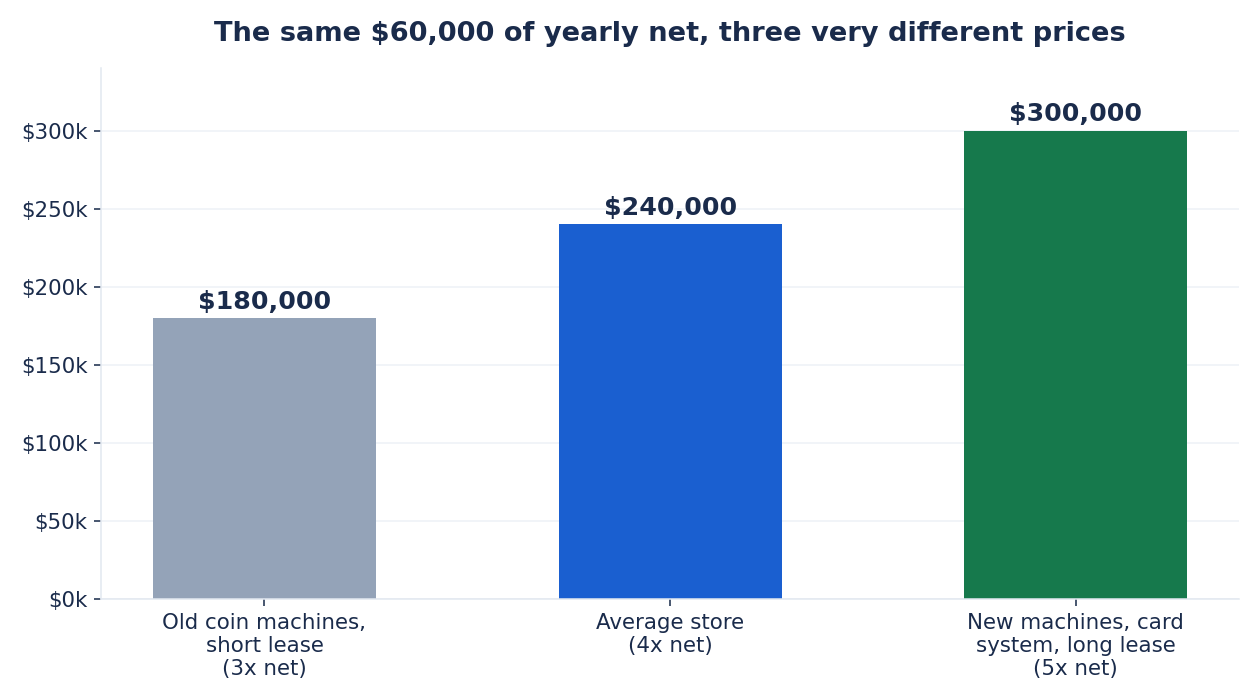
Market prices run from about $50,000 for tired stores to past $1 million for large modern ones. Most change hands between $200,000 and $500,000.
Those multiples sit above the market because a laundromat asks little of its owner. Across all US small businesses sold in 2026 the average was 2.7 times cash flow. Our business valuation calculator works out where a store lands and what a seller keeps once commission and capital gains come out.
The Water Bill Test
Ask for 24 months of water and sewer bills before you ask for anything else. A serious seller hands them over. Then do the math the brokers do. Every machine has a published gallons per cycle figure. Metered water tells you roughly how many cycles the store really ran. Multiply cycles by vend prices and compare that number with the revenue the seller claims. If the claim runs 30% above what the water supports, walk. Or reprice the deal using the water's version of the story.
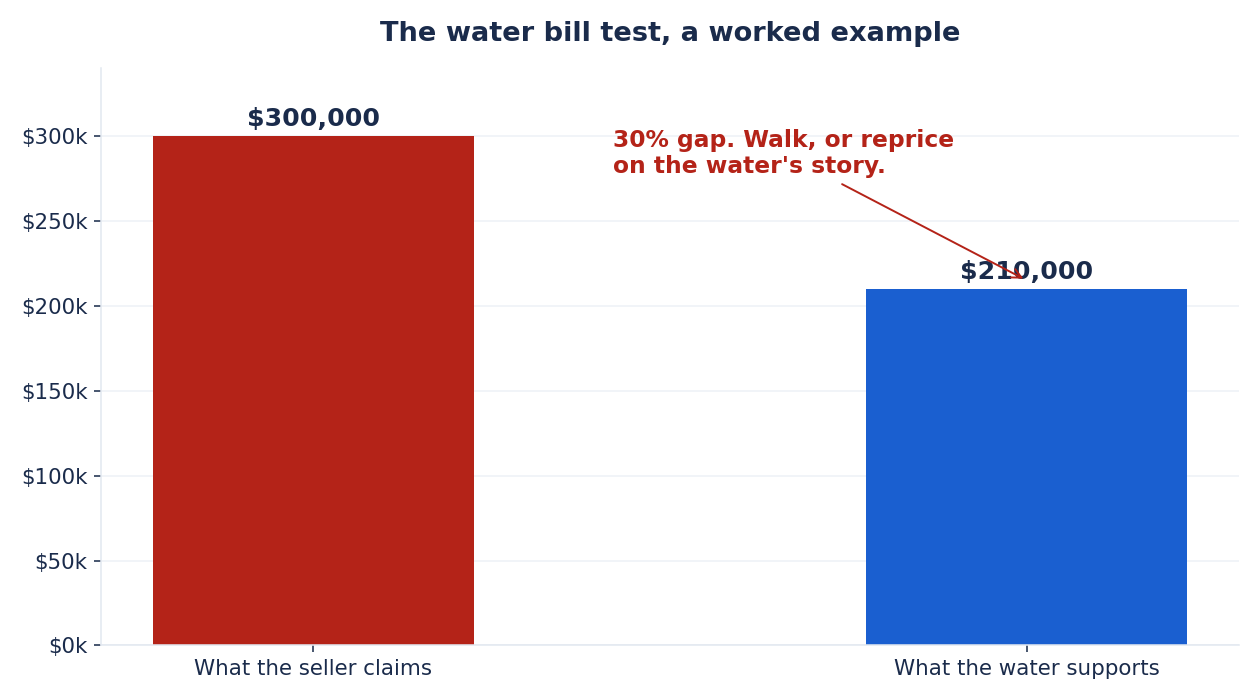
Utilities should also land near 20% to 30% of gross revenue. A store claiming $300,000 in revenue on $2,000 a month of total utilities is telling you two facts that cannot both be true.
How to Finance the Purchase
Most buyers stack two or three sources. An SBA 7(a) loan is the usual spine. Down payments start around 10%, and the store's own books carry the application. Marketplaces reach many SBA lenders with one form, the fastest way to find one that likes laundromats. Seller financing is common in this industry. A seller carrying 20% to 50% believes their own numbers. If part of that note is meant to cover half of your SBA down payment, it has to sit on full standby. That means no payments at all until the SBA loan is repaid, and the seller signs SBA Form 155 to agree to it. Ask about that before you settle the price. Equipment lenders finance machine upgrades against the machines themselves. That helps when you buy a coin store and plan a card system retool. And once you own the store, its trading history can qualify you for working capital and revenue based money. Under $50,000, an operating store is out of reach. Microloans and a smaller footprint fit better. Not sure which lane is yours? Route yourself in four questions.
Own the store already, or closing soon?
Once the store's books are yours, National Funding quotes working capital in about 24 hours on the store's own revenue history.
Check working capital optionsRed Flags That Kill Deals
No utility bills, no deal. The refusal is the answer. Month to month leases mean the landlord can end your business. Revenue claims based on cash collections nobody can verify. A seller who will not let you sit and count customers for a week. Old machines priced like new ones, get a distributor replacement quote first. And environmental surprises. If a dry cleaner ever operated on site, order a Phase I environmental assessment before closing. Solvent contamination follows the property, not the previous owner. The same logic runs the fuel world, our gas station buyer guide is built around it.
Is a Laundromat Actually Passive
No. The sellers marketing them that way are the ones to avoid. Margins run 20% to 35%. Yearly cash flow lands anywhere from $15,000 to $300,000, and that spread IS the labor question. Unattended stores save wages. They also lose machines to vandalism and to service calls nobody reports. Attended stores add wash and fold revenue, and payroll with it. Plan on 10 to 15 hours a week for your first year. Then delegate with numbers you trust.
Step-by-Step Process
- 1
Decide what you are actually buying
Laundromat deals come in three shapes. Machines plus a lease (most common), machines plus the building (best long term, biggest check), or an empty retool where you buy tired equipment cheap and rebuild. The shape changes everything downstream, price, financing, and risk. Buying the building turns lease risk into a mortgage. Buying machines on a short lease is the cheapest entry and the most common way buyers get hurt.
$0 1 weekTips
- Write down your ceiling before you look at listings, stores are easy to fall for.
- If the building is available, price both versions of the deal, SBA lenders like real estate collateral.
Common Mistakes
- Valuing the machines and forgetting the lease is the asset.
- Assuming a retool is cheap, get distributor quotes first.
- 2
Find stores for sale, listings and distributors
BizBuySell and BizBen carry hundreds of laundromat listings at any time. But the better deals often never hit a marketplace. Commercial laundry distributors know every owner in their territory, who is retiring, whose lease is up, who stopped ordering parts. Call the distributors for the machine brands common in your area and say you are buying. Brokers who specialize in coin laundry exist in most metros, they see deals first.
$0 1 to 3 months bizbuysell.comTips
- Ask distributors which local stores have the newest equipment, that list is your acquisition map.
- Visit as a customer first. Run loads at different hours, count machines out of order.
Common Mistakes
- Only shopping public listings, distributors see retirements a year early.
- Trusting listing photos, machine age hides in plain sight.
- 3
Read the lease before you love the store
The lease decides what the business is worth and whether a lender will touch it. You want enough term (with options) to cover your loan and your exit, an SBA lender will generally want the lease to run as long as the loan. Look for assignment rights, demolition clauses, CAM charges, and utility responsibilities. A month to month laundromat is not a business, it is equipment stored in someone else's building.
$500 to $2,000 for attorney review 1 to 2 weeksTips
- Negotiate lease extension with the landlord as a condition of the purchase, sellers cannot, buyers can.
- Ask who pays for water heater and sewer line failures, those bills are large.
Common Mistakes
- Signing a personal guarantee on the lease without capping it.
- Ignoring demolition or redevelopment clauses in gentrifying corridors.
- 4
Verify revenue with the water bill test
Ask for 24 months of water, sewer, gas, and electric bills. Every commercial washer has a published gallons per cycle figure. Metered water divided by average gallons per cycle tells you roughly how many cycles the store ran, and cycles times vend prices approximates real revenue. Compare that with the claim. Utilities in total should also land near 20% to 30% of gross revenue. Sit in the store and count customers across a week, your counts should agree with the water's story too.
$0 2 to 4 weeksTips
- Request bills directly from the utility with the seller's authorization, not screenshots.
- Watch for a suspicious revenue jump in the months right before listing.
Common Mistakes
- Accepting a spreadsheet of collections as proof, cash claims need physical evidence.
- Skipping the customer count because the water math looked fine.
- 5
Value the store at 3 to 5 times net
Price the verified net income, not the story. The industry band is 3 to 5 times yearly net. Newer equipment, card systems, a long lease, and wash and fold revenue push toward 5. Coin only stores with machines past 15 years and short leases belong at 3 or below, because your retool is coming and it is expensive. Get a distributor quote for replacing the oldest third of the machines and subtract reality from the asking price.
$0 1 weekTips
- Ask the seller for their tax returns, the gap between returns and claims is your negotiating room.
- A store priced under 3 times net is not a bargain until you know why.
Common Mistakes
- Paying for potential, you are buying the store that exists.
- Ignoring the retool cost hiding inside a nice looking price.
- 6
Line up the financing stack
Most buyers stack two or three sources. An SBA 7(a) loan is the usual spine. Down payments start around 10%, and the store's own books carry the application. Marketplaces reach many SBA lenders with one form, the fastest way to find one that likes laundromats. Seller financing is common in this industry. A seller carrying 20% to 50% believes their own numbers. Equipment lenders finance machine upgrades against the machines themselves. That helps when you buy a coin store and plan a card system retool. And once you own the store, its trading history can qualify you for working capital and revenue based money. Under $50,000, an operating store is out of reach. Microloans and a smaller footprint fit better.
10% to 20% down typical 30 to 90 daysTips
- Apply with the store's numbers, not just yours, the business is the borrower.
- Ask the seller about carrying a note before you finish negotiating price, it changes the conversation.
Common Mistakes
- Draining every dollar into the down payment and leaving no repair reserve.
- Signing a merchant cash advance for the purchase, acquisition money should be term debt.
- 7
Close, then change nothing for 90 days
Use an escrow that handles bulk sale requirements so the seller's old debts do not follow the machines. Transfer utilities, insurance, and any wash and fold payroll on day one. Then run the store exactly as you bought it for 90 days. Learn its rhythms, its regulars, its dead hours, and its real numbers before you raise vend prices or re sign anything. The customers you inherit are the asset you paid 3 to 5 times net for.
$2,000 to $5,000 closing costs 30 to 45 daysTips
- Meet the attendants before closing if the store has them, they know everything.
- Collect quarters yourself the first month, the routine teaches you the store.
Common Mistakes
- Raising prices in week one and donating regulars to the store down the street.
- Skipping bulk sale escrow and inheriting the seller's unpaid vendors.
Cost Breakdown
| Item | Cost Range | Notes |
|---|---|---|
| Purchase price, established store | $200,000 to $500,000 | Industry band runs $50,000 for tired stores to over $1 million for large modern ones. Priced at 3 to 5 times yearly net. |
| Down payment (SBA 7(a) route) | 10% to 20% | The store's own financials carry the application. Seller financing on top can reduce cash at closing. |
| Attorney, lease and purchase review | $1,500 to $5,000 | The lease review is the part you cannot skip. Bulk sale escrow protects you from the seller's old debts. |
| Due diligence period costs | $0 to $2,000 | Utility bill verification is free. A Phase I environmental assessment applies if a dry cleaner ever shared the site. |
| Repair and working capital reserve | 3 months of rent plus utilities | Utilities alone run 20% to 30% of gross revenue. Machines break in month one, they always do. |
| Card system retool (optional) | Varies by store size | Card stores out earn coin stores per machine. Equipment lenders finance this against the machines. |
Frequently Asked Questions
Usually, yes. Margins run 20% to 35% once a store is stable. Yearly cash flow ranges from $15,000 for small tired stores to $300,000 for large modern ones. Lease terms and machine age decide your end.
Most established stores sell for $200,000 to $500,000. The floor sits near $50,000. Those are stores with old machines or short leases. Large card operated stores in good corridors pass $1 million.
Not an operating one. That budget does not cover a single set of commercial machines. What $15,000 can be is part of a down payment on a seller financed deal, or the start of a microloan funded smaller footprint.
True zero down is mostly marketing. Here is what actually happens. Sellers carry financing for buyers they trust. SBA loans go down to about 10% on strong deals. Equipment value can be refinanced to cover part of the price. Stack those and cash at closing gets small. It rarely reaches zero.
An SBA 7(a) loan built on the store's own books. Most deals pair it with seller financing. Equipment loans fund machine upgrades after the purchase. Once you have owned it 6 months or more, working capital lenders will read the store's revenue history for expansion money.
Plan for 10 to 15 hours a week in year one. That holds even for an unattended store. Collections, maintenance calls, cleaning, and refunds all need an owner until your systems earn trust.
This page is for educational and informational purposes only and is not professional financial, legal, or investment advice. Purchase prices, lending terms, and valuation multiples vary by market and by deal. Verify every number independently and use qualified professionals for lease review and closing. StartupOwl earns a referral fee on some financing providers, which does not affect our guidance.
Sources & References
About the Author
Editor, StartupOwl
Eliot leads StartupOwl's state data research. He maintains the site's fifty state records of LLC filing fees, annual costs, processing times, and small business grant programs, checking each figure against the state office that publishes it and logging the date it was verified. Based in New Jersey, he has spent his working life in and around small businesses, and he writes for the founder who wants the real number rather than the advertised one. Every figure under his byline traces to a named source, and when a state proves a number wrong, the correction is published, not buried.
Was this article helpful?
Questions about How to Buy a Laundromat in 2026, Costs, Valuation and Financing
No comments yet. Ask the first question and a member of our team will answer.
Leave a comment