
Business Valuation Calculator
Work out what your business is worth on 2026 closed deal data, then see what you actually keep after broker commission and capital gains tax. Median US business sold for $349,250.

In This Article
What Your Business Is Worth
These move you within the range above, they do not produce a new number. Nobody publishes data on what customer concentration or owner dependence is worth in turns of earnings, so anyone quoting you a precise premium is guessing.
Fill in revenue, profit and what you pay yourself to see what your business is worth.
The One Line Answer
Your business is worth its earnings times a multiple. That is the whole formula. For a small owner run business the earnings figure is SDE, seller's discretionary earnings, which is your net profit with your own salary and perks added back. The multiple is set by your industry, your size and how much of the business is you.
Across 2,117 US businesses that changed hands in the second quarter of 2026, the average multiple of cash flow was 2.7. That is the real anchor. Most sellers expect 5.
What Businesses Actually Sold For in 2026
BizBuySell tracks closed deals, not asking prices. That is why it is the number to trust. Its Q2 2026 report covers April to June and 2,117 completed sales worth $1.8 billion.
The median business sold for $349,250. It had $692,087 of revenue and $155,921 of cash flow. That works out to an average cash flow multiple of 2.7 and an average revenue multiple of 0.7. One note on reading it, those multiples are averages while the dollar figures are medians, so do not call the 2.7 a median.
Sale prices split hard by sector. Manufacturing led at $704,500 and took 247 days to close. Service businesses came in at $350,000 and made up 40 percent of every deal done. Retail sat at $250,000. Restaurants sold for $205,000.
Subsector multiples get more useful, though the published table still covers full year 2025. Auto repair 2.70 times cash flow. Bakeries 2.68. Landscaping 2.56. Cleaning businesses 2.30. Hair salons 2.18. Some assets run far above the average because they need little of your time. Laundromats price at 3 to 5 times yearly net, which our laundromat guide breaks down.
Online Businesses Run on a Different Clock
An ecommerce store or a content site is priced against a different set of comps. Empire Flippers publishes a live scoreboard of its own closed deals, and it quotes multiples of MONTHLY net profit, not annual. Check the unit. Miss it and you are out by a factor of twelve.
On its trailing twelve months to July 2026, a typical business sold at 26.4 times monthly profit. Premium businesses reached 28.4. Businesses above $1 million hit 36.7. Distressed ones went for 14.5. Divide by twelve and those become 2.20, 2.37, 3.06 and 1.21 times annual profit.
SaaS earns a real premium. Acquire.com's report on 2025 closed deals puts the median SaaS profit multiple at 3.9 times annual profit, steady across 2024 and 2025.
Flippa says something more conservative than its own marketing. Its help centre tells sellers to start at 2 to 2.5 times annual net profit. Its blog quotes SaaS at 6.13 and ecommerce at 3.98. Those blog figures read as top quartile and one of the tables cites a third party rather than Flippa's own deals. We use the help centre number.
Three datasets. Three ways of measuring. All of them land between 2 and 3 times earnings, and that agreement is the most useful fact on this page.
SDE and EBITDA, and What You Can Add Back
SDE is for businesses under about $5 million. EBITDA is for the ones above it. The difference is one salary. SDE assumes a buyer will run the business themselves, so your compensation comes back into earnings. EBITDA assumes a hired manager, so it does not.
Start with net profit from your tax return. Add back your own salary and payroll taxes. Add back interest, depreciation and amortization. Add back one time costs that will not repeat for the buyer, a legal settlement, a rebrand, a flood. Add back genuine personal expenses running through the business, the car, the phone, the family health plan.
Then stop. Do not add back a salary for a manager who will still be needed, or marketing you cut last year to flatter the numbers. Buyers rebuild your add-back schedule from the bank statements, and every one they reject costs you the multiple times that amount. A $10,000 add-back thrown out at a 2.7 multiple is $27,000 off your price.
The Quality of Earnings Report, Where Your Price Gets Re-Cut
Accepting an offer is not the same as agreeing a price. On any deal a lender is funding, and on most deals of any size, the buyer signs a letter of intent and then hires an accounting firm to run a quality of earnings report. It is not an audit. Its one job is to work out whether the earnings you claimed are the earnings a new owner will actually collect, and it is where the number you shook hands on gets revisited.
Three things in that report decide what happens to your price, and they do not hurt you equally.
| What it re-tests | What the buyer's accountant is looking for | How it reaches your price |
|---|---|---|
| Your add-back schedule | Every add-back rebuilt from bank statements and tax returns rather than from your spreadsheet | Multiplied. It cuts earnings first, then the multiple cuts the price again |
| Your own compensation | What the market would pay someone to do your job, which replaces your actual salary once the deal is priced on EBITDA | Multiplied, the same way |
| The working capital peg | A normal level of receivables, inventory and payables the business has to be handed over carrying | Dollar for dollar. No multiple, but it comes straight off the cash you leave with |
The peg is the one sellers do not see coming, because it is not a valuation argument at all. You and the buyer agree what a normal month of working capital looks like, that figure goes into the purchase agreement, and if you hand the business over carrying less than it, the price drops by the shortfall. Which means collecting your receivables hard and running inventory down before closing does not make you money. It moves money from one line of the deal to another and hands the difference to the buyer.
The report is normally the buyer's cost rather than yours. Bedrock, a boutique firm that publishes its own rate card, charges a flat $6,000 to $12,000 on deals between $1 million and $30 million, and puts a $1 million to $3 million deal at $5,000 to $8,000. DueDilio, a marketplace that has run more than 1,300 of these projects, quotes $5,000 to $20,000 for a solo practitioner or a boutique, though that page has not been revised since 2022. Two firms with different business models landing on the same band is about as solid as this number gets. The large national firms publish no rate at all.
Everything you can do about it happens before the report is commissioned.
- Reconcile your books before you go to market, not after the letter of intent. Bedrock's own account is that disorganised records turn an $8,000 engagement into a $15,000 one, and the weeks that adds are weeks your letter of intent is ageing.
- Keep the invoice or statement behind every add-back, while you still remember what it was for. An add-back you cannot evidence is an add-back the report removes.
- Ask how the working capital peg will be calculated while the letter of intent is still being drafted. Agreeing the method up front is worth more than arguing the number once diligence is under way.
One thing this page will not tell you, because nobody can. There is no public dataset on how often a quality of earnings report moves the agreed price, or by how much. Brokers and diligence firms quote figures for it, and every one we could trace led back to an estimate rather than a measurement, so we are not repeating them.
What Moves Your Multiple
Six things decide where you land inside the band. Owner dependence is the big one. If the business needs you in it every day, you are selling yourself a job, not an asset, and the multiple drops.
Customer concentration is next. One client at 40 percent of revenue is a risk the buyer prices in. Clean books come third. Buyers who cannot verify your numbers discount them, and lenders will not fund what they cannot see. After that come growth, recurring revenue and age.
Be careful with the numbers you read on this. Plenty of broker sites will tell you concentration costs you exactly 0.5 to 2.0 turns of the multiple, or that recurring revenue above 70 percent adds a premium of 1.5 to 2.5 turns. No published dataset backs those figures. They are estimates dressed as measurements, so we do not repeat them.
What is measured is the distress gap. Empire Flippers closed distressed businesses at 14.5 times monthly profit against 26.4 for a typical one. Being forced to sell costs about 45 percent of the multiple. Sellers also close at 87 percent of asking price on average, so price with that haircut in mind.
What You Actually Keep
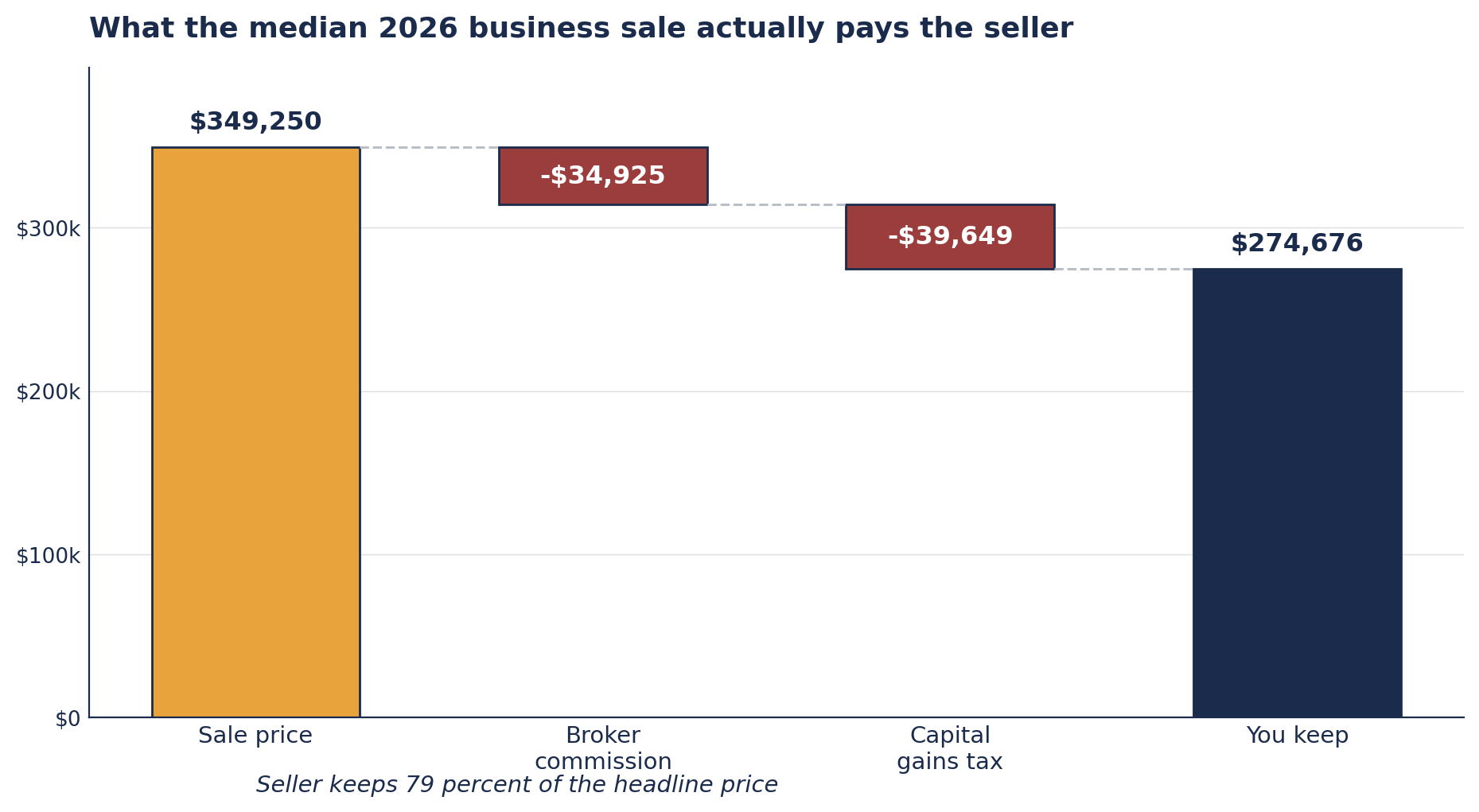
Here is the part every other calculator leaves out. Take the median 2026 sale, $349,250.
First the broker. They charge 10 to 15 percent on deals up to about $1 million, and under $100,000 many take a flat $10,000 to $15,000 instead. At 10 percent that is $34,925 gone, leaving $314,325.
Now tax. You owe on the gain, not the sale price, so your basis matters. Say you built this business from nothing and your basis is $50,000. Your gain is about $264,325. Here the rate depends on the rest of your year. A married couple filing jointly in 2026 pays nothing on long term gains until taxable income passes $98,900, then 15 percent up to $613,700. If this couple has other income that already fills the nil rate band, the tax is roughly $39,649. With no other income at all, part of the gain falls in the zero band and the bill drops to about $24,814.
That leaves about $274,676. A $349,250 business put roughly $275,000 in the bank. Close to one dollar in five went to commission and tax, and that is before legal and accounting fees. Change the other income figure and that split moves, which is why the calculator above asks for it.
Two things can make it worse. In an asset sale the price gets allocated asset by asset, so inventory throws off ordinary income and depreciated equipment triggers recapture taxed as ordinary income, not at 15 percent. That is why buyers want asset sales and sellers want stock sales. The split itself gets reported on Form 8594, and where each dollar lands can move five figures on a seven figure deal. The other is the 3.8 percent net investment income tax, which bites above $250,000 of income for joint filers. It usually spares an owner who actually ran the business, because the IRS treats that income as nonpassive.
None of this is tax advice. Your basis and your deal structure will move every number above, so run it past your accountant before you accept an offer.
Where to Sell, and What It Costs
Three routes, three cost structures.
A broker takes 10 to 15 percent. They earn it by finding buyers, screening them and holding the deal together. That suits a restaurant or a local service business.
An online marketplace suits a digital business. Flippa charges a listing fee and a success fee. Listing packages run $29 for a 60 day entry listing, $49 for a boosted or standard slot, and $199 to $599 for premium and ultimate tiers, with an NDA add-on at $199 on the lower tiers. On the success fee Flippa states only that fees start at 3 percent, and it does not publish a rate card. You will find blogs quoting 10 percent under $50,000 and 5 percent above $100,000. That tiering appears nowhere on Flippa's own site, so ask them in writing before you list. Worth knowing, listing fees come back in full if no qualified buyer contacts you within 30 days of going live. Flippa reports median closing times of 15 days under $50,000 and 73 days above $250,000.
Empire Flippers publishes its rate card. That is easier to plan against. It takes $10,000 flat up to $66,666, 15 percent to $700,000, 8 percent on the slice to $5 million and 2.5 percent above.
Selling direct costs no commission. It costs time instead. It works when you already know the buyer, a competitor, an employee or a family member. Expect to pay a lawyer properly, because you are doing the broker's job on the paperwork.
Frequently Asked Questions
Usually not. Across 2,117 US businesses sold in the second quarter of 2026, the average multiple of cash flow was 2.7. Five times is what larger businesses with real management depth achieve, or fast growing SaaS. Acquire.com puts the median SaaS profit multiple at 3.9 for 2025 deals. If someone has told you 5, ask which dataset it came from.
About $350,000 on the 2026 average revenue multiple of 0.7. Treat it as a sanity check, not a price. Revenue multiples ignore whether you actually make money, which is why buyers price on earnings instead. If that $500,000 of sales throws off $120,000 of cash flow, the 2.7 average puts you nearer $324,000. Work from earnings.
Roughly $700,000 on the 0.7 revenue multiple, but the earnings answer matters more. The median business sold in 2026 had $692,087 of revenue and $155,921 of cash flow, so a million in sales is comfortably above average size. Margin decides everything from there. A million in sales at a 20 percent margin values far higher than the same sales at 6 percent.
Ten to 15 percent of the sale price on deals up to about $1 million, with a reduced rate above that. Below $100,000 many brokers charge a flat fee of roughly $10,000 to $15,000 instead, because a percentage would not cover their time. Marketplaces work differently, charging a listing fee upfront plus a success fee on completion. Get the rate in writing.
The gain. Your basis comes off first, so a $349,250 sale with a $50,000 basis and $34,925 of commission is taxed on about $264,325. Long term gains run 0, 15 or 20 percent in 2026 depending on your taxable income. The structure matters as much as the rate, because an asset sale can push part of the money into ordinary income through depreciation recapture.
You will want a stock sale. Your buyer will want an asset sale. A stock sale gives you one clean capital gain, while an asset sale splits the price across assets, so inventory becomes ordinary income and depreciated equipment triggers recapture at ordinary rates. Buyers push for asset sales because they get a fresh depreciation basis and leave your liabilities behind. There is real money in it.
Valuations on this page are estimates built from published closed deal data, not a professional appraisal. Multiples, fees and tax rates change, and your own basis and deal structure will change every figure here. Nothing on this page is tax, legal or financial advice. Speak to your accountant and your attorney before you accept an offer.
Sources & References
- BizBuySell Insight Report, Q2 2026
- BizBuySell Insight Report data tables, full year 2025
- Empire Flippers Scoreboard, closed deal multiples
- Acquire.com Biannual Acquisition Multiples Report
- Flippa, how to value an asset or business
- Flippa pricing
- IRS Revenue Procedure 2025-32, 2026 capital gains rate bands
- IRS, questions and answers on the Net Investment Income Tax
- IRS, sale of a business
- BizBuySell learning centre, business broker fees
- Bedrock Quality of Earnings, how much a quality of earnings report costs
- DueDilio, how to get an affordable quality of earnings report
About the Author
Editor, StartupOwl
Eliot leads StartupOwl's state data research. He maintains the site's fifty state records of LLC filing fees, annual costs, processing times, and small business grant programs, checking each figure against the state office that publishes it and logging the date it was verified. Based in New Jersey, he has spent his working life in and around small businesses, and he writes for the founder who wants the real number rather than the advertised one. Every figure under his byline traces to a named source, and when a state proves a number wrong, the correction is published, not buried.
Was this article helpful?
Questions about Business Valuation Calculator
No comments yet. Ask the first question and a member of our team will answer.
Leave a comment