
Startup Costs: What to Budget For and How to Estimate Your First-Year Expenses
Average startup costs run $40,000 in year one. Learn what to budget for, from $50 LLC fees to $130,000 equipment, plus how to estimate and fund your launch.

In This Article
- Key Takeaways
- Step-by-Step
- Cost Breakdown
- What Startup Costs Actually Include (and Why Most Founders Underestimate Them)
- Who Needs to Budget for Startup Costs (and How Requirements Vary by Industry)
- How to Estimate Your Startup Costs in 5 Steps
- The Real Cost of Starting a Business (Category by Category)
- How to Fund Your Startup Costs (Best Options Compared)
- What to Do If Your Startup Budget Falls Short
- 5 Startup Budgeting Mistakes That Drain Your Cash
- FAQ
$100–$750,000
Est. Cost
30 minutes
Timeline
5
Total Steps
The difference comes down to your business model, industry, location, and whether you hire employees. This guide gives you the specific dollar ranges for every major category so you can build a realistic first-year budget and avoid the cash-flow crises that sink nearly one-third of failed startups.
You will also learn about the funding options available to cover your startup costs, from SBA microloans to business credit cards, and the IRS tax deduction that lets you write off up to $5,000 in your first year.
What Startup Costs Actually Include (and Why Most Founders Underestimate Them)
Startup costs are every expense you incur to get a business from idea to open-for-business status, plus the ongoing operating costs during your first year. The SBA breaks these into two buckets: one-time expenses (equipment, formation fees, build-out) and recurring monthly expenses (rent, payroll, utilities, software subscriptions).
The most expensive single line item for most businesses is equipment, which can range from $10,000 to $130,000 depending on your industry. Rent is the second biggest hit, with retail space averaging $23.98 per square foot nationally and office space averaging $35 per square foot as of 2026. Those are base rent figures. In a multi tenant building you also pay common area charges, and the annual CAM reconciliation settles them up after the year closes.
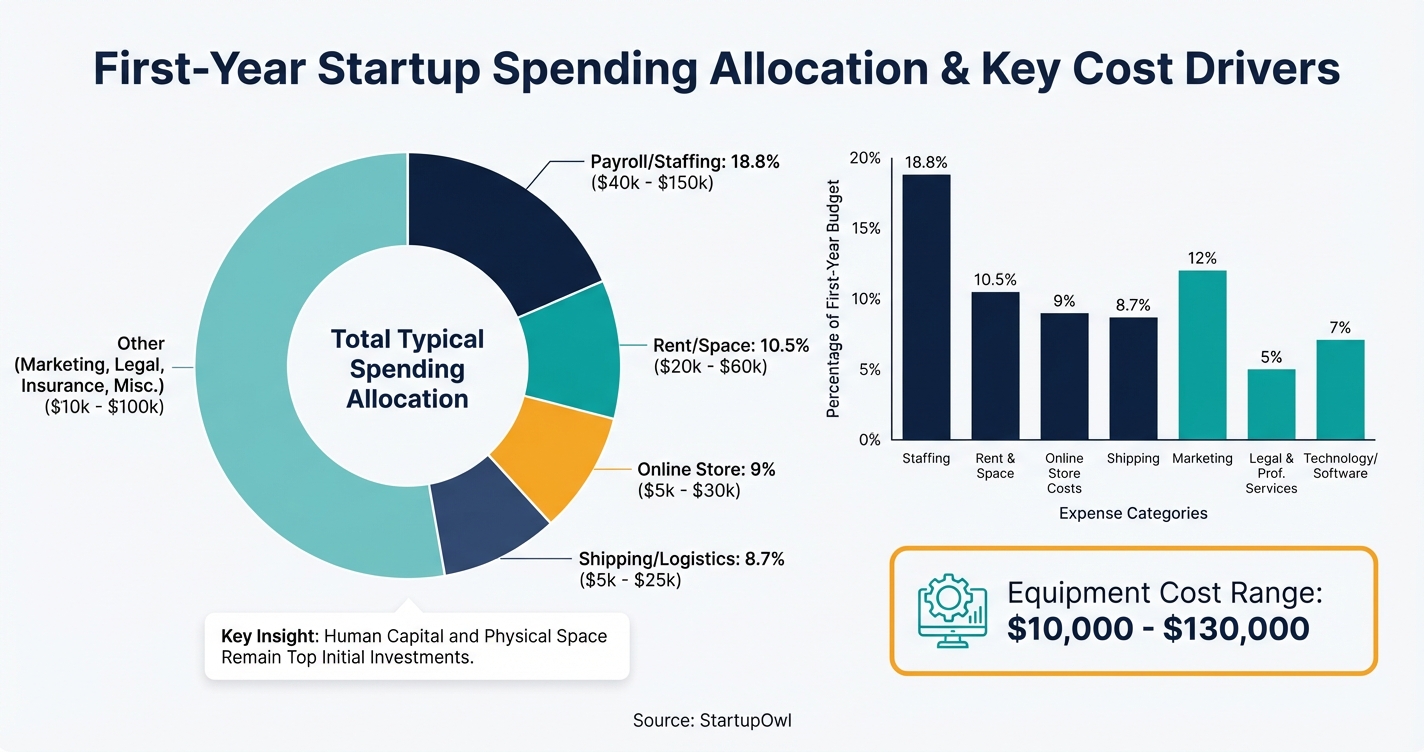
If you hire employees, payroll becomes the dominant ongoing cost. The SBA recommends estimating employee costs at 1.25x to 1.4x their base salary to cover taxes, benefits, and insurance. A $50,000 salary actually costs you $62,500 to $70,000.
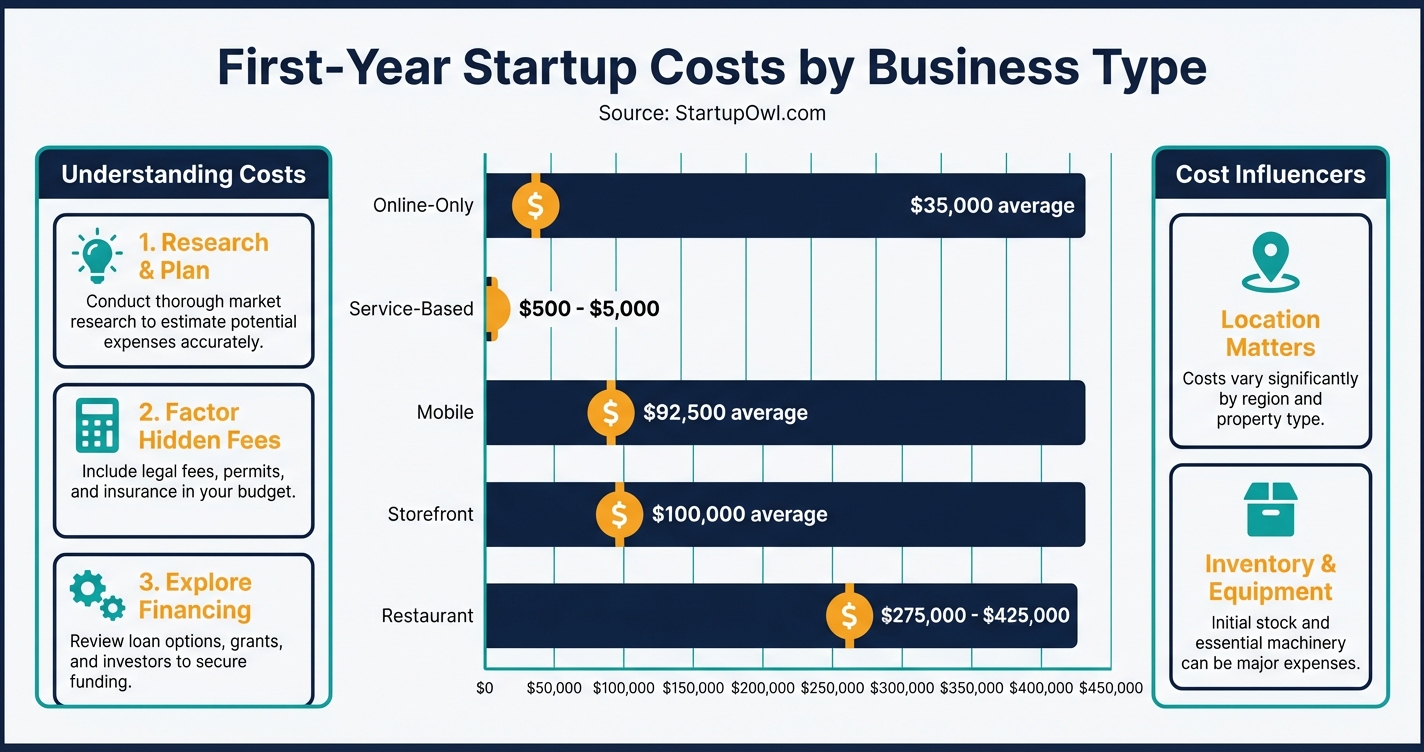
The businesses most likely to underestimate are those combining online and offline operations. Survey data from Business.org shows online-only owners spend an average of $35,000, while storefront owners spend $100,000 and mobile business owners spend $92,500 in their first year.
Who Needs to Budget for Startup Costs (and How Requirements Vary by Industry)
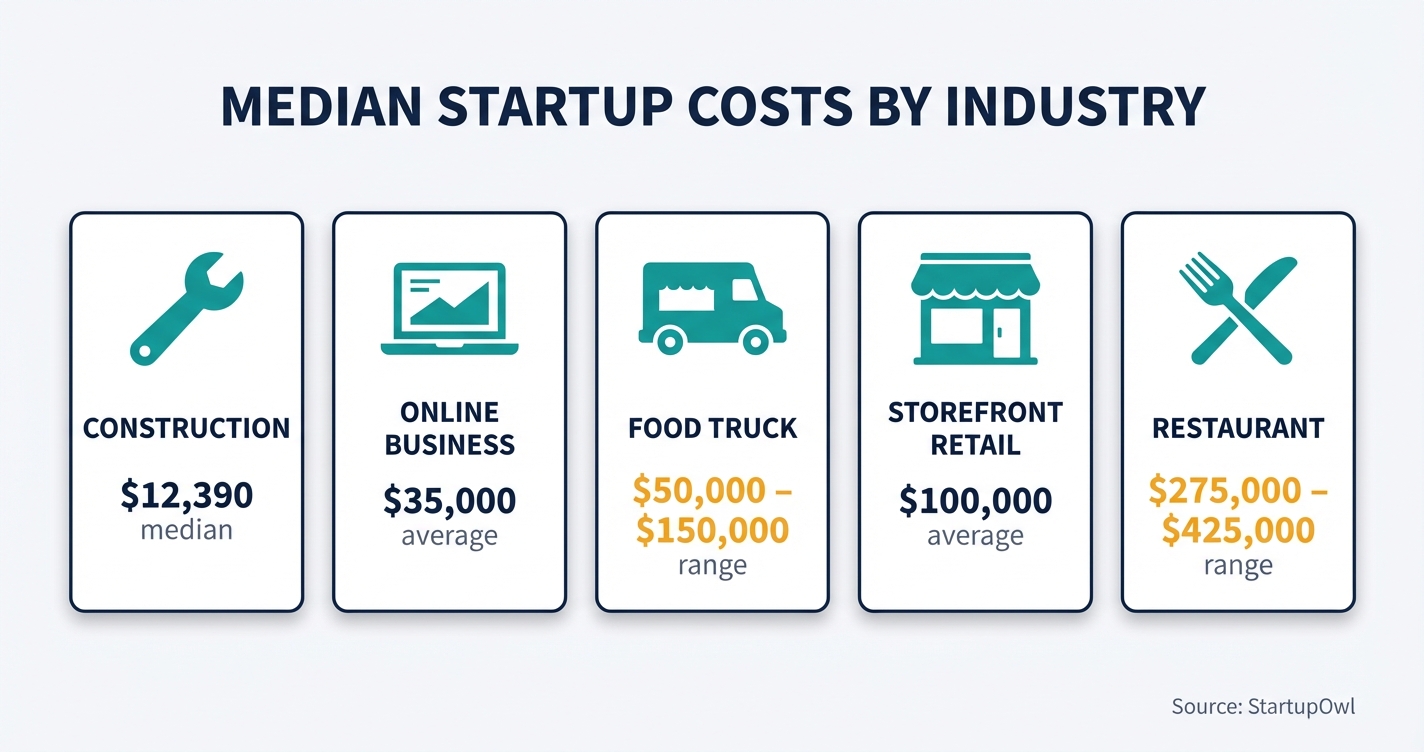
Every new business faces startup costs, but the magnitude depends heavily on your industry. LendingTree's analysis of Census Bureau data found that construction is the least expensive industry to enter, with a median startup cost of just $12,390. At the other end, food and accommodation businesses need a median of $93,621, and management companies average $440,740.
Low-cost startups in accounting, online retail, landscaping, and consulting can often launch with under $5,000. A food truck runs $50,000 to $150,000, while a full restaurant costs $275,000 to $425,000 as estimated by Sage.
If you plan to seek outside funding, your credit profile matters. SBA loans generally want a personal credit score of 680+, at least 2 years in business (or strong collateral for startups), and a solid business plan with financial projections. Traditional bank loans require similar qualifications with rates of 7% to 12% APR as of 2026.
How to Estimate Your Startup Costs in 5 Steps
Estimating your startup budget does not require an MBA. It requires discipline, a spreadsheet, and a willingness to get real numbers instead of guessing. Follow these five steps to build a budget your lender or investors will take seriously.
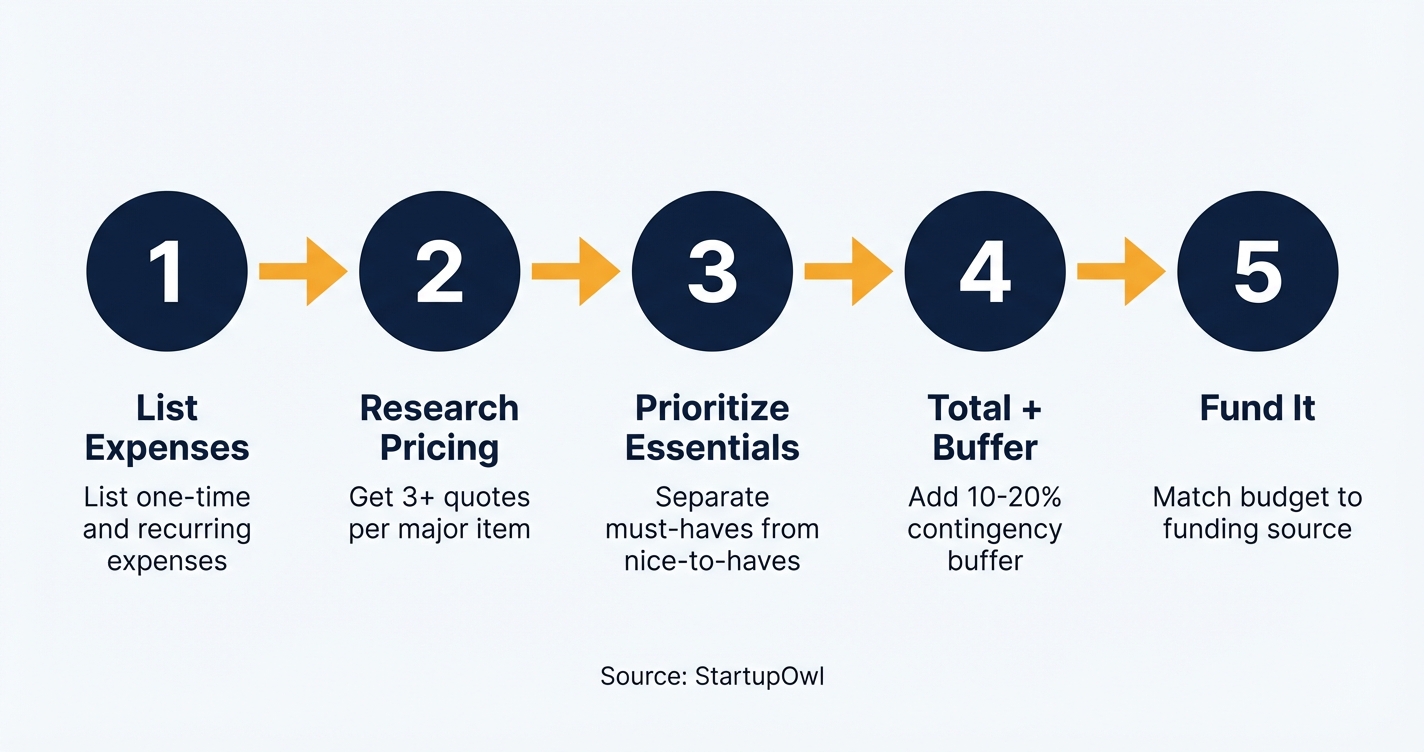
Step 1: List every expense by category. Start with the SBA's free startup cost calculator. Separate one-time costs (formation, equipment, build-out) from monthly recurring costs (rent, payroll, insurance, software). Aim to capture at least 15-20 line items for a typical small business.
Step 2: Research real pricing. Get 3+ quotes for every major cost. National averages can mislead you because location matters. Retail rent runs $18.26/sq ft in the Midwest but $29.01/sq ft in the West.
Step 3: Separate essentials from nice-to-haves. A business license ($50 to $550) and general liability insurance ($45/month) are non-negotiable. A premium office redesign is not. Delay non-essential spending until revenue supports it.
Step 4: Total everything and add a buffer. Multiply your monthly costs by 12, add your one-time costs, then add 10-20% as a contingency fund. If your total is $50,000, budget $55,000 to $60,000.
Step 5: Match your budget to a funding source. Use our guides to best small business loans, small business grants, and best business credit cards to find the right fit for your amount and timeline. About two-thirds of founders use personal savings, but 16% seek a business loan.
Those personal savings have to cover the founder as well as the business. Our Runway Number works out what six months without a salary costs in each state, living costs, health cover and the first year business fee added together.
The Real Cost of Starting a Business (Category by Category)
Here is what you should expect to spend across every major category, based on 2026-2026 industry data. Your specific numbers will depend on your business model, but these ranges give you a defensible starting point.
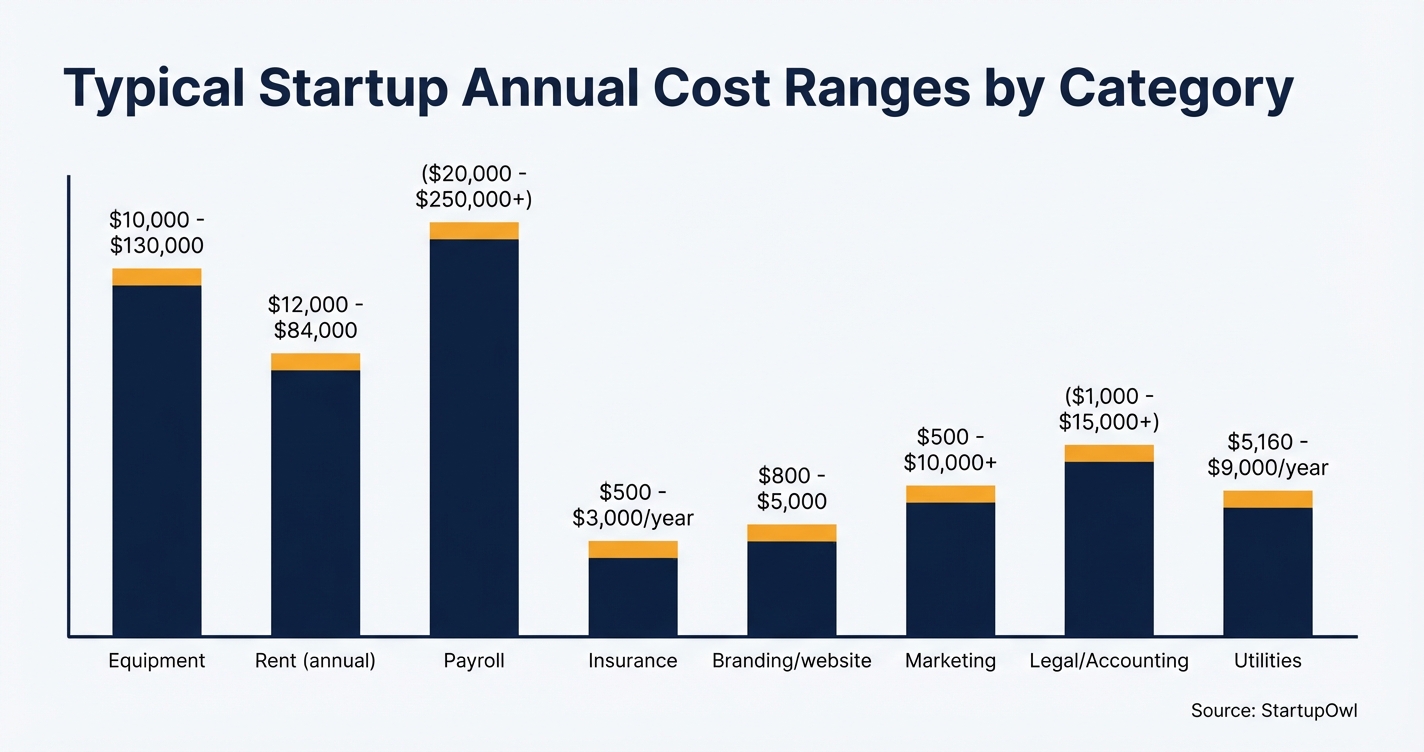
Formation fees are your cheapest line item at $50 to $500 for an LLC or corporation filing. You can handle this through an LLC formation service for under $100 plus the state fee in most cases.
Equipment is often the most expensive, running $10,000 to $130,000. A freelance consultant needs a laptop and software ($1,500 to $3,000). A restaurant needs commercial kitchen equipment that can easily exceed $100,000.
Insurance is a must-have from day one. General liability insurance averages $45 per month (about $538 per year). A Business Owner's Policy (BOP) that bundles liability and property coverage averages $83 per month ($990 per year) according to Insureon.
Marketing and branding should be $1,000 to $5,000 for initial branding (logo, website, social media setup) plus an ongoing budget of 5-10% of projected annual revenue. Digital marketing tools like email platforms start at $300 per month and paid ads run $1 to $2 per click.
Utilities for a physical space run $430 to $750 per month total, covering electricity ($180-$300), gas ($90-$150), water ($100-$200), and internet/phone ($60-$100). Set up accounting software early to track every dollar from the start.
Startup Costs at a Glance by Business Type
| Type / Provider | Rate | Notes |
|---|---|---|
| Online-Only Business (first year) | $35,000 average | E-commerce, freelancing, digital services. Lowest overhead, no physical space. |
| Mobile Business (first year) | $92,500 average | Food trucks, mobile services. Vehicle and equipment costs drive the total up. |
| Storefront Business (first year) | $100,000 average | Retail, restaurants, salons. Rent, build-out, and inventory are the biggest drivers. |
| Low-Cost Startup (service-based) | $500 - $5,000 | Consulting, freelancing, landscaping, accounting. Minimal equipment needed. |
| Food Truck | $50,000 - $150,000 | Vehicle, kitchen equipment, permits, and initial inventory. |
| Full-Service Restaurant | $275,000 - $425,000 | Commercial kitchen, build-out, liquor license, staffing, and initial inventory. |
| Tech Startup (lean) | $45,000/month burn rate | Payroll-heavy. Personnel costs dominate at 75%+ of monthly spend. |
Save Money on Your Taxes with the Section 195 Deduction
Under IRS Section 195, you can deduct up to $5,000 of qualifying startup costs in your first year of business. This deduction phases out dollar-for-dollar once your total startup costs exceed $50,000, and disappears entirely above $55,000. Any remaining costs are amortized over 180 months (15 years).
Qualifying expenses include market research, advertising before launch, consultant fees, site selection analysis, and employee training. Capital purchases like equipment and vehicles do not qualify (they use separate depreciation rules). Keep detailed receipts for every pre-launch expense and elect the deduction on your first-year tax return.
How to Fund Your Startup Costs (Best Options Compared)
Once you know your number, you need a plan to pay for it. Here are the most common funding paths for new businesses, ranked from lowest to highest cost of capital.
Personal savings and family funding. About two-thirds of small business owners tap personal or family savings. This is the cheapest capital (no interest), but it puts your personal finances at risk. Only invest what you can afford to lose entirely.
SBA Microloans. For startup costs under $50,000, SBA microloans offer rates of 8% to 13%. They are issued through nonprofit intermediary lenders and often include free mentoring and technical assistance.
SBA 7(a) Loans. The flagship SBA program goes up to $5 million. SBA applies the prime rate from the first business day of the month, and with prime at 7.00%, SBA's rate rule caps your rate from 1 October 2026 between 10.00% and 13.50% depending on loan size, and your lender can price below that cap. You will need a credit score of 680+, a solid business credit profile, and collateral for larger amounts. Read our full SBA loan guide.
Business credit cards. Good for smaller recurring costs and earning rewards on everyday spending. Check our best business credit cards guide. Use a 0% intro APR offer to finance initial inventory or equipment interest-free for 12-15 months.
Online lenders. Companies like OnDeck and Lendio fund in days, not weeks. But you pay for speed with APRs of 15% to 50%+. Best reserved for bridging short-term gaps, not long-term startup financing. A merchant cash advance carries even higher effective costs (factor rates of 1.1 to 1.5).
Grants. Free money exists but is competitive. Check our small business grants guide for current federal, state, and private programs. Pre-seed funding and angel investors are options if you have a scalable tech or product startup.
What to Do If Your Startup Budget Falls Short
If your funding gap is under $10,000, start smaller. Launch a minimum viable version of your business from home, test demand, and reinvest revenue into growth. Many successful businesses in accounting, online retail, and landscaping started with under $5,000.
If you need more capital but have limited credit history, start building your business credit score now. A secured business credit card and a small working capital loan can establish your credit file in 3-6 months. Invoice factoring is another option once you have outstanding invoices from customers.
Consider phasing your launch. Open with the smallest footprint and lowest cost version of your concept, prove the model works, then expand. Coworking spaces and virtual offices can cut your rent cost by 50-75% compared to a traditional commercial lease.
5 Startup Budgeting Mistakes That Drain Your Cash
1. No contingency fund. Roughly one-third of startups that fail cite running out of cash as the primary reason. A 10-20% buffer on your total budget is not optional. Unexpected costs (equipment repairs, supplier price hikes, permit delays) are a certainty, not a possibility.
2. Ignoring your own salary. You need to eat and pay rent while building the business. If you do not include your personal living expenses in the budget, you will either burn through personal savings faster than expected or be forced to take on expensive emergency debt.
3. Underestimating employee costs. A $40,000 salary actually costs you $50,000 to $56,000 after payroll taxes, health insurance, and other benefits. Budget 1.25x to 1.4x every salary figure in your plan.
4. Overspending on aesthetics before revenue. Professional branding and a polished office are nice, but they do not generate customers. Prioritize spending on activities that directly drive revenue (marketing, inventory, sales tools) and delay everything else.
5. Treating the budget as a one-time exercise. Your budget is wrong on the day you finish it. Costs change. Revenue comes in slower or faster than planned. Review your budget against actual spending monthly and adjust your plan. Set up your accounting system from day one to make this easy. If you want AI to handle transaction categorization and reconciliation automatically, explore AI bookkeeping tools that connect directly to your bank feeds.
Step-by-Step Process
- 1
List every expected expense by category
Start by writing down every cost you will face before and after opening day. Separate them into one-time expenses (LLC filing, equipment, logo design) and recurring monthly expenses (rent, utilities, payroll, software).
Use the SBA's free startup cost worksheet at SBA.gov to make sure you don't miss a category. Common items include formation fees ($50 to $500), equipment ($10,000 to $130,000), insurance ($500 to $3,000 per year), and branding ($1,000 to $5,000).
Tips
- Include at least 12 months of recurring costs in your estimate, not just one-time expenses.
- Ask other founders in your industry what they actually spent versus what they budgeted.
- Track pre-launch spending from day one so you can claim the IRS Section 195 deduction later.
Common Mistakes
- Forgetting to include personal living expenses (your salary) in the first-year budget.
- Listing only obvious costs like rent and equipment while overlooking insurance, permits, and software subscriptions.
- 2
Research real pricing with multiple quotes
Get at least 3 quotes for every major expense line item (office space, equipment, insurance, professional services). Industry benchmarks are a starting point, but local pricing can differ significantly from national averages.
Check resources like your local Chamber of Commerce, SBA local assistance offices, and trade associations for region-specific data. Retail rents, for example, average $23.98 per square foot nationally but run $29.01 in the West and $18.26 in the Midwest as of 2026.
Tips
- Always clarify what is included in vendor quotes (installation, maintenance, training) to avoid hidden charges.
- Use free tools and trials first for software (accounting, CRM, project management) before committing to paid plans.
Common Mistakes
- Relying on a single vendor quote and getting locked into above-market pricing.
- Using national averages for location-dependent costs like rent and utilities without adjusting for your city.
- 3
Separate essential costs from nice-to-have expenses
Split your list into must-have (legally required licenses, minimum viable equipment, insurance) and can-wait (premium office space, advanced software, full branding package). Focus your launch budget on essentials only.
A business license runs $50 to $550. General liability insurance averages $45 per month. These are non-negotiable. A custom-designed office interior at $100 to $200 per hour for a designer? That can wait until revenue supports it.
Tips
- Skip premium office space and work from home until you are profitable or need a client-facing location.
- Start with freelancers and contractors instead of full-time hires to keep payroll flexible.
Common Mistakes
- Spending heavily on branding and office design before validating that customers will pay for your product or service.
- 4
Build your total budget with a contingency buffer
Add up all one-time costs plus 12 months of recurring expenses to get your total first-year startup budget. Then add a contingency buffer of 10-20% on top. A simple service business might only need 10%, while a manufacturing or product-based business should lean toward 20%.
For example, if your projected total is $50,000, budget $55,000 to $60,000. Most businesses take longer than expected to turn a profit, with only 15% of owners becoming profitable in under a year, according to a Business.org survey.
Tips
- Use a spreadsheet with separate tabs for one-time costs, monthly costs, and your contingency fund.
- Plan for at least 6 months of runway, but 12 months is significantly safer for most startups.
- Revisit and update your budget monthly once you are operating to catch cost overruns early.
Common Mistakes
- Skipping the contingency fund entirely and running out of cash when an unexpected expense hits.
- Treating the budget as a one-time exercise instead of a living document you update regularly.
- 5
Choose your funding sources and apply
Almost two-thirds of small business owners use personal or family savings to start. About 16% seek a business loan. Your best options depend on how much you need and your credit profile.
If you need under $50,000, consider an SBA microloan (rates of 8% to 13%) or a business line of credit. For larger amounts, SBA 7(a) loans go up to $5 million with rates currently between 10.00% and 13.50% as of 1 October 2026. Online lenders charge 15% to 50%+ APR but fund much faster. Check our guide to business loans for startups for a full comparison.
Varies by funding type (SBA guarantee fees range from 0.25% to 3.75%) 2-12 weeks depending on lender type SBA.govTips
- Apply to multiple lenders simultaneously to compare offers. SBA loan marketplaces like Lendio can simplify this.
- Have your business plan, financial projections, and personal credit report ready before applying.
- Explore small business grants as free capital that does not require repayment.
Common Mistakes
- Taking the first loan offer without shopping around, which can cost thousands in excess interest over the loan term.
Cost Breakdown
| Item | Cost Range | Notes |
|---|---|---|
| Business Formation (LLC/Corp Filing) | $50 - $500 | State filing fees vary. Some states charge annual report fees on top of the initial filing. |
| Business License and Permits | $50 - $550 | Varies by city, county, and industry. Food and alcohol businesses face additional permit costs. |
| Equipment and Supplies | $10,000 - $130,000 | Largest upfront variable. Ranges from a laptop for online businesses to commercial equipment for restaurants. |
| Office or Retail Rent (annual) | $12,000 - $84,000 | Based on retail average of $23.98/sq ft nationally. Office space averages $35/sq ft. Home-based = $0. |
| Business Insurance (annual) | $500 - $3,000 | General liability averages $45/month. A BOP (business owner's policy) averages $83/month per Insureon. |
| Branding and Website | $800 - $5,000 | Includes logo, website design, and initial social media setup. DIY with website builders can reduce this. |
| Marketing and Advertising (first year) | $500 - $10,000+ | Plan for 5-10% of projected annual revenue. Digital ads, email tools, and content creation. |
| Professional Services (legal, accounting) | $500 - $5,000 | Legal structure setup ($500-$2,000) plus initial accounting/bookkeeping setup. |
| Utilities (annual) | $5,160 - $9,000 | Electricity $180-$300/mo, gas $90-$150/mo, water $100-$200/mo, internet/phone $60-$100/mo. |
| Office Furniture and Supplies | $1,500 - $4,000 per employee | Desk, chair, and storage average $1,500-$2,000 per person. Supplies run $61-$125/employee/month. |
| Payroll (per employee, annual fully loaded) | $50,000 - $70,000 | SBA estimates 1.25x to 1.4x base salary. A $50,000 salary costs $62,500-$70,000 with taxes and benefits. |
| Contingency Buffer | 10% - 20% of total | Covers unexpected costs, price hikes, and slower-than-expected revenue. Do not skip this. |
Frequently Asked Questions
The average small business owner spends $40,000 in the first full year of operation. Online-only businesses average about $35,000, while storefront businesses average $100,000 and mobile businesses average $92,500, according to a Business.org survey. Low-cost service businesses like consulting or freelancing can launch for under $5,000.
Equipment is typically the single largest one-time cost at $10,000 to $130,000. Rent is the biggest recurring cost, averaging $23.98 per square foot for retail space nationally. If you hire employees, payroll quickly becomes the dominant expense at 1.25x to 1.4x each person's base salary.
Yes. Under IRS Section 195, you can deduct up to $5,000 of qualifying startup costs in your first year. This deduction phases out dollar-for-dollar once total costs exceed $50,000 and disappears at $55,000. Remaining costs are amortized over 180 months.
Start with the SBA's free startup cost worksheet. List every one-time and recurring expense, get 3+ quotes for major items, then add 12 months of monthly costs to your one-time total. Always include a 10-20% contingency buffer for unexpected expenses.
Service-based and online businesses have the lowest startup costs. Freelancing, consulting, tutoring, and dropshipping can launch for $500 to $5,000. The construction industry has the lowest median startup cost among all industries at just $12,390 per LendingTree's analysis of Census data.
At minimum, you need general liability insurance, which averages $45 per month ($538/year). A Business Owner's Policy (BOP) that bundles liability and property coverage averages $83 per month ($990/year). Budget $1,000 to $3,000 annually for total insurance coverage as a new business.
Only 15% of small business owners turn a profit in under a year. About 40% report reaching profitability within the first or second year, per Business.org. This is exactly why your startup budget should include at least 6-12 months of operating runway before you expect to break even.
This content is for informational purposes only and does not constitute financial, legal, or tax advice. Business financing terms, rates, and eligibility vary by lender, credit profile, and business characteristics. Consult a licensed financial advisor or CPA before making borrowing decisions. APR ranges reflect industry averages as of 2026 and may change without notice.
Sources & References
- SBA - Calculate Your Startup Costs
- Bankrate - Average Cost of Starting a Small Business (2026)
- Business.org - Small Business Startup Costs Survey (2026)
- NerdWallet - 16 Business Startup Costs Business Owners Need to Know
- LendingTree - Startup Costs by Industry
- Lendio - Current SBA Loan Interest Rates (February 2026)
- Insureon - Small Business Insurance Costs
- SBA - 7(a) Loan Terms, Conditions, and Eligibility
- IRS - 26 U.S. Code Section 195 (Start-Up Expenditures)
- Sage - Business Startup Costs Budget Templates by Industry
- Toast - How Much Does It Cost to Open a Small Business (2026)
- The Hartford - Startup Business Insurance Costs
- BusinessCapital.com - Business Loan Interest Rates for 2026
- Brex - The Guide to Startup Costs
About the Author
Editor, StartupOwl
Eliot leads StartupOwl's state data research. He maintains the site's fifty state records of LLC filing fees, annual costs, processing times, and small business grant programs, checking each figure against the state office that publishes it and logging the date it was verified. Based in New Jersey, he has spent his working life in and around small businesses, and he writes for the founder who wants the real number rather than the advertised one. Every figure under his byline traces to a named source, and when a state proves a number wrong, the correction is published, not buried.
Was this article helpful?
Questions about Startup Costs
No comments yet. Ask the first question and a member of our team will answer.
Leave a comment