
Small Business Grants in Vermont
Farms and sawmills get Vermont's grant money. The biggest programme, Working Lands, opens on October 9 and closes at 2pm on December 10.

Farms and sawmills get Vermont's grant money. The biggest programme, Working Lands, opens on October 9 and closes at 2pm on December 10. It pays $10,000 to $50,000 out of a $508,000 fund and asks for no match. The Trade Show Assistance grant follows, opening December 4 with $2,000 to $7,500 for exhibiting a Vermont product out of state. Read the two headline incentives carefully, VEGI pays nothing until after you have created the jobs, and the SSBCI money is a loan. Each card below says which is which.
Which Vermont grants fit your business?
Answer 7 quick questions and we sort the 12 programs on this page into likely fits and long shots. Nothing personal is asked or stored, and final eligibility is always decided by the granting agency.
Vermont Small Business Grant Programs
State-administered funding programs available to Vermont small businesses. Verify deadlines directly with the granting agency before applying.
Working Lands Business Enhancement Grant
Working Lands Enterprise Initiative
$10,000 to $50,000, no match required
Deadline Dec 10, 2026Vermont's biggest working lands award, opening on October 9 and closing at 2pm on December 10, 2026, with $508,000 available this round, down from $620,000 last year. There is no match requirement, though you must show you can cover any project cost above the grant. Projects run twelve months, awards are announced around late February 2027 and work starts in April. Eligibility is farm, forest and food, so farms in food or fibre, logging, sawmills, firewood, agricultural trucking and distribution, value added food and fibre sourcing at least half its ingredients in Vermont, and retail selling primarily Vermont products. Cannabis, Christmas trees, equine, flowers, topical CBD hemp, horticulture and indoor only growers are excluded, and past grantees from the last three fiscal years sit out.
Vermont Employment Growth Incentive (VEGI)
Vermont Economic Progress Council (VEPC)
Performance based, paid over five years
RollingNot startup capital, and the shape matters more than the size. VEGI pays cash in five annual instalments, in arrears, only after you have hit and held job, payroll and capital targets, so nothing arrives before the hiring. It is still open with no successor programme, and it is absent from the state's recently closed list. Any business expanding in or relocating to Vermont can apply, with no minimum job count, but you must pass a but for test showing the project would not happen without the incentive, a net fiscal benefit test, local plan conformance and an unfair competition test. Final approval has to land in the same calendar year the project begins.
Apply / Learn MoreElevate Vermont Matching Grant
Agency of Commerce and Community Development (ACCD)
Up to $50,000
RollingA follow on grant for a company that has already won federal money, which is the condition most readers miss. You must hold an SBIR or STTR Phase I or Phase II award before you apply, so this is not open to a Vermont startup at large, and the match people ask about is that prior federal award rather than cash from you. Up to $50,000, reviewed first come first served rather than competitively, and the programme team sets each amount. One grant per federal award, five in a lifetime, and you are ineligible with more than three prior Phase II awards. Travel is capped at 10 percent of the budget and the project must run under six months.
Vermont Training Program (VTP)
Agency of Commerce and Community Development (ACCD)
Up to 50% of training cost, no published cap
RollingUp to half the cost of training, paid to the employer, and no maximum award is published anywhere, so the programme director is the only source for what your project could get. It covers pre employment training, new hire training and incumbent worker training, on site or through an outside provider, and it funds work based learning run with a school. The applicant is an employer with payroll, which rules out a pre revenue founder training themselves.
Apply / Learn MoreState Trade Expansion Program (STEP)
Agency of Commerce and Community Development (ACCD)
Up to $30,000 a year across four activities
RollingUp to $30,000 a year at 75 percent reimbursement, and the structure is the thing to plan around. That ceiling spreads across as many as four eligible activities and each one needs its own application, so this is four smaller pieces of paperwork rather than one large grant. Only pre approved expenses are reimbursed. The state publishes no application deadline and no federal award year on the programme page, so confirm the current period with the programme contact before you commit to a trade mission.
Apply / Learn MoreTrade Show Assistance Grants
Working Lands Enterprise Initiative
$2,000 to $7,500 across up to four shows
Deadline Jan 20, 2027Back on this page after being dropped, with the right numbers this time. The range is $2,000 to $7,500 across up to four trade shows in one yearly marketing plan, not the $2,000 to $5,000 we used to publish, reimbursed at 75 percent against a 25 percent cash match. The 2027 request for applications lands on November 20, 2026, applications open December 4 and close at 2pm on January 20, 2027, for shows held between April 2027 and March 2028. You must be a Vermont agricultural or forestry business, registered with the Secretary of State, trading over a year, with three or more wholesale accounts and products at least half Vermont grown. Shows must be business to business and target out of state buyers.
Rutland Business Incentive Assistance Program
Rutland Redevelopment Authority
Up to 15% of your investment, capped at $5,000
RollingRutland City only, and the timing rule is what disqualifies people. An existing business must apply before the work is substantially complete, and a new business before it starts trading, so an application filed after the fit out is finished is ineligible however good the project. The tier described here pays up to 15 percent of your total investment capped at $5,000. The same programme also runs a $10,000 grant for fixed infrastructure at half the renovation cost, and a secured loan up to $50,000 through a local credit union. Awards sit at the discretion of the redevelopment authority and the Board of Aldermen, and you must be in good standing on city taxes, fees and permits.
Apply / Learn MoreState Small Business Credit Initiative (SSBCI)
Vermont Economic Development Authority (VEDA) with ACCD
A loan, projects under $20M qualify
RollingA loan, and the state agency says so in as many words, these are loans, not grants, and must be repaid under standard repayment terms. Vermont put $29 million of its $57.9 million federal SSBCI allocation into loan participation, with the other half funding a separate venture capital programme. Total project financing must sit under $20 million, you must have fewer than 750 employees worldwide, and passive real estate is out, as is stacking with an SBA or USDA guaranteed loan or an SBA 504 for the same purpose. You do not apply to the state authority for it, you approach a participating lender.
Apply / Learn MoreFederal Grant Programs
These federal programs are available to small businesses in every state.
SBA 7(a) Loan Program
The SBA's primary lending program guarantees loans through participating lenders. This is a loan, not a grant. But the terms favor small businesses that may not qualify for conventional financing.
Learn moreSBA Microloan Program
Loans up to $50,000, not grants. You borrow from a nonprofit lender near you, not from the SBA itself. The money can cover working capital, inventory, supplies or equipment. Most people get far less than the cap. The average microloan is about $13,000.
Learn moreSBIR/STTR Grants
Competitive federal grants for small businesses doing research and development with commercial potential. Eleven federal agencies take part. Phase I funds proof of concept. Phase II funds full development.
Learn moreNorthern Border Regional Commission (NBRC) Catalyst Program
Funds growth projects in Vermont, Maine, New Hampshire and New York. For profit companies cannot apply. The money goes to towns, tribes, non profits and career technical centers. A business reaches it through one of those, never directly.
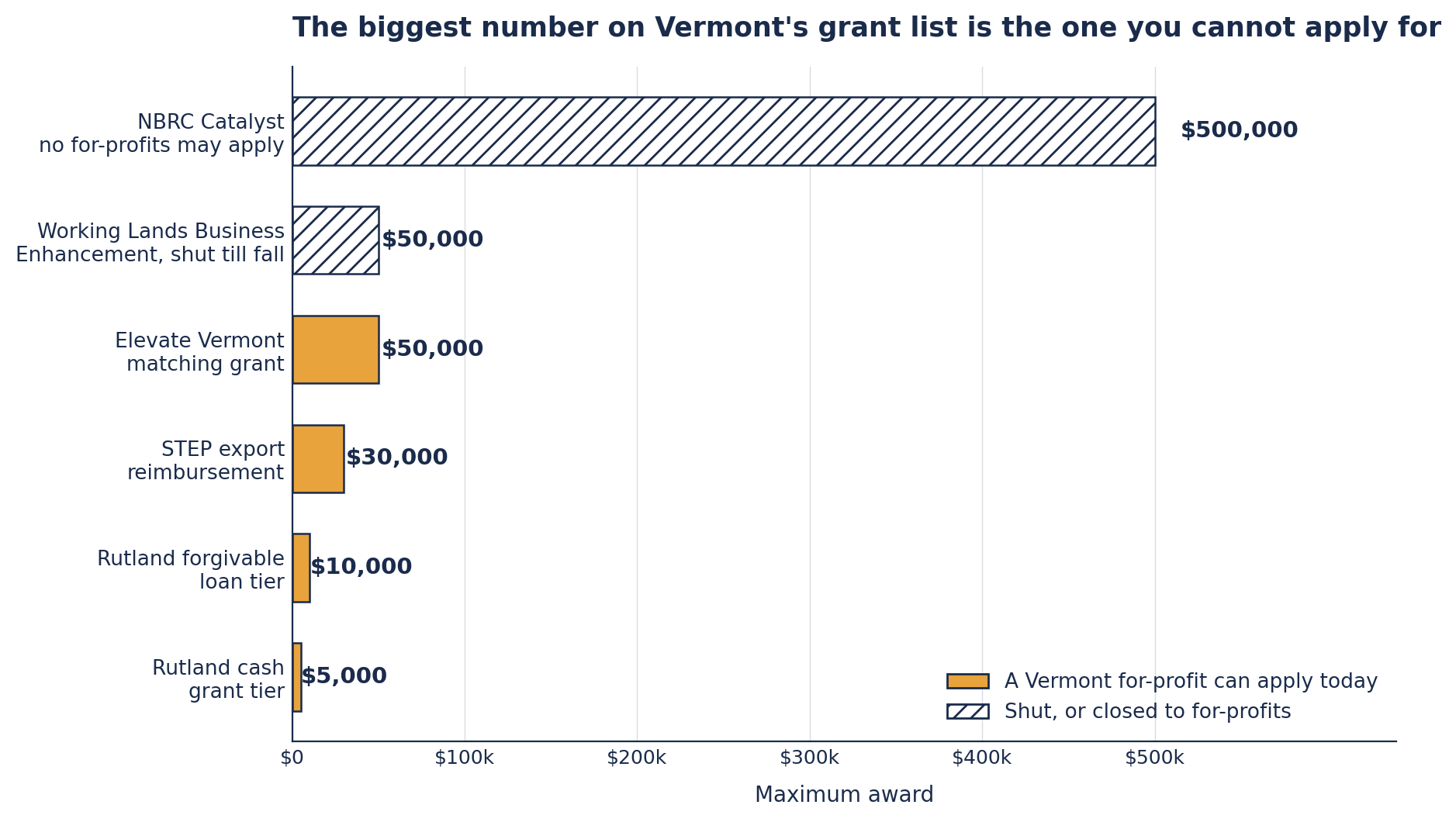
View program pageSize is the wrong question here. The tallest bar on this chart is ten times the next one, and a Vermont company may not apply for it. The chart plots the top award for each program against whether a for profit business can apply today.
Get Grant-Ready
Before you apply, most Vermont grant programs expect these basics to be in place.
Form your business entity
Most Vermont grant programs require applicants to be a registered LLC, corporation, or nonprofit. If you haven't formed yet, that's the first step.

$39 + state fee. Includes registered agent, business address, and more.
Get your EIN
An Employer Identification Number is free from the IRS and required on nearly every grant application. You can apply online and receive it immediately.

Open a business bank account
Grant funds need to go into a dedicated business account, not your personal checking. Most agencies will ask for your banking details on the application.

Mercury is a fintech company, not an FDIC-insured bank. Banking services provided through Choice Financial Group and Column N.A., Members FDIC.
Grants by Business Type
Targeted programs for specific business owners in Vermont.
Technology/Innovation Business Grants
Elevate Vermont pays up to $50,000. There is a catch. It goes only to a for profit that already won a federal SBIR or STTR award. One grant per federal award. Five over a company's life. Firms with more than 3 prior Phase II awards are out. The program also coaches first time SBIR applicants, free.
- ›Elevate Vermont
- ›SSBCI venture capital through VEDA
Rural Business Grants
Working Lands is the real rural grant. It pays $10,000 to $50,000 to farms, sawmills and forestry firms. The next round opens October 9 and closes December 10. NBRC Catalyst is not a rural business grant. Its 2026 rules bar for profit applicants. USDA's Rural Business Development Grant says the same. Ask your town or a local non profit to apply.
- ›Working Lands Enterprise Initiative
- ›Northern Border Regional Commission
Women-owned Business Grants
WomensNet awards the $10,000 Amber Grant every month. A $50,000 award follows at year end. Both are open to Vermont women aged 18 and over. The state runs no women only grant. The Small Business Development Center advises women founders, free.
- ›Amber Grant for Women
- ›Vermont Small Business Development Center
Minority-owned Business Grants
ACCD contracts the Vermont Professionals of Color Network. It gives BIPOC owners coaching, training, technical help and introductions, at no cost. It is help, not cash. No Vermont program asks for minority certification. Every program here, including the $50,000 Elevate grant, judges you on the same terms as anyone else.
- ›BIPOC Business and Career Assistance Program
- ›Vermont Professionals of Color Network
Veteran-owned Business Grants
Vermont runs no veteran grant. The Small Business Development Center advises veterans free, on planning and on applications. No program here asks about veteran status. Nothing here is closed to you, and nothing is held for you either.
- ›Vermont Small Business Development Center
- ›SBA veteran contracting assistance
Tips for Applying in Vermont
Increase your chances of approval with these state-specific tips.
- 1Apply before you start. VEGI, STEP and the Vermont Training Program all refuse to fund work already under way. VEGI cannot pay for jobs you have already made.
- 2Check whether the money is a grant. Vermont's largest published figure is the $57.9 million SSBCI pool. That pool is venture capital and loan participation through VEDA. You repay it.
- 3For STEP, file Part A first. Send a W-9 signed inside the last 12 months, plus your conflict of interest policy. Send a certificate showing $1,000,000 of general liability cover. Reimbursement runs to $30,000 a year at 75 percent, with a 25 percent cash match.
- 4Working Lands wants three statements. A profit and loss statement, a balance sheet and a cash flow statement. Past grantees sit out three fiscal years. Read the ineligible list before you write anything.
- 5Talk to the state advisers first. The Vermont Small Business Development Center is free and confidential. BIPOC owners can add coaching through the Vermont Professionals of Color Network at no cost.
State Economic Development Agency
Vermont Agency of Commerce and Community Development (ACCD)
ACCD is Vermont's economic development agency. It runs 4 of the programs here. The Training Program, STEP, Elevate Vermont and the Rural Industry Development Program. It also keeps a Recently Closed Programs page. Read it before you chase a grant you saw elsewhere.
Funding While You Wait
Grant applications in Vermont can take weeks or months to process. These options can bridge the gap.
Grants in Other States
All state grant guidesFrequently Asked Questions
Four, and two more open within ten weeks. Elevate Vermont takes applications continuously, up to $50,000, but only from a company that already holds a federal SBIR or STTR award. The Vermont Training Program covers up to half of training costs. STEP reimburses 75 percent of export costs up to $30,000 a year. The Rutland incentive pays up to $5,000 inside Rutland City. Working Lands opens October 9 and Trade Show Assistance opens December 4.
Not a general one. Elevate Vermont is the closest thing to a startup grant and it is a follow on to an SBIR or STTR award you already hold, capped at five in a lifetime. VEGI is open to any business expanding here but pays only in arrears over five years once jobs and payroll targets are met and held. If you are pre revenue and outside farming and forestry, the honest answer is that Vermont offers training money and export money rather than startup capital.
$10,000 to $50,000, out of a $508,000 pool this round. No match is required. The window is October 9 to December 10, 2026 at 2pm. Awards land in late February and projects start in April. It is farm, forest and food only. That covers logging, sawmills, firewood, farm trucking, and food makers who source at least half their ingredients in Vermont. Cannabis, Christmas trees, flowers, horticulture and indoor only growers are out.
Not in the way most people mean. VEGI pays cash, but in five yearly instalments, and only after you have hit and held your job, payroll and investment targets. Nothing arrives before the hiring, so it cannot fund the expansion it rewards. You also have to pass a but for test, showing the project would not happen without it, plus tests on fiscal benefit, local plans and fair competition.
It is debt and equity, not grant money. The state authority says so plainly. Half of it, $29 million, funds loan participation. The other half funds a venture capital programme. Projects under $20 million qualify and you need fewer than 750 staff worldwide. Passive real estate is out. You do not apply to the authority either. You go to a participating lender, and the backing may buy you a lower rate.
About the Author
Editor, StartupOwl
Eliot leads StartupOwl's state data research. He maintains the site's fifty state records of LLC filing fees, annual costs, processing times, and small business grant programs, checking each figure against the state office that publishes it and logging the date it was verified. Based in New Jersey, he has spent his working life in and around small businesses, and he writes for the founder who wants the real number rather than the advertised one. Every figure under his byline traces to a named source, and when a state proves a number wrong, the correction is published, not buried.
Was this article helpful?
Grant programs change frequently. Deadlines, eligibility requirements, and funding amounts listed here may be outdated. Always verify information directly with the granting agency before applying. This page is for informational purposes only and does not constitute financial or legal advice.
Questions about Vermont small business grants
No comments yet. Ask the first question and a member of our team will answer.
Leave a comment