
Minority Business Grants: Programs for Black, Hispanic and AAPI Entrepreneurs
Minority business grants range from $500 to $100,000 with no repayment. See 10+ verified programs for Black, Hispanic and AAPI owners plus step-by-step application tips.

In This Article
- Key Takeaways
- Step-by-Step
- Cost Breakdown
- What Are Minority Business Grants and Why Do They Matter
- Who Qualifies for Minority Business Grants
- How to Apply for Minority Business Grants Step by Step
- What Minority Business Grants Actually Cost You
- Top Grant Programs by Community
- What to Do If You Do Not Qualify for Grants
- 5 Mistakes That Get Minority Grant Applications Rejected
- FAQ
Free
Est. Cost
30 days
Timeline
5
Total Steps
Over 12 million minority-owned businesses operate in the United States, representing more than 35% of all American businesses. Yet minority entrepreneurs remain significantly less likely to receive full financing approval from traditional lenders, according to Federal Reserve data published in 2026.
Minority business grants give you $500 to $100,000+ in non-dilutive capital that you never repay. No interest. No equity. No monthly payments. The catch is fierce competition and a serious documentation requirement that trips up most applicants.
This guide lists 10+ verified grant programs open to Black, Hispanic, and AAPI entrepreneurs in 2026. You will find real award amounts, actual deadlines, eligibility requirements, and a step-by-step application process built to maximize your chances of winning.
What Are Minority Business Grants and Why Do They Matter
A minority business grant is non-repayable funding awarded to businesses that are at least 51% owned and controlled by individuals from underrepresented racial or ethnic groups. The SBA 8(a) program no longer names groups. A rule that started on 10 September 2026 deleted the list. Any US citizen can now try its social disadvantage test. Our guide to the new 8(a) test shows what SBA accepts as proof.
Private organizations, nonprofits, and corporate programs often use a broader definition that also includes LGBTQ+ business owners, women entrepreneurs, immigrant founders, and formerly incarcerated individuals. Your business structure does not matter for most grants. LLCs, corporations, sole proprietors, and partnerships all qualify as long as ownership and control requirements are met.
Grants differ from business loans in one critical way: you never pay them back. That makes them ideal if you cannot yet qualify for traditional financing, need to preserve equity, or want to supplement other funding sources. If you also want to explore repayable options, check out our best small business loans comparison.
Who Qualifies for Minority Business Grants
Eligibility varies by program, but most grants share a core set of requirements. Your business must be at least 51% owned by one or more minority individuals who actively control day-to-day operations. You typically need to be a U.S. citizen or permanent resident (NMSDC requires citizenship with no exceptions), and your business must be a for-profit entity located in the United States.
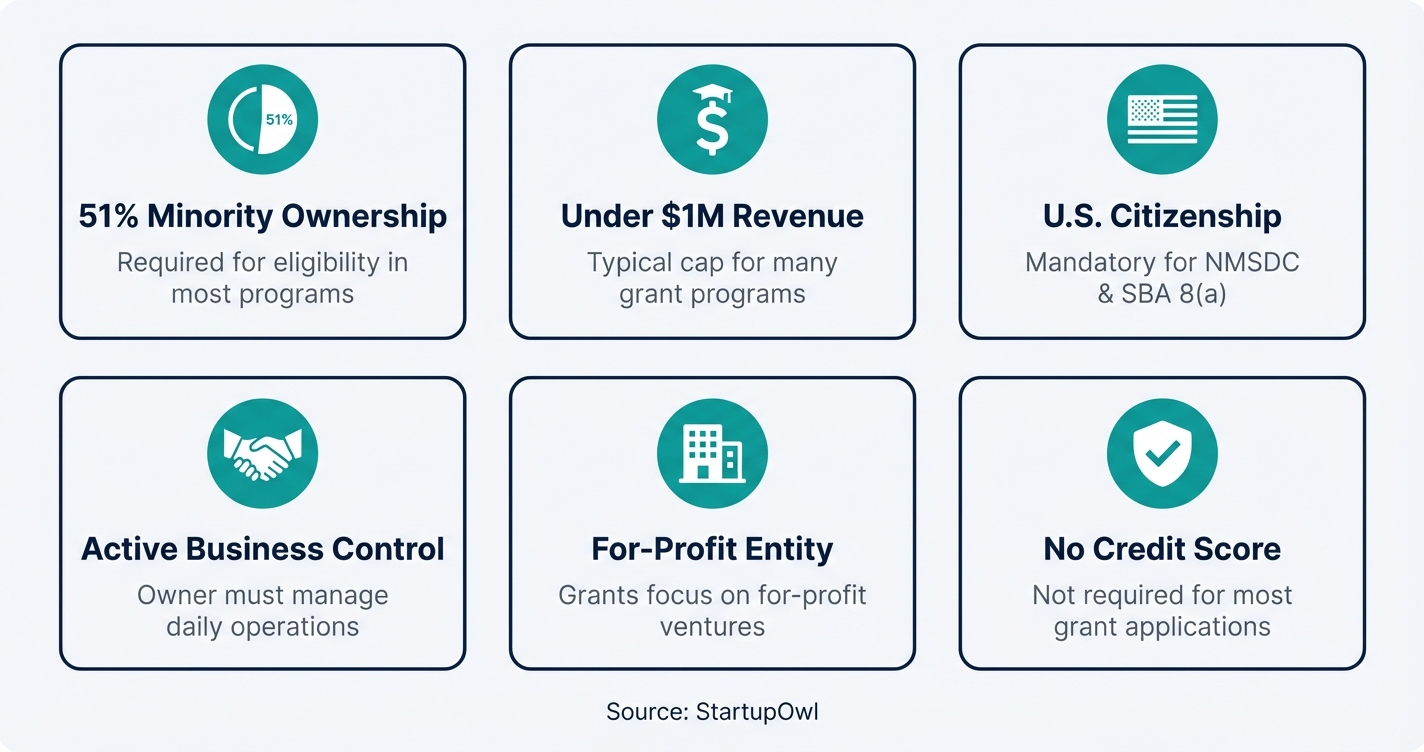
Revenue caps range widely. Programs like HerRise and Wish Local cap annual revenue at under $1 million. The U.S. Chamber's CO-100 competition allows up to $20 million in revenue over 2 years. Employee limits range from 2 to 250 depending on the program. Most programs require the business owner to be at least 18 to 21 years old.
Unlike loans, most grants do not require a credit score check, collateral, or personal guarantee. This makes them particularly valuable for early-stage businesses and founders without established business credit scores. If you are still building credit, see our guide on how to build business credit.
How to Apply for Minority Business Grants Step by Step
The application process for minority business grants follows a predictable pattern across most programs. Whether you are applying for a $1,000 HerRise microgrant or a $25,000 NAACP Powershift grant, the documentation and strategy overlap significantly. Preparing a master application packet will let you apply to multiple programs quickly.
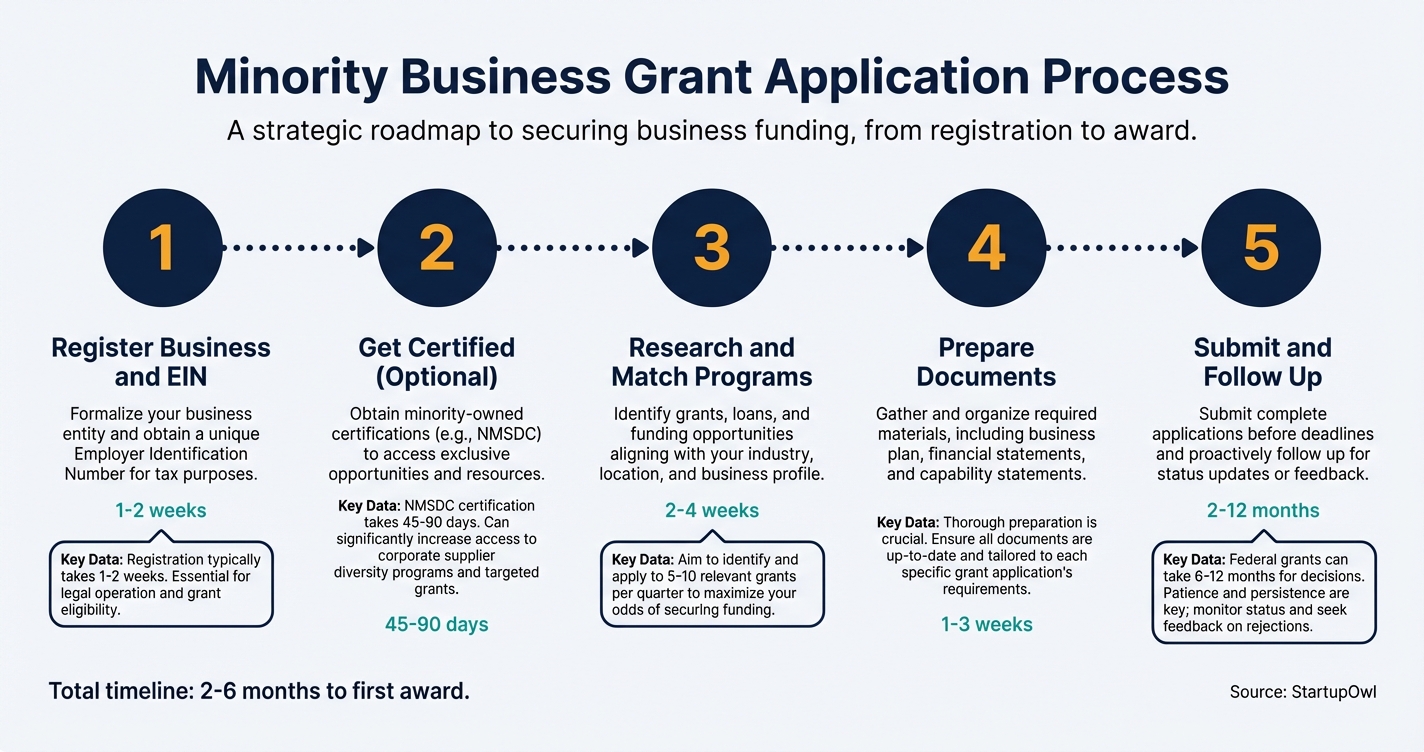
Start by registering your business and getting your EIN if you have not already. For federal grants through Grants.gov, you will also need a Unique Entity ID from SAM.gov and a Grants.gov account. These registrations are all free but can take 1 to 3 weeks to complete, so do not wait until a deadline is approaching.
Next, decide whether to pursue minority business certification. For grants under $10,000 from private or corporate programs, you can usually skip certification and apply with proof of ownership alone. For larger grants, government contracts, and corporate supplier programs, NMSDC MBE certification (the national gold standard) or SBA 8(a) certification will strengthen your application significantly.
Prepare your core documents: business plan, 2 years of financial statements, tax returns, proof of minority ownership, business licenses, and insurance certificates. Write each proposal to match the specific funder's stated mission. Grant reviewers look for authentic community impact stories backed by specific numbers, not boilerplate text.
What Minority Business Grants Actually Cost You
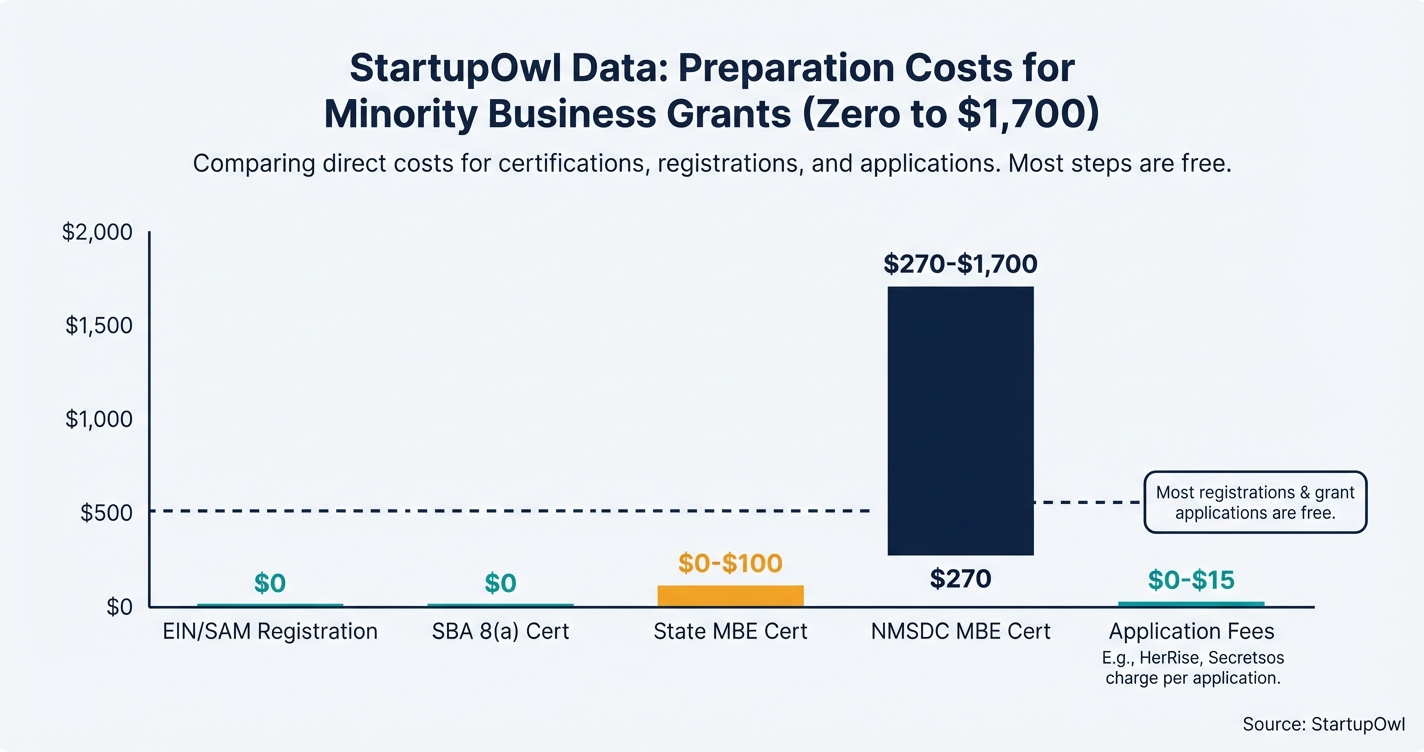
The grants themselves are 100% free money with no repayment obligation. However, you may incur costs to prepare competitive applications. NMSDC MBE certification runs $270 to $1,700 annually depending on your business size, as of 2026. SBA 8(a) certification is completely free.
Some individual grant programs charge small application fees. HerRise and Secretsos both charge $15 per application. The vast majority of grant programs (including all federal grants) charge nothing to apply. Be wary of any program asking for hundreds of dollars upfront. Legitimate grants from government agencies, established corporations, and nonprofit organizations do not charge large fees.
One cost most applicants overlook is taxes. The IRS generally treats grant income as taxable business income. You will report it on your business tax return, and grant providers may issue a 1099 form for awards of $600 or more. Exceptions exist for federally declared disaster relief grants and grants to 501(c)(3) nonprofits. Set aside 25-30% of any grant for taxes, and consult a CPA before spending the full amount.
Verified Minority Business Grant Programs (2026)
| Type / Provider | Rate | Notes |
|---|---|---|
| NAACP Powershift Entrepreneur Grant | $25,000 | Black entrepreneurs; annual cycle typically opens in October; includes mentorship from Daymond John |
| Black Ambition Prize (Pharrell Williams) | $20,000-$100,000 | Black and Hispanic founders; early-stage ventures; $13M+ awarded to 131 entrepreneurs since 2020 |
| NAACP Power Forward Grant | $25,000 | Black-owned businesses in New England; rolling basis; includes marketing and design resources |
| Breva Thrive Grant | $5,000 | All U.S. businesses impacting underserved communities; quarterly cycle; must be generating revenue |
| NASE Growth Grants | Up to $4,000 | NASE membership required; quarterly deadlines (April, July, October, January) |
| Secretsos Small Business Grant | $2,500 | Minority, woman, veteran-owned or located in low-income area; $15 application fee; quarterly |
| Wish Local Empowerment Program | $500-$2,000 | Black business owners; 20 or fewer employees; under $1M revenue; brick-and-mortar only; rolling |
| HerRise Microgrant | $1,000 | 51%+ owned by woman of color; under $1M revenue; $15 fee; monthly deadline (last day of month) |
| NAACP x Leslie's Certification Boost | $5,000 | People of color, women, disabled business owners in AZ, CA, FL, GA, TX |
| CO-100 (U.S. Chamber of Commerce) | $2,000-$25,000 | Under 250 employees; under $20M revenue; $25K grand prize; 10 finalists get $2,000 each |
Top Grant Programs by Community
For Black Entrepreneurs. The NAACP Powershift Entrepreneur Grant awards $25,000 to selected Black business owners each year during Black Entrepreneurs Day. Since its inception, the program has distributed over $900,000 in total grants. The Black Ambition Prize, founded by Pharrell Williams, has awarded approximately $13 million to 131 entrepreneurs since 2020, with individual prizes ranging from $20,000 to $100,000.
For Hispanic and Latino Entrepreneurs. Black Ambition explicitly includes Hispanic and Latino founders in its eligibility. The Santander Bank Cultivate program targets food businesses in low-to-moderate income areas with grants up to $20,000 plus a 12-week virtual education program. The SBA 8(a) program dropped its list of qualifying groups on 10 September 2026. The 9-year track is now open to any US citizen who meets its social disadvantage test.
For AAPI Entrepreneurs. The SBA no longer names groups for 8(a) eligibility. That rule started on 10 September 2026. NMSDC certification covers Asian-Indian Americans and Asian-Pacific Americans specifically. The MBDA operates Business Centers nationwide that provide free consulting, procurement matching, and capital access support for all minority entrepreneurs, including AAPI business owners.
For Women of Color. HerRise awards $1,000 monthly microgrants to for-profit businesses that are 51%+ owned by a woman of color. The BeyGOOD Foundation provides $10,000 grants to Black women entrepreneurs. For additional funding options, see our small business grants overview.
How to Spot Grant Scams
Real grants never require large upfront payments to "unlock" funding. If someone asks you to pay hundreds or thousands of dollars before receiving a grant, walk away immediately. Legitimate programs come from government agencies (websites ending in .gov), established corporations, or recognized nonprofits.
Verify any grant program through Grants.gov, your local SBDC, or the Minority Business Development Agency before applying. The SBA does not charge any costs for applying to its programs, and the only legitimate SBA phone number for certifications is 1-866-443-4110.
What to Do If You Do Not Qualify for Grants
If you do not meet grant eligibility requirements or need funding faster than grant timelines allow, you have several strong alternatives. Microloans for small business through the SBA program offer up to $50,000 with rates averaging 8-13% and are specifically designed for underserved entrepreneurs.
Business lines of credit give you flexible access to capital on demand, and several online lenders approve applicants with credit scores as low as 600. Invoice factoring can turn unpaid invoices into immediate cash without a credit check on your business.
For pre-revenue startups, look into pre-seed funding or angel investors who focus on diverse founders. The SBIR and STTR programs fund research and development projects with awards ranging from $150,000 to over $1 million across 11 federal agencies. You can also strengthen your financial foundation with business credit cards that offer 0% intro APR periods of 12-15 months.
5 Mistakes That Get Minority Grant Applications Rejected
1. Submitting incomplete documentation. This is the number-one reason applications are disqualified. Missing a single required document (often a tax return or proof of minority ownership) means your application goes straight to the rejection pile. Build a master folder with every commonly requested document before you start applying.
2. Ignoring the funder's mission. Every grant program has a stated purpose and priority areas. Writing a generic proposal that does not reference the grantor's goals is the fastest way to lose. Tailor each application to show how your business advances the specific funder's objectives.
3. Applying only to national programs. Federal and national grant programs attract thousands of applicants. State and local grants have smaller applicant pools and approval timelines measured in weeks instead of months. Start local.
4. Forgetting about taxes. The IRS generally treats grant money as taxable business income. If you spend every dollar of a $25,000 grant without reserving funds for taxes, you could owe $5,000-$7,500 at tax time. Set aside 25-30% immediately.
5. Giving up after one rejection. Grant funding is a numbers game. Apply to 5-10 programs per quarter, expect most to result in rejection, and use the feedback to improve your next application. Many quarterly programs (like Secretsos and Breva) let you reapply every 3 months.
This content is for informational purposes only and does not constitute financial, legal, or tax advice. Grant programs, eligibility requirements, award amounts, and deadlines change frequently. Verify all program details directly with the granting organization before applying. Consult a licensed CPA or tax advisor regarding the tax treatment of grant income. Information reflects verified data as of February 2026 and may change without notice.
Step-by-Step Process
- 1
Register Your Business and Get an EIN
Before you can apply for any grant, you need a legally registered business entity and an Employer Identification Number (EIN) from the IRS. If you plan to pursue federal grants through Grants.gov, you will also need a Unique Entity ID from the System for Award Management (SAM).
Register your business through your state's Secretary of State office. You can get your EIN for free at IRS.gov. Then create your SAM.gov profile (required for federal grants) and your Grants.gov account. Need help choosing a structure? See our LLC formation guide.
Tips
- Apply for your EIN online and receive it instantly instead of waiting weeks by mail.
- Start your SAM.gov registration at least 3 weeks before any grant deadline because validation can take 7-10 business days.
- Keep your SAM registration active with annual renewals or your federal grant applications will be rejected.
Common Mistakes
- Waiting until a grant deadline to start SAM registration and missing the submission window entirely.
- Using a personal Social Security number instead of an EIN on grant applications, which signals an unregistered business.
- 2
Certify Your Minority-Owned Business Status
Many private grants do not require formal certification, but getting certified opens the door to larger programs, government contracts, and corporate supplier diversity spending. The NMSDC MBE certification is widely considered the gold standard for private-sector recognition. Fees range from $270 to $1,700 depending on business size, and the process takes 45 to 90 days.
The SBA 8(a) Business Development program provides access to set-aside federal contracts for a 9-year term. To qualify, your business must be at least 51% owned by a U.S. citizen who is socially and economically disadvantaged, with a personal net worth of $850,000 or less. The SBA charges no application fee. Learn more in our SBA loan guide for related federal programs.
$0 for SBA 8(a); $270-$1,700 for NMSDC MBE certification 45-90 days for NMSDC; approximately 90 days for SBA 8(a) nmsdc.orgTips
- Start with free state-level MBE certification through your state's supplier diversity office before investing in NMSDC.
- Gather all ownership documents, tax returns, and financial statements before starting any certification application to avoid delays.
- For most small private grants under $10,000, you can skip certification and apply with ownership proof only.
Common Mistakes
- Assuming SBA 8(a) certification is a grant itself (it provides contract access and business development, not direct cash grants).
- Submitting incomplete documentation, which restarts the 90-day NMSDC review clock.
- 3
Find and Research Grant Programs That Match Your Business
Focus your search on three tiers. State and local grants (typically $5,000 to $50,000) have smaller applicant pools and faster approval timelines. Corporate grants from companies like Comcast RISE, Visa, and the NAACP Powershift program offer $1,000 to $25,000 with straightforward applications. Federal programs through Grants.gov offer the largest awards but take 6 to 12 months and face intense competition.
Your local Small Business Development Center (SBDC) can connect you with grants that never get advertised nationally. The Minority Business Development Agency (MBDA) operates Business Centers that offer free consulting and can match you with current opportunities. Apply to 2-3 grants simultaneously in each category to maximize your odds. Also explore our small business grants guide for additional options.
Tips
- Set up email alerts on Grants.gov filtered by 'small business' and 'minority' to catch new opportunities the day they open.
- Check your state's economic development office website monthly since state-level grants turn over faster than federal ones.
- Apply to state or local grants first for your best chance of winning before tackling national programs.
Common Mistakes
- Applying only to national programs where competition is fiercest and ignoring local grants with much better odds.
- Missing deadlines because you did not track multiple application windows across programs.
- 4
Prepare Your Application Documents
Most grant applications require the same core documents, so preparing a master packet saves weeks of scrambling. You will typically need your business plan or executive summary, at least 2 years of financial statements, business and personal tax returns, proof of minority ownership (such as birth certificate, naturalization papers, or tribal enrollment), business licenses, proof of insurance, and a D-U-N-S Number from Dun & Bradstreet.
Your grant proposal is the make-or-break element. Write it to match the funder's mission statement. Reference specific community impact numbers (jobs created, customers served, revenue growth) rather than vague goals. Keep your business accounting setup clean because grant reviewers evaluate your financial management alongside your business concept. Use accounting software to generate professional financial statements.
Tips
- Create a 'grant-ready' folder on your computer with PDFs of every required document so you can submit within hours of a deadline opening.
- Tailor every proposal to the specific grantor's mission; generic copy-paste applications are easy for reviewers to spot and reject.
- Have a CPA or SBDC advisor review your financial statements before submitting to catch errors that disqualify applications.
Common Mistakes
- Submitting outdated financial statements or tax returns from more than 2 years ago.
- Writing a grant proposal that focuses on your needs rather than your community impact and alignment with the funder's goals.
- 5
Submit Applications and Follow Up
Submit your application well before the deadline (at least 48 hours early for online portals that experience traffic spikes). Print or screenshot your submission confirmation. For Grants.gov federal applications, you will receive a tracking number that lets you monitor your status.
After submitting, follow up with the grant organization within 7 to 10 business days to confirm receipt. If you do not win, request feedback on your application so you can improve for the next cycle. Many grants (like HerRise and Secretsos) operate on quarterly cycles, so you can reapply every 3 months. If you need capital faster than grants allow, explore business lines of credit, microloans for small business, or business loans for startups.
Tips
- Apply to at least 5-10 grants per quarter to account for the low approval rates common across most programs.
- Track every application in a simple spreadsheet with columns for program name, deadline, amount, status, and follow-up date.
Common Mistakes
- Submitting on the final day and losing your application to a portal crash or upload error.
- Giving up after one rejection instead of treating grants as a numbers game that rewards persistence.
Cost Breakdown
| Item | Cost Range | Notes |
|---|---|---|
| Business Registration (EIN, SAM.gov) | $0 | All federal registrations are free; do not pay third-party sites |
| NMSDC MBE Certification | $270-$1,700 | Annual fee based on business revenue size; as of 2026 |
| SBA 8(a) Certification | $0 | No cost to apply; SBA does not charge for any certification |
| D-U-N-S Number | $0 | Free from Dun & Bradstreet; required for some federal grants |
| Grant Application Fees | $0-$15 | Most are free; HerRise and Secretsos charge $15 per application |
| CPA Review of Financials | $200-$500 | Optional but recommended for applications over $10,000 |
| Notarization Fees | $5-$25 per document | Some SBA 8(a) documents require notarized verification as of 2026 |
Frequently Asked Questions
Yes, grants are non-repayable and non-dilutive. You do not pay them back and you do not give up equity. However, most grant income is treated as taxable income by the IRS, so set aside 25-30% for taxes. The only upfront costs are optional certification fees (up to $1,700 for NMSDC) and small application fees charged by some programs ($15 for HerRise and Secretsos).
Most private and corporate grants do not require formal certification. They need proof that a minority individual owns at least 51% of the business and controls daily operations. Certification helps when you pursue larger grants, government contracts, or corporate supplier diversity programs. Start with free state-level certification before investing in NMSDC ($270-$1,700) or the free SBA 8(a) program.
Yes. LLCs, corporations, sole proprietors, and partnerships all qualify for minority business grants. Your business structure does not determine eligibility. What matters is that a minority individual owns at least 51% of the business and actively controls its operations. See our LLC vs S Corp comparison for help choosing the right structure.
No. The federal government does not provide direct grants to start or expand a business. The SBA itself states this clearly on its website. The SBA 8(a) program provides business development support and access to set-aside federal contracts (up to $7 million for manufacturing contracts), not cash grants. For startup capital, explore private grants, state programs, or SBA microloans up to $50,000.
Timelines vary widely by program type. Corporate and private grants like HerRise, Breva, and Wish Local typically notify winners within 4-8 weeks of the deadline. State grants may take 4-12 weeks. Federal grants through Grants.gov can take 6-12 months from application to funding. Plan your cash flow around these timelines and consider a working capital loan if you need funding sooner.
In most cases, yes. The IRS generally classifies business grants as taxable income, and you must report them on your business tax return. Grant providers may issue a 1099 form for awards of $600 or more. Exceptions include federally declared disaster relief grants and grants to 501(c)(3) nonprofits. Consult a CPA before spending your full grant amount to avoid an unexpected tax bill.
This content is for informational purposes only and does not constitute financial, legal, or tax advice. Grant programs, eligibility requirements, award amounts, and deadlines change frequently. Verify all program details directly with the granting organization before applying. Consult a licensed CPA or tax advisor regarding the tax treatment of grant income. Information reflects verified data as of February 2026 and may change without notice.
Sources & References
- SBA 8(a) Business Development Program
- SBA Minority-Owned Businesses Resource Page
- Minority Business Development Agency (MBDA) Grants
- Grants.gov Federal Grant Database
- NMSDC Certification Process
- NAACP Grants for Black-Owned Businesses
- Black Ambition Prize Competition
- SBA Certify Portal (8a, WOSB, HUBZone)
- NerdWallet: 35 Small-Business Grants for Minorities
- IRS: Grants to Organizations
About the Author
Editor, StartupOwl
Eliot leads StartupOwl's state data research. He maintains the site's fifty state records of LLC filing fees, annual costs, processing times, and small business grant programs, checking each figure against the state office that publishes it and logging the date it was verified. Based in New Jersey, he has spent his working life in and around small businesses, and he writes for the founder who wants the real number rather than the advertised one. Every figure under his byline traces to a named source, and when a state proves a number wrong, the correction is published, not buried.
Was this article helpful?
Questions about Minority Business Grants
No comments yet. Ask the first question and a member of our team will answer.
Leave a comment