
Startup Grants: Free Money for New Businesses and How to Apply
Startup grants range from $1,000 to $100,000 with no repayment required. Learn top grant programs, eligibility requirements, and how to apply in 2026.

In This Article
- Key Takeaways
- Step-by-Step
- Cost Breakdown
- Why Startup Grants Are the Best Funding You Will Never Repay
- What Startup Grants Are and When to Use Them
- Who Qualifies for Startup Grants
- How to Apply for Startup Grants Step by Step
- What Startup Grants Cost You (Hint: Almost Nothing)
- Best Places to Find and Apply for Startup Grants
- What to Do If You Do Not Win a Grant
- 5 Mistakes That Kill Grant Applications
- FAQ
Free
Est. Cost
90 days
Timeline
4
Total Steps
Why Startup Grants Are the Best Funding You Will Never Repay
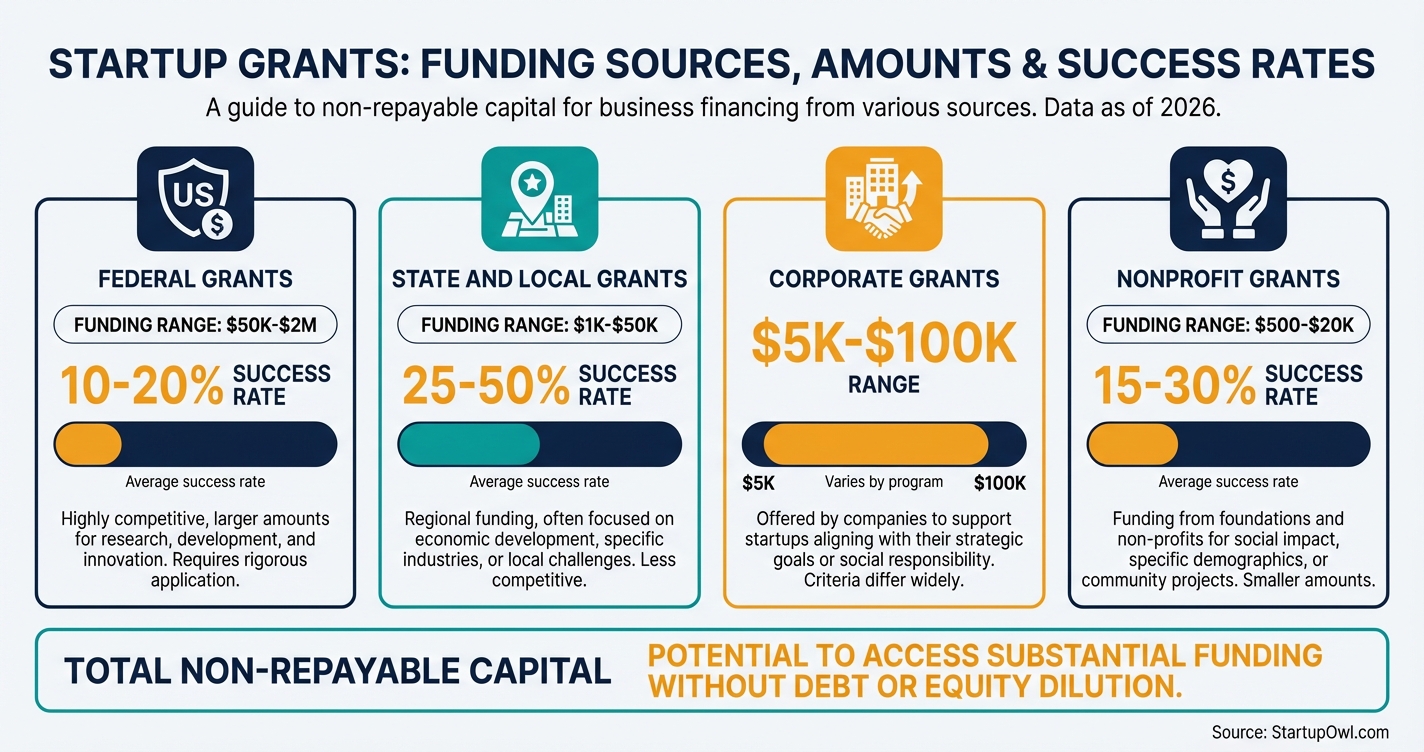
Startup grants give you $1,000 to $100,000+ in non-dilutive capital that you never repay and that never touches your cap table. Unlike business loans, grants carry no APRs, no monthly payments, and no personal guarantees. The trade-off is competition: only about 10% to 20% of applicants win federal grants, and roughly 25% to 50% win local or corporate ones, according to GrantWatch data.
That math still works in your favor if you apply strategically. Submitting 3-5 well-matched applications dramatically improves your odds compared to sending a single long-shot entry to a high-profile national program. This guide shows you exactly where to find open grants, how to qualify, and how to write applications that reviewers actually fund.
What Startup Grants Are and When to Use Them
A startup grant is non-repayable funding awarded by a government agency, corporation, nonprofit, or foundation to a business that meets specific criteria. The four main types of grants available to small businesses are federal grants (like SBIR/STTR for R&D), state and local grants (tied to specific regions), corporate grants (funded by companies like American Express, Visa, and DoorDash), and nonprofit grants (awarded by charitable organizations for community impact). Some programs called grants are actually loans, tax credits, equity deals or advisory services, so confirm the type before you apply. You can read how we sorted our own list and checked which are still open in our study of open grants.
Grants work best when you have time but not collateral. If you need cash within days, a business line of credit or merchant cash advance will move faster. If you can wait 30-90 days for a decision and invest 5-20 hours per application, grants give you free capital that preserves your equity and borrowing capacity.
The SBA itself does not provide grants directly for starting or expanding a for-profit business. The SBA provides grants to nonprofits, resource partners, and educational organizations that support entrepreneurship through counseling and training. For-profit businesses should focus on the private, corporate, and state-level programs listed below, plus the SBIR/STTR program (currently awaiting congressional reauthorization as of early 2026).
Who Qualifies for Startup Grants
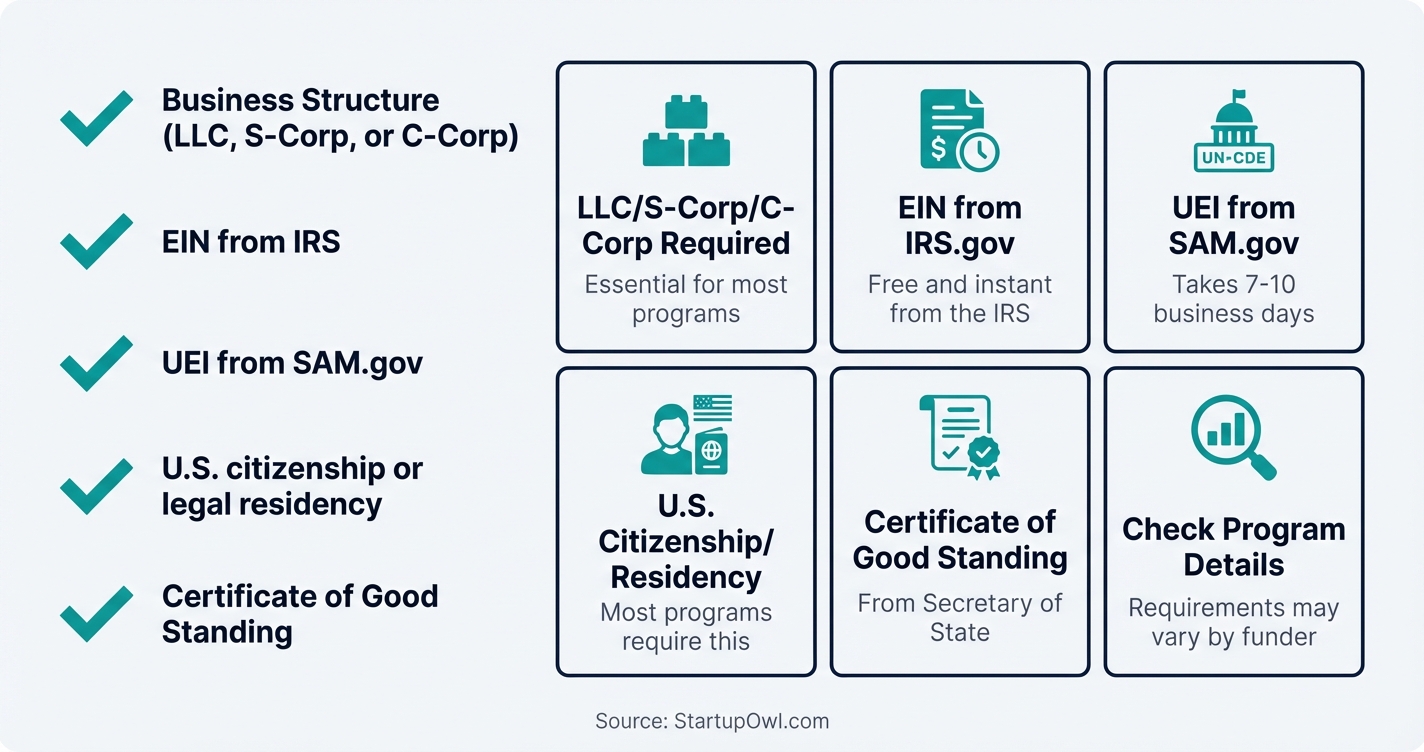
Every grant program sets its own eligibility rules, but most share a common baseline. You typically need a legally registered business (LLC, C-Corp, or S-Corp), a valid EIN, and U.S. citizenship or legal residency. Many programs define "small business" as fewer than 500 employees, though the most startup-friendly grants target companies with under 20 or under 50 employees.
Demographic-specific grants narrow the field further. The Amber Grant from WomensNet requires at least 50% women ownership and awards $10,000 monthly (with three $50,000 year-end grants). The Hello Alice platform partners with companies like DoorDash and Allstate to offer grants of $10,000-$20,000 targeting women, people of color, and veterans. Veteran-owned businesses (51%+ ownership) with 3-20 employees and under $5M annual revenue can pursue the Hiring Our Heroes Small Business Grant.
For federal grants (particularly SBIR/STTR), you also need a Unique Entity Identifier (UEI) from SAM.gov. Registration is free but takes 7-10 business days to process. Without an active SAM.gov registration, you are ineligible for any federal funding.
SBIR/STTR Programs Are Currently Paused
Congressional authorization for the SBIR and STTR programs expired on September 30, 2026. Federal agencies cannot release new solicitations or fund new awards until Congress reauthorizes the programs. The House passed a 1-year extension (H.R. 5100) through September 30, 2026, but the Senate has not yet acted as of February 2026. If you are planning an SBIR/STTR application, prepare your materials now so you are ready to submit as soon as reauthorization passes. Visit SBIR.gov for the latest status updates.
How to Apply for Startup Grants Step by Step
The application process varies by program, but the core workflow is the same: register, research, prepare, submit, and follow up. Federal grants through Grants.gov require the most preparation (SAM.gov registration, Login.gov account, organizational profile). Private and corporate grants like Hello Alice or Breva Thrive use simpler online application portals.
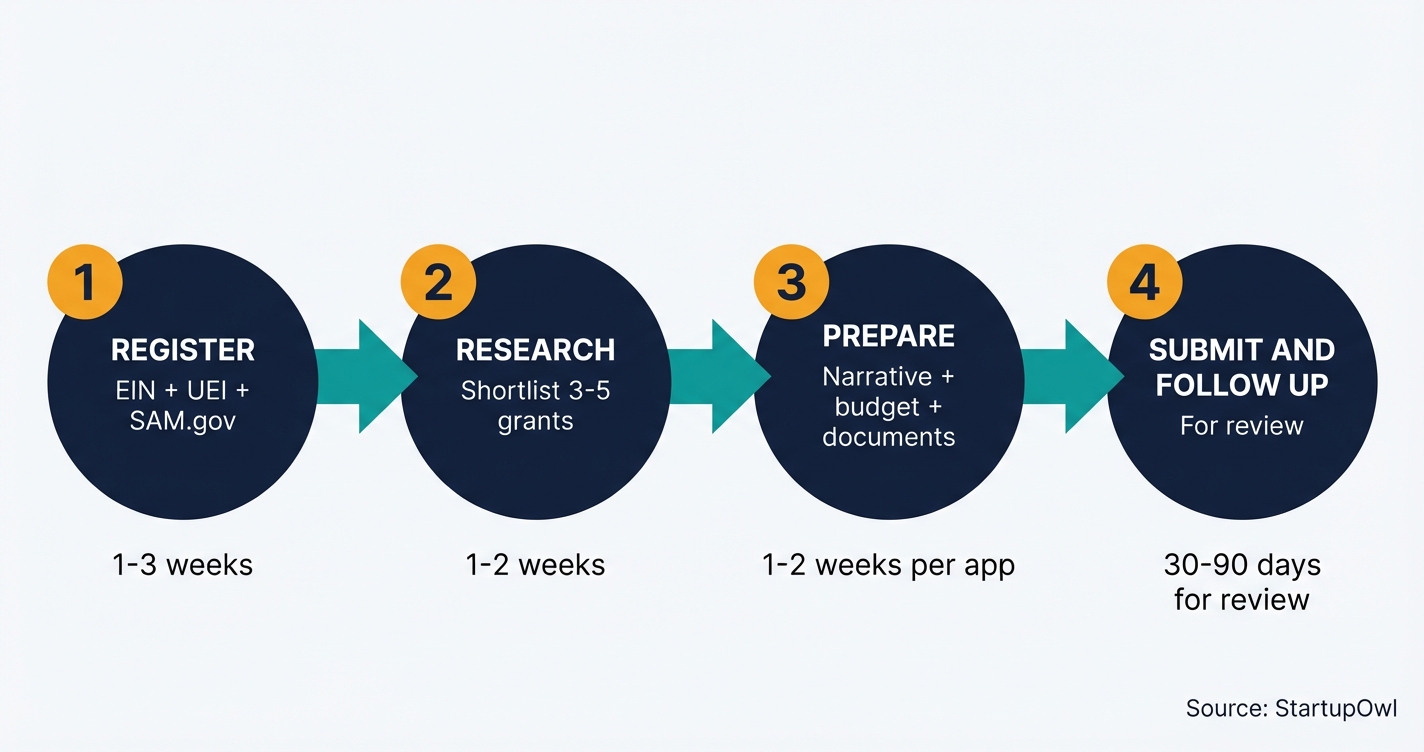
Plan for 5-20 hours of work per application. Federal grant proposals can take 80-200 hours for complex R&D submissions, but most private startup grants take 1-5 hours to complete. The NASE Growth Grant, for example, primarily requires a business plan and an explanation of how the funds will support growth. The Amber Grant application asks you to tell your story from the heart (no corporate jargon needed) and takes about 30 minutes.
For a deeper look at building creditworthiness before applying, see our guide on how to build business credit. Strong financials and a solid business credit score can strengthen grant applications that include a financial viability component.
What Startup Grants Cost You (Hint: Almost Nothing)
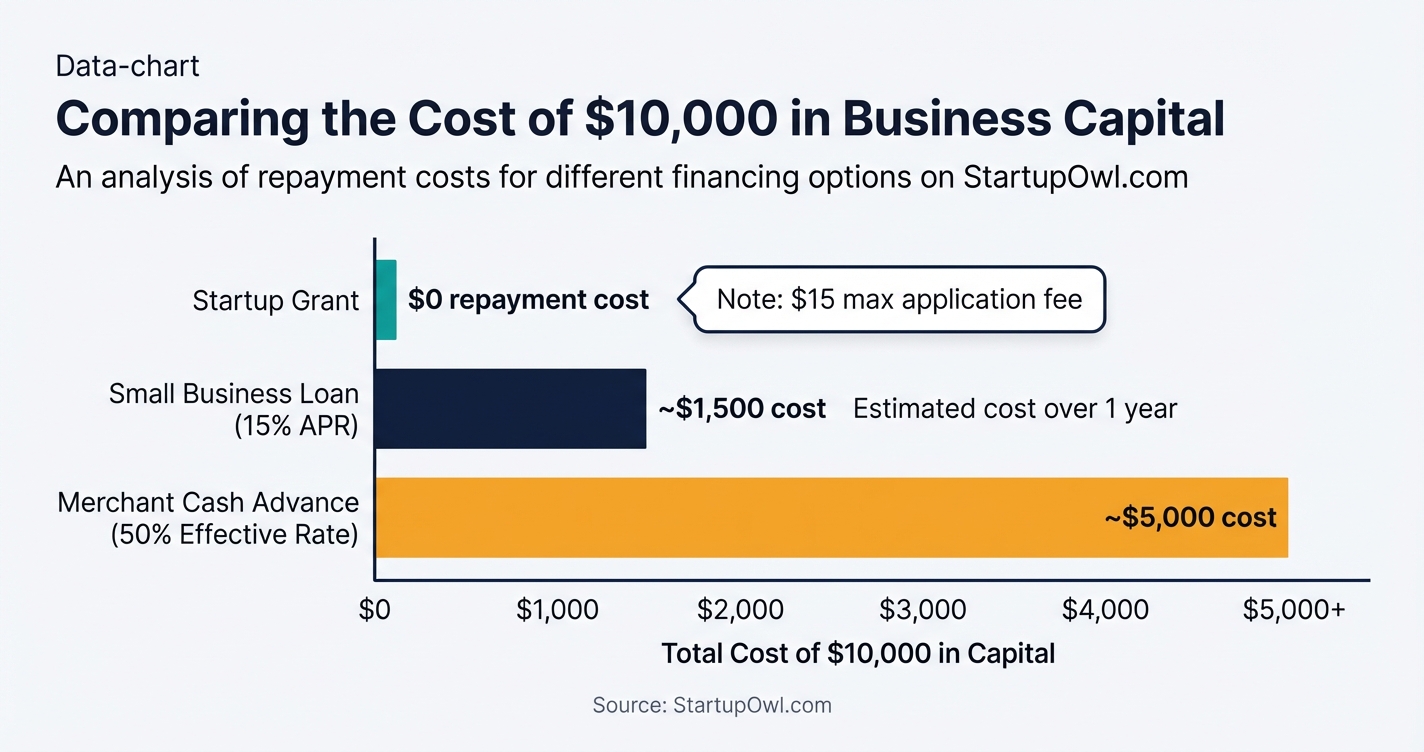
Grants themselves are $0 to receive and $0 to repay. Your only direct costs are business formation fees ($50-$500 depending on your state), which you need regardless. Most grant applications are free to submit. The Amber Grant charges a $15 application fee. SAM.gov and Grants.gov registration are both free.
The real cost is your time. Writing 3-5 grant applications per quarter takes roughly 15-60 hours of research, writing, and document preparation. If you hire a professional grant writer, expect to pay $20-$100 per hour. A single federal grant proposal can run $1,600-$20,000 in writer fees for a complex SBIR submission, but most private grants do not require that level of investment.
Compare that to the cost of a small business loan where you might pay 7-30% APR in interest, or a merchant cash advance with effective rates of 40-150%. Grants are objectively the cheapest capital available if you can win them.
Top Open Startup Grant Programs for 2026
| Type / Provider | Rate | Notes |
|---|---|---|
| Amber Grant (WomensNet) | $10,000/month; $50,000/year-end | 50%+ women-owned; U.S. or Canada; 18+; $15 application fee; monthly deadlines |
| NASE Growth Grant | Up to $4,000 | NASE members only (90-day waiting period for monthly members); quarterly awards; funds cannot pay debt or rent |
| Breva Thrive Grant | $5,000 | Quarterly; must be generating revenue; prefers 1+ year in business and community impact in underserved areas |
| Intuit QuickBooks Small Business Hero | $20,000 | Must be nominated (not self-applied); 1+ year in business; fewer than 99 employees; awarded in phases |
| Freed Fellowship | $500/month + $2,500 annual | Women or people of color; rolling basis; includes 2 months of business mentorship |
| Hello Alice Partner Grants | $10,000-$20,000 (varies) | Partners include DoorDash, Allstate, Block Advisors; free account required; multiple deadlines throughout 2026 |
| American Express x Main Street America | $20,000 (250 grants) | Brick-and-mortar; 20 or fewer FTE; must include 6-month project plan with itemized budget |
Best Places to Find and Apply for Startup Grants
Grants.gov is the central portal for all federal grant programs from 26 grant-making agencies. You can search by keyword, CFDA number, or agency. Registration is free but requires a SAM.gov UEI first. Best for: R&D-focused businesses seeking SBIR/STTR or agency-specific grants (once reauthorized).
Hello Alice is a free platform that partners with major corporations to distribute grants. Create an account, complete your business profile, and you will receive personalized recommendations. Hello Alice has awarded millions in grants to thousands of small businesses. Best for: women-owned, minority-owned, and veteran-owned businesses.
WomensNet (Amber Grant) gives away $510,000 in grants per year. One application makes you eligible for the monthly $10,000 Amber Grant, the $10,000 Startup Grant, the $10,000 Business Category Grant, and the $50,000 year-end grant. Best for: women-owned businesses at any stage, including idea-phase startups.
NASE Growth Grants have distributed nearly $1 million to members since 2006. Awards of up to $4,000 can be used for equipment, marketing, hiring, and training. You must be an NASE member in good standing. Best for: self-employed and micro-business owners.
GrantWatch is a curated search engine with over 11,000 active grant opportunities across 61+ categories. It also offers AI-powered grant searching and writing tools. Best for: broad research when you want to find niche or regional grants. For additional non-debt funding paths, explore small business grants or microloans for small business.
What to Do If You Do Not Win a Grant
If grants do not come through (and statistically, most applications will not), you have other paths to non-traditional capital. SBA microloans offer up to $50,000 at average interest rates around 7-8% through nonprofit intermediary lenders. These are designed for startups and underserved businesses that banks typically turn down.
A business line of credit gives you revolving access to $10,000-$250,000 that you only pay interest on when you draw. If your personal credit score is 680+, you may qualify for competitive rates. For pre-revenue startups, pre-seed funding from angel investors can provide $25,000-$500,000 in exchange for equity (typically 10-25%).
You can also build a funding stack by combining a business credit card with a small working capital loan and continue applying for grants each quarter. Many successful founders treat grants as a parallel track, not a primary strategy.
5 Mistakes That Kill Grant Applications
1. Applying without checking eligibility first. Roughly 30-40% of grant applications are rejected on eligibility grounds before content is ever reviewed. Read every requirement, including employee limits, revenue caps, geographic restrictions, and business structure rules. If the grant says "LLC or corporation" and you are a sole proprietor, you are automatically disqualified.
2. Writing a vague use-of-funds statement. Reviewers want to see exactly where the money goes. "I will use the $5,000 for business expenses" loses to "$2,000 for commercial kitchen equipment, $1,500 for food safety certification, $1,500 for initial inventory" every time. Itemize your budget with dollar amounts.
3. Missing the SAM.gov registration window. Full SAM.gov registration takes 7-10 business days under ideal conditions and can stretch to several weeks if your entity information has discrepancies. Starting this process the week of a federal grant deadline guarantees you will miss it.
4. Applying to only one grant per quarter. With federal grant success rates at 10-20% and private grants at 25-50%, applying to a single program is a coin flip at best. Submitting 3-5 targeted applications per quarter meaningfully increases your probability of winning at least one.
5. Giving up after the first rejection. Most grant programs run quarterly or monthly cycles. The NASE Growth Grant, Breva Thrive, and Amber Grant all accept reapplications. Refine your narrative, update your financials, and resubmit. Persistence is a legitimate grant strategy.
Step-by-Step Process
- 1
Register Your Business and Get Federal Identifiers
Before you apply to a single grant, you need a formal business structure and the right federal identifiers. Most grant programs require an LLC, C-Corp, or S-Corp registration. Sole proprietorships qualify for fewer programs overall.
Get your Employer Identification Number (EIN) from the IRS website (free, instant online). Then register at SAM.gov to obtain your Unique Entity Identifier (UEI), which is mandatory for nearly all federal and pass-through state grants. SAM.gov registration takes 7-10 business days on average, so start well before any deadline.
Tips
- Start SAM.gov registration at least 30 days before your earliest grant deadline to account for delays.
- Keep your Certificate of Good Standing from your Secretary of State current, as many grants require it.
- Set a calendar reminder to renew your SAM.gov registration annually so it stays active.
Common Mistakes
- Waiting until the week of a grant deadline to start SAM.gov registration, which takes 7-10 business days minimum.
- Operating as a sole proprietor and missing out on the majority of grant programs that require LLC or corporate structure.
- 2
Research and Shortlist Grant Programs That Match Your Business
You will waste hours applying to grants you do not qualify for unless you check eligibility criteria first. Look for disqualifiers like revenue caps, geographic restrictions, industry exclusions, and demographic requirements. Many programs target specific groups (women-owned, minority-owned, veteran-owned) or specific industries.
Use free grant databases like Grants.gov for federal opportunities, Hello Alice for corporate and private grants, and GrantWatch for curated options across categories. Aim to shortlist 3-5 grants that closely match your business profile, then apply to all of them.
Tips
- Create a free Hello Alice account to receive personalized grant recommendations matched to your business profile.
- Focus on niche grants tied to your industry or demographics first, since they have less competition than broad national programs.
- Track every grant deadline in a spreadsheet or calendar so you never miss an open window.
Common Mistakes
- Applying only to the biggest, most-publicized grants where competition is fiercest instead of targeting niche programs.
- Ignoring eligibility details like employee count limits or revenue caps and wasting time on applications you cannot win.
- 3
Prepare Your Application Materials
Most grant applications require a business plan, financial projections, a clear statement of how funds will be used, and evidence of community or economic impact. Some programs (like the NASE Growth Grant) ask you to detail a specific business need and how the grant will address it. Others (like the Amber Grant) want a personal, passionate narrative.
Gather these documents before you start writing: your Certificate of Good Standing, EIN confirmation, UEI number, most recent tax returns, profit-and-loss statement, and a project budget with itemized line items. Federal grants through Grants.gov also require a Login.gov account linked to your organization profile.
Tips
- Write a clear, specific use-of-funds statement with dollar amounts for each line item (e.g., '$2,000 for equipment, $1,500 for marketing').
- Have someone outside your business read your application for clarity before you submit.
Common Mistakes
- Writing a vague use-of-funds statement like 'general business expenses' instead of itemizing exactly how you will spend the money.
- Submitting an application with inconsistent financials (your revenue numbers on the application do not match your tax return).
- 4
Submit Your Applications and Follow Up
Submit each application before the deadline (not on the deadline day, since portal glitches are common). Some programs like the Queens Tech + Innovation Challenge require attending program events in addition to your written application. Others, like the Intuit QuickBooks Small Business Hero Program, require a nomination from someone other than the business owner.
After you submit, mark the expected review timeline. Most grants take 30-90 days to announce results. The NASE Growth Grant makes award decisions within 60 days of receiving a completed application. If you do not win, apply again in the next cycle and refine your narrative based on any feedback you can get.
Tips
- Submit at least 48 hours before the deadline to avoid last-minute portal crashes or upload errors.
- If you do not win, apply again next quarter with a stronger narrative and updated financials.
- Keep copies of every submitted application so you can reuse and improve sections for future grants.
Common Mistakes
- Assuming you can only apply once and giving up after a single rejection instead of reapplying in the next cycle.
- Missing a program's supplemental requirements like event attendance, social media posts, or video submissions.
Cost Breakdown
| Item | Cost Range | Notes |
|---|---|---|
| Grant Application Fees | $0-$15 per application | Most grants are free to apply; the Amber Grant charges a $15 fee |
| Business Registration (LLC) | $50-$500 | State filing fees vary; required for most grant eligibility |
| EIN from IRS | $0 | Free and instant via IRS online portal |
| SAM.gov Registration and UEI | $0 | Free; required for all federal grant programs; takes 7-10 business days |
| Professional Grant Writer (optional) | $20-$100/hour | Hourly rates vary; typically 40-200 hours per federal application |
Frequently Asked Questions
Yes, grants are non-repayable capital that does not require equity or interest payments. You receive a lump sum award and use it for the approved purpose. The only costs are your time to apply and small fees like the $15 Amber Grant application fee. Keep in mind that grant income may be taxable depending on the program structure and your business entity type, so consult a CPA.
Most programs take 30-90 days from your submission to an award announcement. The NASE Growth Grant makes decisions within 60 days. The Amber Grant announces winners by the 21st of the following month. Federal grants through Grants.gov can take 3-6 months for complex programs, though many are currently paused pending SBIR/STTR reauthorization.
Most startup grants do not check your personal credit score. Unlike business loans for startups, grants evaluate your business plan, community impact, use-of-funds specificity, and alignment with the program's mission. That said, some programs review your financial statements for viability, so having organized finances and a solid business credit score still helps.
Some grants accept sole proprietors, but your options are significantly more limited. Most federal and many private grant programs require a formal business structure like an LLC, S-Corp, or C-Corp. If you are currently a sole proprietor, consider forming an LLC before applying. The filing cost ($50-$500 depending on your state) opens the door to dozens of additional programs.
The Awesome Foundation awards $1,000 monthly grants with essentially no eligibility requirements beyond completing the application. The Amber Grant is also straightforward (fill out a personal narrative, pay $15) and awards $10,000 monthly. For the best odds, focus on niche grants matched to your specific industry, geography, or demographics rather than chasing the largest national programs.
Apply to at least 3-5 grants per quarter. With success rates ranging from 10% for federal programs to 25-50% for local and corporate grants, a single application gives you slim odds. Applying to five well-matched programs in the same quarter gives you a statistically meaningful chance of winning at least one. Quality still matters more than quantity, so only apply where you genuinely meet the criteria.
This content is for informational purposes only and does not constitute financial, legal, or tax advice. Business financing terms, rates, and eligibility vary by lender, credit profile, and business characteristics. Consult a licensed financial advisor or CPA before making borrowing decisions. Grant program details, award amounts, deadlines, and eligibility requirements are subject to change without notice. Verify all details on the official program website before applying. Information reflects publicly available data as of February 2026.
Sources & References
- SBA.gov Grants Programs
- Grants.gov Applicant Registration
- SAM.gov Entity Registration
- SBIR.gov (America's Seed Fund)
- WomensNet Amber Grant
- NASE Growth Grants
- Hello Alice Grant Platform
- GrantWatch Grant Success Rates
- US Chamber of Commerce Grants and Programs
- Inc.com 12 Small Business Grants for 2026
- Shopify Small Business Grants Guide
- NSBA SBIR/STTR Reauthorization Update
About the Author
Editor, StartupOwl
Eliot leads StartupOwl's state data research. He maintains the site's fifty state records of LLC filing fees, annual costs, processing times, and small business grant programs, checking each figure against the state office that publishes it and logging the date it was verified. Based in New Jersey, he has spent his working life in and around small businesses, and he writes for the founder who wants the real number rather than the advertised one. Every figure under his byline traces to a named source, and when a state proves a number wrong, the correction is published, not buried.
Was this article helpful?
Questions about Startup Grants
No comments yet. Ask the first question and a member of our team will answer.
Leave a comment