
Small Business Grants in Idaho
Idaho's grant money is training money. The state's biggest grants pay a city, a county or a tribe, and your business is the project rather than the applicant.

Idaho's grant money is training money. The state's biggest grants pay a city, a county or a tribe, and your business is the project rather than the applicant. What you can file yourself comes from the Workforce Development Council. Its Employer Grant caps at $250,000 and is reviewed four times a year. The apprentice grant pays $1,000 per apprentice a year, up to $10,000. The Education to Careers Grant pays $1,500 to $15,000 for STEM and career learning and closes on October 20, 2026. The Gem Grant, the block grant, the Rural Community Investment Fund and the Opportunity Fund are the ones your city has to file. You spend the money first and claim it back. The export grant has been shut since September 2025.
Which Idaho grants fit your business?
Answer 7 quick questions and we sort the 15 programs on this page into likely fits and long shots. Nothing personal is asked or stored, and final eligibility is always decided by the granting agency.
Idaho Small Business Grant Programs
State-administered funding programs available to Idaho small businesses. Verify deadlines directly with the granting agency before applying.
Workforce Development Training Fund (WDTF) Employer Grant
Idaho Workforce Development Council
Up to $250,000 per grant, $750,000 over ten years
Rolling, the committee reviews quarterlyThe one Idaho grant with real money that a single employer files on its own. It pays back costs, with a 25 percent match and a two year term. The cap is $250,000 per grant and $750,000 over ten years. You must be registered and in good standing with the Secretary of State. You must pay at least the 25th percentile regional wage and offer a health plan. No per employee cap is published, because the council sizes each award with a funding model. Cutoffs are quarterly. The September 4, 2026 cutoff fed the October review, and the next date is not yet posted.
WDTF Industry Sector Grants
Idaho Workforce Development Council
No published cap, sized by the review committee
Deadline Dec 4, 2026A single business cannot apply for this one. The applicant is a group of at least three industry partners, led by a company, a nonprofit or a training provider. It pays back costs over a three year term. The match is 25 percent in cash or 100 percent in kind. No cap is published, and the review committee sizes each award on labour market evidence. For money for your own company alone, use the Employer Grant.
Registered Apprenticeship Incentive
Idaho Workforce Development Council
$1,000 per apprentice per year, $10,000 a year per employer
Deadline Jun 30, 2027Money back for taking on registered apprentices, paid to the employer. The headline is $10,000 per employer a year. The unit is $1,000 per apprentice a year, so the full sum needs ten apprentices. You are paid once RAPIDS confirms 500 hours of on the job training, or 175 hours for a youth apprentice. You need a Labor Department registered apprenticeship, a starting wage of at least $12 an hour and a health plan. Jobs that pay at or above the county average wage come first. Only full time, year round Idaho taxable staff count. Quarterly reports must carry each trainee's full Social Security number. Applications are open until June 30, 2027.
WDTF Outreach Projects
Idaho Workforce Development Council
Reimbursement, no published cap
Quarterly, aim for one month before the committee meets, seven days is the hard minimumIt takes employers directly, which is rare in Idaho. Outreach Projects fund public information work about careers, education and training in the occupations Idaho employers are short of, and the Council prefers new projects or the expansion of an existing one. The money is paid back to you after you spend it, and terms run up to three years. No cap is published. The Outreach Committee reviews every quarter. The page asks for applications one month before the meeting and also says seven days is the minimum, so aim for the month. It has no proper section on the public grants page, which is why it rarely turns up on lists like this one.
Apply / Learn MoreWDTF Innovation Grant
Idaho Workforce Development Council
Up to $25,000 per region
Rolling, the committee reviews quarterlyA single business cannot file this one either. The applicant must be a team of business, school and community partners, based in Idaho and able to manage the money. It pays for new or better training that closes a skills gap employers have named. It may not compete with training that already exists. The cap is $25,000 per region, and a team serving several regions can ask for $25,000 for each. You describe your match rather than meet a set share. The term is one year, or two for work based learning such as apprenticeships and internships. The review committee meets each quarter, and September 4, 2026 was the cutoff for October.
Community Development Block Grant (CDBG)
Idaho Commerce (funded by HUD)
Up to $500,000, city or county applies
Third Monday in March, June, September and DecemberFederal money passed through Idaho Commerce. Only incorporated cities or counties under 50,000 people may apply, and a special district needs one of them to sponsor it. A company gains when its town applies for infrastructure that serves a named job creating project. Job creation applications are due the third Monday of March, June, September and December, and the next is December 21, 2026. Public facilities applications are due the Friday before Thanksgiving. Job creation grants stop at $30,000 per job and $500,000 in all.
Rural Community Investment Fund (RCIF)
Idaho Commerce
$50,000 to $500,000, city or county applies
No published deadlineGrants run from $50,000 to $500,000 and need a local match. The Economic Advisory Council awards them, and no deadline is published. A city under 25,000, a county or a tribe applies. It may then pass the money to an approved partner. Its key elected officials have to present the case. One use is worth knowing. The fund can pay a city to buy or build a building that a company then leases or buys, so it is not only pipes and roads. The old name, Rural Community Block Grant, now lives only in the web address and one stray line of the state rule.
Idaho Gem Grant Program (IGG)
Idaho Commerce
Up to $100,000, city or county applies
Quarterly cutoffs, next are Dec 21, 2026 and Mar 15, 2027A business cannot apply for this, but its city can. Idaho Commerce says a city, county or tribal government must file, and a company appears as the job creating project, not the applicant. It pays back costs after they are spent, with a 20 percent match. Read the ceiling with care. The web page still says up to $50,000. The FY27 guide and the state rule both say up to $100,000, with awards above $50,000 kept for major job creation projects. FY27 cutoffs are September 21 and December 21, 2026 and March 15, 2027. A city, county or tribe can hold only one Gem Grant at a time. An open one must close before Commerce looks at the next, so a neighbouring project can block yours.
Idaho Opportunity Fund (IOF)
Idaho Commerce
Negotiated per project, paid to a local government
No application window, awarded at Commerce discretionNot a business grant in any form. The state rule says the grants go to local governments. The money pays public costs tied to one job creation project, such as water, sewer, gas, power, rail, broadband, parking, roads and flood work. The company signs its own performance deal with the city and never gets the grant. Commerce has no page for it, and the button on its grants hub leads nowhere. The rule that governs it is IDAPA 28.02.03.300.
State Trade Expansion Program (STEP) Grant
Idaho Commerce
$2,000 to $12,000 when a round is open
Deadline Sep 29, 2025Shut, and shut for longer than it looks. Idaho Commerce says the Financial Assistance Awards window is closed. The page still shows the award year that ran to September 29, 2025, which ended nearly a year ago. When it runs, awards are roughly $2,000 to $12,000 and you claim the money back. You put up a 20 percent cash match, so every approved $100 you spend returns $80. The rules are narrow. You must be an SBA eligible Idaho small business trading at least a year. Consultants, retail, hospitality, tourism, law firms, land developers and distributors acting for clients are all shut out. The only eligible activity is a trade show, at home or abroad, and one application is taken per round. Check back each quarter.
Education to Careers Grant
Idaho Workforce Development Council
$1,500 to $15,000, one round a year
Deadline Oct 20, 2026A for profit company can win this one, but the money must pay for STEM learning or career work, not your own running costs. Schools, libraries, museums, nonprofits, for profit firms and local government can all apply. A single person cannot. Regional projects get $1,500 to $5,000. Statewide projects get $5,000 to $15,000. The money is split by the population of Idaho's six education regions. No more than a fifth may go on staff, tech or materials. None of it may pay rent, utilities or shared office costs. The 2026 round opened on September 14 and closes at 5pm on October 20, and awards come on December 5.
Federal Grant Programs
These federal programs are available to small businesses in every state.
SBA 7(a) Loan Program
The SBA's primary lending program guarantees loans through participating lenders. This is a loan, not a grant. But the terms favor small businesses that may not qualify for conventional financing.
Learn moreSBA Microloan Program
Loans up to $50,000, not grants. You borrow from a nonprofit lender near you, not from the SBA itself. The money can cover working capital, inventory, supplies or equipment. Most people get far less than the cap. The average microloan is about $13,000.
Learn moreSBIR/STTR Grants
Competitive federal grants for small businesses doing research and development with commercial potential. Eleven federal agencies take part. Phase I funds proof of concept. Phase II funds full development.
Learn moreMinority Business Development Agency (MBDA) Programs
Help for minority owned businesses that need capital, contracts or new markets. MBDA runs business centers around the country. They give advice, help with bids, and point you toward lenders.
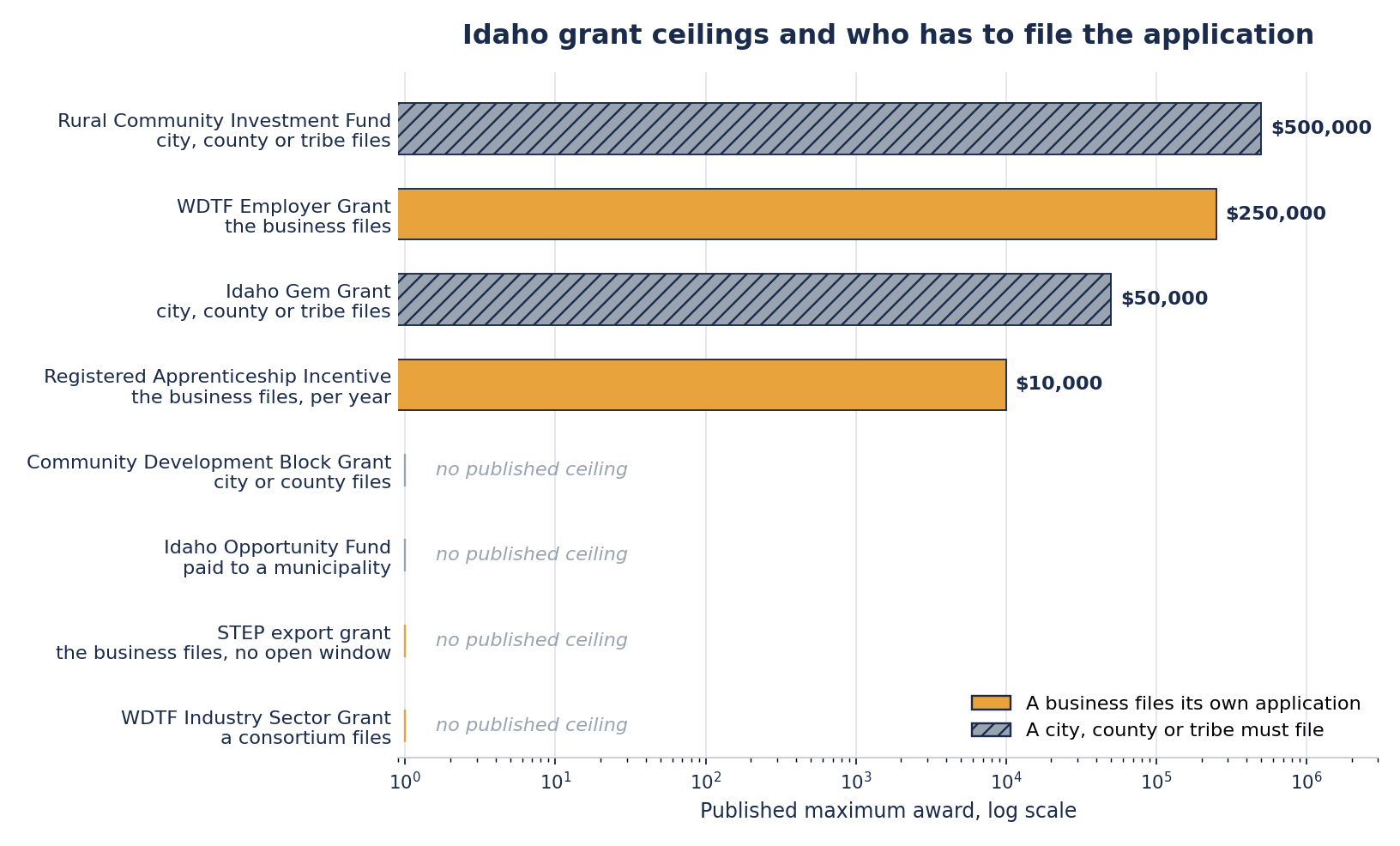
Learn moreThe chart sorts Idaho's grant programs by published award ceiling and by who has to file the paperwork. Gold means a business files it. Hatched grey means a city, a county or a tribe files for you.
Get Grant-Ready
Before you apply, most Idaho grant programs expect these basics to be in place.
Form your business entity
Most Idaho grant programs require applicants to be a registered LLC, corporation, or nonprofit. If you haven't formed yet, that's the first step.

$39 + state fee. Includes registered agent, business address, and more.
Get your EIN
An Employer Identification Number is free from the IRS and required on nearly every grant application. You can apply online and receive it immediately.

Open a business bank account
Grant funds need to go into a dedicated business account, not your personal checking. Most agencies will ask for your banking details on the application.

Mercury is a fintech company, not an FDIC-insured bank. Banking services provided through Choice Financial Group and Column N.A., Members FDIC.
Grants by Business Type
Targeted programs for specific business owners in Idaho.
Rural Business Grants
Idaho's rural money is real and it does not come to you. RCIF pays $50,000 to $500,000. The Gem Grant now pays up to $100,000 under its FY27 guide. Both need a city, county or tribe to apply for you. RCIF covers cities under 25,000, and so does the Gem Grant since the FY27 guide lifted its old 10,000 limit. If your plan needs water or power run to a site, start at city hall.
- ›Rural Community Investment Fund (RCIF)
- ›Idaho Gem Grant Program
- ›Community Development Block Grant
Technology/Innovation Business Grants
SBIR and STTR are the biggest grants an Idaho tech firm can win. Eleven federal agencies fund them. None of that money passes through the state. Closer to home, the Innovation Grant pays up to $25,000 per region, but you have to apply as part of a team with schools and community partners. Elevate Idaho and the Idaho SBDC help with proposals at no cost.
- ›SBIR/STTR Grants
- ›Elevate Idaho
- ›Idaho SBDC
Women-owned Business Grants
Idaho runs no state grant for women-owned businesses. The national ones are open to you. WomensNet awards three $10,000 Amber Grants every month, and three of the monthly winners take another $50,000 at year end. Idaho Partners for Good and the Idaho SBDC offer mentoring, not money.
- ›Idaho Partners for Good
- ›Idaho SBDC
- ›SBA Women's Business Center
Veteran-owned Business Grants
Idaho runs no veteran-only grant. The Idaho SBDC advises veteran founders at no cost. The SBA runs veteran lending and counseling nationally. What reaches veterans here is mostly loans, contracting help or advice. Not grant money.
- ›Idaho SBDC
- ›SBA Veterans Programs
- ›Idaho Division of Veterans Services
Tips for Applying in Idaho
Increase your chances of approval with these state-specific tips.
- 1Apply through the Idaho Commerce grant portal. Email [email protected] for portal access first. A login takes days you will not have near a deadline.
- 2Check who applies before the amount. The Gem Grant, CDBG, the Rural Community Investment Fund and the Opportunity Fund all name a city, county or tribe as the applicant. Your route to that money is a talk with your local government, not a form.
- 3Budget your own money too. The Employer Grant expects at least 25 percent from you. The Industry Sector Grant wants 25 percent cash or 100 percent in kind from the consortium.
- 4Know what the training fund excludes. Onboarding, safety, sales, leadership, compliance refreshers and ERP rollouts are all off the list. Trainee wages are out too.
- 5Call your regional Idaho SBDC office first. The consulting is free. They will tell you whether your project is a grant project or a loan project.
State Economic Development Agency
Idaho Commerce
Idaho Commerce is the state's lead agency for economic development. It runs the state grants. It also runs the tax incentives and the rural programs, and helps firms that want to move here or grow here.
Funding While You Wait
Grant applications in Idaho can take weeks or months to process. These options can bridge the gap.
Grants in Other States
All state grant guidesFrequently Asked Questions
The Workforce Development Council runs all of them. Its Employer Grant funds training up to $250,000 against a 25 percent match, on quarterly cutoffs. The apprentice grant pays $1,000 per apprentice a year, up to $10,000. Outreach Projects fund work that promotes careers and training, and they take employers directly. The Industry Sector Grant and the Innovation Grant both need partners, so you cannot file either one alone.
Because they are community money. The Gem Grant takes applications only from a city, a county or a tribal government. The block grant takes them from cities and counties under 50,000 people. The Rural Community Investment Fund names cities under 25,000, counties and tribes. The Opportunity Fund pays the local government and you sign a separate deal with the city. Your business gains. It does not receive.
Not right now. Idaho Commerce says the Financial Assistance Awards window is closed, and the page still shows a project period that ended on September 29, 2025. When a round runs, awards are $2,000 to $12,000 with a 20 percent cash match, so every approved $100 you spend returns $80. The only eligible cost is a trade show. Consultants, retail, hospitality and law firms are shut out.
Up to $100,000, and Idaho Commerce says two things at once. The program web page still reads up to $50,000. The current FY27 guide and the state rule both say $100,000, with awards above $50,000 held for big job creation projects. We publish $100,000 because the guide and the rule are newer. Your city or county has to file it, and one open Gem Grant has to close out before they can file another.
Only if you run ten apprentices. The rate is $1,000 per apprentice a year and $10,000 is the yearly cap per employer. You get paid after RAPIDS confirms 500 hours of on the job training, or 175 hours for a youth apprenticeship, so the money follows the work. You need a Department of Labor registered apprenticeship, an entry wage of at least $12 an hour and a health plan.
Usually yes. The IRS says a government grant to a business generally is not excluded from gross income, so it is taxable. Most Idaho awards pay you back for training costs you have already met, and those costs are usually deductible, so the two often cancel out. That is not a rule, so ask your accountant. A loan is different. Borrowed money is not income when you take it.
About the Author
Editor, StartupOwl
Eliot leads StartupOwl's state data research. He maintains the site's fifty state records of LLC filing fees, annual costs, processing times, and small business grant programs, checking each figure against the state office that publishes it and logging the date it was verified. Based in New Jersey, he has spent his working life in and around small businesses, and he writes for the founder who wants the real number rather than the advertised one. Every figure under his byline traces to a named source, and when a state proves a number wrong, the correction is published, not buried.
Was this article helpful?
Grant programs change frequently. Deadlines, eligibility requirements, and funding amounts listed here may be outdated. Always verify information directly with the granting agency before applying. This page is for informational purposes only and does not constitute financial or legal advice.
Sources & References
- Idaho Commerce - Grants
- Idaho Commerce - Community Development Block Grant (CDBG)
- Idaho Commerce - Rural Community Investment Fund (RCIF)
- Idaho Commerce - Idaho Gem Grant
- Idaho Commerce - State Trade Expansion Program (STEP)
- Idaho Workforce Development Council - Grant Opportunities
- Idaho Workforce Development Council - WDTF Policy, updated March 11 2026
- Idaho SBDC - Grant Resources
- SBIR and STTR - About the programs
- Northwest and Rocky Mountain Regional Food Business Center - Idaho Business Builder
Questions about Idaho small business grants
No comments yet. Ask the first question and a member of our team will answer.
Leave a comment