
Multiply the months remaining by the monthly rent. That is your exposure. It is the ceiling on what this can cost you, and everything that follows is an argument about who ends up carrying it.
Explainer Guide·Updated August 7, 2026
How to Get Out of a Commercial Lease, the Four Exits
For the tenant who has already signed. The four exits from a commercial lease, what each costs, and the guarantee that outlives the lease.
10 min read

Written byEliot Reynolds
Editor, StartupOwl
In This Article
- Work out what is left before you call anyone
- The four exits, and who has to say yes
- Exit one, buy your way out
- Exit two, hand the lease to someone else
- Exit three, sublet and stay on the hook
- Exit four, stop paying
- Does the landlord have to re rent it
- Your personal guarantee does not leave when you do
- What the release has to say
- FAQ
Key Takeaways
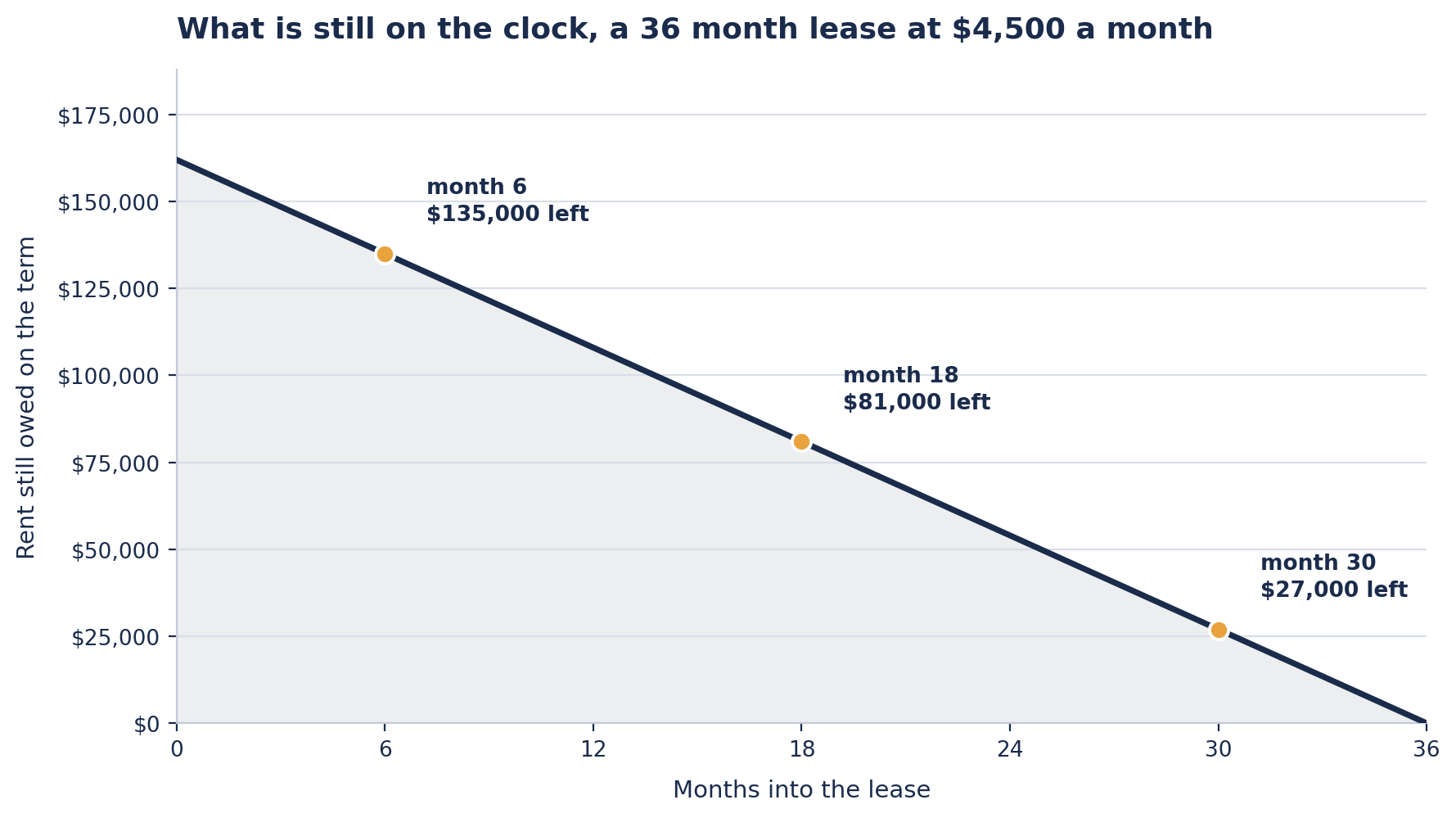
- The rent left on the term decides everything. A 36 month lease at $4,500 has $135,000 left at month 6 and $27,000 left at month 30. Same tenant, two different conversations.
- Three of the four exits need the landlord to agree. Only default does not, and default is the one that reaches your own money.
- Whether the landlord must try to re rent the space is a state law question, and the answer quoted online often comes from a residential statute. In Florida the four remedies list and the good faith relet duty sit in section 83.595, written throughout about a dwelling unit.
- Ending the lease does not end your personal guarantee. The release has to name you, not just the LLC.
Quick Answer
Four exits, and the lease decides which are open. Surrender, you pay for a release, and the landlord has to agree. Assignment, a new tenant takes over your lease, and the landlord usually has to consent. Sublease, somebody rents from you while you stay the tenant, also usually consent. Default, you stop paying, and what it costs depends on your state and on whether you signed a personal guarantee. Work out the rent left on the term first. Start there.
You signed. That is the situation this page is written for.
A 36 month lease at $4,500 a month is $162,000 of promises. Four ways out of it exist, and which ones are open to you is decided by the lease document rather than by how badly you need to leave. A negotiated surrender. An assignment. A sublease. Or you stop paying and let it go into default.
Before any of that, work out one number, the rent still owed on the term. Everything below is an argument about who ends up carrying it.
Work out what is left before you call anyone
Take a 36 month lease at $4,500 a month. The whole term is $162,000. At month 6 you are still holding $135,000 of it. At month 18 you are holding $81,000. At month 30 you are holding $27,000. Same lease, same tenant, three quite different positions. That arithmetic is base rent only. If the unit also carries common area charges, the annual CAM reconciliation can move your real exposure again after the year closes.
This is why timing comes before tactics. A landlord looking at $135,000 of empty term has a reason to sit down with you. A landlord looking at $27,000 has less to gain from the conversation. Know which one you are talking to.
Watch Out
Get a lawyer before you send anything. A commercial lease is a contract between businesses, and the tenant protections written for apartments do not apply to it. An email to your landlord saying the business cannot afford the space can be read back to you later. Have a real estate attorney in your state draft or review whatever you sign.
The four exits, and who has to say yes
| Exit | Landlord consent needed | Who is the tenant afterwards | What you can still owe |
|---|---|---|---|
| Surrender or buyout | Yes, always | Nobody, the lease ends | The agreed payment, and nothing beyond it if the release says so |
| Assignment | Usually, the lease says | The new tenant | Often nothing, but only with a written release naming you |
| Sublease | Usually, the lease says | You, with a subtenant under you | Everything, you are still the tenant on the lease |
| Default | No | You, until the landlord acts | Unpaid rent and whatever else your state and the lease allow |
Read the assignment and subletting clause first. It is usually one paragraph and it settles three of those four rows. Some leases ban both outright. Some require consent that cannot be unreasonably withheld, which is a real limit on the landlord. Some say nothing at all, and silence is a question for your lawyer rather than an invitation. Only 1 of the 4 exits needs nobody's permission, and it is the one that reaches your own money.
Exit one, buy your way out
A buyout buys a release. You hand over money, the landlord hands over a document saying the lease is finished and nothing further is owed. It is the cleanest exit and the only one that ends on a date you can put in a calendar.
There is no formula for the price. Your side of it is the number from the chart above, $135,000 at month 6 on our example lease. The landlord side is what the space is worth to relet, how long that takes, and what it costs to make it ready. Neither of you knows those figures exactly. That is why buyouts settle in a range.
Ask to see the release wording before you agree to a figure. A payment with no release is just a payment.
Exit two, hand the lease to someone else
An assignment moves the lease to a new tenant. They take your term and your rent. Every obligation in the document becomes theirs, and if the landlord releases you in writing, you are out.
That release is the part people skip. Without it, an assignment can leave you standing behind whoever took over, which swaps a problem you control for one you do not. Ask for the release in the same document, not in a later one.
Assignments go easiest when the space suits the next tenant as it stands. A fitted out kitchen is easier to hand on than a plain office, because the fit out is worth something to the next operator in the same trade. On our example lease at month 6, an assignment removes $135,000 of exposure in one signature. Chase this before the buyout conversation starts.
Exit three, sublet and stay on the hook
A sublease keeps you as the tenant. You rent the space to somebody else, collect from them, and keep paying the landlord. From the landlord side almost nothing changes, which is one reason consent often comes easier here than on an assignment.
The risk is plain. If your subtenant stops paying, you still owe the rent to the landlord. You have taken on a tenant of your own, with none of the tools a landlord has.
Watch the gap too. Sublet our example space at $3,800 while you owe $4,500 and you are paying $700 a month for the privilege. Over the last 24 months of the term that is $16,800. A sublease can be the right answer and still cost real money.
Exit four, stop paying
This is the exit nobody recommends and plenty of tenants end up taking. It is described here because pretending it does not exist helps nobody. It is not a plan.
Stopping payment does not end the lease. It puts you in default. What happens next is set by your state law and by the lease, and the landlord usually wants possession back before anything else.
Florida is a short illustration. Under section 83.05, a commercial landlord whose tenant has not paid has the right to obtain possession, but recovers it only through a court action, or when the tenant surrenders, or when the tenant abandons the premises. Abandonment is presumed after 30 consecutive days of absence, unpaid rent, and a served notice with 10 days elapsed. That is the possession half. What you owe afterwards is a separate fight, and it turns on the question in the next section.
Does the landlord have to re rent it
This decides the size of the bill. It is also the question the internet answers worst.
The idea you will meet is that the landlord must try to re rent the space, and that whatever the next tenant pays comes off what you owe. That duty is real in many states. It is also, in a lot of what you will read, being quoted out of a residential statute.
Florida shows the split cleanly. Section 83.595 lists the four choices a landlord has after a tenant leaves early, and one of them carries a duty to exercise good faith in attempting to relet, defined as at least the same efforts used in the original rental. The same section caps an agreed early termination fee at two months rent. Every line of it is written about a dwelling unit, and it sits in Part II of the chapter.
Commercial tenancies sit in Part I. Section 83.001 says so in one sentence. And 83.05, the commercial default section, gives the landlord the right to possession and says nothing about reletting at all.
So the answer for a Florida shop is not the answer for a Florida apartment, and a page that never says which one it means is no use to either. Ask your lawyer which part of your state law your lease sits under. Ask it early. It is a short question with a large number attached to it.
Your personal guarantee does not leave when you do
Most small commercial leases carry one. You signed the lease as the LLC and the guarantee as yourself. That is 2 documents and 2 separate promises.
So every exit above has two halves. Ending the lease deals with what the company owes. The guarantee is separate and it survives unless the exit document releases it by name.
Check the wording yourself. A release of the tenant is not a release of the guarantor. If your own name is on a guarantee page, your own name has to be in the release. Our guide to what a personal guarantee actually does covers the clauses worth asking for, including burn offs and good guy clauses.
Read next
The personal guarantee is the part of the lease that reaches your savings account
What the release has to say
Whichever exit you take, the paperwork is the exit. These 6 lines decide whether it worked.
- The date the lease ends. Not the day you move out, the day the obligation stops. They are often different dates.
- The amount and the schedule. One figure, one payment plan, and a sentence saying it settles everything.
- A release of the tenant. Naming the LLC, covering rent, charges and damages through the end date.
- A release of the guarantor. Naming you personally. This is the line that gets left out.
- The security deposit. Say whether it is applied, returned or kept. Silence here turns into an argument later.
- Condition on handover. What you must remove, what you may leave, and who pays to make good.
Signed by both sides, dated, and kept somewhere you can find it in three years. Keep your own copy. If the landlord draft is missing one of these six lines, that is the negotiation, not a detail to tidy up afterwards.
If the business is closing rather than moving, the lease is one of several loose ends. Order matters here. Our guide to dissolving an LLC properly covers what to do first, because dissolving while a lease is still running does not make the lease go away.
Frequently Asked Questions
Usually only if the lease lets you. Look for an early termination clause, sometimes called a break clause, which sets a notice period and a fee. Without one, every route out involves either paying the landlord or finding a replacement tenant they will accept. There is no general right to leave a commercial lease early, and the protections written for residential tenants do not reach commercial space.
The same four routes, and the month you are in decides which is realistic. Timing is most of it. On a 36 month lease at $4,500 a month you hold $135,000 at month 6 and $27,000 at month 30. Early on, a buyout is expensive and finding a replacement tenant is usually the cheaper path. Later on, the remaining sum is small enough that a negotiated payment becomes the simple option.
An assignment transfers the lease to a new tenant, who takes over your term and your rent. A sublease keeps you as the tenant and puts somebody underneath you. The difference is liability. After a clean assignment with a written release, you are out. After a sublease you remain responsible, so if the subtenant stops paying, the landlord still comes to you for the rent.
It depends on your state. It also depends on whether the rule you found applies to commercial property at all. Florida is a clear example. The section listing the landlord remedies and the duty to relet in good faith, 83.595, is written throughout about a dwelling unit and sits in the residential part of the chapter. Commercial tenancies sit in Part I under 83.001. Ask your lawyer which applies.
Not on its own. The lease and the guarantee are 2 separate contracts, and you signed the second one as yourself rather than on behalf of the company. A settlement that releases the tenant can leave the guarantee standing. The release has to name you personally and say the guarantee is discharged. Read that line before you pay anything, because it is the one protecting your own money.
There is no standard figure, and any page quoting one is guessing. Do the arithmetic first. The starting point is the rent left on the term, months remaining multiplied by monthly rent. From there it is a negotiation about how fast the landlord expects to relet and what that costs them. You cannot judge an offer without knowing what it is a fraction of.
This guide is editorial, not legal advice. Commercial lease law, landlord remedies, and the duty to relet vary by state and turn on the wording of your own lease. Speak to a real estate attorney licensed in your state before you sign or send anything.
Sources & References
About the Author
Editor, StartupOwl
Eliot leads StartupOwl's state data research. He maintains the site's fifty state records of LLC filing fees, annual costs, processing times, and small business grant programs, checking each figure against the state office that publishes it and logging the date it was verified. Based in New Jersey, he has spent his working life in and around small businesses, and he writes for the founder who wants the real number rather than the advertised one. Every figure under his byline traces to a named source, and when a state proves a number wrong, the correction is published, not buried.
Was this article helpful?
Questions about this guide
No comments yet. Ask the first question and a member of our team will answer.
Leave a comment