
A personal guarantee makes you the backup borrower. If the LLC does not pay, the lender comes to you. Your pay, your savings, and sometimes your home equity are in reach. The LLC is still standing. It just is not standing between you and this one debt.
Explainer Guide·Updated August 8, 2026
Personal Guarantee, the Exception to Your LLC Protection
What a personal guarantee is, the four contracts that carry one, and the asks that shrink it.
13 min read

Written byEliot Reynolds
Editor, StartupOwl
In This Article
- What a personal guarantee actually is
- Why lenders ask for one at all
- The four places founders sign one without noticing
- The types of guarantee, and which one you signed
- Commercial leases, where most founders meet it
- SBA loans and the 20 percent rule
- Business credit cards and equipment finance
- What a guarantee does to your personal credit
- Your spouse, and the nine community property states
- How to negotiate it down, five asks that work
- Four ways to avoid signing one
- What happens when the business cannot pay
- How to get out of one you already signed
- When signing is the right call
- FAQ
Key Takeaways
- A personal guarantee is a separate promise you sign, so the LLC never failed, you waived it for one debt.
- The SBA requires one from any owner of 20 percent or more, under 13 CFR 120.160(a).
- The SBA guaranty protects the bank, up to 85 percent. Yours is always 100 percent and it is owed by you.
- Leases are the most negotiable. Ask for a good guy clause, a burn off, or a cap, by name, before you sign.
Quick Answer
A personal guarantee is a separate contract making you personally liable for a business debt if the LLC cannot pay it. It does not break your LLC. It is a voluntary exception you sign for one specific debt, most often a commercial lease, a business credit card, an SBA loan, or an equipment lease. The SBA requires one from every owner of 20 percent or more. Leases are the most negotiable of the four, so ask for a good guy clause, a burn off, or a dollar cap before you sign.
Your LLC still works. You signed around it.
A personal guarantee is a promise to pay a business debt from your own pocket. It sits inside a lease, a loan, or a card agreement. Under 13 CFR 120.160(a) the SBA requires one from any owner of 20 percent or more. Landlords and card issuers ask for their own. The shield did not fail. You waived it for that one debt.
That is how a founder with a valid LLC still loses a savings account. No court needed. It is the widest gap between what people think an LLC does and what it does.
What a personal guarantee actually is
The word people miss is separate. The lease is one contract. The guarantee is a second one. You sign the first as a manager of the LLC. You sign the second as yourself.
Courts read them that way too. Piercing the corporate veil is a fight a creditor has to win, and it takes proof of fraud or sloppy books. A guarantee needs no fight at all. You already agreed. That is why one signature can undo the protection a whole formation was meant to buy.
The SBA's own version of the document is called the Unconditional Guarantee, form 148, and the agency's description of it is one sentence long. Owners of 20 percent or more must provide an unlimited personal guaranty. Nobody softened the title.
Guaranty and guarantee mean the same thing here. Lenders use both spellings. Sometimes on the same page.
Why lenders ask for one at all
A new LLC is a stranger. It has no credit file, no filed accounts, and often no assets past a laptop and a bank balance. The lender is being asked to advance real money against that. On a $150,000 loan its downside is $150,000 and its upside is the interest. So it asks for the one thing on the table with a track record behind it, which is you. The same logic is why a founder trying to finance a vehicle in the LLC's name is told the loan still needs their signature.
Hold onto that. It tells you when the ask should go away, because the guarantee prices the risk of an unknown borrower. Once the business is known, the risk is different. After two years of filed returns and clean payment history, a lender that still demands an unlimited guarantee is charging you for information it now has.
It also explains which asks land. A lender will trade the guarantee for anything that replaces the missing information. Collateral does that. So does a deposit, a shorter term, or a track record you can show on paper.
The four places founders sign one without noticing
Nearly every guarantee a small business owner signs comes from one of four contracts. Here is each one. The table shows what it covers and what you can realistically ask for.
| Where you signed it | What it usually covers | Negotiable | The ask that works |
|---|---|---|---|
| Commercial lease | Rent for the whole term, plus repairs and legal fees | Often | A good guy clause, or a cap at 6 to 12 months rent |
| SBA 7(a) or 504 loan | The full loan balance | No, at 20 percent ownership | Nothing on the guarantee, but shop the lender |
| Business credit card | The full balance and fees | Rarely | Move to a card that takes no guarantee |
| Equipment lease or finance | The remaining payments plus the equipment | Sometimes | A cap at the equipment value |
Two of those four surprise people. A card feels like a card. A landlord feels like a landlord, not a creditor. Both can send the debt to collections under your own name.
The lease is the one that hurts most. Take a 3 year lease at $4,000 a month. That is a $144,000 promise. The guarantee usually covers all of it from day one, not just the months you occupy the space. Check what the guarantee covers, because many are written over rent and all other sums due, which pulls in the annual CAM true up as well as base rent.
There is a fifth place, and it is the quietest. Trade credit applications with suppliers often carry a guarantee in the small print. You fill in a one page credit form to get net 30 terms on stock. Buried in it is a line making you personally responsible if the LLC does not pay. Nobody calls it a loan. It behaves like one. The supplier on the other side of that form is running his own decision, which our guide to net 30 payment terms walks through.
The types of guarantee, and which one you signed
Read your guarantee for two words. Unlimited, and several. They decide almost everything else.
An unlimited guarantee covers the whole debt. It also covers interest, late fees, and the lender's legal costs. Most standard forms are unlimited. A limited guarantee caps you at a number or a share. The cap has to be written in. Nothing is capped by default.
Joint and several means each partner can be chased for 100 percent. Say you own 40 percent and your partner vanishes. The lender can still take the full amount from you, then leave you to chase your partner yourself. Several liability splits it, so a 40 percent owner owes 40 percent. Lenders start from joint and several. It is better for them.
A bad boy carve out is the reverse shape. It catches people out. The guarantee sits dormant and starts at zero. It springs to full liability if you do something on a listed set of triggers, like fraud, hiding collateral, or filing for bankruptcy. Sellers of these clauses call them non recourse. They are non recourse only while you stay inside the list.
A continuing guarantee does not end when the loan is repaid. It rolls onto the next loan. It covers the renewal and the increased line too. Founders sign one in their first year and are still bound in their sixth.
Commercial leases, where most founders meet it
Of the four, the lease guarantee is the one you can actually move. A landlord who loses a tenant loses more than a bank that loses one borrower among thousands, and an empty unit costs money every month it stays empty. That asymmetry is your leverage. Use it before you sign. If you have already signed and need to leave, the same asymmetry runs through the four exits from a commercial lease.
Three clauses matter here. All three have real names you can say out loud in the negotiation.
The good guy clause
A good guy clause ends your personal liability on the day you hand back the keys. You give notice first, usually 60 to 90 days. You leave the space clean and empty. You pay everything owed up to that date. After that the remaining rent is the LLC's problem, not yours.
It is standard in New York commercial leasing. It is spreading elsewhere. Landlords accept it because the alternative is worse for them, a tenant who stops paying and sits out the term while they cannot rent to anyone else.
The burn off
A burn off shrinks the guarantee over time. A common shape is full liability for 24 months, dropping to zero if you were never late. The trigger has to be countable. “Twelve consecutive on time payments” is a trigger. “Good payment history” is not. That one lets the landlord decide.
The cap
A capped guarantee limits you to a set figure. It is often written as a number of months rent. Six months on a 5 year lease turns a $240,000 promise into a $24,000 one. Caps are easier to win than good guy clauses in some markets. Ask for both. Settle for one.
If the landlord refuses everything, offer a bigger security deposit. You are swapping open ended exposure for cash you can count.
SBA loans and the 20 percent rule
The SBA rule is not negotiable. It is written in federal regulation. Under 13 CFR 120.160(a), holders of at least a 20 percent ownership interest generally must guarantee the loan. The same paragraph lets the SBA, or a lender with delegated authority, require guarantees from other people regardless of what they own. Or whether they own anything at all.
So 20 percent is a floor. Not a ceiling. A 5 percent owner can be asked to sign, and so can a spouse or an outside investor the lender leans on.
Here is the part almost nobody explains. The SBA guaranty and your personal guarantee are two different promises. They point in opposite directions.
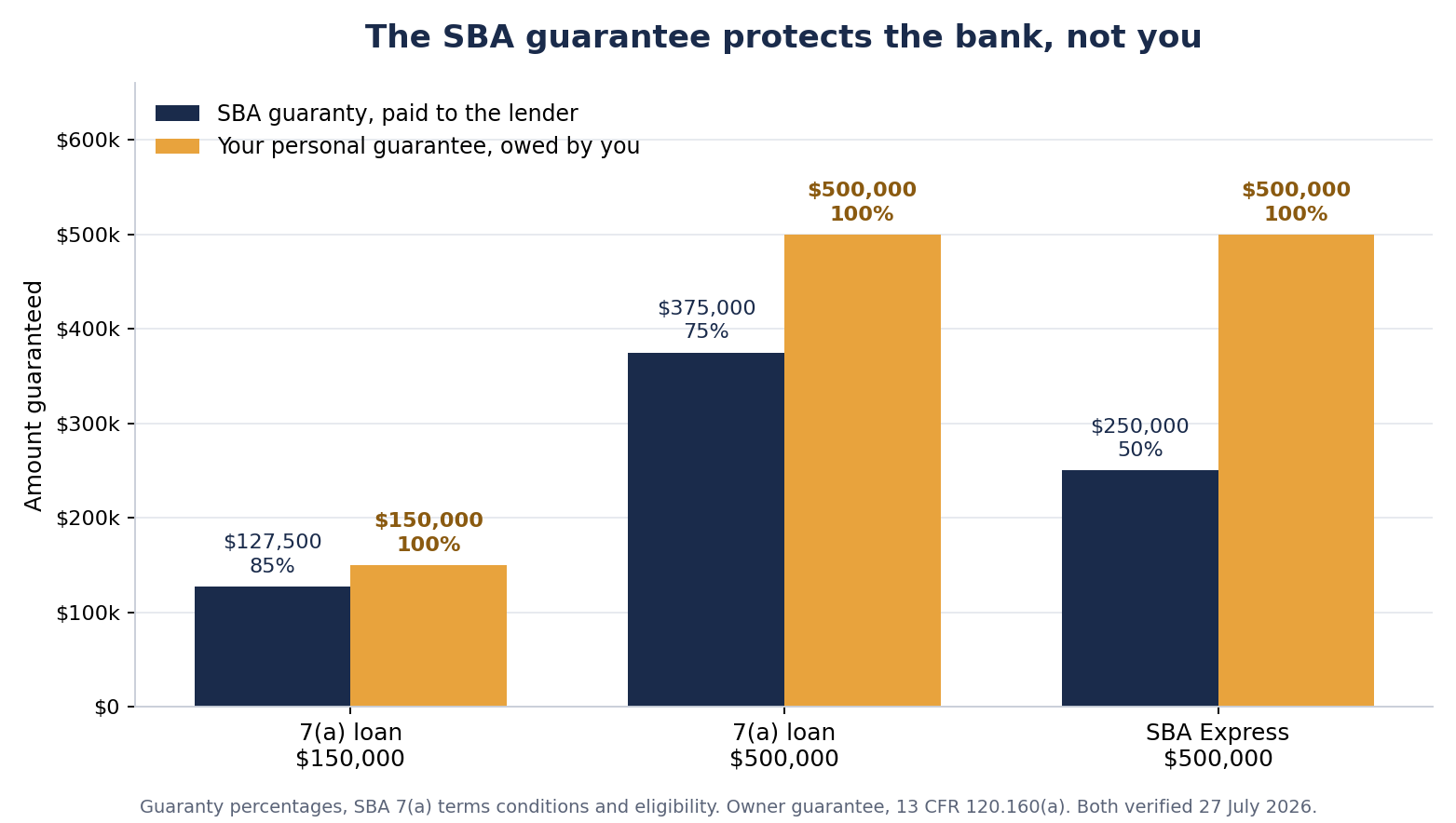
The SBA guarantees a share of the loan to the bank. On a 7(a) loan of $150,000 or less that share runs up to 85 percent. Above $150,000 it is up to 75 percent. On SBA Express it is 50 percent. Your guarantee is always 100 percent.
Run the numbers on a $500,000 SBA Express loan. The bank is covered for $250,000. You are on the hook for $500,000. “SBA backed” describes the bank's protection. It never described yours.
One more SBA number matters here. The 7(a) maximum is $5 million, and $500,000 under SBA Express. The bigger the loan, the bigger the promise you personally sign.
Business credit cards and equipment finance
Most small business credit cards require a personal guarantee. That is why the application wants your Social Security number. It is why the issuer pulls your personal credit file before approving a card for a company. The card belongs to the LLC. The debt follows you.
Corporate cards are the exception. Issuers like Ramp and Brex underwrite the business bank balance instead of the founder, so they take no guarantee. The trade is real. They want deposits or revenue that a one month old LLC does not have yet. Our guide to business credit cards with no personal guarantee tracks who takes what.
Equipment finance sits in the middle. The lender already holds the equipment as collateral. A guarantee there is extra protection, not the only protection. So ask for it to be capped at 100 percent of the equipment value and no further. That ask is often granted, because the lender gives up very little by agreeing.
What a guarantee does to your personal credit
Signing a guarantee does not put it on your credit report. Missed payments can. Once a lender reports the debt under your name, or wins a judgment, it lands on your file like any other default.
Business credit cards are the usual route. Most issuers report to the personal bureaus only when an account goes badly wrong. The threshold differs by issuer, so read the card agreement rather than assume. A judgment is worse than a late payment. It is public record, and it hands the creditor enforcement tools that vary by state.
The practical read is short. Keep the business debt current and the guarantee stays invisible. Fall far enough behind and it stops being the LLC's problem. A $20,000 card balance the company cannot clear becomes a $20,000 debt with your name on it.
Your spouse, and the nine community property states
A spouse who did not sign is usually not liable. Usually is doing real work in that sentence.
Nine states run community property rules. In them, most property acquired during a marriage belongs to both spouses. Those nine states are Arizona, California, Idaho, Louisiana, Nevada, New Mexico, Texas, Washington, and Wisconsin, per IRS Publication 555. Registered domestic partners in Nevada, Washington, and California generally follow the same rules.
In practice that means a creditor holding a judgment against you may reach shared assets. Including ones your spouse earned. Which assets are reachable differs by state, and the exceptions are real. Ask a lawyer in your state rather than working from a rule of thumb.
Lenders often ask a spouse to sign anyway. That request is not automatic. Ask why before anyone signs.
How to negotiate it down, five asks that work
Ask before you sign. Afterwards your leverage is close to zero. The lender already has what it wanted, and has no reason to give it back.
1
Ask for a cap
Name a figure, or a number of months rent. A cap is the easiest concession to win, because the lender still walks away with something.
2
Ask for a burn off
Tie it to a countable trigger, like 24 on time payments or two years of positive net income. Never accept a trigger the other side judges.
3
Ask for several instead of joint and several
With two or more owners, split liability by ownership share. Your partner's exit stops being your bill.
4
Ask to carve out an asset
Retirement accounts and a primary home are the usual carve outs. Some are already protected by state law. Check first, so you do not spend leverage on protection you already have.
5
Ask for a good guy clause on any lease
It is the highest value ask here. Landlords say yes more often than founders expect.
One move sits outside that list. Offer collateral instead. A lender holding equipment or a cash deposit will sometimes drop the guarantee, because it already has a way to get paid.
Four ways to avoid signing one
Some of these take time. That is the point. A guarantee is what a lender takes when it has nothing else, so give it something else.
- Build a business credit file. Open trade accounts with suppliers that report, pay them early, and keep the balance on any business card low. This is the slow route. It is also the only one that compounds. A file with 24 months of clean history changes what a lender will accept.
- Offer collateral instead. Equipment, receivables, or a cash deposit all do the job a guarantee does. Secured borrowing often prices better too. The lender's downside is already covered.
- Use a card that underwrites the business. Corporate card issuers look at the bank balance and the revenue, not the founder, so they take no guarantee. There is a catch. They want deposits or revenue you may not have in month one.
- Take less money. Many lenders drop the guarantee under a threshold, often on small lines rather than term loans. Size the ask to that. A smaller unguaranteed facility can beat a large guaranteed one, depending on what the money is for.
What happens when the business cannot pay
The sequence is predictable. The lender demands payment from the LLC. That fails. A demand letter arrives addressed to you as guarantor. Then comes a lawsuit for the balance plus interest and legal costs. On that $144,000 lease guarantee, the number the court hears is larger than $144,000.
A judgment is the turning point. With one in hand, a creditor can try to garnish wages, levy bank accounts, or put a lien on property. What is available depends on your state. Closing the LLC stops none of it. Dissolving the company ends the company. Your separate promise survives it.
Watch Out
Understand this before you sign, not after. The guarantee is not a formality that gets waived when things go wrong. It is the reason the lender said yes in the first place.
How to get out of one you already signed
There are four real routes. None of them is fast.
Pay the debt to zero, which releases most guarantees by their own terms. Refinance with a lender that requires none, which usually needs two years of trading history. Negotiate a release, which works best when you sell the business and the buyer assumes the debt. Or settle. The creditor takes a lump sum and closes the file.
Before any of that, read your guarantee for an exit already in it. A forgotten burn off. A termination clause. A notice provision. Founders miss these constantly, because nobody rereads a document they signed under pressure 3 years ago. Bankruptcy can discharge a personal guarantee too, but that reaches far past this one debt and needs a lawyer.
When signing is the right call
Refusing every guarantee is not a strategy. It is a way to not get funded. A guarantee is a price. Sometimes it is a fair one.
Pros
- The amount is one you could survive losing
- The debt buys something that earns, like equipment or inventory
- You won a cap, a burn off, or a good guy clause
- The alternative costs far more, and a merchant cash advance at triple digit rates makes a $50,000 guaranteed loan look reasonable
Cons
- ✕The guarantee is unlimited and continuing, on a debt the business cannot repay
- ✕Nobody will name the release trigger in writing
- ✕The lender wants a guarantee, full collateral, and a rate that prices in neither
- ✕You are guaranteeing a partner's decisions under joint and several liability with no say in them
Next step
Compare the business credit cards that take no personal guarantee
Frequently Asked Questions
It is a written promise that you will pay an LLC debt yourself if the company cannot. Your LLC still protects you elsewhere. The guarantee is an exception you sign for one specific debt, most often a lease, a business credit card, or a loan. On SBA loans it is required from any owner of 20 percent or more. It does not weaken the LLC for anything else.
Your personal assets back the debt. If the LLC defaults the lender can demand payment from you, sue, and enforce a judgment against wages, bank accounts, or property, with the details set by your state. Closing the LLC does not cancel it. On an unlimited guarantee you also cover interest, late fees, and legal costs, so the final figure runs past the original balance.
A guarantee is any promise to cover somebody else's debt, and the guarantor can be a person or a company. A personal guarantee is the version where a named individual signs, so their own assets stand behind the debt. In small business lending the two terms get used as if they mean the same thing. Guaranty is just the alternate spelling.
Sometimes, though rarely fast. The clean routes are paying the debt off, refinancing with a lender that requires none, or negotiating a release when you sell the business. Some guarantees already carry a burn off or a termination clause the owner forgot, so read yours first. A creditor may settle for a lump sum. Bankruptcy can discharge one and needs legal advice.
Signing one usually does not show up on your credit report. Missing payments can. Once a lender reports the debt in your name, or wins a judgment, it hits your file like any other default. Business credit cards are the common route, and reporting thresholds differ by issuer, so read the card agreement instead of assuming yours stays quiet.
Not automatically, and a spouse who does not sign is usually not liable. The exception is the nine community property states, Arizona, California, Idaho, Louisiana, Nevada, New Mexico, Texas, Washington, and Wisconsin, where shared marital assets can be exposed to a judgment against you. The rules vary. Ask a lawyer in your state first.
This content is for informational purposes only and does not constitute legal or financial advice. Guarantee terms, creditor remedies, and community property rules vary by state and by contract. Consult a qualified attorney before signing or attempting to exit a personal guarantee.
Sources & References
About the Author
Editor, StartupOwl
Eliot leads StartupOwl's state data research. He maintains the site's fifty state records of LLC filing fees, annual costs, processing times, and small business grant programs, checking each figure against the state office that publishes it and logging the date it was verified. Based in New Jersey, he has spent his working life in and around small businesses, and he writes for the founder who wants the real number rather than the advertised one. Every figure under his byline traces to a named source, and when a state proves a number wrong, the correction is published, not buried.
Was this article helpful?
Questions about this guide
No comments yet. Ask the first question and a member of our team will answer.
Leave a comment