
Your lease sets an estimate. You pay one twelfth of it each month next to base rent. After the year closes, the landlord adds up the real cost of running the building and works out your slice.
Explainer Guide·Updated August 7, 2026
CAM Reconciliation, How to Check the Bill Before You Pay It
A tenant side guide to reading the annual CAM reconciliation statement, checking the pro rata share, the management fee cap, capital costs and the CPI escalation clause, and objecting inside the lease window.
9 min read

Written byEliot Reynolds
Editor, StartupOwl
Key Takeaways
- The true up is the gap between the estimate you paid all year and your share of what the building actually cost. Most leases give you 30 to 90 days to object once it lands.
- Check your pro rata share first. A 60,000 foot building restated at 55,000 moves a 3,000 foot tenant from 5 percent to 5.45 percent, or $1,818 on $400,000 of spend.
- Five CPI series in one BLS table gave answers from 2.6 to 3.5 percent for the year to June 2026. On a $6,000 rent that is a $648 spread in year one, and it compounds.
- BLS says seasonally adjusted CPI is inappropriate for escalation, because those figures can be revised for up to 5 years after release.
- Only 3 metro CPI areas publish monthly. A clause naming a month for one of the other 20 can name a month BLS never published.
- The lease objection window and the state limitations period are two clocks. New York allows six years on a contract, Florida five on a written instrument, but missing the lease window can waive the challenge anyway.
- Do not withhold payment to force the argument. In most leases non payment is a default, which is a worse position than a disputed invoice.
Quick Answer
The true up bill is the gap between the CAM estimate you paid all year and your share of what the building really cost. Before you pay it, check four things. Your pro rata share, because it multiplies every other line. The management fee against its cap. Any capital item billed as one year maintenance. And the CPI series behind your escalation, where five series in one BLS table gave answers from 2.6 to 3.5 percent for the year to June 2026. Most leases give you 30 to 90 days to object in writing, and that clock starts when the statement is delivered.
A statement lands in the first quarter with a number you did not budget for, and most leases give you 30 to 90 days to object. That number is the true up. All year you paid an estimate for common area maintenance. Your landlord has now totalled the real spend and billed you the gap. Sometimes the gap is honest. Sometimes it holds a management fee above your lease cap, a new roof billed as upkeep, or a share of a building you do not occupy. The clock starts when the statement lands. Not when you read it.
What the true up does to your cash
Pay less than your slice and you owe the gap. Pay more and you get a credit. A credit is not a refund, and most leases say so plainly.
The whole dispute lives in one fraction. Your slice. Get that wrong and every line on the statement is billed at the wrong rate, including the honest ones. A tenant carrying 5 percent of $400,000 in spend owes $20,000, so a small error in the fraction is real money.
Check your pro rata share before anything else
Your share is your square footage over the building's. Both numbers sit in the lease.
Landlords bill on rentable square feet, not on the floor you fill with desks. Rentable folds in a slice of lobbies, corridors and plant rooms. So your lease figure already exceeds the space you use. That part is normal.
The denominator moving is not. If the building added rentable space, your fraction should fall. If your own figure changed since last year, nobody told you.
Run the arithmetic. A tenant at 3,000 rentable feet in a 60,000 foot building carries 5 percent. On $400,000 of spend that is $20,000. Shrink the building to 55,000 feet and the same tenant carries 5.45 percent, or $21,818. Nothing about the tenant changed. The bill moved $1,818.
The four errors that repeat
Tenants report the same handful of problems. Check these first.
- The management fee over its cap. Most leases cap it as a percentage of operating expenses, often 3 to 5 percent. Divide the billed fee by the expense total. The two should agree.
- A capital item billed as maintenance. A resurfaced lot and a new lot differ. Most leases exclude capital costs or make the landlord spread them over their useful life. A single year charge for a roof is the classic overcharge.
- The wrong pro rata share. Covered above. Check it first, because it multiplies everything else.
- The escalation taken off the wrong index. This one is quiet. It repeats every year and almost nobody checks it.
Two more deserve a look. Costs for space you cannot use, and charges the lease excludes outright, like leasing commissions or the landlord's own legal fees.
The CPI clause is where the quiet money sits
Does your rent escalate by an inflation index? Then your lease names that index in a sentence most tenants skim. The Bureau of Labor Statistics publishes guidance on writing those sentences. It is useful to a tenant. Read it.
BLS wants four things named. The population coverage, the area coverage, the series title and the index base period. Plenty of leases say "the CPI" and stop.
Here is the cost of stopping there. In one table released on 14 July 2026, BLS published these unadjusted twelve month changes for the year to June 2026.
| CPI-U series, U.S. city average | 12 month change | Added rent in year one |
|---|---|---|
| All items | 3.5% | $2,520 |
| Shelter | 3.3% | $2,376 |
| Services less energy services | 3.2% | $2,304 |
| Rent of primary residence | 2.8% | $2,016 |
| All items less food and energy | 2.6% | $1,872 |
Same year. Same agency. One table. Five answers.
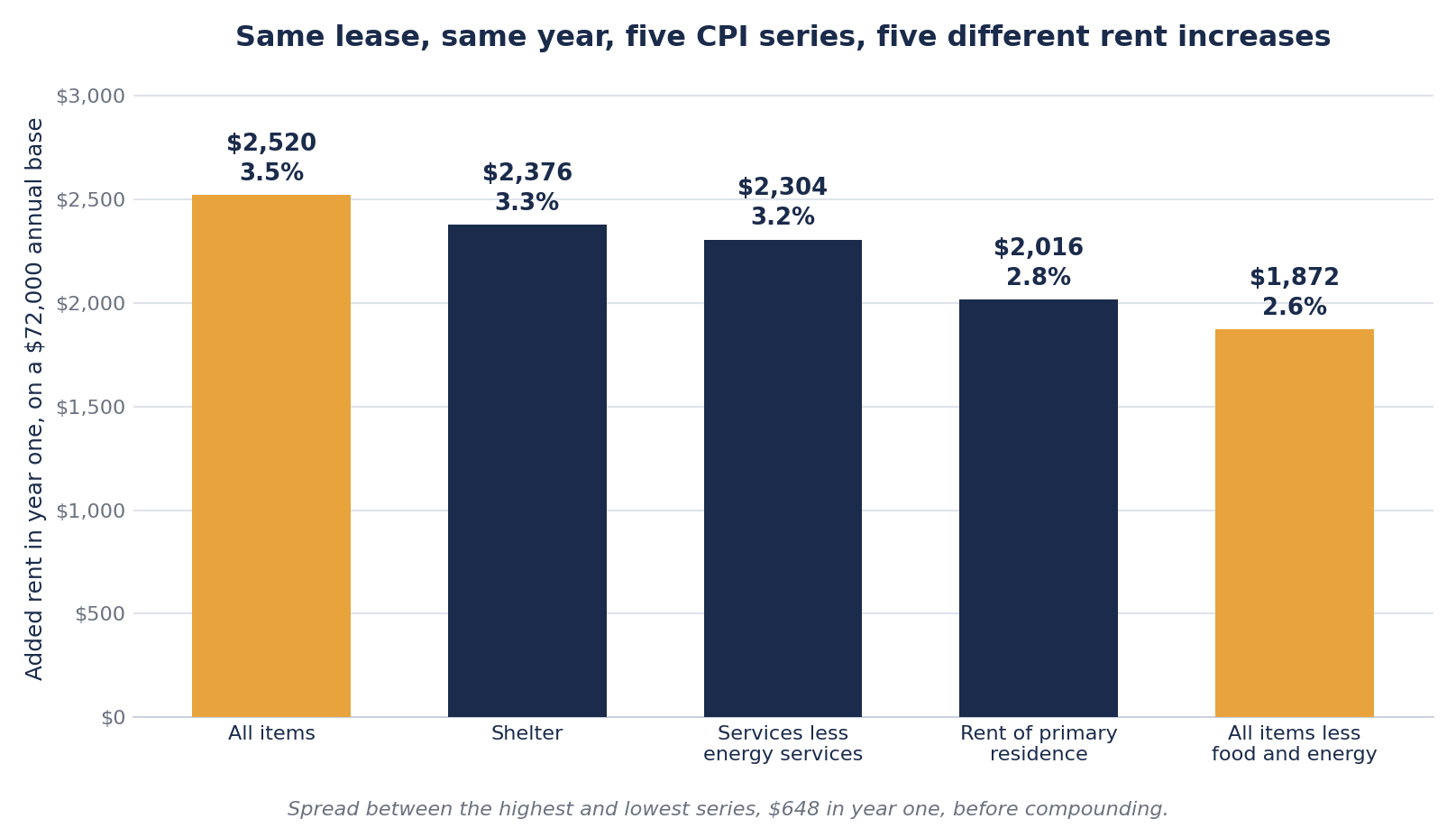
Take a $6,000 monthly base rent. The spread between the top and bottom series is $648 in year one. Then it compounds, because next year builds on the raised rent.
Three more things BLS says out loud
Seasonally adjusted data does not belong in a lease. BLS calls its use in escalation agreements inappropriate. The factors are updated yearly and adjusted figures can be revised for up to 5 years after release. So the number can move after you pay. Check which one your lease names.
BLS recommends the U.S. City Average, not your metro. Metro indexes run on smaller samples and swing harder. Someone chose that.
Most metro indexes skip months. Only 3 publish monthly. Those are Chicago, Los Angeles and New York. The other 20 published metro areas come out every other month. A clause pointing at February for your metro can point at a month that was never published. Check the calendar.
Timing matters too. A month's index arrives about two weeks later, so May lands in mid June. A rent rise due 1 January cannot use the December index. In early January it does not exist yet.
You are watching two clocks
Your lease gives you a window to object. Read it and diary it. Thirty days goes fast when the statement arrives with a backup file to reconcile.
A second clock runs longer. It is the state limitations period. New York allows six years to sue on a contract under CPLR section 213. Florida allows five on a written instrument under section 95.11(2)(b).
Neither clock replaces the other. Miss the lease window and you can waive your right to challenge that statement while the state clock still runs. Treat the short one as the deadline.
Watch Out
This is not legal advice and the rules move by state. Limitations periods differ, and a lease can shorten your window by contract. The two states named here were checked at their own legislatures on 7 August 2026. If the disputed amount matters to your business, put a commercial lease attorney in your state on it before the lease window closes.
What to put in the letter
Object in writing, inside the window. Send it the way the notice clause tells you to, because email alone often fails that test.
Keep it short. Name the statement by date, say you dispute it, and reserve every right the lease gives you, including the audit right. Then list 4 questions as line items. The pro rata share and the numbers behind it. The management fee against its cap. Any charge you read as capital. The index and reference month behind the escalation.
Ask for the ledger detail under each category you question. A summary is not backup.
Avoid one move. Do not withhold payment unless the lease clearly lets you. In many leases non payment is a default, and a default is a worse place to stand than a disputed invoice. If you signed a personal guarantee, that default reaches past the business.
When the audit right is worth using
Many commercial leases give the tenant a right to audit the landlord's books. Conditions come with it. A deadline, a rule that you be current on rent, and often a threshold that decides who pays for the audit.
That threshold is the number that matters. Your lease may say the landlord covers the cost once the error passes 3 or 5 percent. Work out what that is in dollars for your suite first.
Say you pay $20,000 a year in CAM. A 5 percent threshold is $1,000. Suspect a $6,000 problem and the audit pays for itself. Suspect $400 and the letter is the right tool.
The habit that saves the most
Read the reconciliation the year it arrives. Every year. An error in a pro rata share or an index reference does not fix itself. It repeats on all 5 or 10 statements of your term until somebody asks.
Weighing whether to stay in the space at all? The four exits from a commercial lease and what each one costs are covered separately.
Read next
The four ways out of a commercial lease, and what each one costs you
Frequently Asked Questions
It is the annual settling up on common area maintenance. You pay a monthly estimate all year alongside base rent. After the year closes the landlord totals what the building actually cost to run, applies your pro rata share, and compares that to what you paid. You owe the shortfall or receive a credit. The statement showing that comparison is the reconciliation.
Your lease sets the window and 30 to 90 days is common. It usually starts when the statement is delivered, not when you open it, so check the notice clause for how delivery is defined. The state limitations period for a contract claim is separate and much longer, six years in New York and five in Florida on a written instrument, but missing the lease window can waive your contractual right anyway.
Divide your rentable square footage by the building's total rentable square footage. Both figures come from the lease. Rentable is larger than the space you occupy because it includes an allocation of lobbies, corridors and plant rooms, so that gap alone is not an error. What is worth questioning is a denominator that changed since last year, or your own figure changing without notice.
It depends entirely on your lease, which is why the exclusions list is the clause to read. Leases commonly exclude capital improvements, or require the landlord to amortise them over their useful life rather than bill them in one year. Leasing commissions, the landlord's own legal fees on disputes, and costs tied to space you cannot use are also common exclusions.
BLS recommends the U.S. City Average, because metro indexes run on smaller samples and swing harder. BLS also says seasonally adjusted data is inappropriate for escalation, since those figures can be revised for up to 5 years. Your clause should name four things, the population coverage, the area coverage, the series title and the index base period.
Work out the threshold first. Many leases make the landlord pay for the audit only when the error exceeds 3 or 5 percent. On $20,000 of annual CAM a 5 percent threshold is $1,000. If you suspect a $6,000 problem the audit pays for itself. If you suspect $400, a written objection asking for the ledger detail is the proportionate tool.
This page explains how commercial lease billing works. It is not legal or accounting advice, and lease terms and state limitations periods vary. Check your own lease and speak to a commercial lease attorney before disputing a charge.
Sources & References
- BLS, How to Use the Consumer Price Index for Escalation
- BLS, CPI news release Table 1, CPI-U U.S. city average, June 2026
- New York CPLR section 213, actions to be commenced within six years
- Florida Statutes section 95.11, limitations other than for the recovery of real property
- BLS, CPI Regional Resources, published metro area index series
About the Author
Editor, StartupOwl
Eliot leads StartupOwl's state data research. He maintains the site's fifty state records of LLC filing fees, annual costs, processing times, and small business grant programs, checking each figure against the state office that publishes it and logging the date it was verified. Based in New Jersey, he has spent his working life in and around small businesses, and he writes for the founder who wants the real number rather than the advertised one. Every figure under his byline traces to a named source, and when a state proves a number wrong, the correction is published, not buried.
Was this article helpful?
Questions about this guide
No comments yet. Ask the first question and a member of our team will answer.
Leave a comment