
Employee Offboarding Checklist
A working offboarding sequence for an employer with no HR department, and the four federal record and benefit clocks that keep running after the last day.

In This Article
Offboarding runs in three parts. Before the last day you confirm the departure in writing and get the handover done. On the last day you collect property, close accounts and run the final pay. After the last day four federal clocks keep running, payroll records for 3 years, the Form I-9 for 1 to 3 years, COBRA if you have 20 or more employees, and final pay timing that federal law leaves to your state.
7
Total Steps
1 week before the last day, then 1 afternoon
Timeline
Medium
Difficulty
The paperwork outlives the job. Someone hands back a laptop, you shake hands, and a Form I-9 in your drawer still has up to 3 years to run. Every checklist currently ranking for this search was written for a company with an HR department, an IT department and a payroll team. This one is written for the person who is all three.
What follows is administrative. It covers what happens, in what order, and which records you keep. It does not cover whether a particular departure was lawful. If the person leaving has raised a complaint, mentioned a lawyer, or is going in a way you expect to be argued about, stop reading checklists and call an employment lawyer before you act.
Before the last day
You did the paperwork on the way in, and hiring your first employee covers that half. This is the other one. Two things happen while they are still working. Get the departure in writing. Then get the handover out of their head.
Written confirmation is the smaller job. It is also the one people skip. If they resigned, keep the message, even if it arrived as a text. If you ended it, put the last day in a short written note. You are not building a case here, you are making sure that in 6 months the date on the payroll record and the date everyone remembers are the same number.
The handover is the expensive one. In a business of 5 people, one person is usually the only one who knows something. The supplier who takes orders by phone, the spreadsheet that runs the rota, the domain renewal sitting in their personal email. Ask for a written list of everything in flight and who it should go to, then sit down and walk through it with them, because the list somebody writes alone is always shorter than the list they talk through.
Start the account list now too. Write down every service their work email can log into, the ones you pay for, the ones you do not, and the ones you did not know about. This is what you work through on the last day. Building it a week early turns a frantic afternoon into 20 minutes.
The last day itself
The last day is a list. Work it in this order, because each step makes the next one safer.
Property first. Do it while they are still in front of you. Laptop, phone, keys, badge, card, and anything carrying the company name. Write down what came back and what did not. A missing laptop noticed on the day is a conversation, and the same laptop noticed 3 weeks later is a problem.
Access second. Change the password on every account from your list, not only the ones you think matter. Shared logins are what catch people out, the accountant's portal, the courier account, the password taped inside a drawer. If a login is shared and you do not change it, you have not revoked anything. You have removed one copy of a key that still opens the door.
Then their own accounts. Email, file storage, chat, and any tool they signed into with the work address. Move ownership of shared documents and recurring calendar invites before you disable the login, because on most services the files go dark the moment the account does.
Final pay last. Employers are not required by federal law to hand over the final paycheck immediately, per the Department of Labor, and the same page says some states do require immediate payment. So the deadline that binds you is your state's. Check your own state labor department before you set the date. And if you run payroll software, enter the termination date rather than deleting the employee, because deleting the record is how a final run gets missed.
Step-by-Step Process
- 1
Get the departure in writing
Keep the resignation message if they resigned, in whatever form it arrived. If you ended the employment, send a short note stating the last day and keep a copy. One date, written down, agreed. Every later step reads from it, the final payroll run, the records clocks, and the unemployment response.
10 minutes Your own records - 2
Take the handover out of their head
Ask for a written list of everything in flight and who each item should go to. Then talk it through. The spoken version is always longer than the written one, and suppliers who deal with one person by phone, files stored locally, and anything renewing on a personal email address are the items that go missing.
1 to 3 hoursTips
- Ask what they would worry about if they were you.
- Check for renewals and subscriptions in their name.
- 3
Build the account list before you need it
Write down every service the work email can log into, paid and unpaid, plus shared logins nobody thinks of as accounts. This is the last day's script. Building it a week early is the difference between a frantic afternoon and 20 minutes.
30 minutesCommon Mistakes
- Listing only the tools you pay for.
- Forgetting logins shared across the whole team.
- 4
Collect company property on the last day
Laptop, phone, keys, badge, cards, and anything carrying the company name. Do it while they are in front of you. Write the list as you go. A missing item noticed on the day is a conversation, and the same item noticed 3 weeks later is a problem.
15 minutesCommon Mistakes
- Agreeing to post the laptop back later.
- Keeping no record of what was returned.
- 5
Close access, shared logins first
Change the password on every account from your list. Shared logins matter most. Removing one person's copy of a shared password revokes nothing at all. Then move ownership of shared documents and recurring calendar invites, and only after that disable their own accounts, since on most services the files go dark with the login.
20 to 60 minutesTips
- Move file ownership before you disable anything.
- Reassign recurring meetings they organised.
- 6
Run the final pay to your state's deadline
Federal law does not require immediate payment of a final paycheck, and some states do, per the Department of Labor. Look up your state first. The deadline often differs depending on whether the person resigned or was let go. In payroll software, enter the termination date rather than deleting the employee.
Set by your state dol.govCommon Mistakes
- Quoting a pay date from memory.
- Deleting the employee record from payroll.
- 7
File the records and note the dates they expire
Payroll records run at least 3 years from the last date of entry under 29 CFR 516.5. The Form I-9 runs 3 years from hire or 1 year from the last day, whichever falls later, so write the expiry date on the folder rather than working it out again in two years. Sort them by hire date.
20 minutes ecfr.gov
The four clocks that start on the last day
Everything above ends when they walk out. These four do not. Not one of the pages currently ranking for this checklist puts a date on any of them.
Final pay, and your state sets the deadline
Federal law sets no deadline here. The Department of Labor states plainly that employers are not required by federal law to give former employees their final paycheck immediately, and that some states may require immediate payment. That makes this the first thing to look up and not the last. The rules commonly differ depending on whether the person resigned or you ended it, so read the entry for both.
COBRA, which starts at 20 employees
COBRA generally applies to group health plans sponsored by employers with 20 or more employees in the prior year, per the Department of Labor. Under 20 and the federal rule does not reach you. That matters in both directions. A business of 4 people is not required to offer COBRA and should not tell a leaver that it is. Many states run their own continuation rules for smaller employers, which are state law rather than federal, so ask your insurance broker instead of assuming. Where COBRA does apply, the person may be required to pay the entire premium, up to 102 percent of what the plan costs.
Payroll records, 3 years from the last entry
Payroll records must be preserved for at least 3 years under 29 CFR 516.5. The start date is the trap. The clock runs from the last date of entry rather than from the hire date, so a leaver's records begin their 3 years on the final payroll run. The same section puts your sales and purchase records on the same 3 year rule.
The Form I-9, and it is not the rule most people assume
Under 8 CFR 274a.2(b)(2)(i)(A) an employer must keep the Form I-9 for 3 years after the date of hire or 1 year after the date employment is terminated, whichever is later. Read that twice. The practical result runs backwards from the instinct. Someone who worked for you 6 years and left today generates a 1 year obligation. Someone who worked 6 months and left the same day generates a 2.5 year obligation. The shorter the job, the longer you hold the file.
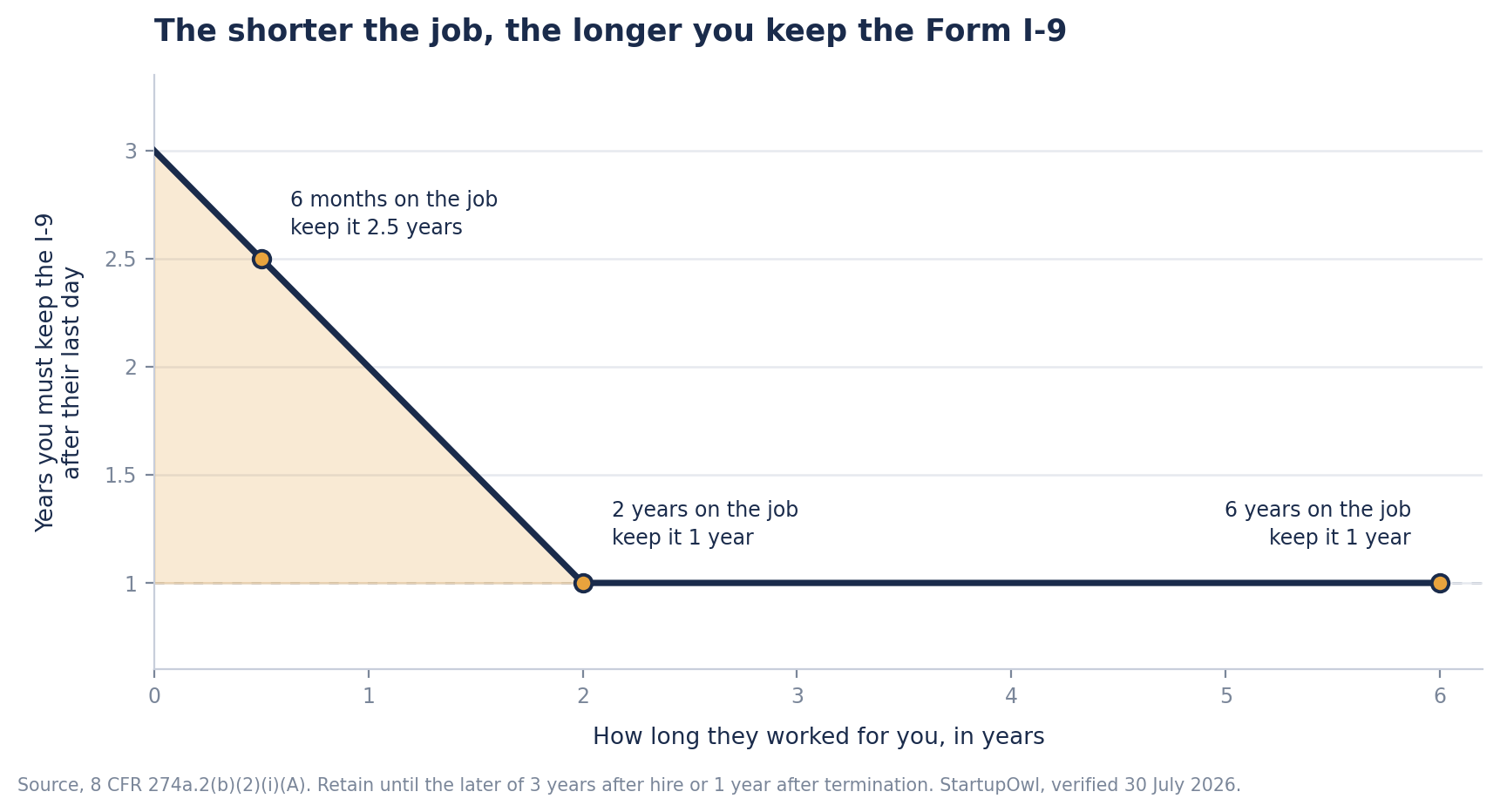
Most HR software stores these files and dates them for you, which is the practical argument for it in a business too small to have an HR person. The filing rule is short. If you keep one folder per person, sort them by hire date and not by leaving date. The files safest to bin are the long servers, and the ones a founder tends to throw out first, the short stints and the seasonal hires, are the ones with years left to run.
The unemployment claim, on somebody else's timetable
Unemployment insurance is run by each state within federal guidelines, per the Department of Labor, so the claim, the notice and any appeal come from your state agency rather than a federal one. The notice arrives when it arrives. It usually asks for the separation date and the reason, which is the moment the written note from before the last day pays for itself, because you are answering from a record rather than from memory. Deadlines to respond are short and your state sets them, so open the envelope the day it lands.
What small employers get wrong
These are the 5 that cost real money or real time, in the order they tend to happen.
Deleting the payroll record instead of dating it. Removing the employee from payroll software feels like the tidy move. It is how the final run gets skipped, and it works against the 3 year retention rule in 29 CFR 516.5 at the same time. Date it, do not delete it. See how to do payroll for the wider run.
Changing one password and calling it access revoked. The work email is the account everyone remembers. The shared ones are the exposure. Nobody keeps a list of those unless somebody sat down and made one.
Disabling the account before moving the files. Shared drives, recurring meetings and anything they created and owned tend to disappear with the login. Move ownership first, disable second, and there is no order in which those two can be swapped safely.
Promising a final pay date you have not checked. Federal law sets none. Your state does, and the date often depends on whether the person quit or was let go, so a number given from memory in the last conversation is a number you may not be able to keep.
Offering COBRA when COBRA does not apply to you. Do not guess this one. Below 20 employees the federal rule does not reach you, and saying otherwise creates an expectation you cannot meet while hiding the question worth asking, which is whether your state runs a continuation rule for employers your size.
Frequently Asked Questions
Seven things, in order. Written confirmation of the last day, a handover of everything in flight, a list of every account the person can reach, company property returned and logged, access closed with shared logins changed first, the final pay run to your state's deadline, and the records filed with their retention dates noted. The first three happen before the last day and the rest happen on it or after.
Your state decides. The Department of Labor says employers are not required by federal law to give former employees their final paycheck immediately, and that some states may require immediate payment. Rules often differ depending on whether the person resigned or you ended the employment, so check both entries for your state before promising a date. Set the date from the state rule, not from your normal pay cycle.
Two clocks run. Payroll records run at least 3 years from the last date of entry under 29 CFR 516.5. The Form I-9 runs 3 years from the date of hire or 1 year from the termination date, whichever is later, under 8 CFR 274a.2(b). That second rule surprises people, because someone who worked 6 months and left generates a 2.5 year obligation while a 6 year employee generates 1 year.
No. COBRA generally applies to group health plans sponsored by employers with 20 or more employees in the prior year, so a business of 5 sits outside the federal rule. Do not tell a departing employee otherwise. Many states run continuation rules of their own covering smaller employers, and those are state law rather than federal, so the useful question for your broker is what your state requires at your headcount.
You do, and the sequence is what replaces the org chart. Published checklists split these tasks between HR, IT, finance and the manager, which is useless when those are one person. Work it as a timeline instead. Two jobs in the week before, four on the day, and a set of dated records afterwards. The order matters more than who owns each line.
This page describes an administrative process. It is not legal advice. Employment law varies by state and by situation. If a departure is contested, or the person leaving has raised a complaint or mentioned a lawyer, speak to an employment lawyer before you act.
Sources & References
About the Author
Editor, StartupOwl
Eliot leads StartupOwl's state data research. He maintains the site's fifty state records of LLC filing fees, annual costs, processing times, and small business grant programs, checking each figure against the state office that publishes it and logging the date it was verified. Based in New Jersey, he has spent his working life in and around small businesses, and he writes for the founder who wants the real number rather than the advertised one. Every figure under his byline traces to a named source, and when a state proves a number wrong, the correction is published, not buried.
Was this article helpful?
Questions about Employee Offboarding Checklist
No comments yet. Ask the first question and a member of our team will answer.
Leave a comment