
Business Setup Timeline for Your First 90 Days
A week-by-week plan to set up your business operations from Day 1 through Day 90, with real costs, specific tools, and actionable deadlines.

In This Article
A typical first-year business setup costs $1,200 to $4,500 and takes about 90 days to complete. The four highest-priority tasks in your first week are getting your EIN (free, instant online), opening a business bank account ($0 at Mercury or Bluevine), buying a domain ($10 to $20/year), and claiming your Google Business Profile (free, 10 minutes).
Setting up a business costs between $500 and $5,000 in your first year, depending on your structure and industry. Most founders waste the first month Googling random tasks when a clear 90-day timeline would get them operational in half the time. This guide maps every setup milestone (banking, accounting, insurance, payroll, website, and legal compliance) into a week-by-week plan with specific costs, provider names, and links.
Formation (LLC filings, articles of organization) lives in our LLC formation guide. This page picks up right after you have your entity and walks you through the operational setup that actually makes your business run.
Your first 90 days of business setup follow a clear sequence. Each phase depends on the one before it: you need an EIN before you can open a bank account, you need a bank account before you can connect accounting software, and you need accounting in place before you run payroll. Skipping ahead creates costly gaps you will pay for at tax time.
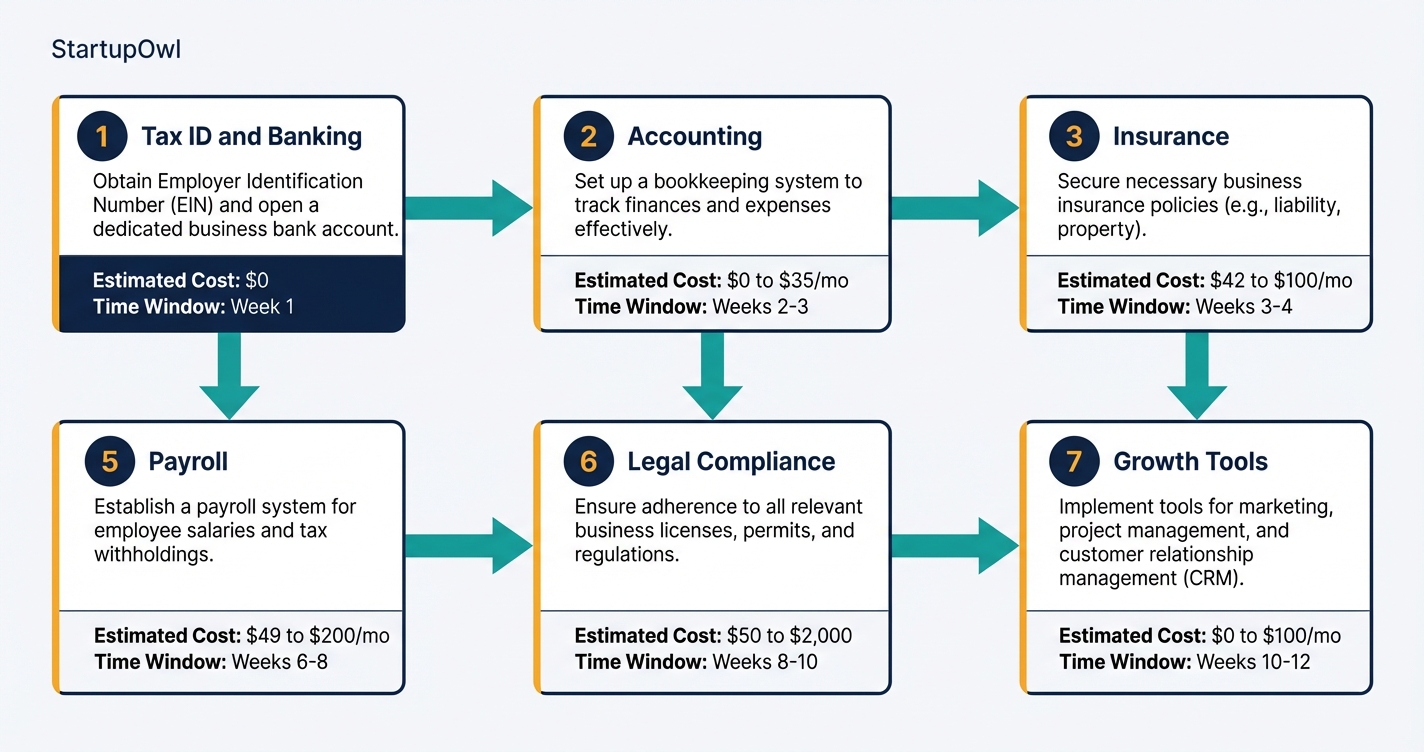
Here is the order that matters most:
- Week 1: EIN, business bank account, domain registration, and Google Business Profile
- Weeks 2 through 3: Accounting software setup and chart of accounts
- Weeks 3 through 4: Business insurance quotes and purchase
- Weeks 4 through 6: Business website launch
- Weeks 6 through 8: Payroll setup (if hiring employees)
- Weeks 8 through 10: Contracts, licenses, and legal compliance
- Weeks 10 through 12: Growth tools (CRM, email marketing, business credit)
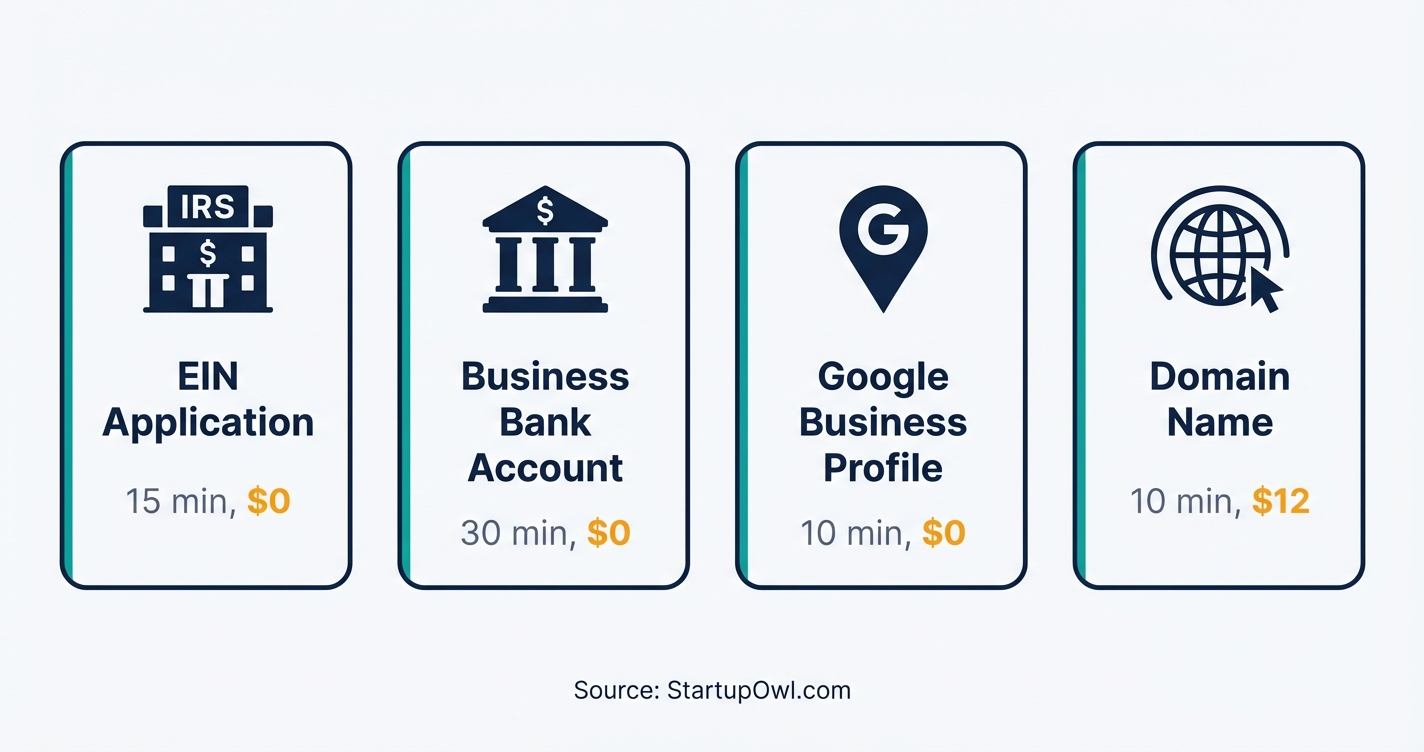
The four quick wins above cost $0 and take under 2 hours combined. If you accomplish nothing else on Day 1, handle those four items and you will be ahead of 80% of new founders.
Add one more free task to Day 1 if you plan to publish a number anywhere. Setting up a separate business line takes minutes and the basic route costs nothing, and it saves reprinting cards and rewriting listings later. Our guide on how to get a business phone number covers the free route and where it runs out.
Phase-by-Phase Breakdown
- 1
Get Your Tax ID and Business Banking in Place
Your EIN and business bank account are prerequisites for everything else. You cannot accept payments, run payroll, or file taxes without them. Apply for your EIN online at IRS.gov for free (takes about 15 minutes) and open a business checking account the same day.
- Apply for a free EIN at IRS.gov (instant approval online)
- Open a $0 business checking account at Mercury, Bluevine, or Relay
- Order a business debit card and set up online banking access
1-3 days $0 - 2
Set Up Your Accounting System
Connect your bank account to accounting software within the first two weeks. If you wait until tax season, you will spend hours reconciling months of missed transactions. QuickBooks Online starts at $35/month, Wave is free, and Xero starts at $25/month.
- Choose and subscribe to accounting software (QuickBooks, Wave, or Xero)
- Connect your business bank account and credit card feeds
- Set up a chart of accounts and configure tax categories
1-2 hours $0 to $35/month - 3
Secure Business Insurance Coverage
General liability insurance costs a median of $45/month (about $538/year) for most small businesses, according to Insureon. If you sign a commercial lease, most landlords require proof of at least $1 million in liability coverage before you get the keys.
- Get 3 or more quotes for general liability insurance
- Bundle general liability with property insurance into a BOP to save 10-20%
- Add professional liability (E&O) if you provide advice or services
3-7 days $42 to $100/month - 4
Build Your Business Website and Online Presence
Register your domain ($10 to $20/year), claim your Google Business Profile (free), and launch a basic website. A simple site on Squarespace or WordPress costs $16 to $33/month. You do not need a $5,000 custom site on Day 1.
- Register a .com domain through Namecheap, Google Domains, or Cloudflare
- Claim and verify your Google Business Profile
- Launch a one-page website with contact info, services, and a call to action
1-2 weeks $200 to $600/year - 5
Set Up Payroll (If You Have Employees)
If you plan to hire W-2 employees, set up payroll before your first hire. Gusto starts at $49/month plus $6 per employee as of 2026. Solo founders paying themselves through an S Corp also need payroll. Register for state employer tax accounts first.
- Register for state unemployment and withholding tax accounts
- Choose a payroll provider (Gusto, OnPay, or QuickBooks Payroll)
- Run a test payroll before your first real pay date
1-2 weeks $49 to $200/month - 6
Handle Legal Compliance and Contracts
Draft your LLC operating agreement, get required business licenses, and set up basic contracts. Legal templates from services like LegalZoom or Rocket Lawyer cost $0 to $40/month, while a business attorney charges $500 to $2,000 for custom contracts.
- File for any required local and state business licenses ($50 to $500)
- Draft or finalize your LLC operating agreement
- Create standard client contracts and terms of service
1-3 weeks $50 to $2,000 - 7
Add Growth and Productivity Tools
By month 3, your foundation is solid. Now add the tools that help you grow: CRM software, email marketing, project management, and a business credit card. These are not Day 1 priorities, but they become essential once revenue starts flowing.
- Set up a free CRM (HubSpot Free or Zoho CRM Free)
- Apply for a business credit card to build business credit
- Choose a project management tool (Notion, Asana, or Trello free tiers)
1-2 weeks $0 to $100/month
Your year-1 operational setup budget (excluding rent, inventory, and employee salaries) typically falls between $1,200 and $4,500 for a service-based business. Product-based businesses and restaurants should budget $3,000 to $10,000+ due to insurance, inventory systems, and equipment. Below is a realistic line-item breakdown.
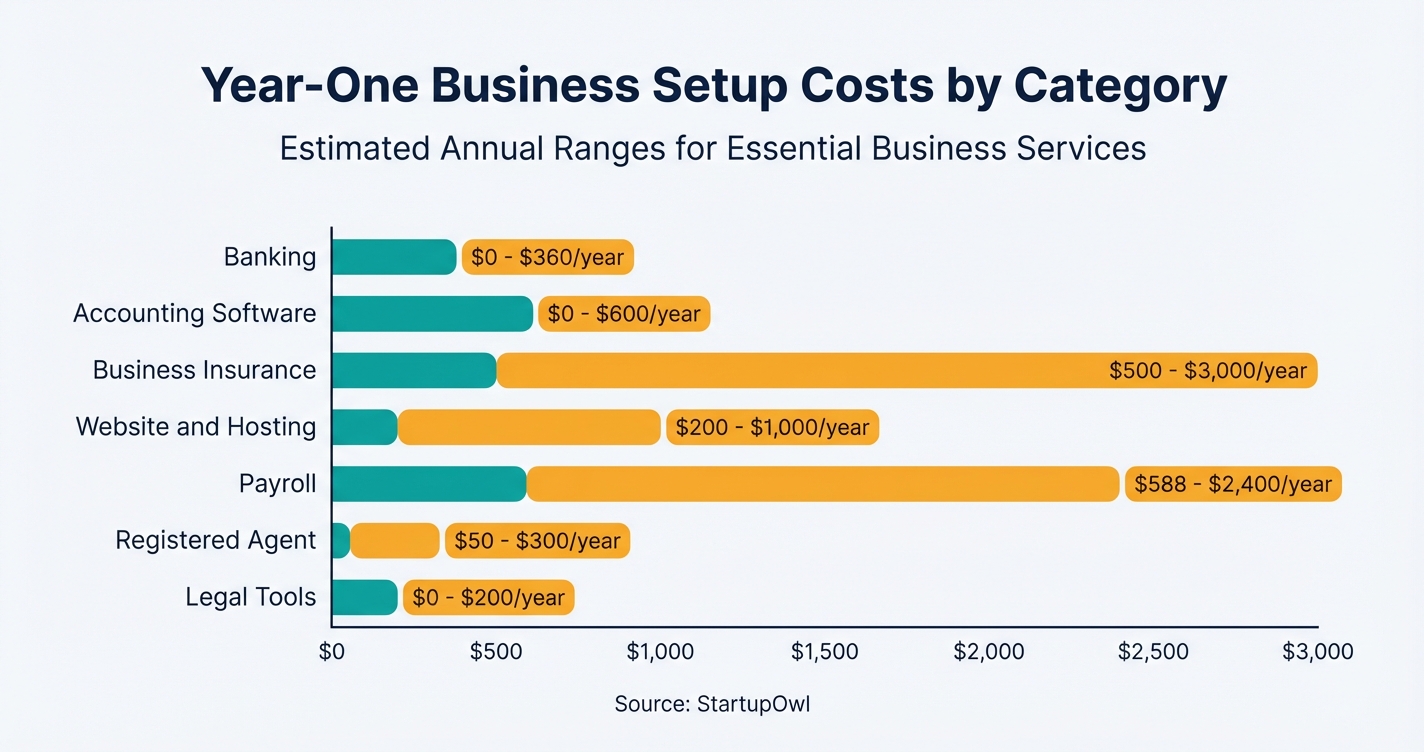
- Business banking: $0 to $30/month. Mercury, Bluevine, and Relay offer free business checking. Traditional banks like Chase and Bank of America charge $12 to $30/month unless you meet a minimum balance. That is $0 to $360/year. See our business bank account fees breakdown.
- Accounting software: $0 to $50/month. Wave is free. QuickBooks Online runs $35 to $99/month for the plans most small businesses need (as of 2026). That is $0 to $600/year. See our best accounting software comparison.
- Business insurance: $500 to $3,000/year. General liability insurance has a median premium of $45/month ($538/year) according to Insureon. A business owner's policy (BOP) bundling liability and property coverage costs about $83/month ($990/year). See our general liability insurance guide.
- Website and hosting: $200 to $1,000/year. Domain registration runs $10 to $20/year. A Squarespace Business plan is about $33/month. WordPress hosting on SiteGround or Bluehost starts around $3 to $12/month.
- Payroll (if applicable): $50 to $200/month. Gusto starts at $49/month plus $6 per employee (as of 2026). That is $588 to $2,400/year for a small team. See our best payroll services guide.
- Registered agent: $50 to $300/year. Required in every state where your LLC is registered. See our best registered agent services comparison.
- Legal tools and templates: $0 to $200/year. Free contract templates are available from many sources. A legal plan with Rocket Lawyer or LegalZoom runs $10 to $40/month if you need ongoing access.
Year-1 total estimate:
- Solo freelancer or consultant (no employees, minimal insurance): $1,200 to $2,000
- Small LLC with 1 to 3 employees: $3,000 to $5,500
- Brick-and-mortar retail or restaurant: $5,000 to $10,000+
The IRS allows you to deduct up to $5,000 in startup costs plus an additional $5,000 in organizational costs in your first year (as of 2026), so keep every receipt from day one. See IRS Publication 535 for details.
Quick Wins to Start Today
Apply for a free EIN online at IRS.gov
Open a free Mercury business bank account
Claim your Google Business Profile
Register your business domain name
Set up a free Wave accounting account
The Complete Checklist
- Apply for your EIN at IRS.gov01
Use the free IRS online application to get your Employer Identification Number instantly.
15 minutes$0 - Open a business bank account02
Open a free business checking account at Mercury, Bluevine, Relay, or your preferred bank.
1-3 days$0 to $30/month - Register your business domain name03
Purchase a .com domain through Namecheap, Cloudflare Registrar, or Google Domains.
10 minutes$10 to $20/year - Claim your Google Business Profile04
Create and verify your free Google Business Profile at business.google.com for local search visibility.
10-15 minutes (verification may take 5-14 days)$0 - Set up accounting software05
Connect QuickBooks Online, Wave, or Xero to your bank account and configure your chart of accounts.
1-2 hours$0 to $35/month - Get general liability insurance quotes06
Request at least 3 quotes from insurers like CoverWallet, NEXT Insurance, and Hiscox.
3-7 days$42 to $100/month - Purchase your business insurance policy07
Buy a general liability policy or business owner's policy (BOP) and save your certificate of insurance.
1 day after quotes$500 to $3,000/year - Apply for required business licenses and permits08
Check your city and county clerk's office for any required local business licenses or permits.
1-3 weeks$50 to $500 - Launch your business website09
Build and publish at least a one-page site with your contact info, services, and a call to action.
1-2 weeks$200 to $600/year - Hire a registered agent (if not already done)10
Confirm you have a registered agent in every state where your LLC is registered.
1 day$50 to $300/year - Register for state employer tax accounts (if hiring)11
Register with your state's department of revenue and unemployment agency before your first payroll.
1-2 weeks$0 - Set up payroll (if hiring employees)12
Subscribe to Gusto, OnPay, or QuickBooks Payroll and run a test payroll before your first real pay date.
1-2 weeks$49 to $200/month - Finalize your LLC operating agreement13
Draft or finalize your operating agreement even if you are a single-member LLC. Banks and investors may request it.
1-3 days$0 to $500 - Create standard client contracts and terms of service14
Use legal templates or hire an attorney to draft your service agreement, payment terms, and scope of work.
1-2 weeks$0 to $2,000 - Set up a CRM and email marketing tool15
Install a free CRM (HubSpot Free or Zoho CRM) and an email platform (Mailchimp Free or ConvertKit) to capture leads from day one.
1-2 hours$0 to $50/month
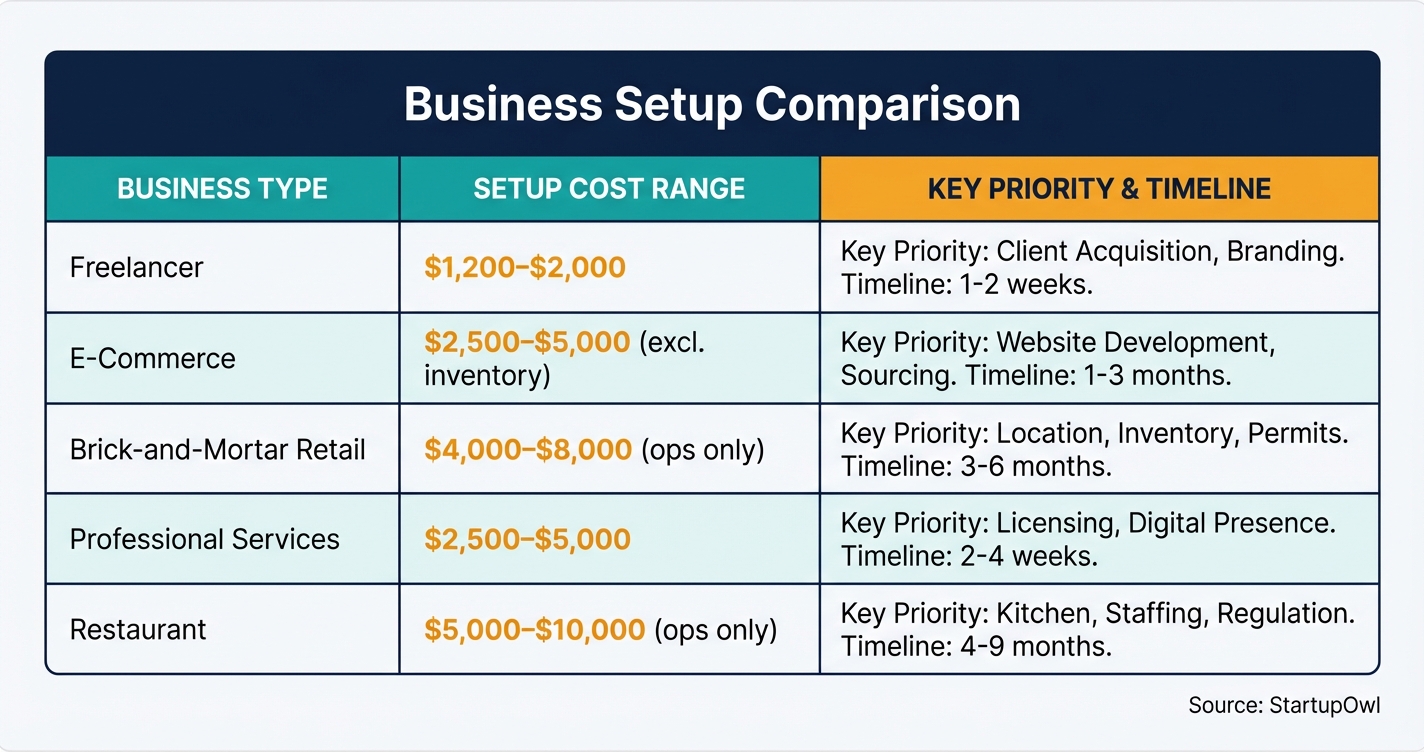
Your 90-day setup checklist changes based on your business type. Here is how the timeline and cost shift for five common models.
Freelancer or Consultant
- Priority setup: EIN, bank account, accounting software, professional liability (E&O) insurance, and a simple portfolio website.
- You can skip payroll if you are a single-member LLC taxed as a sole proprietor. If you elect S Corp taxation, you need payroll to pay yourself a reasonable salary.
- Estimated year-1 setup cost: $1,200 to $2,000.
E-Commerce Business
- Priority setup: EIN, bank account, Shopify or WooCommerce store, sales tax registration in nexus states, product liability insurance, and a shipping workflow.
- Budget an extra $2,000 to $20,000+ for initial inventory depending on your product.
- Estimated year-1 setup cost (excluding inventory): $2,500 to $5,000.
Brick-and-Mortar Retail
- Priority setup: Everything above, plus commercial lease, BOP insurance, POS system, local business license, signage permits, and workers' compensation insurance.
- Retail businesses typically need $30,000 to $50,000 total to get started including inventory and build-out.
- Estimated year-1 setup cost (ops only, excluding build-out): $4,000 to $8,000.
Professional Services (Law Firm, CPA, Consulting Firm)
- Priority setup: EIN, bank account, professional liability insurance (often $1,000 to $3,000/year), trust/IOLTA accounts (for attorneys), CRM, and client portal.
- Estimated year-1 setup cost: $2,500 to $5,000.
Restaurant or Food Service
- Priority setup: Health department permits, food handler certifications, liquor license (if applicable), commercial kitchen insurance, POS system, payroll, and workers' comp insurance.
- Restaurants typically require $50,000 to $150,000+ total to open, with operational setup costs of $5,000 to $10,000.
- Estimated year-1 setup cost (ops only): $5,000 to $10,000.
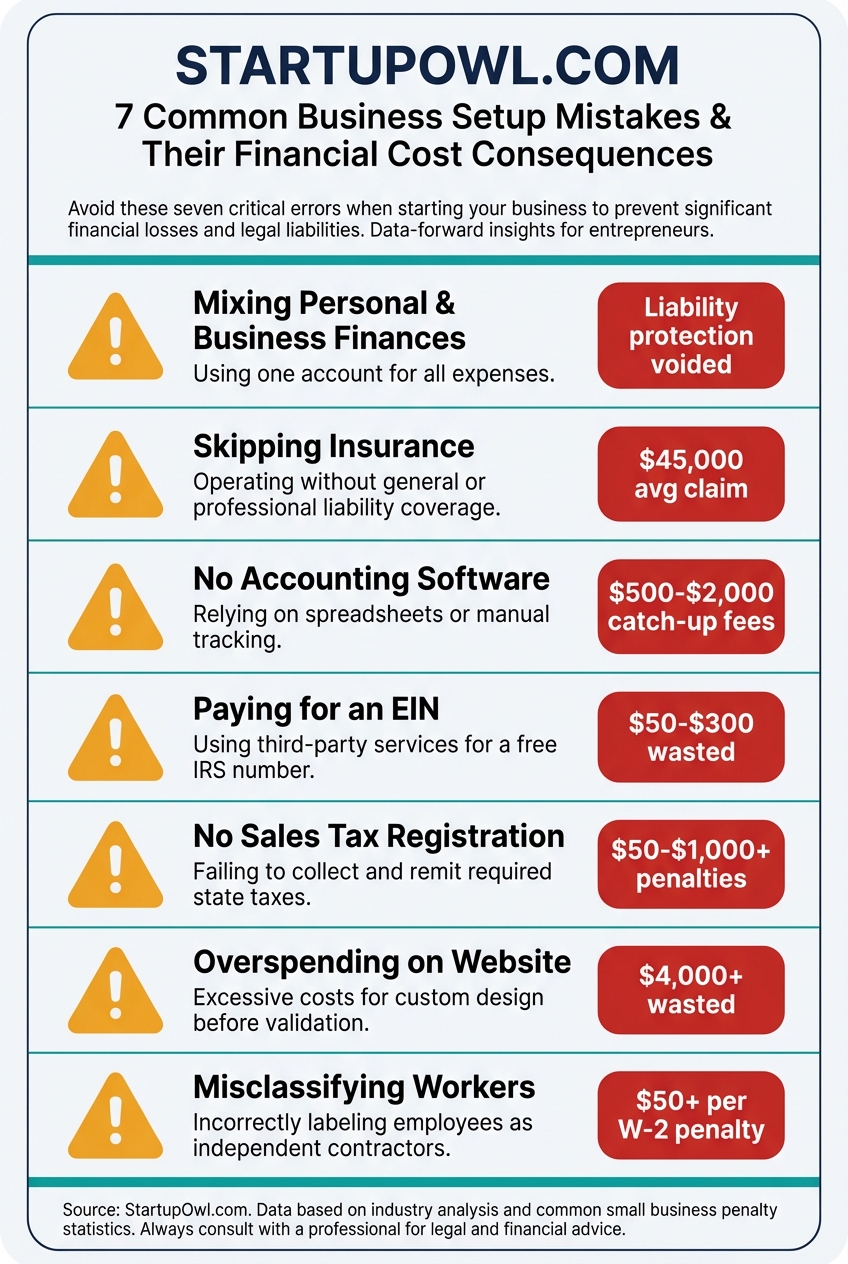
These are the most expensive mistakes founders make during setup. Each one has a real dollar cost.
- Mixing personal and business finances. Using your personal bank account for business transactions makes bookkeeping a nightmare and weakens your LLC's liability protection. If a court decides you have not maintained separation, your personal assets become fair game. Opening a business bank account is free at Mercury, Bluevine, or Relay.
- Skipping business insurance. General liability insurance costs a median of $45/month. The average slip-and-fall claim costs about $45,000, according to The Hartford. One uninsured claim can sink a business that has been open for 6 months.
- Waiting until tax season to set up accounting. Reconstructing a full year of transactions costs $500 to $2,000 in bookkeeping fees. If you connect accounting software to your bank in week 2, transaction categorization happens automatically.
- Paying a third party for your EIN. The IRS issues EINs for $0 directly at IRS.gov. Third-party services charge $50 to $300 for a free government form. The online application takes about 15 minutes and gives you your number instantly.
- Not registering for state taxes before selling. Most states require sales tax registration before your first taxable sale. Selling without a permit can result in penalties of $50 to $1,000+ depending on your state, plus back taxes owed with interest.
- Overspending on a website too early. You do not need a $5,000+ custom site in month one. A $200 to $400/year site on Squarespace or WordPress gets you live fast. Invest in a custom build once you have validated your business model and have revenue. See our best website builders comparison.
- Classifying employees as independent contractors. The IRS and state labor departments impose penalties for misclassification. Federal penalties start at $50 per misclassified W-2 you failed to file, plus 1.5% of the wages paid. See DOL.gov for current enforcement guidelines.
Frequently Asked Questions
For a service-based solo founder, expect to spend $1,200 to $2,000 on operational setup (banking, accounting, insurance, website, and registered agent). If you hire employees, add $588 to $2,400/year for payroll software. Brick-and-mortar businesses should budget $5,000 to $10,000 for setup alone, before rent and inventory.
Get your EIN from the IRS (free, instant online) and open a business bank account ($0 at Mercury or Bluevine). These two steps are prerequisites for everything else: accepting payments, filing taxes, and setting up accounting software.
If you interact with clients, work on-site, or sign a commercial lease, yes. General liability insurance costs a median of $45/month ($538/year) according to Insureon data. The average slip-and-fall claim costs about $45,000, which would bankrupt most new businesses without coverage.
You can handle several critical tasks for $0: your EIN application, a Mercury or Bluevine checking account, Wave accounting software, and your Google Business Profile. However, you will still need to pay for state LLC filing fees ($50 to $500), insurance (about $500/year minimum), and a domain name ($10 to $20/year).
Set up payroll before your first employee's start date, not after. You need to register for state employer tax accounts first, which can take 1 to 2 weeks. Gusto starts at $49/month plus $6 per employee (as of 2026) and handles tax filings automatically. Solo S Corp owners also need payroll to pay themselves a reasonable salary.
Plan for 90 days from entity formation to full operational readiness. The first 2 weeks cover banking and accounting. Weeks 3 through 6 handle insurance and your website. Weeks 6 through 12 address payroll, contracts, licenses, and growth tools. Some steps (like insurance quotes and license approvals) have built-in waiting periods.
Reconstructing a year of untracked transactions at tax time costs $500 to $2,000 in bookkeeping fees. The second biggest hidden cost is wire transfer fees at traditional banks, which run $15 to $35 per outgoing transfer. Mercury and some fintech banks offer free domestic and international USD wire transfers.
Sources & References
- IRS - Apply for an Employer Identification Number (EIN) Online
- IRS - Instructions for Form SS-4 (December 2026)
- Mercury - Business Banking Pricing
- Gusto - Payroll Pricing
- QuickBooks Online - Pricing
- MoneyGeek - Average General Liability Insurance Cost (2026 Rates)
- NerdWallet - General Liability Insurance for Small Businesses (2026)
- Google Business Profile - Official Site
- SBA.gov - Small Business Resources
- DOL.gov - Misclassification
About the Author
Editor, StartupOwl
Eliot leads StartupOwl's state data research. He maintains the site's fifty state records of LLC filing fees, annual costs, processing times, and small business grant programs, checking each figure against the state office that publishes it and logging the date it was verified. Based in New Jersey, he has spent his working life in and around small businesses, and he writes for the founder who wants the real number rather than the advertised one. Every figure under his byline traces to a named source, and when a state proves a number wrong, the correction is published, not buried.
Was this article helpful?
Questions about Business Setup Timeline
No comments yet. Ask the first question and a member of our team will answer.
Leave a comment