
LLC vs Corporation vs S-Corp vs Sole Prop
A side-by-side comparison of all four business structures with real tax numbers, formation costs, and decision scenarios to help you pick the right one.

- LLCs cost $35 to $500 to form and offer liability protection with pass-through taxes.
- S Corp election (Form 2553) saves $5,000+ annually in SE tax above $80K profit.
- C Corps pay a flat 21% federal rate but face double taxation on distributed profits.
- Sole proprietorships cost $0 to start but expose all personal assets to business debts.
If you earn under $50K, a sole proprietorship or single-member LLC is usually enough. Between $50K and $80K in net profit, form an LLC for liability protection. Above $80K, an LLC with an S Corp election can save you $5,000 to $15,000 per year in self-employment taxes. C Corps make sense primarily for venture-backed startups or businesses reinvesting all profits.
Your business structure determines how much you pay in taxes, whether your personal assets are protected, and how much paperwork you file every year. Those three factors alone can cost (or save) you $5,000 to $30,000 annually depending on your income level and entity choice.
This guide compares the four most common structures: sole proprietorship, LLC, S Corporation, and C Corporation. You will find real tax numbers at specific income levels, formation costs by state, and clear if/then decision scenarios so you can pick the right one for your situation.
Business Entity Types Compared
| Factor | Sole Proprietorship | LLC | S Corporation | C Corporation |
|---|---|---|---|---|
| Tax Treatment | Pass-through. 15.3% SE tax on all net profit plus personal income tax rates. | Pass-through by default. Can elect S Corp or C Corp taxation via IRS forms. | Pass-through with salary/distribution split. Only salary subject to 15.3% payroll tax. | Double taxation. 21% corporate rate, then 0% to 23.8% on dividends to shareholders. |
| Liability Protection | None. Personal assets (home, savings, car) are exposed to all business liabilities. | Strong. Personal assets protected. Must maintain separation of personal and business finances. | Strong. Same corporate veil protection as a C Corp. Requires proper corporate formalities. | Strong. Strongest formal separation between business and personal assets. |
| Formation Cost | $0. No state filing. May need local license ($25 to $100) or DBA ($10 to $50). | $35 to $500 state filing fee. National average is $132. Plus registered agent $0 to $300/year. | Same as LLC or Corp formation fee plus $0 for Form 2553. Add $1,500 to $3,000/year compliance. | $50 to $500 state filing fee. Plus annual franchise taxes, registered agent, and compliance costs. |
| Ongoing Compliance | Minimal. File Schedule C with your 1040. Pay quarterly estimated taxes if you owe $1,000+. | Low to moderate. Annual report ($0 to $300/year), maintain operating agreement, file personal return. | Moderate to high. Payroll, W-2s, Form 1120-S, Schedule K-1s, annual reports, corporate minutes. | Highest. Form 1120, board meetings, corporate minutes, annual reports, dividend reporting. |
| Ownership Limits | Single owner only. Cannot have partners or investors without restructuring. | Unlimited members. No restrictions on who can be a member (individuals, entities, foreigners). | Max 100 shareholders. U.S. citizens/residents only. One class of stock. | Unlimited shareholders. Any person or entity worldwide. Multiple stock classes allowed. |
| Best For | Testing a business idea, side income under $50K, or minimal-risk solo services. | Small businesses needing liability protection with minimal formality and maximum tax flexibility. | Profitable businesses ($80K+ net) where SE tax savings outweigh added compliance costs. | Venture-funded startups, companies planning IPO, or businesses reinvesting 100% of profits. |
Four business structures cover 99% of U.S. small businesses: sole proprietorship, LLC, S Corporation, and C Corporation. Each one treats taxes, liability, and paperwork differently, and the right pick depends on your income level, risk exposure, and growth plans.
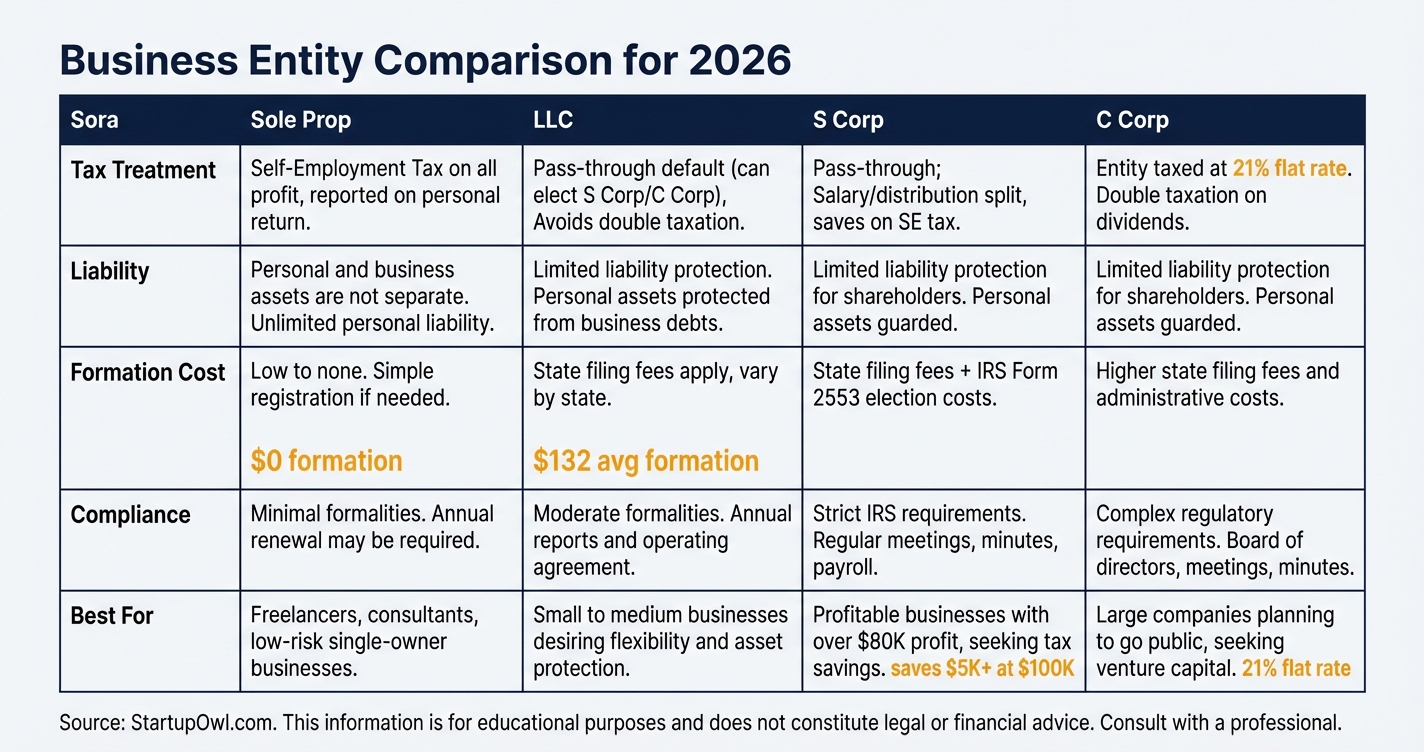
The biggest financial factor is taxes. A sole proprietorship and a default LLC pay the same 15.3% self-employment tax on all net profit. An S Corp election lets you split income and save thousands. A C Corp pays a flat 21% but risks double taxation on distributions. For a detailed breakdown of the LLC-to-S-Corp decision, see our LLC vs S Corp comparison.
The second biggest factor is liability protection. Only the sole proprietorship leaves your personal assets (home, savings, car) fully exposed. All three other structures create a legal wall between your business and personal finances. If you are starting simple, read our sole proprietorship vs LLC guide for a deeper dive.
Sole Proprietorship
A sole proprietorship is the default structure when you start earning income from a business without filing any formation documents. There is no state filing required and no formation cost. You report all business income and expenses on Schedule C attached to your Form 1040.
The downside is total personal liability. If someone sues your business or you cannot pay a vendor, they can go after your house, car, and personal bank accounts. There is no legal separation between you and the business.
You also pay 15.3% self-employment tax on every dollar of net profit (applied to 92.35% of net earnings). On $75,000 in profit, that is roughly $10,597 in SE tax alone, before income tax. For many people, a sole proprietorship works fine at first, but the lack of asset protection and the full SE tax burden make upgrading to an LLC worthwhile as income grows past $50K.
Limited Liability Company (LLC)
An LLC (Limited Liability Company) is the most popular structure for small businesses because it combines liability protection with tax flexibility and low compliance requirements. You form an LLC by filing Articles of Organization with your state's Secretary of State. Filing fees range from $35 in Montana to $500 in Massachusetts, with a national average of about $132 as of 2026.
By default, a single-member LLC is taxed exactly like a sole proprietorship: all profit flows to your personal return on Schedule C, and you pay 15.3% SE tax on net earnings. A multi-member LLC is taxed as a partnership by default. The critical advantage is that you can elect S Corp or C Corp taxation without changing your legal structure, giving you the best of both worlds.
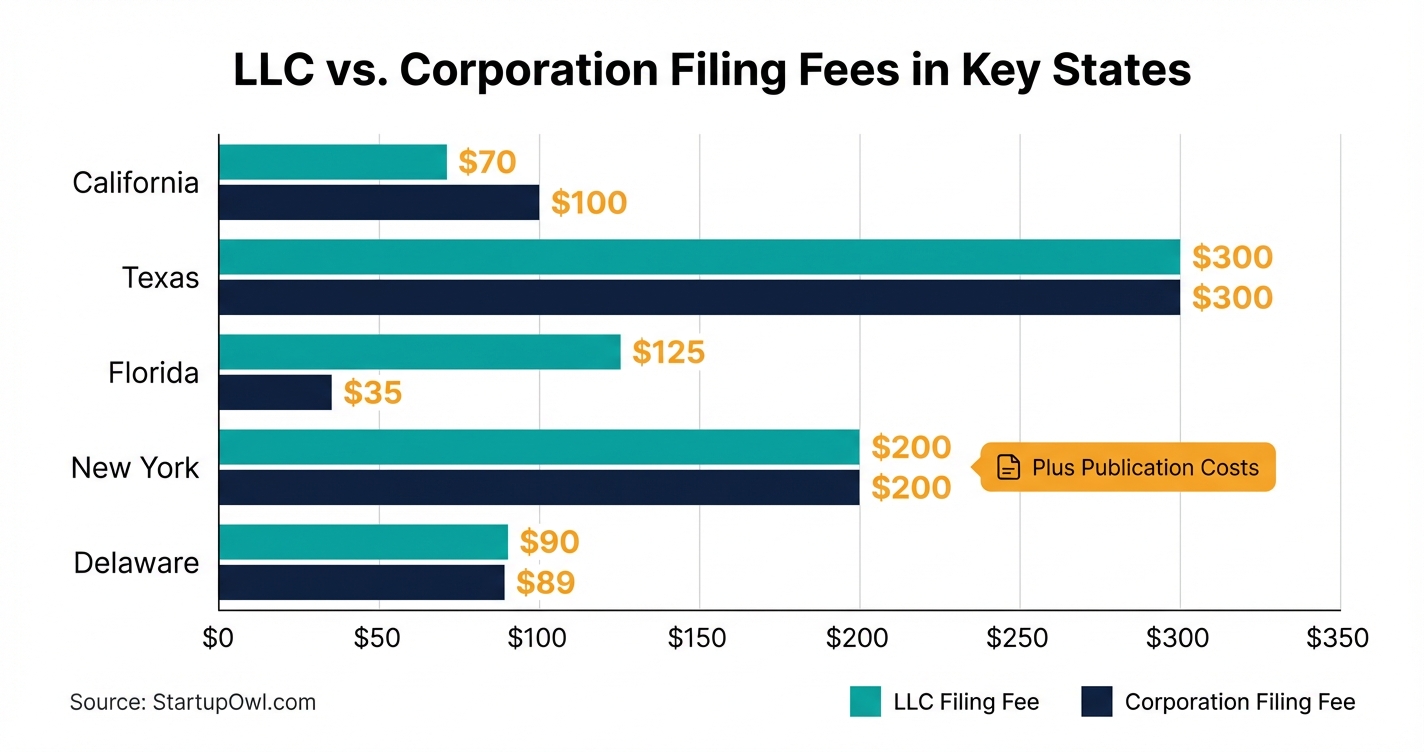
LLCs have no ownership limits. Members can be individuals, other LLCs, corporations, trusts, or foreign nationals. You need a registered agent in your formation state, and most states require an annual report ($0 to $300/year). Five states (CA, NY, DE, MO, ME) require or strongly recommend an operating agreement. California also charges an $800 annual franchise tax regardless of income, making it one of the most expensive states for LLCs.
For step-by-step guidance, see our complete guide to business entity types.
The liability shield has one common exception, and you create it yourself. Signing a personal guarantee on a loan, a lease, or a business credit card puts your own assets behind that debt, and no entity type blocks it.
S Corporation
An S Corporation is not a separate business entity. It is a tax election made by filing IRS Form 2553. Any LLC or corporation can elect S Corp status if it meets the requirements: no more than 100 shareholders, all U.S. citizens or resident aliens, and only one class of stock.
The core benefit is the salary/distribution split. As an S Corp, you pay yourself a "reasonable salary" (subject to 15.3% payroll tax), and take remaining profits as distributions (not subject to SE tax). At $100K net profit with a $60K salary, you save roughly $5,000 to $6,000 per year compared to a default LLC. At $200K, savings jump to $12,000 to $15,000 annually.
The trade-off is added compliance. You must run payroll, issue W-2s, file Form 1120-S, and maintain corporate formalities. That adds $1,500 to $3,000 per year in accounting and payroll costs. The general rule: S Corp makes sense when net profit consistently exceeds $80,000, because that is where the SE tax savings clearly outpace the compliance costs. Learn more in our how to start an S Corp guide.
C Corporation
A C Corporation is the default classification when you file Articles of Incorporation with your state. It pays a flat 21% federal income tax on profits, and shareholders pay tax again when they receive dividends (at rates of 0%, 15%, or 20% depending on income). That double taxation produces a combined effective rate of roughly 36% to 40% on distributed profits. Three situations justify it anyway, and our C Corp vs S Corp comparison goes deeper.
- You are raising venture capital. VCs require a corporation.
- You are reinvesting 100% of profits. With no distributions, there is no second layer of tax yet.
- You are building toward a QSBS exit under Section 1202. For stock acquired after July 4, 2025, it can exclude up to $15 million of gain, or 10 times your basis if that is higher. Stock acquired on or before that date caps at $10 million. Our QSBS requirements guide covers who qualifies.
C Corps also have the most complex compliance: bylaws, board meetings, corporate minutes, annual reports, and a separate corporate tax return (Form 1120). State franchise taxes add more cost (Delaware charges a minimum $225/year, California charges $800/year). For most small businesses that need regular distributions, the S Corp or LLC structure avoids double taxation entirely.
If you already run an LLC and an investor wants a corporation, changing it is a state filing with its own fee, $293 in Delaware and $600 in Texas. Our guide to an LLC to C corp conversion covers the filing, the tax treatment and the EIN question.
The real decision comes down to three variables: your annual net profit, your risk of being sued, and whether you plan to raise outside investment. Here is how each entity stacks up on the dimensions that matter most.
Tax Treatment at Real Income Levels
Below $50K in net profit, all pass-through entities (sole prop, LLC, S Corp) produce similar tax bills. The S Corp's compliance costs ($1,500 to $3,000/year) often eat the savings entirely at this level.
At $100K net profit, the differences become meaningful. A sole proprietorship or default LLC pays approximately $14,130 in SE tax (15.3% on 92.35% of net earnings). An S Corp with a $60K salary pays about $9,180 in payroll tax, saving roughly $5,000. A C Corp pays $21,000 in corporate tax, but if it distributes that $79K remainder as dividends, the shareholder pays another $11,850 (at the 15% rate), totaling $32,850.
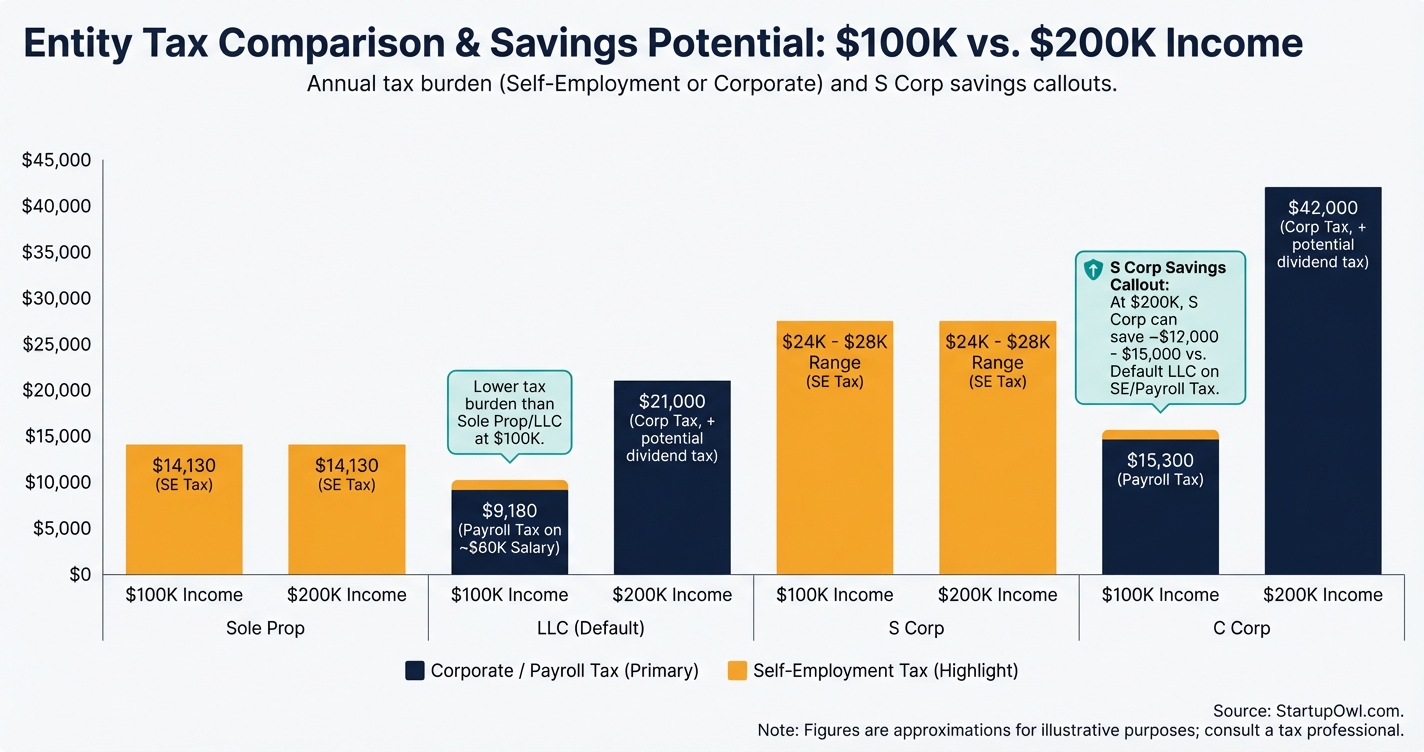
At $200K net profit, the S Corp advantage widens. Setting a reasonable salary of $100K, you save approximately $12,000 to $15,000 in SE tax versus a default LLC. The C Corp is only competitive if you retain all earnings (paying just $42,000 at the 21% rate with no distributions).
Liability Protection
LLCs, S Corps, and C Corps all provide the same fundamental protection: your personal assets are separate from business debts. The sole proprietorship provides none. However, all entities require you to maintain the "corporate veil" by keeping personal and business finances separate, holding required meetings, and following state formalities.
Formation and Ongoing Costs
Sole proprietorships cost $0. LLCs average $132 to form. Corporations range from $50 to $500. Annual compliance costs scale from $0 (sole prop) to $300 to $800 (LLC annual reports and registered agent) to $1,500 to $5,000+ (S Corp or C Corp payroll, accounting, and state filings). Use our best LLC formation services comparison to find the most affordable option.
Use These If/Then Scenarios
- If you are testing a side hustle with under $20K in revenue and no liability risk, then start as a sole proprietorship. You can always upgrade later.
- If you earn $50K+ in net profit or face any client-facing liability (consulting contracts, physical services, products), then form an LLC. The $35 to $500 filing fee buys you liability protection that a sole prop cannot provide.
- If your net profit consistently exceeds $80K per year and you are comfortable running payroll, then elect S Corp taxation for your LLC by filing Form 2553. At $100K profit, you save roughly $5,000/year after compliance costs.
- If you plan to raise venture capital, issue stock options, or build toward a large exit, then incorporate as a Delaware C Corporation. VCs expect it, and QSBS benefits can save millions in capital gains tax.
- If you have foreign owners or more than 100 investors, then you cannot use an S Corp. Choose an LLC or C Corp based on whether you need to issue stock (C Corp) or want pass-through taxation (LLC).
- If you run a low-margin business that reinvests all profits and pays no distributions, then a C Corp's 21% flat rate may be lower than your personal rate (up to 37%).
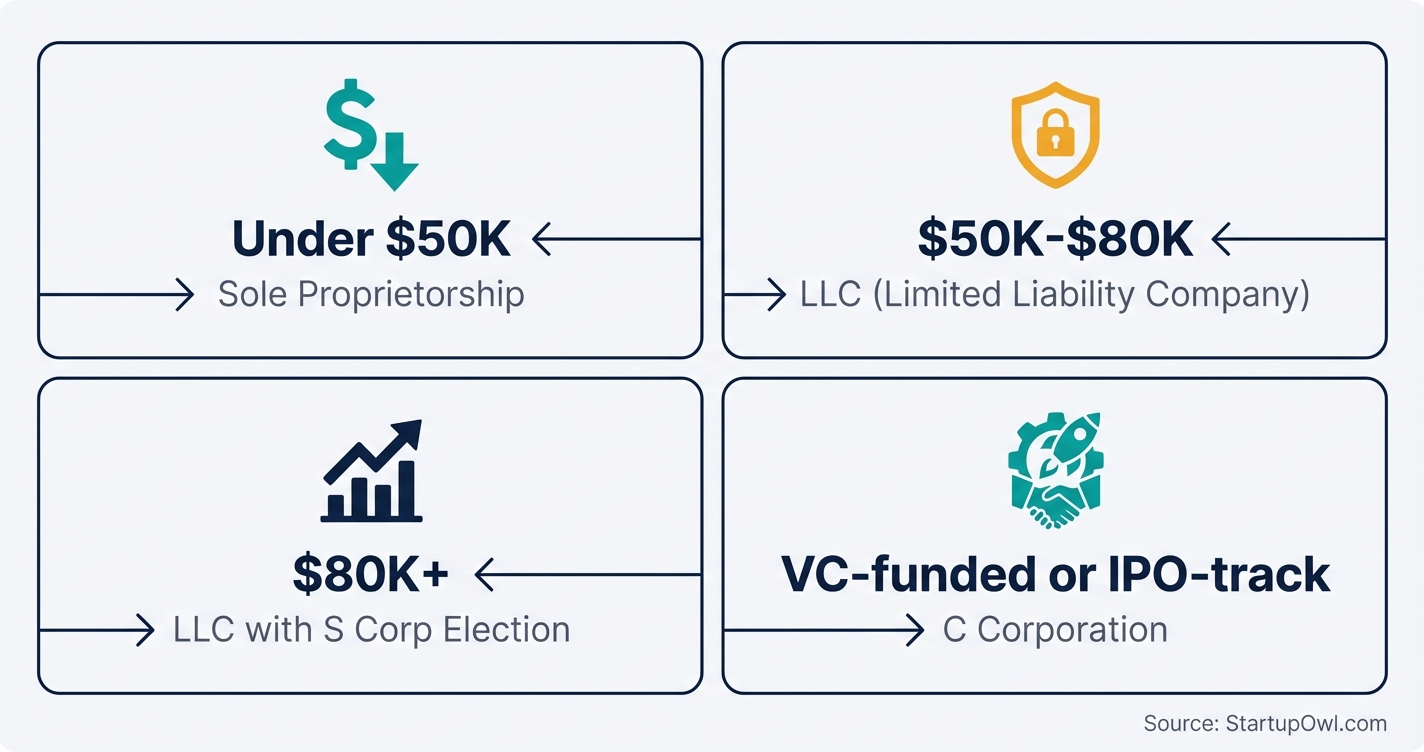
Still not sure? Our complete guide to business entity types walks through each option in more detail with state-specific nuances.
Sole Proprietorship
No filing required. Start operating and report income on Schedule C. If you use a name other than your legal name, file a DBA with your county or state ($10 to $50). Apply for a free EIN at IRS.gov if you have employees or want a business bank account.
LLC
- Choose a business name and check availability on your state's Secretary of State website. See our guide on how to choose a business name.
- File Articles of Organization with your state ($35 to $500).
- Appoint a registered agent ($0 if you serve yourself, or $49 to $300/year for a service).
- Draft an operating agreement ($0 DIY to $2,000 with an attorney).
- Get an EIN at IRS.gov (free, instant).
- Open a business bank account.
S Corporation (Tax Election)
- First, form an LLC or corporation using the steps above.
- File IRS Form 2553 within 2 months and 15 days of formation (or by March 15/17 for calendar-year businesses already operating). The form is free but must be mailed or faxed.
- Set up payroll to pay yourself a reasonable salary. Budget $500 to $1,500/year for payroll service.
- The IRS sends a CP261 confirmation letter within 60 to 90 days.
C Corporation
- File Articles of Incorporation with your state ($50 to $500).
- Appoint a registered agent and create corporate bylaws.
- Issue stock certificates and hold an initial board meeting.
- Apply for an EIN at IRS.gov (free, instant).
- Open a business bank account and obtain business licenses and permits.
Need help choosing a formation service? Compare pricing in our best LLC formation services review.
Mistakes That Cost You Money
Forming in a "business-friendly" state when you do not live there. Delaware and Nevada market themselves aggressively, but if you live and operate in another state, you will need to register as a foreign LLC in your home state too. That means double filing fees, double annual reports, and double registered agent costs. Most small businesses should form in their home state.
Electing S Corp status too early. If your net profit is under $50K to $60K, the payroll compliance costs ($1,500 to $3,000/year) can exceed your SE tax savings. Run the numbers before filing Form 2553.
Skipping the operating agreement. Even in states that do not legally require one, an operating agreement protects your liability shield. Without it, courts may question whether your LLC is a legitimate separate entity.
Mixing personal and business finances. Using one bank account for personal and business expenses is the fastest way to "pierce the corporate veil" and lose your liability protection. Open a separate business bank account immediately after formation.
Ignoring the S Corp reasonable salary requirement. The IRS watches for S Corp owners who pay themselves unreasonably low salaries to minimize payroll taxes. If you earn $150K and pay yourself $30K, expect an audit. Pay yourself what the market would pay someone in your role.
Forgetting annual reports and franchise taxes. Missing your state's annual report deadline can result in your entity being administratively dissolved. In California, the $800 minimum franchise tax is due regardless of income, and the penalty for late payment is $200 plus 1.5% monthly interest in Delaware.
Frequently Asked Questions
Sources & References
- IRS: Self-Employment Tax (Social Security and Medicare Taxes)
- IRS: Business Structures
- IRS: About Form 2553, Election by a Small Business Corporation
- SBA: Choose a Business Structure
- SSA: 2026 Social Security Wage Base
- LLC University: LLC Filing Fees by State (2026)
- FinCEN: Beneficial Ownership Information Reporting
About the Author
Editor, StartupOwl
Eliot leads StartupOwl's state data research. He maintains the site's fifty state records of LLC filing fees, annual costs, processing times, and small business grant programs, checking each figure against the state office that publishes it and logging the date it was verified. Based in New Jersey, he has spent his working life in and around small businesses, and he writes for the founder who wants the real number rather than the advertised one. Every figure under his byline traces to a named source, and when a state proves a number wrong, the correction is published, not buried.
Was this article helpful?
Questions about this guide
No comments yet. Ask the first question and a member of our team will answer.
Leave a comment