
Business Licenses & Permits
A practical breakdown of every license and permit your business may need, with real costs, timelines, and state-by-state requirements.

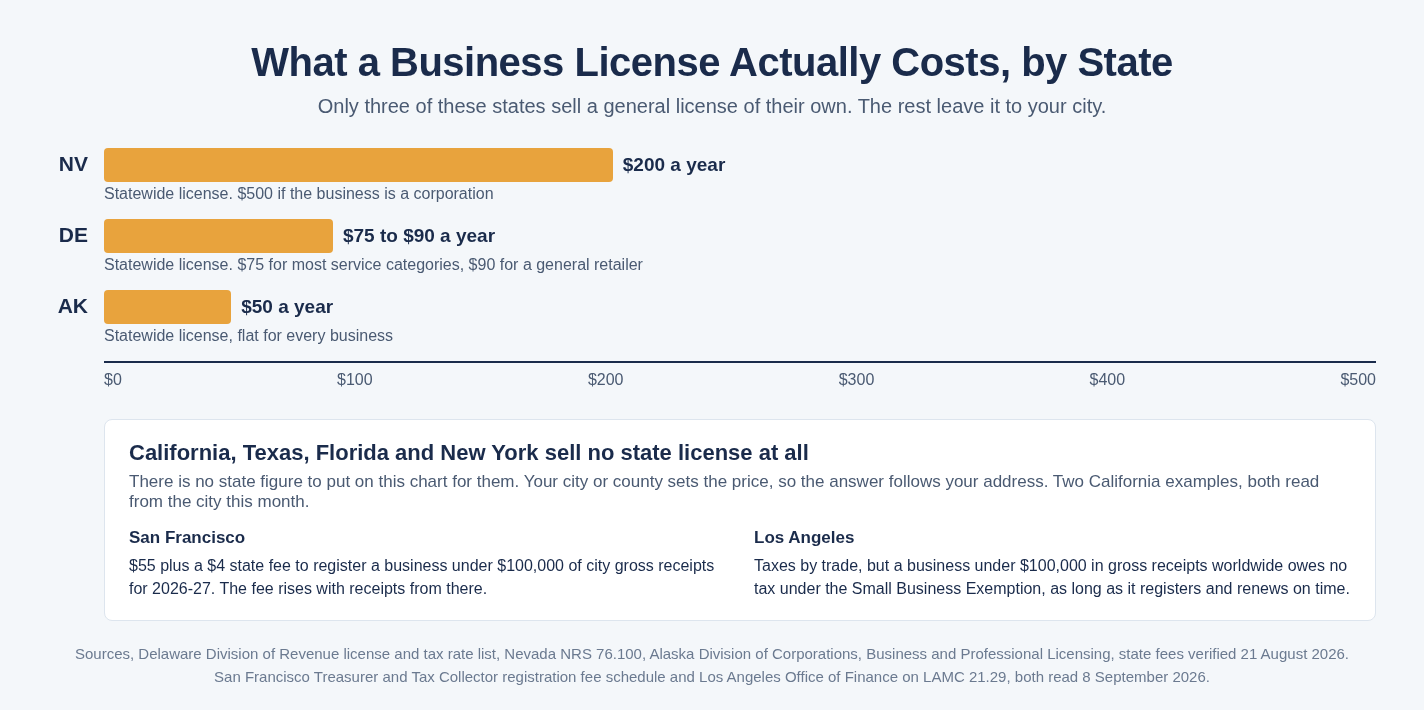
- There is no national price. Alaska sells a state license for $50 a year and Nevada for $200, and most states leave the general license to your city.
- Check three levels: federal, state, and local. Most states regulate licensing at the city or county level.
- Penalties for operating without a license include fines, forced closure, and possible criminal charges.
- Renewals are usually annual. Set calendar reminders or risk late fees and suspension.
Most small businesses need at least one license or permit. There is no national price. Only a handful of states sell a general business license of their own. Those run $50 a year in Alaska to $200 in Nevada. Everywhere else it is a city or county charge. Check three levels, federal (via SBA.gov), state (your Secretary of State or Department of Revenue), and local (your city or county clerk). Start 30 to 45 days before you plan to open.
There is no national business license fee. A few states sell a general license of their own, at prices they publish. Alaska charges $50 a year. Nevada charges $200, or $500 if you are a corporation. Most states sell none at all. In Texas, California and New York the general license is a city or county charge. What you pay follows the address you trade from.
You need to check requirements at three levels (federal, state, and local) before you open your doors. Missing even one permit can trigger back taxes, fines and forced closure. Florida, for example, adds a penalty of 25 percent of the tax you owed to any business that traded without the local receipt it needed. This guide walks you through exactly what you need, where to find it, and what it costs.
| Level | What it covers | Who issues it | What it costs |
|---|---|---|---|
| Federal | Regulated activities only, such as alcohol, firearms, aviation and broadcasting | The agency that regulates the activity, listed at SBA.gov | Most businesses owe nothing here |
| State | Sales tax registration, plus your trade licence if your trade is regulated | Your Department of Revenue and your state licensing board | Sales tax permits are free in Texas and New York. Only a few states sell a general licence, $50 in Alaska and $200 in Nevada |
| Local | The general business licence, plus zoning, signage and health permits | Your city or county clerk | Set by your address. San Francisco starts at $55 plus a $4 state fee. Dallas charges nothing general |
Business Location
Your city, county, and state each set different licensing requirements. San Francisco charges $55 plus a $4 state fee to register a business under $100,000 of city gross receipts, while Los Angeles taxes by trade and exempts a business under $100,000 that registers and renews on time.
Industry and Business Activity
Regulated industries (food service, construction, healthcare, alcohol, childcare) require additional permits that can cost $200 to $5,000 or more on top of your general business license.
Business Structure (LLC, Corp, Sole Prop)
Your entity type affects registration and filing requirements. LLCs and corporations must register with the state; sole proprietors may only need local licenses and a DBA filing.
Number of Employees
Hiring employees triggers additional requirements including workers' compensation insurance, unemployment insurance registration, and potentially employer-specific permits.
Physical Storefront vs. Home-Based vs. Online
A storefront needs zoning approval, a certificate of occupancy, signage permits, and fire department clearance. Home-based businesses may need a home occupation permit. Online-only businesses still need sales tax permits in most states.
Selling Across State Lines
If you sell into multiple states, you may need foreign LLC registration and sales tax nexus compliance in each state where you have customers or physical presence.
Operating without the right licenses can cost far more than the license. What you pay depends on which one you skipped. A missed local registration is a tax problem. You pay the back tax plus a percentage penalty, often 25 percent. A missed trade license is a different category. In a few trades it is criminal.
Florida shows both halves. Most Florida cities and counties call the general business licence a business tax receipt. Skip one and you have a tax problem, not a crime. Every jail term below belongs to a licensed trade, and each sits in its own statute.
| What you skipped | Statute | Penalty |
|---|---|---|
| A Florida local business tax receipt | F.S. 205.053 | 25 percent of the tax due, on top of the tax. Once 150 days pass from the first notice the county can sue for court costs, attorney fees and a further $250 |
| A Florida contractor licence | F.S. 489.127 | A first-degree misdemeanor, up to one year in jail and a $1,000 fine. A second offense is a third-degree felony, as is any offense during a declared state of emergency. The same section says a business tax receipt is not a licence for its purposes |
| A California contractor licence | Bus. and Prof. Code 7028 | A misdemeanor. A first conviction carries up to $5,000, up to six months in county jail, or both |
Beyond fines, you risk lawsuits. A customer can cite your lack of licensure as fraudulent activity, and courts may issue a default judgment against your business regardless of the case's merits. The reputational damage alone can take years to recover from.
Getting licensed requires checking three distinct levels of government. Think of it as a three-layer system: federal, state, and local. Each layer operates independently, and you may owe permits at all three.

Step 1. Check Federal Requirements
Most businesses do not need a federal license. You only need one if your business operates in a federally regulated industry. According to the SBA, federal agencies that issue licenses include the USDA (agriculture and animal products), ATF (firearms, ammunition, explosives), TTB (alcohol manufacturing and wholesale), FAA (aviation), FCC (broadcasting), FDA (food manufacturing), and EPA (environmental). The federal government does not impose a fee for most of these permits.
Step 2. Check State Requirements
Some states do require a statewide general business license. Delaware is the one most guides name. Its fee follows the activity. Most service and professional categories pay $75 per year through the Division of Revenue. A general retailer pays $90. Nevada charges $200 a year, or $500 for a corporation. Alaska charges $50. Most states have none at all. California, Texas, New York and Florida all regulate at the local and industry level instead.
If you sell taxable goods or services, you will need a sales tax permit (or seller's permit). This is free in most states, including Texas, California, New York, and Florida. Apply through your state's Department of Revenue or Tax Commission. That permit is not the document a wholesale supplier asks for, which is a separate paper you write yourself, and our guide to the resale certificate versus the seller's permit covers what has to be on it. That form is usually the first place a state asks for your six digit industry code, so it is worth knowing what a NAICS code decides later before you type one in.
Step 3. Check Local Requirements (City and County)
This is where most businesses actually encounter licensing requirements. Your city or county may require a general business operating license (often called a business tax receipt in Florida), zoning approval, a certificate of occupancy, health department permits, fire department clearance, and signage permits. Contact your local city hall or county clerk's office directly. Fees typically range from $25 to $500 depending on your municipality.
Step 4. Apply for Industry-Specific Permits
If your business involves food service, construction, healthcare, childcare, alcohol, real estate, or cosmetology, you will need additional permits from the appropriate regulatory agency. These cost anywhere from $100 to $5,000+ depending on the industry and state.
Step 5. Set Up Renewals and Compliance Tracking
Most licenses renew annually. Some renew biennially or every three years (Delaware offers a three-year option). Create a spreadsheet or use the Texas Business Permit Office's free License and Permit Tracker template to track every permit number, renewal date, and cost. Late renewals in many jurisdictions trigger penalties, and licenses expired for more than 90 days may require you to reapply from scratch.
Sole Proprietors
If you operate under your legal name, you may not need to register with the state at all. You will still need local licenses and permits, a sales tax permit if applicable, and potentially a DBA filing if you use a trade name. Formation cost is $0, but license costs still apply. Learn more in our sole proprietorship vs LLC comparison.
LLCs
After filing your Articles of Organization with your state's Secretary of State (fees range from $50 to $500 depending on the state), you need to check for local business licenses, sales tax permits, and industry-specific permits. An LLC does not automatically come with a business license. They are two completely separate things. If you are unsure what structure to pick, see our complete guide to business entity types.
Corporations (S Corp and C Corp)
Corporations follow the same licensing process as LLCs at the local and state level. The additional wrinkle is that S Corps must file IRS Form 2553 for their tax election, and both S Corps and C Corps face heavier ongoing compliance (annual meetings, minutes, stock records). See our C Corp vs S Corp guide for tax treatment details.
Freelancers and Home-Based Businesses
Many freelancers assume they do not need licenses. That is often wrong. If your city requires a general business operating license, it applies to home-based businesses too. You may also need a home occupation permit (common in Austin, TX, and many California cities). Online-only freelancers still need a sales tax permit if they sell taxable services. Read our full LLC for freelancers guide for details.
Licensing requirements vary dramatically across states. Here are the five most-searched states and what you need to know about each.
California
California has no statewide general business license. Licensing happens at the city and county level, with fees typically ranging from $50 to $100 for a general business license. The two big cities are cheaper than people expect. San Francisco charges a sliding scale fee to sign up. Under $100,000 of city gross receipts you pay $55 plus a $4 state fee for the 2026-27 year. The fee climbs with receipts from there. The schedule is on the Treasurer and Tax Collector site. Los Angeles taxes by trade instead. But earn $100,000 or less in gross receipts worldwide and you can claim the Small Business Exemption. You owe no tax at all. The rule is LAMC 21.29. It only works if you are registered and renew on time, says the Office of Finance. So register either way. That is what protects the exemption. Use the CalGOLD tool to find your local requirements. Seller's permits are free through the California Department of Tax and Fee Administration. Keep in mind California also charges an $800 annual franchise tax on all LLCs and corporations.
Texas
Texas does not require a general state business license. The state's 2024-2026 Business Licenses & Permits Guide lists over 300 business types and their state-level requirements. The Texas sales tax permit is free, issued by the Comptroller of Public Accounts. Local costs vary, and the two largest Texas cities charge nothing general. Dallas has no city business registration. The city's own Small Business Quick Reference Guide sends a sole proprietor or a general partnership to the Dallas County Clerk for an assumed name certificate. City licences are kept for set activities, among them dance halls, billiard halls, dealers in precious metals and theatres. The $120 Dallas figure is the annual contractor registration fee. Contractors pay it. Other businesses do not. Austin works the same way, and issues permits by activity through Development Services. Professional licenses through the Texas Department of Licensing and Regulation (TDLR) run $50 to $500+.
Florida
Florida has no statewide business license, but most cities and counties require a business tax receipt (their version of a local business license). Fees range from $25 to several hundred dollars depending on locality. The Florida Department of Business and Professional Regulation (DBPR) handles professional licenses for construction, cosmetology, real estate, and food service. Skipping the receipt is a tax matter, not a crime. You owe 25 percent of the tax due under F.S. § 205.053. Receipts run through September 30 each year. Criminal charges attach to the trade licenses DBPR issues. Unlicensed contracting is the one that carries jail.
New York
New York has no general statewide business license. A Certificate of Authority for sales tax is free from the NY Department of Taxation and Finance. New York City has no general business license either. The Department of Consumer and Worker Protection licenses more than 45,000 businesses in over 40 industries. The fee follows the industry, not the borough. A general vendor pays $200 applying between 1 October and 30 March, or $100 from 31 March to 30 September. An honorably discharged veteran pays nothing. A home improvement contractor pays $150 or $200, set by where the two year cycle has reached, and must add a trust fund payment or a $20,000 surety bond. Professional licenses cost $50 to $1,000+. Use the New York Business Express portal to find your requirements.
Delaware
Delaware runs a statewide general business license through the Division of Revenue. The fee follows what you do. It is not one flat rate. Most service, professional and personal service categories pay $75 per year for one location. Each extra location adds $25. A general retailer pays $90, and $40 for each extra location, because retail licenses carry a $15 retail crime fee. A few categories cost more again. A travel agency pays $225 and a small loan agency $450. Apply online through the Delaware One Stop portal. Licenses expire on December 31 each year. Most are prorated in your first year. After that you can buy a three-year license. It costs three times the annual fee, so it saves paperwork rather than money.
Delaware charges no sales tax. There is no seller's permit to add. What takes its place is the gross receipts tax. The same registration sets it up. Rates run from 0.0945 percent to 1.9914 percent, depending on your activity.
These are the official tools and databases you will actually use during the licensing process. Every URL has been verified.
- SBA Licenses and Permits Guide (federal requirements by industry): sba.gov/business-guide/launch-your-business/apply-licenses-permits
- IRS EIN Application (free, instant): irs.gov/businesses/small-businesses-self-employed/apply-for-an-employer-identification-number-ein-online
- FinCEN BOI Reporting: fincen.gov/boi
- USPTO Trademark Search (TESS): tmsearch.uspto.gov
- California CalGOLD (local license lookup): calgold.ca.gov
- Texas Business Permits Guide (PDF): gov.texas.gov (PDF)
- Florida DBPR License Search: myfloridalicense.com
- New York Business Express: businessexpress.ny.gov
- Delaware One Stop: onestop.delaware.gov
- Massachusetts Licenses and Permits: mass.gov/topics/business-licenses-permits

For EIN applications specifically, see our step-by-step how to get an EIN guide (it is free and takes 15 minutes). To choose and protect your business name, start with our how to choose a business name guide.
Use this checklist before you open for business. Print it, bookmark it, or save it to your phone. Every item is a real requirement that applies to most small businesses.

- Choose your business structure. See our complete guide to business entity types if you have not decided yet.
- Register your business name. Check availability with your state SOS, search the USPTO trademark database, and secure a matching domain. Full details in our business naming guide.
- File formation documents (Articles of Organization for LLCs, Articles of Incorporation for corporations) with your state. Use a recommended LLC formation service if you want help.
- Get your EIN from the IRS at IRS.gov. It is free and takes 15 minutes.
- Appoint a registered agent if your state requires one (all 50 states do for LLCs and corporations). See our registered agent requirements guide.
- Apply for your state sales tax permit if selling taxable goods or services (free in most states).
- Apply for your local business license or business tax receipt from your city or county clerk's office. Budget $25 to $500.
- Get zoning approval for your business location. Verify with your city's zoning department before signing a lease.
- Obtain industry-specific permits (health department, fire department, building permit, professional license).
- File your BOI report with FinCEN if you are a reporting company.
- Open a business bank account using your EIN. See our best business bank accounts comparison.
- Create a renewal calendar with every license, its expiration date, and the renewal fee. Set reminders 60 days before each expiration.
Assuming Your LLC Replaces a Business License
Forming an LLC makes your business a legal entity. It does not give you permission to operate. You still need every applicable license and permit at the federal, state, and local level. These are two completely separate processes.
Checking Only One Level of Government
You may pass your state requirements and miss your city's. Or you may get a local license and overlook a state professional license. Always check all three levels: federal, state, and local. The SBA's licenses and permits page is the best starting point for federal requirements.
Missing Renewal Deadlines
Most business licenses require annual renewal. In Sacramento County, California, a late renewal triggers an $18 fee, and a license expired for more than 90 days forces you to reapply entirely. In Delaware, licenses expire on December 31 every year. Set calendar reminders at least 60 days before each expiration.
Ignoring Zoning Laws
Signing a lease and opening a restaurant in a space zoned for retail will get you shut down. Before committing to a location, check your city's zoning ordinances. Home-based businesses often need a separate home occupation permit, especially in Texas cities like Austin and California municipalities.
Forgetting About Sales Tax Registration
If you sell taxable goods or services, you need a sales tax permit (or seller's permit) in your state. This is free in most states. Skipping this registration means you are collecting sales tax illegally or failing to collect it at all. Either way, your state's Department of Revenue will eventually notice. If you have already been trading there a while, read sales tax voluntary disclosure before you register, because several states withdraw the shorter lookback once you are on their books.
Underestimating Total Costs for Regulated Industries
A general business license might cost $75. But if you run a restaurant, add a health permit (your county sets the price and publishes its own schedule), a food service establishment license, a fire department permit, a building permit, and perhaps a liquor license. California publishes both halves of that last one. The beer and wine licence most restaurants use, a Type 41, costs $1,135 to apply for and $565 a year after that. A full spirits licence for an eating place, a Type 47, costs $19,840 to apply for through the state's priority drawing. It then costs $985 to $1,545 a year, set by your city's population. Your total can pass $2,000 before you serve a customer. Budget for the full stack.
Frequently Asked Questions
Sources & References
- SBA: Apply for Licenses and Permits
- Delaware Division of Revenue: Business Licenses FAQs
- Texas Governor: Start a Business in Texas
- California CalGOLD: Business Permit Assistance
- Florida DBPR: License Requirements
- New York Business Express
- FindLaw: Federal Small Business Requirements
- FinCEN: Beneficial Ownership Information
- Florida Statutes 205.053, business tax receipts and penalties
- Florida Statutes 489.127, unlicensed contracting penalties
- Delaware Division of Revenue: Detailed List of Licenses and Tax Rates
- Nevada Revised Statutes Chapter 76: State Business Licenses
- Alaska Division of Corporations, Business and Professional Licensing: Business Licensing Forms and Fees
- California Department of Alcoholic Beverage Control, application fee schedules
- California Department of Alcoholic Beverage Control, annual fee schedule
- New York City Department of Consumer and Worker Protection, business licenses
- City of Dallas Small Business Quick Reference Guide
About the Author
Editor, StartupOwl
Eliot leads StartupOwl's state data research. He maintains the site's fifty state records of LLC filing fees, annual costs, processing times, and small business grant programs, checking each figure against the state office that publishes it and logging the date it was verified. Based in New Jersey, he has spent his working life in and around small businesses, and he writes for the founder who wants the real number rather than the advertised one. Every figure under his byline traces to a named source, and when a state proves a number wrong, the correction is published, not buried.
Was this article helpful?
Questions about this guide
No comments yet. Ask the first question and a member of our team will answer.
Leave a comment