
How to Choose a Business Name
Your business name must pass 3 checks before you commit: state availability, federal trademark clearance, and domain availability.

- All 3 name checks (state SOS, USPTO trademark, domain) are free and take under 30 minutes total.
- DBA registration costs $10 to $100; LLC entity name registration costs $50 to $500 by state.
- Federal trademark registration starts at $350 per class as of January 2026.
- Every state requires LLCs and corporations to include a designator like "LLC" or "Inc." in their legal name.
Run a 3-part availability check before committing to any business name: (1) search your state Secretary of State database for entity name conflicts, (2) search the USPTO Trademark Search for federal trademark conflicts, and (3) check domain availability at any ICANN-accredited registrar. All three searches are free.
Your business name is one of the few decisions that touches every part of your company: your state registration, your contracts, your bank account, your website, and your tax returns. Get it wrong and you face cease-and-desist letters, rejected formation filings, or a costly rebrand down the road. Get it right and you lock in a name that's legally clear, brand-ready, and protectable from day one.
The entire name-checking process costs $0 if you do it yourself using free government tools. Registering that name (through entity formation or a DBA filing) typically runs $10 to $300 depending on your state and business structure. This guide walks you through the exact steps, tools, and state-specific rules you need.
State Name Availability
Your name must be distinguishable from every existing entity in your state's Secretary of State database. If a similar name exists, your formation filing will be rejected and filing fees are non-refundable.
Federal Trademark Clearance
Even if your state approves your name, a federally trademarked name in the same industry can force you to rebrand. The USPTO database contains over 11.5 million trademark records. A free search takes 10 minutes and can save you thousands.
Domain Name Availability
A matching .com domain costs $10 to $15 per year. If the .com is taken, consider .co or .io alternatives. Premium domains (ones already registered by someone else) can cost $500 to $50,000+ to acquire.
Entity Suffix Requirements
All 50 states require LLCs to include 'LLC' or 'Limited Liability Company' in their legal name, and corporations to include 'Inc.,' 'Corp.,' or similar designators. A DBA name does not need these suffixes.
Future Scalability
If you plan to expand beyond your home state, your name needs to be available in those states too. A geographic name like 'Austin Web Design LLC' works locally but limits you if you grow to other cities.
Restricted Word Compliance
Words like 'bank,' 'insurance,' 'trust,' and 'engineering' are restricted in most states and require special licensing or state agency approval before they can appear in your business name.
Your business name is baked into everything: your EIN application, your bank account, your contracts, your website, and every invoice you send. Changing it later means filing an amendment with your Secretary of State (typically $25 to $150), updating your EIN records with the IRS, rebranding your marketing materials, and notifying every client and vendor. For an established business, a name change can cost $1,000 to $5,000+ when you factor in legal fees, new signage, and lost brand equity.
A name that conflicts with an existing trademark is even worse. Federal trademark infringement can lead to a court order forcing you to stop using your name, plus damages. The average trademark litigation case costs $120,000 to $750,000 according to the American Intellectual Property Law Association. A 30-minute search on free government tools eliminates that risk before you spend a dime on formation.
The stakes are highest for businesses that operate online or across state lines. If you only serve customers in your city, a state entity registration may be sufficient protection. But if you sell products on Shopify or take clients in multiple states, you need federal trademark protection to prevent someone in another state from using your exact name.
The most reliable way to pick a business name is to run a 3-part availability check before you commit. Each step is free and takes about 10 minutes. Do all three in order, because passing one check does not guarantee you'll pass the others.
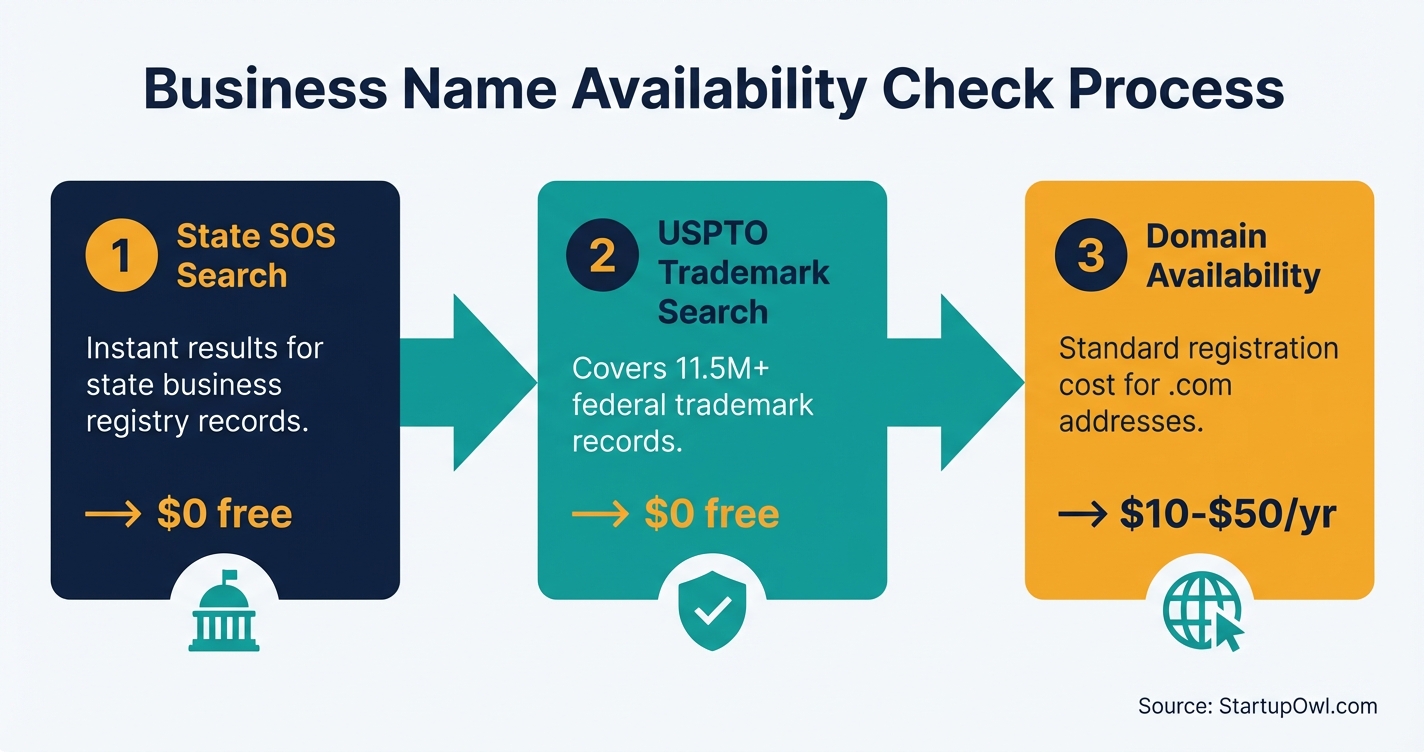
Step 1: Search your state's Secretary of State business database. Every state maintains a free, searchable database of registered entity names. Go to your state's SOS website (for example, California's bizfile, Texas SOSPortal, or Illinois Business Entity Search) and type in your proposed name. If a name that's too similar already exists, the state will reject your formation filing.
Step 2: Search the USPTO Trademark Search database. Go to tmsearch.uspto.gov and search for your proposed name. This free database covers over 11.5 million trademark records. Look for exact matches and similar-sounding names in your industry. If you find a live trademark in the same goods/services class, choose a different name.
Step 3: Check domain name availability. Search for your name at any ICANN-accredited registrar (Namecheap, Cloudflare, Google Domains, or GoDaddy). A .com domain costs $10 to $15 per year. If the .com is taken, consider .co, .io, or a hyphenated variation. Check social media handles at the same time.
If your name passes all three checks, you have a strong candidate. If it fails any one of them, go back to your list and try the next option. Ideally, start with 3 to 5 name candidates so you have backups ready.
The rules for your business name change depending on your business entity type. Here's what applies to each structure.
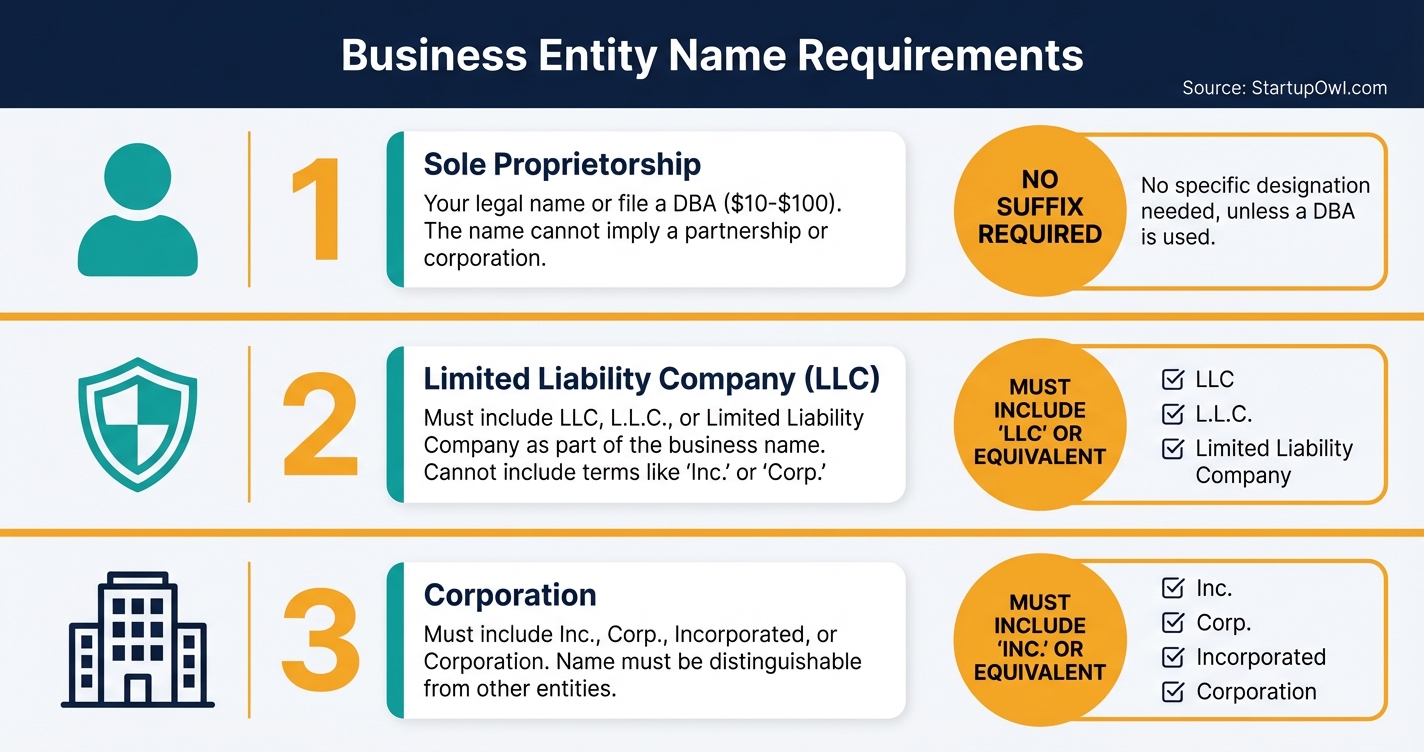
Sole proprietorship. If you're a sole proprietor, your legal business name is your personal name by default. You don't need to register anything with the state unless you want to operate under a different name. To use a trade name (like "Sunrise Photography" instead of "Jane Smith"), you'll file a DBA with your county clerk or Secretary of State. DBA costs run $10 to $100 depending on your state. Some states, like California, also require you to publish a notice in a local newspaper for 4 consecutive weeks, which adds $40 to $200. See our full guide on DBA filing for state-by-state details.
LLC. When you form an LLC, your entity name is registered with the state through your Articles of Organization. Every state requires your LLC name to include a designator: "LLC," "L.L.C.," or "Limited Liability Company" are accepted in all 50 states. Your name must be distinguishable from other entities already on file. If you want to do business under a shorter or catchier name (without the "LLC" suffix), you'll need to file a separate DBA. For example, "Greenfield Holdings LLC" might operate publicly as "Greenfield Coffee" via a DBA filing.
Corporation. Corporations must include a designator like "Inc.," "Corp.," "Incorporated," or "Corporation" in their legal name. The rules mirror LLC naming: the name must be distinguishable on the state's records, and restricted words ("bank," "trust," "insurance") require special authorization. If you're weighing LLC vs. corporation structures, see our LLC vs corporation comparison.
Business name registration costs and rules vary significantly by state. Here are the specifics for the 5 most popular formation states.
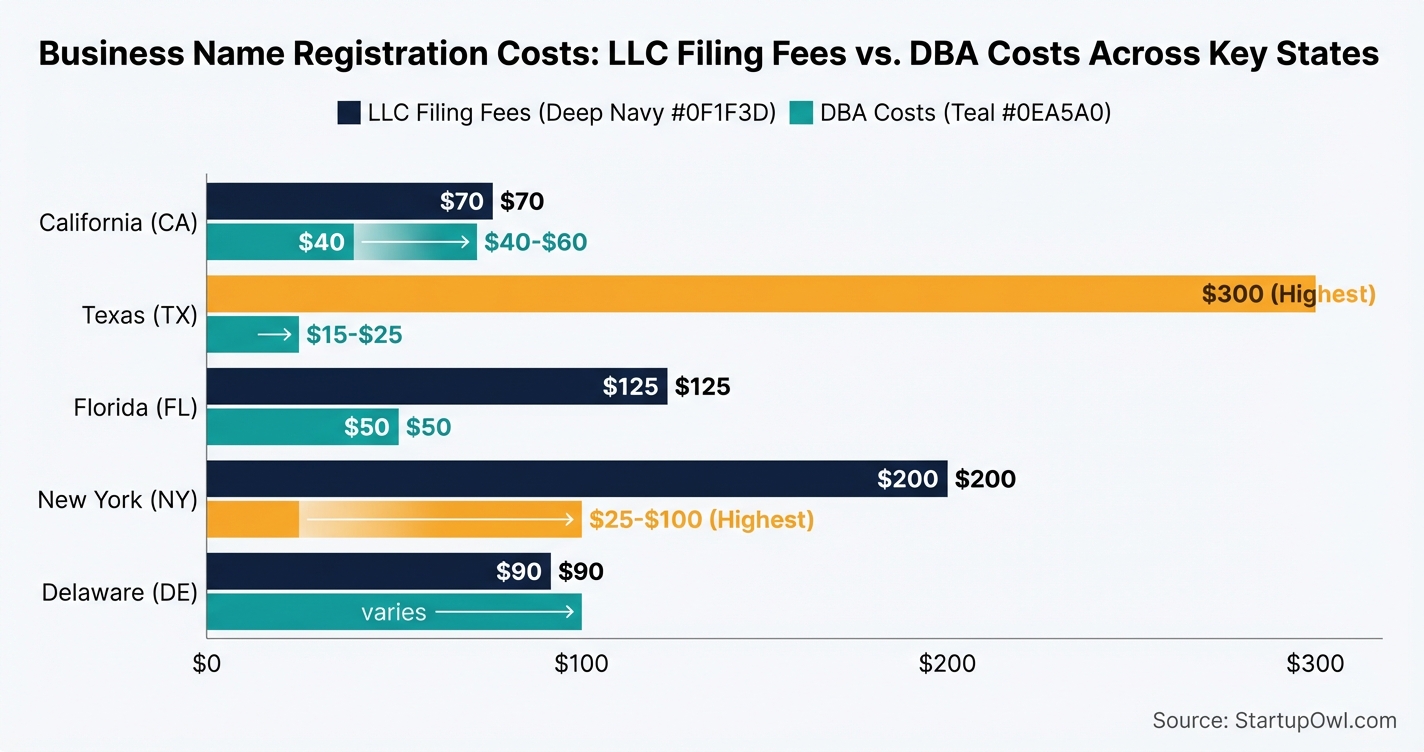
California. LLC formation costs $70. DBA (called a "Fictitious Business Name") registration is handled at the county level for $40 to $60, plus a mandatory newspaper publication fee of $40 to $100. You can reserve a name for $10 for 60 days through the California Secretary of State. California also charges an $800 annual franchise tax regardless of revenue, so factor that into your total first-year costs.
Texas. LLC formation costs $300. DBA (called an "Assumed Name") registration is filed with the county clerk for $15 to $25 or with the Secretary of State for a $25 filing fee. Texas DBAs are valid for 10 years before renewal. Search business names at SOSPortal (note the $1 search fee).
Florida. LLC formation costs $125. DBA (called a "Fictitious Name") registration is $50 filed with the Department of State. Florida also requires a newspaper publication notice. Annual reports cost $138.75. Search name availability at the Florida Division of Corporations (Sunbiz).
New York. LLC formation costs $200. New York requires LLCs to publish formation notices in two newspapers for 6 consecutive weeks, adding $200 to $1,500 depending on the county. DBA filing costs $25 base, with additional per-county fees. For New York City counties, expect an additional $100 per county for corporate DBAs.
Delaware. LLC formation costs $110, the $90 filing fee plus the municipality fee, which still puts it among the cheaper states to form. Name reservations are available for $75 for 120 days. The annual LLC tax is a flat $400, raised from $300 on January 1, 2026, and it is due each June 1 for the year before. Delaware is popular for its business-friendly court system, but if you operate in another state, you'll also need foreign LLC registration there.
Every tool listed here is free to use (except domain registration, which costs $10 to $15 per year). Bookmark these before you start your name search.
- State Business Name Searches: California bizfile | Texas SOSPortal | Florida Sunbiz | New York DOS | Delaware ECORP. For a complete list of all 50 state search portals, see LLC University's directory.
- Federal Trademark Search: USPTO Trademark Search (replaced the old TESS system in November 2023). Free. Covers all pending, registered, and dead trademarks in the U.S.
- Domain Availability: ICANN Lookup for WHOIS data on existing domains. For registration, use any ICANN-accredited registrar like Namecheap, Cloudflare Registrar, or Google Domains.
- SBA Name Guidance: SBA.gov "Choose Your Business Name" page covers entity names, trademarks, DBAs, and domain registration in one overview.
- Business Licenses and Permits: After naming, check what business licenses and permits you need. The SBA license finder is a good starting point.
For trademark registration (not just searching), the USPTO trademark portal lets you file online. The base application fee is $350 per class as of January 2026. Most small businesses filing in a single class will pay only the base fee.
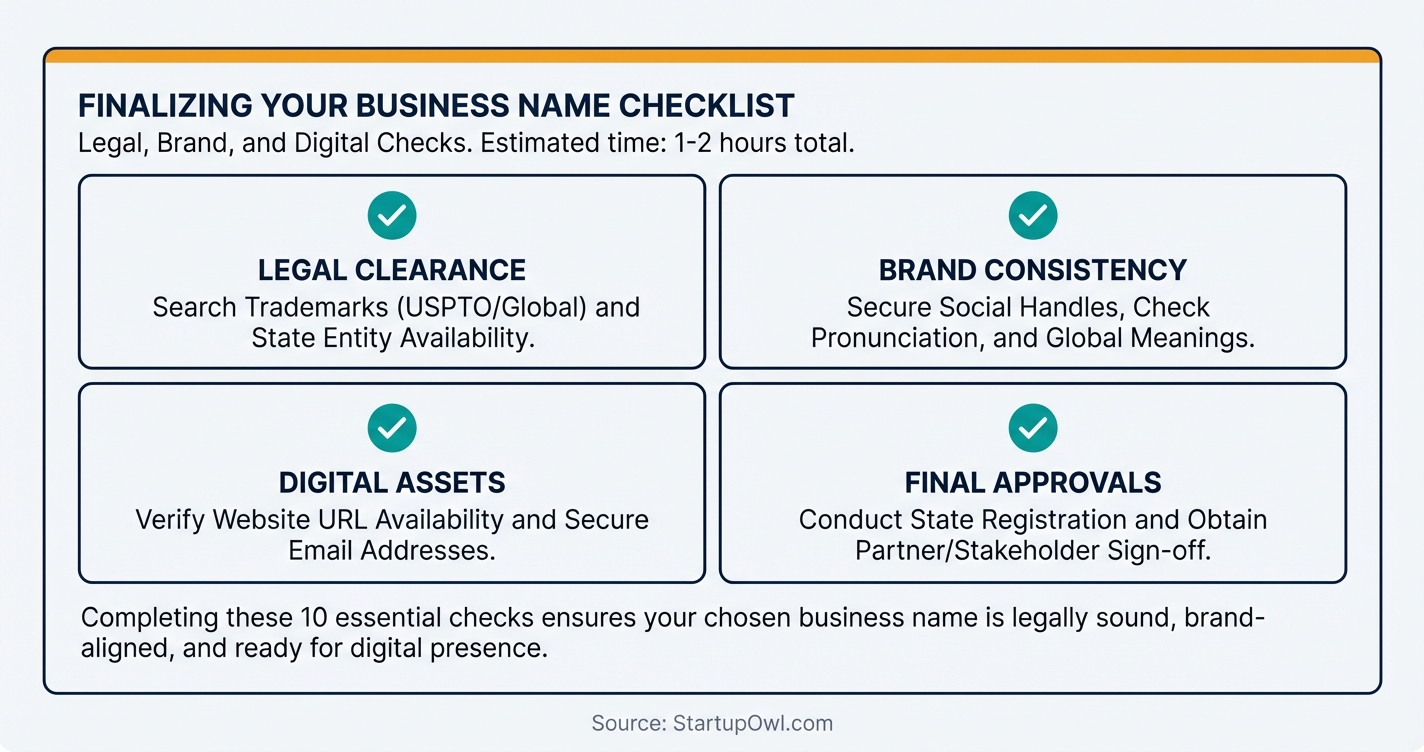
Use this checklist to move from brainstorm to fully registered business name. You can complete most steps in a single afternoon.
- Brainstorm 3 to 5 candidates. Write down names that are short (2 to 3 words), easy to spell, and easy to say aloud. Avoid names that limit your growth ("Austin Web Design" won't work if you expand to Dallas).
- Run a state SOS search for each candidate. Free and instant. Eliminate any name that's too similar to an existing entity.
- Run a USPTO trademark search. Go to tmsearch.uspto.gov. Search for exact matches and phonetic equivalents. Check the status ("LIVE" marks are the ones to worry about).
- Check .com domain availability. If the exact-match .com is available, buy it immediately (they move fast). Budget $10 to $15 per year.
- Check social media handles. Search Instagram, LinkedIn, X (Twitter), and Facebook for your name. Consistent handles across platforms strengthen your brand.
- Verify state naming rules. Make sure your name includes the required suffix ("LLC," "Inc.") and doesn't contain restricted words like "bank" or "insurance" without proper licensing.
- Reserve the name if you're not filing yet. Costs $10 to $50 in most states and holds the name for 60 to 120 days.
- File your formation documents. For an LLC, file Articles of Organization. For a corporation, file Articles of Incorporation. This officially registers your entity name. See our guide to best LLC formation services if you want help.
- File a DBA if needed. Only required if you'll operate under a name different from your legal entity name. Costs $10 to $100. See DBA filing.
- Register your domain and set up email. A professional email ([email protected]) costs about $6 per month through Google Workspace or Microsoft 365.
- Consider federal trademark protection. If you sell online or across state lines, a $350 trademark application gives you nationwide name protection.
- Get your EIN. Once your name is registered, apply for a free EIN at IRS.gov. It takes 15 minutes and costs $0.
Skipping the trademark search. Your state might approve your LLC name even if an identical federal trademark already exists. State entity registration and federal trademark registration are two completely separate systems. If you skip the USPTO search and later receive a cease-and-desist from a trademark holder, you'll have to rebrand at your own expense.
Choosing a generic or descriptive name. Names like "Best Plumbing Services LLC" or "Quality Home Cleaning Inc." are nearly impossible to trademark because they describe the service rather than identify a unique brand. The USPTO requires trademarks to be distinctive. Coined words ("Kodak"), suggestive names ("Netflix"), and arbitrary names ("Apple" for computers) are the strongest and easiest to protect.
Forgetting the required suffix. If you file LLC Articles of Organization without "LLC" or "Limited Liability Company" in the name, most states will reject the filing and your fee is typically non-refundable. Double-check your state's accepted designators before submitting.
Not checking domain availability first. You might lock in the perfect LLC name only to discover the .com domain is owned by a cybersquatter asking $10,000 for it. Always check domain availability before filing formation documents.
Using restricted words without approval. Words like "bank," "trust," "insurance," and "engineering" require separate approval from state regulatory agencies in most states. In Alabama, even the word "Olympic" is prohibited without authorization. Filing with a restricted word will result in rejection.
Ignoring DBA renewal deadlines. In California, DBAs expire every 5 years and must be renewed. In Texas, assumed names last 10 years. If your DBA lapses, you legally cannot operate under that name. Set a calendar reminder the day you file.
Paying a third-party service for searches you can do for free. Some companies charge $50 to $200 for "business name search packages" that simply query the same free government databases you can access yourself. The state SOS search, USPTO Trademark Search, and domain WHOIS lookup are all free.
Frequently Asked Questions
Sources & References
- Choose Your Business Name - U.S. Small Business Administration
- USPTO Trademark Search
- Summary of 2026 Trademark Fee Changes - USPTO
- Register Your Business - U.S. Small Business Administration
- ICANN Accredited Registrars
- California Secretary of State - Business Entities
- Secretary of State Business Entity Search (All 50 States) - LLC University
About the Author
Editor, StartupOwl
Eliot leads StartupOwl's state data research. He maintains the site's fifty state records of LLC filing fees, annual costs, processing times, and small business grant programs, checking each figure against the state office that publishes it and logging the date it was verified. Based in New Jersey, he has spent his working life in and around small businesses, and he writes for the founder who wants the real number rather than the advertised one. Every figure under his byline traces to a named source, and when a state proves a number wrong, the correction is published, not buried.
Was this article helpful?
Questions about this guide
No comments yet. Ask the first question and a member of our team will answer.
Leave a comment