
Women Entrepreneur Resources
Women own 14.2 million U.S. businesses generating $2.8 trillion yearly. Find programs, grants, WOSB certification, and tools built for women entrepreneurs.

In This Article
- Key Takeaways
- Steps From Idea to Growth
- What Counts as a Woman-Owned Business
- Real Advantages Women Entrepreneurs Have Right Now
- How to Get Started as a Woman Entrepreneur
- Government Programs and Organizations for Women Entrepreneurs
- The Biggest Challenges Women Founders Face (and How to Handle Them)
- Tools and Services Built for Women Founders
- Five Things You Can Do This Week
- Quick Wins
- FAQ
Steps From Idea to Growth
- 1
Validate Your Business Idea
Research your market, identify your target customer, and confirm demand before spending money on formation or tools.
- Write a one-page business concept using the free StartupOwl business plan template
- Research competitors in your niche using free tools like Google Trends
- Connect with a free SCORE mentor to pressure-test your idea
$0 - 2
Form and Register Your Business
Choose a business structure (LLC is the most common for women-owned businesses), register with your state, and get your EIN from the IRS.
- File your LLC using ZenBusiness ($0 + state fees) or Northwest Registered Agent ($39 + state fees)
- Apply for a free EIN at IRS.gov
- Open a dedicated business bank account to separate personal and business finances
$39–$500 depending on state - 3
Secure Funding and Certifications
Apply for grants, explore SBA loans, and pursue WOSB certification if you want access to federal contracts.
- Apply for the Amber Grant ($10,000 monthly, $15 application fee)
- Complete your WOSB certification at certifications.sba.gov (free)
- Submit your universal grant application at IFundWomen
- Visit your local Women's Business Center for free capital access counseling
$0–$15 per grant application - 4
Launch and Market Your Business
Get your first customers, set up your online presence, and build the systems that let you grow without burning out.
- Build a basic website and claim your Google Business Profile
- Create a small business marketing plan focused on your best customer channel
- Set up accounting software to track income and expenses from day one
$0–$100/mo for tools - 5
Scale and Build Your Network
Join women's business organizations, pursue larger contracts, and hire your first team members or contractors.
- Join NAWBO or your local women's business chapter for networking and advocacy
- Bid on WOSB set-aside contracts on SAM.gov
- Hire your first contractor or employee and set up payroll
$359/yr for NAWBO membership + hiring costs
StartupOwl may earn a commission when you use links on this page to sign up for business tools or services. This does not affect our recommendations or editorial independence. We only recommend products we have researched and believe will help you.
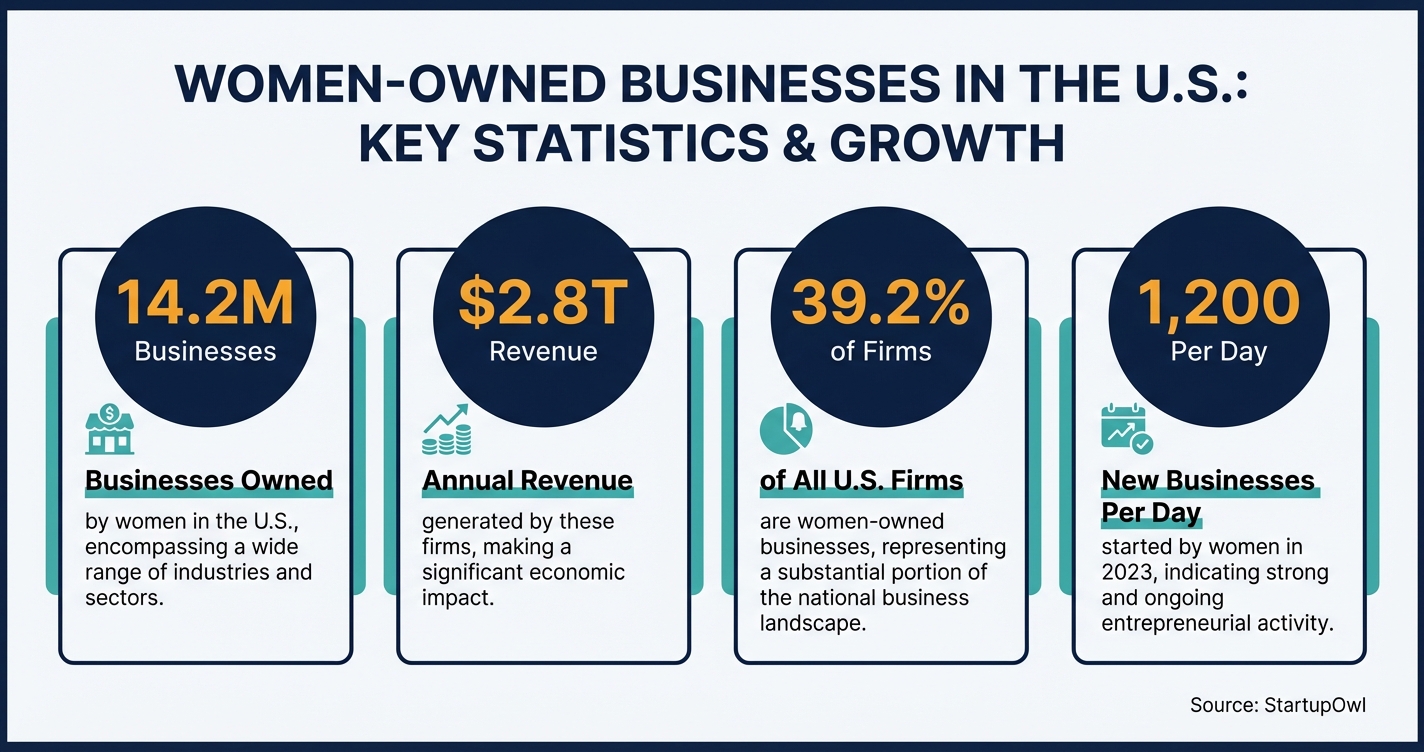
Women own 14.2 million U.S. businesses, representing approximately 39.2% of all U.S. firms and generating $2.8 trillion in annual receipts, according to the U.S. Census Bureau (2026). Between 2019 and 2024, revenue from women-owned businesses grew 53.8%.
Women started an average of 1,200 new businesses per day in 2023, and 25% of women plan to start a business in 2026. If you are one of them, this page is your starting point for the programs, grants, certifications, and tools that actually matter.
What Counts as a Woman-Owned Business
The SBA defines a Women-Owned Small Business (WOSB) as a firm that is at least 51% owned and controlled by one or more women who are U.S. citizens. Those women must manage day-to-day operations and make long-term decisions for the business, per SBA.gov.
An Economically Disadvantaged Women-Owned Small Business (EDWOSB) meets the same requirements plus additional income limits: each qualifying woman must have a personal net worth under $850,000 and adjusted gross income of $400,000 or less averaged over three years. EDWOSB certification opens access to an even smaller, less competitive pool of federal set-aside contracts.
You do not need WOSB certification to call yourself a woman-owned business. But certification through the SBA MySBA Certifications portal (free) or through a third-party certifier like WBENC is required if you want to compete for WOSB set-aside federal contracts. If you are unsure whether to choose a sole proprietorship or LLC, read our comparison first.
Real Advantages Women Entrepreneurs Have Right Now
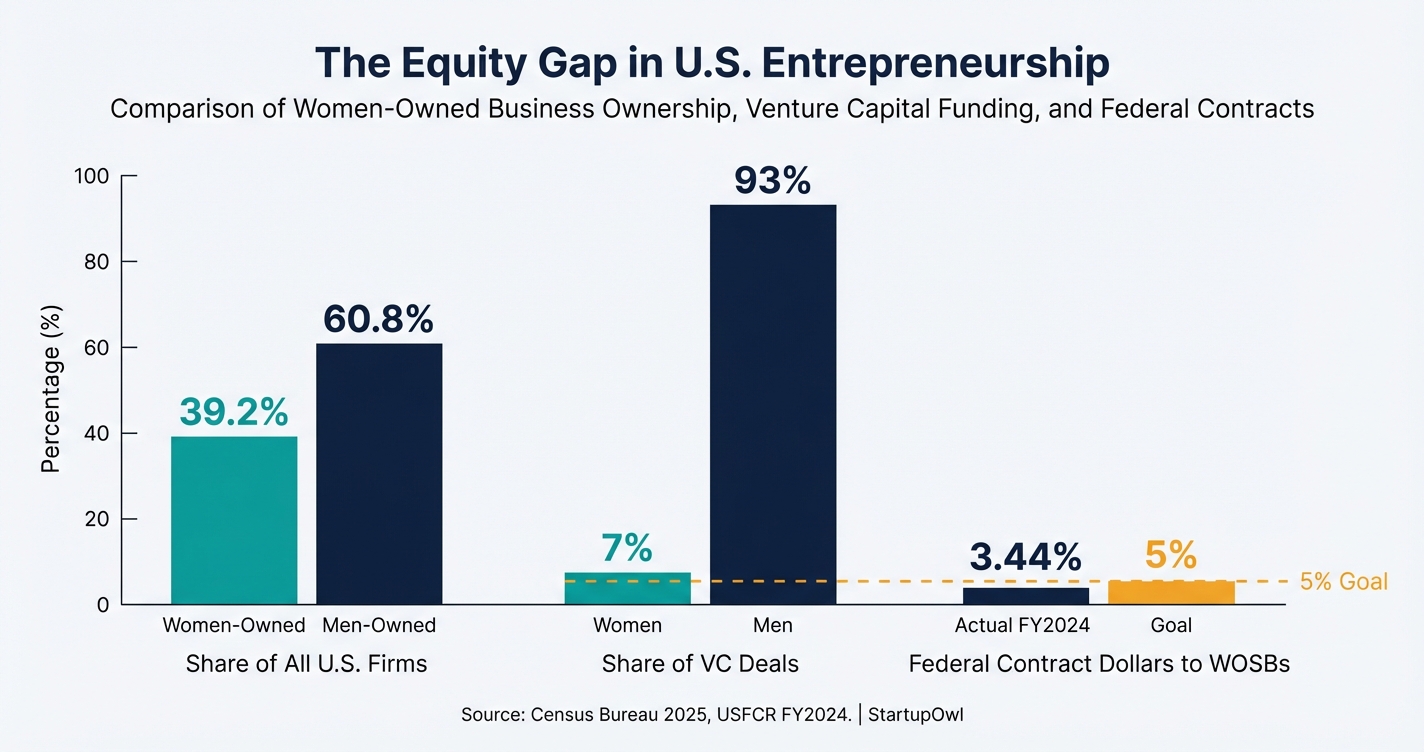
The federal government's goal is to award at least 5% of all federal contracting dollars to women-owned small businesses each year, according to SBA.gov. In FY 2024, $26.64 billion was awarded to WOSBs. That pool is growing, and WOSB-certified firms get exclusive bidding rights on set-aside solicitations.
Women are 32% more successful at reaching their crowdfunding goals than men, according to 2024 Census Bureau business data. If traditional venture capital is not available (and for most women founders, it is not), crowdfunding is a proven alternative worth considering.
Women entrepreneurs are 30% more likely than men to start businesses in health, education, or social services. These sectors offer strong community trust, recurring revenue, and growing demand. Women-owned firms in healthcare and social assistance already employ nearly 1.7 million people.
64% of new women-led businesses in 2023 were started by women of color, building companies with built-in diversity advantages in talent networks and market understanding. If you are a woman of color, explore our minority business resources page for additional grants and programs.
The SBA's network of 168 Women's Business Centers provides free one-on-one counseling, training, and mentoring on business development topics. WBCs generate $6 in small business revenue for every $1 of SBA support, according to data gathered by the Association of Women's Business Centers in 2026. These centers also sustain 340,000 jobs that contribute $16 billion in salaries.
How to Get Started as a Woman Entrepreneur
The first step is choosing a business structure. Most women-owned businesses start as an LLC because it separates your personal assets from business debts and gives you flexible tax options. You can form an LLC for as little as $0 + state fees with ZenBusiness or $39 + state fees with Northwest Registered Agent. Compare your options in our best LLC formation services guide.
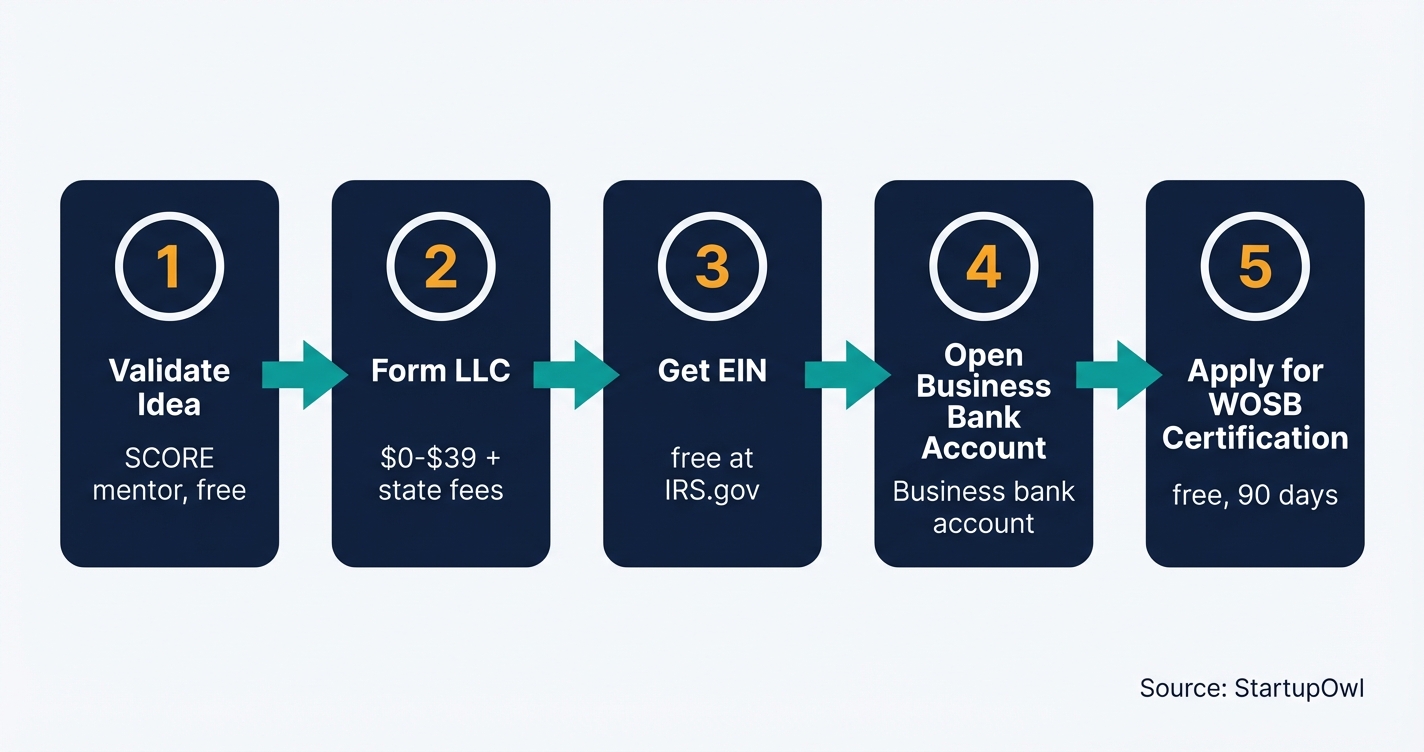
After formation, apply for a free Employer Identification Number (EIN) at IRS.gov. You will need this to open a business bank account, hire employees, and file taxes. Keep personal and business finances completely separate from day one.
Next, visit your nearest Women's Business Center for free counseling. WBCs offer training in finance, management, marketing, and access to SBA loan programs. 64% of SCORE's clients are women, per SCORE data from 2024, so you will be in good company when you request a free SCORE mentor as well.
If you plan to pursue federal contracts, begin your WOSB certification at MySBA Certifications. The process requires registering at SAM.gov (free), gathering three years of tax returns, and submitting formation documents. The SBA typically makes a determination within 90 calendar days. There is no fee to certify directly through the SBA.
For a full list of steps when you are brand new, read our guide on how to register your business. If you are still weighing whether to go solo or build a team, our solopreneur guide breaks down the tradeoffs.
Government Programs and Organizations for Women Entrepreneurs
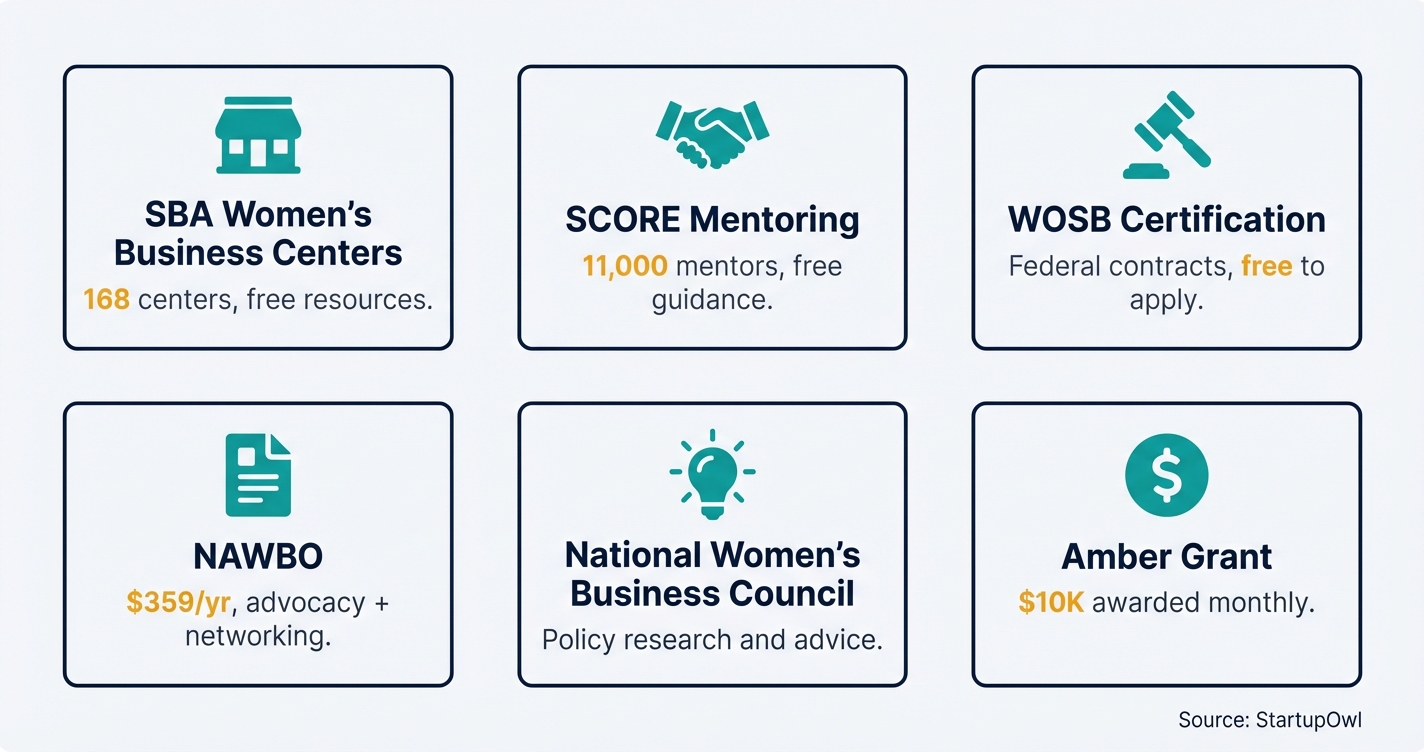
The SBA Office of Women's Business Ownership (OWBO) coordinates programs through SBA district offices nationwide, including business training, counseling, federal contracts, and access to credit and capital. The OWBO oversees 168 Women's Business Centers, the largest network in program history after a $26.25 million expansion in January 2026.
In February 2026, the WBC program received a record $27 million in federal funding through the Consolidated Appropriations Act, according to the Association of Women's Business Centers. This was the highest funding ever for the program and the first time it was explicitly included in legislative text.
SCORE provides free business mentoring through 11,000 volunteer mentors across 300+ chapters, per score.org. SCORE mentees who receive three or more hours of mentoring report higher revenues and faster growth. SCORE has a dedicated Women Entrepreneurs Resource Hub with funding webinars, networking group directories, and government contracting guidance.
The National Women's Business Council is the federal government's only independent advisory body for women entrepreneurs. It advises the President, Congress, and the SBA on economic issues affecting women-owned businesses. You can find its research and policy recommendations at nwbc.gov.
The National Association of Women Business Owners (NAWBO) is the largest dues-paying organization for women entrepreneurs, founded in 1975. NAWBO membership starts at $359.40/year plus a one-time $100 application fee. It offers advocacy, mentoring, masterminds, and chapters in approximately 50 states. Learn more at nawbo.org.
For grants and capital access, explore our grants for women-owned businesses page. If you are also a veteran or minority business owner, check our veteran business grants and minority business grants guides for additional programs.
Top Grants for Women Entrepreneurs at a Glance
| Type / Provider | Rate | Notes |
|---|---|---|
| Amber Grant (WomensNet) | $10,000/mo; $50,000/yr | $15 application fee. Open to women-owned businesses in U.S. or Canada. No industry restrictions. |
| IFundWomen Grants | $2,500–$25,000 | Free to apply via Universal Grant Application. Corporate partners include Visa and American Express. |
| EmpowHer Grant (Boundless Futures Foundation) | Up to $25,000 | For women 22+ operating a U.S. business for 3 years or less that addresses a social issue. |
| BMO Celebrating Women Grant | $10,000 | 15 grants awarded. Must be 51% women-owned, 2+ years in operation, under $5M revenue. |
| SBA Women's Business Centers | Free training and counseling | 168 centers nationwide. Includes access to SBA microloan and 7(a) loan programs. |
The Biggest Challenges Women Founders Face (and How to Handle Them)
Women-owned businesses receive only 7% of total venture capital deals, despite representing 39.2% of all U.S. firms. Only 8% of partners at U.S. venture capital firms are women, according to Census Bureau business data (2026). If VC is not realistic for you, explore startup funding options that include SBA loans, crowdfunding, and grants.
58% of women entrepreneurs use personal savings to start their business rather than seeking external capital. That bootstrapping instinct is common but can limit your growth. Apply for at least two to three grants per quarter and talk to your local WBC about SBA microloan programs (up to $50,000) to supplement personal funds.
48% of women cite lack of mentorship as a barrier to business growth. SCORE mentoring is free, available nationwide, and 87% of entrepreneurs with a SCORE mentor are still in business after one year, compared to 75% without a mentor, according to SBA.gov.
42% of women entrepreneurs run their businesses alone, compared to 19% of men. Solo founders typically have fewer resources, less margin for risk, and may delay hiring. If that describes you, our solopreneur vs entrepreneur comparison can help you decide whether to scale up or optimize your solo operation.
31% of women entrepreneurs face challenges related to childcare while running their business. The SBA's 2026 WBC expansion included the first-ever grants specifically for childcare enterprise support, signaling that policymakers are starting to address this gap. Check with your local WBC for childcare-focused programming.
Tools and Services Built for Women Founders
The right tools save you time and money in your first year. Here are the ones we recommend based on price, ease of use, and relevance to women-owned businesses.
- For LLC formation, ZenBusiness starts at $0 + state fees with a Starter plan that includes a name search, filing, and compliance alerts. The Pro plan ($199 + state fees, renewing at $199 a year) adds 1-day processing, an operating agreement template, and an EIN. If you prefer a privacy-first, no-upsell experience, Northwest Registered Agent charges $39 + state fees to file, with its registered agent service billed separately at $125 a year. Compare both in our best LLC services guide.
- For accounting, QuickBooks remains the standard for small business bookkeeping, invoicing, and tax preparation. Plans start at $35/month. See more options in our accounting software comparison.
- For mentoring (free), SCORE connects you with one of 11,000 volunteer business mentors at no cost. You can meet in person or via video, and return as often as you need for the life of your business.
- For grants and crowdfunding, IFundWomen operates a universal grant application database that matches you with corporate-sponsored grants from partners like Visa and Neutrogena. Free to apply.
- For legal services, review our best legal services for small business page. A business attorney can help with contracts, intellectual property, and compliance. Consult a CPA for tax structure decisions (LLC vs. S-corp election).
- For networking and advocacy, NAWBO membership ($359.40/year) gives you access to local chapters, mastermind groups, legislative advocacy, and corporate partner discounts.
WOSB Certification Is Free Through the SBA
You can certify as a Women-Owned Small Business at certifications.sba.gov at no cost. The process requires SAM.gov registration, three years of tax returns, and formation documents. The SBA aims to decide within 90 days. There is no term limit on program participation, so you can bid on WOSB set-aside contracts as long as you remain eligible. Sole source contract thresholds are $7 million for manufacturing and $4.5 million for all other contracts.
Five Things You Can Do This Week
You do not need a finished business plan or a perfect idea to take your first steps. These are concrete actions you can complete in the next seven days.
- Request a free SCORE mentor. Go to score.org/find-mentor, enter your ZIP code, and you will be matched with a volunteer business expert within days.
- Apply for the Amber Grant. Visit ambergrantsforwomen.com and submit your application ($15 fee). Three winners receive $10,000 every month, and monthly winners are eligible for a $50,000 annual prize.
- Locate your nearest Women's Business Center. Use the SBA WBC locator to find free in-person counseling, training, and loan packaging support.
- Download the free StartupOwl business plan template. Use our free business plan template to sketch out your idea in one page before committing any money.
- Register at SAM.gov. Registration is free and is required for WOSB certification and bidding on federal contracts. Start at sam.gov. The registration process takes 3 to 5 business days on average.
If you want a broader roadmap for your first year, read our guide on how to become an entrepreneur. Watch out for common first-time founder mistakes that cost women entrepreneurs time and money. And if burnout is already on your radar, our entrepreneur burnout guide has evidence-based strategies for managing it.
Quick Wins to Start Today
Request a free SCORE mentor at score.org/find-mentor (takes 5 minutes, matched within days)
Apply for the Amber Grant at ambergrantsforwomen.com ($10,000 monthly award, $15 fee)
Find your nearest Women's Business Center at sba.gov/local-assistance for free in-person training
Download the free business plan template at StartupOwl.com/fund/business-plan-template
Register on SAM.gov for free to begin the WOSB certification process
Frequently Asked Questions
Women own 14.2 million U.S. businesses, representing approximately 39.2% of all firms, according to the U.S. Census Bureau (2026). These businesses generate $2.8 trillion in annual revenue and employ 11.4 million to 12.9 million people.
WOSB certification verifies that your business is at least 51% owned and controlled by women who are U.S. citizens, per SBA.gov. You can certify for free at certifications.sba.gov or through a third-party certifier like WBENC. The process requires SAM.gov registration, three years of tax returns, and formation documents. The SBA aims to make a determination within 90 calendar days.
The Amber Grant from WomensNet awards three $10,000 grants monthly (with a $50,000 annual grand prize). IFundWomen connects women to corporate-sponsored grants ranging from $2,500 to $25,000. The EmpowHer Grant from Boundless Futures Foundation provides up to $25,000 for businesses under 3 years old. See our full list of grants for women-owned businesses.
Women-owned businesses receive only 7% of total venture capital deals, according to 2026 Census Bureau data. Only 8% of partners at U.S. venture capital firms are women. As an alternative, 58% of women entrepreneurs bootstrap with personal savings, and women are 32% more successful at reaching crowdfunding goals than men.
Women's Business Centers (WBCs) are SBA-funded centers that provide free one-on-one counseling, training, and mentoring to women entrepreneurs. There are 168 centers across the United States as of 2026. WBCs offer training in finance, management, marketing, and access to SBA loan programs. Find your nearest center at sba.gov.
The federal government's goal is 5%, but actual awards have consistently fallen short. In FY 2024, $26.64 billion (representing 3.44% of total federal contracts) went to WOSBs. The government has only met the 5% goal twice since 1994 (in FY2015 and FY2019). WOSB certification gives you exclusive access to set-aside contracts in underrepresented industries.
The information on this page is for educational purposes only and does not constitute financial, legal, or investment advice. Loan terms, interest rates, and eligibility requirements vary by lender and change frequently. Always consult with a qualified financial advisor before making funding decisions. StartupOwl may earn a commission if you click our links at no extra cost to you.
Sources & References
- U.S. Census Bureau Business Owner Characteristics (2026)
- SBA Women-Owned Small Business Federal Contract Program
- SBA Office of Women's Business Ownership
- SBA Women's Business Centers
- SBA Women's Business Center Expansion ($26.25M, January 2026)
- Association of Women's Business Centers Record Funding (2026)
- SCORE Women Entrepreneurs Resource Hub
- SBA Grow Your Business Through Mentorship
- WOSB Certification Requirements (13 CFR Part 127 Subpart B)
- Amber Grant for Women (WomensNet)
- NAWBO Membership
- USFCR WOSB Federal Contracting Data FY 2024
- Congressional Research Service: The WOSB Contract Program
About the Author
Editor, StartupOwl
Eliot leads StartupOwl's state data research. He maintains the site's fifty state records of LLC filing fees, annual costs, processing times, and small business grant programs, checking each figure against the state office that publishes it and logging the date it was verified. Based in New Jersey, he has spent his working life in and around small businesses, and he writes for the founder who wants the real number rather than the advertised one. Every figure under his byline traces to a named source, and when a state proves a number wrong, the correction is published, not buried.
Was this article helpful?
Questions about Women Entrepreneur Resources
No comments yet. Ask the first question and a member of our team will answer.
Leave a comment