
Entrepreneur Burnout: Prevention and Recovery
Entrepreneur burnout affects 53% of startup founders each year. Learn evidence-based prevention strategies, recovery steps, and tools to protect your health and business.

StartupOwl may earn a commission from partner links on this page at no extra cost to you. Our editorial recommendations are based on independent research and real-world testing. See our full disclosure policy for details.
A 2024 survey of 156 startup founders found that 53% experienced burnout within the past year, according to Entrepreneur.com. Burnout is not a badge of honor; it is a measurable threat to both your health and your company.
CB Insights reports that burnout was cited as a reason for startup failure in 5% of post-mortems (2021 analysis), and the true figure is likely higher when you factor in burnout-driven poor decisions and team mismanagement. If you are building a business, protecting your mental health is not optional.
What Entrepreneur Burnout Actually Looks Like
The World Health Organization defines burnout as chronic workplace stress that has not been successfully managed. For founders, it shows up as persistent exhaustion that sleep cannot fix, growing cynicism about work you once loved, and a measurable decline in your ability to make good decisions.
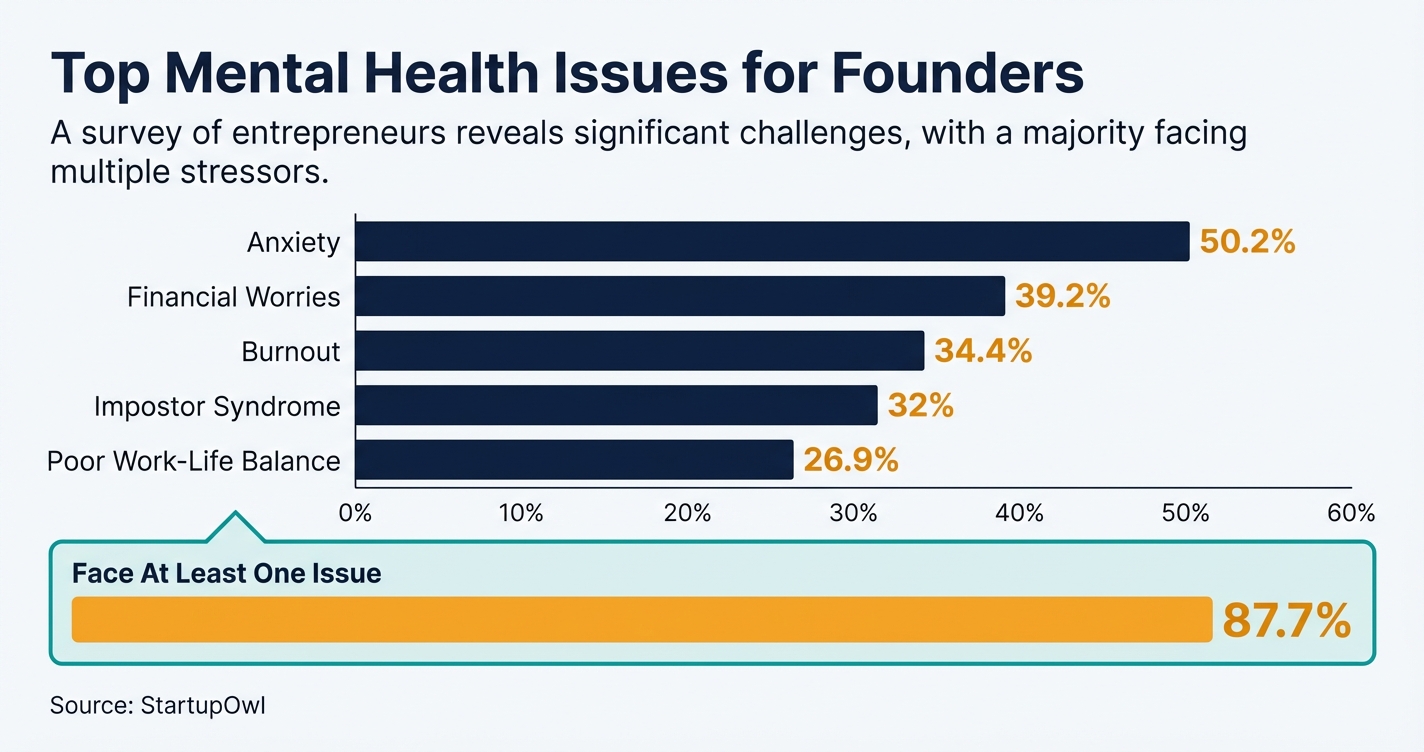
According to a Founder Reports survey, 87.7% of entrepreneurs struggle with at least one mental health issue, with anxiety (50.2%), high stress, financial worries, and burnout topping the list. Only 12.3% said they face no mental health challenges at all.
Burnout hits differently depending on who you are. About 36.1% of male entrepreneurs report burnout compared to 30.9% of women, while women experience higher rates of financial worry (44.1% vs 37.1% for men) and impostor syndrome (41.2% vs 27.8%), per the same survey. If you are under 35, you are also more likely to struggle with isolation (30.7% vs 21.2% for those 35 and older).
Burnout is most commonly experienced within the first three years of starting a business, according to WiFiTalents. That window lines up with the period when you are most likely to be wearing every hat, bootstrapping finances, and building without a safety net. If you are in that phase, recognize that you are in the highest-risk zone.
Five Steps to Prevent and Recover from Entrepreneur Burnout
Burnout is usually triggered by avoidable patterns, not by the inherent difficulty of building a business. The steps below are backed by research and designed for founders who do not have time for vague wellness advice.
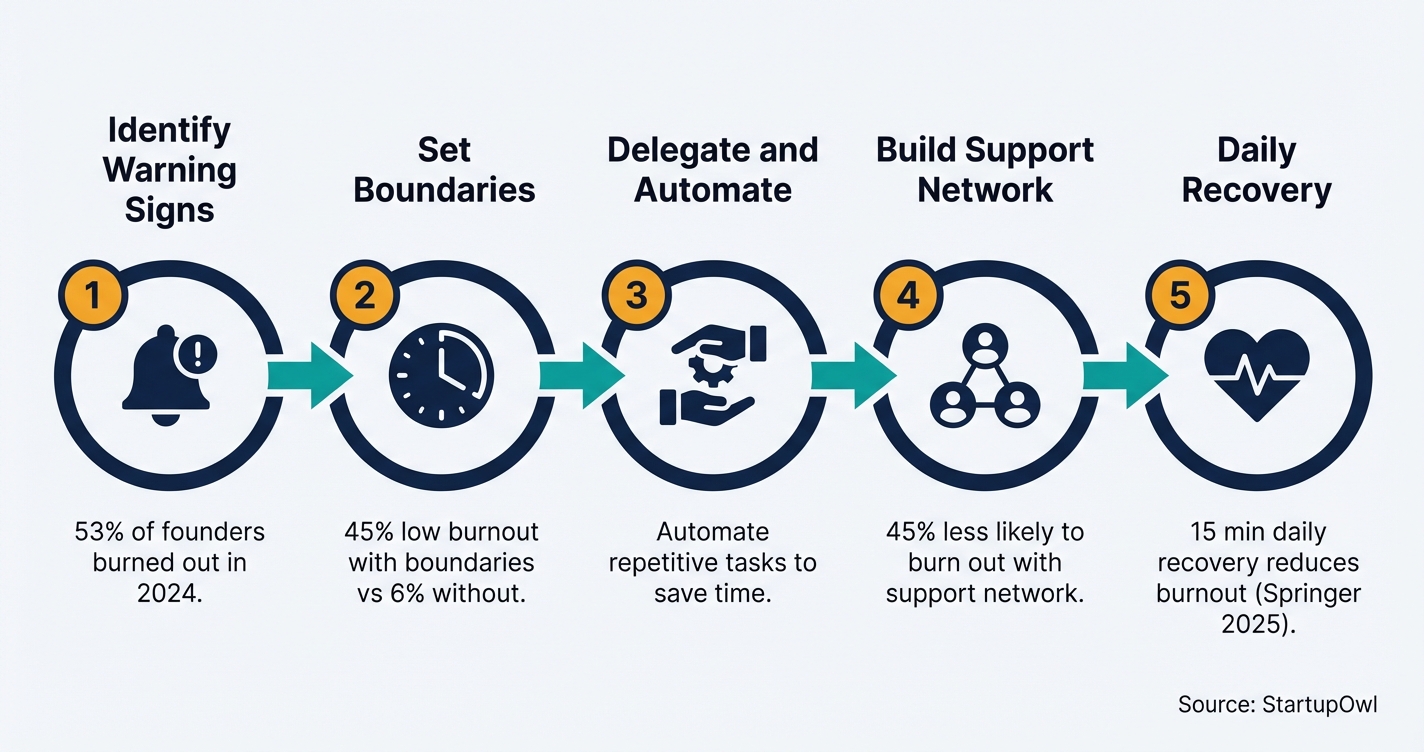
Step 1. Identify your personal warning signs. One of the earliest signs of founder burnout is not feeling too much but the absence of feeling, according to Mercury. Track your daily energy on a 1-to-10 scale for one week. Three or more days below a 4 is a red flag.
Step 2. Set non-negotiable work-life boundaries. Research shows that 45% of entrepreneurs with clear work-life boundaries report low burnout, compared to just 6% of those without boundaries. Define your work hours, enforce a digital sunset, and schedule at least one no-meeting day per week.
Step 3. Delegate or automate low-value tasks. Many founders operate as the bottleneck for every major process. Start by logging every task you do for five business days, then hand off anything someone else can do at 80% quality. Explore AI tools for small business to automate social media, customer support, and basic bookkeeping.
Step 4. Build a support network. Entrepreneurs with a support network are 45% less likely to burn out, per Gitnux. SCORE provides free business mentoring with 10,000 volunteers nationwide. You can also join peer groups, attend local founder meetups, or find an accountability partner who understands the pressure of building a company.
Step 5. Invest in daily recovery. A 2026 study published in Small Business Economics (Springer) confirmed that daily recovery experiences (relaxation, mastery activities, and control over free time) directly reduce burnout in entrepreneurs. Even 15 minutes of intentional downtime each day matters. Try meditation apps, take a daily walk, or block recovery time on your calendar like any other meeting.
If you are still in the early stages of starting your business, make sure your legal foundation is solid so you are not adding unnecessary stress. Form an LLC to protect your personal assets, and consider using LLC formation services to save yourself hours of paperwork.
Tools That Help Founders Manage Stress and Workload
The right tools will not cure burnout, but they can remove friction from your daily operations and free up mental bandwidth. Here are four worth considering.
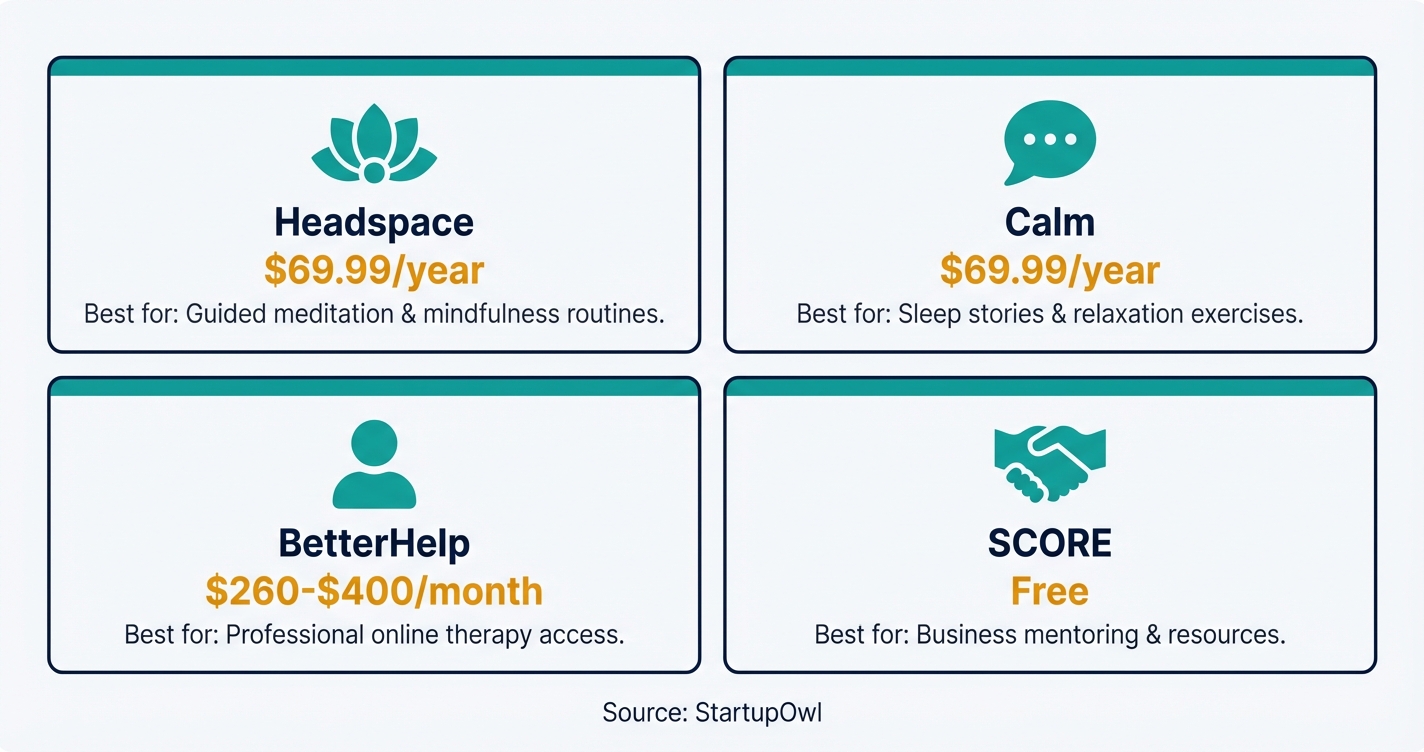
- Headspace offers guided meditation courses designed for beginners at $69.99/year (or $12.99/month). It also now includes therapy through Headspace Care, with sessions starting at $0 with insurance or $149 cash-pay per session.
- Calm focuses on sleep and relaxation with celebrity-narrated Sleep Stories and daily meditation, priced at $69.99/year (or $14.99/month). Ideal if your burnout symptoms center on insomnia or difficulty winding down.
- BetterHelp connects you with a licensed therapist for $260 to $400 per month (billed every four weeks), including weekly live sessions and unlimited messaging. Financial aid is available if cost is a barrier.
- SCORE Mentoring is 100% free. Matching with an experienced mentor can reduce isolation and give you a sounding board for the decisions that keep you up at night. Mentored businesses survive at twice the rate of non-mentored ones, per a UPS Store survey.
For the operational side, set up accounting software to automate your bookkeeping, and open a dedicated business bank account to separate personal and business finances. These two steps alone eliminate hours of weekly admin stress.
Five Burnout Mistakes That Founders Keep Making
1. Treating exhaustion as proof you are working hard enough. Hustle culture glorifies overwork, but 53% of entrepreneurs who experienced burnout reported a decline in creativity and innovation (ZipDo, 2026). Exhaustion actively degrades the quality of your work.
2. Ignoring financial stress as a burnout driver. About 45% of entrepreneurs cite financial stress as a core factor in burnout (ZipDo). If cash flow anxiety is keeping you awake, address it directly with a pricing calculator and a startup funding plan instead of just working more hours.
3. Scaling your team too fast without systems. A University of Amsterdam study found that solopreneurs had the lowest burnout risk, and that risk increased when founders expanded and hired employees. Hiring without documented processes creates more fires for you to put out, not fewer.
4. Refusing to delegate because "nobody does it as well as I do." This is the single fastest path to becoming a bottleneck. Start with two low-stakes tasks and build your delegation muscle gradually.
5. Skipping professional help because of cost or stigma. Only 23% of founders see a psychologist or coach, according to research from UC San Francisco. The top barriers are cost (73%) and lack of time (52%). If BetterHelp's $260/month minimum is too steep, start with SCORE mentoring (free) or the 988 Suicide and Crisis Lifeline if you are in immediate distress.
What to Do This Week
Start with one action today. Request a free SCORE mentor, download a meditation app, or simply block two hours of recovery time on your calendar this week. Small, consistent changes prevent burnout far more effectively than dramatic overhauls after a breakdown.
If you are still building your business foundation, make sure the basics are right. Register your business properly, review sole proprietorship vs LLC to pick the right structure, and explore small business grants so financial stress does not become your primary burnout trigger.
For more on building a sustainable founder mindset, read our guides on entrepreneur mindset, common first-time founder mistakes, and turning a side hustle into a business without burning out in the process.
Step-by-Step Process
- 1
Identify your personal burnout warning signs
Burnout starts with emotional flattening, not dramatic collapse. Watch for loss of excitement about work you used to enjoy, chronic fatigue that sleep does not fix, and increasing cynicism about your business tasks.
Track your energy levels for one week using a simple 1-to-10 daily rating. If you score below 4 for three or more consecutive days, you are likely approaching burnout.
Tips
- Ask yourself: if the last two months continued indefinitely, how long could you sustain this pace?
- Note physical symptoms like headaches, insomnia, or appetite changes alongside emotional ones.
Common Mistakes
- Dismissing fatigue as normal hustle culture behavior.
- Waiting for a full breakdown before acknowledging the problem.
- 2
Set non-negotiable work-life boundaries
Research shows that 45% of entrepreneurs with work-life boundaries report low burnout, compared to only 6% without boundaries. Define specific work hours and protect them with the same discipline you apply to client meetings.
Create a "digital sunset" ritual where you put devices away at a set time each evening. Schedule at least one "no-meeting" day per week for deep work or rest.
$0 1-2 days to set upTips
- Use app blockers like Freedom ($8.99/month) or built-in phone focus modes to enforce boundaries.
- Tell your team and clients about your boundaries so they become the expected norm.
Common Mistakes
- Setting boundaries but making constant exceptions that erode them within a week.
- Feeling guilty when not working, which leads to checking Slack or email during off hours.
- 3
Delegate or automate your lowest-value tasks
Many founders operate as the bottleneck for every process. Identify three to five recurring tasks you handle out of habit rather than necessity, and transfer ownership. Use AI tools for small business to automate email responses, social media scheduling, and basic customer support.
If you are a solopreneur, consider hiring a virtual assistant for $5 to $15 per hour through platforms like Belay or Time Etc.
$0-$500/month 1-2 weeksTips
- Start by logging every task you do for five days, then highlight anything someone else could do at 80% of your quality.
- Automate invoicing and bookkeeping with accounting software to save 3-5 hours per week.
Common Mistakes
- Trying to delegate everything at once instead of starting with two or three tasks.
- Re-doing delegated work because it is not perfect, which defeats the purpose.
- 4
Build a support network of peers and mentors
Entrepreneurs with a support network are 45% less likely to burn out, according to Gitnux research. Isolation is one of the biggest accelerators of burnout, especially for founders under 35 (where 30.7% report struggling with isolation).
SCORE offers free one-on-one business mentoring through a network of 10,000 volunteers in all 50 states. You can also join local founder meetups or online communities to share the emotional load of running a business.
Tips
- Request a SCORE mentor who has experience in your specific industry.
- Join at least one peer group (YPO, Indie Hackers, local chamber) and attend monthly.
Common Mistakes
- Only talking to other founders about business tactics instead of openly discussing stress.
- Skipping peer events because you feel too busy, which deepens the isolation cycle.
- 5
Invest in daily recovery practices
A 2026 study in Small Business Economics found that daily recovery experiences (relaxation, control over free time, and mastery activities) directly reduce burnout and increase well-being in entrepreneurs. Even 15 minutes of deliberate daily recovery makes a measurable difference.
Try meditation apps like Headspace ($69.99/year) or Calm ($69.99/year). The WHO recommends 150 minutes of physical activity per week, which also serves as a powerful burnout buffer.
Tips
- Anchor your recovery habit to an existing routine (e.g., meditate right after your morning coffee).
- Exercise does not need to be intense; a 20-minute daily walk counts.
Common Mistakes
- Treating self-care as a reward you earn only after hitting milestones.
- Skipping recovery during busy weeks, which are precisely when you need it most.
Frequently Asked Questions
A 2024 survey found that 53% of startup founders experienced burnout in the past year. Separately, a Founder Reports survey shows 34.4% of entrepreneurs have faced burnout, making it the fourth most common mental health issue behind anxiety, high stress, and financial worries.
The earliest signs are emotional flattening (not feeling excited or upset about anything), difficulty focusing, and loss of motivation. Physical symptoms include chronic fatigue, headaches, and disrupted sleep. If you dread Sunday nights or feel cynical about tasks you used to enjoy, those are reliable warning signals.
Yes. CB Insights found that burnout was cited as a reason for failure in 5% of startup post-mortems (2021 report). The real impact is higher because burnout causes poor decision-making, team mismanagement, and loss of motivation that show up under other failure categories.
SCORE provides free business mentoring with 10,000 volunteers nationwide. The 988 Suicide and Crisis Lifeline offers 24/7 support. NAMI (National Alliance on Mental Illness) has free support groups, and many meditation apps like Headspace offer limited free content or student pricing as low as $9.99/year.
A University of Amsterdam study found that solopreneurs had the lowest burnout risk among entrepreneurs studied. The risk increased for founders who expanded and hired employees. That said, solopreneurs are more vulnerable to isolation, so building a peer network is essential. Read our solopreneur guide for more on sustainable solo business building.
BetterHelp costs $260 to $400 per month for weekly sessions with a licensed therapist. Headspace Care offers therapy starting at $0 with insurance or $149 per session cash-pay. SCORE mentoring is free and addresses business-related stress directly.
The information on this page is for educational purposes only and does not constitute financial, legal, or investment advice. Loan terms, interest rates, and eligibility requirements vary by lender and change frequently. Always consult with a qualified financial advisor before making funding decisions. StartupOwl may earn a commission if you click our links at no extra cost to you.
Sources & References
- Entrepreneur.com: 1 in 2 Founders Reported Experiencing Burnout in 2024
- Founder Reports: 17 Mental Health Statistics for Entrepreneurs (2026)
- CB Insights: The Top 12 Reasons Startups Fail (2021)
- University of Amsterdam: Burnout Study via Entrepreneur.com (2023)
- Gitnux: Entrepreneur Burnout Statistics (2026)
- ZipDo: Entrepreneur Burnout Statistics (2026)
- WiFiTalents: Entrepreneur Burnout Statistics
- Springer: Mental Health of Entrepreneurs and Daily Recovery Experiences (2026)
- CEREVITY: Tech Founder Burnout Statistics (2026)
- SCORE: Free Business Mentoring
- BetterHelp: Pricing Information
- Headspace: App Pricing
- Mercury: The 3 Alarms of Founder Burnout
- SBA: SCORE Business Mentoring
About the Author
Editor, StartupOwl
Eliot leads StartupOwl's state data research. He maintains the site's fifty state records of LLC filing fees, annual costs, processing times, and small business grant programs, checking each figure against the state office that publishes it and logging the date it was verified. Based in New Jersey, he has spent his working life in and around small businesses, and he writes for the founder who wants the real number rather than the advertised one. Every figure under his byline traces to a named source, and when a state proves a number wrong, the correction is published, not buried.
Was this article helpful?
Questions about Entrepreneur Burnout
No comments yet. Ask the first question and a member of our team will answer.
Leave a comment