
The Entrepreneur Mindset
Learn the entrepreneur mindset traits that separate the 80% of businesses surviving year one from those that fail. Self-discipline, risk tolerance, and 5 actionable shifts.

StartupOwl may earn a commission when you use links on this page to sign up for business tools and services. This does not affect our editorial recommendations, and you pay nothing extra. Read our full disclosure policy for details.
About 80% of new U.S. businesses survive their first year, according to 2024 Bureau of Labor Statistics data. The other 20% that close share common patterns: no market validation, poor cash management, and a mindset that treats entrepreneurship as a personality trait instead of a set of trainable skills.
This is not a pep talk. The entrepreneur mindset is a specific combination of risk assessment, self-discipline, and adaptability that you can build deliberately, regardless of your education, age, or background. 39% of successful entrepreneurs have a college degree, and 30% started with only a high school diploma, according to TeamStage research.
If you are exploring whether to start a business, read our full guide on how to become an entrepreneur. If you already know you want to go solo, our solopreneur guide covers the nuts and bolts.
What the Entrepreneur Mindset Actually Means (and What It Does Not)
The entrepreneur mindset is not about being fearless or working 80-hour weeks. It is the ability to evaluate risk accurately, act on incomplete information, and learn from failure faster than your competition. A Kauffman Foundation study of 300 founders found a measurable link between a founder's mindset and their company's culture, innovation output, and funding success.
Growth-minded founders in that study built companies that were more flexible, more ethical, and less internally competitive. Their employees reported higher trust and lower turnover. Fixed-mindset founders, by contrast, saw higher burnout rates on their teams.
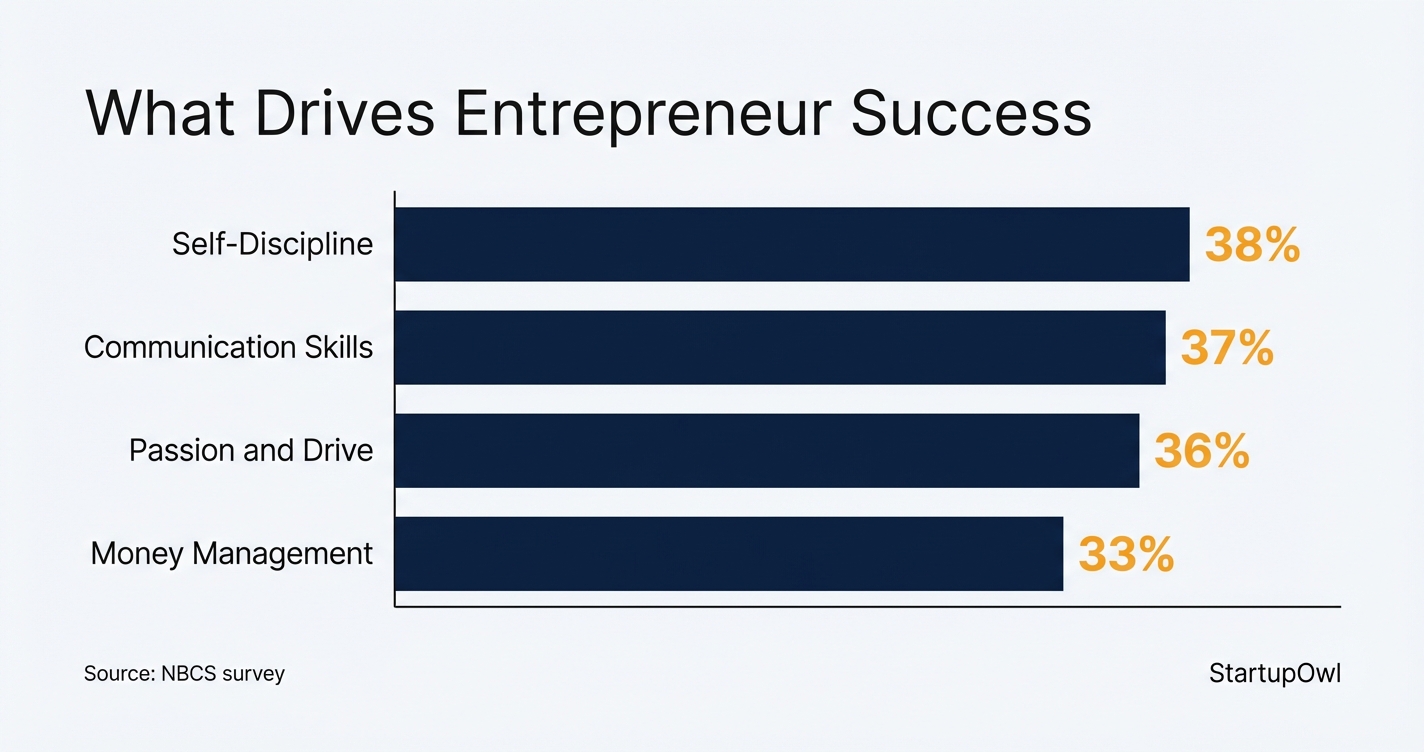
Here is what the research says matters most. According to a National Business Capital and Services survey, 38% of entrepreneurs named self-discipline as the single biggest factor in their success. People and communication skills came in at 37%, followed by passion and drive.
Notice what is not on that list: venture capital, a business degree, or a revolutionary product idea. The entrepreneur mindset is about daily execution, not flashes of genius.
Five Steps to Build Your Entrepreneur Mindset
These five steps follow what research and real founder experience show to be the highest-impact mental shifts. They are presented in order, starting with risk assessment and ending with burnout prevention.
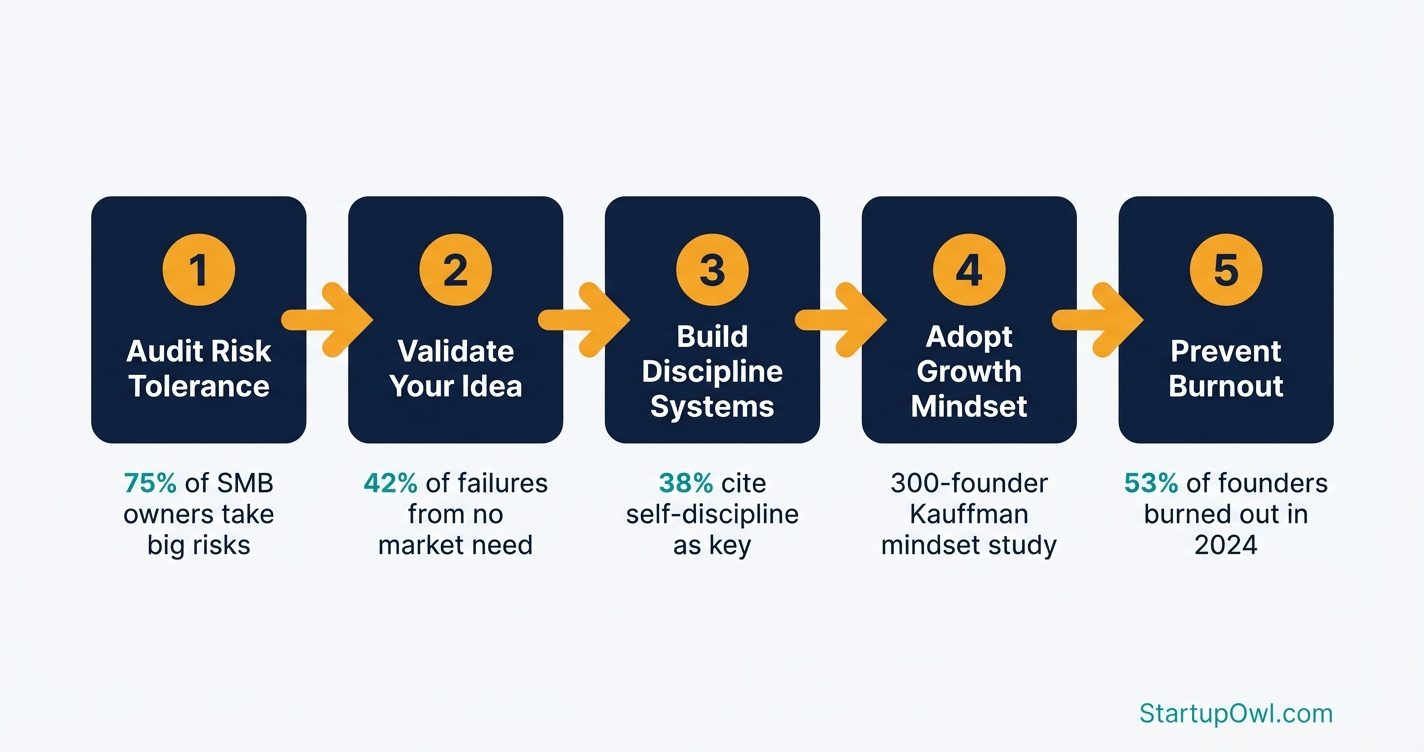
Step 1: Audit your risk tolerance honestly. 75% of small and medium business owners say they are ready to take significant risks, according to Oxford Economics data. Before you commit, calculate your personal runway (how many months you can survive on savings if revenue is zero). If your runway is under six months, build it up before you quit your job.
Step 2: Validate your idea with real customers. 42% of failed startups cite no market need as the reason they shut down, according to CB Insights research. Talk to at least 20 potential customers. Ask what they pay today to solve the problem you want to address. If they cannot name a number, that is a red flag. Use our free business plan template to organize your findings.
Step 3: Replace motivation with self-discipline systems. Motivation disappears when things get hard. Systems do not. Start with one 90-minute daily time block for your most important task. Review your progress every Sunday for 15 minutes. Track it with a simple tool like Notion or Todoist.
Step 4: Adopt a growth mindset deliberately. The Kauffman Foundation study found that growth-minded founders secured a larger share of their target funding round. After every setback, write down one lesson and one change. This is not journaling therapy; it is a business feedback loop that improves your decision-making over time.
Step 5: Build burnout prevention into your operating system. A 2024 survey found that 53% of startup founders experienced burnout. Nearly 60% said it hurt their ability to make decisions. Schedule one full day off each week. Cap your work hours at 50 in a normal week. Entrepreneurs with a support network are 45% less likely to burn out, so connect with a free SCORE mentor or join a founder peer group. Read more in our guide on entrepreneur burnout.
Tools That Support the Entrepreneur Mindset
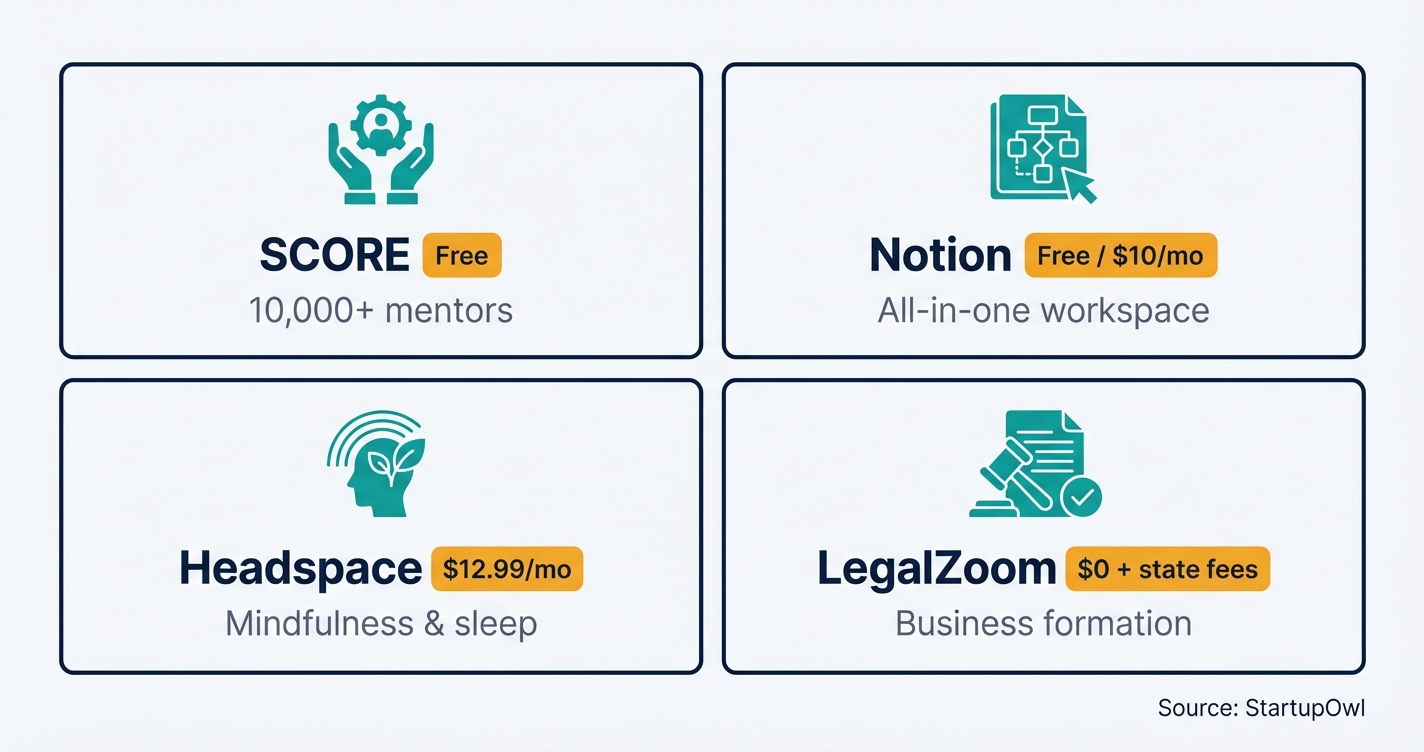
The right tools reduce friction and protect your mental energy. Here are four that directly support the mindset habits in this guide.
- SCORE Mentoring is free, funded by the SBA, and connects you with one of 10,000+ volunteer mentors across all 50 states. Small business owners who receive three or more hours of SCORE mentoring report higher revenues and faster growth.
- Notion (free plan available, paid from $10/month) works as a combined task manager, lessons-learned log, and business wiki. It replaces scattered notes with one searchable system.
- Headspace (from $12.99/month) offers guided meditations specifically designed for stress and focus. Given that 50% of entrepreneurs experience anxiety, this is a business tool, not a luxury.
- LegalZoom (LLC formation from $0 + state fees) handles the legal setup so you can focus mental energy on customers and product. If you are ready to form an LLC, starting the legal paperwork removes one of the biggest mental blockers for new founders.
For a deeper comparison of formation services, check our review of the best LLC formation services. And once you are set up, open a business bank account to separate personal and business finances on day one.
Five Mindset Mistakes That Kill Businesses
1. Skipping market validation. 42% of failed startups cite no market need, per CB Insights. Falling in love with your idea without talking to real customers is the most expensive mental error you can make. Validate before you build.
2. Confusing activity with progress. Working 70 hours per week means nothing if you spend those hours on low-value tasks. The entrepreneur mindset demands ruthless prioritization, not just effort. Focus on the one metric that moves your business forward each week.
3. Ignoring burnout signals. 72% of entrepreneurs report experiencing burnout at some point in their careers, according to Gitnux research. Insomnia, chronic fatigue, and irritability are not signs of hustle. They are warning lights that your decision-making is about to degrade. Read our full guide on entrepreneur burnout.
4. Refusing to ask for help. Only 18.5% of entrepreneurs know about mental health resources available to them, according to Founder Reports research. Free mentoring through SCORE and free advising at your local Small Business Development Center (SBDC) exist specifically so you do not have to figure everything out alone.
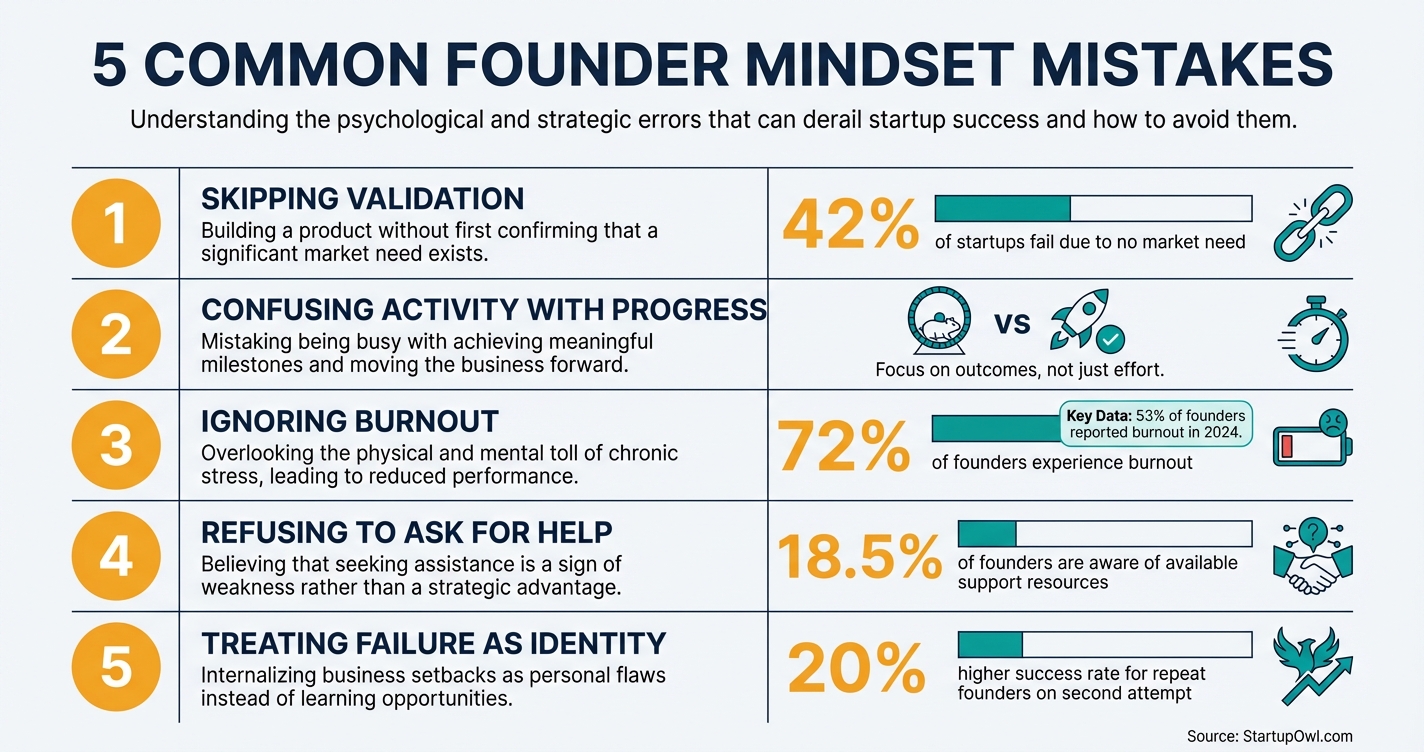
5. Treating failure as identity instead of data. Entrepreneurs who failed once are more likely to succeed on their second attempt. Prior experience with failure raises your odds of success by 20%, according to Harvard Business School research cited by TeamStage. The growth mindset reframes every failure as an experiment that produced useful results. For more on this, see our list of common first-time founder mistakes.
What to Do This Week
Pick one step from this guide and act on it today. If you have not validated your business idea, schedule five customer conversations this week. If burnout is already creeping in, sign up for a free SCORE mentor and schedule your rest day.
When you are ready to make your business official, walk through our step-by-step guide to register your business or compare the sole proprietorship vs. LLC structures. Pair those with our top picks for accounting software and you will have the operational foundation to match your mindset work.
For funding your idea, explore startup funding options or browse small business grants that do not require repayment.
Step-by-Step Process
- 1
Audit your current risk tolerance honestly
Three-quarters of small and medium business owners say they are willing to take significant risks for success, according to Oxford Economics data. Before you launch, write down the three biggest financial risks you would face if your business earned zero revenue for six months.
This exercise is not about scaring yourself. It gives you a realistic picture of what you can handle and where you need a financial buffer.
Tips
- Calculate your personal runway in months, not years.
- Include household expenses, not just business costs.
Common Mistakes
- Overestimating your comfort with risk because you feel excited about your idea.
- 2
Validate your idea before building anything
The number one reason startups collapse is that 42% cite no market need, according to CB Insights post-mortem research. Talk to at least 20 potential customers before spending a dollar on product development.
Ask them what they currently pay to solve the problem you want to address. If they cannot name a dollar amount, you may not have a real market.
Tips
- Use free tools like Google Forms or Typeform to collect responses.
- Focus on the problem, not your proposed solution.
Common Mistakes
- Asking friends and family who will tell you what you want to hear.
- Skipping validation because you are certain about the concept.
- 3
Build self-discipline systems, not motivation habits
According to a National Business Capital and Services survey, 38% of entrepreneurs named self-discipline as the number one factor behind their success. Motivation fluctuates daily, but systems (time-blocking, non-negotiable daily actions, weekly reviews) produce consistent output.
Start with a 90-minute morning block dedicated to your highest-value task. Protect it the way you would protect a meeting with your most important client.
$0 - $15/month for a productivity app OngoingTips
- Use a tool like Notion or Todoist to track daily non-negotiables.
- Review your week every Sunday for 15 minutes.
Common Mistakes
- Relying on willpower instead of pre-built routines.
- Trying to overhaul your entire schedule at once rather than adding one habit at a time.
- 4
Adopt a growth mindset backed by Kauffman Foundation research
A Kauffman Foundation study of 300 entrepreneurs found that founders with a growth mindset built more innovative, more ethical company cultures and secured a larger share of funding in their latest round. Fixed-mindset founders saw higher employee turnover and burnout.
In practice, a growth mindset means treating every failure as data. After every setback, write down one thing you learned and one thing you will change. This is not self-help fluff; it directly affects your fundraising outcomes.
Tips
- Keep a 'lessons learned' log in your phone or notebook.
- Ask your team for honest feedback monthly.
Common Mistakes
- Confusing a growth mindset with toxic positivity (ignoring real problems).
- Assuming growth mindset means saying yes to everything.
- 5
Set up burnout prevention from day one
A 2024 survey found that 53% of startup founders reported burnout in the prior year. Nearly 60% said it impaired their ability to lead and make decisions. Burnout is not a badge of honor. It is a business risk that kills companies.
Schedule at least one full day off per week and cap work at 50 hours in a normal week. Entrepreneurs with a support network are 45% less likely to burn out, so find a peer group or mentor through SCORE right away.
Tips
- Block personal time on your calendar before filling it with work tasks.
- Join a founder peer group (YPO, Indie Hackers, or a local meetup).
Common Mistakes
- Treating rest as a reward for productivity instead of a requirement for it.
- Ignoring physical symptoms like insomnia and chronic fatigue.
Frequently Asked Questions
You can absolutely develop it. A Kauffman Foundation study of 300 founders confirmed that mindset is measurable and trainable, and that growth-minded founders built better cultures and raised more capital. Start with daily self-discipline habits and deliberate learning from each failure.
Self-discipline, according to 38% of entrepreneurs surveyed by National Business Capital and Services. Communication skills and passion tie for second at 37%. Discipline keeps you executing on hard days when motivation is gone.
Reframe failure as data, not identity. Entrepreneurs who failed once have a 20% higher chance of succeeding on their next venture, per Harvard Business School research. Write down what you learned from each setback, adjust your approach, and keep moving. Free mentoring through SCORE can give you an experienced sounding board.
Schedule one full rest day per week and cap your normal work hours at 50. A 2024 survey found 53% of founders experienced burnout, and nearly 60% said it damaged their decision-making. Connect with a peer group or mentor early. Entrepreneurs with a support network are 45% less likely to burn out.
No. Only 9% of entrepreneurs hold a bachelor's degree in business, yet 40% of small businesses are profitable. Industry experience matters far more. A National Bureau of Economic Research study found that founders with prior experience in their industry are up to 125% more likely to achieve high growth.
The information on this page is for educational purposes only and does not constitute financial, legal, or investment advice. Loan terms, interest rates, and eligibility requirements vary by lender and change frequently. Always consult with a qualified financial advisor before making funding decisions. StartupOwl may earn a commission if you click our links at no extra cost to you.
Sources & References
- U.S. Bureau of Labor Statistics (2024) - Business Employment Dynamics
- Kauffman Foundation - Entrepreneur Mindset Case Study (2024)
- Kauffman Indicators of Entrepreneurship
- CB Insights - Top Reasons Startups Fail
- National Bureau of Economic Research - Age and High-Growth Entrepreneurship
- SCORE - Free Business Mentoring (SBA Resource Partner)
- SBA Office of Advocacy - Small Business Facts
- WithDouble (2024) - Founder Burnout Survey
- Founder Reports - Entrepreneur Mental Health Statistics
- LegalZoom - Key Entrepreneur Statistics (2024)
About the Author
Editor, StartupOwl
Eliot leads StartupOwl's state data research. He maintains the site's fifty state records of LLC filing fees, annual costs, processing times, and small business grant programs, checking each figure against the state office that publishes it and logging the date it was verified. Based in New Jersey, he has spent his working life in and around small businesses, and he writes for the founder who wants the real number rather than the advertised one. Every figure under his byline traces to a named source, and when a state proves a number wrong, the correction is published, not buried.
Was this article helpful?
Questions about The Entrepreneur Mindset
No comments yet. Ask the first question and a member of our team will answer.
Leave a comment