
Solopreneur Business Ideas
Explore proven solopreneur business ideas backed by data from 30.4 million U.S. nonemployer businesses generating $1.8 trillion. Find your best fit today.

In This Article
StartupOwl may earn a commission when you use links on this page to sign up for business tools or services. This does not affect our editorial recommendations. We only suggest products we have researched and believe are genuinely useful for solopreneurs.
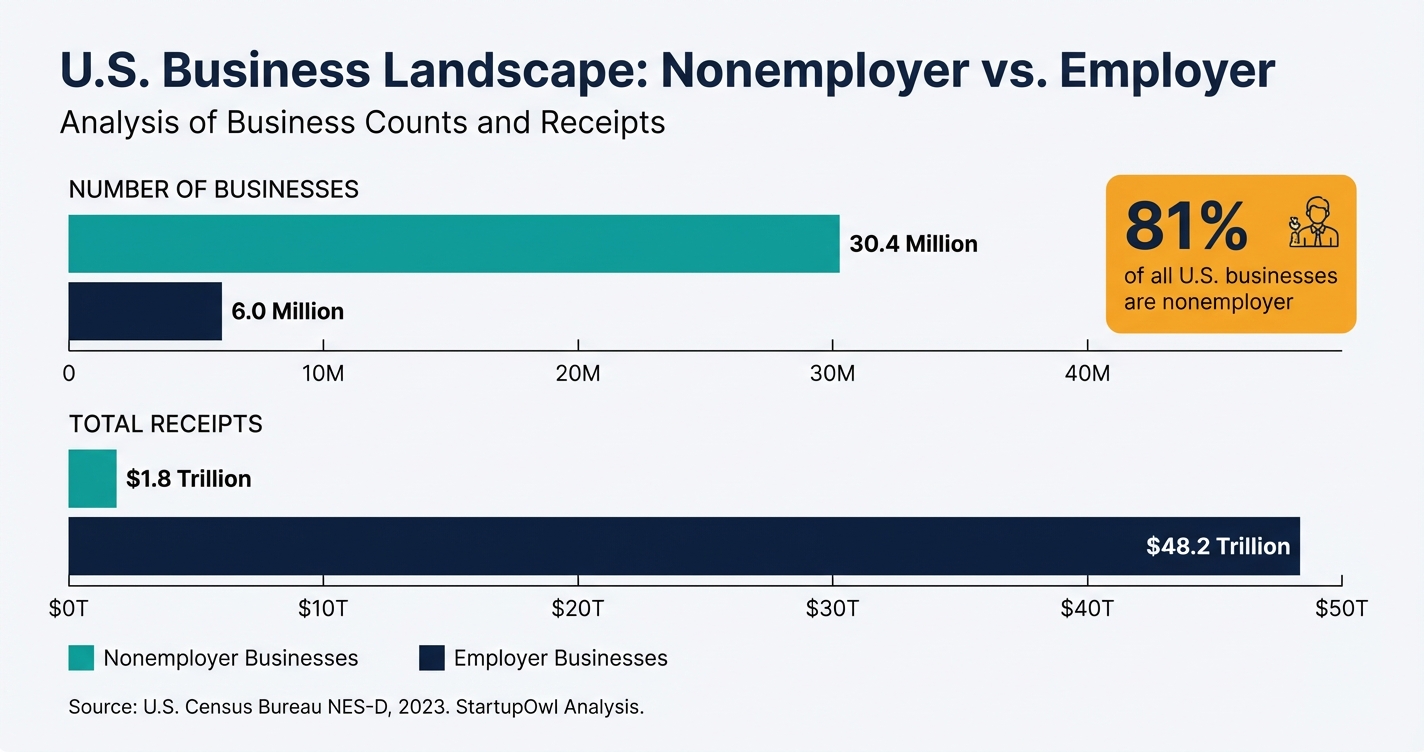
30.4 million nonemployer businesses operated in the U.S. in 2023, pulling in a combined $1.8 trillion in receipts, according to the U.S. Census Bureau NES-D (2023). That is roughly 81% of every business in America, run by one person with zero employees.
You do not need a team, a warehouse, or venture capital to build a real business. Nearly half of solopreneurs launched with under $5,000 in startup capital, and 77% reported profitability in their first year. The ideas below are not hypothetical; they are proven models that real solo operators use to earn a living on their own terms.
Why Solopreneur Businesses Are Booming Right Now
From 2012 to 2023, nonemployer businesses grew at an average of 2.7% per year, outpacing employer businesses at just 1.1%, according to the U.S. Census Bureau. Post-pandemic growth spiked even harder, with nonemployer establishments jumping 4.9% in 2021 and 4.7% in 2022.
Freelancers now contribute an estimated $1.27 trillion to the U.S. economy annually, according to Upwork's Freelance Forward report. More than 70 million Americans are part of the independent workforce in 2026, representing about 36% of the total labor force.
AI tools, no-code platforms, and automation software have lowered the barrier to running a one-person business. A Zapier report found that automation has slashed solopreneur workloads by about 30%. If you are thinking about going solo, the timing and the tooling have never been more favorable. Check out our solopreneur guide for a full breakdown of the model.
How to Choose and Launch the Right Solopreneur Business Idea
Picking the right idea is the highest-leverage decision you will make. The wrong choice means months of spinning your wheels; the right one can get you to profitability in weeks. Below are the categories that consistently produce profitable solo businesses, followed by a step-by-step process to get you from idea to first customer.
Digital Services (Highest Margins)
Digital services like freelance writing, web design, social media management, SEO consulting, and AI-assisted content creation typically run at 80-94% gross margins because your overhead is a laptop and an internet connection. Social media marketing alone is a $153 billion industry, and individual operators can earn $2,000 to $5,000 per client per month.
If you want to explore this path, read our guide on turning a side hustle into a business for practical transition steps.
Consulting and Coaching
Consulting is one of the most profitable solopreneur paths if you have deep expertise. AI consultants who help businesses implement artificial intelligence solutions can charge between $15,000 and $50,000 for strategy development. Cybersecurity consultants earn $20,000 to $30,000 per project assessment. Business coaches and career consultants monetize their experience through one-on-one sessions (typically $150 to $500 per hour) and group programs.
Online Courses and Digital Products
Digital products generate recurring revenue with minimal ongoing effort after the initial build. One well-known solopreneur, Kat Norton, turned Excel training into a $2 million per year business starting with just a $1,000 investment. Platforms like Teachable, Gumroad, and Podia let you sell courses, templates, and digital downloads with profit margins often exceeding 90%.
E-Commerce Microbrands
Print-on-demand and dropshipping let you run a full online store as a one-person operation. Platforms like Shopify, Printful, and Etsy handle fulfillment and payments. Focus on a tight niche (eco-friendly goods, pet accessories, hobby gear) to stand out. One solopreneur grew a niche apparel brand to $10,000 per month using Shopify alone.
Fractional Executive Services
The fractional executive model has become a highly profitable path for experienced professionals. Fractional COOs earn $10,000 to $15,000 monthly per client while serving 4 to 5 clients simultaneously. This model works for fractional CMOs, CFOs, and CTOs as well.
Service-Based Local Businesses
The service sector accounts for more than 75% of the country's GDP, making it a stable foundation for a solo operation. Cleaning businesses can launch for as little as $3,500 and deliver 40-50% profit margins from day one. Mobile pet grooming, personal training, and home repair are all viable with minimal startup costs.
For a deeper look at how solopreneurs differ from traditional entrepreneurs, read our solopreneur vs entrepreneur comparison. And if you are not sure whether to choose a sole proprietorship or LLC, that guide breaks down the legal and tax implications for solo operators.
Solopreneur Business Ideas at a Glance
| Type / Provider | Rate | Notes |
|---|---|---|
| Freelance Digital Services | $0-$500 startup | 80-94% margins. Web design, writing, SEO, social media. Earn $2K-$10K/month per client. |
| Consulting (AI, Cyber, Business) | $0-$1,000 startup | $15K-$50K per project. Requires deep domain expertise. High hourly rates. |
| Online Courses and Digital Products | $100-$2,000 startup | 90%+ margins after creation. Recurring revenue potential. Scalable without more hours. |
| E-Commerce Microbrand | $500-$5,000 startup | Print-on-demand keeps inventory costs near zero. $5K-$20K/month achievable in a niche. |
| Fractional Executive | $0-$500 startup | $10K-$15K/month per client. Serve 3-5 clients. Requires C-suite experience. |
| Local Service Business (Cleaning, Pet Care) | $500-$5,000 startup | 40-50% margins. Cleaning can hit $7,800/month profit with 13 weekly contracts. |
Recommended Tools for Solopreneurs
You do not need dozens of subscriptions. These four tools cover the basics that every solo business needs, and most offer free tiers you can use while you build revenue.
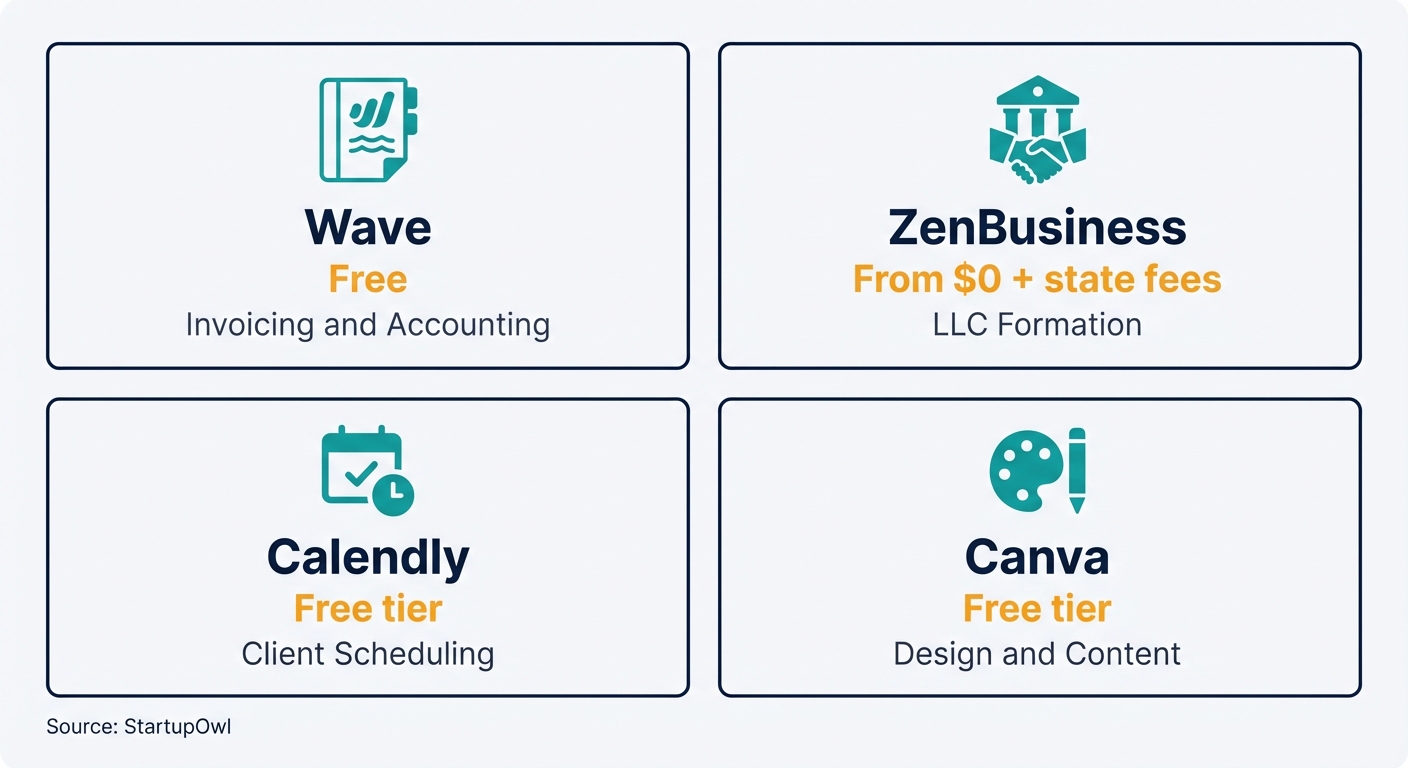
- Wave Accounting (Free) handles invoicing, expense tracking, and basic financial reports. It is the best zero-cost option for solopreneurs who are not yet ready to pay for QuickBooks.
- ZenBusiness (from $0 + state fees) files your LLC paperwork, gets your EIN, and manages your registered agent requirement. It is the fastest way to form an LLC without a lawyer.
- Calendly (Free tier) automates scheduling so clients can book time with you without endless email threads. The free plan covers one event type and unlimited bookings.
- Canva (Free tier, Pro from $13/month) lets you create professional-looking presentations, social graphics, and proposals without design skills. AI-powered features speed up content creation significantly.
For a full comparison of business banking options, see our best business bank accounts guide. If you need legal help setting up contracts or reviewing agreements, check our legal services roundup.
5 Mistakes That Kill Solopreneur Businesses Early
Knowing the pitfalls is just as important as picking the right idea. These are the patterns that sink first-time solopreneurs. For a broader look, read our guide on common first-time founder mistakes.
- Underpricing your work. Service-based solopreneurs often charge hourly rates that leave zero gross margin once you account for non-billable hours (marketing, admin, invoicing). Price by project or retainer, not by the hour, and build in at least a 30% margin above your effective hourly cost.
- Skipping validation. Building a course, product, or website before confirming that anyone will pay for it wastes weeks or months. Talk to real prospects first and get at least one pre-sale before investing heavily.
- Not separating business and personal finances. Mixing money in one account creates a tax nightmare and weakens your liability protection if you have an LLC. Open a business bank account on day one.
- Ignoring taxes until April. Solopreneurs pay both the employer and employee portions of Social Security and Medicare taxes (15.3% of net income). Set aside 25-30% of every payment for quarterly estimated taxes to avoid a surprise bill.
- Trying to do everything yourself forever. Automation tools and occasional contractors exist for a reason. Document your processes early so you can hand off low-value tasks when revenue allows it. This is the key difference between running a business and just working a demanding job.
If you are already feeling the weight of doing everything alone, our entrepreneur burnout guide has practical strategies for protecting your energy without slowing your growth.
Free Government Resources for Solopreneurs
You have access to free mentoring, consulting, and training programs funded by the U.S. government. These are not generic advice sites; they are staffed by experienced business professionals who work with you one-on-one.
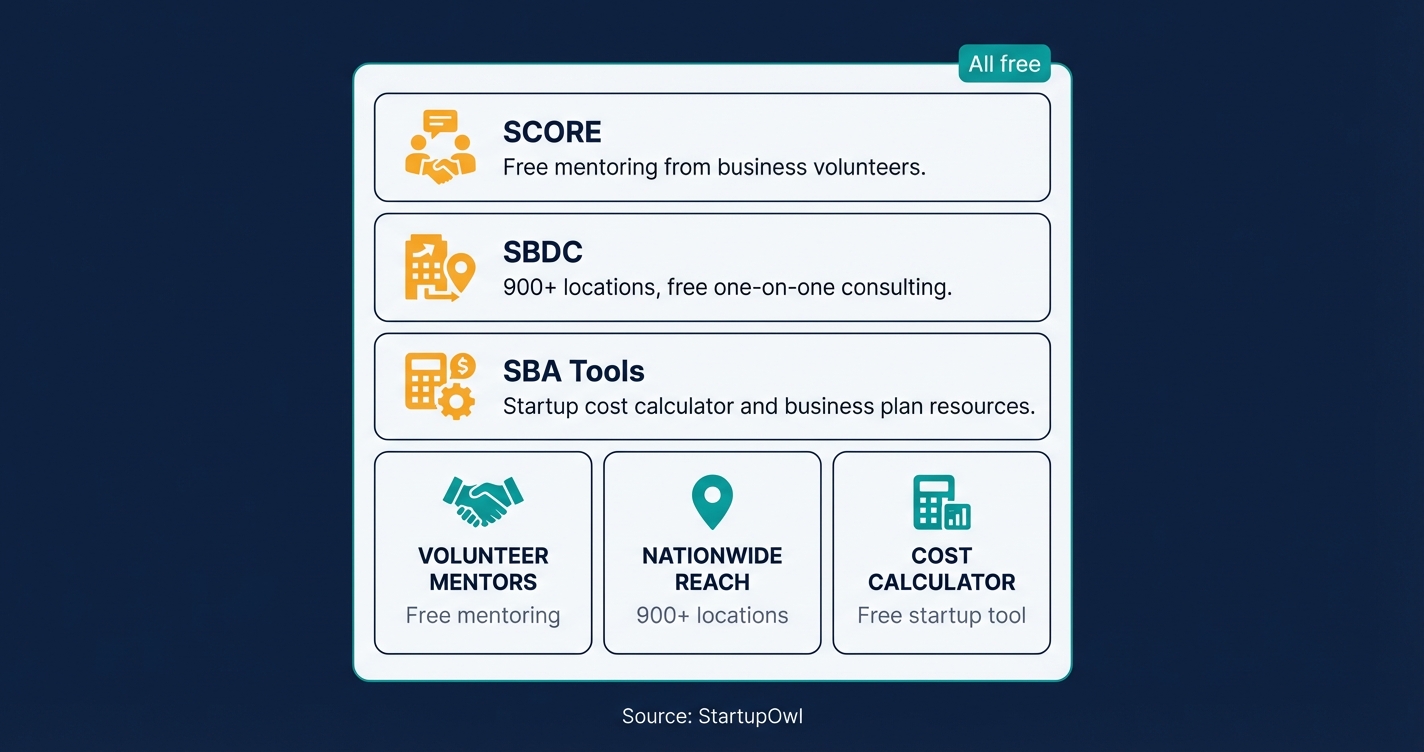
- SCORE provides free mentoring from experienced business volunteers. SCORE partners with the SBA and offers webinars, templates, and local workshops specifically for solopreneurs.
- Small Business Development Centers (SBDCs) operate over 900 locations nationwide and provide free, one-on-one consulting on business planning, financial management, and accessing capital.
- SBA Startup Cost Calculator helps you estimate expenses for your specific business type and build a realistic financial plan before you launch.
For funding beyond bootstrapping, explore small business grants and startup funding options. Our free business plan template also gives you the structure lenders and mentors expect to see.
What to Do This Week
Pick one idea from the list above, validate it with at least 5 conversations this week, and register your business before the month ends. The gap between thinking about solopreneurship and doing it is usually just paperwork and one phone call to a potential customer.
If you are still weighing your options, browse our full solopreneur business ideas list or read the solopreneur guide for a complete roadmap. You can also explore AI tools for small business to see how automation can multiply your output from day one.
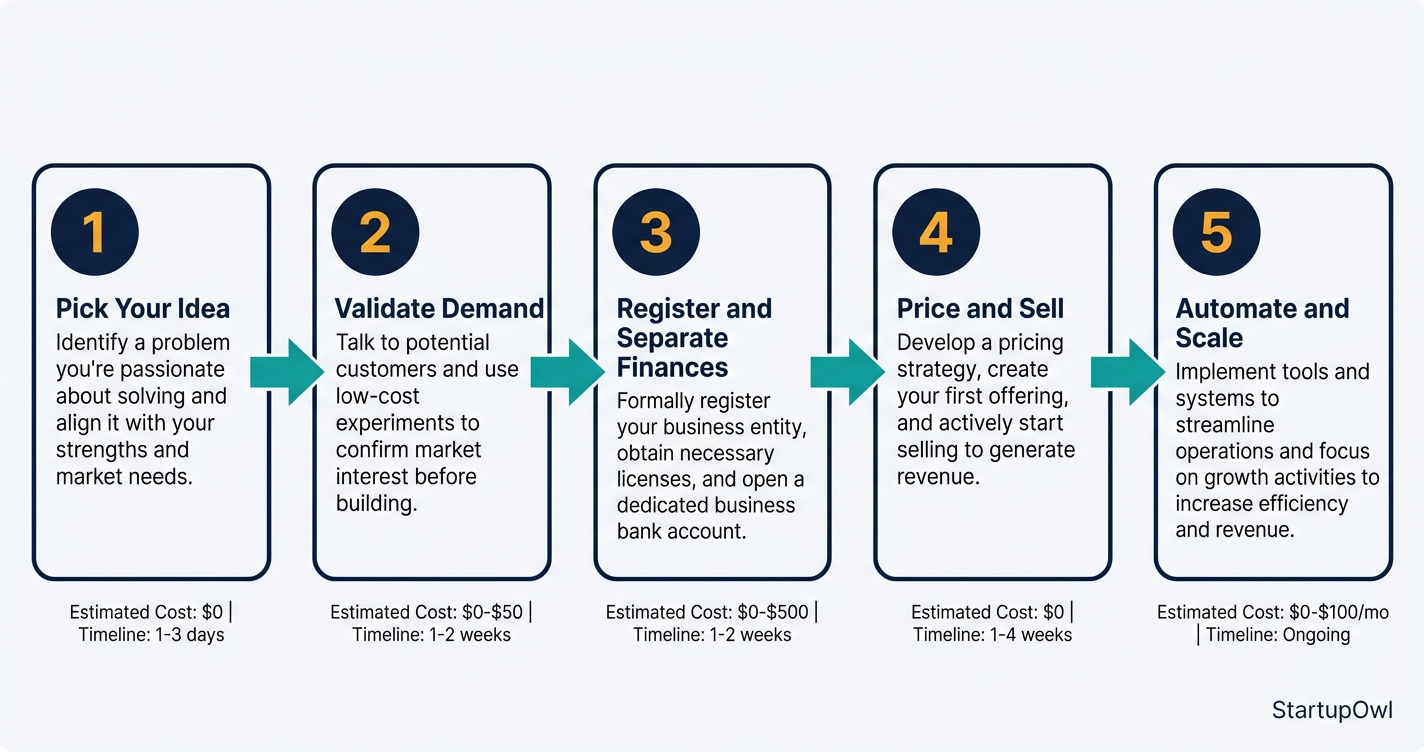
Step-by-Step Process
- 1
Pick an idea that matches your existing skills
Start with what you already know. The most profitable solopreneur businesses build on existing expertise because you skip the learning curve and start earning faster. Review the idea categories below and identify where your professional experience, certifications, or personal strengths give you an edge.
Tips
- List 3-5 skills people have paid you for (or asked your advice about) in the past year.
- Check demand by searching your skill + 'freelance' on Upwork or Fiverr to see active gigs.
Common Mistakes
- Choosing an idea based on a trend instead of your actual strengths.
- Overthinking the decision and never launching.
- 2
Validate demand before building anything
Talk to 5 to 10 potential customers before you spend a dollar. Ask them what they struggle with and whether they would pay for a solution. You can also pre-sell a service on a simple landing page to confirm real demand before you invest in a full setup.
Tips
- Use free tools like Google Trends and AnswerThePublic to gauge search demand.
- Post in relevant online communities and track the response.
Common Mistakes
- Skipping validation entirely and building something nobody wants.
- Asking friends instead of actual target customers.
- 3
Register your business and separate your finances
Choose a legal structure that protects your personal assets. Most solopreneurs start as a sole proprietorship or single-member LLC. Open a dedicated business bank account from day one to keep your personal and business money separate.
Tips
- Compare the pros and cons of sole proprietorship vs LLC before filing.
- Get a free EIN from the IRS even if you are a sole proprietor for added protection.
Common Mistakes
- Running business income through a personal checking account.
- Skipping liability protection by not forming an LLC when your business carries risk.
- 4
Set your pricing and land your first paying customer
Research what competitors charge, then price yourself based on the value you deliver (not just your time). Your first customer matters more than perfection. Offer a limited-time introductory rate or a small pilot project to get testimonials and build momentum quickly.
Tips
- Charge per project or per deliverable rather than by the hour to build margin.
- Ask your first 3 clients for written testimonials you can use on your website.
Common Mistakes
- Pricing too low to compete and burning out with low-margin work.
- Waiting until everything is 'ready' before reaching out to prospects.
- 5
Automate and systematize to protect your time
Use automation tools to handle scheduling, invoicing, email marketing, and client onboarding. A Zapier report found that automation has cut solopreneur workloads by roughly 30%. Build simple systems early so you can take on more clients without working more hours.
Tips
- Start with free tiers of tools like Calendly, Wave, and Mailchimp.
- Document every repeating task in a simple checklist so you can delegate it later.
Common Mistakes
- Spending all your time on client work and never building systems.
- Buying expensive tools before you have enough revenue to justify the cost.
Frequently Asked Questions
Nearly half of solopreneurs launched with under $5,000. Digital service businesses (writing, design, consulting) can start for $0 to $500 since your main costs are a computer and internet. If you form an LLC, expect $50 to $500 in state filing fees depending on where you register.
Consulting and digital products consistently produce the highest margins. AI consultants charge $15,000 to $50,000 per strategy project, and digital products (courses, templates) run at 90%+ gross margins after the initial creation. Fractional executives earn $10,000 to $15,000 per month from each client.
You do not legally need one, but a single-member LLC protects your personal assets if someone sues your business. It costs $50 to $500 depending on your state. Read our sole proprietorship vs LLC guide for a side-by-side comparison of liability, taxes, and paperwork.
You pay self-employment tax of 15.3% on net income (covering both Social Security and Medicare), plus regular income tax. The IRS requires quarterly estimated tax payments if you expect to owe $1,000 or more. Most solopreneurs set aside 25-30% of every payment to cover their tax obligation.
The U.S. Census Bureau counted 30.4 million nonemployer businesses in 2023, generating $1.8 trillion in total receipts. These solo-operated businesses represent about 81% of all U.S. businesses. Women owned 14.2 million of all U.S. businesses (employer and nonemployer combined) as of 2023.
Yes. Solopreneurs scale through digital products, automation, and smart outsourcing rather than hiring employees. Justin Welsh built a knowledge business generating over $2 million in annual revenue with zero full-time employees. The key is building systems and selling products that do not require your direct time for every dollar earned.
The information on this page is for educational purposes only and does not constitute financial, legal, or investment advice. Loan terms, interest rates, and eligibility requirements vary by lender and change frequently. Always consult with a qualified financial advisor before making funding decisions. StartupOwl may earn a commission if you click our links at no extra cost to you.
Sources & References
- U.S. Census Bureau - 2023 Nonemployer Statistics by Demographics (NES-D)
- U.S. Census Bureau - The Steady Rise of the Nonemployer Business (2026)
- U.S. Census Bureau - 2023 Nonemployer Statistics
- U.S. Census Bureau - Business Formation Statistics
- SBA - Small Business Development Centers (SBDC)
- SCORE - Resources for Solopreneurs
- SBA - Calculate Your Startup Costs
- Upwork - Freelance Forward 2023 Report
- Fiverr - Freelancer Economic Impact Report (2026)
About the Author
Editor, StartupOwl
Eliot leads StartupOwl's state data research. He maintains the site's fifty state records of LLC filing fees, annual costs, processing times, and small business grant programs, checking each figure against the state office that publishes it and logging the date it was verified. Based in New Jersey, he has spent his working life in and around small businesses, and he writes for the founder who wants the real number rather than the advertised one. Every figure under his byline traces to a named source, and when a state proves a number wrong, the correction is published, not buried.
Was this article helpful?
Questions about Solopreneur Business Ideas
No comments yet. Ask the first question and a member of our team will answer.
Leave a comment