
Gen Z Entrepreneurs
43% of Gen Z plan to start a business in 2026. Get programs, funding, tools, and step-by-step guidance to launch your first venture as a Gen Z entrepreneur.

In This Article
- Key Takeaways
- Step-by-Step
- The Real Advantages You Have as a Gen Z Founder
- The Biggest Challenges Gen Z Founders Actually Face
- How to Go From Side Hustle to Registered Business
- Government Programs and Organizations That Help Gen Z Founders
- Legal and Financial Considerations for Young Founders
- The Best Tools for Gen Z Founders on a Budget
- What to Do This Week
- FAQ
StartupOwl may earn a commission when you use links on this page. This does not affect our editorial independence. Read our full disclosure policy for details.
Nearly 1 in 5 business founders in 2024 were Generation Z, per PCBB analysis. Of those Gen Z founders already running businesses, 39% employ five or more people. You are not just side hustling; you are building real companies.
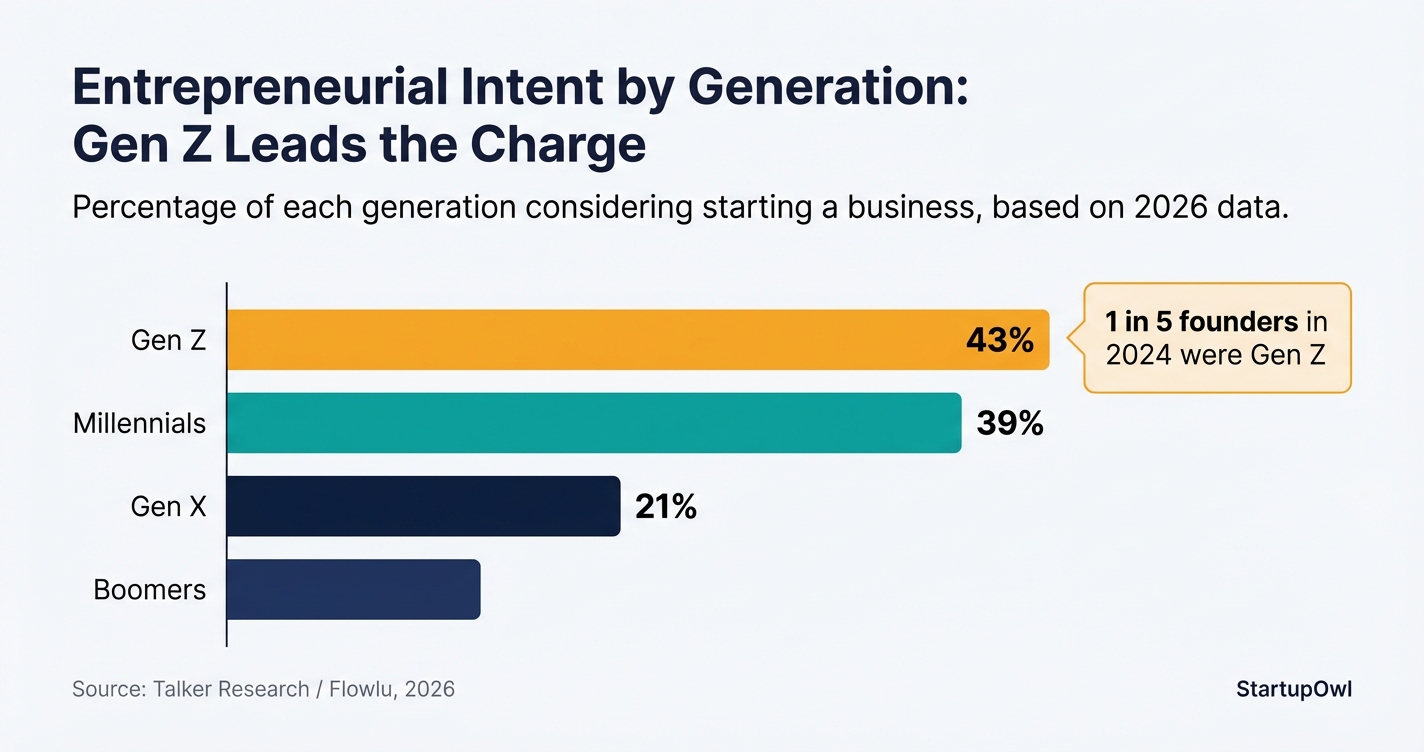
This guide covers the specific programs, funding options, and tools that give you an advantage as a Gen Z entrepreneur. If you are still deciding whether to make the leap, start with our overview of how to become an entrepreneur.
The Real Advantages You Have as a Gen Z Founder
You are the first generation of true digital natives. 80% of Gen Z business owners started their businesses online or with a mobile component, per Intuit's Side Hustle Generation report. That means you can launch and iterate faster than any generation before you, often from your phone.
Social media doubles as your free market research lab. Gen Z entrepreneurs validate ideas in real time with followers on platforms like TikTok and Instagram, getting instant feedback at scale instead of paying for formal surveys, according to Intuit.
Your generation also shows a 56.0% social media buyer rate compared to 36.5% for the total population. You understand how your peers discover, evaluate, and buy products because you do it yourself every day.
50% of Gen Z respondents in a HubSpot survey identify as content creators. That gives you built-in skills for brand building, audience engagement, and direct-to-consumer sales that older founders have to learn from scratch.
AI adoption is another edge. More than 60% of aspiring entrepreneurs plan to use AI to help launch their business in 2026. Three-quarters of Gen Zers (74%) believe GenAI will impact the way they work within the next year, according to Deloitte's 2026 survey. You can automate tasks that used to require a full team.
The Biggest Challenges Gen Z Founders Actually Face
94% of Gen Z business owners say they do not feel well-equipped to handle financial tasks such as taxes, day-to-day expenses, and long-term budgeting, according to a Square report. That is the single biggest self-reported gap for your generation.
Funding is the next hurdle. Only 16% of Gen Z entrepreneurs took loans from traditional lenders like banks. Meanwhile, 45% funded their businesses entirely from personal savings, and 39% cite not having enough money as their biggest barrier, per PCBB research.
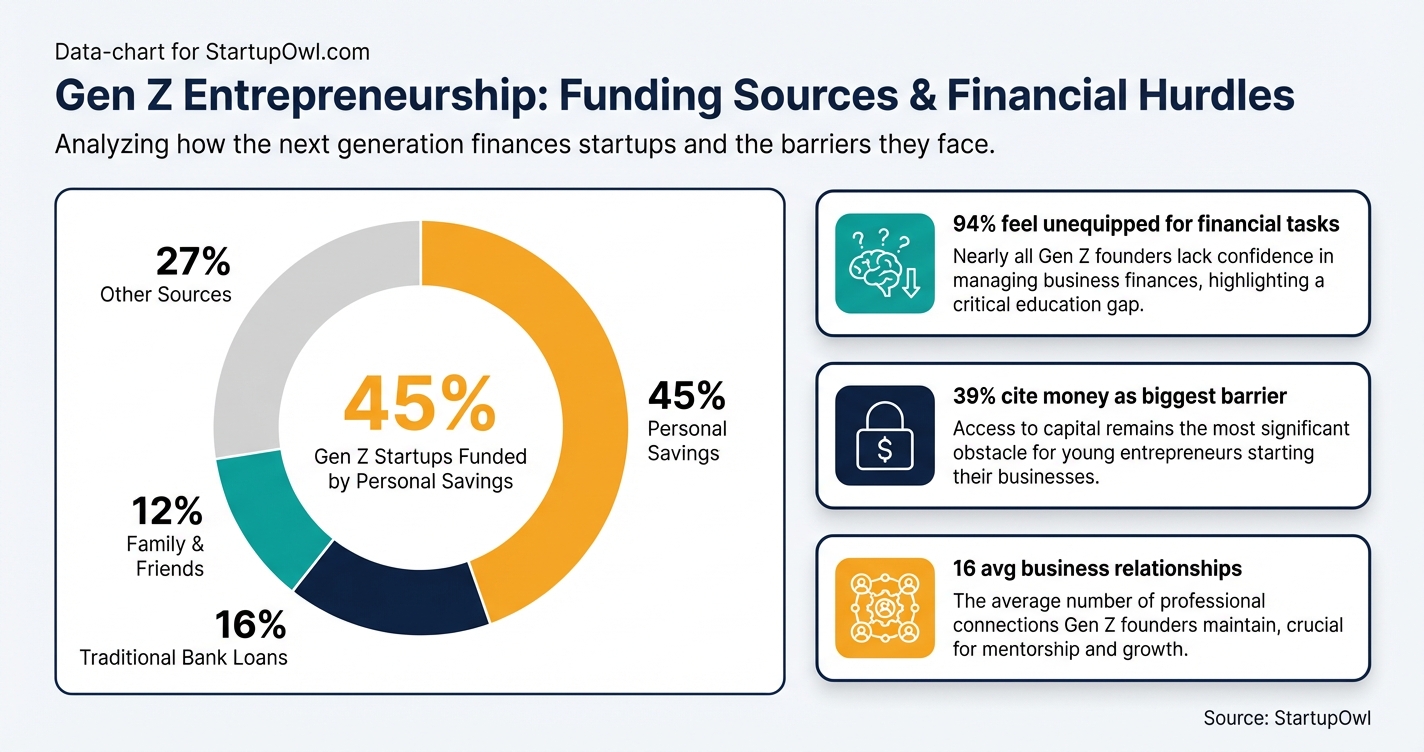
Your professional network is thinner than older founders. Gen Z has an average of only 16 strong business relationships, compared to 21 for Millennials and 40 for Gen X. Despite 95% understanding the importance of personal connections, 69% of Gen Z say technology has made them feel less connected.
Age bias is real but not universal. In a HubSpot survey, some Gen Z respondents reported that potential customers do not trust them as much as someone older. Others said their youth is an advantage because of comfort with current technology and digital tools.
72% of Gen Z entrepreneurs believe their generation has fewer economic opportunities than previous generations. Yet 84% still plan to pursue entrepreneurship within the next five years, per a report cited by Whop. That combination of realism and persistence is what separates those who build from those who just talk about it.
If the stress of starting up feels overwhelming, read our guide on entrepreneur burnout. Deloitte's 2026 survey found that 40% of Gen Z respondents feel stressed or anxious all or most of the time.
How to Go From Side Hustle to Registered Business
Only 1 in 5 side hustlers have actually registered their business. Registration is what separates a hobby from a company with liability protection, tax advantages, and access to funding. Here is how to do it step by step.
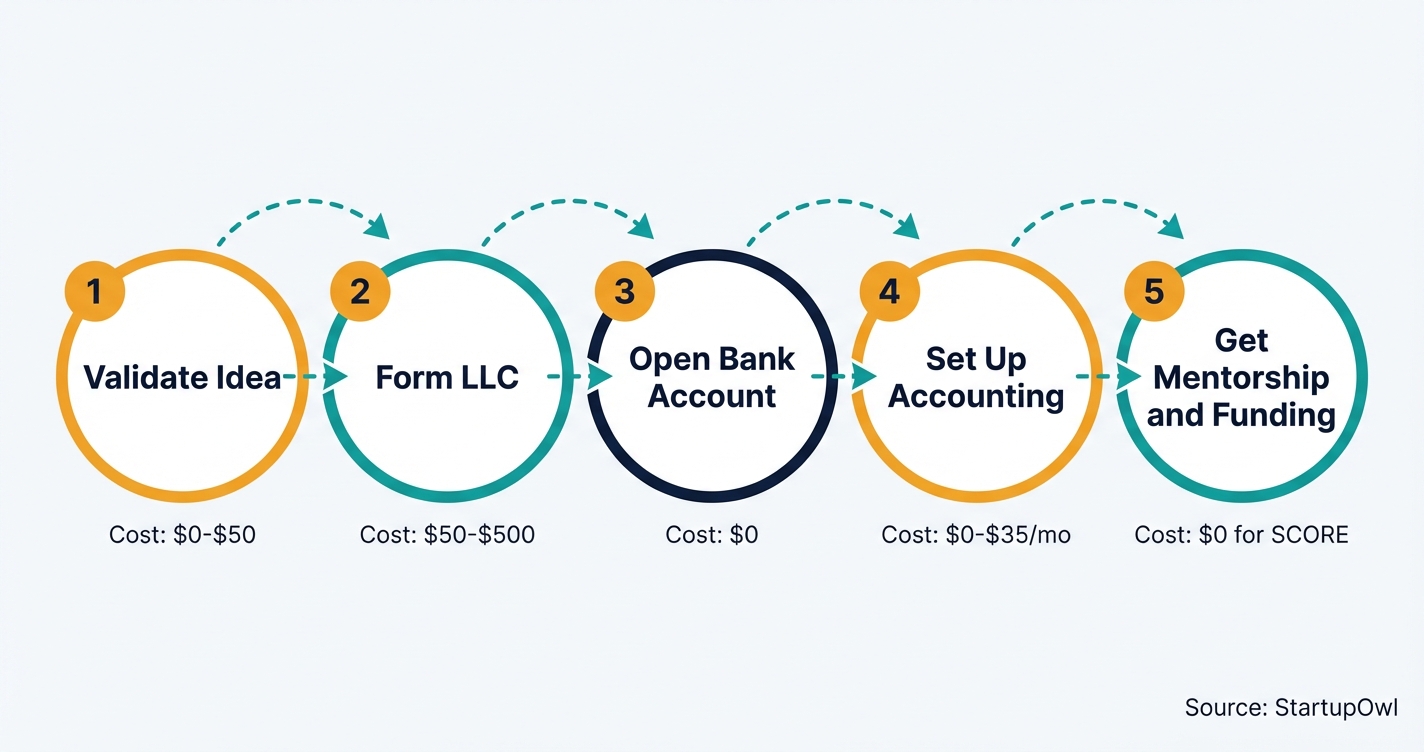
Step 1. Validate before you build. Post your concept on social media and track real interest. Use a free business plan template to outline your revenue model, target customers, and costs. This document is also required for most loan applications.
Step 2. Pick your business structure. For most Gen Z founders, an LLC is the right choice. It protects your personal assets and is simple to set up. Read our sole proprietorship vs LLC comparison to understand the tradeoffs. Then use our guide to form an LLC in your state.
Step 3. Get your EIN and open a business bank account. An Employer Identification Number is free from the IRS and takes five minutes online. Then open a business bank account to keep your personal and business money completely separate.
Step 4. Set up basic accounting. Install accounting software the same day you open your bank account. Wave is free for invoicing and bookkeeping. QuickBooks starts at $35/month if you need more features.
Step 5. Apply for mentorship and funding. Contact SCORE for a free mentor and explore startup funding options including the SBA Microloan program. More on both below.
For a complete walkthrough, check out our guide on how to register your business. If you are converting a side hustle to a business, that page covers the exact timing and sequence.
Government Programs and Organizations That Help Gen Z Founders
The SBA actively supports Gen Z entrepreneurs. The agency has hosted a Youth Entrepreneurship Summit and encourages young founders to use its full network of resource partners.
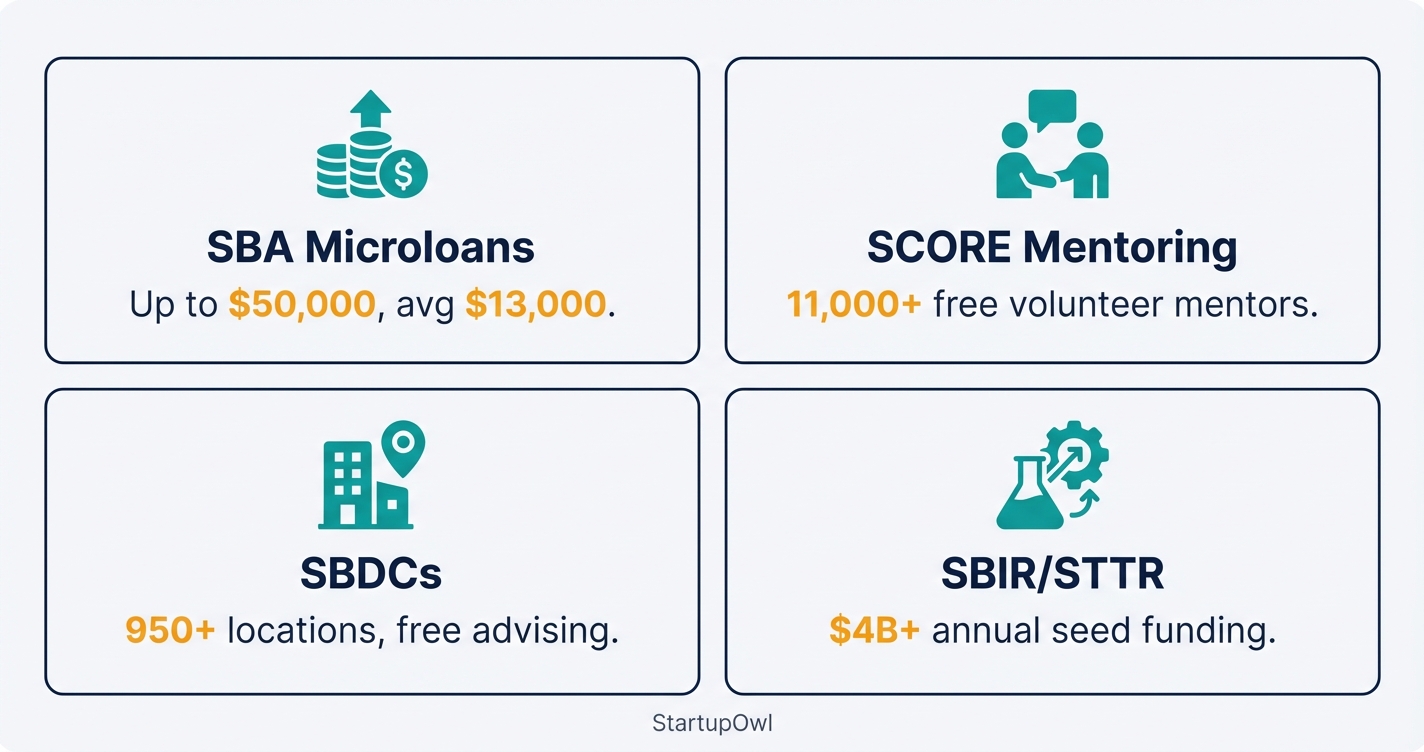
- The SBA Microloan program provides loans up to $50,000 (average $13,000) through nonprofit intermediary lenders. It is designed for startups and underserved entrepreneurs, and credit requirements are more flexible than traditional bank loans. Learn more at sba.gov/microloans.
- SCORE offers free, confidential business mentoring from 11,000+ volunteer professionals in all 50 states. You can meet remotely via email, phone, or video. Find a mentor at score.org.
- Small Business Development Centers (SBDCs) provide free one-on-one advising at over 950 locations nationwide. They cover business planning, marketing, financial management, and access to capital. Locate yours at sba.gov/sbdc.
- The SBIR/STTR program (America's Seed Fund) allocates more than $4 billion per year in early-stage funding for technology-focused startups. It is competitive (about 18% selection rate) but equity-free. Details at sbir.gov.
- The SBA 7(a) loan program guarantees loans up to $5 million and is the SBA's primary business lending program. SBA Express loans can be approved in as little as 36 hours. See sba.gov/7a-loans.
If you are a woman, a minority, or a veteran, additional targeted programs exist. Check our guides on grants for women-owned businesses, minority business grants, and grants for veteran-owned businesses.
Legal and Financial Considerations for Young Founders
If you are under 18, most states do not allow minors to form an LLC or sign contracts on their own. You will need a parent or legal guardian to serve as the organizer or member. Consult a business attorney in your state (many offer free initial consultations) or use a legal service to get guidance.
You need to file taxes on business income regardless of your age. The IRS requires you to report all self-employment earnings over $400. A CPA or tax professional can help you understand quarterly estimated taxes and deductions specific to your business type. We strongly recommend working with a tax professional rather than guessing.
If you are an international student on an F-1 visa, you have additional restrictions. Optional Practical Training (OPT) and STEM OPT may allow you to work in a business you founded, but the rules are complex. Consult an immigration attorney before starting a business on a student visa. Visit uscis.gov for official requirements, and read our immigrant entrepreneur guide for more details.
83% of new businesses with employees do not access capital from banks or other financial institutions, according to a 2023 Kauffman Foundation report. Building personal credit early (even with a secured credit card) and keeping clean financial records from day one will set you apart when you do need outside capital.
The Best Tools for Gen Z Founders on a Budget
Gen Z founders prefer starting lean and scaling up. Here are tools that match that approach.
- The ZenBusiness LLC formation service starts at $0 + state filing fees and includes a free registered agent for the first year. It is the fastest way to get your business legally set up. Compare it with other options at best LLC services.
- Mercury offers a free business checking account with no monthly fees or minimum balance. It integrates with popular tools like QuickBooks and Stripe, making it ideal for online-first businesses.
- Wave provides free accounting, invoicing, and receipt scanning. If you are a solopreneur or freelancer earning under $100,000 per year, Wave handles everything you need without a monthly subscription.
- QuickBooks Online starts at $35/month and is the most widely used small business accounting software. It connects to your bank, tracks expenses automatically, and generates reports you can share with a CPA or lender.
- Canva (free tier available) lets you create social media graphics, pitch decks, and marketing materials without a designer. Most Gen Z founders already know this tool.
For more recommendations, explore our full list of accounting software for small business and business bank accounts.
What to Do This Week
Action 1. Write a one-page business plan using our free business plan template. Focus on your target customer, how you will make money, and your first-month costs.
Action 2. Form your LLC or at minimum, research the filing requirements and fees in your state. If you are under 18, talk to a parent or guardian about forming it together.
Action 3. Schedule a free mentoring session with a SCORE mentor. You can meet by video call and get personalized advice on your exact business idea.
Action 4. Open a free business bank account and connect it to Wave or QuickBooks so every dollar is tracked from the start. Browse our business bank account guide to pick the best option.
For inspiration on what to build, check out solopreneur business ideas or our solopreneur guide. If you are weighing the differences between working solo and hiring a team, read solopreneur vs entrepreneur.
Step-by-Step Process
- 1
Validate your business idea with real customers
Post your product concept or service offer on TikTok, Instagram, or a simple landing page and gauge reactions before you spend money. Gen Z entrepreneurs are already doing this at scale, using social platforms as real-time R&D labs, according to Intuit.
Aim for at least 50 responses or pre-orders before you invest further. Use a free business plan template to document your target market and unit economics.
Tips
- Ask for payment commitments (pre-orders) to test real demand, not just likes.
- Use Google Forms or Typeform to collect structured feedback at zero cost.
Common Mistakes
- Spending months perfecting a product nobody has asked for.
- Confusing social media engagement with actual purchase intent.
- 2
Choose your business structure and register it
Only 1 in 5 side hustlers have registered their business, according to a 2026 survey. Registering protects your personal assets and makes you eligible for business bank accounts, loans, and grants.
An LLC is the most popular structure for new founders. You can form an LLC in most states for $50 to $500 in filing fees, or use an LLC formation service to handle the paperwork. Read our guide on sole proprietorship vs LLC to pick the right fit.
Tips
- If you are under 18, most states require a parent or guardian to form the LLC on your behalf.
- Get an EIN from the IRS for free at irs.gov. You need it to open a business bank account.
Common Mistakes
- Operating as a sole proprietor and exposing your personal savings to business liability.
- Skipping the EIN and mixing personal and business finances.
- 3
Open a dedicated business bank account
Mixing personal and business money is one of the fastest ways to lose your LLC's liability protection and create a tax nightmare. Open a business bank account the same week you get your EIN.
Fintech options like Mercury and Relay offer free business checking accounts with no minimum balance requirements, making them ideal for Gen Z founders just getting started.
Tips
- Set up a separate savings sub-account for estimated quarterly taxes from day one.
- Connect your bank account to accounting software immediately.
Common Mistakes
- Using Venmo or personal Cash App for business transactions.
- Waiting until tax season to separate personal and business expenses.
- 4
Connect with a free SCORE mentor or SBDC advisor
Gen Z has an average of only 16 strong business relationships, compared to 21 for Millennials and 40 for Gen X, per a 2024 workforce survey. A free mentor can fill that gap fast.
SCORE provides free one-on-one mentoring from 11,000+ volunteer business professionals. SBDCs offer free business advising at over 950 locations nationwide.
Tips
- Request a mentor with experience in your specific industry.
- Prepare a one-page summary of your business before the first meeting.
Common Mistakes
- Thinking you need to figure everything out alone because you are young.
- Not following up with your mentor after the initial session.
- 5
Explore startup-friendly funding options
45% of Gen Z business owners use personal savings to fund their businesses, and only 16% took loans from traditional lenders like banks, per a Square Gen Z Entrepreneur Report. You have more options than you think.
The SBA Microloan program provides loans up to $50,000 (average $13,000) with flexible credit requirements. Browse small business grants and startup funding options for equity-free capital.
Tips
- Build a basic credit history now with a secured credit card if you have none.
- Crowdfunding platforms like Kickstarter let you validate demand and raise capital simultaneously.
Common Mistakes
- Giving up equity too early when grants and microloans are available.
- Assuming you need perfect credit to get any business funding.
Frequently Asked Questions
Roughly 43% to 50% of Gen Z express interest in starting a business, depending on the survey. A Samsung and Morning Consult survey found 50% of U.S. students aged 16 to 25 want to start a business, while a Talker Research survey found 43% plan to do so in 2026. Both figures exceed every other generation.
Yes, but with restrictions. Most states require a parent or legal guardian to form the LLC, sign contracts, and open bank accounts on your behalf. The business income is still taxable, and you must report any self-employment earnings over $400 to the IRS. Consult a business attorney in your state for specifics.
45% use personal savings, according to a Square Gen Z Entrepreneur Report. Only 16% take traditional bank loans. Other popular options include crowdfunding on platforms like Kickstarter, SBA microloans (up to $50,000 with flexible credit requirements), and revenue from pre-orders or digital product sales.
File directly with your state's Secretary of State office. Filing fees range from $50 to $500 depending on your state. Services like ZenBusiness offer $0 + state fees packages that handle the paperwork for you. You can also get a free EIN from the IRS at irs.gov in about five minutes.
There are no federal grants exclusively for Gen Z, but many programs target young, first-time, or low-income entrepreneurs. The SBA's Microloan program and SBIR/STTR seed fund ($4 billion+ annually) are open to all qualifying small businesses. Check small business grants for curated options.
No. 67% of Gen Z entrepreneurs came from non-traditional routes, including skipping or leaving college, according to a report cited by Whop. No federal or state program requires a degree for business registration or SBA loan eligibility. What matters is a viable business plan and the willingness to learn on the go.
The information on this page is for educational purposes only and does not constitute financial, legal, or investment advice. Loan terms, interest rates, and eligibility requirements vary by lender and change frequently. Always consult with a qualified financial advisor before making funding decisions. StartupOwl may earn a commission if you click our links at no extra cost to you.
Sources & References
- 25 Main Entrepreneur Statistics to Know in 2026 (Flowlu, citing Talker Research)
- Five Ways to Attract Gen Z Entrepreneurs (PCBB, 2026)
- The Side Hustle Generation: Gen Z and Millennials Redefine Financial Success (Intuit, 2026)
- Why Gen Z is Redefining Entrepreneurship (Intuit, 2026)
- 100+ Entrepreneurship Statistics for 2026 (Whop, citing Square Gen Z Entrepreneur Report)
- Deloitte Global Gen Z and Millennial Survey 2026
- 2026 Small Business Trends (Guidant Financial)
- The Rise of Gen Z Small Business Owners (UH SBDC)
- SBA Microloan Program (SBA.gov)
- Small Business Development Centers (SBA.gov)
- Access to Capital for Entrepreneurs: Removing Barriers (Kauffman Foundation, 2023)
- Is Gen Z the Entrepreneurial Generation? (HubSpot, 2024)
- 45+ Small Business Owners Statistics in 2026 (BusinessDasher, citing Guidant Financial)
About the Author
Editor, StartupOwl
Eliot leads StartupOwl's state data research. He maintains the site's fifty state records of LLC filing fees, annual costs, processing times, and small business grant programs, checking each figure against the state office that publishes it and logging the date it was verified. Based in New Jersey, he has spent his working life in and around small businesses, and he writes for the founder who wants the real number rather than the advertised one. Every figure under his byline traces to a named source, and when a state proves a number wrong, the correction is published, not buried.
Was this article helpful?
Questions about Gen Z Entrepreneurs
No comments yet. Ask the first question and a member of our team will answer.
Leave a comment