
How to Trademark a Business Name in 2026
The federal registration process end to end, with the January 2025 fee rule priced out properly, the surcharges that trigger without warning, and the state register almost nobody explains.

In This Article
- Forming an LLC does not trademark the name. Your state searched its own register only, so a business in another state can trade under your exact name legally.
- The base fee is $350 per class of goods or services. Two ordinary surcharges push one class to $650, and a missed deadline takes it to $1,175.
- Use the Trademark ID Manual instead of the free-form text box. It saves $200 per class, and the USPTO says applications with no surcharges are more likely to be approved on first action.
- Registration is not permanent. A declaration of use falls due between year five and year six at $325 per class, and renewal between year nine and year ten at $650 per class.
6
Total Steps
$350–$1,175
Est. Total Cost
5 months to a first answer, 11 months or more to a final outcome
Timeline
Moderate, and much cheaper if you slow down
DIY Difficulty
Two agencies can approve the same name. Only one of them can stop a competitor from using it, and it is not the Secretary of State who took your filing fee. That one costs $350 and lives at the USPTO.
Your state searched its own register and found nothing identical. Then it mailed you a certificate. That search stopped at the state line. A firm three states over can open under your exact name next week, and your certificate does nothing about it. Federal registration is the part that travels. The $350 buys one class of goods or services, not the name itself.
The fee is where guides go wrong. The old $250 tier was abolished on January 18, 2025. Guides written before that date still quote it. What replaced it is one base fee plus three surcharges. A founder filling in the form the obvious way will trigger two of them without noticing.
What to settle before you open the form
Four decisions come first. Getting them wrong is what turns a $350 filing into a $650 one.
Whether a trademark is even the right tool. The USPTO is plain about this. A trademark protects a brand name or logo used on goods and services. A patent protects an invention. A copyright protects a written or artistic work. Want to protect a product design or a manual? You are on the wrong form. The fee is not refunded.
What you actually sell. You register per class of goods or services, not per name. The office gives a clothing example. Golf shirts, dress shirts and T-shirts all sit in one class, so one $350 fee covers them. Add custom T-shirt printing as a service and you have crossed into a second class. That doubles the bill to $700.
Whether you are using the name yet. Filing on use in commerce means you sell under the name today. Intent to use means you plan to. Intent to use is legal and common. It also costs more, because you pay $150 per class later to prove you started.
Whether the name is strong enough. The office refuses names that are generic or functional for what you sell. It also refuses names too close to something already claimed on related goods. Descriptive is the trap. A name that says exactly what the product is tends to be the hardest one to protect.
None of this is the same job as registering the business name with your state, or filing a DBA. Both are lists. This one gives you the right to stop somebody.
Step-by-Step Process
- 1
Work out whether a trademark is the right tool
The USPTO refuses the wrong kind of application and keeps the fee. A trademark covers a brand name or logo on goods and services. It does not cover an invention, which needs a patent. It does not cover a manual or a jingle, which need a copyright. Registering a domain gives you nothing either. The USPTO says a domain registrar grants no trademark rights, and that using a business name does not by itself count as trademark use.
Common Mistakes
- Assuming the state certificate already protects the name across state lines
- Filing for a product design, which is a patent question rather than a trademark one
- 2
Search the register before you spend anything
Search first. A conflict found now is free. A conflict found by an examining attorney costs you the whole fee. Use the USPTO search system and try the exact name, then phonetic variants and similar spellings. The refusal ground is not identical wording. It is likelihood of confusion on related goods. So a close spelling in your own field matters more than an identical name in an unrelated one. Check state registers and ordinary web listings too. Someone who never registered a name can still hold common law rights in their area.
Common Mistakes
- Searching only for an exact match, when the test is likelihood of confusion
- Skipping the state registers and the common law users who never filed anything
- 3
Pick your classes from the ID Manual, not the text box
This step is where the surcharges live. Trademark Center lets you pick a pre-approved description from the ID Manual, or type your own into a free-form text box. Typing your own adds $200 per class. Every extra block of 1,000 characters past the first adds another $200 per affected class. There is a second reason to use the manual. It has nothing to do with money. The USPTO dashboard says applications with no surcharges are more likely to be approved on first action than any other filing type.
Common Mistakes
- Typing a custom description when an ID Manual entry would have done, $200 per class
- Listing every product you might sell one day, which adds classes at $350 each
- 4
Choose your filing basis
Two bases cover most founders. Use in commerce means you already sell under the name. It is the shorter road. Registration can issue once the examining attorney and the opposition window are clear. Intent to use means you have not started. It adds a second half to the process. After publication you get a notice of allowance, then six months to file a statement of use at $150 per class. Need longer? Each extension request is $125 per class. The statement of use fee is not refundable and cannot be withdrawn, even if the application is refused later.
Common Mistakes
- Filing intent to use after you have already sold something, which adds $150 per class for nothing
- Missing the six month statement of use deadline, which abandons the application
- 5
File in Trademark Center, then watch for the letter
Paper is gone. Trademark Center has been the only route since February 15, 2020, with narrow exceptions. It needs a USPTO.gov account with two-step sign in. Once filed, the application goes to an examining attorney who searches for conflicts and checks the form. If anything is wrong you get an office action. The clock that matters starts there. Miss it and the application is declared abandoned. You have three months to respond, with one three month extension available for a fee. Madrid Protocol applicants get six months and no extension at all.
Common Mistakes
- Letting the office action deadline pass, which then needs a $250 petition to revive
- Not keeping your email address current, which is how most missed deadlines happen
- 6
Publication, then keeping it alive
Approval is not the end of the money. Once the examining attorney is satisfied, your name is published in the Trademark Official Gazette. Anyone who believes they would be harmed then has 30 days to oppose. Clear that and registration follows. Then the maintenance clock starts. This is the part founders forget. Between the fifth and sixth year after registration you file a declaration of use at $325 per class. Between the ninth and tenth year you file the renewal with its declaration at $650 per class, and again every ten years. Miss either window and a six month grace period costs $100 per class. Miss the grace period and the registration dies. The only way back is filing again from the start.
Common Mistakes
- Treating registration as permanent, when the first maintenance filing falls due in year six
- Expecting the USPTO to enforce it, which the office says plainly it will not do
What a trademark filing really costs
One class, filed cleanly, is $350. That is the only number most guides print. It is the floor rather than the price. Every scenario below is addition over the USPTO fee schedule, with no estimates and no ranges.
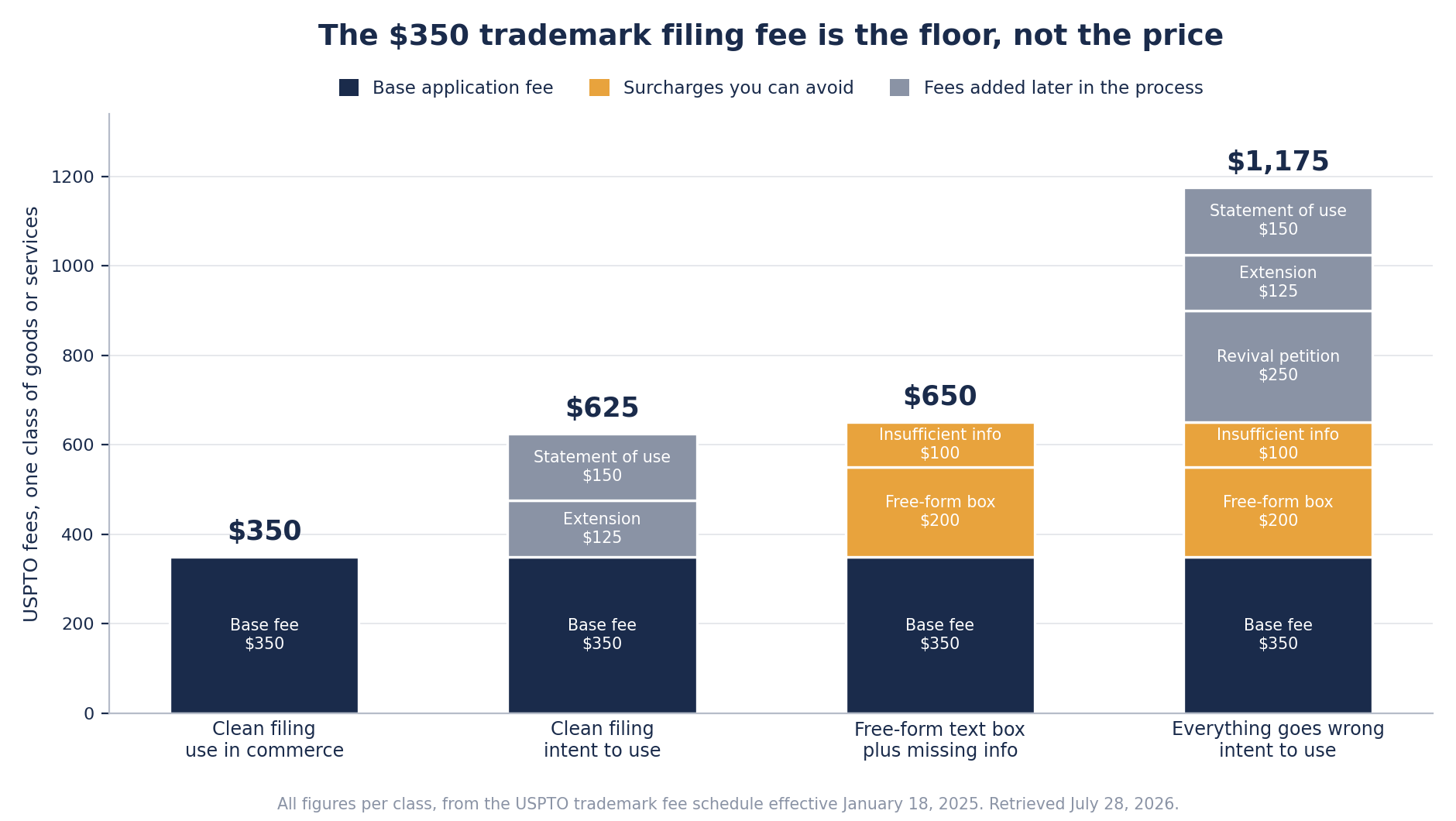
The chart reads left to right as the same filing getting worse. A clean use in commerce filing in one class is $350. Type your own goods description and leave something out, and the same filing is $650. Neither surcharge is exotic. One class can reach $1,175. That is an intent to use filing with both surcharges, a missed deadline, a revival petition, an extension and a statement of use.
| Fee | Amount | When it applies |
|---|---|---|
| Base application, Section 1 or 44 | $350 per class | Every application that meets the base requirements |
| Insufficient information surcharge | $100 per class | The application is missing something required |
| Free-form text box surcharge | $200 per class | You typed your own goods description instead of using the ID Manual |
| Long description surcharge | $200 per affected class | Each extra block of 1,000 characters past the first |
| Statement of use or amendment to allege use | $150 per class | Intent to use filings, to show you started selling |
| Extension of time to file the statement of use | $125 per class | Each request, on intent to use filings |
| Petition to revive an abandoned application | $250 | You missed a deadline and want the application back |
| Declaration of use, year five to six | $325 per class | First maintenance filing after registration |
| Renewal with declaration, year nine to ten | $650 per class | Then again every ten years |
| Grace period fee, either maintenance deadline | $100 per class | Six months after a missed maintenance deadline |
| Declaration of incontestability, Section 15 | $250 per class | Optional, and it strengthens the registration |
| Refused or charged back payment | $50, not per class | Your card declines |
| Madrid Protocol filing | $600 per class | International route, raised from $500 on February 18, 2025 |
Then there is the decade. Filing one class and holding it through the first renewal costs $350 now, $325 between year five and year six, and $650 between year nine and year ten. That is $1,325 for ten years in one class, before any surcharge. It is the figure to compare against whatever a filing service quotes you.
Filing it yourself against paying somebody to file it
The $350 is the same fee whoever types it in. What a filing service sells you is the work that happens before the application goes in, and that is worth different amounts to different founders.
Northwest Registered Agent charges $599 flat and that figure includes the USPTO filing fee for one class. So the service itself is $249 over what you would pay the office directly. Their attorneys review your intake form, run a clearance search before anything is filed, and answer procedural office actions if any arrive. Checked on their own trademark service page on August 8, 2026.
Put that $249 next to the fee table above and the decision gets easier to see. Typing your own goods description costs $200 per class. Leaving something out costs $100 per class. Trigger both, which is the ordinary way a first timer fills in the form, and you have paid $300 in surcharges to save $249 in service fees. Avoid both and the DIY route is genuinely the cheaper one, by exactly that $249.
So file it yourself when the answers are already clear. You sell in one class, your goods description exists word for word in the ID Manual, and your search came back with nothing close. The form is the easy part of this process and the office wrote it for people without lawyers.
Pay somebody when the clearance search is the part you cannot do. A name that leans descriptive, a mark that sits near something already registered on related goods, a choice between a word mark and a design mark, or an intent to use filing with its own later deadlines. Those are judgement calls, and a refusal costs you the whole fee rather than a correction.
Two limits belong in the decision. Substantive office actions, the ones that argue about whether your mark can be registered at all, get referred to Law on Call, the law firm Northwest owns, at a separate flat fee. And no service can promise registration, which Northwest says on its own page. Their price covers the filing fee for one class, so ask what a second class costs before you sign up.
The state trademark almost nobody explains
Most states run a second register. It is a trademark register, separate from the business entity list and separate from the USPTO. It is the option the federal guides skip and the state guides bury.
A state trademark covers that state only. Trading in one state and always will? A state registration can be enough. It is usually cheaper and faster than the federal route. What it cannot do is stop a company in the next state. It also gives you no standing in federal court and no route to record the mark with Customs.
Neither one is your LLC certificate. The National Association of Secretaries of State puts it in a single line, registration of a business name does not establish trademark rights. That applies to your entity filing, your DBA and your domain alike. Worth knowing before you pick a formation service on the assumption that the name is handled.
We have not published state trademark fees. We have not verified them at fifty state sources, and an unverified fee does not go on the page. Ask your own Secretary of State for the trademark register rather than the business register. They are different offices in several states.
How long the USPTO takes
The office publishes targets, not promises. Read them as the shape of the wait. They are not a date you can hold anyone to. Every figure below is from the USPTO trademarks dashboard, last refreshed April 30, 2026, and the targets move when the office sets new ones.
First response from an examining attorney has a target of 5 months from filing. The long term goal is 4.5 months. Total time to a final outcome has a target of 11 months on average. That becomes 14 months once suspended cases and Trademark Trial and Appeal Board disputes are counted. On an intent to use filing, add the notice of allowance at roughly 8 weeks after publication. Then your own six months to file the statement of use. Then about 4 months from that filing to registration.
Two other numbers are worth holding. Publication opens a 30 day window for anyone to oppose. Three to four months can pass after the notice of publication before the next status update arrives. Renewals are slower than the target says. The office aims at 90 days and its own fiscal year figure is 107.
Five ways founders lose money here
Believing the LLC did it. This is the big one. Your state approved the name against its own register and nothing more. The USPTO says using a business name does not by itself count as trademark use. The Secretaries of State say business name registration establishes no trademark rights. It is a list, not a right.
Typing the goods description. $200 per class. The ID Manual avoids it, and it also lifts your odds of approval without a letter.
Filing intent to use out of caution. Sell first if you can. Already sold something under the name? File on use in commerce. Intent to use adds $150 per class later, and can add $125 per class on top of that.
Missing the office action. Three months. That runs from the letter issue date, not from when you noticed it. Reviving a dead application costs $250, and the office keeps everything you already paid.
Expecting the USPTO to police it. It will not. The office registers trademarks and says outright that enforcement is the owner job. That includes bringing any legal action. Registration is the standing to act, not the acting.
Frequently Asked Questions
Six steps. Confirm a trademark is the right protection. Search the USPTO register for anything close. Choose your classes from the Trademark ID Manual, pick your filing basis, then file in Trademark Center at $350 per class. An examining attorney reviews it, your name is published for 30 days of possible opposition, and registration follows. Then you keep it alive at year six and year ten.
The base fee is $350 per class of goods or services. That is the floor. Three surcharges can lift it, $100 per class for missing information and $200 per class for typing your own goods description, plus $200 per affected class for each extra 1,000 characters. Intent to use filings add $150 per class to prove use, and $125 per class for each extension. Holding one class for ten years runs $1,325.
It depends how far you sell. Trading in one town and always will? Your state registration and common law rights may be enough, and a state trademark is cheaper. Federal registration earns its $350 the moment you sell across state lines, advertise nationally or build anything a competitor would want to copy. It also gives you standing in federal court, which nothing else on this list does.
No entity is required. An individual, a partnership, an LLC or a corporation can all file, and the $350 per class fee is the same either way. The reverse matters more. Forming an LLC does not trademark your name. The state checked its own register and issued a certificate, which is why a company in another state can use the same name without breaking any rule.
You cannot. Paper filings ended on February 15, 2020 with narrow exceptions, and every electronic route carries the $350 per class base fee. The USPTO generally does not refund fees either, and filing does not guarantee registration. So a refused application costs you the full amount. The search is free, and it is the step most likely to save you the $350.
It turns on the clearance search rather than the paperwork. Northwest Registered Agent charges $599 flat and that includes the USPTO fee for one class, so the service costs $249 over filing direct. Two ordinary surcharges cost $300, which is more than that, so a founder who would have typed their own goods description saves money by paying. A founder whose goods sit word for word in the ID Manual, in one class, with a clean search, does not. Nobody can guarantee registration either way, and a refusal keeps your fee.
Sources & References
- USPTO, trademark fee information
- USPTO, the trademark process step by step
- USPTO, trademarks data dashboard and pendency targets
- USPTO, Trademark ID Manual
- USPTO, keeping your registration alive
- USPTO, Trademark Center filing system
- National Association of Secretaries of State, business names and trademarks
About the Author
Editor, StartupOwl
Eliot leads StartupOwl's state data research. He maintains the site's fifty state records of LLC filing fees, annual costs, processing times, and small business grant programs, checking each figure against the state office that publishes it and logging the date it was verified. Based in New Jersey, he has spent his working life in and around small businesses, and he writes for the founder who wants the real number rather than the advertised one. Every figure under his byline traces to a named source, and when a state proves a number wrong, the correction is published, not buried.
Was this article helpful?
Questions about this guide
No comments yet. Ask the first question and a member of our team will answer.
Leave a comment