
Four separate checks want an address from your LLC, and they are run by organisations that never speak to each other. Each is testing something different. A process server has to physically hand your business a lawsuit. The IRS just needs post to arrive. Stripe is matching records about where people and companies really are. Google is asking whether a customer could walk in.
Explainer Guide·Updated August 12, 2026
Business Address for an LLC, Which One Survives Verification
Which business address clears the state filing, the IRS, payment processor onboarding and Google Business Profile, resolved against USPS, Stripe and Google primary sources.
10 min read

Written byEliot Reynolds
Editor, StartupOwl
In This Article
- There is no such thing as one business address
- What the state filing actually wants
- The IRS is the easy one
- Why Stripe keeps rejecting your address
- Google Business Profile is the check that says no
- What signing Form 1583 actually does
- Registered agent address versus business address
- So which address should you actually buy
- FAQ
Key Takeaways
- A virtual mailbox clears the state filing and the IRS. It does not clear Google Business Profile, and Google says so in writing.
- Google's guidelines: if your business rents a physical mailing address but does not operate out of that location, also known as a virtual office, that location is not eligible for a Business Profile.
- Signing USPS Form 1583 registers your address as a CMRA. USPS ships a CMRA table inside its DPV product, so any address validator a platform buys can see the flag.
- Form 1583 does not have to be notarized. DMM 508.1.8.3 lets the CMRA owner, manager or an authorized employee witness the signature, in person or over live video. Box 14a on the form is that signature line.
- A CMRA address must carry PMB or a hash sign. Mail without it can be returned marked Undeliverable as Addressed, Missing PMB or # Sign.
- Stripe asks for a company address and a separate residential address for the representative. Those are two different fields and one mailbox cannot fill both.
- If you travel to customers, Google tells you to hide your address and set a service area. That route is free and it is Google's own guidance.
Quick Answer
There is no single business address. Four checks want an address from you and they want different things. The state wants a street address it can serve papers at. The IRS wants somewhere mail arrives. Stripe wants the place you actually run the business, in a field most founders fill in wrong. Google Business Profile wants premises with your own staff and a sign, and its guidelines say a rented mailing address you do not work from is not eligible. A virtual mailbox handles the first three. Nothing you rent handles the fourth.
Your LLC needs an address before the state will file it. Most guides stop there. That address then has to clear three more checks, and signing USPS Form 1583 for a mailbox flags it in a federal database. Google Business Profile rejects flagged addresses outright. So the address that fixes your privacy problem can quietly break something else.
There is no such thing as one business address
That is why one address cannot pass all four. It is not a trick. The checks measure different things.
Here is how the six address types founders use hold up. Every cell comes from a primary source read on 8 August 2026. The sections below give you the clause.
| Address type | State filing | IRS and EIN | Stripe onboarding | Google Business Profile |
|---|---|---|---|---|
| Your home address | Accepted, becomes public | Accepted | Accepted | Eligible, and Google says hide it |
| PO box | No for the agent line | Accepted as mailing | Not a street address | Named as not acceptable |
| Registered agent address | Accepted, that is its purpose | Accepted | Not where you administer | Not eligible |
| Virtual mailbox, a CMRA | Accepted in most states | Accepted | Accepted as the company address | Not eligible |
| Virtual office, also a CMRA | Accepted in most states | Accepted | Accepted as the company address | Only if your own staff work there |
| Office or shop you lease | Accepted | Accepted | Accepted | Eligible |
Read the last column first. It is the one that surprises people.
What the state filing actually wants
All 50 states need a street address for your registered agent, and a PO box will not do. The reason is physical. If your LLC is sued, a process server has to hand the papers to a person, so someone must be at that address in business hours.
Your principal office address is a separate line on the same form. It is a different job. Some states let you use your agent's address there too. That is the whole reason a registered agent service doubles as a privacy tool. Northwest says it uses its own address on that line wherever it is allowed.
Both lines are public. Whatever you type goes on a register anyone can search. You cannot take it back later.
The IRS is the easy one
The IRS accepts a mailing address on Form SS-4, including a virtual mailbox. It is not inspecting premises. It is deciding where to post you a letter, and that matters more than founders expect, because IRS notices still arrive on paper.
So the test here is not whether the address is allowed. It is whether you will see the mail. A plan that scans 10 items a year is fine for a registered agent line. It is thin if the IRS writes in March and you find out in December. Check the scanning limit, not the price.
Why Stripe keeps rejecting your address
Stripe asks for more than one address and founders fill in the wrong one. There is a company address. There is an administrative address, which Stripe defines as the location where the business is administered. And there is a residential address for you as the representative.
That last field is the trap. It wants where the person lives. A mailbox in a personal field is a mismatch Stripe cannot resolve, because it is checking a human against records that know where humans live.
Stripe is blunt about the company fields. If the addresses are the same, submit the same values to each and do not skip any of them. When Stripe cannot verify an address it asks for a document. Its own list calls that a scan of an address document.
So the fix is usually not a better address. It is placement. Put the right address in each field. You also need a document that matches what you typed.
Google Business Profile is the check that says no
Google's guidelines disqualify a rented mailing address outright. The line is short and it is not ambiguous.
Watch Out
Google, Guidelines for representing your business on Google, read 8 August 2026. "If your business rents a physical mailing address but doesn't operate out of that location, also known as a virtual office, that location isn't eligible for a Business Profile." The same section says "P.O. boxes or mailboxes located at remote locations aren't acceptable."
No mailbox clears this one. Not ours, not anybody's. A coworking desk does not clear it either, unless that office keeps clear signage, receives customers during business hours, and is staffed in business hours by your business staff. Your staff, not the building's.
Google also asks any business showing an address to keep permanent fixed signage with the business name on it.
The route that is private and still allowed
If you travel to customers rather than receiving them, you are a service-area business. Google then tells you to hide the address. So hide it. Register your real location, clear it from the profile, then set a service area instead. Google caps that area at roughly 2 hours of driving from where the business is based.
That is free. It is Google's own guidance. And it solves the problem the mailbox was bought to solve, as long as customers genuinely come to you rather than to a shop.
What signing Form 1583 actually does
Two things happen when you sign USPS Form 1583. Both matter. Your provider becomes your legal mail agent, and your address goes into a federal database. The provider must enter every form and upload both ID images into the USPS CMRA Customer Registration Database, then certify that database four times a year, on 15 January, 15 April, 15 July and 15 October.
A commercial mail receiving agency is defined by the postal manual as a business that accepts US mail for someone else as a service. Virtual offices are named in that definition. So are reshipping services. If a company takes your post for money, it is a CMRA.
Then there is the marker. The manual requires a CMRA address to carry PMB or a hash sign, and post without it can come back to the sender endorsed Undeliverable as Addressed, Missing PMB or # Sign.
That marker is why the flag travels. USPS sells a product called DPV that tells buyers whether an address is a known delivery point, and it ships a CMRA table inside it. A DPV licence runs $22,800 a year and the licensee must be a CASS software manufacturer. That tells you who is looking. Large platforms, and the vendors who sell them address checks.
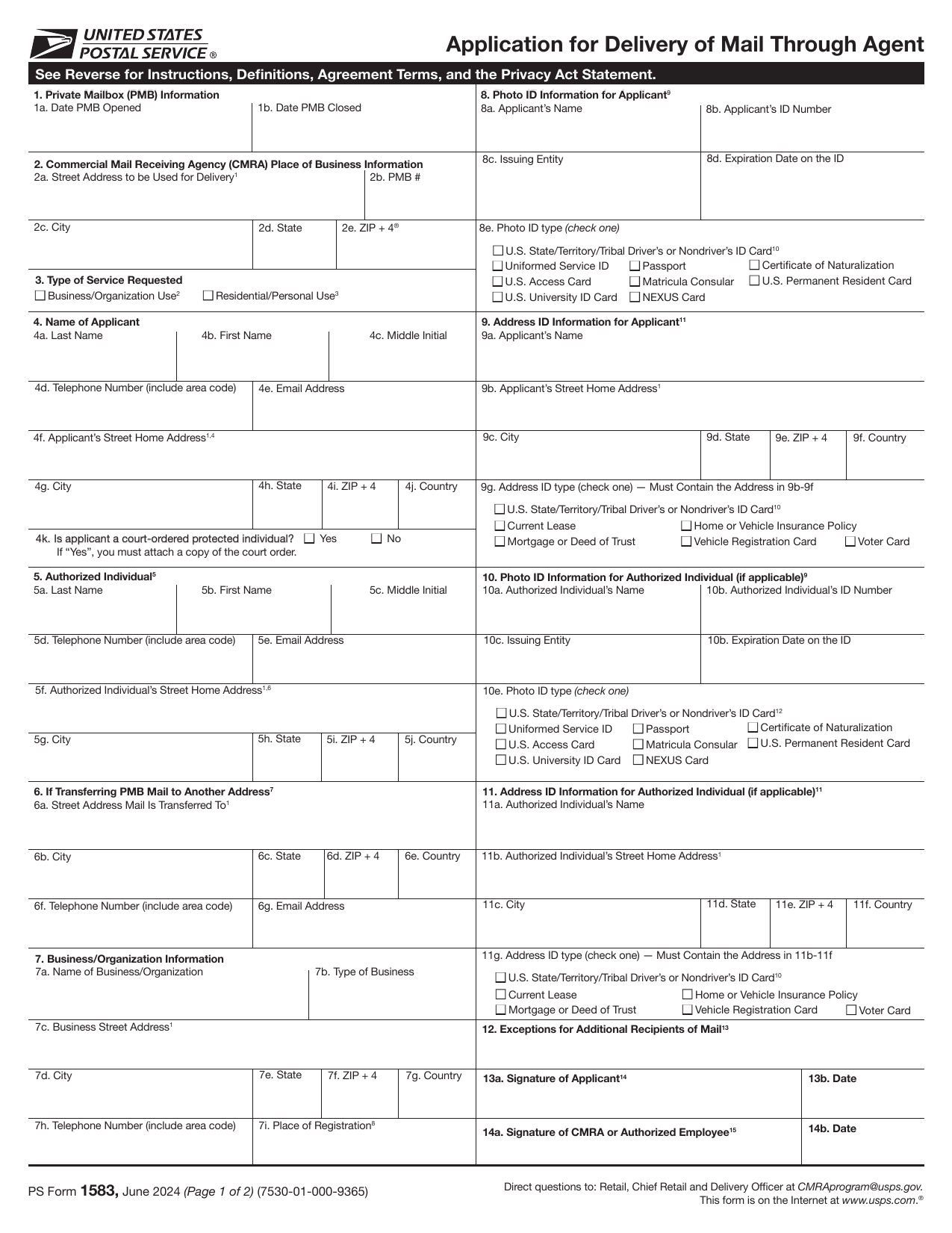
The form asks for your street home address twice, at box 4f and again at box 9b, and box 9g will only accept a document that carries that same home address. The list is short. A driver's or nondriver's ID card, a current lease, a mortgage or deed of trust, a home or vehicle insurance policy, a vehicle registration card, or a voter card.
You probably do not need a notary
The postal manual gives two routes and most of the internet mentions one. DMM 508.1.8.3 lets you sign in front of the CMRA owner, manager or an authorised employee, either in person or over live audio and video. Acknowledging the signature before a notary is the alternative. It is not the rule.
You can see it on the form above. Box 13a takes your signature and box 14a right beneath it is headed Signature of CMRA or Authorized Employee. Google's own AI summary for this form currently states notarisation as a requirement. Ask your provider whether its staff can witness the signature before you go and pay a notary.
The manual asks for one more thing. Your provider has to confirm that you live or do business at the permanent address you wrote on the form. You still need a real address to get the mailbox, which is why so many threads from founders abroad read as circular.
Registered agent address versus business address
These are two jobs and swapping them is where trouble starts. A registered agent address exists to receive lawsuits and state notices, and someone has to be there in business hours. A business address receives everything else.
Most registered agent services will not take your general post. Northwest says so plainly. You should not expect an agent to accept and forward all your business mail, because they are there for legal and state mail only.
Its business address comes with 10 free scans a year for mail that is not state or legal mail, and each further item costs $15 to view. Mail Forwarding starts at $49 a year and runs in 24 states rather than all 50.
So which address should you actually buy
Buy for the checks. Match the address to the ones you will really face, then take the cheapest thing that clears them. Our registered agent comparison carries the current pricing across the field.
- You just need the filing done and your home off the register. A registered agent address covers it. Northwest charges $125 a year and the business address is included, with 10 free scans a year of non-state, non-legal mail. State and legal mail is scanned at no extra cost.
- You get real business post. You need more scans than a registered agent plan includes, so that is a mail forwarding or virtual office plan. Northwest charges $49 a year for 15 scans or $99 a year for 20 scans plus an office lease, across 24 states. If your state is not on that list, our Anytime Mailbox review covers the alternative.
- You want local customers to find you on Google Maps. No rented address does this. Either you have premises with a sign and your own staff, or you run a service-area profile with the address hidden.
- You are outside the US. Expect the residential field to be the hard part rather than the company one, because a provider still has to confirm a permanent address before it can take you on.
Picking between the providers is a separate job from understanding the checks. We read what Stable, Northwest, iPostal1 and Anytime Mailbox each publish about banks, and only one of them names the banks its customers use. That comparison is in our guide to virtual address services compared.
One thing to avoid. Do not buy a single address, put it in every field on every form, and hope. The four checks want different things, which is the entire point of the grid at the top.
Read next
Registered agent services compared, what each one charges and what the address actually covers
Frequently Asked Questions
Not for the registered agent line. All 50 states want a street address there, because a process server has to hand papers to a person. A PO box has nobody to hand them to. Some states will accept a PO box as a mailing address on other lines, but it is a poor default. Google names PO boxes as not acceptable for a Business Profile, and most payment processors reject them too.
No. The postal manual gives two routes and most guides only mention one. DMM 508.1.8.3 lets you sign in front of the CMRA owner, manager or an authorized employee, either in person or over live audio and video. Acknowledging your signature before a notary is the alternative. Box 14a on the form is literally headed Signature of CMRA or Authorized Employee. Ask your provider before you pay a notary.
Different jobs. A registered agent address exists to receive lawsuits and state notices, so somebody has to be there in business hours. A business address receives everything else. Most agent services will not accept your general post. Northwest says as much on its own page, that you should not expect an agent to forward all your business mail because they handle legal and state mail only.
A rented mailing address is not eligible for a Business Profile at all. Google's guidelines say that if your business rents a physical mailing address but does not operate out of that location, it is not eligible. A coworking desk only qualifies if the office has clear signage, receives customers in business hours, and is staffed by your own people. If you travel to customers instead, run a service-area profile with the address hidden.
Yes. The IRS takes a mailing address on Form SS-4, and a virtual mailbox qualifies. It is not inspecting premises, it is deciding where to post you a letter. What deserves your attention is scanning volume. IRS notices still arrive on paper, and a registered agent plan with 10 free scans a year can still miss one that matters if you also receive a lot of other mail.
Usually because the wrong address is in the wrong field. Stripe asks for a company address, an administrative address which it defines as where the business is administered, and a separate residential address for you as the representative. That last one wants where the person lives. A mailbox there is a mismatch Stripe cannot resolve. When it cannot verify, it asks for a document that matches what you typed.
This page explains how postal, tax and platform rules treat business addresses. It is not legal advice. State filing rules vary and platform policies change, so check your own state requirements and the platform's current guidelines before you rely on an address.
Sources & References
- USPS Domestic Mail Manual 508.1.8, Commercial Mail Receiving Agencies
- USPS PS Form 1583, Application for Delivery of Mail Through Agent, June 2024
- Google, Guidelines for representing your business on Google
- USPS PostalPro, Delivery Point Validation product
- Stripe, Required verification information
- Northwest Registered Agent, business address pricing, read 8 August 2026
About the Author
Editor, StartupOwl
Eliot leads StartupOwl's state data research. He maintains the site's fifty state records of LLC filing fees, annual costs, processing times, and small business grant programs, checking each figure against the state office that publishes it and logging the date it was verified. Based in New Jersey, he has spent his working life in and around small businesses, and he writes for the founder who wants the real number rather than the advertised one. Every figure under his byline traces to a named source, and when a state proves a number wrong, the correction is published, not buried.
Was this article helpful?
Questions about this guide
No comments yet. Ask the first question and a member of our team will answer.
Leave a comment