
Pricing Strategies for Small Business: A Complete Guide for 2026
Pricing strategies for small business explained with 6 proven models. 73% of owners struggle with pricing. Find the right strategy plus free tools for 2026.

In This Article
$0–$399
Est. Cost
120 minutes
Timeline
5
Total Steps
Your pricing strategy determines your margins, your brand perception, and whether you can afford to grow. A 2026 Small Business Expo survey of 900+ owners found that 67.4% have already raised prices or plan to this year. If you have not reviewed your pricing recently, you are likely leaving money on the table.
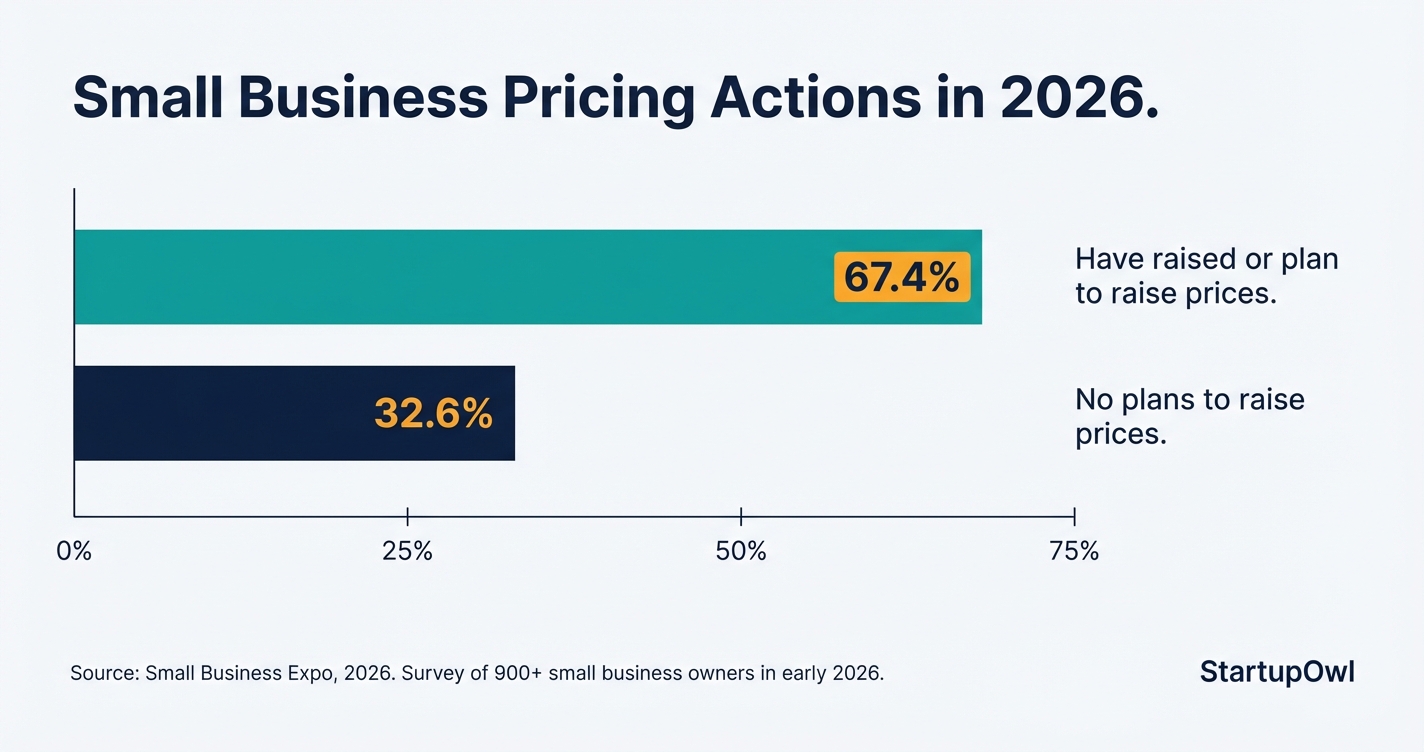
This guide covers the six core pricing strategies that work for small businesses right now, the tools that automate the heavy lifting (starting at $0), and the mistakes that cost you the most. Whether you sell products, services, or subscriptions, you will walk away with a pricing plan you can implement this week. If you need a broader view of your marketing approach, start with our small business marketing plan guide first.
Why Your Pricing Strategy Matters More Than Your Marketing Budget
Pricing is the most powerful profit lever you have. A 1% improvement in price has a bigger impact on your bottom line than a 1% increase in sales volume, customer count, or cost reduction. Yet most small business owners treat pricing as a one-time decision rather than an ongoing process.
The National Federation of Independent Business reports that pricing decisions in early 2026 reflect what they call a "strategic balance between protecting margins and maintaining customer relationships." That is a fancy way of saying: you need to raise prices carefully and tie every increase to visible value.
Small businesses that compete on price alone face a brutal reality. As The Balance puts it, having the lowest price invites customers to see your offering as a commodity, and larger competitors with economies of scale can undercut you whenever they choose. Your pricing should communicate quality, not desperation.
For 2026, three trends are reshaping pricing for small businesses. First, AI-powered dynamic pricing tools are now accessible at price points under $100/month. Second, tiered and outcome-based models are replacing flat-fee pricing. Data from Stripe shows the top 10% of fast-growing companies are 80% more likely to use tiered pricing and twice as likely to use usage-based models. Third, tariffs have impacted 68% of small businesses in 2026 (per Intuit QuickBooks), forcing 32% to pass costs on to customers through price increases.
How to Choose and Implement Your Pricing Strategy in 5 Steps
The step-by-step process below works for product businesses, service providers, and SaaS companies. Each step builds on the previous one, and the whole process takes about 2-3 weeks for a first pass (with quarterly reviews after that).
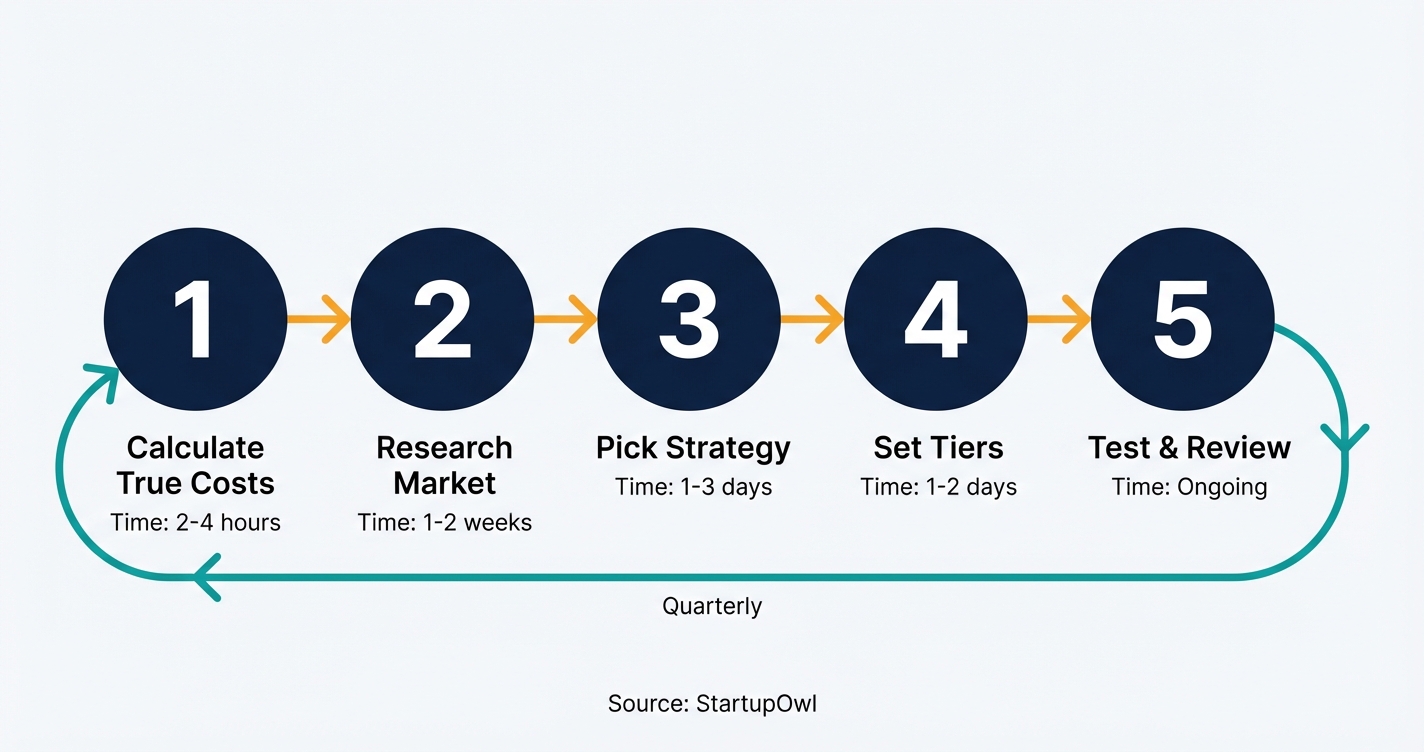
Before you start, make sure you have access to your accounting software or financial records, a list of your top 3-5 competitors, and at least 5 customers or prospects you can talk to. If you are building a brand from scratch, our building a brand guide covers how positioning and pricing work together.
The detailed steps, costs, and timelines are listed above in the step-by-step section. Here is a quick summary of the flow.
- Step 1 is calculating your true cost floor (including overlooked indirect costs like marketing and payment fees).
- Step 2 is researching your competitors and talking to actual customers about willingness to pay.
- Step 3 is selecting the pricing model that fits your business type (cost-plus, value-based, competitive, penetration, premium, or dynamic).
- Step 4 is structuring your prices into tiers and applying psychological pricing principles.
- Step 5 is testing, measuring results, and reviewing quarterly.
Use our pricing calculator to model different margin scenarios before committing to a price point. And if you are running a product business, compare your platform options in our Shopify vs Squarespace guide since your platform affects what pricing features you have access to.
The Best Pricing Tools for Small Businesses in 2026
You do not need expensive enterprise software to price intelligently. Here are four tools that cover the most common small business pricing needs, with verified pricing as of late 2026.
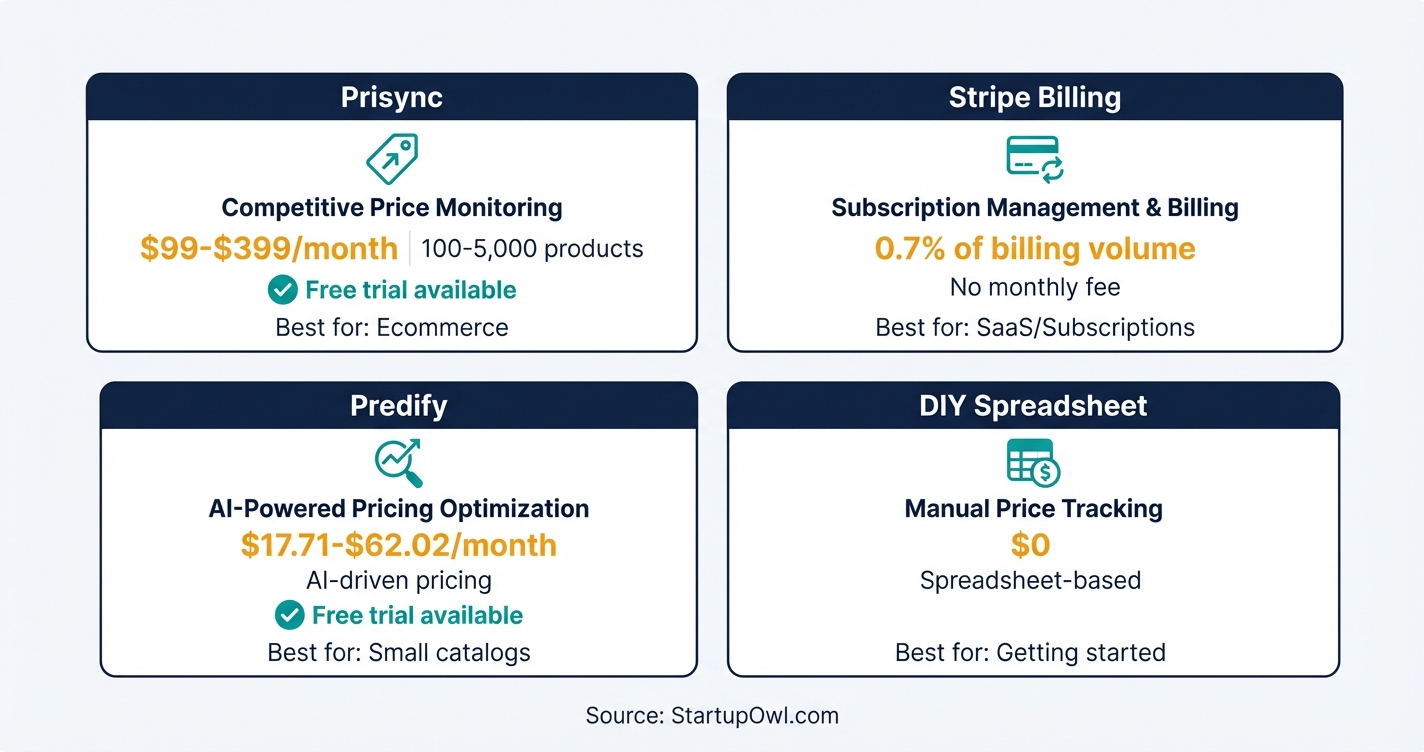
Prisync is the go-to for ecommerce competitor price tracking. It monitors competitor prices daily, offers dynamic pricing rules, and works with Shopify, Amazon, and Google Shopping. G2 lists three tiers from $99 to $399/month, covering 100 to 5,000 products with unlimited competitors. A 14-day free trial requires no credit card. On Capterra, Prisync holds a 4.8/5 rating across 129 reviews, and the company claims retailers see a 20% average increase in sales.
Stripe Billing is ideal if you sell subscriptions, memberships, or usage-based services. It supports fixed-price, tiered, and usage-based billing models. The pay-as-you-go plan charges 0.7% of billing volume with no monthly fee, making it accessible for early-stage businesses. Annual subscription tiers are also available for higher-volume businesses. Standard Stripe payment processing fees (2.9% + 30 cents per domestic card transaction) apply on top of Billing fees.
Predify uses AI and big data to automate financial control and product pricing. Plans range from $17.71/month (Small) to $62.02/month (Business), and a free trial is available. It integrates with SAP Business One. The main limitation is its focus on the Brazilian market, so verify compatibility with your region before signing up.
For SaaS companies with complex billing models, Chargebee and Orb offer segment-based metered billing with more advanced pricing logic than Stripe Billing alone. If you are looking for a CRM for startups that also handles quotes and pricing workflows, HubSpot CRM offers free deal tracking with paid tiers starting at $15-20/month per seat.
Pricing Tool Comparison (2026-2026)
| Type / Provider | Rate | Notes |
|---|---|---|
| Prisync | $99-$399/month | 100-5,000 products; unlimited competitors; 14-day free trial; 4.8/5 on Capterra |
| Stripe Billing | 0.7% of billing volume (pay-as-you-go) | No monthly fee on pay-as-you-go; annual plans available; 2.9%+30c processing separate |
| Predify | $17.71-$62.02/month | AI-driven pricing optimization; free trial; SAP integration; primarily Brazil market |
| HubSpot CRM (deal/quote tracking) | $0 free tier; $15-20/seat/mo Starter | Free plan includes basic deal tracking; paid plans add quotes, automation |
| Manual research (DIY) | $0 | Spreadsheet analysis; effective but time-intensive; no automation |
5 Pricing Mistakes That Silently Destroy Your Margins
1. Underpricing out of fear. Research indicates that 80-90% of poorly chosen prices are too low. Underpricing signals low quality, attracts price-sensitive customers who are less loyal, and makes it nearly impossible to raise prices later. If you have never lost a single customer to price, you are almost certainly charging too little.
2. Setting prices once and never reviewing them. Costs shift, demand changes, and competitors evolve. Yet many owners set prices at launch and never look back. A quarterly pricing review catches rising supplier costs (tariffs impacted 68% of small businesses in 2026) and lets you adjust before margins erode.
3. Applying the same markup to every product. Using a flat percentage markup across your entire catalog ignores the reality that different products carry different perceived value. A 50% markup on a commodity item might be appropriate, but that same markup on a unique, high-demand product could leave significant revenue uncaptured.
4. Ignoring indirect costs in your calculations. Direct costs like materials and labor are obvious. But forgetting overhead like rent, utilities, marketing, payment processing fees (Stripe's 2.9% + 30 cents adds up fast), and your own salary leads to prices that look profitable on paper but lose money in practice.
5. Copying competitor prices without understanding their cost structure. Your competitors may have different overhead, different supplier deals, or different target customers. They could also be underpricing and struggling financially. Instead, understand your unique value proposition and build your small business marketing plan around it.
When to Switch From Cost-Plus to Value-Based Pricing
If you sell services, consulting, or any product with a unique benefit that competitors cannot easily replicate, value-based pricing will almost always generate higher margins than cost-plus. Start by asking 5-10 customers what outcomes they value most, then price based on those outcomes rather than your time or materials. Even a partial shift (using cost-plus as your floor and value-based as your ceiling) can boost margins by 15-30% without changing your product.
What to Do This Week
Start with one action today: open your accounting software and calculate your true cost per unit (or per hour of service), including every indirect expense you have been ignoring. That number is your pricing floor. Then pick one of the six strategies above, set an initial price, and commit to reviewing it in 90 days.
If you are ready for a broader growth strategy, grab our free marketing plan template and map out how pricing fits alongside your local SEO, Google Ads, and guerrilla marketing ideas. Your price is not just a number. It is your most direct statement about the value you create.
Step-by-Step Process
- 1
Calculate your true costs before choosing a strategy
Start by tallying every expense that goes into delivering your product or service. That means direct costs (materials, labor, packaging) plus indirect costs (rent, utilities, marketing, insurance, and your own salary). Most owners forget to include overhead, which leads to artificially low prices from day one.
Use a spreadsheet or accounting tool to break your costs down per unit or per hour of service. Once you have this number, you know your absolute floor price. You can not go lower than this long-term without losing money.
Tips
- Include your own salary in the cost calculation, even as a solopreneur
- Factor in payment processing fees (Stripe charges 2.9% + 30 cents per transaction as of 2026)
- Recalculate your cost floor every quarter to catch rising supplier prices
Common Mistakes
- Forgetting indirect costs like marketing, shipping, and payment processing fees
- Using last year's supplier costs instead of current prices
- 2
Research your market and competitors
Identify 3-5 direct competitors and document their pricing structure, including base prices, premium tiers, and any promotional discounts. You are not copying their prices. You are mapping the range your customers expect to see.
Talk to at least 5-10 current or potential customers. Ask what they would pay, what alternatives they have considered, and what features matter most. This customer insight is what separates value-based pricing from pure guesswork.
$0-$99/month (free for manual research; Prisync from $99/month for automated tracking) 1-2 weeks prisync.comTips
- Use Google Shopping and Amazon to benchmark product prices quickly
- Ask customers 'What would make this worth paying more for?' to surface value drivers
Common Mistakes
- Blindly matching the lowest competitor price without understanding their cost structure
- Skipping customer conversations and relying only on competitor data
- 3
Pick the pricing strategy that fits your business type
You have six main options, and the right one depends on your industry, product, and customers. Cost-plus pricing adds a fixed markup (typically 30-50%) to your production cost. It is simple and predictable, best for manufacturing, retail, and government contracts. Value-based pricing sets prices based on what customers believe your product is worth, ideal for services, SaaS, and unique products.
Competitive pricing benchmarks against rivals. Penetration pricing starts low to grab market share (think 50% of competitor pricing), but makes raising prices later difficult. Premium pricing sets your price 2-3x above competitors to signal quality. Dynamic pricing adjusts based on demand, time, or customer segment in real time.
Most small businesses benefit from starting with cost-plus to ensure profitability, then moving toward value-based pricing as you better understand your customers. Read our full breakdown of cost-plus pricing for a deeper walkthrough.
Tips
- Start with cost-plus to protect your margins, then layer in value-based adjustments over time
- Service businesses almost always benefit more from value-based pricing than cost-plus
- Consider a hybrid approach with cost-plus on commodity items and value-based on premium offerings
Common Mistakes
- Choosing penetration pricing without a plan to raise prices within 6-12 months
- Applying the same flat markup to every product instead of segmenting by value
- 4
Set your prices and build a tiered structure
Fast-growing companies on Stripe are 80% more likely to use tiered pricing models than average businesses. Create at least 2-3 pricing tiers (for example, Starter, Pro, and Premium) that let customers self-select based on their needs and willingness to pay. Tiered pricing captures more revenue from high-value customers without scaring off budget-conscious ones.
Use psychological pricing tactics like ending prices in .99 or .97 to reduce perceived cost. Remove dollar signs on menus or pricing pages where appropriate. Bundle complementary products to increase average order value.
Tips
- Name your tiers after outcomes (Growth, Scale) rather than generic labels (Plan A, Plan B)
- Place your most profitable tier in the middle, as most customers pick the middle option
Common Mistakes
- Offering too many tiers (more than 4) which causes decision paralysis
- Not including a clear 'most popular' indicator on your recommended tier
- 5
Test, measure, and adjust quarterly
Your pricing is not a set-it-and-forget-it decision. Costs change, demand shifts, and competitors evolve. Test small price increases with a segment of customers (new customers or a specific product line) before rolling out changes across your business. Many owners discover that conversion rates stay flat even after a 10-15% price increase.
Review your pricing at least once per quarter. Track your gross margin, customer acquisition cost, and churn rate after every change. If you are using an ecommerce platform, A/B test different price points on product pages to see real purchase behavior.
Tips
- Start price tests with new customers so existing ones are not immediately affected
- Document every price change and its result so you build an internal pricing playbook
- Use the StartupOwl pricing calculator to model different margin scenarios before testing
Common Mistakes
- Raising prices without communicating added value to customers first
- Waiting a full year between pricing reviews when costs change quarterly
Cost Breakdown
| Item | Cost Range | Notes |
|---|---|---|
| Manual pricing research (DIY) | $0 | Spreadsheet-based competitor and cost analysis |
| Prisync (competitor price tracking) | $99-$399/month | 3 tiers covering 100 to 5,000 products; 14-day free trial (as of 2026, per G2) |
| Predify (AI pricing optimization) | $17.71-$62.02/month | Best for smaller catalogs; free trial available; focused on Brazil market |
| Stripe Billing (subscription/tiered pricing) | 0.7% of billing volume | Pay-as-you-go with no monthly fee; custom pricing for high volume (as of Oct 2026) |
| Pricing consultant (one-time engagement) | $500-$5,000 | For complex pricing strategy overhauls; varies widely by scope |
Frequently Asked Questions
Cost-plus pricing is the safest starting point because it guarantees you cover all expenses and hit a target profit margin. Add a 30-50% markup to your fully loaded costs (including overhead). Once you understand what customers value most, transition toward value-based pricing to capture higher margins on your strongest offerings.
At minimum, review your pricing once per quarter. Costs change faster than most owners realize (tariffs impacted 68% of small businesses in 2026 alone). A quarterly review lets you catch rising supplier costs, shifting competitor prices, and changing customer demand before your margins erode.
Tie every increase to visible added value (new features, faster delivery, better support). Give existing customers 30-60 days notice and apply the increase to new customers first. Most businesses find that a 10-15% increase has minimal impact on customer retention when communicated transparently.
Cost-plus starts with your production cost and adds a fixed markup (for example, cost + 50%). Value-based starts with what the customer believes the product is worth and prices accordingly. Cost-plus is simpler but can leave money on the table. Value-based requires more research but typically produces higher margins, especially for services and unique products.
You can start with a spreadsheet for free and get solid results. Pricing software like Prisync ($99-$399/month) becomes worthwhile once you track more than 50 competitor products or need daily price updates. For subscription businesses, Stripe Billing at 0.7% of billing volume automates tier management and recurring charges.
Dynamic pricing adjusts your prices based on demand, time of day, inventory levels, or customer segment. It works best for ecommerce, hospitality, and high-volume commodity sales. Tools like Prisync automate this for ecommerce stores. If you sell fewer than 50 products or run a service business, simpler tiered pricing will serve you better.
Some links on this page are affiliate links. If you sign up for a service through them, we may earn a commission at no extra cost to you. This does not influence our rankings.
Sources & References
- 14 Pricing Strategies for Small Businesses in 2026 - QuickBooks
- Top 10 Common Pricing Strategies for Businesses - Shopify
- Steady But Strategic: Small Business Pricing In 2026 - Small Business Expo
- The Science Behind Successful Pricing Strategies - Stripe Sessions 2026
- Prisync Pricing - G2
- Prisync Reviews - Capterra
- Stripe Billing Pricing
- How Much Does Stripe Billing Really Cost - MetaCTO
- Pricing Strategies for Small Business - The Balance
- Signs Your Prices Are Too Low - Beancount.io
- Common Pricing Mistakes Small Businesses Make - Small Business Coach
- Cost-Based and Value-Based Pricing - Stripe
About the Author
Editor, StartupOwl
Eliot leads StartupOwl's state data research. He maintains the site's fifty state records of LLC filing fees, annual costs, processing times, and small business grant programs, checking each figure against the state office that publishes it and logging the date it was verified. Based in New Jersey, he has spent his working life in and around small businesses, and he writes for the founder who wants the real number rather than the advertised one. Every figure under his byline traces to a named source, and when a state proves a number wrong, the correction is published, not buried.
Was this article helpful?
Questions about Pricing Strategies for Small Business
No comments yet. Ask the first question and a member of our team will answer.
Leave a comment