
How to Fight a Chargeback and Win, the Merchant Playbook
You get 7 to 21 days to answer a chargeback and Stripe keeps the $15 fee either way. The deadlines, the arithmetic, the evidence, and the current Visa and Mastercard thresholds.

Miss it and the case closes. It closes against you whatever the evidence would have shown, because nobody reads evidence that arrives late. Most merchants lose on the calendar, not on the merits.
So this page starts with the clocks. Then the arithmetic of whether a fight pays, the evidence that answers each reason code, and the point where Visa and Mastercard start counting you. Every fee figure here is Stripe's published price, read on 5 August 2026. Other processors charge differently, so treat the method as portable and the numbers as Stripe's. If the payment stack itself is the problem, our best POS systems for small business guide covers the processor side.
The four clocks running against you
You have 7 to 21 days to respond once a chargeback is created, and the exact number depends on the card network. That is the only deadline you control. The other three belong to the cardholder, the bank, and the process.
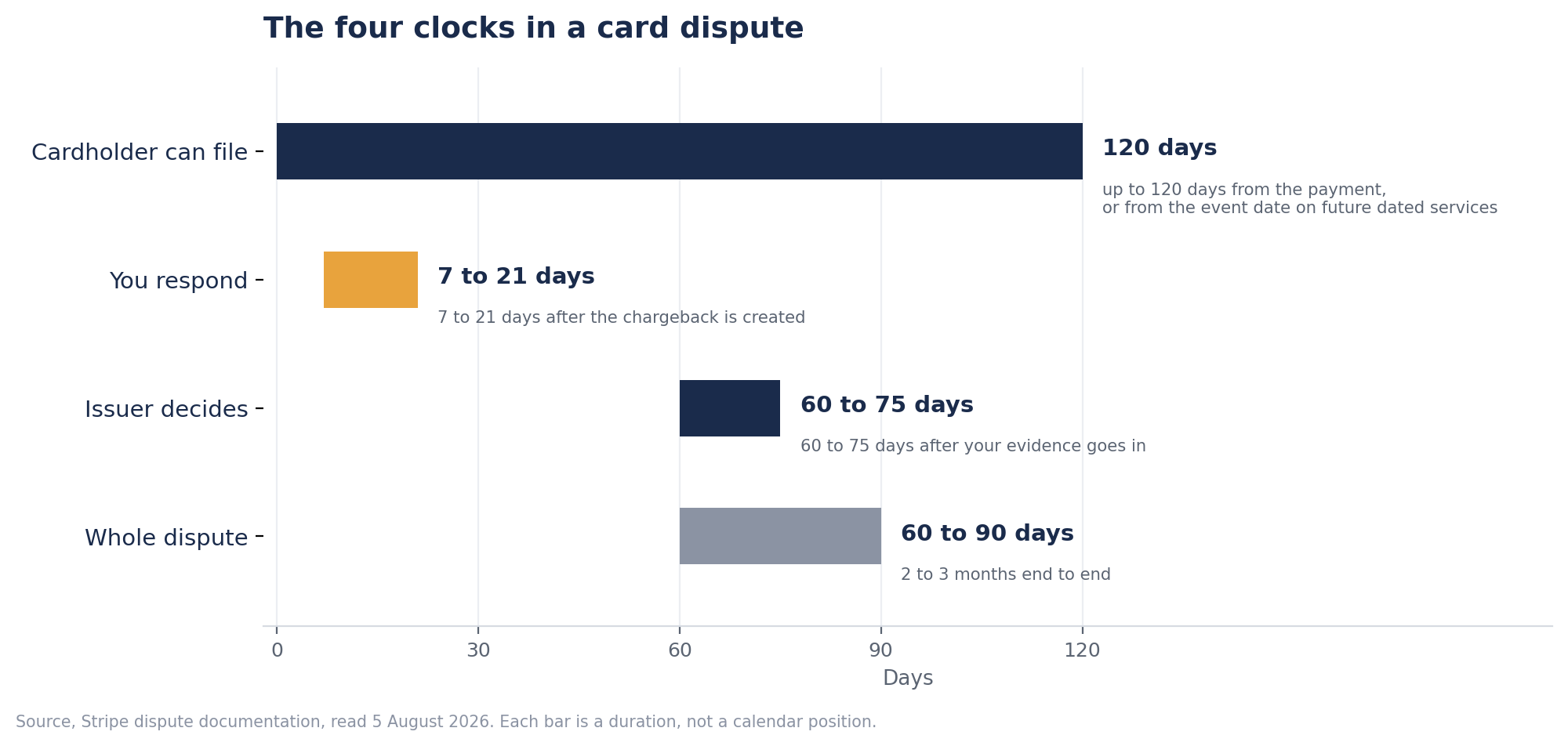
The cardholder normally gets 120 days from the payment to file. One exception catches service businesses badly. When a customer pays for a future event or service, a vacation booking, a professional appointment, an event ticket, Stripe's dispute documentation says the 120 day window starts on the event date, not the payment date. Sell a March wedding package in June and the clock has not started yet.
Once you submit evidence the issuer takes 60 to 75 days to decide. End to end, a dispute runs 2 to 3 months. You cannot speed that up. The only lever is accepting the dispute, which ends it and gives up the money.
Local payment methods run their own rules. Klarna and PayPal typically allow 180 days rather than 120, and each sets its own evidence deadlines.
Work out what the fight is worth before you start
The $15 dispute received fee is gone the moment the dispute arrives. Stripe's own docs say it plainly, "we never return the dispute received fee" for businesses outside Mexico. A second $15 dispute countered fee applies when you respond manually, and Stripe returns that one if you win. So a win still costs you $15.
Smart Disputes is the other route. Stripe's AI prepares the evidence and charges 30 percent of the disputed amount on a win, nothing on a loss. The $15 received fee still applies either way.
One basis for all five outcomes. Everything below measures how far down you end up against a $100 sale that was never disputed.
| What you do with a disputed $100 sale | Fees you pay | Down against the sale |
|---|---|---|
| Counter manually and win | $15 received, countered fee refunded | $15 |
| Counter with Smart Disputes and win | $15 received, $30 Smart Disputes | $45 |
| Counter with Smart Disputes and lose | $15 received | $115 |
| Accept without fighting | $15 received | $115 |
| Counter manually and lose | $15 received, $15 countered | $130 |
Read the last two rows together. Accepting is not free. It costs $115, which is the whole sale plus the fee, so the real question is never fight versus nothing.
That turns into a rule. Fighting manually beats accepting once your chance of winning is better than about 1 in 8, because a manual loss costs only $15 more than accepting does. Smart Disputes beats manual below roughly a 1 in 3 chance and manual beats it above, because the AI route trades a cheaper loss for a costlier win. Both thresholds are arithmetic on Stripe's published fees, not a guess at how often anyone wins.
Early fraud warnings are the cheaper decision. These are issuer fraud reports, Visa TC40 and Mastercard SAFE, and they arrive before any dispute. Stripe states that 80 percent of them become a fraud dispute if you do nothing. Its guidance sets a band rather than a line, refund at or below your $15 dispute fee, and above about $20 (35 percent over the fee) refunding is likely not worth it. Between $15 and $20 it is your call.
What evidence answers which claim
Submitting evidence is the only way to overturn a dispute. There is no other route. Stripe's docs are blunt about one trap, even when a customer says they withdrew the dispute, you still have to respond with evidence or it closes in their favour.
Every claim arrives with a reason code. The code tells you which argument you are having. Stripe sorts the hundreds of network codes into eight categories, and the category decides what evidence counts. Sending your whole file every time wastes the one thing that wins them.
| What the cardholder is claiming | Visa reason code | What answers it |
|---|---|---|
| Unrecognized | Visa has no code for this | Your billing descriptor as it appears on the statement, the receipt, and earlier payments on the same card that were never disputed |
| Fraudulent | 10.1 to 10.4 | AVS matched shipping address, signature or ID at pickup, CVC result, evidence a household member made the purchase |
| Product not received | 13.1 | Carrier, tracking number, shipping date, and a shipping address matching the one AVS verified |
| Product unacceptable | 13.3 to 13.5 | The listing or spec the customer bought from, photographs, and your returns process |
| Subscription canceled | 13.2 | Your cancellation terms shown at signup, plus usage logs after the date they claim they cancelled |
| Credit not processed | 13.6 and 13.7 | Your refund policy as published, and proof of any refund already issued |
| Duplicate | 12.6.1 and 12.6.2 | Proof the two charges are separate purchases, or the receipt for the other payment method |
One code is worth knowing by name. Visa 10.5 is the Visa Fraud Monitoring Program code, and Stripe's documentation says Visa treats those transactions as fraudulent and does not accept evidence at all. There is no argument to have.
Some other disputes cannot be challenged either. Stripe closes those as lost the moment it notifies you. It does not support the arbitration phase, so a lost card dispute is finished.
Watch the inquiry stage on American Express and Discover. An inquiry closes with evidence or a full refund at no dispute fee, which makes it the only free exit in this process. Visa and Mastercard no longer use inquiries. Ignore one and Stripe says it can escalate into a formal and likely unwinnable chargeback, so an unanswered inquiry costs you the $15 fee and the case.
What a no refund policy is actually worth
A published no refund policy is evidence, not a shield. It answers a claim about the goods or the cancellation, because there the argument turns on the terms of sale and the terms of sale are what you published. It answers nothing on a fraud reason code. The cardholder says they never bought this. Your refund terms are not part of that question.
So the policy earns its place in a services or subscription dispute, and only there. Show it before they pay. The checkout page and the receipt both count, and a policy sitting in a footer is weaker evidence than the same words in a confirmation email. Our guide to business contracts covers where those terms belong. That is the cheapest fix here, because it costs nothing and it is the gap between winning a $200 subscription dispute and paying $215 for it.
When the networks start counting you
This is where a run of disputes stops being an accounting problem. Visa retired two programs here. The Visa Dispute Monitoring Program and the Visa Fraud Monitoring Program were folded into the Visa Acquirer Monitoring Program, and what gets counted changed with them. Most published chargeback guides still describe the retired version. The numbers below come from Visa's own VAMP fact sheet, read on 5 August 2026.
The VAMP ratio counts fraud reports and disputes together, divided by settled card not present transactions. In formula terms it is TC40 fraud plus TC15 disputes over TC05 settled transactions. Both halves count against you.
| Program level | Ratio threshold | Count threshold | Applies to |
|---|---|---|---|
| Visa VAMP, acquirer Above Standard | 50bps, 0.50 percent | 1,500 monthly fraud and disputes | Your processor's whole portfolio |
| Visa VAMP, acquirer Excessive | 70bps, 0.70 percent | 1,500 monthly fraud and disputes | Your processor's whole portfolio |
| Visa VAMP, Excessive Merchant, US | 150bps, 1.50 percent | 1,500 monthly fraud and disputes | You, when your processor is clean |
| Mastercard ECM | 1.50 to 2.99 percent | 100 to 299 chargebacks | You |
| Mastercard HECM | 3.00 percent and above | 300 and above | You |
The US Excessive Merchant threshold dropped from 220bps to 150bps on 1 April 2026, which is the change nearly every competing page has missed. Note what that lines up with. Visa's merchant threshold and Mastercard's Excessive Chargeback Merchant floor are now the same number, 1.50 percent, measured different ways. One thing softens the Visa side, the 1,500 monthly count has to be met as well as the ratio, so a small merchant does not get pulled in by a bad month. At the acquirer level, Visa says an acquirer has to run several times the global average to be identified, which is why most merchants meet these programs through their processor's risk team rather than through Visa directly.
Mastercard counts differently and the difference matters. Its Excessive Chargeback Program divides this month's chargebacks by last month's sales, so June chargebacks over May sales. A month of falling sales raises your ratio without a single extra dispute. Both the count and the ratio have to be met. You exit by staying below the Excessive Chargeback Merchant thresholds for 3 consecutive months.
Mastercard fines escalate on a published schedule, per Braintree's ECP documentation. It runs month by month, ECM first and HECM second. Month 1, nothing either way. Month 2, $1,000 and $1,000. Month 3, $1,000 and $2,000. Months 4 to 6, $5,000 and $10,000. Months 7 to 11, $25,000 and $50,000. Months 12 to 18, $50,000 and $100,000. Month 19 onward, $100,000 and $200,000. High Excessive merchants also pay $5 per chargeback above 300. A fine holiday exists, an extension holds assessment for 6 months, but the fines keep accruing and all land at once if you are still over at the end.
Prevention that also keeps you off the list
Pre-dispute resolution does two jobs. The second one is the one nobody prices. Visa excludes disputes resolved through pre-dispute solutions from your VAMP ratio, and excludes TC40 fraud that qualified for Compelling Evidence 3.0. So paying to settle a dispute early ends the case and keeps it out of the number that decides whether you enter the program.
Stripe publishes what that costs. Dispute deflection lookups are included, a Visa resolution is $15, a Compelling Evidence 3.0 block is $15, and a Mastercard resolution through Ethoca is $29. Against a $15 received fee plus the disputed amount plus a ratio point, a $15 Visa resolution is usually the cheaper end of the trade.
The unglamorous prevention still does most of the work. Put a recognisable billing descriptor on the statement, because the recognition claim is the one your customer would not have filed if they had known who you were. Answer support before the bank does. If you sell online, the checkout itself is where most of this is won, see our guide to selling online. Refund the small early fraud warnings under $20 and fight the rest. If your processor is the reason disputes are piling up, our POS and payments comparison covers what each provider does when the disputes start.
Frequently Asked Questions
Some links on this page are affiliate links. If you sign up for a service through them, we may earn a commission at no extra cost to you. This does not influence our rankings.
Sources & References
About the Author
Editor, StartupOwl
Eliot leads StartupOwl's state data research. He maintains the site's fifty state records of LLC filing fees, annual costs, processing times, and small business grant programs, checking each figure against the state office that publishes it and logging the date it was verified. Based in New Jersey, he has spent his working life in and around small businesses, and he writes for the founder who wants the real number rather than the advertised one. Every figure under his byline traces to a named source, and when a state proves a number wrong, the correction is published, not buried.
Was this article helpful?
Questions about How to Fight a Chargeback and Win, the Merchant Playbook
No comments yet. Ask the first question and a member of our team will answer.
Leave a comment