
Business Growth Strategies for Small Business, 10 Proven Approaches for 2026
Business growth strategies that work for small businesses in 2026. 10 approaches with real costs, tools from $0 to $140/mo, and timelines you can act on today.

In This Article
- Key Takeaways
- Step-by-Step
- Cost Breakdown
- Why Most Small Businesses Pick the Wrong Growth Strategy
- What Business Growth Actually Means (and Why Retention Beats Acquisition)
- 10 Business Growth Strategies, Step by Step
- Recommended Tools for Each Growth Strategy
- 5 Growth Mistakes That Cost Small Businesses Real Money
- What to Do This Week
- FAQ
$0–$500
Est. Cost
30 days
Timeline
10
Total Steps
Some links in this guide are affiliate links. If you sign up through them, StartupOwl may earn a commission at no extra cost to you. We only recommend tools we have researched and believe deliver real value. Our editorial opinions are never influenced by affiliate partnerships. For more on how affiliate links work, see the FTC's endorsement guidelines.
Why Most Small Businesses Pick the Wrong Growth Strategy
About 74% of small business owners expect revenue growth in 2026, according to the Comerica Small Business Pulse Index. But expecting growth and actually achieving it are two different things. The gap usually comes down to picking strategies that sound exciting instead of strategies that match your current stage, budget, and capacity.
This guide gives you 10 proven business growth strategies with specific tool recommendations, real pricing (as of 2026), and timelines you can hold yourself to. Every approach here can be started for under $50/month, and most have a $0 entry point.
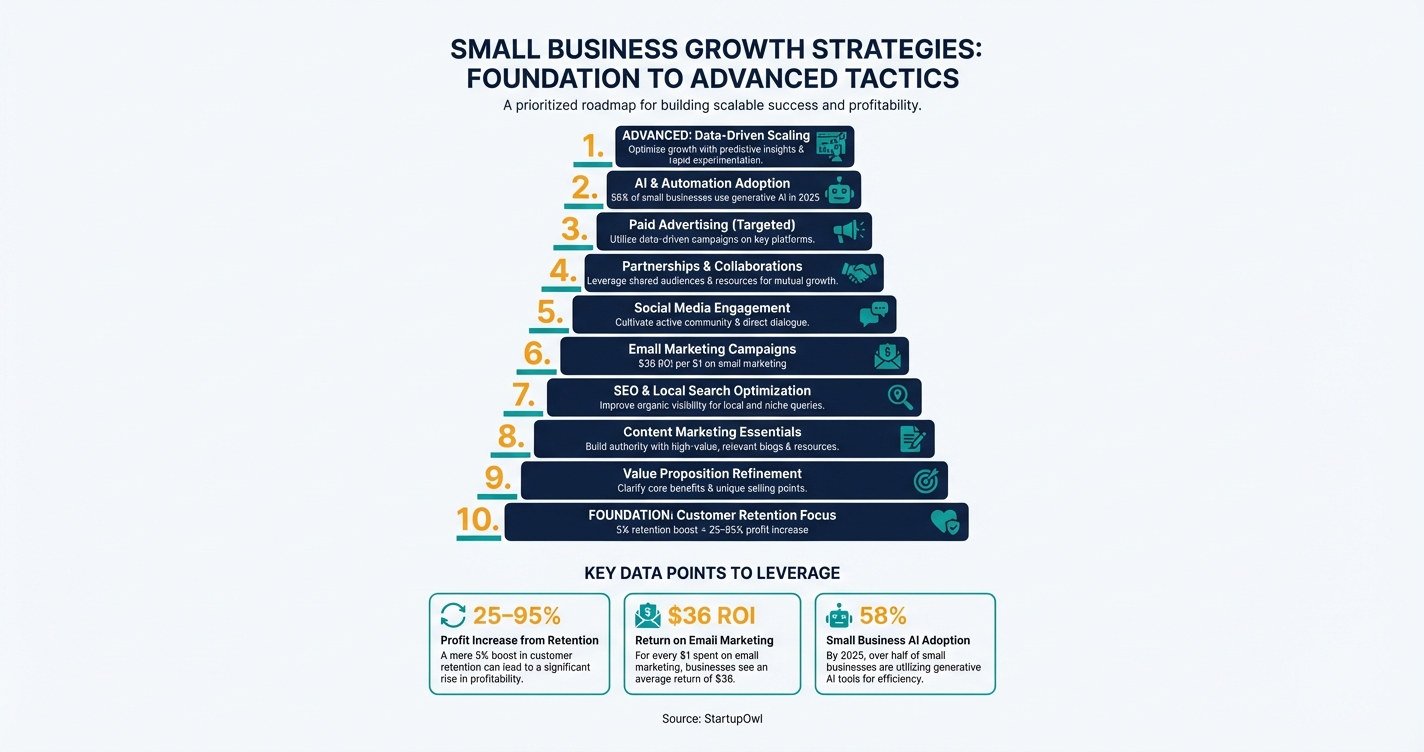
Whether you are pre-revenue and building your first customer base or already generating steady income and looking to scale, you will find at least 3 strategies below that fit. If you want the full picture on where these strategies fit into a broader plan, start with our small business marketing plan guide.
What Business Growth Actually Means (and Why Retention Beats Acquisition)
Business growth is not just about getting more customers. It is about increasing revenue, improving margins, and building systems that compound over time. The most overlooked lever is customer retention. A 5% increase in retention can boost profits by 25% to 95%, per Bain & Company research cited by Harvard Business Review.
Repeat customers spend 67% more than first-time buyers on average, and the probability of selling to an existing customer is 60% to 70%, compared to just 5% to 20% for a new prospect. Yet 44% of businesses still focus more on acquisition than retention. If you flip that ratio, you will outperform most of your competitors without spending more on ads.
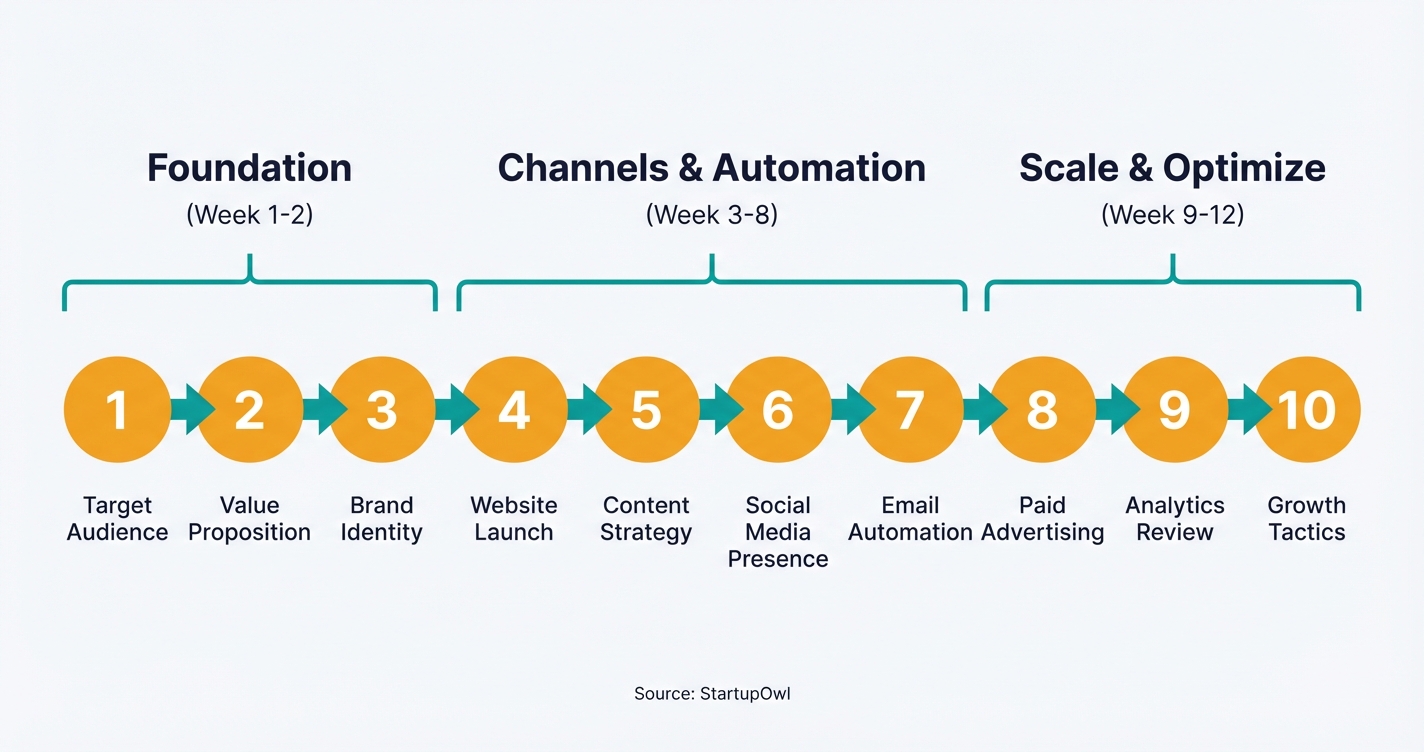
The 10 strategies below are organized in order of implementation: start with your foundation (customer profile and retention), then add marketing channels, automation, and paid tactics. Think of it as a growth stack you build over 90 days. For pricing fundamentals, see our cost-plus pricing guide to make sure your margins support your growth investment.
10 Business Growth Strategies, Step by Step
These are strategies, not tools. Each one changes where your revenue comes from. For every strategy you get the reasoning, the first moves, what it costs, and the number that tells you it is working.
1. Grow Customer Lifetime Value First
Growing revenue from customers you already have is the cheapest growth there is. Bain & Company found a 5% lift in retention raises profits 25% to 95%. The acquisition cost is already spent. Every repeat order lands at nearly full margin.
Execution looks like this. Map what happens after the sale, then fill the gaps. A 30 day check in, a win back email after 90 days of silence, and one loyalty mechanic, store credit or a simple punch card. Watch your repeat purchase rate monthly. If under 20% of customers ever buy twice, this strategy outranks everything else on this list.
Cost, $0 to $13 a month. Payback, 60 to 90 days. Watch, repeat purchase rate.
2. Engineer Referrals Instead of Waiting for Them
Referred customers close faster and spend more. Word of mouth already drives most small business sales. The strategy is refusing to leave it to chance.
Build a two sided incentive, $20 to the referrer and $20 off for the friend beats any points scheme. Then engineer the ask. The moment a customer praises you is the moment you hand them the link. Print it on invoices. Say it at checkout. Track referral codes so you know which customers are your real salesforce, and thank them personally.
Cost, the incentive itself. Payback, first month. Watch, referrals per month.
3. Build Compounding Search Traffic
Rankings sell while you sleep. Search traffic compounds because the work you did last year still pays this year. Paid reach stops the day you stop paying.
Start with your phone.
Write down the 10 questions customers ask most. Each is a page. Answer it better than anything currently ranking. Then mine Google Search Console monthly for pages sitting on page two and push them up with fresher facts and better coverage. Expect 3 to 6 months before traffic moves. That delay is why competitors quit, and why the ones who do not quit own the rankings.
Cost, $0 plus your time. Payback, 3 to 6 months. Watch, organic leads.
4. Own Your Audience With an Email List
Your email list is the only audience an algorithm cannot take away. Email returns about $36 per $1 spent, the strongest ratio in digital marketing. Social reach rents attention. A list owns it.
Two assets do most of the work. A three email welcome sequence that introduces you, sets expectations, and makes one offer. And one genuinely useful monthly newsletter. Grow the list at every touchpoint, checkout, invoices, the workshop signup sheet. A thousand real subscribers beat ten thousand followers.
Cost, $0 to $20 a month. Payback, 4 to 8 weeks. Watch, revenue per email.
5. Form Partnerships That Feed Your Pipeline
Other businesses already serve your exact customers. A partnership turns their trust into your pipeline. A plumber and an electrician, a photographer and a florist, an accountant and a business attorney.
Pick the three adjacent businesses your customers use most. Propose a formal swap, one referral a month each, tracked, reviewed quarterly. Then ask your suppliers about co-op marketing funds. Many manufacturers reserve budgets for local partners and most owners never claim them. Free money sits unclaimed.
Cost, $0. Payback, 1 to 2 months. Watch, partner referrals.
6. Buy Customers Only When the Math Works
Paid ads follow math. Know your allowable acquisition cost first, gross margin times expected lifetime orders. Most small ad budgets die from skipping that arithmetic.
Run one test, one offer, one audience, $150 to $300 over 30 days. Kill it if leads cost more than your allowable number. Scale it slowly if they cost less. Retargeting site visitors is the cheapest first campaign because the audience already knows you.
Cost, $150 to $300 per test. Payback, 30 days per verdict. Watch, cost per lead against your allowable number.
7. Raise Your Average Order Value
Sell more per order. It is usually the fastest lever on this list. A 15% lift in average order value flows almost entirely to profit.
Three mechanics do the work. Bundles that package what customers already buy together. A good, better, best version of your core offer, most buyers pick the middle. And one natural add-on offered at the moment of purchase. Restaurants mastered this with one question, "want fries with that." Your version exists.
Cost, $0. Payback, immediate. Watch, average order value.
8. Niche Down and Own One Segment
The specialist beats the generalist at every price point. The wedding photographer out earns the photographer. Niching down concentrates referrals, sharpens ads, and justifies premium pricing because message and customer match exactly.
Pick the segment where you win most often and enjoy the work. Rewrite your homepage for that segment, build one landing page per niche use case, and let your case studies speak their language. You can serve everyone. You market to someone.
Cost, $0 plus repositioning time. Payback, 1 to 2 quarters. Watch, close rate.
9. Reprice With Evidence
Most small businesses underprice and compensate with volume. A 10% price increase usually beats a 10% customer increase on profit, with less work. Pricing is a strategy, not an afterthought.
Test new prices on new customers first, existing customers keep their rate for now. Anchor the price with evidence, case studies, guarantees, before and after numbers. Expect to lose a few price shoppers. The margin on everyone else pays for them several times over.
Cost, $0. Payback, next sale. Watch, margin per sale.
10. Expand Only What Already Works
Expansion works when it copies a proven model, not when it flees a broken one. New territory multiplies whatever you already are. Fix the machine first, then copy it.
Test demand before committing. One landing page per new service area costs nothing and measures real interest through calls and form fills. When an area produces steady leads for a quarter, invest in it properly. Physical expansion follows demand evidence, never precedes it.
Cost, one landing page per area. Payback, a quarter of evidence. Watch, leads per area.
You do not run all 10 at once. Start with the first two, lifetime value and referrals, they cost the least and pay for everything after. Add one new strategy every 2 to 3 weeks.
If you are a brand-new business still choosing your web platform, check out our Squarespace vs WordPress comparison or Shopify vs Squarespace guide before investing in SEO or content marketing. Your website is the foundation everything else builds on.
What These Growth Strategies Cost in 2026
| Type / Provider | Rate | Notes |
|---|---|---|
| HubSpot CRM (free plan) | $0/month | Up to 1,000 contacts, 2 users, no time limit |
| HubSpot Starter | $20/seat/month | Removes branding, adds automation and reporting, $7 per seat on annual billing |
| Mailchimp Essentials | $13/month | 500 contacts, 10x monthly send limit, email support |
| Mailchimp Standard | $20/month | 500 contacts, 12x send limit, predictive segmentation |
| Semrush SEO plan | $139/month | 500 keywords tracked daily, 5 websites, site audit (17% off annually) |
| Zapier Professional | $19.99/month (annual) | 750 tasks, multi-step Zaps, premium apps |
| ChatGPT free tier | $0/month | Unlimited everyday text chats, limited images and deep research |
| Google Ads test budget | $150–$300/month | Minimum viable test; scale only with proven ROI |
Recommended Tools for Each Growth Strategy
You do not need to buy all of these tools. Match each tool to the strategy you are implementing this month, then add as you grow.
For CRM, HubSpot's free plan is the best starting point for most small businesses. It holds 1,000 contacts, with deal tracking and Gmail or Outlook integration. Free access never expires. The cap that bites first is 2 users, so a team of three moves to Starter, which is $20 per seat monthly or $7 per seat on annual billing. HubSpot for Startups offers 30% to 90% off the first year for eligible companies. Read our full CRM for startups comparison for alternatives.
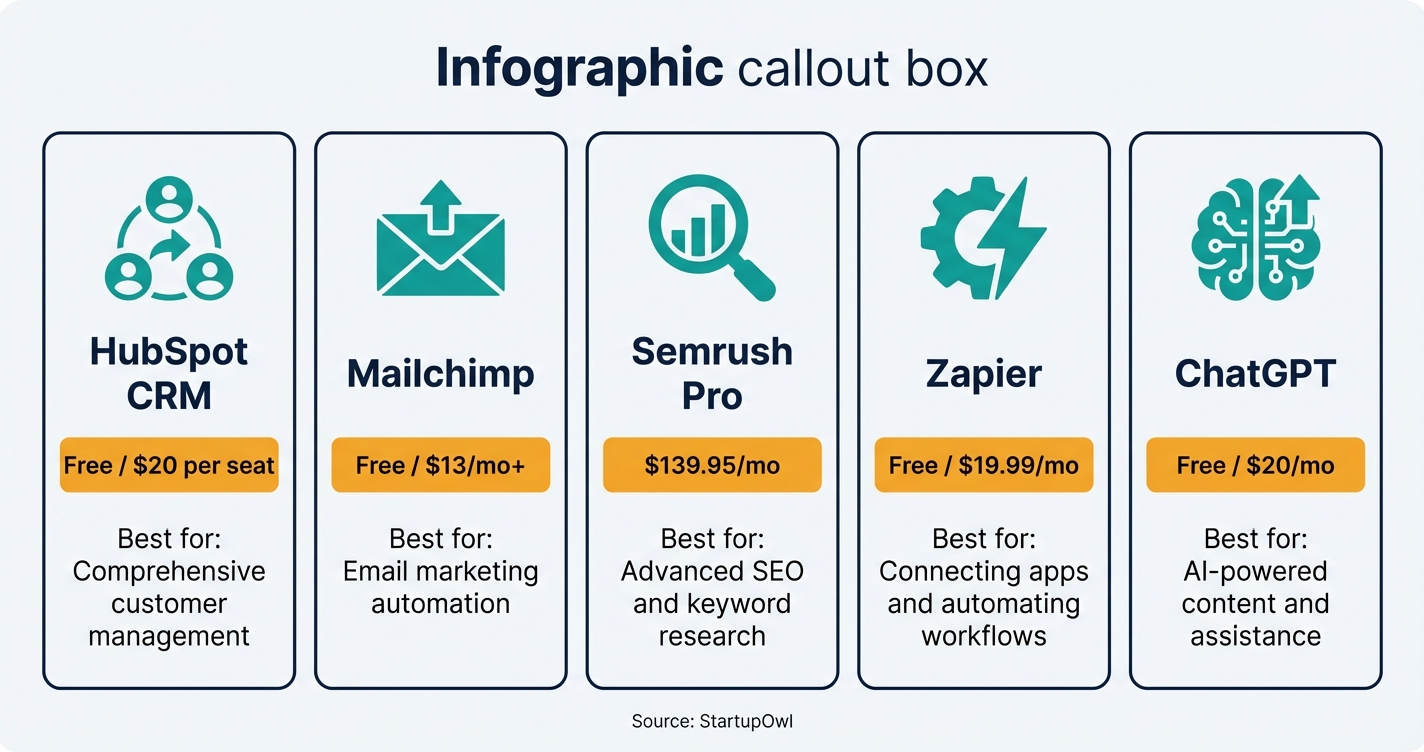
For email marketing, Mailchimp offers a free plan for up to 250 contacts. The Essentials plan at $13/month supports 500 contacts with a 10x monthly send limit. Mailchimp Standard at $20/month adds predictive segmentation and a 12x send limit. Prices scale with your contact count, so a list of 2,500 contacts costs roughly $45/month on Essentials or $60/month on Standard (as of 2026).
For SEO, the Semrush SEO plan at $139/month covers keyword research, site audits, and position tracking. It watches 500 keywords daily. Annual billing drops that to $117.33/month, a 17% saving. Starter and Pro+ sit above it at $199 and $299 a month, adding AI search visibility rather than more keywords. If Semrush is beyond your budget, Google Search Console is free and shows your existing keyword performance.
For automation, Zapier connects over 9,000 apps. The free plan includes 100 tasks/month with 2-step workflows. The Professional plan at $19.99/month (annual billing) provides 750 tasks and multi-step Zaps. Zapier's annual billing discount is roughly 33% cheaper than month-to-month pricing.
Best Free CRM for Small Businesses
HubSpot's free CRM holds 1,000 contacts, with deal tracking, email integration, and basic reporting. It never expires. Two limits push you off it, the contact ceiling and the 2 user cap. Starter costs $20 per seat monthly, or $7 per seat if you commit to a year. Eligible startups can save up to 90% in their first year through HubSpot for Startups.
5 Growth Mistakes That Cost Small Businesses Real Money
1. Spending on acquisition before fixing retention. If your churn rate is above 5% per month, every dollar you spend on new customers leaks out the bottom. Fix your onboarding, follow-up, and customer experience first. A 5% retention improvement is worth more than a 20% increase in ad spend.
2. Ignoring email marketing in favor of social media. Email delivers an average ROI of $36 per $1 spent. Organic social reach on most platforms is under 5%. You do not own your social media followers, but you do own your email list. Build the list first, use social to feed it.
3. Skipping keyword research before creating content. Publishing blog posts without checking search volume is like opening a store on a street with no foot traffic. Use Semrush or even free tools like Google Keyword Planner to validate demand before writing. For creative low-cost approaches, see our guerrilla marketing ideas guide.
4. Not using a CRM and tracking leads in spreadsheets. Spreadsheets break when you hit 50+ leads. A CRM automates follow-ups, prevents leads from falling through cracks, and gives you pipeline visibility. HubSpot's free CRM handles this for $0.
5. Changing strategies every 2 weeks. SEO needs 3 to 6 months. Email list building compounds over quarters, not days. Give each strategy at least 90 days of consistent effort before deciding it does not work. Track your numbers weekly and adjust tactics within the strategy, but do not abandon the entire approach too early. For help with your finances during growth, explore business loan options or small business grants to fund your next phase.
What to Do This Week
Start with 3 actions today: set up your free HubSpot CRM, create your ideal customer profile document, and draft your first 3-email welcome sequence. That foundation costs $0 and takes less than a day. Use our social media content calendar to plan your first month of content alongside your email strategy.
After that, work through the 10 steps above at a pace of 1 new strategy every 2 weeks. In 90 days, you will have a working growth system with real data showing which channels deserve more investment. Revisit our building a brand guide to make sure your growth efforts reinforce a consistent brand identity across every channel.
Step-by-Step Process
- 1
Grow Customer Lifetime Value First
List every touchpoint a customer hits after paying. Add a 30 day check in, a 90 day win back email, and one loyalty mechanic.
$0 to $13/month 2 weeksTips
- Store credit beats discount codes, it feels like money owned rather than money saved.
- Automate the win back email so silence triggers it, not memory.
Common Mistakes
- Chasing new leads while 80% of customers never buy twice.
- Launching a complex points program nobody understands.
- 2
Engineer Referrals Instead of Waiting for Them
Set the incentive for both sides. Put the ask at the moment of praise, on invoices, and at checkout. Track codes per customer.
The incentive itself 1 week to launchTips
- $20 each side beats points, instantly understood.
- Thank every referrer personally, they are your salesforce.
Common Mistakes
- Waiting for referrals instead of asking for them.
- Rewarding only the referrer, the friend needs a reason too.
- 3
Build Compounding Search Traffic
Turn the 10 most asked phone questions into pages. Each month, find pages ranked 11 to 20 in Search Console and improve them.
$0 plus time 3 to 6 months to tractionTips
- Answer the question in the first paragraph, then elaborate.
- One page per question beats one page covering ten.
Common Mistakes
- Quitting at month two, compounding starts around month four.
- Writing for keywords instead of the customer who asked.
- 4
Own Your Audience With an Email List
Three welcome emails, who you are, what to expect, one offer. Then one useful newsletter a month, no more.
$0 to $20/month 1 week to first automationTips
- Collect emails at every touchpoint, checkout, invoices, events.
- Write the newsletter you would actually read.
Common Mistakes
- Buying lists, they poison deliverability.
- Going quiet for months then blasting promotions.
- 5
Form Partnerships That Feed Your Pipeline
Pick the three adjacent businesses your customers already use. Agree a tracked referral swap. Ask every supplier about co-op marketing money.
$0 1 to 2 monthsTips
- Put the swap in writing, one referral a month each, reviewed quarterly.
- Ask suppliers directly, most co-op budgets go unclaimed.
Common Mistakes
- Partnering with businesses that share your category instead of your customer.
- Letting the swap go untracked, it dies quietly.
- 6
Buy Customers Only When the Math Works
Gross margin times expected lifetime orders is your allowable acquisition cost. Test one offer against one audience and judge by that number.
$150 to $300 per test 30 days per verdictTips
- Start with retargeting, the audience already knows you.
- Write the kill number down before spending a dollar.
Common Mistakes
- Scaling spend before the math proves the offer.
- Testing three variables at once, you learn nothing.
- 7
Raise Your Average Order Value
Package what customers already buy together. Offer good, better, best versions. Add one natural upsell at the moment of purchase.
$0 Same weekTips
- Most buyers pick the middle tier, design it as your target.
- The add-on must feel like a favor, not a squeeze.
Common Mistakes
- Bundling slow movers with winners, customers notice.
- Offering five add-ons where one would convert.
- 8
Niche Down and Own One Segment
Find where you win most often. Rewrite the homepage for that segment, build one page per niche use case, retell your case studies in their language.
$0 plus repositioning time 1 to 2 quartersTips
- Your niche is where referrals already cluster, follow the evidence.
- Serve everyone, market to someone.
Common Mistakes
- Picking a niche by wishful thinking instead of win rate.
- Niching the marketing but keeping a generic homepage.
- 9
Reprice With Evidence
New customers see the new price first. Anchor it with case studies, guarantees, and before-and-after numbers. Existing customers keep their rate for now.
$0 Next saleTips
- A 10% price rise usually beats 10% more customers on profit.
- Losing a few price shoppers is the plan working.
Common Mistakes
- Raising prices on loyal customers overnight without warning.
- Apologizing for the price instead of anchoring it.
- 10
Expand Only What Already Works
One page per candidate service area. Measure calls and form fills for a quarter. Invest only where demand is proven.
One landing page per area A quarter of evidence per areaTips
- A steady quarter of leads is the green light, one good week is not.
- Copy the model exactly, expansion multiplies what you already are.
Common Mistakes
- Expanding to escape a weak core business.
- Signing a lease before a landing page proved demand.
Cost Breakdown
| Item | Cost Range | Notes |
|---|---|---|
| CRM (HubSpot free to Starter) | $0–$20/seat/month | Free supports 1,000 contacts and 2 users; Starter is $20 per seat monthly or $7 annually |
| Email Marketing (Mailchimp) | $0–$20/month | Free for 250 contacts; Essentials $13/mo; Standard $20/mo for 500 contacts |
| SEO Tool (Semrush SEO plan) | $0–$139/month | Google Search Console is free; the Semrush SEO plan tracks 500 keywords daily |
| Automation (Zapier) | $0–$19.99/month | Free plan has 100 tasks and two-step Zaps; Professional starts at $19.99/mo for 750 tasks |
| AI Tools (ChatGPT) | $0 free tier | Free tier covers unlimited everyday chats; Go, Plus and Pro add higher limits and stronger models |
| Paid Ads (Google/Meta) | $150–$300/month | Minimum test budget; scale only after proving positive ROI |
| Social Media Calendar | $0 | Use StartupOwl's free social media content calendar template |
Frequently Asked Questions
Email marketing paired with a free CRM is the highest-ROI starting point. HubSpot's free CRM holds 1,000 contacts. Mailchimp's free plan handles 250 contacts. Email marketing returns an average of $36 for every $1 spent. You can build a lead-generation engine for $0/month and only upgrade when your list outgrows the free tiers.
Expect 3 to 6 months before you see meaningful organic traffic from a new SEO effort. Some lower-competition keywords may rank within 4 to 8 weeks, but sustainable search traffic takes consistent content publishing and link building over multiple quarters. The payoff is compounding: once a page ranks, it generates traffic for months or years without ongoing ad spend.
Yes, but primarily for content and marketing tasks right now. According to the U.S. Chamber of Commerce, 58% of small businesses use generative AI as of 2026, up from 40% in 2024. The most practical use cases are drafting marketing emails, generating social media posts, and researching competitors. Start with ChatGPT's free tier before investing in paid AI tools.
Most small businesses can start with $0 to $50/month using free tiers of HubSpot, Mailchimp, Zapier, and ChatGPT. A typical growing business spends $50 to $175/month on the Mailchimp Essentials plan ($13), Zapier Professional ($19.99), and a small Google Ads test ($150). Scale spend only after proving positive ROI on each tool.
A growth strategy is the overall approach to increasing revenue (retention, new markets, product expansion, pricing changes). A marketing plan is the tactical document that spells out which channels, tools, budgets, and timelines you will use to execute that strategy. You need both. Start with the strategy (this guide), then build your marketing plan using our small business marketing plan template.
Retention first. Acquiring a new customer costs 5 to 7 times more than keeping an existing one (Harvard Business Review). Your existing customers already trust you and spend 67% more on average than new buyers. Fix your onboarding, follow-up sequences, and customer experience before scaling ad spend on acquisition.
Some links on this page are affiliate links. If you sign up for a service through them, we may earn a commission at no extra cost to you. This does not influence our rankings.
Sources & References
- Bain & Company / HBR: Customer Retention and Profitability
- HubSpot 2026 State of Marketing Report
- HubSpot CRM Pricing
- Mailchimp Pricing Plans
- Semrush SEO Toolkit Pricing
- Zapier Pricing Plans
- U.S. Chamber of Commerce: Empowering Small Business 2026
- DemandSage: Customer Retention Statistics 2026
- Capterra: HubSpot CRM Reviews
- FTC Endorsement Guides
- Comerica Small Business Pulse Index
- Thryv AI and Small Business Survey 2026
About the Author
Editor, StartupOwl
Eliot leads StartupOwl's state data research. He maintains the site's fifty state records of LLC filing fees, annual costs, processing times, and small business grant programs, checking each figure against the state office that publishes it and logging the date it was verified. Based in New Jersey, he has spent his working life in and around small businesses, and he writes for the founder who wants the real number rather than the advertised one. Every figure under his byline traces to a named source, and when a state proves a number wrong, the correction is published, not buried.
Was this article helpful?
Questions about Business Growth Strategies for Small Business, 10 Proven Approaches for 2026
No comments yet. Ask the first question and a member of our team will answer.
Leave a comment