
SBA EIDL Loan Status, Eligibility and How to Apply in 2026
No, COVID-19 EIDL loans are not forgiven. Eligible borrowers can cut payments 50 percent for six months. See repayment options, rates and alternatives.

In This Article
- Key Takeaways
- Step-by-Step
- Cost Breakdown
- What You Need to Know About EIDL Loans in 2026
- How the Two EIDL Programs Work
- Who Qualifies for an EIDL Loan
- How to Apply for an Active Disaster EIDL
- What an EIDL Loan Actually Costs
- Where to Get Help With Your EIDL
- What to Do If You Do Not Qualify for an EIDL
- 5 Costly Mistakes EIDL Borrowers Make
- FAQ
$0–$2,000,000
Est. Cost
20 minutes
Timeline
4
Total Steps
What You Need to Know About EIDL Loans in 2026
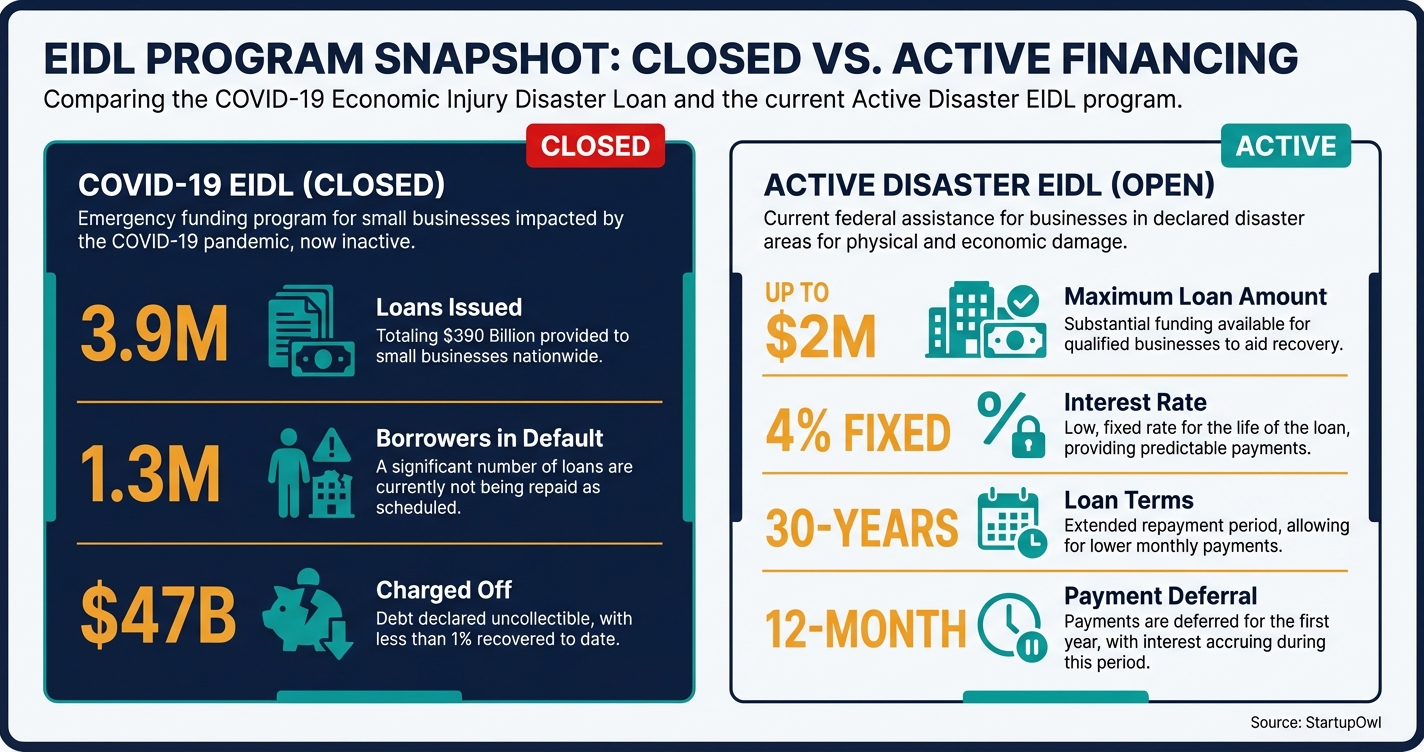
The COVID-19 Economic Injury Disaster Loan program issued nearly 4 million loans totaling almost $387 billion between 2020 and 2022. That makes it one of the largest federal lending programs in U.S. history. As of January 1, 2022, the SBA stopped accepting new COVID-19 EIDL applications. Two kinds of reader land here.
First, you may already hold a COVID-19 EIDL and need help managing repayment (or dealing with default). The SBA had charged off 369,588 of these loans by December 18, 2024, more than $47 billion. Another 96,745 were still delinquent. Second, your business may have been hit by a recent natural disaster and you are looking at the SBA's still-active disaster EIDL program.
This guide covers both programs. You will find current rates, eligibility rules, application steps for active disaster EIDLs, and every repayment option open to existing COVID-19 EIDL borrowers. Payment assistance is still one of them. If you need working capital outside a disaster, read our how to get a business loan guide.
COVID-19 EIDL Program Is Permanently Closed
The SBA stopped accepting new COVID-19 EIDL applications on January 1, 2022. Increase requests and reconsiderations stopped on May 6, 2022. The application portal (covid19relief1.sba.gov) shut down on May 16, 2022. There is no reopening. If you need non-disaster financing, look at an SBA 7(a) loan, a business line of credit, or an SBA microloan instead.
How the Two EIDL Programs Work
Two different programs share the EIDL name. Confusing them is the most common mistake readers make here. The COVID-19 EIDL was a one-time pandemic response program. It lent up to $2 million over 30 years, at a fixed 3.75% for businesses and 2.75% for nonprofits. It is closed permanently, and millions of borrowers are still repaying.
The regular disaster EIDL is a standing SBA program. It activates whenever the SBA declares a disaster for a specific area. This one is still open. As of 2026, rates run as low as 4% for businesses and 3.625% for nonprofits. Terms reach 30 years. The cap is $2 million. Interest does not accrue and payments are not due until 12 months from first disbursement.
Both programs are direct SBA loans. No bank sits in the middle. EIDL funds cover working capital, meaning fixed debts, payroll, accounts payable, rent and utilities. They cannot fund expansion, replace lost profits, or pay dividends. The SBA may ask for receipts showing at least 80% of funds went to approved uses.
Who Qualifies for an EIDL Loan
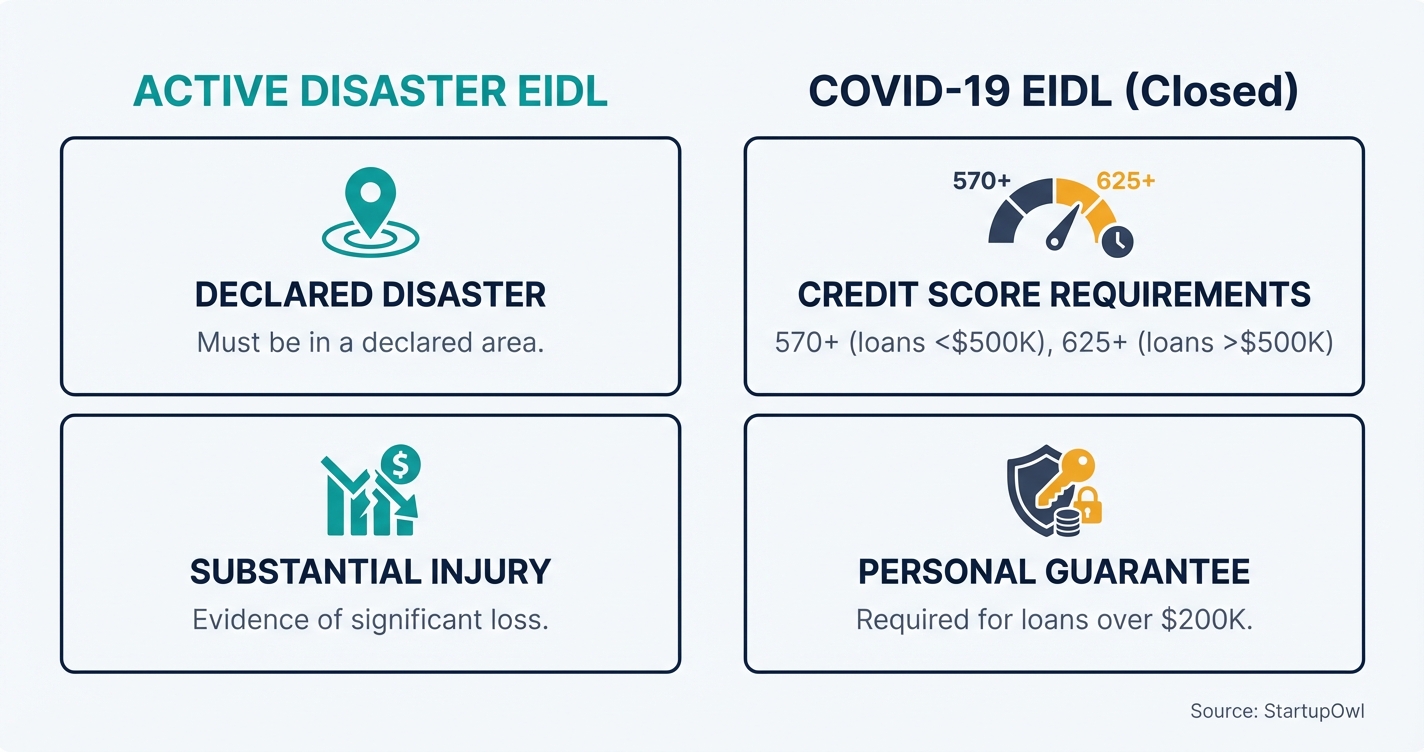
Active disaster EIDL, available now. Location decides this one. Your business must sit in a declared disaster area. It must have suffered real economic injury from that disaster. It must also be unable to get credit elsewhere. Eligible entities include small businesses, small agricultural cooperatives, nurseries, and most private nonprofits. Farmers and ranchers are not eligible. Aquaculture is the exception.
COVID-19 EIDL, closed, for reference. While the program ran, applicants needed fewer than 500 employees. The business had to be operating before January 31, 2020. Credit score minimums were 570 under $500,000 and 625 above it. A personal guarantee was required above $200,000. Collateral was required above $25,000.
For the active disaster program, the SBA will not decline a loan for lack of collateral alone. It does ask you to pledge whatever you have. Real estate is preferred. Loans of $200,000 or less do not require your primary residence as collateral if you hold other qualifying assets.
How to Apply for an Active Disaster EIDL
You can only apply for a disaster EIDL when the SBA has issued a formal disaster declaration for your county. Check the SBA Disaster Assistance page for current declarations. The list changes constantly.
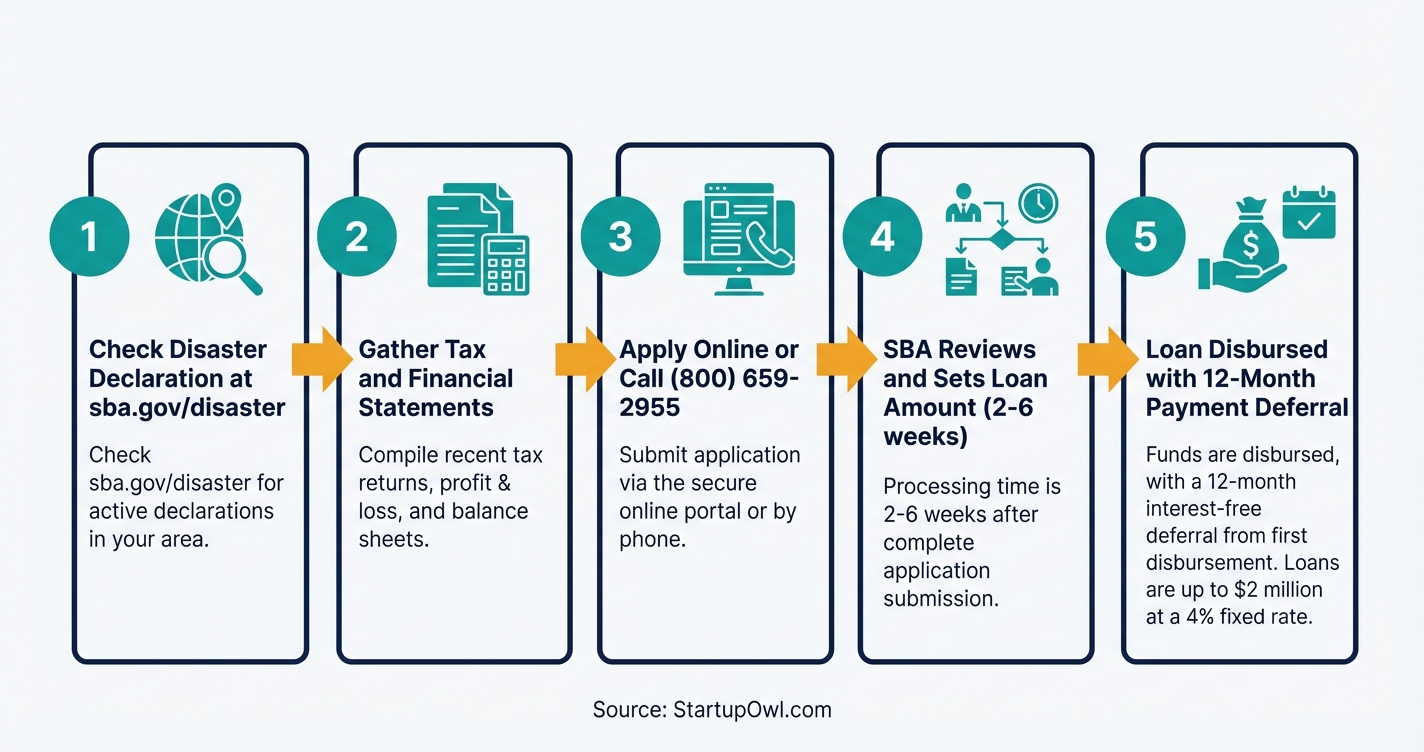
Apply online at sba.gov/disaster. You will need your most recent business tax returns, a personal financial statement, and a schedule of liabilities. The SBA sets your loan amount and terms from your actual financial condition, not a standard formula. You can also call the SBA Customer Service Center at (800) 659-2955 or email [email protected].
Processing typically takes 2-6 weeks after a complete application arrives. Deadlines are strict. Physical damage applications are due roughly 60 days after the declaration, while economic injury applications are typically due 6-9 months later. After the deadline there is generally a 60-day grace period in which the SBA will still accept applications.
What an EIDL Loan Actually Costs
EIDL loans are among the lowest-cost business financing the federal government offers. There are no application fees, no origination fees, and no prepayment penalties. That holds for both versions.
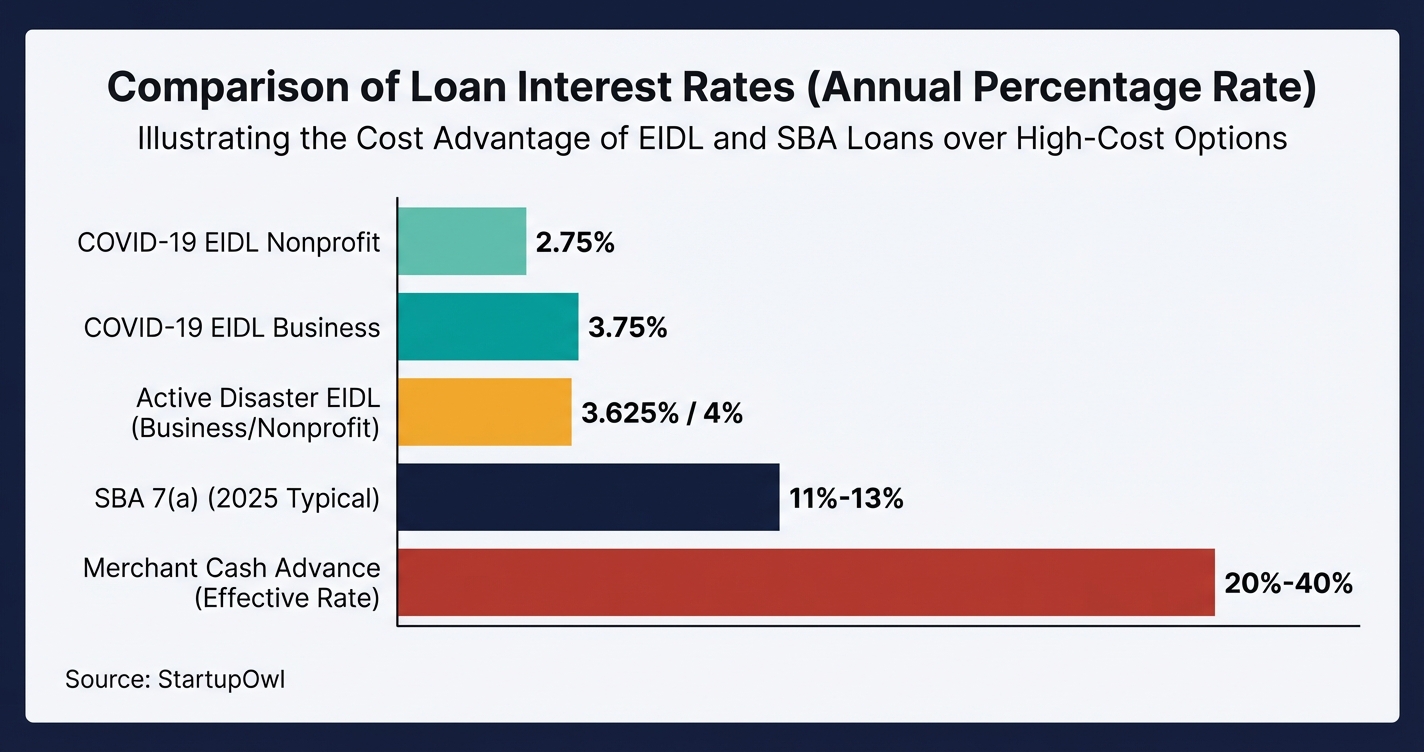
Active disaster EIDL rates, as of 2026. Rates run as low as 4% fixed for businesses and 3.625% fixed for nonprofits. Terms reach 30 years. Interest does not accrue for the first 12 months from disbursement. The first year is free. On a $100,000 loan at 4% over 30 years, the monthly payment is about $477.
COVID-19 EIDL rates, for existing borrowers. All COVID-19 EIDLs carry a 3.75% fixed rate for businesses and 2.75% fixed rate for nonprofits. The original deferment ran 24-30 months from origination, but interest accrued throughout. Your balance is therefore higher than the amount you borrowed. By comparison, the SBA does not set one rate for an SBA 7(a) loan. It caps what a lender may charge. With prime at 7.00%, those caps run from 13.50% on the smallest loans down to 10.00% above $350,000. Your EIDL rate beats all of them.
EIDL Rate Comparison at a Glance
| Type / Provider | Rate | Notes |
|---|---|---|
| COVID-19 EIDL (Businesses) | 3.75% fixed, 30-year term | Program closed Jan 1, 2022. Rate applies to all existing borrowers. |
| COVID-19 EIDL (Nonprofits) | 2.75% fixed, 30-year term | Program closed Jan 1, 2022. Rate applies to all existing nonprofit borrowers. |
| Active Disaster EIDL (Businesses) | Up to 4% fixed, 30-year term | As of 2026 declarations. Rate set per disaster. 12-month payment deferral. |
| Active Disaster EIDL (Nonprofits) | 3.625% fixed, 30-year term | As of 2026 declarations. 12-month interest-free deferral from first disbursement. |
| SBA 7(a) Loan (for comparison) | 10.00% to 13.50% variable | Active program. SBA caps the rate rather than setting it, and the cap tightens as the loan gets larger. Prime rose to 7.00% on 17 September 2026. |
| Treasury Collection on a Defaulted Loan | Interest, penalties and collection costs | Added once a defaulted COVID-19 EIDL is referred to Treasury. Treasury publishes no flat rate. 31 U.S.C. 3717 is the authority. |
Where to Get Help With Your EIDL
EIDLs are direct SBA loans, so your contact points are all inside the federal government. Here are the ones that matter.
- SBA Disaster Assistance Portal (sba.gov/disaster) is for new disaster EIDL applications. Apply there during an active declaration.
- SBA Loan Portal (lending.sba.gov) is for existing COVID-19 EIDL borrowers. Log in first. You can check your balance, make payments, request servicing actions, and apply for payment assistance there.
- COVID EIDL Servicing Center, reachable at [email protected] or [email protected]. Always include your loan number. This team handles change of ownership, collateral releases, subordination and reinstatement requests.
- SBA Customer Service Center at (800) 659-2955 handles general inquiries and disaster loan application help. For TTY, dial 7-1-1.
- SBA payments run through the loan portal or by phone at (833) 853-5638. Paper checks stopped on October 1, 2025. Mailed bill-pay payments now get returned.
- Treasury Bureau of the Fiscal Service at (800) 289-7388, once a loan has moved to cross-servicing. The SBA is out of it then.
Outside a disaster, an SBA 7(a) loan through a private lender is the usual route. Faster money costs more. Our guide to working capital loans covers those.
What to Do If You Do Not Qualify for an EIDL
If your business is not in a declared disaster area and cannot reach the active EIDL program, you still have options. The SBA 7(a) loan program lends up to $5 million. The SBA caps the variable rate rather than setting it, between 10.00% and 13.50% today. Bigger loans cost less. You will typically need a personal credit score of 680+ and at least 2 years in business.
If you are a startup or a business with a shorter track record, an SBA microloan offers up to $50,000 at 8%-13%. For smaller needs, microloans for small business through nonprofit intermediaries fund amounts as low as $500. If you need cash within days, invoice factoring or a merchant cash advance can deliver working capital. Speed costs money. Expect effective rates of 20%-40% or higher.
Do not overlook free money. Small business grants from federal, state, and private sources do not require repayment. And if you are still building your foundation, building business credit and proper accounting software strengthen every application you make.
5 Costly Mistakes EIDL Borrowers Make
1. Ignoring SBA collection notices. Every month you wait, interest accrues and you move closer to Treasury referral. The SBA refers an account to the Treasury Offset Program at 120 days of delinquency. Loans meeting further tests then transfer to cross-servicing. Treasury adds interest, penalties and the cost of collecting under 31 U.S.C. 3717. The balance only grows.
2. Assuming your COVID-19 EIDL will be forgiven. Unlike PPP loans, EIDLs were never designed to be forgiven. Congress has passed no EIDL forgiveness legislation. The SBA has not offered one either. Do not wait for a bailout that is not coming.
3. Paying a third-party company to settle your SBA debt. Compromise does exist, but you never need a middleman to ask for it. While the SBA still holds the loan, that route is its Offer in Compromise program. Once Treasury holds the debt, you call a debt recovery analyst on 888-826-3127. Both routes are free.
4. Selling business assets without SBA authorization. Many EIDLs are secured by a UCC filing on business assets. If yours is, you need SBA approval before you transfer or sell them. Doing it anyway turns a debt problem into a possible fraud problem. Ask first.
5. Not knowing your personal guarantee status. COVID-19 EIDLs under $200,000 generally required no personal guarantee. That limits the SBA to business assets. Above $200,000 you signed one. A guarantee lets a federal agency garnish up to 15% of your disposable pay under 31 CFR 285.11. No court order is needed. Tax refunds and Social Security can be taken too. Know which side you are on.
This content is for informational purposes only and does not constitute financial, legal, or tax advice. We are not your advisor. Business financing terms, rates, and eligibility vary by lender, credit profile, and business characteristics. Consult a licensed financial advisor, CPA, or attorney before making borrowing or repayment decisions. EIDL program details and interest rates here reflect publicly available SBA and Treasury sources as of August 2026 and may change without notice. If you are in default on an EIDL, consult an attorney experienced with SBA debt before taking any action.
Step-by-Step Process
- 1
Determine which EIDL program applies to your situation
Two programs, one name. The COVID-19 EIDL is permanently closed and now only affects existing borrowers managing repayment. The regular disaster EIDL remains active. It opens whenever the SBA declares a disaster for your area.
Pick your path. If you already have a COVID-19 EIDL, skip ahead to Step 3 for repayment options. If a federally declared disaster hit your business, go to Step 2 instead. That covers floods, storms, drought and wildfire.
Tips
- Check the SBA disaster declarations page to see if your area has an active declaration before applying.
- Regular disaster EIDLs are only available when the SBA has formally declared a disaster for your specific county.
Common Mistakes
- Confusing the closed COVID-19 EIDL with the active disaster EIDL program and assuming no disaster loans are available.
- 2
Apply for an active disaster EIDL through the SBA portal
If you are in a declared disaster area, apply online at sba.gov/disaster. You can borrow up to $2 million over terms up to 30 years. Rates run as low as 4% for businesses and 3.625% for nonprofits, as of 2026. There is no application fee.
Interest does not accrue and payments are not due until 12 months from the date of first disbursement. You will need business tax returns, a personal financial statement, and a schedule of liabilities. Collateral is required above $50,000.
Tips
- Apply as early as possible after a declaration. Deadlines are strict, typically 60 days for physical damage and longer for economic injury.
- You do not need to wait for an insurance settlement before applying for an SBA disaster loan.
- Call the SBA Customer Service Center at (800) 659-2955 if you need help with the application.
Common Mistakes
- Missing the economic injury application deadline, which is typically 6-9 months after the disaster declaration.
- Attempting to use EIDL funds for business expansion or replacing lost profits, which is not allowed.
- 3
Log into the SBA Loan Portal to review your existing COVID-19 EIDL
If you already hold a COVID-19 EIDL, log into the SBA Loan Portal at lending.sba.gov. Start there. Check your current loan status, your payment history, and whether the account has been flagged as delinquent.
Verify what you owe each month. Payments began 30 months from your disbursement date. Interest accrued during the deferment, so your final balloon payment will exceed your original principal. If the loan is already charged off but has not gone to Treasury cross-servicing, you can still fix it. Pay the full overdue balance in the portal. Then email [email protected] and ask for reinstatement to current status.
Tips
- Download and save all payment confirmation records as proof in case the SBA misapplies your payments.
- Email [email protected] with your loan number and a description of any discrepancy you find.
Common Mistakes
- Ignoring SBA notices and letting the loan drift past 120 days delinquent. That forces a Treasury referral and hands the debt to cross-servicing.
- 4
Request SBA payment assistance before a Treasury referral
SBA payment assistance is open, not closed. Eligible COVID-19 EIDL borrowers can cut payments by 50% for six months. The SBA says all eligible COVID EIDL loans can now request it through the SBA Loan Portal. You can use it once every five years.
The eligibility rules are narrow. Your loan must be less than 90 days past due and in current status. The business must be open and operating. Neither you nor any owner may be in active bankruptcy. It is meant for a temporary cash flow problem, not a permanent one. Interest is not waived during the six months, so your balloon payment at maturity grows. If your loan was approved above $200,000, email [email protected] until the portal supports those loans.
Act before day 120. That is when the SBA must refer a delinquent account to the Treasury Offset Program. Treasury then adds interest, penalties and collection costs. It can garnish up to 15% of your disposable pay without a court order, intercept tax refunds, and offset Social Security. Once a loan transfers to cross-servicing the SBA can no longer help. You deal with Treasury on 800-289-7388. A bankruptcy attorney experienced with SBA debt can also explain Subchapter V, which restructures the debt while the business stays open.
$0 to request SBA payment assistance; $3,000-$10,000+ for a bankruptcy attorney 2-4 weeks for SBA hardship response; 3-6 months for bankruptcy proceedings SBA.govTips
- Call the SBA early. Contact 1-800-659-2955 as soon as you start falling behind, because payment assistance requires the loan to be under 90 days past due.
- Gather bank statements and profit-and-loss statements before you request payment assistance.
- Do not sell or transfer business assets without SBA authorization, as this can escalate a debt problem into a federal fraud issue.
Common Mistakes
- Waiting until after a Treasury referral to ask for help. Payment assistance needs the loan under 90 days past due.
- Assuming the 50% payment reduction ended. SBA confirms all eligible COVID EIDL loans can apply for it through the loan portal.
- Paying a third-party company to settle an SBA debt when both the SBA and Treasury routes are free.
Cost Breakdown
| Item | Cost Range | Notes |
|---|---|---|
| COVID-19 EIDL Interest Rate (Businesses) | 3.75% fixed | Historical rate for all COVID-19 EIDLs issued 2020-2022. Program closed. |
| COVID-19 EIDL Interest Rate (Nonprofits) | 2.75% fixed | Historical rate for all COVID-19 EIDLs issued to nonprofits. Program closed. |
| Active Disaster EIDL Interest Rate (Businesses) | Up to 4% fixed | Current rate as of 2026 for businesses that cannot obtain credit elsewhere. |
| Active Disaster EIDL Interest Rate (Nonprofits) | 3.625% fixed | Current rate as of 2026 for private nonprofit organizations. |
| Application and Origination Fees | $0 | No fees for either COVID-19 or disaster EIDL programs. |
| Prepayment Penalty | $0 | No penalty for early repayment on any EIDL. |
| Treasury Collection Surcharge (if defaulted) | 30% of outstanding balance | Added automatically once loan is referred to U.S. Treasury for collection. |
Frequently Asked Questions
You cannot apply for a COVID-19 EIDL because that program closed on January 1, 2022. However, the regular disaster EIDL program is active and available if the SBA has declared a disaster in your area. Check sba.gov/disaster for current declarations. If your area is covered, you can borrow up to $2 million at rates as low as 4% fixed.
No. Unlike PPP loans, COVID-19 EIDLs were structured as repayable 30-year loans, not forgivable grants. Congress has passed no forgiveness legislation and the SBA has offered none. Waiting costs you money. If you cannot pay, apply for SBA payment assistance in the SBA Loan Portal. It cuts payments by half for six months. A bankruptcy attorney can also explain Subchapter V restructuring.
At 30 days past due the SBA sends collection notices. At 90 days it can issue a formal default notice and accelerate the balance. Day 120 is the cliff. The account goes to the Treasury Offset Program, which adds interest, penalties and collection costs. Treasury can garnish up to 15% of your disposable pay without a court order, intercept tax refunds, and offset Social Security.
COVID-19 EIDLs carry a 3.75% fixed rate for businesses and 2.75% for nonprofits over 30 years. Active disaster EIDLs, as of 2026, run as low as 4% for businesses and 3.625% for nonprofits, also on 30-year terms. Both charge zero application fees, zero origination fees, and zero prepayment penalties. The rate is fixed for the life of the loan. Nothing you do changes it.
For COVID-19 EIDLs under $200,000, no personal guarantee was required. The SBA can pursue business assets, not your personal property, bank accounts or wages. Above $200,000 you signed one. Check your loan documents. A guarantee lets a federal agency garnish up to 15% of disposable pay under 31 CFR 285.11. It can also seize tax refunds and offset Social Security. No court order is needed.
Ask the SBA for payment assistance first. It is still open. Eligible borrowers cut payments by 50% for six months, once every five years, requested through the SBA Loan Portal. Your loan must be under 90 days past due and the business open. Interest still accrues, so the balloon payment grows. Other routes are an Offer in Compromise, refinancing privately, or Subchapter V bankruptcy.
This content is for informational purposes only and does not constitute financial, legal, or tax advice. Business financing terms, rates, and eligibility vary by lender, credit profile, and business characteristics. Consult a licensed financial advisor, CPA, or attorney before making borrowing or repayment decisions. APR ranges and program details reflect publicly available SBA data as of 2026 and may change without notice. EIDL loan terms are set by the SBA and the U.S. federal government.
Sources & References
- COVID-era programs, COVID-19 EIDL servicing and payment assistance (SBA.gov)
- SBA Loan Portal
- SBA Disaster Assistance
- SBA OIG Report 25-23 on collection efforts for delinquent COVID-19 EIDLs
- Treasury Bureau of the Fiscal Service, Cross-Servicing FAQs for debtors
- Treasury Bureau of the Fiscal Service, Cross-Servicing program
- 31 CFR 285.11, administrative wage garnishment
- 31 U.S.C. 3717, interest and penalty on claims
- SBA disaster loan interest rates (Congressional Research Service R46963)
- SBA 7(a) terms, conditions and eligibility, maximum interest rates
- Federal Reserve H.15 Selected Interest Rates, bank prime loan
- SBA offers relief to Pennsylvania businesses and private nonprofits (SBA.gov, Aug 2026)
About the Author
Editor, StartupOwl
Eliot leads StartupOwl's state data research. He maintains the site's fifty state records of LLC filing fees, annual costs, processing times, and small business grant programs, checking each figure against the state office that publishes it and logging the date it was verified. Based in New Jersey, he has spent his working life in and around small businesses, and he writes for the founder who wants the real number rather than the advertised one. Every figure under his byline traces to a named source, and when a state proves a number wrong, the correction is published, not buried.
Was this article helpful?
Questions about SBA EIDL Loan Status, Eligibility and How to Apply in 2026
No comments yet. Ask the first question and a member of our team will answer.
Leave a comment