
Updated April 18, 2026

BigCommerce

Shopify
Shopify vs BigCommerce 2026 Comparison
Compare Shopify and BigCommerce on pricing transparency, transaction fees, B2B features, headless options, and true cost. Pick the ecommerce platform that fits your store in under three minutes.

For most small business founders, Shopify is the better pick. The 8,000 app ecosystem, faster setup, and included POS make it the default answer for a first online store, and Shop Pay plus Shop app give merchants a free customer acquisition surface BigCommerce cannot match. BigCommerce wins for mid market retailers with heavy B2B, multi storefront, or headless Catalyst needs, and for any brand that wants zero platform transaction fees at scale.
Shopify and BigCommerce are the two hosted ecommerce platforms every founder short lists when they are ready to run a real online store. Shopify is the publicly traded category leader from Ottawa with over 5 million active merchants, 8,000 apps in its App Store, and the fastest zero to launch path in the industry. BigCommerce is the Austin based challenger, taken private by Apax Partners and GIC in November 2024 at $1.8 billion, now pushing Open SaaS, Catalyst headless storefronts, and native B2B features as its mid market differentiation.
We researched both as of April 18, 2026. Shopify Basic starts at $19 per month billed annually (or $27 monthly) and scales to Shopify Plus at $2,300 per month on a three year term. BigCommerce Standard starts at $29 per month billed annually (or $39 monthly) and scales to Enterprise B2B Edition on a custom quote. The choice is less about who is cheaper on paper and more about two hidden cost mechanics, Shopify charges 0.5 to 2.0 percent in transaction fees if you do not use Shopify Payments, BigCommerce auto upgrades your plan once your store crosses $50K, $180K, or $400K in annual online sales.
Which one to pick
Solo founder launching first dropshipping or print on demand store
Pick, ShopifyShopify Basic at $19/mo annual gets you live in under an hour with drag and drop themes plus plug and play apps for suppliers like DSers, Printful, and Printify
Omnichannel retailer with physical store plus online
Pick, ShopifyShopify POS is included on every plan and syncs inventory across online and in person, BigCommerce requires third party POS integrations that add cost and complexity
B2B or wholesale brand with customer group pricing and quote workflows
Pick, BigCommerceBigCommerce B2B Edition ships these features natively on Enterprise, Shopify requires the $2,300/mo Plus plan plus some configuration work for B2B on Shopify
Existing store doing $500K+ annual revenue considering a replatform
Pick, BigCommerceBigCommerce Enterprise flat pricing plus zero transaction fees can save five figures per year at this volume, and Catalyst headless lets you replatform the frontend independent of backend
Team of 3 with complex product variants and large catalog (10K+ SKUs)
Pick, BigCommerceBigCommerce native handling of product variants, customer groups, and SKU level visibility reduces the app stack you need to buy and integrate
International brand selling in 10+ markets with currency and language variants
TieShopify Markets plus Shopify Plus expansion stores handle this cleanly, BigCommerce multi storefront plus Catalyst is also strong. Pick the one your team already knows, replatform cost exceeds the feature differential
Pricing side by side
Plans side by side
| Plan | BigCommerce | Shopify |
|---|---|---|
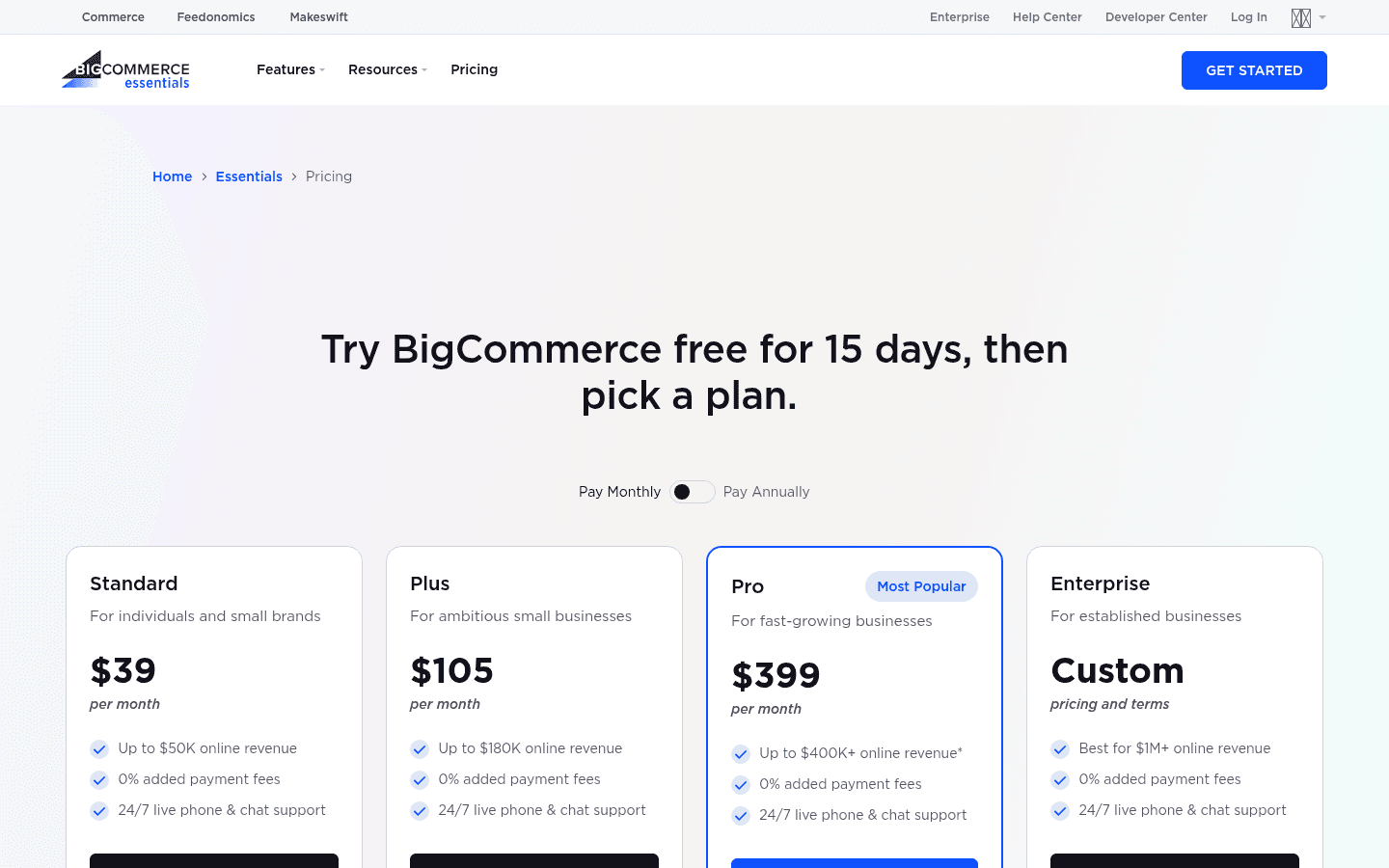
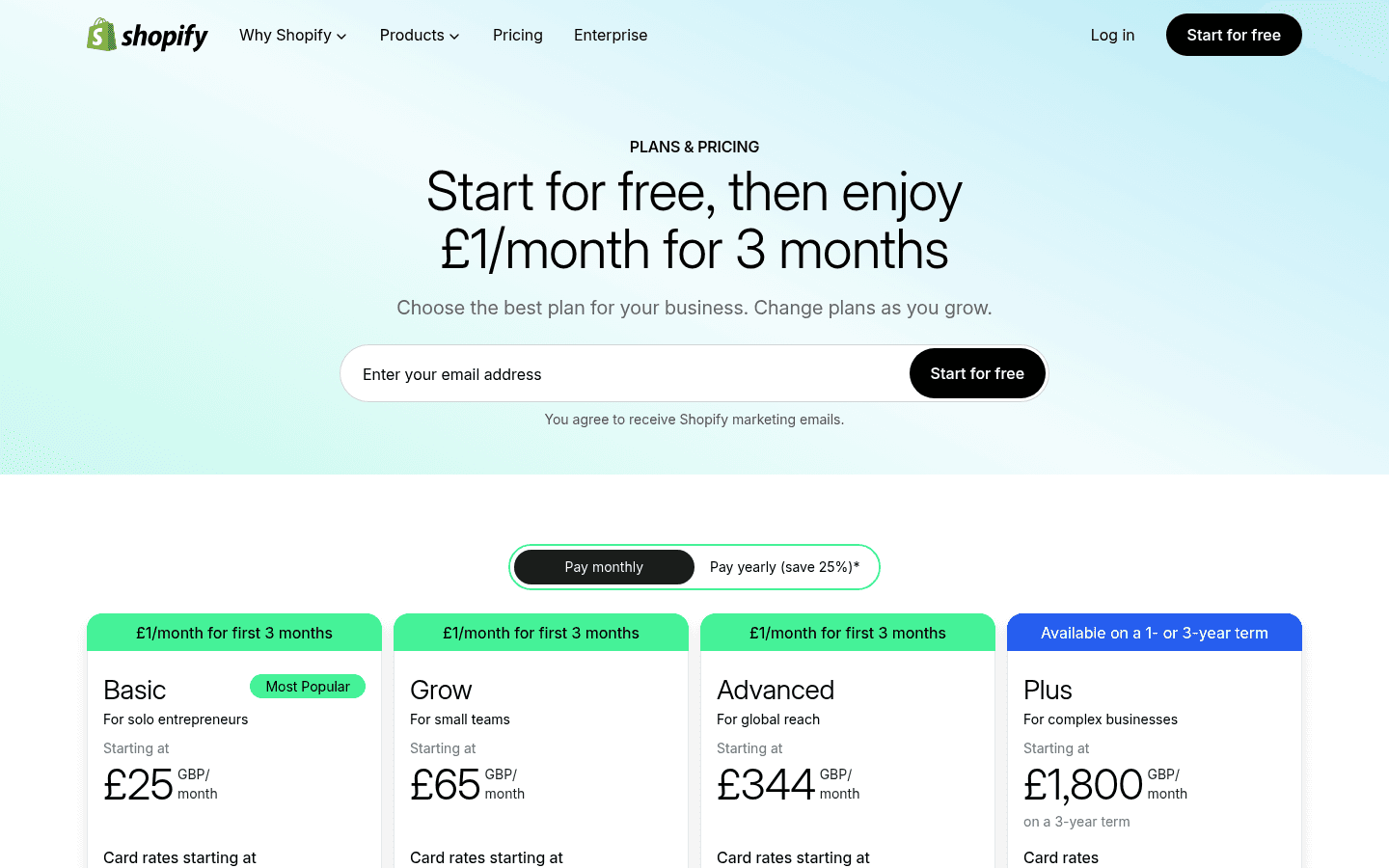
| Entry plan monthly | $39/mo BigCommerce Standard month to month, up to $50K annual online sales, unlimited products, 24/7 phone and chat support | $27/mo Shopify Basic month to month, full storefront, unlimited products, 10 inventory locations, 24/7 chat support |
| Entry plan annual | $29/mo billed annual BigCommerce Standard annual, same cap of $50K online sales per year before forced upgrade | $19/mo billed annual Shopify Basic annual, 2026 repricing brought this tier from $29 to $19 per month billed yearly |
| Mid tier annual | $79/mo (Plus) BigCommerce Plus covers up to $180K annual sales, adds abandoned cart recovery and advanced customer segmentation | $54/mo (Grow) Shopify Grow annual at $54/mo (2026 reprice from $79), adds 5 staff accounts, professional reports, up to 88 percent shipping discounts |
| Top hosted tier annual | $299/mo (Pro) BigCommerce Pro covers up to $400K annual sales, Google customer reviews, advanced product filtering, custom SSL | $299/mo (Advanced) Shopify Advanced adds 15 staff accounts, custom reporting, duties and import taxes on checkout |
| Enterprise tier | Custom (Enterprise B2B Edition) BigCommerce Enterprise is negotiated, includes B2B suite, multi storefront, dedicated account team, and API priority | $2,300/mo (Plus, 3 year term) Shopify Plus is $2,300/mo on a three year term or $2,500/mo on a one year, includes B2B on Shopify, Hydrogen headless, 10 expansion stores |
| Platform transaction fee (third party gateway) | 0% on every plan BigCommerce does not charge a platform fee on any payment processor | 2.0% Basic, 1.0% Grow, 0.6% Advanced, 0.2% Plus Shopify adds this penalty unless you use Shopify Payments, where it drops to 0 percent |
| Card processing rate (Shopify Payments / BigCommerce Standard gateway) | Gateway direct (Stripe or PayPal ~2.59%+49c) BigCommerce passes you the gateway's own rate with no platform markup | 2.9%+30c Basic, 2.7% Grow, 2.5% Advanced Shopify Payments rates scale down with plan tier, Plus rate is custom negotiated |
| Free trial | 15 days free on any paid plan BigCommerce trial does not require a credit card, full Standard features | 3 days free then $1/mo for 3 months on Basic Shopify promo may vary, recently trialed from 3 to 14 day windows |
| Revenue cap mechanic | Forced upgrade at $50K, $180K, $400K BigCommerce tracks trailing 12 month online sales and auto upgrades plan, no opt out | None Shopify keeps the same plan price regardless of how much you sell on the platform |
| App ecosystem size | ~1,000 apps BigCommerce App Marketplace, smaller but features heavier use of native functionality to reduce app dependency | ~8,000 apps Shopify App Store, the largest in the category, plug and play solutions for most niche workflows |
Total cost by scenario
| Profile | Timeframe | BigCommerce | Shopify |
|---|---|---|---|
| Solo founder, first year online store, $30K in annual sales | 12 months | $348 + gateway fees | $228 + 0 to 2.0% fee on non Shopify Payments sales Method. BigCommerce Standard annual at $29/mo times 12 is $348. Card processing is gateway direct, roughly 2.59% + 49c per transaction with Stripe or PayPal, no platform fee. Shopify Basic annual at $19/mo times 12 is $228 after the 2026 reprice. If you use Shopify Payments you pay 2.9% + 30c and no third party fee. If you use PayPal or Stripe instead you pay 2.9% + 30c to them plus 2.0 percent to Shopify, so a store doing $30K in annual sales eats roughly $600 in platform penalties before cards. Ecosystem app spend runs $50 to $150/mo on Shopify for email, reviews, SEO, and adds $600 to $1,800/year to either platform depending on what you buy. Net TCO favors Shopify on subscription now that Basic is $19/mo, BigCommerce only catches up when you cannot use Shopify Payments and eat the 2.0 percent gateway penalty. |
| Growing store hitting $100K annual sales | 24 months | $348 first year then $948 second year ($1,296 total for 24 months) | $456 + card fees (no plan upgrade) Method. BigCommerce Standard at $29/mo covers year 1 at $348, but trailing 12 month revenue trips the $50K cap and auto upgrades to Plus at $79/mo annual ($948 per year) for year 2. Total over 24 months roughly $1,296 before gateway and app fees. Shopify Basic stays at $19/mo annual for both years ($456 total), regardless of sales volume. Add Shopify transaction fees of 0.5 to 2.0 percent on non Shopify Payments, which on $100K is $500 to $2,000 per year. At this profile Shopify plus Shopify Payments is clearly the cheapest path, BigCommerce Plus at $948/yr also beats Shopify non Shopify Payments gateway once the 2.0 percent penalty lands. |
| Mid market B2B brand at $500K annual sales with wholesale module | 24 months | Custom Enterprise, roughly $900 to $1,500/mo, 24 month estimate $21,600 to $36,000 | Shopify Plus at $2,300/mo on 3 year term, 24 month estimate $55,200 Method. BigCommerce Enterprise B2B Edition is negotiated, typically $900 to $1,500/mo based on public partner comments and migration case studies. Over 24 months roughly $21,600 to $36,000. Shopify Plus at $2,300/mo times 24 is $55,200. Shopify Plus includes B2B on Shopify, Hydrogen headless, and 10 expansion stores. BigCommerce Enterprise includes B2B Edition, multi storefront, and Catalyst access. On subscription alone BigCommerce Enterprise is 40 to 60 percent cheaper at this profile, on the total stack including app spend Shopify Plus can close the gap or take the lead depending on what third party apps you replace with native B2B on Shopify features. Real platform decisions at this tier are usually driven by B2B requirements and partner ecosystem, not subscription delta. |
Feature comparison
| Feature | BigCommerce | Shopify |
|---|---|---|
| Starting price annual Shopify Basic was repriced to $19/mo billed yearly in early 2026, undercutting BigCommerce Standard by $10 per month. BigCommerce caps you at $50K annual sales on Standard, Shopify keeps you on Basic at any revenue. | $29/mo (Standard) | $19/mo (Basic) |
| Top hosted tier annual Same price but very different mechanics. BigCommerce Pro auto upgrades to Enterprise past $400K, Shopify Advanced stays $299 regardless of sales volume. | $299/mo (Pro, cap $400K) | $299/mo (Advanced, no revenue cap) |
| Platform transaction fees on third party gateways BigCommerce's flagship pricing transparency feature. Shopify's fee is waived only if you use Shopify Payments. | 0% always | 2.0% Basic, 1.0% Grow, 0.6% Advanced |
| Revenue cap forcing plan upgrade BigCommerce tracks trailing 12 month online sales and auto upgrades. Shopify plans are revenue agnostic. | Yes ($50K, $180K, $400K) | No |
| Free trial BigCommerce trial is longer and does not require credit card. Shopify promo may change without notice. | 15 days | 3 days plus $1/mo for 3 months (promo) |
| App ecosystem Shopify App Store dominates on count. BigCommerce positions native features as the reason to need fewer apps. | ~1,000 apps | ~8,000 apps |
| Free theme library Similar count on free themes. Shopify's paid theme marketplace is much larger and generally higher quality. | 12 themes | 13 free themes, 150+ paid themes |
| Theme customization framework Both require learning a platform specific framework for deep customization. Shopify Liquid has far more tutorials, hires, and third party developer services. | Stencil (proprietary templating) | Liquid (proprietary templating) |
| Native B2B features BigCommerce B2B Edition bundles price lists, customer groups, quote management, and corporate hierarchies. Shopify B2B on Shopify matches the feature set but requires the $2,300/mo Plus plan. | B2B Edition (Enterprise tier) | B2B on Shopify (Plus tier, $2,300/mo) |
| Multi storefront Shopify gives more storefronts out of the box on Plus. BigCommerce multi storefront is contract driven past 3. | Up to 3 on B2B Edition, more on contract | Up to 10 expansion stores on Plus |
| Headless / composable stack Both are production ready. Catalyst leans into the MACH alliance composable story, Hydrogen leans into Shopify's integrated frontend plus backend. | Catalyst (Next.js) plus Makeswift visual editor | Hydrogen plus Oxygen hosting |
| Built in POS Major difference for omnichannel. Shopify POS syncs inventory in real time across online and in person, BigCommerce relies on partners like Square or Lightspeed. | No native POS, third party required | Shopify POS included on every plan |
| Mobile merchant app Shopify ships the most used native ecommerce app for store owners. BigCommerce mobile app is iOS only. | 4.5 stars iOS, no Android | 4.7 stars iOS, 4.2 stars Android |
| AI features Shopify Sidekick ships on every plan, BigCommerce AI is still being rolled out across product generation and analytics. | BigAI product description generator, forthcoming | Shopify Sidekick AI merchant agent (general availability 2025) |
| Parent company BigCommerce was taken private at $1.8B in Nov 2024 and no longer reports quarterly earnings. Shopify remains publicly traded with Tobi Lütke as CEO and largest individual shareholder. | Apax Partners and GIC (private since Nov 2024) | Public (NYSE and TSX, SHOP) |
Starting price annual
- BigCommerce
- $29/mo (Standard)
- Shopify
- $19/mo (Basic)
Shopify Basic was repriced to $19/mo billed yearly in early 2026, undercutting BigCommerce Standard by $10 per month. BigCommerce caps you at $50K annual sales on Standard, Shopify keeps you on Basic at any revenue.
Top hosted tier annual
- BigCommerce
- $299/mo (Pro, cap $400K)
- Shopify
- $299/mo (Advanced, no revenue cap)
Same price but very different mechanics. BigCommerce Pro auto upgrades to Enterprise past $400K, Shopify Advanced stays $299 regardless of sales volume.
Platform transaction fees on third party gateways
- BigCommerce
- 0% always
- Shopify
- 2.0% Basic, 1.0% Grow, 0.6% Advanced
BigCommerce's flagship pricing transparency feature. Shopify's fee is waived only if you use Shopify Payments.
Revenue cap forcing plan upgrade
- BigCommerce
- Yes ($50K, $180K, $400K)
- Shopify
- No
BigCommerce tracks trailing 12 month online sales and auto upgrades. Shopify plans are revenue agnostic.
Free trial
- BigCommerce
- 15 days
- Shopify
- 3 days plus $1/mo for 3 months (promo)
BigCommerce trial is longer and does not require credit card. Shopify promo may change without notice.
App ecosystem
- BigCommerce
- ~1,000 apps
- Shopify
- ~8,000 apps
Shopify App Store dominates on count. BigCommerce positions native features as the reason to need fewer apps.
Free theme library
- BigCommerce
- 12 themes
- Shopify
- 13 free themes, 150+ paid themes
Similar count on free themes. Shopify's paid theme marketplace is much larger and generally higher quality.
Theme customization framework
- BigCommerce
- Stencil (proprietary templating)
- Shopify
- Liquid (proprietary templating)
Both require learning a platform specific framework for deep customization. Shopify Liquid has far more tutorials, hires, and third party developer services.
Native B2B features
- BigCommerce
- B2B Edition (Enterprise tier)
- Shopify
- B2B on Shopify (Plus tier, $2,300/mo)
BigCommerce B2B Edition bundles price lists, customer groups, quote management, and corporate hierarchies. Shopify B2B on Shopify matches the feature set but requires the $2,300/mo Plus plan.
Multi storefront
- BigCommerce
- Up to 3 on B2B Edition, more on contract
- Shopify
- Up to 10 expansion stores on Plus
Shopify gives more storefronts out of the box on Plus. BigCommerce multi storefront is contract driven past 3.
Headless / composable stack
- BigCommerce
- Catalyst (Next.js) plus Makeswift visual editor
- Shopify
- Hydrogen plus Oxygen hosting
Both are production ready. Catalyst leans into the MACH alliance composable story, Hydrogen leans into Shopify's integrated frontend plus backend.
Built in POS
- BigCommerce
- No native POS, third party required
- Shopify
- Shopify POS included on every plan
Major difference for omnichannel. Shopify POS syncs inventory in real time across online and in person, BigCommerce relies on partners like Square or Lightspeed.
Mobile merchant app
- BigCommerce
- 4.5 stars iOS, no Android
- Shopify
- 4.7 stars iOS, 4.2 stars Android
Shopify ships the most used native ecommerce app for store owners. BigCommerce mobile app is iOS only.
AI features
- BigCommerce
- BigAI product description generator, forthcoming
- Shopify
- Shopify Sidekick AI merchant agent (general availability 2025)
Shopify Sidekick ships on every plan, BigCommerce AI is still being rolled out across product generation and analytics.
Parent company
- BigCommerce
- Apax Partners and GIC (private since Nov 2024)
- Shopify
- Public (NYSE and TSX, SHOP)
BigCommerce was taken private at $1.8B in Nov 2024 and no longer reports quarterly earnings. Shopify remains publicly traded with Tobi Lütke as CEO and largest individual shareholder.
BigCommerce
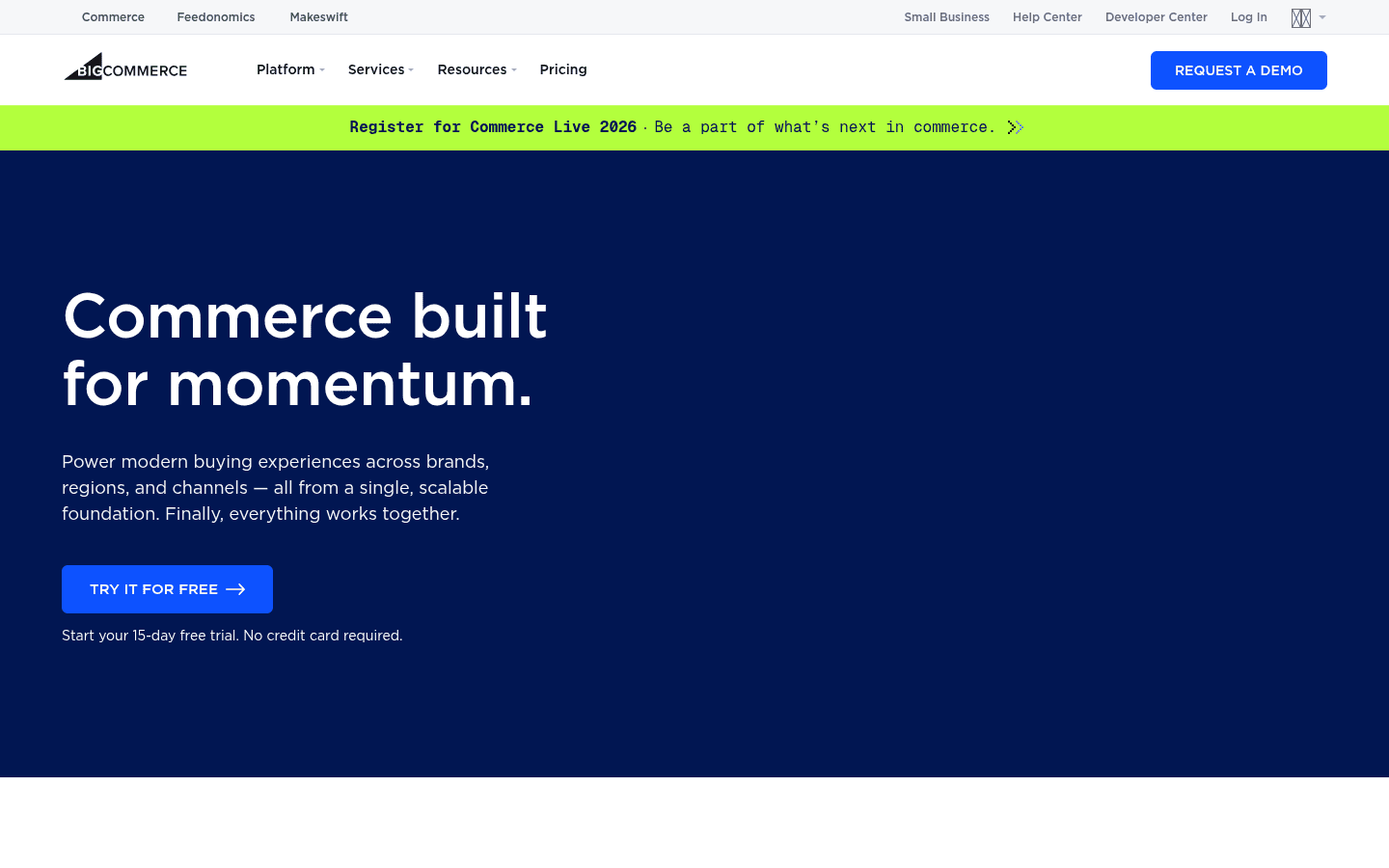
Deep built-in selling tools and no platform fee on orders through its own payment partners, but sales caps force upgrades and a new 2% fee hits Stripe and other open providers.
- Pricing
- $39
- Rating
- 3.2 / 5
- Category
- Ecommerce Platform
Pros
- Zero platform transaction fees on every plan and every payment gateway, which saves real money at scale compared to Shopify's 0.5 to 2.0 percent surcharges on non Shopify Payments gateways.
- Native support for complex product variants, customer group pricing, and multi storefront management without paid apps, which is the reason mid market and B2B brands pick BigCommerce.
- Catalyst on Next.js plus Makeswift is the most production ready headless stack in hosted ecommerce, with MACH alliance membership signaling composable architecture commitment.
- 24/7 live phone and chat support included on every plan, even the $29/mo Standard tier, which Shopify reserves for higher tiers on phone specifically.
- Unlimited products, file storage, and bandwidth on every plan with no throttling, across the full plan ladder from Standard to Enterprise.
Cons
- Revenue caps force automatic plan upgrades at $50K, $180K, and $400K in annual online sales, you cannot opt out, and the trailing 12 month mechanic means a single strong month can trigger the next tier.
- 1.5 Trustpilot score from 448 reviews signals meaningful customer dissatisfaction, mostly concentrated on revenue cap surprise upgrades and Stencil theme friction.
- Stencil templating framework has a steeper learning curve than Shopify Liquid, with fewer community tutorials and fewer third party developers available for hire.
- App ecosystem is around 1,000 apps versus Shopify's 8,000, which means niche workflows may require custom builds or accepting a workaround.
- Take private by Apax Partners in November 2024 removes quarterly earnings discipline but also removes the transparency that public reporting provided for investors and larger merchants evaluating platform risk.
Shopify
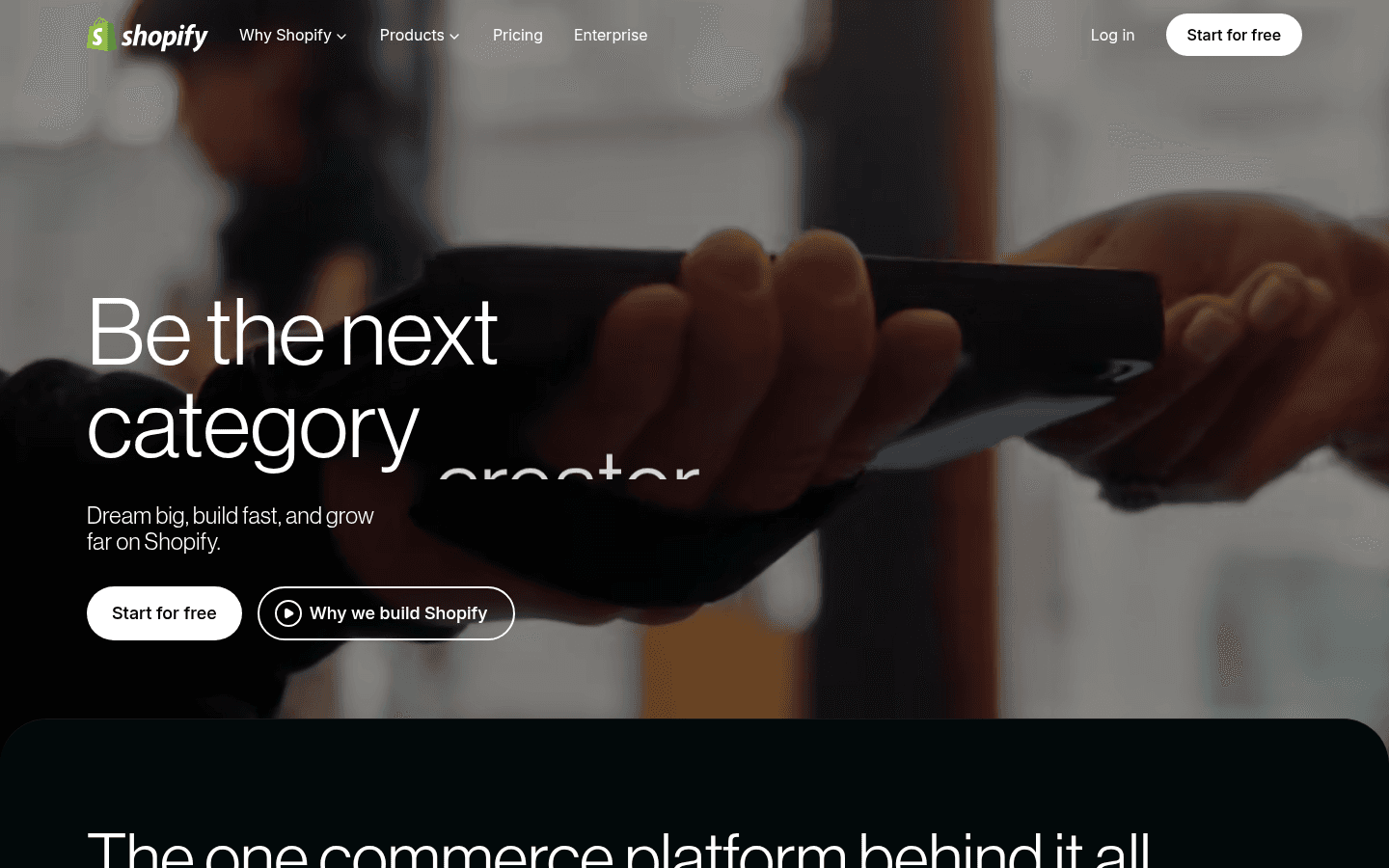
Fast to launch and loaded with features, but third-party app costs and payment gateway penalties quietly inflate what you actually pay.
- Pricing
- $29
- Rating
- 3.8 / 5
- Category
- Ecommerce Platform
Pros
- You can go from zero to a live, functioning store in under an hour with drag and drop themes, no Stencil framework or server management.
- The 8,000 app ecosystem is the largest in hosted ecommerce. If you need a feature, someone has probably built an app for it, and the Shopify App Store vets security and compatibility.
- Shopify POS is included on every plan and syncs inventory across online and in person retail locations in real time, without third party middleware.
- Shop Pay accelerated checkout is used across all Shopify merchants and lifts conversion, and the Shop app with 180M+ downloads acts as a zero marginal cost customer acquisition surface.
- Platform stability and infrastructure investment backed by $11.6B in 2025 revenue, which shows in Black Friday and flash sale uptime where smaller competitors struggle.
Cons
- Essential features like email marketing, advanced reporting, and product reviews require paid third party apps that add $50 to $150/mo to your real cost above the subscription price.
- Using any payment gateway other than Shopify Payments triggers a penalty fee of up to 2.0 percent per transaction on Basic, 1.0 on Grow, 0.6 on Advanced. This is the single biggest pricing transparency issue with Shopify.
- Customer support quality drops sharply for anything beyond basic questions. Account holds and payment freezes get bot responses and slow escalation, backed by a 1.5 Trustpilot score from 4,325 reviews and BBB F rating with 1,661 complaints.
- No open source access. You cannot modify backend code, host on your own server, or migrate easily if you outgrow the platform's constraints, though Hydrogen does let you control the frontend independently.
Switching between them
- Export your BigCommerce product catalog. Admin, Products, Export, select CSV. For large catalogs over 10,000 SKUs, export in batches to avoid timeouts. Keep the exported file, Shopify's import wizard accepts BigCommerce CSV format with minor column mapping.
- Export customer data. Customers, Export, CSV. Passwords do not transfer (hashing scheme differs), all customers will need to reset on first Shopify login. Send a heads up email before go live.
- Export order history. Orders, Export, select date range, CSV. Shopify admin imports order history via an app (Matrixify or Excelify are the standard tools), budget a paid app subscription for the migration month.
- Set up Shopify plan and domain. Shopify Basic $19/mo annual is the starting point (repriced from $29 in early 2026), verify your custom domain DNS with Shopify nameservers. Plan to run both stores in parallel for at least 72 hours so you can cut over cleanly.
- Import into Shopify. Use Admin, Products, Import and point at the exported CSV. For B2B features you will need the $2,300/mo Plus plan, confirm whether you are migrating B2B workflows or just DTC.
- Rebuild theme in Liquid. BigCommerce Stencil does not translate to Shopify Liquid, plan 20 to 60 hours for a simple theme rebuild or hire a Shopify Partner for $2,000 to $8,000.
- Set up 301 redirects from BigCommerce URLs to Shopify URLs. Shopify Admin, Online Store, Navigation, URL Redirects. This is critical for SEO, do not skip it.
- Migrate apps. BigCommerce apps do not port, identify Shopify equivalents before cutover (Klaviyo for email, Yotpo for reviews, Shogun for landing pages). Budget $50 to $300 per month for the new app stack.
- Realistic timeline 4 to 8 weeks for a 5,000 SKU store with straightforward DTC, 8 to 16 weeks for a B2B or multi storefront brand.
Who owns them
BigCommerce
- Founded
- 2009
- HQ
- Austin, Texas
- Owner
- Apax Partners and GIC (private since November 2024)
- Status
- private
Founded 2009 in Austin by Eddie Machaalani and Mitchell Harper. IPO on NASDAQ in August 2020 at $24 per share as BIGC. Struggled with profitability post IPO, multiple rounds of layoffs in 2023 and 2024, CEO Brent Bellm stepped down 2023, Travis Hess took over and led the restructuring. Apax Partners and GIC announced a take private deal in October 2024, closed November 8, 2024 at roughly $1.8 billion or $7.50 per share in all cash. BigCommerce now operates as a private company with Apax and GIC as majority owners.
Shopify
- Founded
- 2004
- HQ
- Ottawa, Canada
- Owner
- Publicly traded (NYSE and TSX, SHOP), Tobi Lütke CEO and largest individual shareholder
- Status
- public
Founded 2004 in Ottawa by Tobi Lütke, Daniel Weinand, and Scott Lake. IPO on NYSE and TSX in May 2015 at $17 per share, trades as SHOP on both exchanges. Tobi Lütke remains CEO and largest individual shareholder. Full year 2025 revenue was $11.6 billion per the most recent 10-K filing. Revenue mix is roughly 23 percent subscription solutions and 77 percent merchant solutions (Shopify Payments, Shipping, Capital). Active merchants across Shopify are estimated at over 5 million globally.
For beginners
If you are launching your first online store, default to Shopify Basic at $19 per month billed annually. Setup time is under an hour with drag and drop themes, the 8,000 app ecosystem means a plug and play solution for virtually any niche need, and Shopify POS is included on every plan if you also sell in person. The Shop Pay accelerated checkout lifts conversion out of the box without any work on your part.
Consider BigCommerce Standard at $29 per month only if you already know you want zero transaction fees on non Shopify Payments gateways, you are B2B focused from day one, or you plan to build a headless storefront in Catalyst. At a first store profile under $50K annual sales, the BigCommerce revenue cap has not kicked in yet, but Shopify Basic now lands $10/mo below BigCommerce Standard on annual billing after the 2026 reprice, and the smaller BigCommerce app ecosystem plus Stencil theme learning curve bite harder on the zero to launch timeline. Most first time founders should start on Shopify Basic and revisit BigCommerce only when a specific B2B or headless workflow forces the evaluation.
For growing teams
Past $500K annual sales or a mid market B2B business model, the decision shifts. If you run DTC with a heavy app stack and omnichannel retail, Shopify Advanced at $299 per month stays the right choice, with Shopify Payments keeping transaction fees at zero. If Shopify Payments is not available in your market, the 0.6 percent third party gateway fee starts to matter at this revenue level, which can tip the decision toward BigCommerce.
BigCommerce Enterprise B2B Edition becomes the serious contender for brands selling wholesale, distributing through resellers, or running complex customer group pricing. Native price lists by customer group, quote workflows, SKU visibility, and corporate account hierarchies are all in the box, which on Shopify would require the $2,300 per month Plus plan plus B2B on Shopify configuration work. BigCommerce Enterprise pricing is negotiated, typically $900 to $1,500 per month based on public partner comments.
Budget realistically, a 5 to 10 person team running mid market DTC on Shopify Advanced plus app stack runs $500 to $1,200 per month all in, BigCommerce Pro plus app stack is similar. Enterprise B2B on either side is a different conversation, plan a 4 to 8 week sales cycle, negotiate year one discounts, and push for flat pricing with no revenue based upgrades.
For enterprise
At $5 million or more in annual ecommerce revenue, the comparison moves past both default plans. Shopify Plus at $2,300 per month on a three year term (or $2,500 on a one year) includes B2B on Shopify, Hydrogen plus Oxygen hosting for headless, 10 expansion stores for multi region, fully customizable checkout, and variable transaction fees based on volume. BigCommerce Enterprise with B2B Edition is negotiated, typically $1,500 to $4,000 per month depending on volume, GMV share terms, and multi storefront needs.
Both platforms compete for enterprise DTC and B2B brands, often selected alongside Salesforce Commerce Cloud, Adobe Commerce (Magento), or commercetools for the largest programs. The decision at this tier is usually about B2B feature depth, headless architecture maturity, partner ecosystem quality, and account team responsiveness rather than subscription delta. Run a 60 to 90 day paid proof of concept with both, benchmark checkout conversion, and compare the cost of third party apps you would need to replace with native features on either side.
The BigCommerce take private matters most at this tier. Apax Partners and GIC have stated they will invest in Catalyst headless and B2B Edition, which should translate to faster roadmap velocity on composable architecture. Shopify remains publicly listed, which means quarterly roadmap discipline and stronger public product announcements. Brands committed to MACH alliance composable architecture tend to lean BigCommerce, brands committed to integrated commerce plus content plus retail tend to lean Shopify Plus.
FAQ
How we tested
Compared 2 products across pricing, features, support, and real user complaints.
We compared Shopify and BigCommerce on pricing transparency, transaction fees, free trials, features, integrations, support, reputation, recent news, and affiliate economics. Prices were captured April 18, 2026 from both vendors pricing pages and cross checked against our internal service reviews. Where a fact could not be verified against a primary source, we flagged it in the research file rather than assert it here. Pros and cons are drawn from the production copy on our /reviews/shopify and /reviews/bigcommerce pages, which are themselves sourced to vendor docs, Trustpilot and BBB counts, and independent reviews.
About the Author
Editor, StartupOwl
Eliot leads StartupOwl's state data research. He maintains the site's fifty state records of LLC filing fees, annual costs, processing times, and small business grant programs, checking each figure against the state office that publishes it and logging the date it was verified. Based in New Jersey, he has spent his working life in and around small businesses, and he writes for the founder who wants the real number rather than the advertised one. Every figure under his byline traces to a named source, and when a state proves a number wrong, the correction is published, not buried.
Ready to pick
Take the next step with either product.
Was this article helpful?
Questions about BigCommerce vs Shopify
No comments yet. Ask the first question and a member of our team will answer.
Leave a comment