
Anonymous LLC
An anonymous LLC shields your ownership from public records. Only 4 states allow them, and costs range from $50 to $425 to form.

In This Article
- Only 4 states allow anonymous LLCs: Wyoming, Delaware, New Mexico, and Nevada.
- Formation costs range from $50 (New Mexico) to $425 (Nevada) in state fees.
- FinCEN ended BOI reporting for good on August 11, 2026, so a U.S.-formed LLC files no report.
- The IRS, banks, and courts can still discover your identity despite state-level anonymity.
Definition
An anonymous LLC is a limited liability company formed in a state that does not require member or manager names on publicly accessible formation documents.
First introduced: Varies by state (Wyoming and Nevada pioneered privacy-friendly LLC statutes in the 1990s and 2000s)
An anonymous LLC is a standard limited liability company with one key twist: your name stays off public state records. Only 4 states (Wyoming, Delaware, New Mexico, and Nevada) let you form one, and the filing fees range from $50 to $425 depending on which state you choose. If you value privacy (whether for personal safety, competitive reasons, or asset protection) this structure gives you a real layer of separation between your name and your business.
But "anonymous" does not mean invisible. You still owe taxes, must get an EIN from the IRS, and must follow banking Know Your Customer rules. This guide breaks down what an anonymous LLC actually protects, where you can form one, and the real costs involved so you can decide if it fits your situation.
What Is It?
An anonymous LLC works exactly like a regular LLC for tax and liability purposes. The only difference is that the owner's name does not appear on publicly searchable state records. Instead, only the registered agent's name and address show up on the Articles of Organization filed with the Secretary of State.
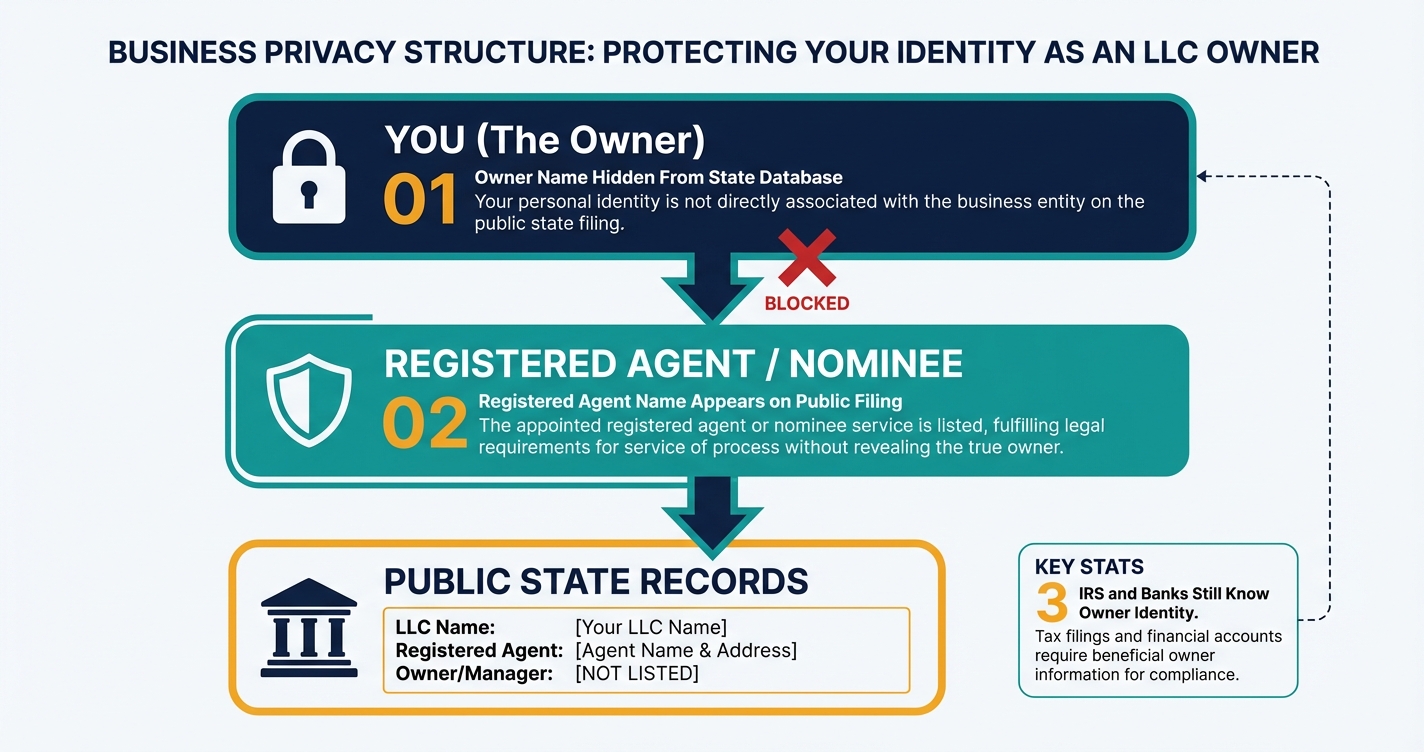
Only 4 states allow this structure: Wyoming, Delaware, New Mexico, and Nevada. In all other states, you must list at least one member or manager by name, and that information becomes part of the public record.
Here is how privacy works in each state:
- New Mexico offers the strongest privacy. No member or manager names appear in any filing, and the state requires zero annual reports. Filing fee: $50. File online at enterprise.sos.nm.gov.
- Wyoming does not require member names on the Articles of Organization and has no state income tax. Filing fee: $100. Annual report: $60 minimum. File at wyobiz.wyo.gov.
- Delaware does not require member or manager names on the Certificate of Formation. Filing fee: $110. Annual LLC tax: $400 due June 1 for the year before, raised from $300 on January 1, 2026. File at corp.delaware.gov.
- Nevada is the weakest of the four. The reason is the Initial List you file with the articles. NRS 86.263 asks for the name, title and address of every manager, or of every managing member if there is no manager, on that list and on each annual list after it. The state's own business search lets anyone look up a firm by officer name. A nominee manager buys the privacy here, not the filing. Filing fee: $425 (includes business license and initial list). Annual cost: $350.
If your business physically operates in another state, forming an anonymous LLC out of state means you must also register as a foreign LLC in your home state. That adds a second set of fees and compliance requirements, which often negates the cost savings of forming in a cheaper state.
Benefits
An anonymous LLC is not for everyone, but in certain scenarios the privacy protection is worth the extra cost. Here are the specific advantages.
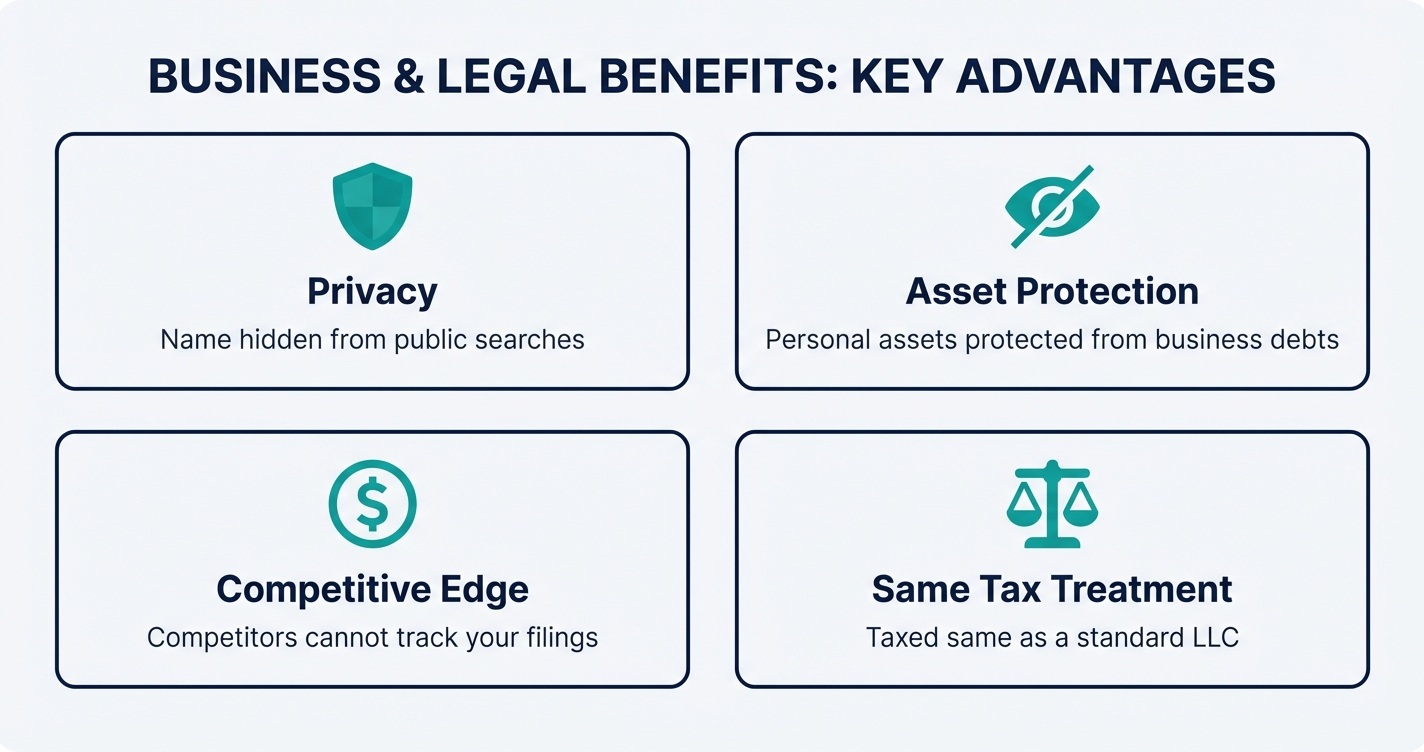
- Your name stays off public state databases. If someone searches the Secretary of State website, they see your registered agent's name and address instead of yours. For a real estate investor with 5 rental properties, this prevents tenants from finding your personal information.
- Reduced risk of identity theft and harassment. Business ownership is a public record in 46 states. Removing your name from that record cuts off one of the easiest paths to your personal details.
- Competitive protection for business strategy. If you are launching a new product line or acquiring property, an anonymous LLC prevents competitors from tracking your moves through state filings.
- Same liability protection as a standard LLC. Your personal assets (home, savings, personal accounts) remain separate from business debts and lawsuits, just like any other LLC.
- Tax-neutral structure. An anonymous LLC is taxed identically to a regular LLC. Single-member anonymous LLCs report on Schedule C; multi-member ones file Form 1065. You can even elect S Corp taxation by filing IRS Form 2553 if that saves you on self-employment tax.
- Pairs well with other privacy tools. You can layer an anonymous LLC with a trust or holding company as the listed member, a virtual mailbox for your business address, and a professional registered agent to keep your home address completely private.
Risks & Limitations
An anonymous LLC has real limits you should understand before spending money on one. Here are the honest drawbacks.
- Anonymity is public-record privacy, not total invisibility. The IRS, your bank, and any court with a subpoena can still find out who owns the LLC. Your name is on the EIN application (IRS Form SS-4) and on your bank's Know Your Customer records. A judge can order ownership disclosure in litigation.
- Out-of-state formation adds double costs. If you form in Wyoming but live and operate in California, you must register as a foreign LLC in California and pay California's $70 registration fee plus its $800/year franchise tax. You also pay Wyoming's fees. For many small businesses, the math does not work.
- Higher setup and maintenance costs. A basic anonymous LLC with an agent and a nominee runs $250 to $1,250 in year one, against $100 to $300 for a plain home state LLC. The floor is New Mexico. The ceiling is Nevada at $425 with the dearest agent and nominee on top. Nominee services alone run $150 to $525/year.
- State laws can change. New York enacted an LLC Transparency Act effective January 1, 2026, requiring certain non-U.S. LLCs authorized to do business in New York to disclose beneficial ownership information. Other states may follow.
- Personal guarantees pierce the veil. If you personally guarantee a lease or loan, anonymity does not protect you from that obligation. Creditors already have your name on the guarantee document.
This content is for informational purposes only. Consult a qualified attorney or CPA before making entity formation decisions, especially if you plan to operate across multiple states.
One more thing worth knowing if you are not a US person. A US LLC wholly owned by a foreign person has to report its transactions with you to the IRS every year, whatever the state filing shows, and the penalty for missing it starts at $25,000. See Form 5472 for foreign owned US LLCs.
If you are weighing the two states most often named for this, our Wyoming vs Delaware LLC comparison covers what each one costs to run and how far the filing level privacy actually goes.
One gap sits outside the filing entirely. The privacy work above keeps a home address off the state record, and then the personal mobile goes on the website, the invoices and the Google Business Profile, where it gets scraped and resold just as fast. A separate line closes it from $10 a month. Our guide on how to get a business phone number prices the four routes.
State Availability
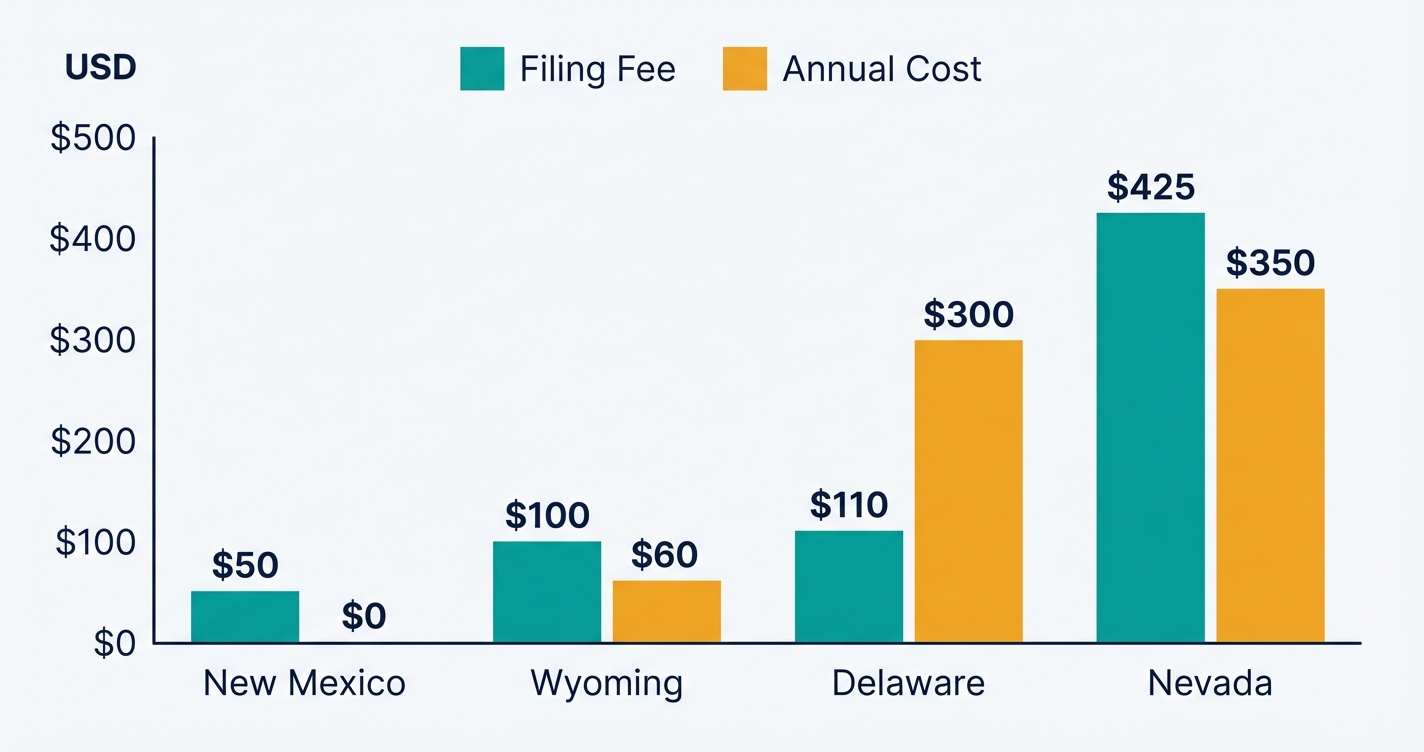
As of 2026, exactly 4 states allow you to form an anonymous LLC. Here is a side-by-side comparison of costs and requirements.
| State | Filing Fee | Annual Cost | Annual Report Required? | State Income Tax? | Privacy Level |
|---|---|---|---|---|---|
| New Mexico | $50 | $0 | No | Yes (4.9%–5.9%) | Highest (no names in any filing) |
| Wyoming | $100 | $60 min | Yes (anniversary month) | No | High (no member names on articles) |
| Delaware | $110 | $400 | No (franchise tax only) | No (if operating outside DE) | High (no member names on certificate) |
| Nevada | $425 | $350 | Yes (annual list) | No | Lowest (manager named on the public initial and annual list) |
If cost is your primary concern, New Mexico is the clear winner at $50 with no ongoing state fees. If you want the lowest ongoing cost plus no state income tax, Wyoming is hard to beat at $60/year. Delaware is ideal if you need the Court of Chancery for complex business disputes or plan to raise venture capital. Nevada has the strongest asset protection statutes of the four. It also names a person on a public list each year. That is a trade, not a bargain.
All 46 other states require you to disclose member or manager names on public formation documents. If you live in one of those states and form an anonymous LLC elsewhere, you will need to register as a foreign LLC in your home state, which may require disclosing your name on that state's records. California, for example, requires all members to file a Statement of Information that becomes public.
Privacy is only one cost. The four states above are not always the cheapest places to run an LLC once the yearly charges land. Our LLC cost by state comparison sets the filing fee against the full first year total for all 50 states. That is where you see what the privacy costs.
How to Set It Up
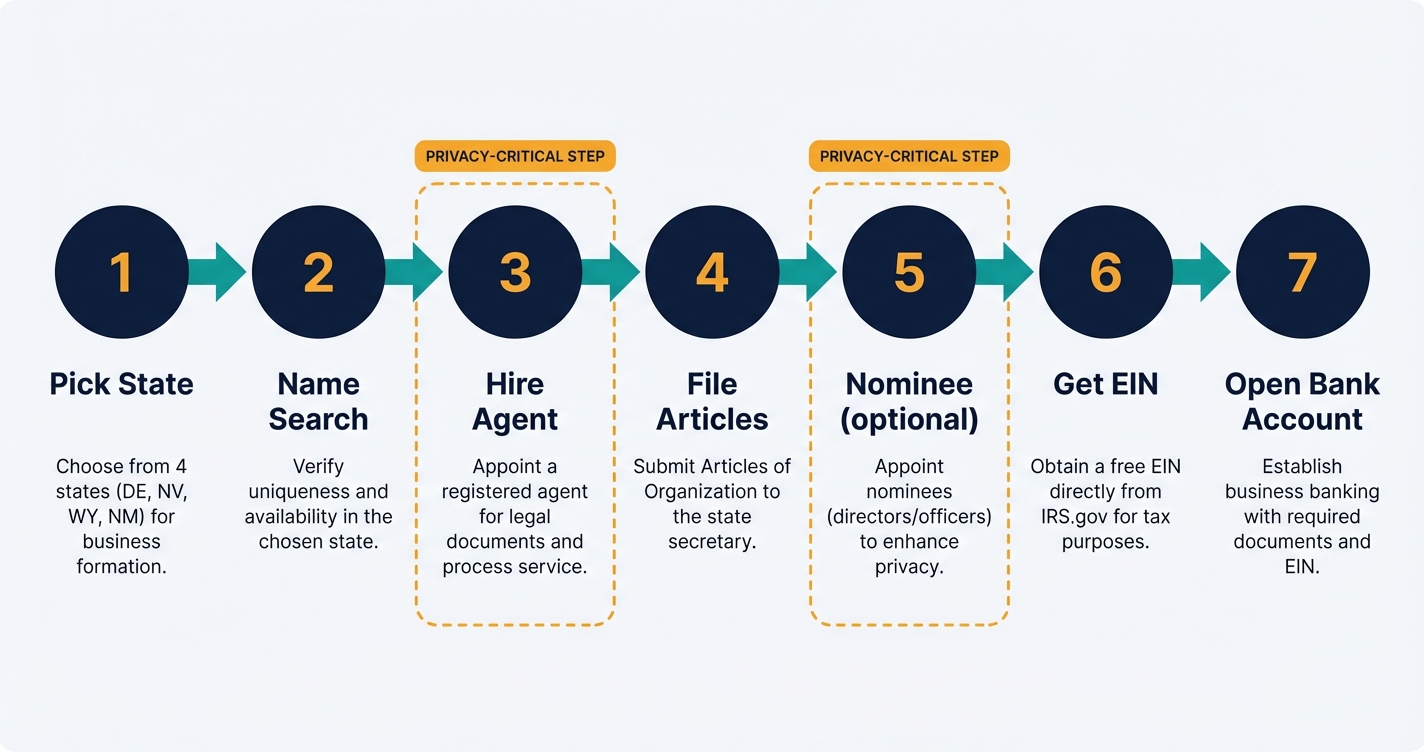
Forming an anonymous LLC follows the same general process as a standard LLC, with a few privacy-specific steps. Here is the process from start to finish.
- Pick your formation state. Compare New Mexico ($50, no annual fees), Wyoming ($100, $60/year), Delaware ($110, $400/year), and Nevada ($425, $350/year). If you operate physically in another state, factor in foreign LLC registration costs in your home state.
- Choose and verify your LLC name. Search the Secretary of State database in your chosen state. Your name must include "LLC," "L.L.C.," or "Limited Liability Company." Wyoming's search is at wyobiz.wyo.gov. New Mexico's portal is at enterprise.sos.nm.gov. Read our business name registration guide for naming tips.
- Hire a professional registered agent. This is critical: do not list yourself as the registered agent for an anonymous LLC. Your agent's name and address will appear on public records. Professional services cost $50 to $300/year depending on the state. See our best registered agent services comparison.
- File Articles of Organization (or Certificate of Formation). File online with your state's Secretary of State. Do not list any member or manager names. Wyoming processes online filings immediately. Delaware takes 1 to 2 business days online or 7 to 10 business days by mail. New Mexico processes online filings within 1 to 3 business days.
- Consider nominee services (optional). For maximum privacy, use a nominee manager or organizer whose name appears on any required filings. Nominee services cost $150 to $525/year depending on the provider and scope.
- Get your EIN from the IRS. Apply online at IRS.gov. It is free and you receive the number instantly. Note that the EIN application requires a "responsible party" with a valid SSN or ITIN, so the IRS will know your identity.
- Draft an operating agreement. This private internal document outlines ownership percentages, member rights, and management structure. It is not filed with the state but is required by many banks to open an account.
- Open a business bank account. Banks require identity verification under federal Know Your Customer rules. Your name will not be public, but the bank will have it on file. See our best business bank accounts for LLC-friendly options.
Total cost for a DIY anonymous LLC ranges from $100 to $725+ in year one depending on state fees, registered agent costs, and whether you use nominee services. Using a formation service like those in our best LLC services guide adds $0 to $299 on top of state fees.
vs Alternatives
An anonymous LLC is not your only option for business privacy. Here is how it compares to the most common alternatives.
Anonymous LLC vs. Standard LLC with a Registered Agent
A standard LLC with a commercial registered agent already hides your home address from public records. The agent's address appears on filings. The difference is that in most states, your name still appears as a member or manager. If keeping your name off public records is important (not just your address) you need to form in one of the 4 anonymous LLC states. Cost difference: a registered agent adds $50 to $150/year, while an out-of-state anonymous LLC adds formation fees plus potential foreign registration in your home state.
Anonymous LLC vs. Trust or Holding Company as Member
You can form a standard LLC and list a trust or another LLC as the member. This creates a layer of separation without needing an anonymous LLC state. The public record shows the trust or holding company name, not your personal name. This works in all 50 states but requires setting up the trust or holding company first, which typically costs $500 to $2,000+ in legal fees.
Anonymous LLC vs. Series LLC
A Series LLC compartmentalizes assets into separate "child" series, each with its own liability. It is designed for asset protection, not privacy. You can combine a Series LLC with an anonymous LLC in states like Wyoming or Delaware for both asset protection and privacy. A Series LLC alone does not hide your ownership.
Anonymous LLC vs. C Corporation
Some founders choose a corporation in states like Nevada or Wyoming for privacy. Corporate shareholders are often not publicly listed, but directors and officers are in most states. A C Corp also creates double taxation unless you elect S Corp status. For most small businesses seeking privacy, the anonymous LLC is simpler and cheaper.
Frequently Asked Questions
State filing fees range from $50 (New Mexico) to $425 (Nevada). Add $50 to $300/year for a professional registered agent and $150 to $525/year for optional nominee services. Total year-one cost for a basic anonymous LLC runs $100 to $725+.
Yes. Forming an anonymous LLC is legal in Wyoming, Delaware, New Mexico and Nevada. Wyoming, Delaware and New Mexico keep member and manager names off the formation document. Nevada stops short. Its list of managers is filed with the articles and is public, so privacy there rests on a nominee rather than on the filing. Federal tax duties still apply.
Yes. When you apply for an EIN, you must list a "responsible party" with a valid SSN or ITIN. The IRS always knows who owns the LLC. Anonymity applies only to public state records, not federal tax filings.
New Mexico is the cheapest ($50 filing, no annual fees). Wyoming offers the best combination of low cost ($100 filing, $60/year) and no state income tax. Delaware is ideal for businesses that need the Court of Chancery. The "best" state depends on your budget and whether you will operate in another state.
No. FinCEN ended the rule for good on August 11, 2026. U.S. companies and the people who own them no longer file a BOI report at all. FinCEN says it is also deleting the ownership data U.S. filers already sent in. The old exemption dated to March 2025 and was only an interim rule, so this is the part that is new. A company formed under the law of another country and then registered in a U.S. state still files, and only for its non-U.S. owners.
No. If you live and operate in California, you owe California taxes regardless of where your LLC is formed. You will also need to register as a foreign LLC in California and pay that state's $800/year franchise tax on top of your formation state's fees.
A nominee is a third party whose name appears on public filings in place of yours. Nominee services typically cost $150 to $525/year. The nominee has no actual ownership or control; they serve purely as a public placeholder. Wyoming, Delaware, and Nevada all allow nominee managers.
Yes, through a court order, subpoena, or legal discovery process. Banks also know your identity through KYC requirements. An anonymous LLC prevents casual public searches, but it does not shield your ownership from law enforcement, judges, or financial institutions.
Yes. An anonymous LLC can buy, sell, and hold real estate just like any other LLC. The property records will show the LLC name as the owner, not your personal name. Real estate investors commonly use anonymous LLCs in Wyoming or New Mexico for rental properties.
The only structural difference is privacy. In an anonymous LLC, member and manager names do not appear in the public state record. Tax treatment, liability protection, and operational rules are identical. An anonymous LLC costs more due to out-of-state filing fees, registered agent requirements, and optional nominee services.
Sources & References
- FinCEN Beneficial Ownership Information Reporting
- IRS - Apply for an EIN Online
- Wyoming Secretary of State - Online Business Services
- Delaware Division of Corporations - Fee Schedule
- New Mexico Secretary of State - Business Services
- SBA - Choose a Business Structure
- Wolters Kluwer - Anonymous LLCs: Privacy, States & Formation Steps
- FinCEN Final Rule Ending BOI Reporting for U.S. Companies (August 11, 2026)
- Nevada Revised Statutes 86.263, initial and annual list of managers
About the Author
Editor, StartupOwl
Eliot leads StartupOwl's state data research. He maintains the site's fifty state records of LLC filing fees, annual costs, processing times, and small business grant programs, checking each figure against the state office that publishes it and logging the date it was verified. Based in New Jersey, he has spent his working life in and around small businesses, and he writes for the founder who wants the real number rather than the advertised one. Every figure under his byline traces to a named source, and when a state proves a number wrong, the correction is published, not buried.
Was this article helpful?
Questions about this guide
No comments yet. Ask the first question and a member of our team will answer.
Leave a comment