
Administratively Dissolved LLC, How to Reinstate It
What administrative dissolution means, how long each state gives you to reverse it, what it costs, and whether the months your LLC spent dissolved still count against you.

In This Article
- The state closed the LLC for a missed filing, not for anything about your business.
- Reinstatement windows differ hard. Georgia, Washington and Virginia stop at 5 years, Texas at 3, Florida and Delaware set no limit.
- State fees run $75 in Texas to $260 in Georgia, and every missed report is charged on top.
- Most states backdate reinstatement to the dissolution date, so contracts signed in the gap stand.
- Texas is the exception. It restores the company and leaves the personal liability of whoever ran it alone.
- Replace a resigned registered agent before you file. The state will not reinstate into a vacancy.
6
Total Steps
$75–$700
Est. Total Cost
7 to 15 business days once you file
Timeline
Moderate
DIY Difficulty
Your right to undo this expires. Georgia gives you 5 years, Washington 5, Texas 3, and Delaware sets no deadline at all. Nobody read your books and shut you down. A form did not arrive, or a fee did not clear, and a computer changed one word on a public record. In most states you can rewind it. All the way back to the day it happened.
Before you start, read the exact word on your state's record
Pull your LLC up on the Secretary of State business search. Write down the status word, letter for letter. States do not agree on the vocabulary. Washington says administratively dissolved. Delaware says cancelled. Texas says forfeited, or involuntarily terminated, depending on which agency acted. Virginia says the company has ceased to exist. Florida uses 2 words for it, administratively dissolved and revoked, in the same sentence.
The same disagreement runs through the certificate that proves you are current again afterwards. Only 22 states call it a certificate of good standing, and the other 28 file it under existence, status or subsistence.
The word decides which form you file and which agency you file it with. In Texas that is 2 agencies. The Comptroller has to release you before the Secretary of State will finish the job.
Put 3 things on a notepad first.
- The effective date of the dissolution, because every deadline counts from that day.
- Every report you missed, because you will be filing all of them.
- The reason the state gave, because reinstatement means curing that reason and not just paying.
What actually happened to your company
Your LLC is not gone. The filing that fixes it is called reinstatement, not formation, and the word is doing real work. Delaware's revival section says the company comes back with the same force and effect as if the certificate had never been cancelled. Washington and Wisconsin say the same thing in their own words. You are not starting a new company. You are turning an old one back on.
The usual trigger is boring. North Carolina lists 5 grounds for administrative dissolution and 2 of them are agent problems. Going 60 days without a registered agent is one. Not telling the state within 60 days that the agent resigned is the other. So the agent quit, the notice went to an old address, and the state gave you 60 days you never saw.
The second most common trigger is the annual report. That one at least arrives with a bill, and our LLC annual report guide carries the deadline for every state.
The tax clearance letter, and whether your state actually asks for one
Some states will not reinstate you until a second agency clears you first. That agency is the revenue department, not the Secretary of State. It issues a letter saying your tax account is current. The request is separate and has its own queue. Most people learn it exists when their filing is rejected.
It is also a minority rule. We checked 24 states at their own agencies on 19 September 2026. Illinois blocked every request, so 23 have an answer. Six want a letter from a second agency. The other 17 do not.
| State | Who has to clear you first | What to ask them for |
|---|---|---|
| Texas | Comptroller of Public Accounts | Tax Clearance Letter, asked for on Form 05-391 |
| Tennessee | Department of Revenue | Certificate of tax clearance |
| Hawaii | Department of Taxation | A tax certificate, attached to reinstatement Form X-4 |
| California | Franchise Tax Board | Certificate of Revivor, Form FTB 3557 LLC |
| Mississippi | Department of Revenue | Tax clearance letter, for corporations and some LLCs |
| Maryland | The county or city where you reported property, not the Comptroller | Tax clearance certificate |
Every row was read at the agency's own site on 19 September 2026. Most of the other 17 states publish a list of what a reinstatement needs, and no tax document is on it.
Only two of the six say how long the letter takes. Hawaii quotes about one day online and 10 to 15 business days on paper Form A-6. Tennessee lets you collect a reinstatement clearance in person. The other four publish nothing, so treat that wait as unknown and start it early.
Three of the six carry a condition worth checking.
- Mississippi's Secretary of State says corporations and certain LLCs, while its revenue department calls the letter a corporate document. It turns on whether you hold a corporate tax account there.
- California stops you only when the Franchise Tax Board is the agency holding you. A hold for a missed Statement of Information is cleared with the Secretary of State instead.
- Maryland's certificate comes from local finance offices, one for each place you reported property. The state warns that a receipt will not do.
This looks like a national rule because for corporations it nearly is one. Ohio, New Jersey, New York and Arizona all put a tax agency in a corporation's path. None of them do that to an LLC. Missouri prints the contrast on its own forms, where the corporate termination form asks for a tax clearance and the LLC version asks for $25.
Delaware confuses people for a different reason. You cannot revive a Delaware LLC until the back tax, penalties and interest are paid. That reads like a clearance. It is not one. The money goes to the Secretary of State, the same office holding your file, and no second agency issues anything.
The letter turns up far more on the filing that closes a company than on the one that reopens it, and that is where most advice about it comes from. Texas wants a different document to terminate, a Certificate of Account Status. Pennsylvania wants clearances from two agencies before it accepts a Certificate of Termination. Alabama wants one before a foreign LLC can withdraw.
So the move is short. Open your state's reinstatement instructions and read what must go with the application. If a tax agency is named, ask for that document first, because its queue is not yours to control. If none is named, you are paying the filing office and nobody else.
Step-by-Step Process
- 1
Read the state record and write the status word down
Search your LLC on the Secretary of State site and copy the status exactly. Note the effective date of the dissolution too. Every deadline on this page counts from that day, not from the day you found out.
Free10 minutes Secretary of State business searchCommon Mistakes
- Working from the notice letter's date instead of the effective date on the register
- 2
Check how long you have left
Georgia, Washington and Virginia all stop at 5 years from the effective date. Texas gives 3 years before your existence stops counting as continuous. Florida, Delaware and Wisconsin publish no limit. If you are close to a wall, this is the step that decides whether you rush.
Free15 minutes State statute or the SoS reinstatement pageCommon Mistakes
- Assuming 5 years is the national rule
- Counting from the notice rather than the dissolution
- 3
Fix the reason the state gave
A missed report gets filed. A resigned agent gets replaced first, because the state will not reinstate into a vacancy. If the agent is what killed the company, see our registered agent comparison before you pick the replacement.
VariesSame day Secretary of StateCommon Mistakes
- Filing the reinstatement while the agent slot is still empty
- 4
Clear the money owed
Back reports, back fees and penalties all have to be paid. In Texas and Delaware the back franchise tax with interest comes first, and Texas will not release you without a tax clearance letter from the Comptroller.
$25 to $138.75 per missed report1 to 2 weeks in Texas State tax agency, then the Secretary of StateCommon Mistakes
- Paying the reinstatement fee before the back reports are filed
- 5
File the reinstatement application
Georgia takes it online through eCorp and charges $260, being a $250 filing fee plus a $10 service charge. Florida takes it through Sunbiz at $238.75 for an LLC. Check who is allowed to sign before you start, Georgia only accepts the agent or a member or manager named in the last annual registration filed.
Common Mistakes
- Signing as someone the state does not recognise, which needs a notarised statement
- 6
Check what did not come back with it
The certificate fixes the entity and nothing else. Your name may have gone, your foreign registrations in other states are separate filings, and banks, licence boards and insurers all need telling. Georgia holds a dissolved name for 5 years, or until you reinstate, whichever is sooner.
Varies1 to 4 weeks Your bank, licence boards, every foreign stateCommon Mistakes
- Assuming a home state reinstatement revives a foreign registration, it does not
What it costs, state by state
Georgia charges $260 to reinstate. That is a $250 filing fee plus a $10 service charge. The $10 is easy to miss. Our own state data was carrying $250 until this page was written. Florida asks $238.75 for an LLC. That is a $100 reinstatement fee plus the $138.75 annual report for the year you were dissolved. Cross into a new January and it becomes $377.50. Washington charges $140 plus every annual report you skipped at $70 each. Virginia charges $100. On top of that come the registration fees and penalties that were due before the company ceased to exist. Texas charges $75 on either reinstatement form. Delaware charges $180 to revive, plus the annual tax, penalties and interest that were owed when the certificate was cancelled.
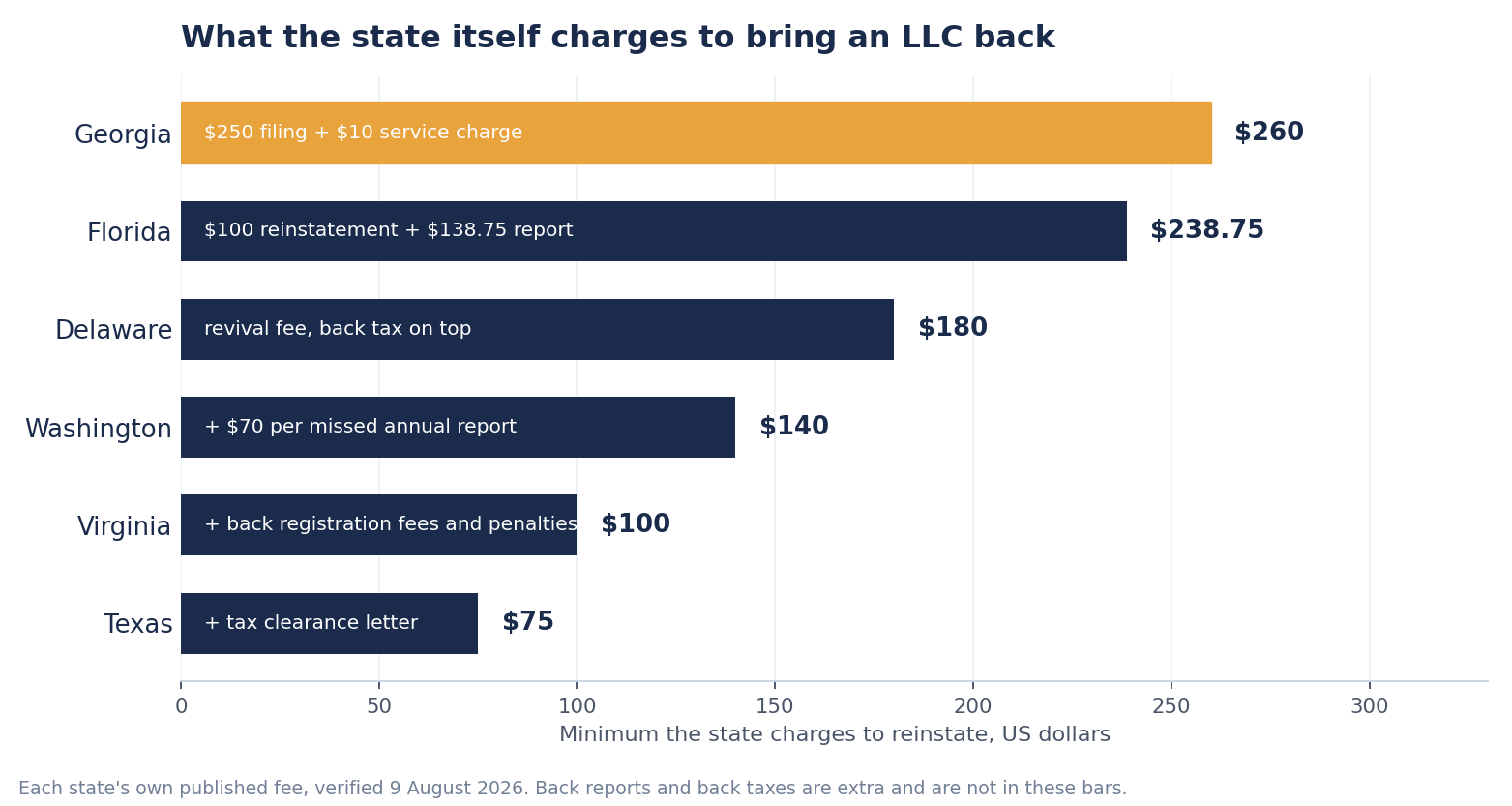
Two states publish no figure at all. Wisconsin's fee schedule has no reinstatement line, and its dissolution page tells you to email the office for the forms. California's Franchise Tax Board page lists what you must file and pay. It never names a price.
| Item | Cost Range | Notes |
|---|---|---|
| Reinstatement or revival fee | $75 to $260 | Texas $75, Virginia $100, Washington $140, Delaware $180, Florida $100, Georgia $260 |
| Each missed annual report | $25 to $138.75 | Wisconsin $25 online, Washington $70, Florida $138.75, all payable for every year skipped |
| Delinquency fee on a late report | $0 to $25 | Washington adds $25, taking a $70 annual report to $95 |
| Back franchise tax with interest | Varies | Texas and Delaware both require it before the reinstatement is released |
| Expedited review | $120 to $275 | Georgia, $120 for 2 business days, $275 same day, requests in before noon |
| Certificate copy | $5 | Florida, optional, added to the $238.75 minimum |
The five year rule is not a rule
Nobody agrees on how long you have, and the differences are large enough to change what you do this week.
| State | What the state calls it | How long you have | What the state charges | Backdated |
|---|---|---|---|---|
| Georgia | Administratively dissolved | 5 years from the effective date | $260, being $250 plus a $10 service charge | Not stated |
| Florida | Administratively dissolved or revoked | No limit stated | $238.75 minimum, $377.50 from 1 January | Yes |
| Washington | Administratively dissolved | 5 years | $140 plus $70 per missed report | Yes |
| Virginia | Ceased to exist | 5 years | $100 plus back fees and penalties | Yes |
| Texas | Forfeited or involuntarily terminated | 3 years for continuous existence | $75 on Form 801 or Form 811 | Yes, with a carve out |
| Delaware | Cancelled | No limit stated | $180 plus back tax and interest | Yes |
| Wisconsin | Administratively dissolved | No limit stated | Not published | Yes |
| California | Suspended, then cancelled | 60 days to object, 90 days to revive | Not published | Not stated |
| North Carolina | Administratively dissolved | Set by the corporate rules | Not checked this run | Yes, with a carve out |
Every figure above was read on the state's own site or in its own statute on 9 August 2026.
Two entries deserve a second look. Florida's rule is not generosity, it is a boundary, because Sunbiz says a company that dissolved itself voluntarily can never reinstate at all. And California is not really a deadline, it is a warning shot. The Franchise Tax Board cancels an LLC that has sat suspended for 60 months or more. You get 60 days to object, then 90 days to revive if you do. After that its page says there are no appeal rights.
The part almost nobody explains, reinstatement is backdated
This is the real question. You invoiced clients, signed a lease and paid staff while the state had you closed. Were you a sole trader that whole time, personally exposed on every one of those contracts?
In most states, no. Washington's statute says reinstatement relates back to and takes effect as of the effective date of the administrative dissolution. The company then carries on as if it never happened. Delaware says a revived LLC has the same force and effect as if the certificate had never been cancelled. It also validates the contracts and acts done in between. Florida, Virginia and Wisconsin all say versions of the same thing. The model statute most states borrow from, the Revised Uniform Limited Liability Company Act, puts it in section 709(d).
Two carve outs matter, and both are in the statutes rather than the marketing.
The first protects other people. North Carolina backdates reinstatement subject to the rights of any person who reasonably relied to his prejudice upon the certificate of dissolution. Say a supplier checked the register, saw a dead company and acted on it. Your rewind does not erase what they did.
The second is Texas. Texas restores continuous existence, then says plainly that this does not affect the personal liability of the governing persons for what happened during the gap. So the entity is fine and the people who ran it may not be. If you traded through a Texas forfeiture, that sentence is worth reading with a lawyer rather than with a guide.
How long reinstatement takes
Georgia publishes real numbers, and they were read again on 23 September 2026. Its office says the time varies with workload.
| Georgia route | Typical processing | Extra fee |
|---|---|---|
| Online through eCorp | 7 to 10 business days | None |
| Paper, by mail or hand delivery | About 15 business days from receipt | None |
| 2 business day expedite | Response within 2 business days | $120 |
| Same day expedite | Response the same business day | $275 |
Same day requests have to reach the office before noon. Most states publish nothing like this. When your state is silent, plan on the paper timetable. The better question is not how fast the queue moves. It is whether the state sells a way past it.
Common mistakes
- Filing the reinstatement before fixing the agent. The state will reject it. Replace the registered agent first, then apply. If the resignation is what killed the company, a paid agent is cheap insurance against a second round. Our registered agent comparison covers what the national providers charge.
- Assuming your name is still yours. Georgia holds a dissolved company's name for 5 years, or until it reinstates, whichever comes first. After that anyone can take it. North Carolina goes further. If the name is no longer distinguishable when you apply, you have to change it before the certificate can issue.
- Forgetting the other states. Reinstating at home does nothing for a foreign registration that lapsed elsewhere. Georgia is blunt about it. A foreign entity whose authority was revoked cannot reinstate at all, and has to apply for a fresh certificate of authority.
- Signing the form yourself when you no longer can. Georgia takes a reinstatement signed by the agent. It also takes one signed by a member or manager named in the last annual registration filed. That is a short list. Anyone else has to attach a notarised statement.
- Treating it as a filing problem. Banks freeze accounts on a dissolved status. Licence boards revoke, and an insurer can decline a claim written against a company the register says is closed. The certificate starts the cleanup. It does not finish it.
Frequently Asked Questions
This guide explains state filing procedures and is not legal advice. Reinstatement deadlines and fees change, and the consequences of trading through a dissolution depend on your state and your facts. Figures here were read at the state's own site or statute on 9 August 2026. Confirm with your Secretary of State, and take advice before relying on the backdating rule.
Sources & References
- Georgia Secretary of State, How to Guide, Reinstate an Entity
- Florida Division of Corporations, File Reinstatement
- Sunbiz, Reinstatement Filing Instructions
- Washington Secretary of State, Return a Business to Active Status
- RCW 23.95.615, Reinstatement following administrative dissolution
- Code of Virginia 13.1-1050.4, Reinstatement of a limited liability company
- Texas Comptroller, Reinstating or Terminating a Business
- Texas Business Organizations Code, Chapter 11
- California Franchise Tax Board, Administrative Dissolution and Cancellation
- Delaware Code Title 6, Chapter 18, Subchapter XI
- Wisconsin Statute 183.0709, Reinstatement following administrative dissolution
- Wisconsin DFI, Administrative Dissolutions
- N.C.G.S. 57D-6-06, Administrative dissolution
- N.C.G.S. 55-14-22, Reinstatement following administrative dissolution
- Texas Comptroller, Requesting Tax Certificates and Tax Clearance Letters
- Tennessee Secretary of State, Business Services FAQs
- Hawaii Department of Taxation, Tax Clearance
- Mississippi Secretary of State, Business FAQs
- Maryland SDAT, Guide for Reinstatement of Maryland LPs, LLCs and LLPs
- Missouri Secretary of State, General Services and Filings
- Pennsylvania Department of Revenue, REV-181-I Tax Clearance Certificate instructions
- California Franchise Tax Board, Publication 1038
About the Author
Business Formation Researcher
Eliot leads StartupOwl's state data research. He maintains the site's fifty state records of LLC filing fees, annual costs, processing times, and small business grant programs, checking each figure against the state office that publishes it and logging the date it was verified. Based in New Jersey, he has spent his working life in and around small businesses, and he writes for the founder who wants the real number rather than the advertised one. Every figure under his byline traces to a named source, and when a state proves a number wrong, the correction is published, not buried.
Was this article helpful?
Questions about this guide
No comments yet. Ask the first question and a member of our team will answer.
Leave a comment